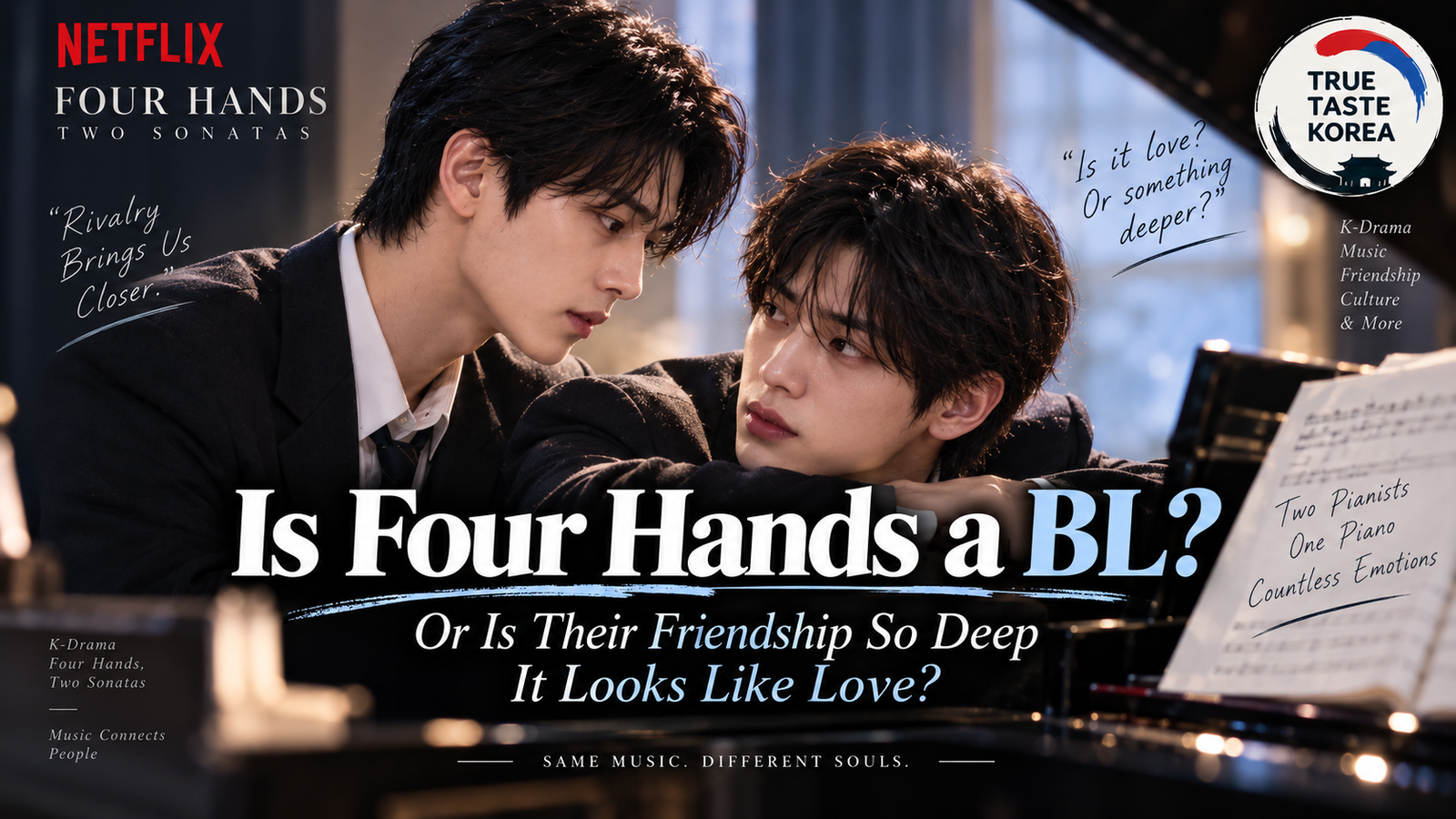
Is Four Hands a BL? Or Is Their Friendship So Deep It Looks Like Love?

편집 대표이미지에서 가장 강조하고 싶은 단어는 CAST가 맞아? 편집 대표이미지에서 가장 강조할 문구는 ENDING EXPLAINED로 할까? 편집 대표이미지에서 가장 강조할 문구는 FOUR HANDS로 할까? 편집 강조 문구는 지금처럼 Why Pianists Sound Different로 할까? 좋아. 이번 글은 검색어 Is Four Hands a BL?을 잡으면서도, 흔한 “No, it isn't” 수준이 아니라 네가 3화까지 직접 보며 느낀 ‘깊은 우정은 사랑처럼 보일 만큼 어렵고 소중하다’는 관점을 중심으로 완성하자. 공식 Netflix 소개도 두 사람의 관계를 friendship, rivalry, growth로 설명하고 있고, tvN 관련 소개 역시 두 사람이 가까운 친구이자 음악적 라이벌이 되어가는 구조를 명확히 하고 있어. 따라서 현재 3화 시점에서는 BL로 공식 분류된 작품은 아니다라고 쓰는 게 정확하다. Is Four Hands a BL? Or Is Their Friendship So Deep It Looks Like Love? Spoiler note: This article discusses the relationship between Kang Pi-o and Choi Jeong-yo through Episode 3 of Four Hands, Two Sonatas. If you've started watching Netflix's Korean drama Four Hands, Two Sonatas, you may already have wondered: Is Four Hands a BL? It's an understandable question. Song Kang's Kang Pi-o and Lee Jun-young's Choi Jeong-yo quickly develop an unusually intense connection. They compete, admire each other's talent, play together, hurt each other, and seem capable of understanding parts of one another that other people cannot. But as of Episode 3, the answer is straightforward: No, Four Hands, Two Sonatas is not officially presented as a BL drama. Netflix describes the story around Pi-o and Jeong-yo in terms of friendship, rivalry and growth, while Korean promotional material describes their evolving relationship as friendship intertwined with musical competition. But after watching the first three episodes in Korea, I think there is a more interesting question than simply asking whether Four Hands is BL. Why can a friendship this deep sometimes look like love? And perhaps that confusion tells us something important about friendship itself. Is Four Hands, Two Sonatas Actually a BL? First, let's separate official information from viewer interpretation. Four Hands, Two Sonatas has not been officially introduced as a Boys' Love series. Netflix's own description centers on two young pianists whose lives become intertwined through their passion for music as they navigate friendship, rivalry and personal growth. Korean promotional coverage similarly describes the drama as following the friendship, love, rivalry and growth of young people who meet at an arts high school and eventually become professional pianists. Most importantly, the relationship between Pi-o and Jeong-yo is repeatedly described as a friendship. So if you're asking: “Are Kang Pi-o and Choi Jeong-yo officially a romantic couple?” At this point in the story, the answer is no. But that doesn't make the question foolish. In fact, I think the reason viewers ask it is one of the most interesting things about the drama. Why Does Four Hands Sometimes Feel Like a BL? Pi-o and Jeong-yo aren't ordinary classmates. Music immediately gives them a connection that other people struggle to enter. They are competitors. They are partners. They admire each other. They threaten each other. And increasingly, they become emotionally important to each other. The official teasers themselves emphasized how the two move from perfectly matched piano partners toward fierce rivals, with constant comparison beginning to damage their friendship. That produces emotional scenes we often associate with romance. There is admiration. There is jealousy. There is disappointment. There is dependence. There is the fear of losing someone. And there is pain when the other person begins to pull away. Put those emotions between two attractive young male leads with strong screen chemistry, and it's not surprising that some viewers interpret the relationship through a romantic lens. But there is another possible interpretation. Maybe friendship can simply be that intense. Perhaps True Friendship and Love Have More in Common Than We Admit Watching Episode 3 made me think about this. We tend to describe friendship as though it should be easy. You meet someone. You like each other. You spend time together. You become friends. But truly deep friendship isn't necessarily simple at all. It requires trust. Understanding. Compromise. Forgiveness. Sometimes sacrifice. And sometimes jealousy. You can be hurt because someone you care about doesn't understand you. You can fear losing a friend. You can resent their success while simultaneously wanting them to succeed. You can desperately want their recognition. None of those emotions belongs exclusively to romantic love. Friendship can hurt precisely because friendship can matter so much. That's why I think Pi-o and Jeong-yo's relationship is more interesting if we don't immediately force it into a romantic category. Pi-o and Jeong-yo Need Something From Each Other The two young pianists are fundamentally different. Pi-o has been shaped by discipline, relentless practice and enormous expectations. Jeong-yo arrives from a completely different life and approaches music with a raw, instinctive quality. Official character material deliberately emphasizes this contrast: Pi-o's playing is described as precise and delicate, while Jeong-yo commands attention with explosive energy. That means their attraction to each other isn't necessarily romantic. It can also be artistic. Each sees something in the other that he himself lacks. Pi-o encounters a pianist who challenges his understanding of talent. Jeong-yo encounters someone whose world and musical discipline are completely different from his own. They don't simply want to defeat each other. They change each other. And that's much more dangerous emotionally than ordinary competition. The Piano Makes Their Friendship Even More Intimate Even the title of the drama helps explain their relationship. Four hands is a piano term referring to two people playing one piano together. Think about what that requires. Two people sit beside each other. They play the same instrument. They must listen to one another. They must control timing together. One cannot simply ignore the other and perform independently. The drama even depicts the two naturally dividing responsibilities while performing together—one dealing with the pedals and the other with the sheet music—as their coordination develops. That makes four-hands piano an almost perfect metaphor for their relationship. Two individuals. One piano. Neither disappears into the other. Yet neither can create the performance alone. That's friendship. And it's also exactly why their relationship can feel unusually intimate on screen. Friendship Becomes Harder When Your Best Friend Is Also Your Rival Then Four Hands adds another complication. Imagine that the person who understands you best is also the person capable of taking away the thing you value most. That's Pi-o and Jeong-yo. They share music. But music is also where they compete. The closer they become, the more dangerous comparison becomes. The drama's promotional material explicitly foreshadowed this: outside comparisons begin putting pressure on their relationship until their previously warm friendship starts to fracture. That creates a painful contradiction. You want your friend to succeed. But what if his success makes you feel like a failure? You admire his talent. But what if everyone begins comparing his talent with yours? You want to remain beside him. But what if being beside him constantly reminds you of your own insecurity? Those aren't specifically BL emotions. They're painfully human emotions. Episode 3 Makes the Friendship Even More Complicated By Episode 3, the drama begins pushing that tension into the open. The relationship between Pi-o and Jeong-yo is no longer simply the warm story of two gifted students discovering that they enjoy playing together. Their competition and emotional frustrations begin colliding. Official previews for Episode 3 even showed their conflict escalating into a physical fight, with the surrounding students having to separate them. But what interests me isn't simply that they fight. It's why fighting with this particular person matters so much. Indifference doesn't normally produce this kind of pain. We are most easily hurt by people whose opinions matter to us. And that may be one reason the relationship feels so emotionally charged. Is It Bromance, Then? “Bromance” is probably closer to the way many international viewers will describe Pi-o and Jeong-yo's relationship at this stage. But even that word can sometimes make deep male friendship sound like a joke. Four Hands seems more serious about it. These aren't simply two guys exchanging funny jokes and becoming buddies. Their friendship becomes tied to: identity, talent, ambition, insecurity and self-worth. The other person becomes a mirror. Pi-o sees himself differently because Jeong-yo exists. Jeong-yo's understanding of himself also changes because Pi-o exists. That is a powerful relationship regardless of whether romance is involved. Why Are Viewers Asking “Is Four Hands a BL?” There is another important reason this question matters. People are actually searching for it. English-language sites have already begun publishing articles specifically answering “Is Four Hands, Two Sonatas a BL?”, which suggests that the ambiguity viewers perceive isn't limited to one audience. And I can understand why. If viewers see two male characters: intensely focused on one another, emotionally affected by one another, jealous or hurt because of one another, sharing an intimate artistic connection, and becoming central to each other's lives, modern audiences may naturally ask whether romance is coming. But perhaps Four Hands offers another possibility. Maybe We Underestimate Friendship This is what I find most interesting about the BL question. Perhaps the confusion isn't only about Four Hands. Maybe it also says something about how we think about friendship. Why do we sometimes find it difficult to believe that two people can love each other deeply without that love being romantic? Friendship is also a form of love. A different form, certainly. But genuine friendship can demand enormous emotional investment. A real friend can change the direction of your life. A friend can recognize something inside you before you recognize it yourself. A friend's success can inspire you. It can also make you jealous. A friend's rejection can hurt. And losing a friendship can sometimes hurt as much as losing a romantic relationship. Perhaps true friendship is sometimes confused with romance because we underestimate how powerful friendship can actually be. Two Pianists, One Piano — And a Difficult Friendship That's why the title Four Hands, Two Sonatas increasingly feels meaningful to me beyond its musical definition. Pi-o and Jeong-yo are different people. Different personalities. Different backgrounds. Different pianists. They cannot become one person. Nor should they. But for four-hands piano to work, they must somehow learn to occupy the same musical space. Maybe friendship works the same way. You don't become identical. You don't surrender your own identity. You learn when to lead. When to listen. When to give space. When to follow. And sometimes you get the timing wrong. So, Is Four Hands a BL? Based on the series' official presentation and the story through Episode 3: no, Four Hands, Two Sonatas is not officially a BL drama. Netflix presents Pi-o and Jeong-yo's central relationship through friendship, rivalry and growth rather than a confirmed romance. But simply answering “no” misses what makes the question interesting. Because Four Hands is showing us a relationship powerful enough that some viewers may mistake its emotional intensity for romantic love. And perhaps that is part of what makes the story moving. True friendship can be difficult. It can involve jealousy. It can involve sacrifice. It can hurt. And it can transform your life. So maybe the most interesting question Four Hands asks isn't: Are Pi-o and Jeong-yo in love? Maybe it's: Why do we sometimes struggle to believe that friendship alone can be this intense? And as the drama continues, that may become one of the most interesting relationships to watch. FAQ Is Four Hands, Two Sonatas a BL drama? No. As of Episode 3, the series is not officially presented as a Boys' Love drama. Netflix describes the central story around friendship, rivalry and growth. Are Kang Pi-o and Choi Jeong-yo a couple? As of Episode 3, they have not been established as a romantic couple. Their relationship is presented as an intense friendship and musical rivalry. Why do people think Four Hands is BL? The two male leads share an unusually intense emotional and musical bond. Their admiration, rivalry, jealousy, dependence and strong chemistry can make some viewers interpret their relationship romantically. What does “Four Hands” mean? In piano music, four hands refers to two pianists playing the same piano together. Is Four Hands about romance or friendship? The broader drama includes friendship, love, rivalry and growth, but the central Pi-o/Jeong-yo relationship is currently officially framed around friendship and rivalry. 워드프레스 SEO 설정 Focus Keyphrase is Four Hands a BL SEO Title Is Four Hands a BL? Pi-o and Jeong-yo's Relationship Explained Slug is-four-hands-a-bl Meta Description Is Four Hands a BL? We explain Pi-o and Jeong-yo’s intense relationship, why viewers see romantic chemistry, and what the drama says about friendship. Tags Four Hands, Four Hands Kdrama, Four Hands BL, Four Hands Two Sonatas, Song Kang, Lee Jun-young, Kang Pi-o, Choi Jeong-yo, Kdrama, Korean Drama Category K-Culture 내부링크는 두 개가 아주 자연스럽다. 첫 번째 배우 소개 부분의 Song Kang and Lee Jun-young에서 기존 Four Hands Kdrama Cast 글로 연결하고, different pianists나 musical interpretation을 설명하는 부분에서 방금 만든 Why Pianists Sound Different 글로 연결하면 된다. 외부링크는 Netflix의 공식 작품 소개를 우선 사용하자. Netflix – Four Hands, Two Sonatas official introduction 그리고 이 글은 “Updated through Episode 3”를 제목 아래나 서두에 작게 표시해두는 걸 추천해. 4~12화에서 관계에 결정적인 변화가 나오면 같은 URL을 업데이트하면 돼. 새 글을 만들 필요가 없다. 대표이미지 편집 대표 문구에서 BL을 지금보다 더 크게 강조할까? 대체텍스트? 대체 텍스트(Alt Text): Is Four Hands a BL? Pi-o and Jeong-yo’s deep friendship and rivalry explained in the Korean drama Four Hands, Two Sonatas

Four Hands, Two Sonatas has left many viewers asking the same question: Is the relationship between Kang Pi-o and Choi Jeong-yo meant to be romantic, or is it an unusually intense friendship?

The question becomes even more interesting after watching the entire series.

Starring Song Kang as Kang Pi-o and Lee Jun-young as Choi Jeong-yo, the drama follows two exceptionally talented pianists whose lives become intertwined through music, competition, separation, and reunion. Their connection is sometimes tender, sometimes painful, and often more emotionally intense than viewers expect from a conventional friendship story.

But does that make Four Hands, Two Sonatas a BL drama?

Not in the conventional genre sense. The series is officially presented as a music-centered Korean drama, while tvN describes its story through friendship, love, rivalry, and growth. It does not officially position itself as a BL production.

That distinction, however, does not explain why so many viewers interpret Pi-o and Jeong-yo’s relationship through a romantic lens.

Perhaps the more important question is this: Can two people become so important to each other that their relationship begins to look like love, even when the story does not give it a clear romantic label?

1. Why Do Viewers Think Four Hands Might Be BL?

The first reason is the emotional intensity between the two leads.

Pi-o and Jeong-yo are not simply classmates who happen to share an interest in piano. Each becomes a person capable of changing the other’s sense of identity.

Pi-o has built his life around discipline, perfection, and the need to remain at the top. Jeong-yo challenges that carefully constructed world. His natural musical instincts expose a side of piano performance that Pi-o cannot achieve through practice alone.

Their relationship begins with tension, but it gradually becomes something more complicated.

They admire each other, compete with each other, hurt each other, and repeatedly find themselves unable to move forward without confronting the other person’s influence.

This emotional dependence is one reason viewers may see romantic chemistry.

In many dramas, romance is communicated through familiar signals: physical closeness, jealousy, longing, and the fear of losing someone. Four Hands, Two Sonatas uses some of the same emotional language, but places much of it inside music and personal ambition.

The result is a relationship that can feel romantic without being clearly defined as one.

2. Pi-o and Jeong-yo Are Not Just Two Rival Pianists

At first, Pi-o sees Jeong-yo as a threat.

He has spent years maintaining his position as an exceptional pianist. His identity is closely connected to being the best, and his disciplined approach gives him a sense of control over his future.

Then Jeong-yo appears.

Unlike Pi-o, Jeong-yo’s musical talent seems to emerge naturally. His playing carries a freedom that cannot easily be measured through practice hours or technical perfection.

This creates an important contrast.

Pi-o represents the fear of losing everything he has worked for. Jeong-yo represents the possibility that music can be experienced differently.

Their rivalry is therefore not simply about winning competitions. It challenges the way each person understands music and himself.

What makes their relationship compelling is that neither can remain unchanged after meeting the other.

Jeong-yo does not merely become Pi-o’s competitor. He becomes someone who can expose Pi-o’s weaknesses, inspire him, and eventually reach parts of his life that professional success cannot repair.

3. The Meaning of Four Hands: Why Music Becomes Their Language

The title itself provides one of the strongest clues to understanding the drama.

In piano terminology, a four-hands performance involves two people playing the same piano together.

It sounds simple, but it requires a special kind of cooperation.

Both performers must understand the rhythm, anticipate changes, listen carefully, and adjust their movements to the other person. Even a technically excellent pianist cannot create a successful duet by ignoring the person sitting beside them.

This is an interesting metaphor for Pi-o and Jeong-yo.

Their relationship is not built on perfect agreement. They have different personalities, different approaches to music, and different emotional wounds.

Yet they are repeatedly drawn back into situations where neither can complete the musical experience alone.

The piano becomes a language through which they express things that ordinary conversation cannot always communicate.

That is why their performances can feel more intimate than a simple exchange of dialogue.

A shared musical moment can represent trust, conflict, forgiveness, or the desire to reconnect.

The four-hands concept is therefore more than a musical technique. It becomes a metaphor for the difficult process of allowing another person to share your world.

4. Why Their Separation Makes the Relationship Feel Even Deeper

The story becomes more emotionally complicated when their shared future is interrupted.

The kidnapping incident surrounding Jeong-yo’s disappearance changes the direction of both lives. Their connection is cut off, leaving Pi-o without the person who had fundamentally challenged his understanding of music.

Years later, Pi-o has achieved professional success, but his life is not necessarily fulfilling.

He continues searching for Jeong-yo.

This detail matters because it shows that Jeong-yo’s importance cannot be measured by their time together or by their musical achievements.

Pi-o has a career, recognition, and the skills he once desperately wanted. Yet something remains unresolved.

The person he lost is not simply an old rival.

Jeong-yo represents a part of Pi-o’s life that success could not replace.

This is where the series moves beyond the familiar story of two talented competitors.

It asks whether someone can remain central to another person’s life even after years of separation.

The answer, at least for Pi-o, appears to be yes.

5. Is Pi-o’s Search for Jeong-yo Romantic Love?

This is perhaps the most interesting question for viewers who interpret the drama as BL.

Pi-o’s continued search for Jeong-yo can be read as a form of longing.

He is not simply looking for information about an old classmate. He is trying to reconnect with someone whose absence has affected his emotional and artistic life.

However, longing is not exclusive to romantic relationships.

A person can miss a friend with extraordinary intensity. Someone who once understood us better than anyone else can leave a space that no new achievement or relationship can easily fill.

The drama does not require viewers to interpret every expression of longing as romantic desire.

Instead, it gives the audience room to consider a different possibility: perhaps Pi-o is searching for the person who once made him feel most understood.

That kind of connection can be difficult to describe precisely because it does not fit neatly into familiar categories.

6. Jeong-yo’s Feelings Are Also More Complicated Than Rivalry

Jeong-yo is not simply the talented rival who appears to disrupt Pi-o’s life.

His own experiences, secrets, and personal struggles shape the way he approaches their relationship.

As the story develops, the truth surrounding his disappearance changes how Pi-o understands the past. Their conflict is no longer just a disagreement between two musicians.

There are painful questions about responsibility, trust, and the damage caused by events beyond their control.

The later episodes show how difficult it is for the two to return to the relationship they once had.

Even when Jeong-yo offers collaboration, Pi-o cannot immediately accept it. Their shared musical history has become inseparable from the pain they carry.

This is important because the drama does not present deep affection as something that automatically removes conflict.

Sometimes, the people who matter most to us are also the people capable of hurting us most deeply.

The emotional weight of their relationship comes from this contradiction.

7. Why the Final Episodes Matter More Than the Early Chemistry

The early episodes encourage viewers to notice the unusual connection between Pi-o and Jeong-yo.

But the later episodes reveal what that connection actually means.

After the events surrounding Jeong-yo’s disappearance are exposed, Pi-o must confront the emotional consequences of the past. Their relationship has been damaged by secrets, guilt, and circumstances that neither can simply erase.

By the final episode, Pi-o is considering leaving music behind.

Jeong-yo reaches out to him, offering a final emotional connection through music. The series returns to the idea that their relationship is not defined only by competition or professional success.

The official finale preview describes Jeong-yo extending a hand to help Pi-o return to music, while the final chapter brings their four-hands performance to its concluding stage.

Their reunion in the Czech Republic further emphasizes that the connection between them has survived time and separation.

The ending does not need to turn their relationship into a clearly labeled romance to make it meaningful.

Instead, it shows that two people can continue to influence each other’s lives long after the circumstances that first brought them together have changed.

8. So, Is Four Hands Actually a BL?

The most accurate answer is that Four Hands, Two Sonatas is not officially presented as a conventional BL drama.

Netflix categorizes it under drama and music, and its official description focuses on two pianists whose lives become closely connected. tvN’s own description includes friendship, love, rivalry, and growth.

Those descriptions matter because they tell us how the production officially frames the story.

At the same time, saying that the drama is not officially BL does not mean viewers are wrong to notice romantic undertones.

There is a difference between a show’s official genre classification and the emotional interpretation viewers bring to its characters.

Some viewers may see Pi-o and Jeong-yo’s connection as an unusually deep friendship. Others may interpret certain moments as romantic subtext.

Both reactions can exist without changing the official classification of the series.

The important point is not to force one interpretation onto every viewer.

9. Why a Friendship This Deep Can Look Like Love

Perhaps the most valuable idea in Four Hands, Two Sonatas is that love does not always have to be understood through romance.

There are relationships in life that are difficult to explain.

Someone may become the person who challenges our limits, understands our fears, and changes the direction of our future. We may think about that person even after years have passed.

That does not automatically tell us whether the relationship is romantic.

It tells us that the relationship matters.

Pi-o and Jeong-yo’s connection is powerful because each sees something in the other that is difficult to find elsewhere.

One pushes the other beyond his limits. One exposes the other’s weaknesses. Their shared passion becomes both a source of conflict and a path toward understanding.

This is why their relationship can feel so emotionally intimate.

The drama does not have to provide a single label for every feeling in order for the audience to recognize its importance.

10. The Final Answer: More Than a BL Label

So, is Four Hands, Two Sonatas a BL?

If the question refers to its official genre and marketing, the answer is no: it is presented as a music-centered coming-of-age drama about friendship, love, rivalry, and personal growth.

But if the question is whether Pi-o and Jeong-yo share a connection that can feel as intense as a romantic relationship, the answer is clearly yes.

Their story is not powerful simply because viewers can imagine romantic chemistry between them.

It is powerful because they become part of each other’s identity.

The piano gives them a way to compete, communicate, hurt each other, and eventually find a path back toward one another.

Perhaps that is the real meaning of the title.

Four hands do not become one pair of hands. They remain two different people, each with a separate history and a separate voice. But when they play together, they can create something neither could produce alone.

Maybe the most interesting thing about Pi-o and Jeong-yo is not whether their relationship should be called friendship or love. It is that their connection is meaningful even before we give it a name.


Frequently Asked Questions

Q1. Is Four Hands, Two Sonatas officially a BL drama?

No. Netflix lists the series as a drama and music title, while tvN describes it through friendship, love, rivalry, and growth. It is not officially marketed as a conventional BL drama.

Q2. Why do viewers think Pi-o and Jeong-yo have romantic chemistry?

Their emotional dependence, separation, longing, and repeated attempts to reconnect create an intimate dynamic that some viewers interpret as romantic.

Q3. Does Four Hands focus more on romance or friendship?

The series focuses heavily on music, rivalry, personal struggles, and the evolving bond between its main characters. Its official descriptions include both friendship and love rather than defining the story through a single romantic genre.

Q4. Does the drama have a satisfying ending for Pi-o and Jeong-yo?

The finale brings their musical journey to a conclusion and shows them reconnecting after a long separation. Their final relationship is best understood through the emotional and musical journey developed throughout the series.

Q5. What does the title Four Hands mean?

It refers to a piano performance in which two people play the same instrument together. In the drama, it also symbolizes cooperation, trust, conflict, and the possibility of creating something meaningful with another person.


코멘트

3 responses to “Is Four Hands a BL? Or Is Their Friendship So Deep It Looks Like Love?”

  1. […] ➤ Is Four Hands a BL? Bi-o and Jeong-yo’s Relationship Explained […]

  2. […] ➤ Is Four Hands a BL? Bi-o and Jeong-yo’s Relationship Explained […]

  3. […] Is Four Hands a BL? Or Is Their Friendship So Deep It Looks Like Love? […]