Kang Pi-o

  • Why Was Jeong-yo Kidnapped in Prague in Four Hands, Two Sonatas?

    Spoiler Warning: This article contains major spoilers for Four Hands, Two Sonatas.

    One of the biggest mysteries in Four Hands, Two Sonatas begins far away from Korea.

    Why was Choi Jeong-yo kidnapped in Prague?

    The Prague incident is more than a sudden action sequence.

    Jeong-yo is kidnapped, violence erupts, and he is eventually shot—turning what seemed like a drama about two young pianists into something much darker.

    But the most important question is not simply who attacked him.

    It is:

    Why did Jeong-yo become a target in the first place?

    The drama has not yet revealed every detail behind the Prague incident, so we should be careful about treating theories as confirmed facts.

    But the story has already given us enough clues to understand the most likely reason.

    Jeong-yo’s kidnapping appears to be connected to the dangerous consequences of Choi Gi-taek’s debts—and to a past Jeong-yo can never completely escape.

    Here’s what we know.


    What Happened to Jeong-yo in Prague?

    Prague should represent a new world for Jeong-yo.

    Music has finally opened a door for him.

    For much of his life, Jeong-yo has been trapped by circumstances he did not choose.

    Poverty.

    His father’s drinking.

    Debt.

    And the responsibility of cleaning up problems created by adults around him.

    His talent gives him a rare opportunity to escape that life.

    But even when Jeong-yo leaves Korea, his old problems follow him.

    The Prague incident violently proves that distance is not enough.

    Jeong-yo is targeted and kidnapped.

    The situation escalates.

    And the incident eventually leads to the shocking shooting that becomes one of the drama’s biggest mysteries.


    Why Would Anyone Kidnap Jeong-yo?

    The strongest explanation is money.

    More specifically:

    Choi Gi-taek’s debt.

    Jeong-yo has repeatedly been forced to deal with the consequences of Gi-taek’s financial problems.

    That relationship is crucial to understanding the kidnapping.

    Jeong-yo may not be the person who created the debt.

    But he is the person who can be pressured because of it.

    This is one of the cruelest patterns in his life.

    Gi-taek creates the problem.

    Jeong-yo pays the price.

    The Prague incident appears to take that pattern to its most dangerous extreme.


    Was Jeong-yo Kidnapped Because of His Father’s Debt?

    That is currently the most convincing interpretation.

    Gi-taek’s debts are not simply background information used to show that Jeong-yo grew up poor.

    They actively shape Jeong-yo’s decisions.

    His father’s problems repeatedly interfere with his music and his future.

    Jeong-yo is forced to carry responsibilities that should never have belonged to him.

    That is why the kidnapping matters thematically as well as narratively.

    Even after music gives Jeong-yo a chance to leave his old life behind, Gi-taek’s debt reaches across the world and drags him back into it.

    Prague is not an escape.

    It becomes proof that Jeong-yo is still trapped.


    Why Prague Matters

    The writers could have staged this incident in Korea.

    They didn’t.

    That makes Prague important.

    Jeong-yo being attacked overseas emphasizes just how impossible his situation has become.

    He has traveled far from home.

    He is entering an international musical world.

    His talent is finally being recognized.

    For perhaps the first time, he can imagine a life defined by music rather than survival.

    And then the past finds him.

    That contrast is what makes the scene so powerful.

    The farther Jeong-yo moves toward his dream, the more violently his old life tries to pull him back.


    Is the Kidnapping Connected to Jeong-yo’s Biological Father?

    This is where things become more speculative.

    The drama has also raised serious questions about Jeong-yo’s parentage.

    If Choi Gi-taek is not his biological father, then Jeong-yo’s family history contains secrets that have not yet been fully revealed.

    That naturally creates a tempting theory:

    Could the Prague kidnapping have something to do with Jeong-yo’s real father?

    It is possible.

    But at this stage, there is not enough evidence to state that as fact.

    The debt connection provides a much more direct explanation for why Jeong-yo would be targeted.

    Still, if later episodes reveal that his biological father is connected to powerful people, money or the older generation’s secrets, the Prague incident may take on a second meaning.

    For now, this remains a theory worth watching—not a confirmed answer.


    Is Do Hyun-soo Connected to the Prague Incident?

    Again, this has not been confirmed.

    Do Hyun-soo has become increasingly interesting because of his position between the drama’s younger and older generations.

    He recognizes Jeong-yo’s musical talent.

    He is connected to the musical world surrounding Pi-o.

    And questions about Jeong-yo’s biological father have made viewers look more closely at every adult connected to his past.

    But there is currently a big difference between saying:

    “Hyun-soo may know more about Jeong-yo’s family than we realize.”

    and saying:

    “Hyun-soo caused or is directly connected to the kidnapping.”

    The first is a reasonable theory.

    The second requires evidence the drama has not yet provided.


    Was Jeong-yo the Real Target?

    This is another question the Prague sequence raises.

    Was the goal actually to harm Jeong-yo?

    Or was Jeong-yo valuable because he could be used against someone else?

    Kidnapping is often about leverage.

    And Jeong-yo’s complicated family circumstances make him vulnerable to exactly that kind of pressure.

    If the attackers are connected to Gi-taek’s debt, Jeong-yo may simply be the person available to force repayment.

    But if later revelations connect Jeong-yo to a larger family secret, the answer could change.

    That is why the Prague incident remains important even after the immediate danger ends.

    We may understand how Jeong-yo was attacked before we fully understand why he specifically mattered.


    Why the Kidnapping Is So Important to Jeong-yo’s Character

    Jeong-yo’s tragedy is that he repeatedly suffers for choices made by other people.

    He did not choose Gi-taek’s debts.

    He did not choose his family secrets.

    He did not choose poverty.

    And he did not choose to abandon his musical dream.

    Yet he carries the consequences of all of them.

    That makes Jeong-yo very different from Pi-o.

    Pi-o’s struggle comes from enormous expectations.

    Jeong-yo’s struggle comes from having almost no room to dream at all.

    Pi-o is pressured to become a great pianist.

    Jeong-yo has to fight simply for the right to remain one.

    The kidnapping makes that difference brutally clear.


    How the Prague Incident Changes Pi-o and Jeong-yo

    The incident is also important because Jeong-yo’s danger does not exist separately from his relationship with Pi-o.

    Until this point, their relationship can still be viewed primarily through music.

    They compete.

    They challenge each other.

    They interpret music differently.

    Pi-o has the polished technique of someone raised inside elite classical music.

    Jeong-yo has a freer instinctive style shaped outside that world.

    But Prague pushes their relationship beyond competition.

    Jeong-yo is no longer simply the pianist who threatens Pi-o musically.

    He becomes someone whose life can actually be lost.

    That changes the emotional stakes between them.

    The competition becomes personal.


    The Kidnapping Explains Why Jeong-yo Can Never Just “Choose Music”

    From the outside, Jeong-yo’s problem seems easy to solve.

    He is extraordinarily talented.

    So why not simply leave his father behind and concentrate on piano?

    Because Four Hands, Two Sonatas keeps showing us that life is not that simple.

    Jeong-yo carries emotional responsibility for his family even when that family hurts him.

    He cannot instantly separate himself from years of obligation.

    And financial consequences do not disappear because someone discovers talent.

    That is what makes his story painful.

    Pi-o must decide what kind of musician he wants to become.

    Jeong-yo must first survive long enough to have that choice.


    Does Gi-taek Being Jeong-yo’s Biological Father Matter?

    Yes—and for a particularly cruel reason.

    The drama’s parentage mystery raises the possibility that Jeong-yo has spent years sacrificing himself for a man who may not even be his biological father.

    But that does not make their relationship meaningless.

    Gi-taek has still occupied the role of father in Jeong-yo’s life.

    His debts are real.

    The damage is real.

    And Jeong-yo’s sense of responsibility toward him is real.

    DNA cannot erase that history.

    Instead, the biological-father revelation makes Jeong-yo’s situation even more tragic.

    He may discover that the family obligation controlling his life was built on another hidden truth.


    Could the Prague Kidnapping Reveal a Bigger Conspiracy?

    Possibly.

    But it is too early to say.

    The drama is clearly building mysteries involving:

    • Jeong-yo’s parentage
    • Gi-taek’s past
    • the older generation
    • Do Hyun-soo
    • Pi-o’s family
    • and the relationship between the two young pianists

    The Prague incident could eventually become the point where several of those mysteries connect.

    However, the safest interpretation based on what has been shown so far remains the most direct one:

    Jeong-yo is dragged into danger because of the financial and criminal consequences surrounding Gi-taek.

    If later episodes reveal another mastermind or motive, then the meaning of Prague will have to be reconsidered.


    Why Was Jeong-yo Kidnapped in Prague? Final Answer

    Jeong-yo’s kidnapping in Prague appears primarily connected to Choi Gi-taek’s debts and the dangerous people surrounding those debts.

    Jeong-yo becomes the target not because he created the problem, but because he has spent his life carrying the consequences of Gi-taek’s actions.

    That is why Prague matters so much.

    Jeong-yo finally reaches a place where his musical talent might allow him to build a different life.

    And then the past literally comes looking for him.

    The drama may later reveal a deeper connection involving Jeong-yo’s biological father or the secrets of the older generation.

    But those possibilities remain theories for now.

    What the story has already made clear is much more painful:

    Jeong-yo can travel thousands of miles toward his dream, but he still cannot escape the debts of the life he came from.

    And that may be the real reason the Prague incident exists.

    It is not only a kidnapping mystery.

    It is the moment Four Hands, Two Sonatas shows us just how difficult it will be for Jeong-yo to become free.


    More Four Hands, Two Sonatas Mysteries

    Who Shot Jeong-yo?

    The shooting is the most shocking part of the Prague incident, but the identity and motive behind the attack should be separated from the larger question of why Jeong-yo became a target.

    Who Is Jeong-yo’s Real Father?

    The drama has raised doubts about Choi Gi-taek’s biological relationship with Jeong-yo, creating one of the story’s biggest family mysteries.

    Is Do Hyun-soo Jeong-yo’s Father?

    Do Hyun-soo is an intriguing possibility because of his connection to Jeong-yo, Pi-o and the older generation, but this has not been confirmed.

    Are Pi-o and Jeong-yo Related?

    There are theories connecting the two pianists through their family histories, but no biological relationship between them should be treated as confirmed until the drama reveals it.

    For now, Prague leaves us with two mysteries.

    Who wanted Jeong-yo?

    And perhaps more importantly:

    What else about Jeong-yo’s past has not been revealed yet?
  • Is Do Hyun-soo Jeong-yo’s Real Father in Four Hands, Two Sonatas?

    Spoiler Warning: This article contains major spoilers for Four Hands, Two Sonatas.

    Who is Choi Jeong-yo’s biological father in Four Hands, Two Sonatas?

    After the drama revealed that Choi Gi-taek may not actually be Jeong-yo’s biological father, viewers were left with an even bigger mystery:

    Who is Jeong-yo’s real father?

    And one name is becoming particularly interesting.

    Do Hyun-soo.

    The piano teacher already has important connections to the story’s older generation, and his unusual interest in the two young pianists makes the theory difficult to ignore.

    So is Do Hyun-soo really Jeong-yo’s biological father?

    For now, the answer is:

    It has not been confirmed.

    But there are several reasons viewers are beginning to suspect him.


    First: Is Choi Gi-taek Really Jeong-yo’s Father?

    This is where the mystery begins.

    Jeong-yo has spent his childhood living with Choi Gi-taek, an alcoholic father whose debts repeatedly drag him into dangerous situations.

    Despite everything Gi-taek puts him through, Jeong-yo continues trying to protect him.

    He works.

    He sacrifices his own opportunities.

    He even becomes involved with loan sharks because of Gi-taek’s debts.

    Then the drama drops its bombshell:

    Gi-taek may not be Jeong-yo’s biological father.

    That revelation changes the way we look at Jeong-yo’s entire family history.

    And immediately creates another question.

    If Gi-taek is not his father, who is?


    Why Are Viewers Suspecting Do Hyun-soo?

    Do Hyun-soo is not a random candidate.

    He is already positioned close to the emotional center of the story.

    He is the piano teacher who brings Kang Pi-o and Choi Jeong-yo together through their four-hands assignment.

    More importantly, Hyun-soo seems capable of recognizing something in Jeong-yo that other adults initially overlook.

    Jeong-yo has had very little formal support.

    His childhood circumstances forced him away from the piano.

    Yet his musical instincts are extraordinary.

    When he finally receives an opportunity to play seriously, his natural ability becomes impossible to ignore.

    Hyun-soo notices that ability.

    That alone does not make him Jeong-yo’s father.

    But in a drama where family secrets and musical inheritance appear increasingly connected, viewers are naturally asking whether their relationship could be more than teacher and student.


    The Musical Connection Is Hard to Ignore

    Jeong-yo is not simply a good pianist.

    He is presented as a natural musical genius.

    That is important.

    Pi-o represents a different kind of excellence.

    He has extraordinary talent, but he has also grown up surrounded by elite musical education, expectations and opportunity.

    Jeong-yo has almost the opposite background.

    He had to abandon the piano because of poverty and family problems.

    Yet when he returns to it, something instinctive appears.

    He interprets music freely.

    He reacts emotionally.

    He does not seem trapped by the same rules that define Pi-o’s playing.

    This raises an obvious drama question:

    Where did Jeong-yo’s extraordinary musical instinct come from?

    It may simply be his own talent.

    But if Four Hands, Two Sonatas intends to connect musical ability with the secrets of the previous generation, Hyun-soo becomes an obvious person to watch.


    Do Hyun-soo Is Also Connected to Pi-o’s Family

    This is where the theory becomes much more interesting.

    Hyun-soo’s importance may not be limited to Jeong-yo.

    There is also speculation surrounding his past connection with Pi-o’s mother, Kang Ji-hye.

    That means Hyun-soo potentially sits at the intersection of both boys’ family mysteries.

    And that opens up a much bigger possibility.

    What if the drama is not telling two separate family stories?

    What if Pi-o and Jeong-yo’s histories are connected?


    Could Pi-o and Jeong-yo Be Brothers?

    This is currently only a theory.

    The drama has not confirmed that Pi-o and Jeong-yo are biological brothers.

    But viewers have begun considering the possibility that Do Hyun-soo could somehow be connected biologically to both boys.

    If that happened, Pi-o and Jeong-yo could potentially turn out to be half-brothers.

    That would completely change the meaning of their relationship.

    They begin as musical rivals.

    They become friends.

    They inspire each other.

    They frustrate each other.

    And eventually, their competition becomes deeply emotional.

    If they were later revealed to share a father, the rivalry would suddenly become a family story as well.

    But again, this is important:

    There is currently no confirmation that Pi-o and Jeong-yo are brothers.

    It remains a fan theory.


    Why This Theory Would Fit the Drama’s Main Theme

    The title Four Hands, Two Sonatas is already built around duality.

    Two pianists.

    Two musical styles.

    Two lives.

    Two different ways of understanding music.

    Pi-o has grown up inside the elite classical music world.

    Jeong-yo has grown up almost completely outside it.

    Pi-o has received training, resources and expectations.

    Jeong-yo has received hardship, debt and responsibility.

    Yet when they sit at the same piano, the difference between them becomes strangely small.

    They understand each other through music.

    That is why a hidden family connection would be dramatically powerful.

    The boys who appear to come from completely different worlds may have been connected long before they ever understood why.


    But There Is a Problem With the Do Hyun-soo Theory

    There is still not enough evidence.

    This matters.

    A strong fan theory is not the same thing as a confirmed plot revelation.

    So far, the drama has created questions about Jeong-yo’s biological father.

    It has also established Hyun-soo as an important adult in the musical lives of Pi-o and Jeong-yo.

    But it has not yet directly revealed that Hyun-soo had a relationship with Jeong-yo’s mother.

    Without that connection, the theory remains speculative.

    The similarities in musical talent are interesting.

    Hyun-soo’s position in the story is interesting.

    His connections to the older generation are interesting.

    But none of those details alone prove paternity.


    Could Jeong-yo’s Real Father Be Someone We Haven’t Met Yet?

    Absolutely.

    This may ultimately be the simplest answer.

    The drama could introduce Jeong-yo’s biological father later.

    Or his father could be another character whose connection to Jeong-yo’s mother has not yet been revealed.

    There is also another possibility:

    Perhaps the identity of Jeong-yo’s father is less important than what the revelation does to Jeong-yo himself.

    Jeong-yo has spent much of his life sacrificing himself for Gi-taek.

    Discovering that Gi-taek may not even be his biological father forces Jeong-yo to reconsider what “family” actually means.

    That question may matter more than DNA.


    Why Gi-taek’s Revelation Hurts Jeong-yo So Much

    Jeong-yo’s reaction is important because he has already given so much of himself to his father.

    He has lived with the consequences of Gi-taek’s drinking.

    He has dealt with his debts.

    He has put his own dream aside.

    He has even placed himself in danger because of him.

    Then he learns that the biological connection he assumed existed between them may not exist at all.

    That does not erase the years they lived together.

    But emotionally, it changes everything.

    Jeong-yo is suddenly forced to ask:

    Who am I?

    Where did I come from?

    And perhaps most painfully:

    Why did I sacrifice so much?


    Jeong-yo’s Father Mystery Could Change His Relationship With Pi-o

    This may become one of the most important consequences of the reveal.

    Pi-o and Jeong-yo’s relationship is already becoming increasingly complicated.

    They admire each other.

    They compete.

    They depend on each other.

    And Jeong-yo’s natural talent begins to threaten the carefully constructed world around Pi-o.

    If their family histories turn out to be connected, their musical rivalry could become much more personal.

    Even if they are not brothers, discovering Jeong-yo’s real father could explain why their lives repeatedly intersect.

    That makes this mystery much bigger than a simple question of parentage.


    Is Do Hyun-soo Jeong-yo’s Biological Father? Final Answer

    We don’t know yet.

    Four Hands, Two Sonatas has raised doubts about Choi Gi-taek being Jeong-yo’s biological father, but the drama has not officially identified Jeong-yo’s real father.

    Do Hyun-soo is currently one of the most interesting possibilities because:

    • He is deeply involved in Jeong-yo’s musical development.
    • He recognizes the extraordinary talent Jeong-yo possesses.
    • He has connections to the story’s older generation.
    • His past appears potentially important to Pi-o’s family as well.
    • Connecting him to Jeong-yo could bring the two young pianists’ family stories together.

    But these are clues and theories—not confirmation.

    Until the drama reveals more, the safest conclusion is:

    Do Hyun-soo could be Jeong-yo’s biological father, but Four Hands, Two Sonatas has not confirmed it.

    And there may be an even bigger question hiding behind this mystery:

    If Hyun-soo is Jeong-yo’s father, what exactly is his connection to Pi-o?

    That could turn out to be one of the biggest twists in the entire drama.


    More Four Hands, Two Sonatas Mysteries

    Is Choi Gi-taek Jeong-yo’s Biological Father?

    The drama has cast serious doubt on Gi-taek being Jeong-yo’s biological father, which is what creates the mystery surrounding Jeong-yo’s real parentage.

    Could Pi-o and Jeong-yo Be Brothers?

    It is possible as a fan theory, but the drama has not confirmed it. Any biological connection between the two boys should still be treated as speculation.

    Why Is Jeong-yo So Important to Pi-o?

    Jeong-yo represents something Pi-o has rarely encountered: a pianist whose natural, emotionally free approach to music challenges Pi-o’s carefully perfected style.

    That is why Jeong-yo may ultimately change much more than Pi-o’s music.

    He may change the way Pi-o understands himself.

  • Four Hands: Is Jeong-yo Really More Talented Than Pi-o?

    There is a question that becomes harder to ignore as Four Hands, Two Sonatas develops:

    Is Choi Jeong-yo actually more talented than Kang Pi-o?

    At first, the answer seems obvious.

    Pi-o has spent years receiving elite piano training. His technique has been refined through endless practice and competitions.

    Jeong-yo comes from a completely different background.

    Yet the more Jeong-yo plays, the more people around him begin to recognize something unusual.

    Even Pi-o notices it.

    Then Pi-o’s grandfather, legendary conductor Kang Seung-woon, takes an interest in Jeong-yo and gives him an opportunity.

    That changes the question.

    Maybe this isn’t simply a story about two talented pianists.

    Maybe Four Hands is asking us what “talent” actually means.

    Pi-o Is the Pianist Who Was Built Through Years of Training

    Pi-o’s greatest advantage is obvious.

    He has been trained.

    For years.

    His musical life has been structured around lessons, practice, competitions and evaluation.

    That matters.

    Sometimes dramas romanticize natural talent so much that years of training begin to look almost meaningless.

    Real musical development doesn’t work that way.

    Technique has value.

    Control has value.

    The ability to reproduce a difficult performance consistently under pressure has value.

    Pi-o has spent years developing those abilities.

    So describing him as simply the “less talented” pianist because Jeong-yo possesses extraordinary instinct would be unfair.

    Pi-o is already an exceptional pianist.

    His tragedy is that he has difficulty believing that is enough.

    Jeong-yo’s Talent Is Different

    Jeong-yo fascinates people for almost the opposite reason.

    He has not followed Pi-o’s path.

    He does not arrive with the same polished musical background.

    Yet when he encounters music, he seems capable of understanding and absorbing it at remarkable speed.

    There is something instinctive about him.

    He does not always possess Pi-o’s refinement.

    But he can produce moments that make people listen.

    That difference is crucial.

    Pi-o often appears to understand how a piece should be played.

    Jeong-yo seems capable of discovering what the music could become.

    One is not automatically superior to the other.

    They represent two different kinds of musical intelligence.

    Technique vs Instinct Is Too Simple

    It would be easy to describe their rivalry like this:

    Pi-o = technique

    Jeong-yo = emotion

    But I think the drama is doing something more interesting.

    Pi-o obviously has emotion.

    Jeong-yo obviously needs technique.

    The difference is where each pianist begins.

    Pi-o begins with structure.

    Jeong-yo begins with instinct.

    Pi-o has spent years learning control.

    Jeong-yo is learning how to control something that seems to come naturally.

    That means their development moves in opposite directions.

    Pi-o may need to loosen himself.

    Jeong-yo may need to discipline himself.

    And somewhere between those two paths is the complete musician both are trying to become.

    The Most Important Person Who Recognizes Jeong-yo’s Talent May Be Pi-o

    This is what makes their relationship so painful.

    Pi-o does not need his grandfather to tell him that Jeong-yo is talented.

    He already knows.

    He hears it himself.

    And instead of hiding that knowledge from Jeong-yo, Pi-o actually helps him.

    He teaches him.

    He corrects him.

    He shares knowledge that took years to acquire.

    That tells us something important about Pi-o.

    Despite his jealousy and insecurity, his musical judgment remains honest.

    If Jeong-yo were mediocre, Pi-o could dismiss him.

    Instead, Pi-o recognizes exactly what makes him dangerous.

    In some ways, Pi-o may understand Jeong-yo’s potential better than almost anyone.

    And That Is Why Jeong-yo Frightens Him

    Imagine Pi-o’s position.

    You have spent most of your childhood practicing.

    You have competed repeatedly.

    You have sacrificed enormous amounts of time.

    Then someone enters your life who has not traveled the same road but possesses an ability you cannot simply reproduce through harder practice.

    That does not make Pi-o’s effort meaningless.

    But emotionally, it can feel that way.

    The frightening question is not:

    “What if Jeong-yo practices more than me?”

    It is:

    “What if Jeong-yo has something I can never learn?”

    That is a completely different kind of fear.

    Then Grandpa Chooses Jeong-yo

    Kang Seung-woon’s interest in Jeong-yo makes this private fear public.

    Pi-o has spent years wanting his grandfather’s recognition.

    But Seung-woon is notoriously uncompromising when it comes to music.

    Being family does not guarantee praise.

    So when this respected conductor recognizes Jeong-yo’s potential, Pi-o cannot dismiss it as meaningless encouragement.

    His grandfather’s judgment matters too much.

    That is why the choice hurts.

    But as I argued in my previous analysis, there is another side to this.

    If Seung-woon genuinely believed Jeong-yo deserved the opportunity, should he have chosen Pi-o simply because Pi-o was his grandson?

    That would not prove Pi-o was better.

    It would prove he was family.

    And eventually, that could create an even deeper wound.

    Does Natural Talent Make Jeong-yo the Better Pianist?

    Not necessarily.

    This is where I think viewers need to separate talent, current ability and potential.

    They are not identical.

    A musician can possess extraordinary potential without yet possessing the consistency of a more experienced performer.

    A highly trained musician can currently perform at a higher level while another musician possesses greater unexplored potential.

    Jeong-yo may have an extraordinary ceiling.

    Pi-o may currently possess abilities built through years of disciplined training that Jeong-yo cannot instantly reproduce.

    So asking simply:

    “Who is better?”

    may be the wrong question.

    Better at what?

    Under what conditions?

    Playing what kind of music?

    After how much preparation?

    That is what makes their rivalry interesting.

    Jeong-yo’s Greatest Advantage May Be His Ability to Learn

    Raw emotion alone does not create a great pianist.

    What makes Jeong-yo truly threatening is something else.

    He absorbs.

    When Pi-o teaches him something, Jeong-yo can use it.

    When he encounters a new musical idea, he changes.

    That means the gap created by Pi-o’s years of training may not remain the same forever.

    This is where natural talent becomes frightening.

    A gifted beginner is one thing.

    A gifted beginner who learns unusually quickly is another.

    And Pi-o is watching that development happen directly in front of him.

    But Pi-o Has Something Jeong-yo Needs Too

    There is a danger in becoming too fascinated by Jeong-yo’s genius.

    We can begin treating Pi-o as if he exists only to be surpassed.

    But the drama itself gives us reasons not to do that.

    Jeong-yo benefits from Pi-o.

    Pi-o possesses knowledge Jeong-yo does not.

    He understands discipline.

    He understands musical structure.

    He understands what years of serious training demand.

    And crucially, he knows how to hear Jeong-yo.

    This relationship is not simply:

    genius defeats hard worker.

    Pi-o contributes to Jeong-yo’s development.

    That means Jeong-yo’s growth itself becomes partly connected to Pi-o.

    The rival is also the teacher.

    The teacher is also the rival.

    And both are becoming different musicians because they met.

    Maybe Neither Pianist Is Complete Yet

    This is where the title Four Hands, Two Sonatas becomes especially meaningful to me.

    Four hands cannot belong to one pianist.

    The image itself suggests coexistence.

    Difference.

    Two musical identities sharing the same space.

    Pi-o possesses qualities Jeong-yo lacks.

    Jeong-yo possesses qualities Pi-o struggles to access.

    What happens if each begins learning from the other?

    Jeong-yo could gain discipline without losing instinct.

    Pi-o could rediscover emotion without losing technique.

    Then the question would no longer be:

    Who defeats whom?

    It would become:

    Who do they become because they met?

    The Real Battle May Be Inside Pi-o

    For Jeong-yo, becoming better at piano is largely a process of growth.

    For Pi-o, the challenge is more psychological.

    He may have to accept that another person’s talent does not erase his own.

    That sounds simple.

    It isn’t.

    Pi-o has spent years measuring his value through comparison.

    Rankings.

    Competitions.

    Judgment.

    Recognition.

    So Jeong-yo forces him into unfamiliar territory.

    Can Pi-o hear another pianist play beautifully without experiencing it as evidence that he himself is inadequate?

    If he can learn that, he may become a far better musician than competition alone could ever make him.

    So, Is Jeong-yo More Talented Than Pi-o?

    If by “talent” we mean raw musical instinct and extraordinary potential, the drama clearly gives us reasons to see Jeong-yo as exceptional.

    But that does not make Pi-o an inferior musician.

    Pi-o possesses years of technique, knowledge, discipline and experience that cannot simply be dismissed.

    They are gifted in different ways.

    And I suspect that distinction is intentional.

    Jeong-yo represents the frightening power of natural musical instinct.

    Pi-o represents what years of disciplined development can create — and what can happen when that development becomes inseparable from pressure and recognition.

    Neither path is complete.

    My Take

    I don’t think Four Hands is ultimately trying to prove that Jeong-yo is the genius and Pi-o is the loser.

    That would be a much less interesting story.

    I think the drama is putting two incomplete musicians beside each other.

    One needs structure.

    The other needs freedom.

    One needs technique.

    The other needs to rediscover why technique exists.

    One has spent too little time inside the elite musical system.

    The other may have spent too much of his life trapped inside it.

    And perhaps that is why they need each other.

    So when viewers ask,

    “Who is more talented — Pi-o or Jeong-yo?”

    my answer, at least for now, is:

    Jeong-yo may possess the more astonishing natural gift. But Pi-o possesses abilities Jeong-yo still needs.

    The real beauty of Four Hands may come when the two stop proving who is better and begin discovering what they can become together.

    Because perhaps the most important performance in this story was never meant to be played by two hands.

    It requires four.

  • Four Hands: Why Is Pi-o Falling Apart Because of Jeong-yo?

    At first, the rivalry between Kang Pi-o and Choi Jeong-yo in Four Hands, Two Sonatas looks familiar.

    Two gifted young pianists meet.

    One has spent his life training for perfection.

    The other possesses extraordinary natural talent.

    Competition begins.

    Jealousy follows.

    But after watching Pi-o more closely, I don’t think jealousy alone explains what is happening to him.

    In fact, the most painful part of their relationship may be the opposite.

    Pi-o knows that Jeong-yo is talented.

    He hears it.

    He sees it.

    And perhaps more importantly, he helps bring that talent out.

    That is what makes Jeong-yo so dangerous to him.

    Jeong-yo is not simply Pi-o’s rival.

    He is becoming the person who forces Pi-o to confront a question he has avoided for most of his life:

    Who am I if being the perfect pianist is no longer enough?

    Pi-o Has Spent His Life Being “The Talented Child”

    Pi-o did not suddenly become competitive after meeting Jeong-yo.

    Competition was already built into his life.

    From childhood, piano was connected to expectations, evaluations and results.

    His mother recognized his talent early and invested herself deeply in his success.

    His grandfather, Kang Seung-woon, is a legendary conductor whose approval carries enormous weight for Pi-o.

    So Pi-o learned something very early:

    Playing well is not enough.

    He has to prove himself.

    Again.

    And again.

    And again.

    Eventually, piano becomes inseparable from recognition.

    A competition result tells him whether he is succeeding.

    A teacher’s judgment tells him whether he is good enough.

    And his grandfather’s approval becomes something almost impossible to obtain.

    That is why one of Pi-o’s most revealing moments comes when he describes himself as having lived like a “competition machine.”

    That phrase explains much more than his career.

    It explains his identity.

    Then Jeong-yo Appears

    Jeong-yo comes from almost the opposite world.

    He does not have Pi-o’s carefully constructed path.

    His life has been unstable.

    His training has not followed the same elite route.

    Yet when he plays, something appears that cannot easily be taught.

    Instinct.

    Emotion.

    Musical intuition.

    Raw talent.

    And Pi-o notices it almost immediately.

    This is important.

    If Pi-o simply believed Jeong-yo was terrible, there would be no real psychological crisis.

    He could dismiss him.

    He could laugh at him.

    He could walk away.

    But Pi-o cannot do that.

    Because he knows.

    Jeong-yo is special.

    The Cruelest Part Is That Pi-o Helps Him

    This may be the most fascinating part of their relationship.

    Pi-o does not merely watch Jeong-yo improve.

    He helps him improve.

    He teaches him.

    He listens to him.

    He points things out.

    He gives Jeong-yo access to knowledge accumulated through years of Pi-o’s own training.

    And Jeong-yo absorbs it.

    That creates an almost unbearable contradiction.

    Pi-o wants his friend to succeed.

    But every step forward Jeong-yo takes also makes him more dangerous as a rival.

    Imagine spending your entire childhood building something brick by brick.

    Then someone arrives with an instinctive understanding of the thing you have spent years trying to master.

    Worse still, you like him.

    And you are helping him.

    That is not simple jealousy.

    That is emotional torture.

    Pi-o Doesn’t Hate Jeong-yo

    This is why I hesitate whenever Pi-o’s behavior is reduced to jealousy.

    There is jealousy, certainly.

    There is competitiveness.

    There is insecurity.

    But there is also affection.

    Pi-o and Jeong-yo genuinely connect through music.

    Pi-o sees something in Jeong-yo that the adults around them may not fully understand.

    And Jeong-yo, in turn, recognizes Pi-o’s importance.

    That makes the conflict much more painful.

    It is easy to compete against someone you hate.

    It is much harder to compete against someone you care about.

    Because every victory has a cost.

    If Jeong-yo fails, Pi-o loses someone important to him.

    If Jeong-yo succeeds, Pi-o feels himself disappearing.

    Grandpa Makes Pi-o’s Fear Real

    Then comes the moment that changes everything.

    Pi-o’s grandfather recognizes Jeong-yo.

    For Pi-o, this is devastating.

    Not simply because Jeong-yo receives an opportunity.

    It is because the person Pi-o most desperately wants recognition from sees something extraordinary in Jeong-yo.

    Suddenly Pi-o’s private fear becomes external reality.

    Until then, he could tell himself:

    Maybe I’m imagining it.

    Maybe Jeong-yo isn’t really better.

    Maybe my insecurity is irrational.

    But when Seung-woon chooses Jeong-yo, Pi-o can no longer hide from the comparison.

    His grandfather has made it real.

    “Who Will Be Left in Ruins?”

    One of Seung-woon’s most brutal observations concerns the relationship between the two young pianists.

    He essentially warns Pi-o to think about which of them will eventually be left emotionally devastated by their rivalry.

    It sounds cruel.

    And it is cruel.

    But it also reveals something Seung-woon has already recognized.

    Jeong-yo and Pi-o are not entering this relationship with the same psychological burden.

    Jeong-yo has many wounds of his own.

    But Pi-o has attached his self-worth to musical recognition.

    That makes every comparison dangerous.

    If Jeong-yo plays better, Pi-o doesn’t simply think:

    “He played better today.”

    Pi-o risks hearing something much more destructive:

    “Maybe I’m not who I thought I was.”

    That is why Pi-o is the one in danger of falling apart.

    Jeong-yo Threatens Pi-o’s Identity, Not Just His Career

    This distinction matters.

    If Jeong-yo were merely threatening Pi-o’s chance to win a competition, the problem would be relatively simple.

    Win the next competition.

    Practice harder.

    Try again.

    But Jeong-yo threatens something deeper.

    Pi-o has spent years constructing an identity around being exceptional.

    Then he meets someone whose talent challenges the meaning of everything he sacrificed.

    If Jeong-yo can reach people through music in a way Pi-o struggles to do, what were all those years of competitions for?

    If his grandfather sees something in Jeong-yo that he does not see in Pi-o, what does that say about Pi-o?

    And if Pi-o himself can hear what makes Jeong-yo special…

    where can he hide?

    He cannot even lie to himself.

    His Mother Makes the Pressure Worse

    Pi-o’s mother, Ji-hye, adds another layer.

    She has invested enormous emotional energy in her son’s success.

    That means Pi-o’s musical life is not entirely his own.

    His achievements carry his mother’s hopes.

    His failures threaten those hopes.

    And Jeong-yo becomes dangerous not only to Pi-o, but to the future Ji-hye has imagined for her son.

    This creates a painful trap.

    Pi-o is beginning to question whether he even wants the life that has been planned for him.

    But at exactly that moment, Jeong-yo appears and begins succeeding in the world Pi-o is considering leaving.

    So Pi-o cannot simply walk away.

    If he leaves, does that mean Jeong-yo won?

    If he stays, is he playing because he loves music?

    Or because he cannot bear to lose?

    That may be the real prison surrounding Pi-o.

    The Great Irony: Jeong-yo May Be Exactly What Pi-o Needs

    This is where I think Four Hands becomes much more interesting than a conventional rivalry drama.

    Jeong-yo may destroy the Pi-o we first meet.

    But perhaps that Pi-o needs to be destroyed.

    The “competition machine.”

    The grandson seeking approval.

    The son carrying his mother’s ambition.

    The technically excellent pianist who cannot explain why he is playing.

    Maybe that identity has to collapse before Pi-o can build another one.

    And strangely, Jeong-yo may be the person who makes that possible.

    Because for the first time, Pi-o is encountering music that cannot be reduced to rankings.

    He is encountering someone who forces him to listen differently.

    And through Jeong-yo, he may eventually be forced to ask:

    What does my own music sound like?

    Not his mother’s music.

    Not his grandfather’s standard.

    Not the judges’ scores.

    His.

    Maybe “Being Ruined” Isn’t the Ending

    That is why Seung-woon’s warning interests me so much.

    What if Pi-o really does end up emotionally shattered?

    The drama may initially make that sound like tragedy.

    But losing an identity is not always the same as losing yourself.

    Sometimes the identity that collapses was never truly yours.

    Pi-o may lose competitions.

    He may lose his grandfather’s approval.

    He may even temporarily lose confidence in his own talent.

    But if that destruction eventually allows him to play because he genuinely wants to play, then Jeong-yo will have done something no teacher, parent or competition could do.

    He will have forced Pi-o to become his own person.

    This Is Why Their Friendship Is More Interesting Than Their Rivalry

    The title Four Hands, Two Sonatas itself suggests that this story is not ultimately about one pianist eliminating the other.

    Four hands require two people.

    Two different players.

    Two different musical identities.

    That makes the emotional direction of the story fascinating.

    Perhaps the question is not:

    Who is better, Pi-o or Jeong-yo?

    Perhaps the real question is:

    Can Pi-o stop needing to be better than Jeong-yo?

    If he can, their rivalry may become something completely different.

    Jeong-yo could stop being proof of Pi-o’s inadequacy.

    He could become the musician who helps Pi-o discover what makes Pi-o unique.

    My Take

    I don’t think Pi-o is falling apart because he hates Jeong-yo.

    I think he is falling apart because he cannot dismiss him.

    He knows Jeong-yo is gifted.

    He cares about him.

    He helps him.

    And then he watches the person whose recognition he has wanted for years recognize Jeong-yo too.

    That combination attacks the very foundation of Pi-o’s identity.

    So when Pi-o becomes jealous, angry or irrational, I don’t see only a spoiled young pianist who cannot tolerate competition.

    I see someone realizing that the identity he spent his entire childhood building may not actually belong to him.

    And that is why Jeong-yo is simultaneously the most dangerous and perhaps the most important person Pi-o has ever met.

    Jeong-yo may be the person who breaks Pi-o.

    But he may also be the person who finally sets him free.

  • Four Hands: Was Grandpa Wrong to Choose Jeong-yo Over Pi-o?

    One of the most painful moments in Four Hands, Two Sonatas comes when Kang Pi-o realizes that his grandfather, legendary conductor Kang Seung-woon, has chosen Choi Jeong-yo instead of him for a major audition opportunity.

    Pi-o cannot understand it.

    Why Jeong-yo?

    Why not his own grandson?

    For Pi-o, this is much more than losing a musical opportunity. It feels like confirmation of the fear he has carried for years: no matter how hard he works, he may never receive the recognition he desperately wants from his grandfather.

    After Episode 4, many Korean viewers criticized the adults surrounding these two young pianists, particularly Pi-o’s grandfather and mother.

    But there is another way to look at Seung-woon’s decision.

    What if choosing Jeong-yo was actually the fair thing to do?

    Why Pi-o Is So Hurt by His Grandfather’s Decision

    Pi-o has spent much of his life trying to become the pianist other people expect him to be.

    His mother, Kang Ji-hye, recognized his talent early and pushed him relentlessly toward competitions and success. His grandfather, meanwhile, is a world-renowned conductor and an uncompromising perfectionist.

    Before the drama even premiered, the character description for Seung-woon emphasized that he does not soften his musical judgment even for family.

    That coldness has left Pi-o with an enormous desire to earn his grandfather’s approval.

    By Episode 4, Pi-o finally begins questioning the life he has been living. He tells his mother that he feels like he has been a “competition machine” since childhood and admits that he does not even understand why people say his music lacks soul.

    Then Jeong-yo enters his life.

    And everything becomes more complicated.

    Jeong-yo Has Something Pi-o Cannot Ignore

    Pi-o is not simply jealous of Jeong-yo.

    He recognizes his talent.

    While helping Jeong-yo practice, Pi-o repeatedly discovers just how extraordinary his friend’s natural musical ability is. That realization creates a painful contradiction.

    Pi-o likes Jeong-yo.

    He wants to help him.

    He even wants to make music with him.

    But every time Jeong-yo shines, Pi-o is forced to confront his own deepest insecurity.

    Netflix itself presents the two characters as contrasting young pianists: Pi-o has followed a path toward technical perfection while carrying tremendous anxiety and pressure, whereas Jeong-yo possesses a raw, instinctive musical brilliance despite his difficult upbringing.

    Their rivalry works precisely because neither young man is simply “better” in every way.

    They possess different kinds of talent.

    Then Grandpa Chooses Jeong-yo

    The emotional explosion finally comes when Pi-o discovers that Seung-woon has encouraged Jeong-yo to audition.

    Pi-o confronts him:

    Why Jeong-yo instead of me?

    It is easy to understand Pi-o’s pain.

    This is his grandfather.

    This is the man whose recognition he has wanted for years.

    And now that man appears to see something extraordinary in the boy Pi-o has only recently brought into his world.

    For Pi-o, the decision does not feel like an objective musical judgment.

    It feels personal.

    But should Seung-woon have chosen Pi-o simply because Pi-o is his grandson?

    What If Grandpa Had Chosen Pi-o Because He Was Family?

    This is where my interpretation differs from some of the criticism I have seen from Korean viewers.

    Imagine the opposite situation.

    Suppose Seung-woon genuinely believed Jeong-yo was the more suitable or exceptional musician for the opportunity, but chose Pi-o anyway for one reason:

    Pi-o is my grandson.

    Would that really have been the more responsible decision?

    I don’t think so.

    Seung-woon is not only Pi-o’s grandfather. He is also one of the most respected musicians in the story.

    If he is making a professional musical decision, blood should not automatically outweigh talent.

    Choosing Pi-o simply because he is family would be favoritism.

    And it would be unfair to Jeong-yo, a young musician who has already had far fewer opportunities because of his background.

    Ironically, it might also hurt Pi-o in a different way.

    If Pi-o eventually realized that he had been chosen because he was Seung-woon’s grandson rather than because of his music, would that really heal his insecurity?

    Or would it create a new one?

    He might begin wondering:

    “Did I earn this, or was it given to me because of my family?”

    Choosing Jeong-yo Wasn’t Necessarily the Problem

    This is why I think two questions need to be separated.

    Was Seung-woon wrong to choose Jeong-yo?

    And:

    Was Seung-woon right in the way he treated Pi-o afterward?

    Those are not the same question.

    Choosing Jeong-yo on musical grounds can be defended.

    But recognizing the better musician in a particular moment does not give an adult permission to humiliate the other young musician.

    And this is where Seung-woon’s behavior becomes much harder to defend.

    When Pi-o confronts him, Seung-woon does more than explain his musical judgment.

    He compares the two boys in a way that strikes directly at Pi-o’s deepest insecurity.

    Even when Jeong-yo defends Pi-o and insists that Pi-o was the person who guided him, Seung-woon warns about which of the two will ultimately be emotionally destroyed by their relationship.

    That is a very different matter from simply choosing the musician he believes deserves an opportunity.

    An Adult Can Make the Right Decision in the Wrong Way

    This may be one of the most interesting ideas in Four Hands.

    Seung-woon may be right about music and still be wrong about people.

    He may accurately recognize Jeong-yo’s extraordinary talent.

    He may also recognize Pi-o’s weaknesses.

    But Pi-o is not merely a pianist being evaluated by a conductor.

    He is also a young man desperately seeking recognition from his grandfather.

    Seung-woon knows that.

    And that creates a responsibility beyond musical judgment.

    Choosing Jeong-yo was not necessarily wrong.

    But making the correct professional decision does not remove an adult’s responsibility to care for the young person hurt by that decision.

    That distinction matters.

    Pi-o’s Mother Makes the Situation Even More Complicated

    Pi-o’s mother, Ji-hye, represents almost the opposite problem.

    While Seung-woon can be brutally detached, Ji-hye is intensely invested in her son’s success.

    When Pi-o says he no longer wants to compete and describes himself as having lived like a competition machine, she does not truly engage with what he is telling her.

    Instead, his refusal threatens the future she has imagined for him.

    Her hostility toward Jeong-yo also grows as he becomes a genuine rival to her son.

    So Pi-o is trapped between two adults.

    One seems to measure him too coldly.

    The other may love him so fiercely that she cannot separate his happiness from his achievement.

    And between them stands Pi-o, asking a much more basic question:

    What kind of musician do I actually want to become?

    This Is Why Jeong-yo Is So Dangerous to Pi-o — and So Important

    Jeong-yo threatens Pi-o precisely because he represents something Pi-o has never been allowed to possess freely.

    Jeong-yo’s life is chaotic and painful, but his relationship with music feels instinctive.

    Pi-o has training, technique and privilege.

    Yet he struggles to understand why he plays.

    That makes their relationship much more interesting than a simple rivalry between two piano prodigies.

    Jeong-yo may become the person who destroys Pi-o’s old identity.

    But he may also be the person who finally helps Pi-o discover his own music.

    That is why the grandfather’s warning is so fascinating.

    Perhaps one of them really will be devastated by this relationship.

    But being devastated is not always the same thing as being destroyed.

    Sometimes the identity that needs to collapse is the one other people built for you.

    My Take

    I understand why many Korean viewers are angry with the adults in Four Hands.

    Pi-o and Jeong-yo are young people carrying emotional burdens that the adults around them helped create.

    But I would not criticize Seung-woon simply for choosing Jeong-yo.

    If he believed Jeong-yo deserved the opportunity, choosing his grandson instead because of blood would have created another kind of injustice.

    For me, the real issue is what happened after the choice.

    A fair decision can still be delivered cruelly.

    And an adult who makes the right decision still has a responsibility toward the child who is wounded by it.

    That may ultimately be one of the most important conflicts in Four Hands:

    Not simply who is the better pianist.

    But whether these young musicians can discover who they are before the expectations, failures and unresolved wounds of the adults around them decide it for them.

  • Why Does Pi-o’s Mother Hate Jeong-yo in Four Hands, Two Sonatas?

    Spoiler Warning: This article contains spoilers for Four Hands, Two Sonatas through Episode 4.

    Why does Pi-o’s mother seem to hate Choi Jeong-yo so much in Four Hands, Two Sonatas?

    At first, Kang Ji-hye’s reaction can look like the behavior of an overly competitive mother.

    Her son, Kang Pi-o, has been raised as an elite pianist. Then Jeong-yo suddenly appears, reveals extraordinary musical instinct and begins receiving attention from the people around Pi-o.

    But Ji-hye’s hostility toward Jeong-yo appears to be about more than protecting her son from a rival.

    Jeong-yo threatens the future Ji-hye has spent years building around Pi-o — and may also force her to confront her own unresolved relationship with her father, Kang Seung-woon.

    Why Is Pi-o’s Mother So Obsessed With His Success?

    Pi-o has grown up under enormous expectations.

    He is talented, disciplined and highly trained, but his musical life has also been shaped by competition and the need to succeed.

    Ji-hye is a major part of that environment.

    She does not simply want Pi-o to enjoy playing the piano.

    She wants him to win.

    That difference matters.

    For Pi-o, success gradually becomes connected to approval. Being talented is not enough. He has to prove that talent repeatedly.

    This helps explain why Jeong-yo’s arrival becomes so threatening.

    Why Does Jeong-yo Threaten Ji-hye?

    Jeong-yo enters Pi-o’s world from almost the opposite direction.

    He does not have Pi-o’s privileged musical upbringing or the same carefully planned career.

    Yet people quickly notice something unusual in his music.

    Jeong-yo possesses an instinctive musical ability that cannot easily be measured by competition results alone.

    And then Kang Seung-woon notices it too.

    That is where the conflict becomes much more personal.

    Jeong-yo is no longer simply Pi-o’s talented friend.

    He becomes someone capable of receiving the recognition Ji-hye desperately wants for her son.

    Grandpa Kang Seung-woon Is the Key

    To understand Ji-hye, we also need to look at her relationship with her father.

    Kang Seung-woon is not an ordinary grandfather.

    He is an enormously respected musician whose judgment carries tremendous weight inside the family.

    Pi-o wants his approval.

    But Ji-hye’s behavior suggests that she also cares deeply about what her father thinks of Pi-o.

    That means Pi-o’s success may represent more than a mother’s ambition for her child.

    His success can also become a way for Ji-hye to prove something to her own father.

    If Pi-o becomes the musician everyone expects him to become, Ji-hye’s choices are validated.

    But then Jeong-yo appears.

    And Seung-woon sees something special in him.

    Suddenly, the person disrupting Ji-hye’s carefully constructed future is not another elite student.

    It is Jeong-yo.

    Why Grandpa Choosing Jeong-yo Changes Everything

    Pi-o has trained for years.

    Ji-hye has invested enormous emotional energy in his success.

    Then Seung-woon becomes interested in Jeong-yo’s music and chooses to work with him.

    For Pi-o, this feels like rejection.

    For Ji-hye, it may feel like something even bigger.

    The person whose judgment matters most is recognizing another young pianist.

    And worse, Jeong-yo represents a kind of musical talent that cannot simply be defeated by making Pi-o practice harder.

    That may explain why Ji-hye sees Jeong-yo less as Pi-o’s friend and more as a danger.

    Does Pi-o’s Mother Really Hate Jeong-yo?

    “Hate” may actually be too simple a word.

    Ji-hye’s behavior can also be understood as fear.

    She fears what Jeong-yo’s talent could mean for Pi-o.

    She fears Pi-o losing his position.

    She may fear losing control over the future she has planned for him.

    And she may fear her father choosing Jeong-yo over Pi-o.

    This is why Jeong-yo’s presence becomes so disruptive.

    He does not have to attack Pi-o.

    Simply being talented is enough.

    Jeong-yo Is Not the Real Problem

    This is one of the most important distinctions in the drama.

    Jeong-yo did not create Pi-o’s pressure.

    That pressure existed long before he arrived.

    He did not create Pi-o’s need for his grandfather’s approval.

    He did not create Ji-hye’s expectations.

    And he did not create the complicated relationship between Ji-hye and Kang Seung-woon.

    Jeong-yo exposes problems that were already inside the family.

    That is why blaming him is so dangerous.

    If Ji-hye decides that removing Jeong-yo will solve Pi-o’s problems, she may completely misunderstand what is happening to her son.

    Pi-o’s Collapse Makes Ji-hye’s Role Even More Important

    Episode 4 ends with Pi-o unconscious in his room.

    The drama has not yet confirmed a specific medical explanation for his collapse.

    But the scene comes after Pi-o has been placed under extraordinary emotional pressure.

    And importantly, Ji-hye is the person who finds him.

    That creates a crucial question for what comes next.

    Will seeing Pi-o collapse make Ji-hye question the pressure she has placed on him?

    Or will she conclude that Jeong-yo is responsible?

    The answer could determine how much worse the conflict becomes.

    Because if Ji-hye chooses the second explanation, Jeong-yo may become the target for problems that began long before he entered Pi-o’s life.

    Is Ji-hye Repeating the Same Cycle?

    There may also be a larger theme developing here.

    Pi-o desperately wants recognition from his grandfather.

    At the same time, Ji-hye appears deeply affected by her own relationship with Kang Seung-woon.

    That creates the possibility of an emotional cycle passing from one generation to the next.

    A daughter struggles with her father’s expectations and judgment.

    Then she places enormous expectations on her own son.

    The son begins measuring his worth through the approval of the same grandfather.

    And eventually, Pi-o begins breaking under that weight.

    If this interpretation is correct, Jeong-yo is not the cause of the family conflict at all.

    He is the outsider who accidentally reveals it.

    Why Does Pi-o’s Mother Hate Jeong-yo?

    So why is Ji-hye so hostile toward Jeong-yo?

    It is probably not because Jeong-yo has personally done something terrible to her.

    Jeong-yo threatens the system of achievement, approval and control that Ji-hye has built around Pi-o.

    His natural musical instinct attracts Kang Seung-woon.

    His friendship changes Pi-o.

    And his presence forces Ji-hye to face the possibility that years of planning and pressure cannot guarantee the future she wants.

    That is what makes Jeong-yo dangerous to her.

    But Episode 4 leaves us with an even more important question.

    After finding her son unconscious, will Ji-hye finally realize that Pi-o needs something other than another victory?

    Or will her fear of Jeong-yo push Pi-o even further away from the music — and the friend — that once made him happy?

    More Four Hands, Two Sonatas Explained

    Read Why Did Pi-o Collapse in Episode 4? for our explanation of the shocking final scene.

    Read Why Is Pi-o Jealous of Jeong-yo? to understand why Grandpa’s recognition affects Pi-o so deeply.

    And see Pi-o vs Jeong-yo: Who Is the Better Pianist? for our analysis of training, instinct and the musical difference between the two characters.

  • Why Did Pi-o Collapse in Four Hands, Two Sonatas Episode 4? Ending Explained

    Spoiler Warning: This article contains major spoilers for Four Hands, Two Sonatas Episode 4.

    Why did Kang Pi-o collapse at the end of Four Hands, Two Sonatas Episode 4?

    The episode ends with one of the drama’s most alarming scenes so far.

    After pushing Jeong-yo away and shutting himself inside his room, Pi-o stops responding. His mother, Kang Ji-hye, eventually goes inside and finds him lying unconscious.

    But Episode 4 does not clearly reveal a specific medical diagnosis for Pi-o’s collapse.

    Instead, the drama spends the entire episode showing us something else:

    Pi-o has been breaking down emotionally under years of pressure, and Jeong-yo’s arrival finally pushes that pressure to a crisis point.

    What Happened to Pi-o at the End of Episode 4?

    Before Pi-o collapses, several parts of his life begin falling apart at the same time.

    Pi-o has spent years training as an elite pianist while carrying enormous expectations from his family.

    His mother expects him to succeed.

    He desperately wants recognition from his grandfather, Kang Seung-woon.

    And then Choi Jeong-yo enters his life.

    At first, Jeong-yo actually helps Pi-o rediscover something he had almost forgotten:

    the joy of playing music.

    But the same friend soon becomes the person who threatens Pi-o’s entire sense of identity.

    Pi-o Has Been Under Pressure for Years

    To understand the collapse, we need to understand Pi-o’s childhood.

    Pi-o did not begin playing the piano simply because he wanted trophies.

    As a child, music brought him genuine happiness.

    But over time, that relationship changed.

    Practice became connected to competition.

    Competition became connected to expectations.

    And success became connected to approval.

    Pi-o learned that being excellent was not enough.

    He had to keep winning.

    That is especially important because his mother, Ji-hye, has placed enormous expectations on him.

    By Episode 4, Pi-o is no longer simply a perfectionist.

    He looks like someone who has spent years carrying a life designed by the adults around him.

    Why Grandpa Choosing Jeong-yo Hurts Pi-o So Much

    Then comes the emotional blow that Pi-o is least prepared for.

    His grandfather recognizes Jeong-yo’s musical ability.

    For another pianist, this might simply create professional jealousy.

    For Pi-o, it is much more personal.

    Pi-o has spent years wanting his grandfather’s recognition.

    Kang Seung-woon is both his grandfather and the musician whose approval means almost everything to him.

    Then Jeong-yo arrives and receives the attention Pi-o has been chasing.

    That creates a terrifying question inside Pi-o:

    What if all my years of work still cannot give me what Jeong-yo seems to possess naturally?

    This is why Pi-o’s jealousy cannot be explained simply as competition between two talented pianists.

    Jeong-yo threatens the way Pi-o understands his own value.

    Jeong-yo Is Both Pi-o’s Friend and His Greatest Threat

    This is what makes their relationship especially painful.

    Jeong-yo is not someone Pi-o simply hates.

    In fact, Jeong-yo had started becoming one of the few people around whom Pi-o could experience music differently.

    They practiced together.

    They began understanding each other.

    And Pi-o gradually opened himself to Jeong-yo.

    That makes the rivalry worse, not easier.

    If Jeong-yo were merely an enemy, Pi-o could simply try to defeat him.

    Instead, the person who helps Pi-o rediscover the happiness of music becomes the same person who triggers his deepest insecurity.

    Pi-o wants Jeong-yo beside him.

    But he is also terrified of standing next to him.

    Why Does Pi-o Push Jeong-yo Away?

    By the end of Episode 4, Pi-o feels betrayed and overwhelmed.

    Jeong-yo tries to reach him, but Pi-o refuses to listen and pushes him away before going into his room.

    That reaction is important.

    Pi-o is no longer dealing with only one problem.

    His feelings toward Jeong-yo, his grandfather’s judgment, his mother’s expectations, his fear of failure and his uncertainty about music are all colliding at once.

    The drama then cuts to the disturbing final image:

    Pi-o lying unconscious in his room.

    Did Pi-o Collapse Because of Stress?

    Episode 4 does not yet give viewers a confirmed medical explanation.

    So it would be premature to diagnose exactly what happened to him.

    However, the storytelling strongly connects his collapse with the enormous emotional and psychological pressure surrounding him.

    Throughout the episode, Pi-o appears increasingly exhausted and overwhelmed.

    The collapse therefore works not only as a cliffhanger but also as a physical representation of what has been happening internally.

    Pi-o has spent years trying to remain perfect.

    Episode 4 may be the moment when he can no longer maintain that perfection.

    Pi-o’s Mother Is Important to Understanding the Scene

    There is another layer to the ending.

    The person who discovers Pi-o is his mother.

    Ji-hye has spent years pushing her son toward achievement, while her own complicated relationship with Kang Seung-woon appears to influence how she raises Pi-o.

    That makes the ending especially significant.

    The mother who has demanded so much from Pi-o is finally forced to see what that pressure may be doing to him.

    And that could become important in the episodes ahead.

    Will she recognize that Pi-o is suffering?

    Or will she blame Jeong-yo for what happened?

    The ending of Episode 4 leaves that conflict wide open.

    The Collapse Is About More Than Jeong-yo

    It would be easy to say:

    Pi-o collapsed because of Jeong-yo.

    But that would oversimplify the story.

    Jeong-yo did not create Pi-o’s problems.

    He exposed them.

    The pressure was already there.

    The need to be perfect was already there.

    The desperate desire for his grandfather’s approval was already there.

    And his mother’s expectations were already there.

    Jeong-yo simply became the person who forced Pi-o to confront a possibility he had never been prepared to accept:

    Someone else could be extraordinary without following Pi-o’s path.

    What Will Happen to Pi-o in Episode 5?

    Episode 4 does not yet tell us exactly what happens after Pi-o is found unconscious.

    That makes his condition one of the biggest questions heading into Episode 5.

    But the more important question may not be whether Pi-o physically recovers.

    It may be whether anything changes after he does.

    Will his mother continue pushing him?

    Will Pi-o blame Jeong-yo?

    Will his grandfather reconsider the way he treats him?

    And can Pi-o return to the friendship that had briefly helped him enjoy music again?

    The collapse may mark the point where Pi-o and Jeong-yo’s friendship begins turning into the painful rivalry we have already been warned about.

    Four Hands Episode 4 Ending Explained

    So why did Pi-o collapse?

    The drama has not yet confirmed a specific medical cause.

    But Episode 4 deliberately shows Pi-o reaching his emotional limit after years of perfectionism, family expectations, competition and his growing insecurity toward Jeong-yo.

    That distinction matters.

    Jeong-yo may be the immediate trigger for Pi-o’s emotional crisis, but he is not the root cause.

    Pi-o has been carrying this pressure for years.

    And perhaps the most tragic part of Four Hands, Two Sonatas is that the person who helped Pi-o rediscover why he loved music may now become the person Pi-o believes is taking everything away from him.

    More Four Hands, Two Sonatas Explained

    Read Why Is Pi-o Jealous of Jeong-yo? Grandpa’s Choice Explained to understand why Jeong-yo’s talent affects Pi-o so deeply.

    You can also read Pi-o vs Jeong-yo: Who Is the Better Pianist? for our analysis of the drama’s “calculation vs instinct” conflict.

    And read Jeong-yo’s Family Secret Explained for the major Episode 4 revelation about his father.

  • Pi-o vs Jeong-yo: Who Is the Better Pianist in Four Hands, Two Sonatas?

    Spoiler Warning: This article contains spoilers for Four Hands, Two Sonatas through Episode 4.

    Who is actually the better pianist in Four Hands, Two Sonatas — Kang Pi-o or Choi Jeong-yo?

    At first, the answer seems obvious.

    Pi-o has years of elite training, competition experience and polished technique. He knows how to perform at the highest level.

    Then Jeong-yo sits at the piano.

    Suddenly, the question becomes much harder.

    The drama is not simply comparing a talented pianist with a less talented one. It is showing us two completely different ways of understanding music.

    Pi-o represents discipline, control and calculation.

    Jeong-yo represents instinct, freedom and musical intuition.

    And that difference may be the real reason their friendship is becoming such a powerful rivalry.

    Pi-o: The Pianist Built Through Training

    Pi-o has spent much of his life inside the competitive world of classical music.

    He has been trained to perform precisely, prepare thoroughly and meet extremely high expectations.

    Technically, Pi-o has almost everything a young pianist could want.

    But there is a problem.

    The more music becomes about competition and recognition, the further Pi-o seems to move away from the reason he loved the piano in the first place.

    He knows how to play well.

    But he begins to question whether playing well is enough to make him happy.

    That is where Jeong-yo changes everything.

    Jeong-yo: The Pianist Who Plays by Instinct

    Jeong-yo approaches music differently.

    His greatest strength is not simply technique.

    It is his musical instinct.

    He can improvise, experiment and respond naturally to what he hears and feels.

    Instead of always asking how a piece is supposed to be played, Jeong-yo seems capable of discovering what the music could become.

    That ability attracts the attention of people around him.

    Most importantly, it attracts the attention of Pi-o’s grandfather, Kang Seung-woon.

    And for Pi-o, that matters more than almost anything else.

    “Calculation vs Instinct” Explains Their Difference

    One of the best ways to understand Pi-o and Jeong-yo is through the contrast between calculation and instinct.

    Pi-o’s music is built on years of discipline.

    He thinks, prepares and controls.

    Jeong-yo’s music feels more spontaneous.

    He listens, reacts and creates.

    But this does not mean Pi-o has no natural talent.

    And it certainly does not mean Jeong-yo succeeds without effort.

    The contrast is more subtle than that.

    Pi-o has learned how to master music.

    Jeong-yo seems to experience music before trying to master it.

    That difference becomes especially painful when Kang Seung-woon recognizes something special in Jeong-yo.

    Why Does Grandpa Choose Jeong-yo?

    This is where a musical difference becomes an emotional conflict.

    Pi-o has spent years wanting recognition from his grandfather.

    Kang Seung-woon is not simply a family member to him. He is also the great musician whose approval Pi-o desperately wants.

    Then Jeong-yo appears.

    And the grandfather sees something in Jeong-yo’s music that fascinates him.

    For Pi-o, this is devastating.

    It is not simply:

    “Jeong-yo might be better than me.”

    It becomes:

    “Jeong-yo has something I may never be able to create through practice alone.”

    That is a much deeper fear.

    And because Jeong-yo is Pi-o’s friend, the feeling becomes even more complicated.

    So Is Jeong-yo More Talented Than Pi-o?

    Not necessarily.

    That may actually be the wrong question.

    Pi-o possesses things Jeong-yo does not.

    He has extensive training, technical control, competitive experience and an understanding of performance developed over many years.

    Jeong-yo has qualities Pi-o struggles to access naturally: spontaneity, improvisation and an unusually instinctive relationship with music.

    They are not simply two pianists standing on the same ladder with one above the other.

    They are different kinds of musicians.

    And that becomes especially clear when they play together.

    Why Pi-o and Jeong-yo Are Better Together

    This may be one of the most interesting ideas in Four Hands, Two Sonatas.

    When Pi-o and Jeong-yo compare themselves, their differences become weapons.

    Pi-o sees Jeong-yo’s instinct and feels threatened.

    Jeong-yo enters a musical world shaped by standards and expectations that Pi-o understands far better.

    But when they sit at the same piano, those differences can complement each other.

    Pi-o brings structure.

    Jeong-yo brings freedom.

    Pi-o brings control.

    Jeong-yo brings spontaneity.

    One musician can potentially give the other what he is missing.

    And that may help explain the meaning behind the drama’s title.

    What Does “Four Hands” Really Mean?

    In piano music, “four hands” describes two pianists playing together on the same piano.

    But the title Four Hands, Two Sonatas may carry a deeper meaning within the story.

    Pi-o and Jeong-yo do not need to become the same kind of pianist.

    In fact, their differences may be precisely what makes their musical relationship special.

    When they treat each other as rivals, those differences create jealousy and insecurity.

    When they listen to each other, the same differences can create something neither could produce alone.

    That is why the question “Who is better?” may eventually become less important than another question:

    Can Pi-o and Jeong-yo stop competing long enough to understand what they can create together?

    Pi-o vs Jeong-yo: Who Is the Better Pianist?

    If we judge only by formal training, experience and technical preparation, Pi-o has the advantage.

    If we focus on instinct, improvisation and natural musical imagination, Jeong-yo appears extraordinary.

    But Four Hands, Two Sonatas seems interested in something bigger than deciding which young pianist deserves first place.

    Pi-o’s greatest challenge may be learning that another person’s talent does not make his own talent worthless.

    Jeong-yo may eventually discover that instinct alone is not everything either.

    One has spent years learning how to control music.

    The other seems to know how to let music breathe.

    Perhaps the best music will only appear when they learn from each other.

    And that is what makes Pi-o and Jeong-yo much more interesting than a simple story about two pianists competing to see who is better.

    More Four Hands, Two Sonatas Explained

    Want to understand the emotional side of their rivalry? Read our analysis of why Pi-o is jealous of Jeong-yo and why Grandpa chooses Jeong-yo.

    You can also read Jeong-yo’s family secret explained to understand the shocking revelation about his father in Episode 4.

    For a broader look at the drama, see our Four Hands, Two Sonatas explained guide: talent vs hard work, rivalry and the meaning of the piano.

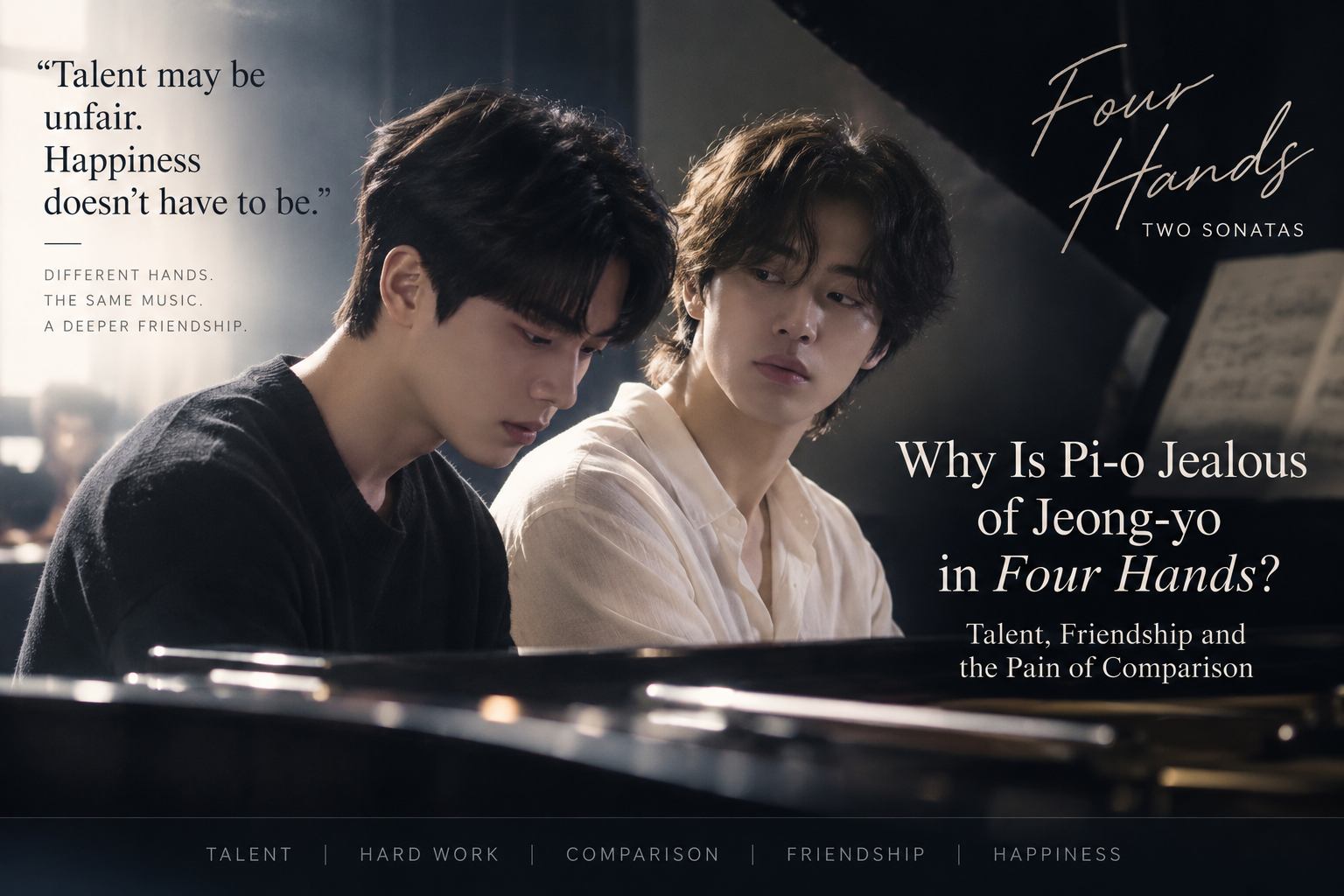
  • Why Is Pi-o Jealous of Jeong-yo in Four Hands, Two Sonatas? Grandpa’s Choice Explained

    Spoiler Warning: This article contains major spoilers for Four Hands, Two Sonatas Episode 4.

    Why is Kang Pi-o suddenly so threatened by Choi Jeong-yo in Four Hands, Two Sonatas?

    The simple answer is jealousy.

    But Episode 4 suggests something much deeper.

    Pi-o is not just afraid that Jeong-yo might become a better pianist. Jeong-yo receives the one thing Pi-o has spent much of his life chasing: recognition from his grandfather, Kang Seung-woon.

    That is what makes their growing rivalry so painful.

    Jeong-yo is not a stranger Pi-o wants to defeat. He is the friend who helped Pi-o rediscover the joy of music — and at the same time, the person who exposes everything Pi-o fears he may be missing as a musician.

    Why Does Pi-o Want His Grandfather’s Approval?

    To understand Pi-o’s jealousy, we first have to understand what his grandfather means to him.

    Pi-o has grown up in a world built around elite musical training, competitions and expectations.

    He knows how to practice.

    He knows how to perform.

    And he knows how to compete.

    But beneath all of that is a much more personal desire.

    Pi-o wants Kang Seung-woon to recognize him as a musician.

    His grandfather is not simply another family member whose praise would make him happy. He represents the musical authority Pi-o desperately wants to impress.

    That helps explain why Jeong-yo’s arrival changes everything.

    Pi-o has spent years trying to earn that recognition.

    Jeong-yo seems capable of attracting it simply by playing.

    Why Does Grandpa Choose Jeong-yo?

    Episode 4 makes the contrast between the two young pianists increasingly clear.

    Pi-o has been shaped by formal training and competition.

    Jeong-yo approaches music differently.

    He improvises. He experiments with harmony. He changes what he plays according to what he feels instead of always remaining confined by the score.

    As Pi-o spends more time practicing with him, he begins noticing this difference himself.

    He discovers Jeong-yo’s composition notebook.

    He sees their teacher, Do Hyun-soo, react to Jeong-yo’s improvisation.

    Even Hong Jae-in becomes absorbed in Jeong-yo’s playing.

    Then comes the moment Pi-o fears most.

    Jeong-yo plays in front of Kang Seung-woon.

    His grandfather likes what he hears enough to consider performing with Jeong-yo.

    For Pi-o, this is not merely another musician receiving praise.

    It is Jeong-yo receiving the approval Pi-o wanted for himself.

    Pi-o vs Jeong-yo: Calculation vs Instinct

    This is where the musical conflict at the center of Four Hands, Two Sonatas becomes much more interesting than a simple question of who is the better pianist.

    Pi-o represents control.

    Jeong-yo represents instinct.

    Pi-o has learned to succeed inside the system: training, technique, competitions and disciplined preparation.

    Jeong-yo possesses a more spontaneous relationship with music.

    This does not mean Pi-o has no talent or that Jeong-yo does not work hard.

    The drama is asking a more uncomfortable question:

    What happens when someone who has spent his entire life perfecting music meets someone who seems to understand it naturally?

    For Pi-o, Jeong-yo becomes a mirror.

    And Pi-o does not necessarily like what that mirror shows him.

    Why Their Friendship Makes the Jealousy More Painful

    There is another reason Pi-o’s reaction feels so tragic.

    Jeong-yo was becoming his closest musical friend.

    When Jeong-yo struggled with stage fright, Pi-o helped him return to the piano.

    When Jeong-yo was in danger, Pi-o helped him.

    And after their conflicts, it was Pi-o who suggested that they become practice partners because he wanted to discover how to enjoy music again.

    That detail matters.

    Jeong-yo is not only Pi-o’s rival.

    He is also the person who reminded Pi-o that playing the piano could make him happy.

    That creates a cruel contradiction.

    The person who helps Pi-o rediscover his love of music is also the person who awakens his deepest insecurity.

    Why Does Pi-o Become Jealous of Jeong-yo?

    Pi-o’s jealousy builds gradually rather than appearing from nowhere.

    He sees Jeong-yo’s natural musical sense.

    He notices other musicians reacting to it.

    He hears that people in the industry may prefer Jeong-yo.

    He watches Jae-in become fascinated by Jeong-yo’s playing.

    And finally, he sees his own grandfather recognize Jeong-yo.

    Each moment reinforces the same fear:

    What if everything Pi-o worked for can be surpassed by something Jeong-yo simply possesses naturally?

    That is why calling Pi-o merely “jealous” misses the point.

    His jealousy is connected to identity.

    If being an exceptional pianist has defined Pi-o for most of his life, Jeong-yo’s talent threatens more than his position in a competition.

    It threatens Pi-o’s understanding of who he is.

    What Does Grandpa’s Warning to Pi-o Really Mean?

    After Kang Seung-woon shows interest in performing with Jeong-yo, Pi-o finally confronts his grandfather.

    He wants to know why Jeong-yo was chosen.

    The answer is devastating because it attacks the insecurity Pi-o has already begun developing.

    His grandfather essentially warns him that if this relationship continues as a competition, Pi-o may be the one who ends up emotionally destroyed.

    The warning can be interpreted in two ways.

    On the surface, Kang Seung-woon may simply believe Jeong-yo possesses greater natural musical talent.

    But there is another possibility.

    He may understand Pi-o better than Pi-o realizes.

    Jeong-yo does not appear to define himself by defeating Pi-o.

    Pi-o, however, is beginning to measure his own worth against Jeong-yo.

    That makes the rivalry far more dangerous for Pi-o.

    The greatest threat may not be losing to Jeong-yo.

    It may be becoming so obsessed with beating him that Pi-o loses the happiness he had only just rediscovered.

    Is Pi-o Really Angry at Jeong-yo?

    This may be the most important question after Episode 4.

    Pi-o appears angry at Jeong-yo.

    But much of that anger may actually be directed at himself.

    Jeong-yo did not steal his grandfather.

    He did not deliberately take Pi-o’s opportunities.

    And he did not become Pi-o’s friend in order to defeat him.

    Instead, Jeong-yo unintentionally reveals Pi-o’s deepest wound.

    Pi-o has spent years doing what everyone expected from him, yet he still cannot obtain the recognition he wants most.

    That is why his jealousy feels less like hatred and more like fear.

    Talent vs Hard Work May Not Be the Real Question

    It would be easy to interpret Four Hands, Two Sonatas as another “talent versus hard work” story.

    But the drama appears to be building toward something more complicated.

    Pi-o has what Jeong-yo lacks.

    Jeong-yo has what Pi-o lacks.

    Pi-o gives Jeong-yo structure and discipline.

    Jeong-yo shows Pi-o freedom and musical instinct.

    When they play together, those differences complement each other.

    When they begin comparing themselves, those same differences become weapons.

    That may be the real meaning of the title Four Hands, Two Sonatas.

    Two musicians do not necessarily have to become identical to create something extraordinary together.

    The tragedy begins when one decides he must become better than the other.

    What Happens Next to Pi-o and Jeong-yo?

    Episode 4 appears to mark an important turning point.

    Until now, Pi-o and Jeong-yo have repeatedly rescued each other.

    Now talent, family expectations, money and the adults surrounding them are beginning to turn friendship into competition.

    The most interesting question going forward is therefore not simply:

    Who is the better pianist?

    It is:

    Can Pi-o accept Jeong-yo’s talent without believing that it makes his own music worthless?

    If he cannot, his grandfather’s warning may become a self-fulfilling prophecy.

    And that would make Pi-o and Jeong-yo’s relationship one of the most painful parts of Four Hands, Two Sonatas.


    Related Four Hands, Two Sonatas Guide

    Want a deeper look at the drama’s central themes?

    Read our Four Hands, Two Sonatas Explained: Talent vs Hard Work, Rivalry and the Meaning of the Piano guide for more on Pi-o and Jeong-yo’s contrasting approaches to music.


  • Why Pi-o Is Jealous of Jeong-yo in Four Hands — Talent, Friendship and the Pain of Comparison

    Why Pi-o Is Jealous of Jeong-yo in Four Hands — Talent, Friendship and the Pain of Comparison

    There is something painful about watching Pi-o and Jeong-yo in Four Hands, Two Sonatas.

    At first, it looks like a familiar story about two gifted young pianists.

    One is disciplined, polished and relentlessly trained.

    The other seems to possess something that cannot be taught.

    But the more I watched Four Hands, the less I thought this was really a story about piano.

    It is a story about something almost everyone experiences at some point in life:

    What happens when you meet someone who is simply more gifted than you?

    Someone who understands in minutes what takes you hours.

    Someone who reaches naturally for something you spent years trying to master.

    And what if that person isn’t your enemy?

    What if he becomes your friend?

    That may be the most difficult relationship at the heart of Four Hands.


    Pi-o Isn’t Ordinary — That’s What Makes It Hurt

    It would be easy to describe Kang Pi-o as the hardworking pianist and Choi Jeong-yo as the genius.

    But that description misses something important.

    Pi-o is extraordinarily talented too.

    To most people, Pi-o would already look like a prodigy.

    He has spent years training, practicing and pursuing perfection. He has developed the discipline required to turn musical ability into performance.

    Netflix describes Pi-o as an elite pianist who has relentlessly pursued perfection, while Jeong-yo is presented as a rougher, freer figure with remarkable natural musical talent.

    Without Jeong-yo beside him, Pi-o might have spent his entire life being called a genius.

    Then Jeong-yo appears.

    And suddenly Pi-o discovers that there are places he has struggled for years to reach that Jeong-yo seems to understand almost instinctively.

    That is what makes their relationship painful.

    Pi-o isn’t discovering that he is bad at piano.

    He is discovering the limits of being very, very good.


    Sometimes We Discover Our Limits Through Other People

    I think this happens far beyond music.

    Most of us don’t clearly see our own limits when we are alone.

    We work.

    We improve.

    Yesterday’s version of ourselves is our reference point.

    Then someone else appears.

    You practice something ten times.

    They understand it after two.

    You spend years learning how a business works.

    They seem to recognize the opportunity almost immediately.

    You study for hours.

    They remember something after reading it once.

    It happens in sports, art, cooking, mathematics, business, writing and almost every kind of work.

    There are people whose results seem disproportionately large compared with the effort required to produce them.

    Meeting someone like that can be uncomfortable.

    Because suddenly the comparison is no longer theoretical.

    Another person becomes a mirror that shows you your own limits.

    That, to me, is part of what Jeong-yo becomes for Pi-o.


    The Cruelest Comparison Is With Someone Close to You

    A genius who lives thousands of miles away is relatively easy to admire.

    Pi-o doesn’t have to wake up every morning consumed by jealousy because some legendary concert pianist somewhere in the world is better than him.

    That person is distant.

    Jeong-yo isn’t.

    He is right there.

    They practice together.

    They fight.

    They laugh.

    They begin to understand each other’s weaknesses.

    They become friends.

    And that makes comparison much more difficult.

    Imagine spending most of your life developing one ability.

    Then your closest friend begins receiving attention for doing something you have desperately wanted to do better than anyone else.

    As a friend, you want him to succeed.

    As a competitor, his success hurts.

    You can be happy for your friend and threatened by him at the same time.

    Those feelings are not mutually exclusive.

    That contradiction is one of the things Four Hands understands remarkably well.


    Maybe Pi-o Isn’t Really Jealous of Jeong-yo’s Success

    Jealousy is an easy word.

    But I think there is something underneath it that hurts more.

    Futility.

    The painful question may not be:

    Why is everyone paying attention to him?

    It may be:

    I spent so much of my life trying to reach this place. Why does he seem to possess naturally what I had to fight for?

    That question can destroy a person’s confidence.

    Because hard work is something we can control.

    Natural ability isn’t.

    We can practice longer.

    We can study harder.

    We can become more disciplined.

    But eventually, many of us encounter someone whose natural advantages cannot simply be erased by working another hour.

    And that is when comparison becomes dangerous.


    This Isn’t Really a Piano Story

    Piano is simply the stage on which Four Hands explores the problem.

    Replace piano with almost anything else and the story still works.

    Two students.

    Two athletes.

    Two artists.

    Two chefs.

    Two entrepreneurs.

    Two coworkers.

    Two writers.

    One person works incredibly hard and becomes exceptional.

    Then another person arrives who seems to see the same world differently.

    Most people will never experience Pi-o and Jeong-yo’s exact musical situation.

    But many people know the feeling behind it.

    “Why is this so much easier for that person than it is for me?”

    That’s why Pi-o’s struggle can feel surprisingly personal.


    Friendship Makes the Problem Harder, Not Easier

    We often assume that a deep friendship should be stronger and therefore harder to break.

    Sometimes the opposite may be true.

    The deeper the friendship, the deeper the possible wound.

    If someone I barely know succeeds, I can congratulate them and move on.

    But if the person walking beside me suddenly races ahead, I cannot avoid seeing the distance between us.

    And if we share the same dream, the problem becomes even harder.

    Pi-o and Jeong-yo are not merely friends.

    They are also rivals.

    The person who understands you best can therefore become the person most capable of hurting you.

    That’s the paradox at the center of their friendship.

    They can help each other grow precisely because they are different.

    But those same differences can tear them apart.


    Jeong-yo’s Side Isn’t Easy Either

    There is another side to this relationship.

    Jeong-yo didn’t choose his talent.

    Imagine realizing that simply doing what comes naturally to you is hurting someone you care about.

    What should you do?

    Pretend to be worse?

    Stop trying?

    Hide your ability?

    Of course not.

    Jeong-yo shouldn’t have to apologize for being gifted any more than Pi-o should feel ashamed of having worked hard.

    This is why a friendship between people with unequal abilities requires maturity from both sides.

    Pi-o needs the wisdom to accept.

    Jeong-yo needs the wisdom to understand.

    Pi-o must learn to recognize Jeong-yo’s gift without using it as evidence that his own life has less value.

    Jeong-yo must understand that something effortless to him may represent years of sacrifice to someone else.

    Neither lesson is easy.


    When I Was Younger, I Envied People Like Jeong-yo

    This is where Four Hands became more than a drama for me.

    When I was younger, people with extraordinary natural ability were easy to envy.

    If two people put in similar effort and one achieves much more, it can feel unfair.

    You begin thinking:

    “If only I had been born with that talent.”

    Then comparison begins.

    Comparison becomes envy.

    Envy can become frustration.

    Frustration can become resentment.

    And eventually some people simply give up.

    Why continue if someone else can always do it better?

    But as I’ve grown older, I’ve started to see the question differently.


    Someone Else’s Talent Does Not Take Away Your Happiness

    This took me a long time to understand.

    Someone else’s gift does not reduce the amount of happiness available to me.

    A person being a better pianist does not make my music worthless.

    Someone making more money does not automatically make my life poorer.

    Someone learning faster does not mean there is no value in what I learn slowly.

    Yet comparison makes us behave as though happiness were a fixed quantity.

    If that person has more, I must have less.

    Life doesn’t necessarily work that way.

    Talent may be distributed unequally.

    Opportunity may be distributed unequally.

    Even effort and results are often unfairly matched.

    But that does not mean happiness has already been assigned in the same proportions.

    Put simply:

    Talent may be unfair. Happiness doesn’t have to be.

    That is one of the things Pi-o’s struggle makes me think about.


    The Wisest Response to Genius Is Not Envy

    So what should we do when we meet someone far more gifted than ourselves?

    As I’ve grown older, my answer has become simpler.

    Acknowledge it.

    That person is better than me at this.

    That person learns this faster.

    That person has something I don’t.

    Saying those things does not make me smaller.

    Then comes the important part:

    Learn what you can.

    Meeting someone better than you can actually be an extraordinary advantage.

    You may learn in months what would have taken you years to discover alone.

    The tragedy begins when admiration becomes resentment.

    If you become consumed by envy, attack the other person, lose confidence and eventually abandon your own path, then their talent has defeated you.

    Not because they were better.

    Because comparison convinced you that your own journey no longer mattered.


    But Genius Doesn’t Mean Having Everything

    There is another mistake we often make.

    When we see an extraordinary person, we focus entirely on what they possess.

    We see Jeong-yo’s musical intuition and think:

    Imagine being born with that.

    But exceptional ability in one part of life does not guarantee completeness in every other part.

    Someone who understands music more naturally than everyone around them may still struggle with things that seem completely natural to other people.

    Relationships.

    Ordinary emotions.

    Belonging.

    Understanding what another person feels.

    This should not be generalized to every gifted person, of course.

    But Four Hands raises an interesting possibility:

    Sometimes the very thing that makes someone extraordinary can also make it harder for them to feel ordinary.

    And perhaps being ordinary contains gifts we rarely recognize as gifts.


    Maybe Jeong-yo Needs Pi-o Too

    This changes how I see their friendship.

    At first, it can look as though Pi-o has more to learn from Jeong-yo.

    Jeong-yo possesses a musical freedom Pi-o struggles to reach.

    But Jeong-yo is not complete either.

    He carries trauma, struggles with the stage, and needs help entering a world Pi-o already understands.

    Pi-o knows discipline.

    He knows training.

    He knows how to stand before an audience.

    He knows how to transform ability into a life as a musician.

    So perhaps their relationship is not:

    The lesser pianist learning from the greater one.

    It is two incomplete people carrying different strengths.

    Jeong-yo can teach Pi-o something about music.

    Pi-o can teach Jeong-yo something about living with music.

    And perhaps both can teach the other something about being human.


    This Is Why the Title “Four Hands” Feels So Perfect

    “Four hands” refers to two pianists playing the same piano together.

    Think about what that requires.

    Two people do not have to be equally gifted.

    But neither person can simply play however they want.

    You have to listen.

    You have to feel the other person’s timing.

    Sometimes you lead.

    Sometimes you follow.

    Sometimes you wait.

    Sometimes you make room.

    The better pianist cannot simply rush ahead and expect the music to survive.

    And the weaker pianist cannot spend the entire performance resenting the other person’s ability.

    The music only works when two different people learn to hear each other.

    Friendship may work the same way.

    Friendship, like four-hands piano, does not require two people to be equally gifted. It requires them to listen to each other’s tempo.

    That may be the real challenge facing Pi-o and Jeong-yo.


    Pi-o Must Accept. Jeong-yo Must Understand.

    If their friendship is going to survive, both of them have work to do.

    Pi-o must accept Jeong-yo’s talent without diminishing himself.

    Jeong-yo must understand Pi-o’s effort without diminishing it.

    Pi-o must learn acceptance.

    Jeong-yo must learn empathy.

    Neither needs to become the other.

    Pi-o doesn’t need Jeong-yo’s exact gift to have value.

    Jeong-yo doesn’t need to hide his talent to protect Pi-o.

    They simply have to learn that difference does not automatically create hierarchy in every part of life.

    One person can be better at piano without being better at being a person.

    That’s a much harder distinction to live than it is to write.


    The Hardest Four-Hands Performance May Not Happen at the Piano

    At this point, I’m not particularly interested in asking whether Pi-o or Jeong-yo is the better pianist.

    The drama has already made Jeong-yo’s extraordinary natural gift clear.

    The question I find much more interesting is:

    Can they remain friends?

    Can Pi-o admire someone more gifted than himself without losing his own sense of worth?

    Can Jeong-yo fully use his gift while understanding what Pi-o’s years of effort mean?

    Can two people who share the same dream survive when one person’s talent becomes a mirror reflecting the other’s limitations?

    That may be the most difficult four-hands performance in the entire drama.

    Not the piece they play together on a piano.

    But learning how to move through life together without one person’s gift becoming the other person’s wound.


    Talent May Be Unequal. Happiness Doesn’t Have to Be.

    Eventually, all of us meet someone better than ourselves.

    Someone smarter.

    Faster.

    More talented.

    More intuitive.

    Someone who reaches in two steps what takes us ten.

    We can resent them.

    We can allow their ability to become proof of our inadequacy.

    We can give up.

    Or we can acknowledge the difference, learn what we can and continue walking our own path.

    Because another person’s talent does not determine the value of our life.

    And another person’s success does not set the ceiling on our happiness.

    When I was younger, extraordinary talent seemed like one of the greatest gifts a person could receive.

    I’m less certain now.

    There are many ways to live a meaningful life, and many forms of happiness that have nothing to do with being the best.

    Perhaps talent was never distributed fairly.

    But happiness was never promised only to the talented.

    And that may be what Pi-o and Jeong-yo ultimately need to discover about each other.

    They don’t need equal gifts to remain friends.

    They need to hear each other’s tempo.

    Because sometimes the hardest part of playing four hands isn’t knowing your own part.

    It’s continuing to listen when the person beside you can play something you never could.


    FAQ: Pi-o, Jeong-yo and Talent in Four Hands

    Why is Pi-o jealous of Jeong-yo in Four Hands?

    Pi-o has spent years pursuing technical and musical perfection, while Jeong-yo possesses an unusually natural musical instinct. Their closeness makes that difference impossible for Pi-o to ignore, turning admiration, competition and friendship into complicated emotions.

    Is Jeong-yo more talented than Pi-o?

    The drama presents Jeong-yo as possessing extraordinary natural musical talent, while Pi-o represents a highly trained elite pianist shaped by discipline and relentless practice. The more interesting contrast is therefore not simply who is “better,” but what each lacks and can learn from the other.

    Are Pi-o and Jeong-yo friends or rivals?

    They are both. Their friendship and rivalry are intertwined, which is one reason their relationship becomes so emotionally complicated. Netflix itself frames Four Hands, Two Sonatas around friendship, rivalry and growth.

    What does “Four Hands” mean?

    In piano music, four-hands playing involves two pianists performing together on one piano. Within the drama, it also works as a powerful metaphor for Pi-o and Jeong-yo: two different people learning to listen, adjust and make room for each other.

    What is the main message of Pi-o and Jeong-yo’s relationship?

    One possible interpretation is that unequal talent does not make friendship impossible, but it makes friendship more demanding. Pi-o must learn to recognize Jeong-yo’s gift without losing his own self-worth, while Jeong-yo must learn to understand the effort and emotions of the person beside him.