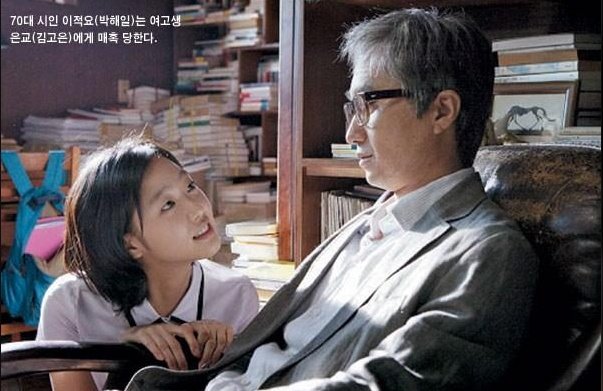
Spoiler Warning: This article discusses important character relationships, major revelations, and the ending of the 2012 South Korean film A Muse (Eungyo).
1. A Young Woman Enters the World of Two Men
At first glance, A Muse appears to be a provocative story about an elderly poet who develops feelings for a teenage girl.
Lee Jeok-yo is a celebrated poet in his seventies. He has achieved literary recognition, established his reputation, and withdrawn from much of the outside world.
His younger assistant and protégé, Seo Ji-woo, appears to be the person who will carry his literary legacy forward.
Then Han Eun-gyo enters their lives.
A 17-year-old high school student, Eun-gyo unexpectedly appears at Jeok-yo’s home. Her presence gradually changes the emotional atmosphere between the two men.
But the most interesting question is not simply which man wants Eun-gyo.
It is what she represents to each of them.
For Jeok-yo, she becomes connected to youth, beauty, and the possibility of feeling alive again. For Ji-woo, she becomes entangled with jealousy, ambition, and the desire to escape his mentor’s shadow.
The film presents a relationship triangle, but its deeper subject is the destructive nature of wanting something that cannot simply be possessed.
2. Lee Jeok-yo: What Happens When a Poet Becomes Afraid of Growing Old?
Jeok-yo is not an ordinary elderly man.
He is a respected literary figure whose work has already secured his place in the cultural world. Yet professional recognition cannot protect him from the physical and emotional realities of aging.
His body has changed. His relationship with the outside world has narrowed. The life that once seemed full of possibilities has become increasingly distant.
Eun-gyo’s arrival awakens feelings that he may have believed were no longer part of his life.
This is where the film becomes psychologically interesting.
Jeok-yo’s attraction is not only directed toward a particular young woman. It is also connected to everything he believes he has lost.
Her youth reminds him of a version of himself that no longer exists.
But there is an important moral distinction.
Understanding why an elderly man experiences desire does not mean that every expression of that desire becomes acceptable.
The film invites us to examine his loneliness without requiring us to approve of his choices.
3. Was Jeok-yo in Love with Eun-gyo or with His Lost Youth?
This may be the central question of the entire film.
Jeok-yo sees something in Eun-gyo that appears to restore his emotional vitality.
She is young, spontaneous, and seemingly untouched by the disappointments that have shaped his life.
But how much does he actually know about her?
There is a difference between loving another person and loving the feelings that person creates inside us.
Jeok-yo may believe that Eun-gyo represents a genuine emotional connection. Yet his perception of her is inevitably influenced by his own memories, frustrations, and fear of aging.
In this sense, Eun-gyo becomes a mirror.
He sees youth when he looks at her. He sees possibility where he experiences limitation. He sees the life he can no longer live.
That does not necessarily mean his feelings are entirely false.
It means that his feelings may be directed as much toward his own emotional needs as toward Eun-gyo herself.
The film becomes more uncomfortable when we recognize that distinction.
4. The Difference Between Imagination and Reality
One of the most important aspects of A Muse is the relationship between Jeok-yo’s imagination and his real-world behavior.
His feelings influence his writing. He creates a fictional narrative inspired by Eun-gyo, allowing his imagination to explore a relationship that exists beyond the boundaries of ordinary reality.
This creates an uneasy question.
Can a writer explore forbidden desires through fiction without making those desires morally acceptable in real life?
Literature has always allowed writers to examine thoughts, fantasies, and experiences that would be troubling or destructive if translated directly into action.
But the film does not make this distinction entirely comfortable.
Jeok-yo’s writing may offer an outlet for feelings he cannot openly express, but Eun-gyo remains a real person rather than merely a character in his imagination.
His artistic freedom does not automatically give him ownership over her identity.
The distinction between the woman and the image of the woman becomes increasingly important as the story develops.
5. Seo Ji-woo: The Student Who Cannot Escape His Teacher’s Shadow
Ji-woo initially appears to be a loyal and devoted student.
He assists Jeok-yo, manages practical matters, and benefits from the older man’s literary guidance.
But beneath this relationship lies a serious imbalance.
Ji-woo wants recognition as a writer in his own right. Yet his success is closely connected to Jeok-yo’s talent.
The film gradually reveals that his public literary identity is not as independent as it appears.
Jeok-yo’s contribution to Ji-woo’s writing creates a relationship built on admiration, dependence, and concealed resentment.
Ji-woo wants to become a successful author, but he also wants to stop being defined by the man who helped create his success.
His frustration is understandable.
His response, however, becomes increasingly destructive.
The tragedy of Ji-woo is that he cannot build an independent identity without repeatedly measuring himself against his mentor.
6. The Manuscript: When Artistic Jealousy Becomes Theft
The manuscript is one of the film’s most important symbols.
Jeok-yo’s writing reflects his private imagination and emotional response to Eun-gyo.
When Ji-woo discovers the work, he is confronted with something that threatens him on several levels.
It reveals Jeok-yo’s renewed creative energy. It also exposes the depth of his mentor’s feelings toward Eun-gyo.
Most importantly, the manuscript represents a kind of artistic power that Ji-woo desperately wants for himself.
The decision to take and publish the work under his own name is therefore more than a simple act of literary plagiarism.
It is an attempt to possess the creative achievement of the person whose shadow he cannot escape.
Ji-woo wants the recognition without acknowledging the dependence that made it possible.
The irony is painful.
He seeks independence by committing an act that makes him even more dependent on Jeok-yo’s talent.
7. Why Is Ji-woo’s Hypocrisy So Important?
Ji-woo criticizes Jeok-yo’s feelings toward Eun-gyo.
On the surface, his objections may appear to be motivated by moral concern. The age difference and Eun-gyo’s status as a minor make the situation deeply troubling.
But Ji-woo’s own attraction to her complicates his position.
He is not simply an observer defending an innocent young woman from an inappropriate relationship.
He also wants her for himself.
This creates a disturbing contrast between what he says and what he does.
The film asks viewers to examine the difference between genuine moral opposition and moral judgment used to disguise personal jealousy.
Ji-woo’s criticism does not become invalid merely because he is hypocritical. Jeok-yo’s behavior still deserves scrutiny.
But Ji-woo’s actions reveal that moral language can become a convenient weapon when someone wants to defeat a rival.
He condemns another man’s desire while failing to confront his own.
8. Han Eun-gyo: The Person at the Center of the Story Who Remains a Mystery
Eun-gyo is the title character, but she is also one of the film’s most difficult characters to understand.
She is the person whose presence changes the lives of both men. Yet much of the narrative is organized around their emotional experiences.
What does Eun-gyo actually want?
Why does she become comfortable in Jeok-yo’s home? What does she see in him? How does she understand the attention she receives?
The film gives us glimpses of her personality, vulnerability, and circumstances, but it does not provide the same psychological access to her that it gives to the two male characters.
This is not necessarily an accidental weakness.
It can also be read as part of the film’s disturbing design.
Jeok-yo sees her as a source of inspiration. Ji-woo sees her as someone he wants to possess. Their interpretations compete, but neither necessarily captures the full person standing in front of them.
Eun-gyo becomes the object of their emotional conflict.
The uncomfortable question is whether either man truly understands her.
9. Is Eun-gyo a Muse or a Human Being?
The word “muse” traditionally describes someone who inspires an artist.
It sounds beautiful.
A muse can awaken creativity, restore passion, and give meaning to a work of art.
But there is a problem when the person being called a muse is treated primarily as a source of inspiration.
A muse can become an image rather than an individual.
The artist may love the beauty, mystery, or emotional energy that the person represents without fully recognizing her independent desires.
This is especially significant in A Muse.
Eun-gyo inspires Jeok-yo’s writing, but her existence cannot be reduced to the literary value she provides.
She is not a reward for his loneliness.
She is not an instrument for restoring his youth.
And she is not a prize that Ji-woo can claim simply because he is younger.
The title therefore carries an uncomfortable double meaning.
Calling someone a muse can be a form of admiration. It can also be a way of turning a human being into an object of someone else’s imagination.
10. Age, Loneliness, and the Fear of Disappearing
One of the film’s strongest themes is the relationship between aging and loneliness.
Society often treats old age as if it automatically removes a person’s emotional complexity.
Older people are expected to become quiet, restrained, and detached from desire.
Jeok-yo challenges that expectation.
His emotions have not disappeared simply because his body has aged.
He still wants connection. He still wants to feel alive. He still experiences jealousy, longing, and the need to be understood.
But the film also reveals the danger of allowing fear of aging to determine how another person is treated.
Jeok-yo’s loneliness deserves to be understood, but it does not give him the right to turn Eun-gyo into a solution for his emotional suffering.
This is what makes the film more complicated than a simple story about an old man’s inappropriate attraction.
It examines a universal fear through a relationship that remains ethically troubling.
11. The Two Men Are More Similar Than They Want to Admit
Jeok-yo and Ji-woo appear to occupy opposite positions.
One is an established elderly poet. The other is a younger writer trying to build his reputation.
One appears to be motivated by emotional longing. The other appears increasingly driven by ambition and jealousy.
But both men share an important weakness.
They struggle to separate their own desires from the identity of the person they want.
Jeok-yo risks turning Eun-gyo into a symbol of youth and inspiration.
Ji-woo treats her as part of his rivalry with his mentor.
Both are capable of looking at her through the lens of their personal needs.
Their differences are real, but their shared inability to see beyond themselves is equally important.
This is why the film’s conflict is not simply about an old man versus a young man.
It is about two men whose desires become increasingly destructive when they cannot accept the limits of their own lives.
12. The Ending: What Does Jeok-yo Leave Behind?
The ending brings together the film’s themes of authorship, identity, guilt, and the consequences of desire.
Jeok-yo’s final choices cannot be understood separately from his relationship with Ji-woo.
Their conflict is not only about Eun-gyo. It is also about the literary legacy, emotional dependence, and resentment that have accumulated between teacher and student.
The film’s final movement forces viewers to reconsider the relationship they have been watching.
Was Jeok-yo trying to protect Eun-gyo, protect his artistic dignity, or recover control over a life that had become increasingly defined by loss?
These motivations are not necessarily mutually exclusive.
What matters is that the story does not offer a simple emotional reward for his suffering.
The ending leaves a lingering sense of tragedy because the characters have spent so much time trying to possess what they cannot truly control.
Jeok-yo’s legacy is therefore not only the poetry he leaves behind.
It is also the damage created when art, desire, and personal identity become inseparable.
13. Why Viewers Still Disagree About A Muse
The film continues to provoke sharply different reactions.
Some viewers appreciate its examination of aging, loneliness, artistic inspiration, and the emotional complexity of desire.
Others find its central relationship uncomfortable to the point that the film’s artistic ambitions cannot overcome the ethical problem at its center.
A Reddit discussion in 2026 illustrates this divide. One viewer described the film as clumsy and sensationalist but singled out its ending as exceptionally memorable. Another viewer found value in its portrayal of desire and loneliness while emphasizing the distinction between Jeok-yo’s private fantasies and Ji-woo’s more selfish behavior.
These are individual reactions, not a representative survey of all viewers.
Still, they reveal an important reason why the film remains discussable.
The disagreement is not only about whether the characters are likable.
It is about whether a film can explore an uncomfortable desire without asking the audience to approve of it.
Some viewers see a thoughtful portrait of aging and loneliness. Others see a story that gives too much attention to male desire while leaving its teenage female character insufficiently developed.
Both reactions point toward the same unresolved question:
Whose emotional experience does the film ultimately ask us to understand?
14. Did He Love Her, or the Youth She Represented?
The most powerful question in A Muse may be the one that remains unanswered.
Jeok-yo’s feelings toward Eun-gyo awaken something in him that he believed had disappeared.
But does that make his feelings love?
Or is he attached to the youth, beauty, and possibility that she represents?
Ji-woo’s desire is different, but it also becomes inseparable from his personal insecurity.
He wants to become a successful writer. He wants recognition. He wants to escape his mentor’s shadow. His attraction to Eun-gyo becomes part of that larger struggle.
And in the middle of these competing desires is a young woman whose own identity is repeatedly interpreted through the needs of others.
Perhaps this is the most uncomfortable aspect of the film.
Both men believe they are experiencing something important because of Eun-gyo. Yet the story repeatedly raises the possibility that they are more interested in what she means to them than in who she actually is.
The film is not simply asking whether an old man can love a young woman.
It is asking whether desire can become so powerful that we stop seeing the person standing in front of us.
Final Thought
A Muse is difficult to reduce to a conventional romance.
Its strongest material lies in the uneasy relationship between aging, artistic ambition, loneliness, and the desire to possess what time has taken away.
Jeok-yo is not automatically innocent because he is lonely. Ji-woo is not morally superior simply because he is younger. And Eun-gyo should not be reduced to the inspiration, prize, or temptation that either man imagines her to be.
The film’s most important question may therefore be larger than its controversial love triangle.
When we call someone our muse, are we celebrating who they are—or simply celebrating what they make us feel?
That question is what makes A Muse worth discussing long after its most provocative scenes have ended.