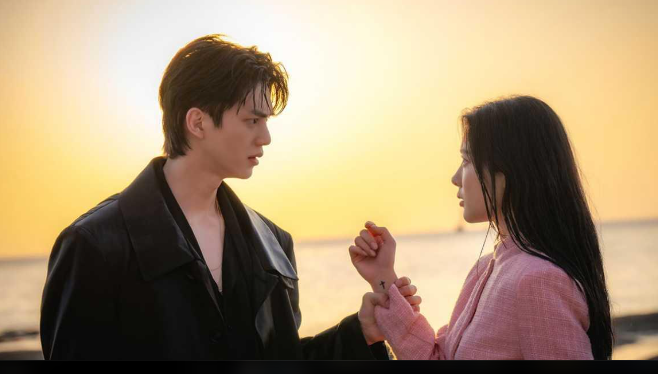
Netflix’s My Demon is often remembered as a stylish fantasy romance between a powerful demon and a human heiress. But beneath its beautiful visuals and supernatural attraction lies a more complicated question: Does loving someone mean saving them, changing them, or accepting them exactly as they are?
1. A Romance Built on an Unusual Contradiction
At first glance, My Demon appears to follow a familiar fantasy-romance formula. Jung Gu-won is a supernatural being who has spent centuries making contracts with humans. Do Do-hee is a wealthy heiress whose life becomes entangled with his after an unexpected encounter.
Their relationship begins with practical necessity rather than emotional commitment. Gu-won’s supernatural power becomes connected to Do-hee, forcing two individuals from completely different worlds to depend on each other.
However, this arrangement creates an interesting contradiction.
Gu-won has spent centuries understanding human weakness as something he can use. Do-hee, meanwhile, has learned to protect herself because trusting other people can be dangerous.
Neither character initially approaches love as a simple act of emotional surrender. Both are accustomed to maintaining control.
Their romance becomes meaningful because it gradually challenges the identities they have built around self-protection.
The real story is not simply whether a demon can fall in love with a human. It is whether two people who have learned to survive through emotional distance can accept the vulnerability that love demands.
2. Gu-won: A Creature Who Understands Desire but Not Its Consequences
Gu-won’s occupation reveals something important about his understanding of humanity.
He makes contracts with people who are desperate enough to exchange something precious for their wishes. His power depends on recognizing what humans desire and how fear influences their decisions.
He understands temptation, ambition, desperation, and weakness.
But understanding desire is not the same as understanding people.
For centuries, Gu-won has observed human beings from a position of superiority. He can identify their weaknesses without having to share their emotional consequences.
This creates an unusual limitation.
He knows how people behave when they want something badly, but he does not initially understand what it means to become emotionally responsible for another person.
His relationship with Do-hee forces him into an unfamiliar position. Instead of standing outside human suffering and benefiting from it, he begins to experience the consequences of attachment himself.
His transformation is therefore not simply about becoming kinder.
It is about discovering that another person’s pain can matter even when there is nothing to gain from responding to it.
3. Do Do-hee: The Cost of Living Without Trust
Do-hee is not a conventional romantic heroine waiting for someone powerful to rescue her.
Her position within a wealthy family exposes her to manipulation, competition, and suspicion. She has learned that affection can carry conditions and that family relationships do not automatically guarantee loyalty.
Her independence is a form of protection.
She relies on her intelligence, professional judgment, and ability to read other people’s intentions. These qualities help her survive, but they also make emotional dependence difficult.
This is an important distinction.
Being independent does not necessarily mean being emotionally free.
Do-hee can manage business conflicts and recognize political manipulation, yet she still struggles with the possibility of trusting someone without knowing exactly what that person expects in return.
Gu-won enters her life as a supernatural problem, but he eventually becomes someone she can depend on.
Their relationship challenges her belief that safety can only come from maintaining control.
The deeper question surrounding Do-hee is not whether she needs a powerful man to protect her. It is whether she can allow herself to be loved without interpreting every relationship as a potential threat.
4. The Tattoo: When Power Becomes a Responsibility
The transfer of Gu-won’s tattoo is one of the drama’s most effective narrative devices.
His supernatural power is no longer entirely under his control. It becomes connected to Do-hee, creating a situation in which his survival and her safety are closely linked.
The tattoo represents more than a magical mechanism.
It is a visible expression of dependence.
A character who has spent centuries exercising power over others suddenly discovers that his own existence can be affected by someone else.
This reverses the original relationship between Gu-won and humanity.
Previously, he was the one who controlled the terms of a contract. Now he must negotiate a relationship in which control is incomplete and emotional consequences cannot be avoided.
The tattoo also raises a larger question about relationships.
When two people become dependent on each other, does that automatically create intimacy?
Not necessarily.
Dependence can produce fear, resentment, and attempts at control. Love develops only when dependence becomes a conscious choice to care about the other person’s well-being.
The supernatural connection creates the conditions for their relationship. It does not automatically create the relationship itself.
5. Is Their Love Based on Attraction or Mutual Recognition?
The visual appeal of My Demon is undeniable. Song Kang and Kim Yoo-jung give the central couple a strong screen presence, and the drama uses their appearance and chemistry as a major part of its romantic identity.
But attraction alone cannot explain why their relationship matters.
The more interesting development is the gradual recognition of each other’s vulnerabilities.
Do-hee sees beyond Gu-won’s confidence and supernatural authority. Gu-won begins to recognize that Do-hee’s apparent toughness is not the absence of fear.
Both discover that the other person has been living behind a protective identity.
This is where their relationship becomes more than a fantasy of physical attraction.
They are not simply fascinated by someone different from themselves. They begin to understand the emotional cost of being that person.
A meaningful relationship does not require two people to have identical experiences.
It requires them to recognize that the other person’s experiences are real, even when they cannot fully understand them.
6. The Drama’s Most Interesting Idea: Can a Demon Become Good?
Traditional stories often present demons as beings that must be defeated, expelled, or transformed before they can participate in a morally acceptable ending.
My Demon approaches this expectation differently.
Gu-won’s identity as a demon is not merely an obstacle that must disappear before he can love Do-hee.
His supernatural nature remains central to who he is.
This distinction matters because the drama separates identity from moral behavior.
Being a demon does not automatically explain every decision he makes. His choices, rather than his species, become the more important measure of his character.
That creates an interesting philosophical possibility.
Perhaps goodness is not determined by the category into which someone is placed. Perhaps it is revealed through the decisions that person makes when confronted with another person’s suffering.
This does not mean that identity is irrelevant.
It means that identity alone cannot tell us everything about someone’s moral character.
Gu-won’s development becomes more compelling when viewed through this distinction. He does not need to become an ordinary human being to develop the capacity for love.
7. Why the Supporting Characters Matter More Than They First Appear
The drama’s supporting characters offer opportunities to examine different forms of attachment.
Jin Ga-young’s feelings for Gu-won introduce the painful difference between loving someone and being loved in return.
Her attachment raises a question that romantic dramas sometimes avoid: What happens when devotion becomes one-sided?
Love does not create an obligation for another person to return the same feelings.
Recognizing that boundary is part of emotional maturity.
The relationships surrounding Do-hee also reveal how affection can coexist with jealousy, ambition, and family conflict.
The Ju family is not simply a background for the central romance. It demonstrates how the language of family loyalty can be used to disguise the pursuit of power.
These secondary stories could have been developed further.
Some Reddit viewers felt that Jin Ga-young and the supporting cast deserved more meaningful emotional arcs, while others believed the central couple’s chemistry remained the drama’s strongest attraction.
The criticism points toward an important weakness: the series introduces several interesting emotional conflicts but does not always give them enough room to develop.
8. Noh Suk-min: When Family Becomes a Weapon
Noh Suk-min represents a different kind of danger from Gu-won.
Gu-won is supernatural, powerful, and initially unfamiliar with ordinary human emotions. Suk-min is entirely human, yet his actions reveal how destructive human ambition can become.
His pursuit of influence within the family demonstrates how easily relationships can become instruments of manipulation.
The contrast is deliberate and revealing.
The demon gradually develops emotional responsibility, while a human being becomes increasingly willing to sacrifice others for personal advantage.
This reversal challenges the assumption that humanity automatically produces morality.
Suk-min’s character is particularly important because he connects the supernatural story to ordinary structures of power.
The threat does not come only from the existence of demons. It also comes from people who use family relationships, inheritance, and social position to justify harmful behavior.
In this sense, the human antagonist may be more frightening than the supernatural protagonist.
A demon’s nature is openly acknowledged. Human cruelty can hide behind respectable appearances.
9. The Question of God: Who Actually Controls the Rules?
One of the most unusual aspects of My Demon is its portrayal of God.
Rather than presenting divine authority as an entirely distant and solemn force, the drama introduces a more unconventional figure who interacts with Gu-won through a mixture of humor, observation, and apparent indifference.
This choice creates a distinctive atmosphere.
The relationship between God and Gu-won resembles a game in which the rules are not fully explained to the participants.
But this raises a serious question.
If a divine being can determine the conditions of a person’s existence, how much freedom does that person really possess?
Gu-won believes he understands the world because he has operated within its supernatural system for centuries. Yet his relationship with God suggests that even his apparent independence may exist within boundaries he cannot fully comprehend.
The drama does not provide a completely satisfying theological explanation.
That uncertainty can be interpreted as a weakness in the storytelling, but it also creates an opportunity for deeper discussion about fate, responsibility, and free will.
A person may not control every circumstance of life. However, the choices made within those circumstances can still reveal character.
10. The Final Sacrifice: Is Giving Up Everything the Ultimate Form of Love?
The climax places Gu-won in a position where saving Do-hee requires an extraordinary sacrifice.
The emotional force of this moment comes from the reversal of his earlier existence.
For much of his life, Gu-won has been associated with contracts in which humans surrender something valuable in exchange for what they desire.
At the end, he becomes the one willing to surrender everything.
This is a powerful transformation.
However, the scene also raises a difficult question: Should sacrifice be considered the highest proof of love?
Romantic storytelling often treats self-destruction as the ultimate expression of devotion. The more someone gives up, the more meaningful the relationship appears.
But this idea can be misleading.
A healthy relationship should not require one person to disappear so that the other can continue living.
Sacrifice can demonstrate extraordinary commitment, but it cannot be the only measure of love.
The more meaningful change in Gu-won is not simply that he is willing to die.
It is that he has finally developed a reason to care about a life beyond his own.
11. The Ending: A Happy Resolution or a Convenient Escape?
The ending of My Demon divides interpretation.
Gu-won appears to disappear after saving Do-hee, but the story eventually brings him back through the intervention of God and the supernatural wager.
For some viewers, this is an emotionally satisfying conclusion.
One Reddit discussion praised the decision to let Gu-won remain a demon rather than transforming him into a human being. From this perspective, Do-hee’s love accepts his identity instead of demanding that he erase it.
Other viewers were less convinced.
A major criticism is that the final resolution weakens the emotional consequences of Gu-won’s sacrifice. If divine intervention can reverse the loss, the permanence of the sacrifice becomes difficult to evaluate.
There is also a question about the rules of the supernatural world.
What exactly did God promise? What did Gu-won win? Why does the outcome restore the relationship in this particular way?
These are not insignificant details.
A fantasy story can introduce extraordinary rules, but the audience still expects those rules to remain consistent enough for emotional consequences to matter.
The ending succeeds emotionally for viewers who prioritize romantic reunion. It is less convincing for those who expect the supernatural system to operate with clearer internal logic.
Both reactions are understandable.
12. Why Remaining a Demon Is More Important Than Becoming Human
One of the most interesting decisions in the ending is that Gu-won does not have to abandon his demonic identity to remain with Do-hee.
This is more meaningful than it might initially appear.
A conventional romantic conclusion might suggest that love makes a supernatural character acceptable by turning him into an ordinary human being.
My Demon offers another possibility.
Perhaps love does not need to erase difference.
Do-hee’s acceptance of Gu-won suggests that a relationship can survive without requiring one person to become someone else.
This is not the same as accepting every action without question.
There is a difference between respecting someone’s identity and excusing harmful behavior.
A person should not have to abandon their essential nature to deserve love, but they remain responsible for how they treat others.
That distinction makes the ending more interesting than a simple transformation into humanity would have been.
Gu-won’s identity remains intact, while his understanding of responsibility changes.
The real transformation is internal rather than biological.
13. Where My Demon Loses Its Narrative Strength
Despite its attractive premise, the drama does not use every idea as effectively as it could.
The early episodes establish several compelling possibilities: a supernatural contract, a murder mystery, a powerful family, a woman struggling to trust, and a demon whose existence becomes dependent on a human being.
These elements could have formed a tightly connected narrative.
However, some viewers on Reddit felt that the story lost momentum in its later episodes. One detailed discussion argued that the murder mystery and supporting characters were not developed as effectively as their introductions suggested.
Other viewers criticized the final episodes for relying on familiar romantic and supernatural resolutions.
The issue is not necessarily that the drama has too many ideas.
It is that several ideas compete for attention without receiving equal development.
The murder mystery could have strengthened Do-hee’s agency. Jin Ga-young’s emotional journey could have explored the difference between devotion and possession. The divine wager could have established clearer rules for the final sacrifice.
Instead, the central romance increasingly carries the burden of resolving almost every major conflict.
The result is visually appealing and emotionally accessible, but not always narratively convincing.
A more disciplined structure might have allowed the drama’s strongest themes to become even more powerful.
14. The Real Question: Does Love Save Us, or Allow Us to Be Ourselves?
Ultimately, My Demon is most interesting when it moves beyond the familiar idea that love can change everything.
Gu-won and Do-hee begin as two people who protect themselves through control. Their relationship gradually reveals the limitations of that strategy.
Gu-won discovers that power cannot prevent emotional vulnerability.
Do-hee discovers that independence does not require permanent isolation.
Their relationship becomes meaningful because each person begins to recognize the other without demanding complete conformity.
The ending is imperfect, and its supernatural logic invites legitimate criticism. Yet the decision to let Gu-won remain a demon offers the drama one of its strongest ideas.
Love does not necessarily require someone to become a different person.
It can mean accepting their identity while expecting them to take responsibility for their choices.
That is a more mature idea than the familiar promise that love will magically turn every flawed person into someone perfect.
Perhaps the most important question is not whether Gu-won becomes human.
It is whether he becomes capable of living with another person’s happiness as something as important as his own.
And perhaps that is what Do-hee discovers as well: being loved does not mean surrendering independence, just as loving someone does not mean demanding that they abandon who they are.
A demon may remain a demon. A human may remain imperfect. But both can still choose what kind of relationship they want to build.
That is where My Demon finds its most compelling meaning — not in the fantasy of changing someone’s nature, but in the difficult decision to accept another person without abandoning responsibility, honesty, or mutual respect.