There is something painful about watching Pi-o and Jeong-yo in Four Hands, Two Sonatas.
At first, it looks like a familiar story about two gifted young pianists.
One is disciplined, polished and relentlessly trained.
The other seems to possess something that cannot be taught.
But the more I watched Four Hands, the less I thought this was really a story about piano.
It is a story about something almost everyone experiences at some point in life:
What happens when you meet someone who is simply more gifted than you?
Someone who understands in minutes what takes you hours.
Someone who reaches naturally for something you spent years trying to master.
And what if that person isn’t your enemy?
What if he becomes your friend?
That may be the most difficult relationship at the heart of Four Hands.
Pi-o Isn’t Ordinary — That’s What Makes It Hurt
It would be easy to describe Kang Pi-o as the hardworking pianist and Choi Jeong-yo as the genius.
But that description misses something important.
Pi-o is extraordinarily talented too.
To most people, Pi-o would already look like a prodigy.
He has spent years training, practicing and pursuing perfection. He has developed the discipline required to turn musical ability into performance.
Netflix describes Pi-o as an elite pianist who has relentlessly pursued perfection, while Jeong-yo is presented as a rougher, freer figure with remarkable natural musical talent.
Without Jeong-yo beside him, Pi-o might have spent his entire life being called a genius.
Then Jeong-yo appears.
And suddenly Pi-o discovers that there are places he has struggled for years to reach that Jeong-yo seems to understand almost instinctively.
That is what makes their relationship painful.
Pi-o isn’t discovering that he is bad at piano.
He is discovering the limits of being very, very good.
Sometimes We Discover Our Limits Through Other People
I think this happens far beyond music.
Most of us don’t clearly see our own limits when we are alone.
We work.
We improve.
Yesterday’s version of ourselves is our reference point.
Then someone else appears.
You practice something ten times.
They understand it after two.
You spend years learning how a business works.
They seem to recognize the opportunity almost immediately.
You study for hours.
They remember something after reading it once.
It happens in sports, art, cooking, mathematics, business, writing and almost every kind of work.
There are people whose results seem disproportionately large compared with the effort required to produce them.
Meeting someone like that can be uncomfortable.
Because suddenly the comparison is no longer theoretical.
Another person becomes a mirror that shows you your own limits.
That, to me, is part of what Jeong-yo becomes for Pi-o.
The Cruelest Comparison Is With Someone Close to You
A genius who lives thousands of miles away is relatively easy to admire.
Pi-o doesn’t have to wake up every morning consumed by jealousy because some legendary concert pianist somewhere in the world is better than him.
That person is distant.
Jeong-yo isn’t.
He is right there.
They practice together.
They fight.
They laugh.
They begin to understand each other’s weaknesses.
They become friends.
And that makes comparison much more difficult.
Imagine spending most of your life developing one ability.
Then your closest friend begins receiving attention for doing something you have desperately wanted to do better than anyone else.
As a friend, you want him to succeed.
As a competitor, his success hurts.
You can be happy for your friend and threatened by him at the same time.
Those feelings are not mutually exclusive.
That contradiction is one of the things Four Hands understands remarkably well.
Maybe Pi-o Isn’t Really Jealous of Jeong-yo’s Success
Jealousy is an easy word.
But I think there is something underneath it that hurts more.
Futility.
The painful question may not be:
Why is everyone paying attention to him?
It may be:
I spent so much of my life trying to reach this place. Why does he seem to possess naturally what I had to fight for?
That question can destroy a person’s confidence.
Because hard work is something we can control.
Natural ability isn’t.
We can practice longer.
We can study harder.
We can become more disciplined.
But eventually, many of us encounter someone whose natural advantages cannot simply be erased by working another hour.
And that is when comparison becomes dangerous.
This Isn’t Really a Piano Story
Piano is simply the stage on which Four Hands explores the problem.
Replace piano with almost anything else and the story still works.
Two students.
Two athletes.
Two artists.
Two chefs.
Two entrepreneurs.
Two coworkers.
Two writers.
One person works incredibly hard and becomes exceptional.
Then another person arrives who seems to see the same world differently.
Most people will never experience Pi-o and Jeong-yo’s exact musical situation.
But many people know the feeling behind it.
“Why is this so much easier for that person than it is for me?”
That’s why Pi-o’s struggle can feel surprisingly personal.
Friendship Makes the Problem Harder, Not Easier
We often assume that a deep friendship should be stronger and therefore harder to break.
Sometimes the opposite may be true.
The deeper the friendship, the deeper the possible wound.
If someone I barely know succeeds, I can congratulate them and move on.
But if the person walking beside me suddenly races ahead, I cannot avoid seeing the distance between us.
And if we share the same dream, the problem becomes even harder.
Pi-o and Jeong-yo are not merely friends.
They are also rivals.
The person who understands you best can therefore become the person most capable of hurting you.
That’s the paradox at the center of their friendship.
They can help each other grow precisely because they are different.
But those same differences can tear them apart.
Jeong-yo’s Side Isn’t Easy Either
There is another side to this relationship.
Jeong-yo didn’t choose his talent.
Imagine realizing that simply doing what comes naturally to you is hurting someone you care about.
What should you do?
Pretend to be worse?
Stop trying?
Hide your ability?
Of course not.
Jeong-yo shouldn’t have to apologize for being gifted any more than Pi-o should feel ashamed of having worked hard.
This is why a friendship between people with unequal abilities requires maturity from both sides.
Pi-o needs the wisdom to accept.
Jeong-yo needs the wisdom to understand.
Pi-o must learn to recognize Jeong-yo’s gift without using it as evidence that his own life has less value.
Jeong-yo must understand that something effortless to him may represent years of sacrifice to someone else.
Neither lesson is easy.
When I Was Younger, I Envied People Like Jeong-yo
This is where Four Hands became more than a drama for me.
When I was younger, people with extraordinary natural ability were easy to envy.
If two people put in similar effort and one achieves much more, it can feel unfair.
You begin thinking:
“If only I had been born with that talent.”
Then comparison begins.
Comparison becomes envy.
Envy can become frustration.
Frustration can become resentment.
And eventually some people simply give up.
Why continue if someone else can always do it better?
But as I’ve grown older, I’ve started to see the question differently.
Someone Else’s Talent Does Not Take Away Your Happiness
This took me a long time to understand.
Someone else’s gift does not reduce the amount of happiness available to me.
A person being a better pianist does not make my music worthless.
Someone making more money does not automatically make my life poorer.
Someone learning faster does not mean there is no value in what I learn slowly.
Yet comparison makes us behave as though happiness were a fixed quantity.
If that person has more, I must have less.
Life doesn’t necessarily work that way.
Talent may be distributed unequally.
Opportunity may be distributed unequally.
Even effort and results are often unfairly matched.
But that does not mean happiness has already been assigned in the same proportions.
Put simply:
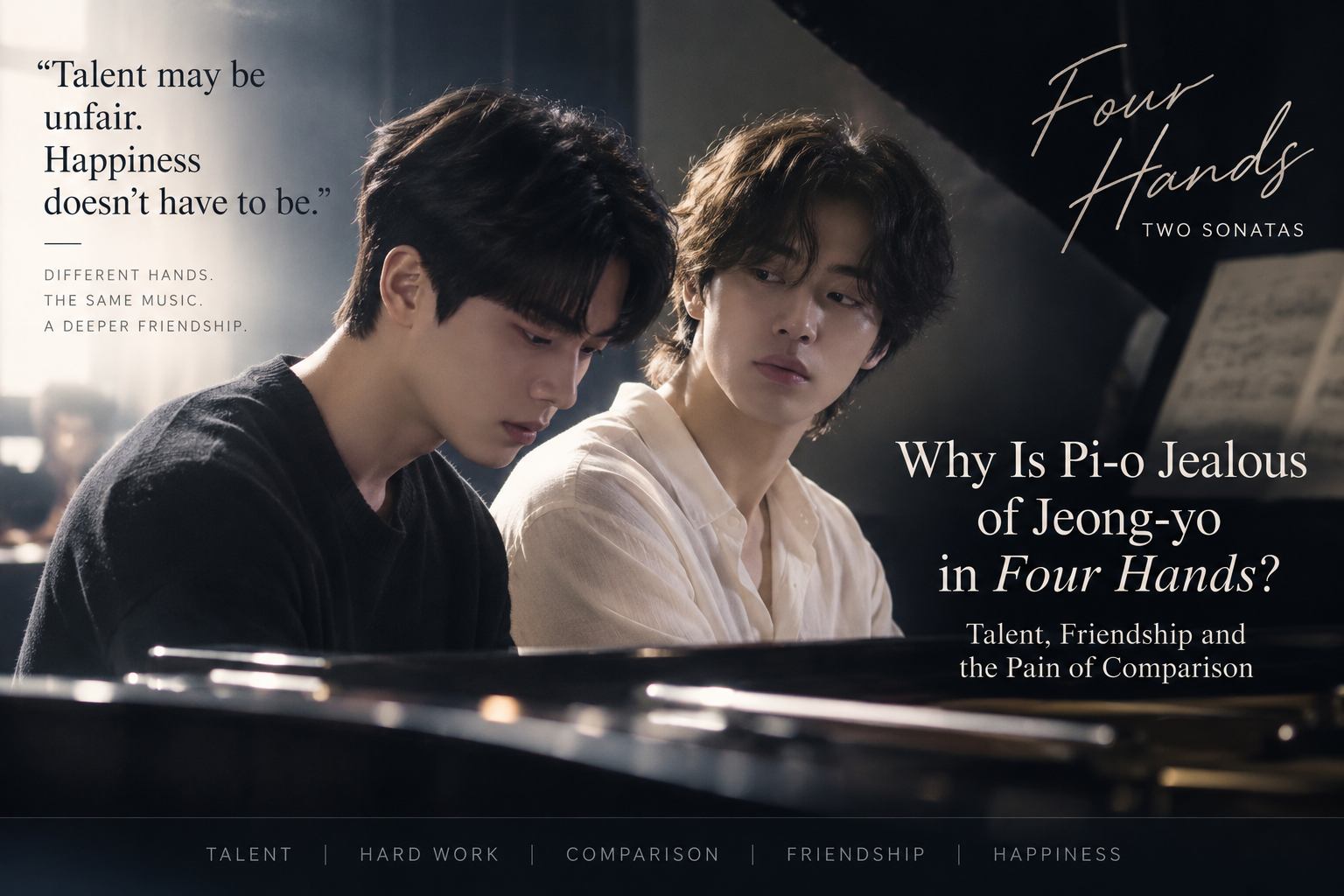
Talent may be unfair. Happiness doesn’t have to be.
That is one of the things Pi-o’s struggle makes me think about.
The Wisest Response to Genius Is Not Envy
So what should we do when we meet someone far more gifted than ourselves?
As I’ve grown older, my answer has become simpler.
Acknowledge it.
That person is better than me at this.
That person learns this faster.
That person has something I don’t.
Saying those things does not make me smaller.
Then comes the important part:
Learn what you can.
Meeting someone better than you can actually be an extraordinary advantage.
You may learn in months what would have taken you years to discover alone.
The tragedy begins when admiration becomes resentment.
If you become consumed by envy, attack the other person, lose confidence and eventually abandon your own path, then their talent has defeated you.
Not because they were better.
Because comparison convinced you that your own journey no longer mattered.
But Genius Doesn’t Mean Having Everything
There is another mistake we often make.
When we see an extraordinary person, we focus entirely on what they possess.
We see Jeong-yo’s musical intuition and think:
Imagine being born with that.
But exceptional ability in one part of life does not guarantee completeness in every other part.
Someone who understands music more naturally than everyone around them may still struggle with things that seem completely natural to other people.
Relationships.
Ordinary emotions.
Belonging.
Understanding what another person feels.
This should not be generalized to every gifted person, of course.
But Four Hands raises an interesting possibility:
Sometimes the very thing that makes someone extraordinary can also make it harder for them to feel ordinary.
And perhaps being ordinary contains gifts we rarely recognize as gifts.
Maybe Jeong-yo Needs Pi-o Too
This changes how I see their friendship.
At first, it can look as though Pi-o has more to learn from Jeong-yo.
Jeong-yo possesses a musical freedom Pi-o struggles to reach.
But Jeong-yo is not complete either.
He carries trauma, struggles with the stage, and needs help entering a world Pi-o already understands.
Pi-o knows discipline.
He knows training.
He knows how to stand before an audience.
He knows how to transform ability into a life as a musician.
So perhaps their relationship is not:
The lesser pianist learning from the greater one.
It is two incomplete people carrying different strengths.
Jeong-yo can teach Pi-o something about music.
Pi-o can teach Jeong-yo something about living with music.
And perhaps both can teach the other something about being human.
This Is Why the Title “Four Hands” Feels So Perfect
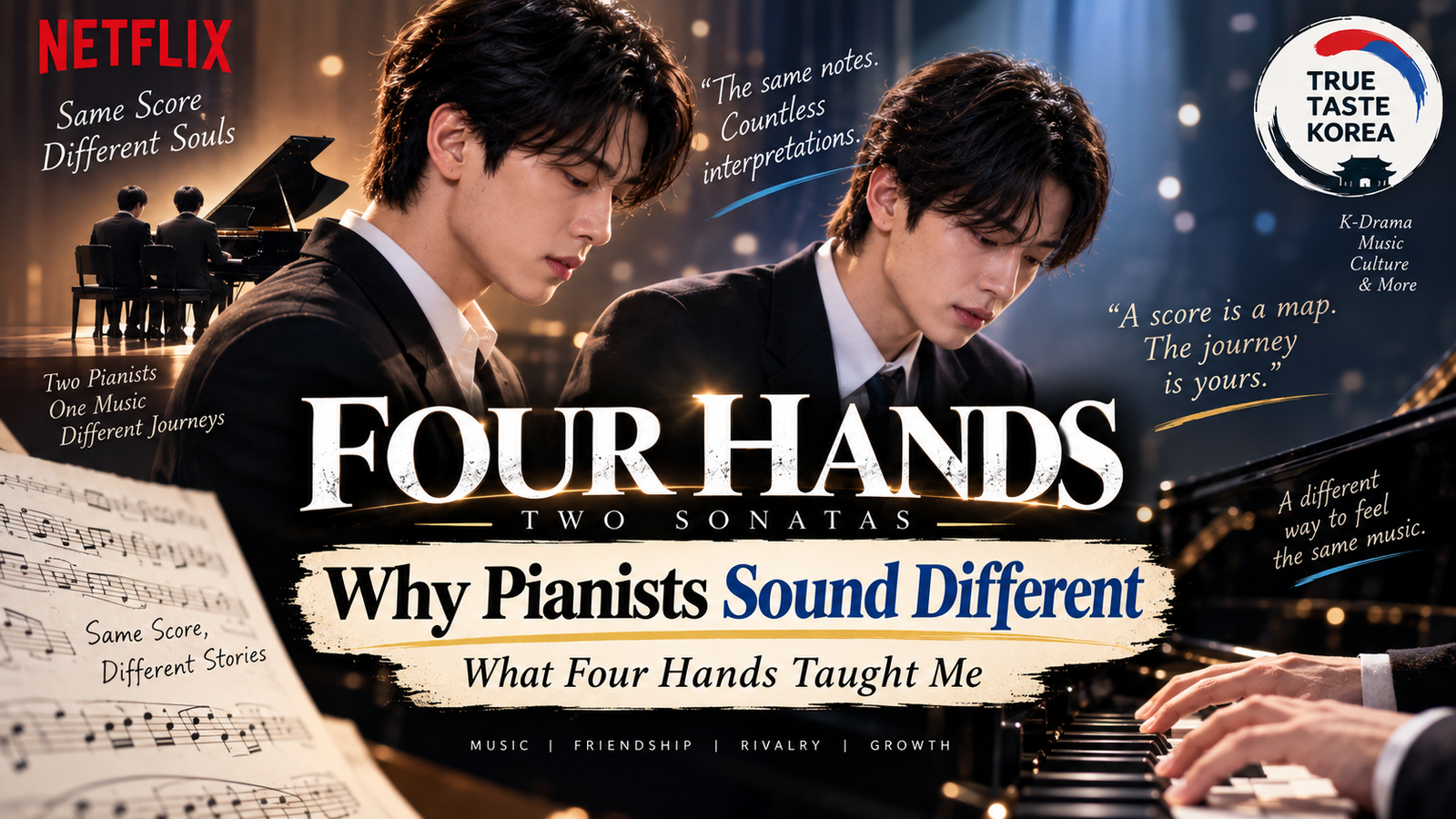
“Four hands” refers to two pianists playing the same piano together.
Think about what that requires.
Two people do not have to be equally gifted.
But neither person can simply play however they want.
You have to listen.
You have to feel the other person’s timing.
Sometimes you lead.
Sometimes you follow.
Sometimes you wait.
Sometimes you make room.
The better pianist cannot simply rush ahead and expect the music to survive.
And the weaker pianist cannot spend the entire performance resenting the other person’s ability.
The music only works when two different people learn to hear each other.
Friendship may work the same way.
Friendship, like four-hands piano, does not require two people to be equally gifted. It requires them to listen to each other’s tempo.
That may be the real challenge facing Pi-o and Jeong-yo.
Pi-o Must Accept. Jeong-yo Must Understand.
If their friendship is going to survive, both of them have work to do.
Pi-o must accept Jeong-yo’s talent without diminishing himself.
Jeong-yo must understand Pi-o’s effort without diminishing it.
Pi-o must learn acceptance.
Jeong-yo must learn empathy.
Neither needs to become the other.
Pi-o doesn’t need Jeong-yo’s exact gift to have value.
Jeong-yo doesn’t need to hide his talent to protect Pi-o.
They simply have to learn that difference does not automatically create hierarchy in every part of life.
One person can be better at piano without being better at being a person.
That’s a much harder distinction to live than it is to write.
The Hardest Four-Hands Performance May Not Happen at the Piano
At this point, I’m not particularly interested in asking whether Pi-o or Jeong-yo is the better pianist.
The drama has already made Jeong-yo’s extraordinary natural gift clear.
The question I find much more interesting is:
Can they remain friends?
Can Pi-o admire someone more gifted than himself without losing his own sense of worth?
Can Jeong-yo fully use his gift while understanding what Pi-o’s years of effort mean?
Can two people who share the same dream survive when one person’s talent becomes a mirror reflecting the other’s limitations?
That may be the most difficult four-hands performance in the entire drama.
Not the piece they play together on a piano.
But learning how to move through life together without one person’s gift becoming the other person’s wound.
Talent May Be Unequal. Happiness Doesn’t Have to Be.
Eventually, all of us meet someone better than ourselves.
Someone smarter.
Faster.
More talented.
More intuitive.
Someone who reaches in two steps what takes us ten.
We can resent them.
We can allow their ability to become proof of our inadequacy.
We can give up.
Or we can acknowledge the difference, learn what we can and continue walking our own path.
Because another person’s talent does not determine the value of our life.
And another person’s success does not set the ceiling on our happiness.
When I was younger, extraordinary talent seemed like one of the greatest gifts a person could receive.
I’m less certain now.
There are many ways to live a meaningful life, and many forms of happiness that have nothing to do with being the best.
Perhaps talent was never distributed fairly.
But happiness was never promised only to the talented.
And that may be what Pi-o and Jeong-yo ultimately need to discover about each other.
They don’t need equal gifts to remain friends.
They need to hear each other’s tempo.
Because sometimes the hardest part of playing four hands isn’t knowing your own part.
It’s continuing to listen when the person beside you can play something you never could.
FAQ: Pi-o, Jeong-yo and Talent in Four Hands
Why is Pi-o jealous of Jeong-yo in Four Hands?
Pi-o has spent years pursuing technical and musical perfection, while Jeong-yo possesses an unusually natural musical instinct. Their closeness makes that difference impossible for Pi-o to ignore, turning admiration, competition and friendship into complicated emotions.
Is Jeong-yo more talented than Pi-o?
The drama presents Jeong-yo as possessing extraordinary natural musical talent, while Pi-o represents a highly trained elite pianist shaped by discipline and relentless practice. The more interesting contrast is therefore not simply who is “better,” but what each lacks and can learn from the other.
Are Pi-o and Jeong-yo friends or rivals?
They are both. Their friendship and rivalry are intertwined, which is one reason their relationship becomes so emotionally complicated. Netflix itself frames Four Hands, Two Sonatas around friendship, rivalry and growth.
What does “Four Hands” mean?
In piano music, four-hands playing involves two pianists performing together on one piano. Within the drama, it also works as a powerful metaphor for Pi-o and Jeong-yo: two different people learning to listen, adjust and make room for each other.
What is the main message of Pi-o and Jeong-yo’s relationship?
One possible interpretation is that unequal talent does not make friendship impossible, but it makes friendship more demanding. Pi-o must learn to recognize Jeong-yo’s gift without losing his own self-worth, while Jeong-yo must learn to understand the effort and emotions of the person beside him.