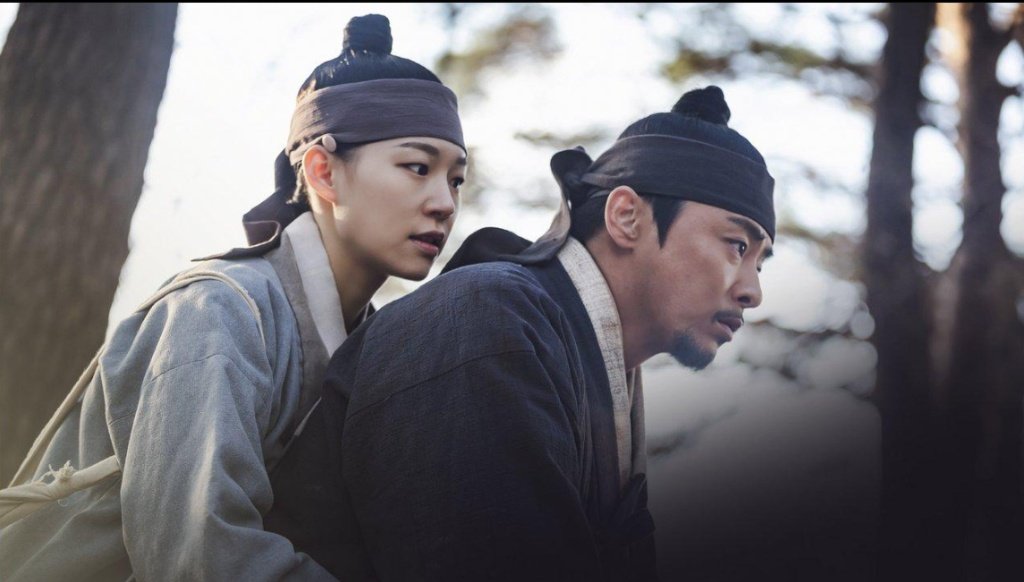
Spoiler Warning: This article discusses major character developments and historical events depicted in the 2019 Korean historical drama Nokdu Flower.
1. Two Brothers, One Father, and Two Different Worlds
At the center of Nokdu Flower is a family divided by the same social system that eventually tears Joseon apart.
Baek Yi-kang and Baek Yi-hyun share the same father, but they do not share the same position in society.
Yi-kang is the older half-brother, born to a woman of the lowest social status. Despite being the son of a wealthy local official, he is treated as someone whose birth makes him inferior.
Yi-hyun, on the other hand, is the legitimate son. He receives education, respect, and opportunities that his older brother can never easily obtain.
Their relationship is not initially defined by hatred. There is affection and a complicated sense of family loyalty between them.
But the Donghak Peasant Revolution changes the meaning of everything they have known.
When the people begin to challenge the existing order, the brothers find themselves moving in opposite directions.
The most painful question is not simply why they become enemies.
It is why the same family could produce two people who see the world so differently.
2. Baek Yi-kang: The Son Who Was Never Allowed to Belong
Baek Yi-kang’s tragedy begins before the revolution.
He is the son of a powerful man, but his mother’s social position prevents him from enjoying the privileges associated with his father’s name.
He is close enough to the ruling household to understand its power, yet too low in the social hierarchy to be accepted as an equal.
This creates a particularly painful identity.
Yi-kang is not an outsider because he lacks a family. He is an outsider because his family refuses to recognize him as someone deserving of the same dignity as his younger brother.
His early life teaches him that social status can matter more than intelligence, loyalty, or personal character.
He has little reason to believe that the existing system will ever reward him fairly.
This is why the revolutionary movement becomes more than a political event for him.
It offers the possibility of a world in which his birth no longer determines the value of his life.
3. Baek Yi-hyun: The Son Who Inherits the World His Brother Rejects
Yi-hyun begins from a completely different position.
He is intelligent, educated, and treated as a legitimate member of the family.
Unlike Yi-kang, he has access to opportunities that allow him to imagine a future beyond his hometown.
He also possesses a more complicated relationship with the existing social order than a simple defender of tradition.
His education and ambitions expose him to ideas about reform and modernization. He wants Joseon to change, but he does not necessarily believe that a popular uprising is the right way to achieve it.
This distinction is essential.
Yi-hyun is not simply a man who wants everything to remain unchanged.
He believes that the country needs transformation, but his understanding of transformation is increasingly shaped by power, political calculation, and his own ambitions.
His tragedy develops when the future he imagines becomes increasingly disconnected from the people who are suffering in the present.
4. The Same Father, but an Unequal Beginning
The brothers’ conflict is rooted in a contradiction that existed long before the revolution.
Their father has the resources to provide both sons with a better life, yet the family structure itself denies them equal treatment.
Yi-kang is forced to experience the consequences of his mother’s status.
Yi-hyun benefits from the legitimacy of his birth.
The difference is not something either brother created.
It is inherited.
This is one of the most important ideas in the drama: people do not begin life with equal choices simply because they share the same family name.
The same household can provide security to one child and humiliation to another.
The brothers therefore represent two different experiences of the same society.
Yi-kang knows what it means to be excluded from the system.
Yi-hyun knows what it means to be given a place within it.
When the revolution arrives, these experiences influence how each man understands justice, order, and responsibility.
5. The Donghak Peasant Revolution: Why Did Ordinary People Rise Up?
The historical background of Nokdu Flower is the Donghak Peasant Revolution of 1894.
The uprising did not emerge from a single disagreement.
It grew from widespread resentment toward corrupt local officials, abusive taxation, economic hardship, social inequality, and a political system that failed to protect ordinary people.
Donghak, a religious and social movement, provided an important source of organization and shared ideas.
The demand for reform became a movement that challenged the authority of the existing order.
The uprising also developed within a wider international crisis. Foreign intervention and competing imperial interests increasingly threatened Joseon’s independence.
The drama uses this historical moment to show how personal suffering can become collective resistance.
For the peasants, the question was not simply who should govern the country.
It was whether ordinary people could live with dignity under the system that governed them.
This is why the revolution becomes the central force connecting the characters’ private lives to the fate of the nation.
6. Jeon Bong-jun: The Man Who Turned Grievances into a Movement
Jeon Bong-jun is one of the most important historical figures represented in the drama.
He was a real leader of the Donghak Peasant Army and became a central figure in the uprising.
Unlike the fictional Baek brothers, his role is rooted in documented history.
His significance lies in his ability to connect the grievances of ordinary people to a larger political movement.
A corrupt local official might be challenged by one village.
But when thousands of people recognize that their suffering comes from a broader system, their resistance becomes something much more difficult to suppress.
The drama uses Jeon Bong-jun to connect individual stories with the collective aspirations of the peasant army.
He represents a question that remains relevant beyond nineteenth-century Joseon:
When a government repeatedly fails to protect its people, how long can those people be expected to remain obedient?
The film’s historical setting makes this question especially powerful because the movement was not merely an imagined rebellion. It was part of a real and devastating period in Korean history.
7. Baek Yi-kang’s Choice: Fighting for a World That Never Accepted Him
Yi-kang’s involvement in the peasant movement is closely connected to his personal experience.
He has spent much of his life being treated as less than his legitimate younger brother.
He knows how arbitrary social privilege can be because he has lived on the wrong side of it.
But his decision to stand with the peasants is not simply an act of personal revenge.
The movement gives him an opportunity to imagine a society in which other people do not have to experience the same humiliation.
His development is therefore larger than an individual attempt to escape his background.
He begins to understand that the injustice he experienced is part of a wider structure.
His personal suffering becomes connected to the suffering of people he may never have known.
This is the transformation that gives his character emotional weight.
He does not merely want to change his own position.
He begins to question the rules that created that position in the first place.
8. Baek Yi-hyun’s Choice: Can a Better Future Be Built Through Power?
Yi-hyun’s path is more difficult to judge.
He wants a stronger and more modern Joseon, but his approach increasingly separates him from the people whose lives are being destroyed by political decisions.
He has access to education and elite networks. He can imagine reform through institutions, military strength, and political alliances.
Yet the desire to build a powerful country can become dangerous when the suffering of ordinary people is treated as an acceptable price.
This is where Yi-hyun’s character becomes particularly tragic.
He may believe that he is choosing the future rather than protecting the past.
But a future built without concern for the people living through the present can become another form of oppression.
His choices also demonstrate that intelligence and education do not automatically produce moral wisdom.
A person can understand political strategy while failing to recognize the human consequences of that strategy.
Yi-hyun’s story asks whether modernization is meaningful if the people it claims to serve are sacrificed along the way.
9. Song Ja-in: A Woman Who Understands the Value of Independence
Song Ja-in provides another important perspective on the changing society.
As the daughter of a powerful merchant, she operates in a world where wealth, political connections, and social relationships are closely connected.
She is ambitious and wants to build her own commercial influence.
Unlike characters whose identities are primarily defined by family rank, Ja-in understands the practical importance of economic independence.
Her experience gives her a different way of reading political events.
She recognizes that a revolution can threaten business and personal security, but she also understands that the existing system is far from fair.
Her character prevents the story from becoming a simple conflict between two brothers.
She brings commerce, negotiation, and personal ambition into the historical narrative.
She also demonstrates that people outside the traditional political leadership can still influence the direction of events.
Her independence is not separate from the revolution.
It is another response to a society in which power determines who gets to make decisions.
10. Was the Revolution Really About Equality?
The Donghak movement is often remembered through its demands for social reform and the dignity of ordinary people.
But a historical revolution is never as simple as a single ideal.
The peasant army included people with different experiences, interests, and expectations.
Some wanted relief from corruption and exploitation.
Others sought deeper social transformation.
The movement also faced internal tensions and the enormous challenge of confronting a state with military resources and established institutions.
The drama does not need to portray every participant as perfect to make the movement meaningful.
In fact, its historical complexity becomes more interesting when viewers recognize that people can fight for justice while remaining imperfect.
A revolution may begin with a moral demand, but the process of turning that demand into a new political order is much more difficult.
The important distinction is between understanding why people rebel and assuming that every action taken in the name of rebellion is automatically justified.
11. The Cost of Choosing a Side
One of the strongest elements of Nokdu Flower is its refusal to make the revolution feel like a distant political debate.
The characters experience its consequences through family relationships, friendships, love, loyalty, and death.
For Yi-kang and Yi-hyun, the conflict is especially painful because choosing a political side also means challenging the emotional bonds that once connected them.
They are not strangers who happen to fight in the same war.
They are brothers whose lives were shaped by the same household.
Their conflict forces viewers to consider whether family loyalty should always come before political conviction.
Can someone remain loyal to a brother whose choices threaten everything they believe in?
Can someone oppose the social system that benefits their family without feeling that they are betraying their own past?
The drama’s emotional power comes from the fact that these questions do not have easy answers.
12. Ugeumchi: When a Revolution Meets the Limits of Its Power
The Battle of Ugeumchi is one of the most significant historical events represented in the drama.
In late 1894, the Donghak Peasant Army confronted government forces supported by Japanese military power.
The peasant army suffered a devastating defeat.
The battle became a turning point in the movement and exposed the enormous military disadvantage faced by the revolutionaries.
For the characters, Ugeumchi represents more than a battlefield.
It is the moment when ideals collide with the reality of organized military power.
The people may have legitimate grievances, courage, and a strong desire for change.
But those qualities alone do not guarantee victory.
This is one of the most painful aspects of the historical story.
The defeat does not prove that the demands of the peasants were meaningless.
It demonstrates that a movement can be morally powerful and still be militarily overwhelmed.
A historical struggle should not be judged only by whether its participants won.
Sometimes its importance lies in the questions it forced later generations to confront.
13. Why Viewers Remember the Two Brothers
A Reddit review of Nokdu Flower praised its substantial storytelling, strong characters, and willingness to depict the darker side of the historical uprising.
The reviewer also recommended it to viewers who enjoyed the serious historical atmosphere of Mr. Sunshine.
The drama’s intensity was not universally comfortable, however. Its violence and tragic developments can make it difficult to watch, especially for viewers expecting a lighter historical romance.
The distinction between the brothers is one reason the story remains memorable.
Yi-kang and Yi-hyun are not simply heroes and villains placed on opposite sides of a rebellion.
They are products of the same unequal society, but they interpret their circumstances differently.
Yi-kang’s experience pushes him toward collective resistance.
Yi-hyun’s privileges and ambitions lead him toward a different understanding of political change.
Their relationship makes a large historical conflict emotionally understandable.
Instead of asking viewers to memorize every political faction, the drama asks them to watch what happens when two people with a shared past can no longer agree on what the future should look like.
This is where its historical storytelling becomes personal.
14. Why Did Two Brothers Fight on Opposite Sides of a Revolution?
The most important question in Nokdu Flower is not whether Yi-kang or Yi-hyun is the better brother.
It is why their experiences produced such different understandings of justice.
Yi-kang grew up knowing that the existing social order could deny him dignity simply because of his birth.
Yi-hyun grew up with the advantages of that same order, even as he began to question its weaknesses.
One experienced the system as something that needed to be broken.
The other increasingly believed that the country needed to be transformed through power and political change.
Their choices were not determined entirely by their birth, but their birth shaped the choices they could imagine.
That is what makes their conflict so meaningful.
The revolution does not simply divide a family.
It reveals the divisions that were already present inside that family.
And it exposes a larger truth about society:
People who benefit from an unequal system may sincerely believe that change is necessary, but they do not always understand why those who suffer under it can no longer wait.
Perhaps the tragedy of the two brothers is that they both wanted a different future for Joseon, but they could not agree on whose suffering should matter most while building it.
Final Thought
Nokdu Flower is not simply a historical drama about a peasant uprising.
It is a story about two brothers who inherit different positions in an unequal society and discover that their family bond cannot protect them from the political conflict surrounding them.
Yi-kang’s journey shows how personal humiliation can become a demand for collective dignity.
Yi-hyun’s journey reveals how ambition and the desire for national transformation can become detached from the people who are supposed to benefit from change.
The Donghak Peasant Revolution ultimately suffered a military defeat, but the questions it raised about equality, corruption, political power, and human dignity did not disappear with that defeat.
If two brothers grow up in the same family but experience completely different worlds, should they be expected to fight for the same future?
That is the question that makes Nokdu Flower worth remembering.