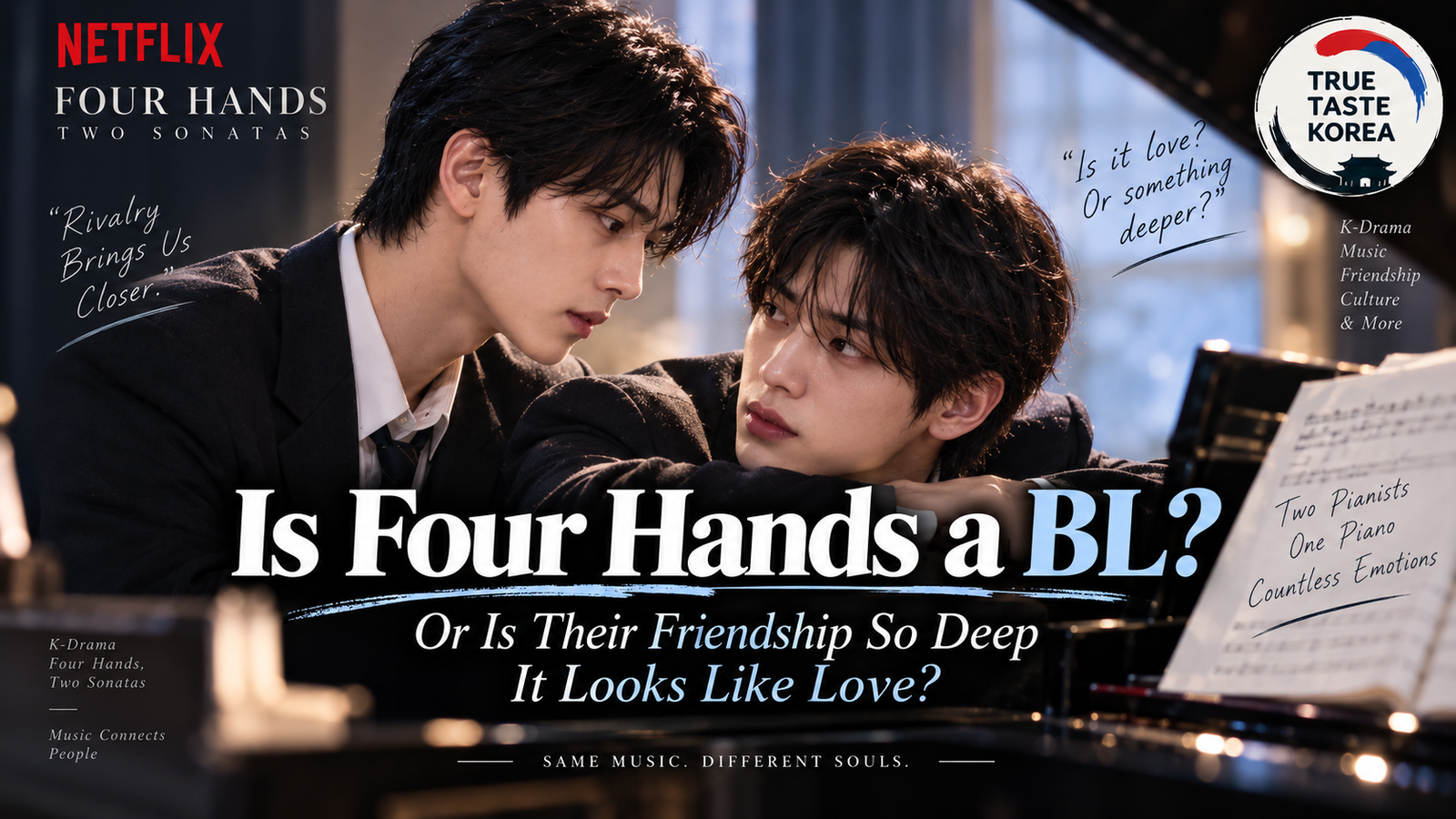
Four Hands, Two Sonatas has left many viewers asking the same question: Is the relationship between Kang Pi-o and Choi Jeong-yo meant to be romantic, or is it an unusually intense friendship?
The question becomes even more interesting after watching the entire series.
Starring Song Kang as Kang Pi-o and Lee Jun-young as Choi Jeong-yo, the drama follows two exceptionally talented pianists whose lives become intertwined through music, competition, separation, and reunion. Their connection is sometimes tender, sometimes painful, and often more emotionally intense than viewers expect from a conventional friendship story.
But does that make Four Hands, Two Sonatas a BL drama?
Not in the conventional genre sense. The series is officially presented as a music-centered Korean drama, while tvN describes its story through friendship, love, rivalry, and growth. It does not officially position itself as a BL production.
That distinction, however, does not explain why so many viewers interpret Pi-o and Jeong-yo’s relationship through a romantic lens.
Perhaps the more important question is this: Can two people become so important to each other that their relationship begins to look like love, even when the story does not give it a clear romantic label?
1. Why Do Viewers Think Four Hands Might Be BL?
The first reason is the emotional intensity between the two leads.
Pi-o and Jeong-yo are not simply classmates who happen to share an interest in piano. Each becomes a person capable of changing the other’s sense of identity.
Pi-o has built his life around discipline, perfection, and the need to remain at the top. Jeong-yo challenges that carefully constructed world. His natural musical instincts expose a side of piano performance that Pi-o cannot achieve through practice alone.
Their relationship begins with tension, but it gradually becomes something more complicated.
They admire each other, compete with each other, hurt each other, and repeatedly find themselves unable to move forward without confronting the other person’s influence.
This emotional dependence is one reason viewers may see romantic chemistry.
In many dramas, romance is communicated through familiar signals: physical closeness, jealousy, longing, and the fear of losing someone. Four Hands, Two Sonatas uses some of the same emotional language, but places much of it inside music and personal ambition.
The result is a relationship that can feel romantic without being clearly defined as one.
2. Pi-o and Jeong-yo Are Not Just Two Rival Pianists
At first, Pi-o sees Jeong-yo as a threat.
He has spent years maintaining his position as an exceptional pianist. His identity is closely connected to being the best, and his disciplined approach gives him a sense of control over his future.
Then Jeong-yo appears.
Unlike Pi-o, Jeong-yo’s musical talent seems to emerge naturally. His playing carries a freedom that cannot easily be measured through practice hours or technical perfection.
This creates an important contrast.
Pi-o represents the fear of losing everything he has worked for. Jeong-yo represents the possibility that music can be experienced differently.
Their rivalry is therefore not simply about winning competitions. It challenges the way each person understands music and himself.
What makes their relationship compelling is that neither can remain unchanged after meeting the other.
Jeong-yo does not merely become Pi-o’s competitor. He becomes someone who can expose Pi-o’s weaknesses, inspire him, and eventually reach parts of his life that professional success cannot repair.
3. The Meaning of Four Hands: Why Music Becomes Their Language
The title itself provides one of the strongest clues to understanding the drama.
In piano terminology, a four-hands performance involves two people playing the same piano together.
It sounds simple, but it requires a special kind of cooperation.
Both performers must understand the rhythm, anticipate changes, listen carefully, and adjust their movements to the other person. Even a technically excellent pianist cannot create a successful duet by ignoring the person sitting beside them.
This is an interesting metaphor for Pi-o and Jeong-yo.
Their relationship is not built on perfect agreement. They have different personalities, different approaches to music, and different emotional wounds.
Yet they are repeatedly drawn back into situations where neither can complete the musical experience alone.
The piano becomes a language through which they express things that ordinary conversation cannot always communicate.
That is why their performances can feel more intimate than a simple exchange of dialogue.
A shared musical moment can represent trust, conflict, forgiveness, or the desire to reconnect.
The four-hands concept is therefore more than a musical technique. It becomes a metaphor for the difficult process of allowing another person to share your world.
4. Why Their Separation Makes the Relationship Feel Even Deeper
The story becomes more emotionally complicated when their shared future is interrupted.
The kidnapping incident surrounding Jeong-yo’s disappearance changes the direction of both lives. Their connection is cut off, leaving Pi-o without the person who had fundamentally challenged his understanding of music.
Years later, Pi-o has achieved professional success, but his life is not necessarily fulfilling.
He continues searching for Jeong-yo.
This detail matters because it shows that Jeong-yo’s importance cannot be measured by their time together or by their musical achievements.
Pi-o has a career, recognition, and the skills he once desperately wanted. Yet something remains unresolved.
The person he lost is not simply an old rival.
Jeong-yo represents a part of Pi-o’s life that success could not replace.
This is where the series moves beyond the familiar story of two talented competitors.
It asks whether someone can remain central to another person’s life even after years of separation.
The answer, at least for Pi-o, appears to be yes.
5. Is Pi-o’s Search for Jeong-yo Romantic Love?
This is perhaps the most interesting question for viewers who interpret the drama as BL.
Pi-o’s continued search for Jeong-yo can be read as a form of longing.
He is not simply looking for information about an old classmate. He is trying to reconnect with someone whose absence has affected his emotional and artistic life.
However, longing is not exclusive to romantic relationships.
A person can miss a friend with extraordinary intensity. Someone who once understood us better than anyone else can leave a space that no new achievement or relationship can easily fill.
The drama does not require viewers to interpret every expression of longing as romantic desire.
Instead, it gives the audience room to consider a different possibility: perhaps Pi-o is searching for the person who once made him feel most understood.
That kind of connection can be difficult to describe precisely because it does not fit neatly into familiar categories.
6. Jeong-yo’s Feelings Are Also More Complicated Than Rivalry
Jeong-yo is not simply the talented rival who appears to disrupt Pi-o’s life.
His own experiences, secrets, and personal struggles shape the way he approaches their relationship.
As the story develops, the truth surrounding his disappearance changes how Pi-o understands the past. Their conflict is no longer just a disagreement between two musicians.
There are painful questions about responsibility, trust, and the damage caused by events beyond their control.
The later episodes show how difficult it is for the two to return to the relationship they once had.
Even when Jeong-yo offers collaboration, Pi-o cannot immediately accept it. Their shared musical history has become inseparable from the pain they carry.
This is important because the drama does not present deep affection as something that automatically removes conflict.
Sometimes, the people who matter most to us are also the people capable of hurting us most deeply.
The emotional weight of their relationship comes from this contradiction.
7. Why the Final Episodes Matter More Than the Early Chemistry
The early episodes encourage viewers to notice the unusual connection between Pi-o and Jeong-yo.
But the later episodes reveal what that connection actually means.
After the events surrounding Jeong-yo’s disappearance are exposed, Pi-o must confront the emotional consequences of the past. Their relationship has been damaged by secrets, guilt, and circumstances that neither can simply erase.
By the final episode, Pi-o is considering leaving music behind.
Jeong-yo reaches out to him, offering a final emotional connection through music. The series returns to the idea that their relationship is not defined only by competition or professional success.
The official finale preview describes Jeong-yo extending a hand to help Pi-o return to music, while the final chapter brings their four-hands performance to its concluding stage.
Their reunion in the Czech Republic further emphasizes that the connection between them has survived time and separation.
The ending does not need to turn their relationship into a clearly labeled romance to make it meaningful.
Instead, it shows that two people can continue to influence each other’s lives long after the circumstances that first brought them together have changed.
8. So, Is Four Hands Actually a BL?
The most accurate answer is that Four Hands, Two Sonatas is not officially presented as a conventional BL drama.
Netflix categorizes it under drama and music, and its official description focuses on two pianists whose lives become closely connected. tvN’s own description includes friendship, love, rivalry, and growth.
Those descriptions matter because they tell us how the production officially frames the story.
At the same time, saying that the drama is not officially BL does not mean viewers are wrong to notice romantic undertones.
There is a difference between a show’s official genre classification and the emotional interpretation viewers bring to its characters.
Some viewers may see Pi-o and Jeong-yo’s connection as an unusually deep friendship. Others may interpret certain moments as romantic subtext.
Both reactions can exist without changing the official classification of the series.
The important point is not to force one interpretation onto every viewer.
9. Why a Friendship This Deep Can Look Like Love
Perhaps the most valuable idea in Four Hands, Two Sonatas is that love does not always have to be understood through romance.
There are relationships in life that are difficult to explain.
Someone may become the person who challenges our limits, understands our fears, and changes the direction of our future. We may think about that person even after years have passed.
That does not automatically tell us whether the relationship is romantic.
It tells us that the relationship matters.
Pi-o and Jeong-yo’s connection is powerful because each sees something in the other that is difficult to find elsewhere.
One pushes the other beyond his limits. One exposes the other’s weaknesses. Their shared passion becomes both a source of conflict and a path toward understanding.
This is why their relationship can feel so emotionally intimate.
The drama does not have to provide a single label for every feeling in order for the audience to recognize its importance.
10. The Final Answer: More Than a BL Label
So, is Four Hands, Two Sonatas a BL?
If the question refers to its official genre and marketing, the answer is no: it is presented as a music-centered coming-of-age drama about friendship, love, rivalry, and personal growth.
But if the question is whether Pi-o and Jeong-yo share a connection that can feel as intense as a romantic relationship, the answer is clearly yes.
Their story is not powerful simply because viewers can imagine romantic chemistry between them.
It is powerful because they become part of each other’s identity.
The piano gives them a way to compete, communicate, hurt each other, and eventually find a path back toward one another.
Perhaps that is the real meaning of the title.
Four hands do not become one pair of hands. They remain two different people, each with a separate history and a separate voice. But when they play together, they can create something neither could produce alone.
Maybe the most interesting thing about Pi-o and Jeong-yo is not whether their relationship should be called friendship or love. It is that their connection is meaningful even before we give it a name.
Frequently Asked Questions
Q1. Is Four Hands, Two Sonatas officially a BL drama?
No. Netflix lists the series as a drama and music title, while tvN describes it through friendship, love, rivalry, and growth. It is not officially marketed as a conventional BL drama.
Q2. Why do viewers think Pi-o and Jeong-yo have romantic chemistry?
Their emotional dependence, separation, longing, and repeated attempts to reconnect create an intimate dynamic that some viewers interpret as romantic.
Q3. Does Four Hands focus more on romance or friendship?
The series focuses heavily on music, rivalry, personal struggles, and the evolving bond between its main characters. Its official descriptions include both friendship and love rather than defining the story through a single romantic genre.
Q4. Does the drama have a satisfying ending for Pi-o and Jeong-yo?
The finale brings their musical journey to a conclusion and shows them reconnecting after a long separation. Their final relationship is best understood through the emotional and musical journey developed throughout the series.
Q5. What does the title Four Hands mean?
It refers to a piano performance in which two people play the same instrument together. In the drama, it also symbolizes cooperation, trust, conflict, and the possibility of creating something meaningful with another person.