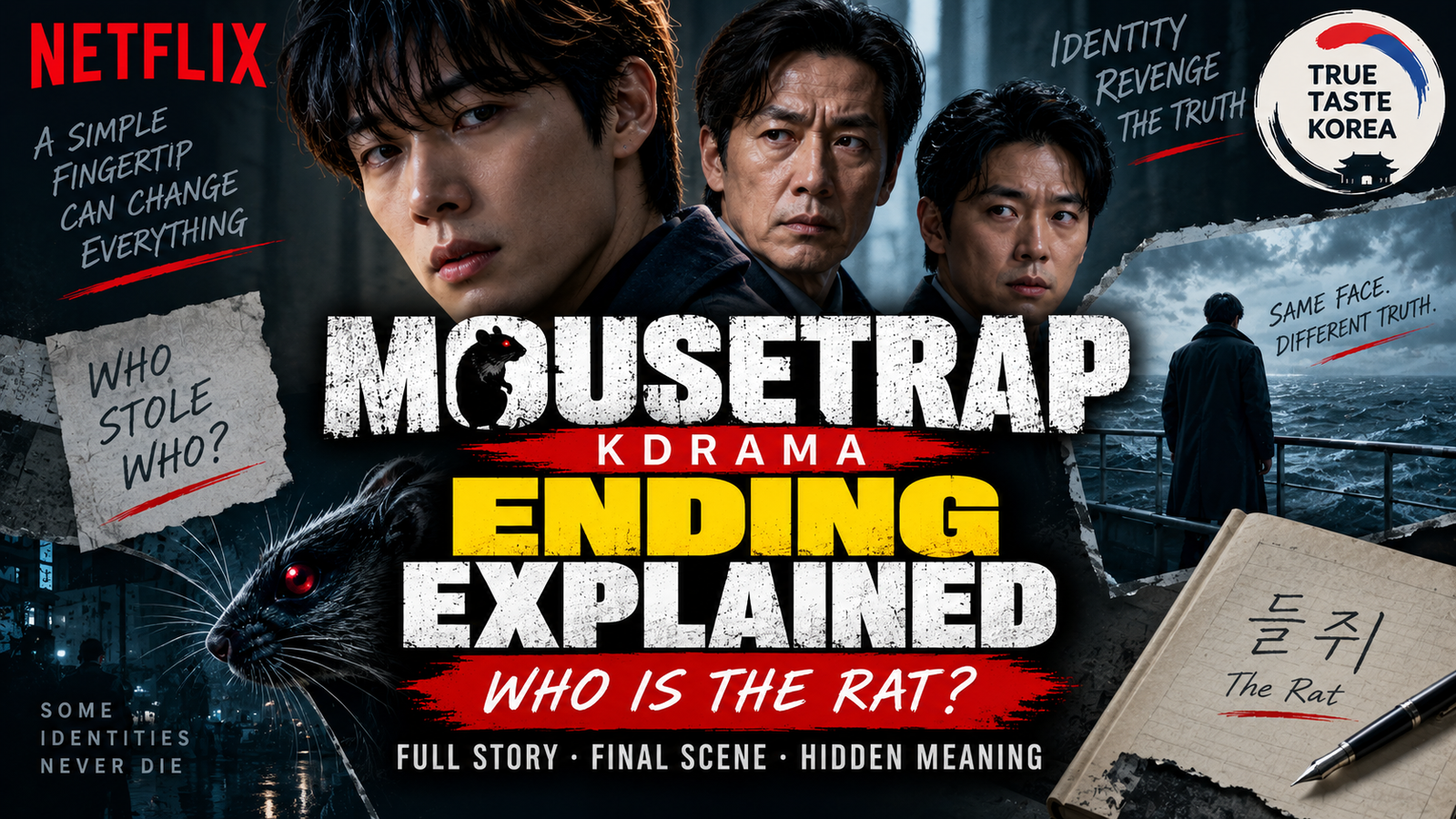
Warning: Major spoilers for all 10 episodes of Netflix’s Mousetrap (들쥐).
At first, Mousetrap looks like a story about a man whose life has been stolen.
Novelist Je Moon-jae discovers that someone has taken his face, name, money, and public identity. The more he tries to prove that he is the real Moon-jae, the more the world seems to recognize the impostor instead.
For most of the series, viewers are encouraged to share his fear. We want to know who the Rat is, how the identity theft happened, and whether Moon-jae can recover his former life.
But Episode 10 changes the meaning of that mystery.
The person who stole Moon-jae’s identity was not simply an opportunistic criminal. Seo Yu-min had a history with him, and that history reveals that Moon-jae had already taken something from Yu-min long before the identity theft began.
The final episode also introduces a disturbing possibility: even after Moon-jae survives the confrontation and returns home, he may not be able to escape the consequences of what he did.
The ending is not simply about discovering the Rat. It is about understanding why the man who catches the Rat may have been trapped from the beginning.
1. Who Is the Rat in Mousetrap?
The person behind the identity theft is Seo Yu-min.
Yu-min changes his appearance to resemble Moon-jae and gradually takes control of the novelist’s life. He does not merely copy a photograph or use someone else’s documents. His plan involves taking over the identity that other people recognize as Je Moon-jae.
However, the finale makes the answer more complicated.
Years earlier, Moon-jae had stolen Yu-min’s unpublished writing and used it to establish his own literary career. He had also damaged Yu-min’s relationship with Min-yeong through jealousy and a fabricated story.
That history creates the central reversal of the drama:
- Yu-min steals Moon-jae’s face and public identity.
- Moon-jae previously stole Yu-min’s creative work and literary opportunity.
- Both men try to occupy a life that has been taken from someone else.
This does not make their actions morally equivalent. Yu-min’s elaborate revenge involves manipulation, identity theft, and violence. Understanding his motive does not excuse what he does.
But it does change how we should interpret Moon-jae.
He is not an entirely innocent victim whose life is suddenly destroyed by a stranger. He is also someone who benefited from another person’s loss.
The question is no longer just who stole Moon-jae’s identity. It is who first made a life out of another person’s identity.
2. Why Did Yu-min Want to Become Moon-jae?
Yu-min’s revenge began with a betrayal that affected both his professional future and his personal life.
Years before the main events, Moon-jae, Yu-min, and So Min-yeong were connected through a university literary circle.
Moon-jae had entered that environment under false pretenses. Yu-min, by contrast, was a genuinely talented writer who trusted him enough to share his notebooks and unfinished work.
Moon-jae took Yu-min’s writing and used it as the foundation for his own literary success. The work that should have helped establish Yu-min’s future instead became part of Moon-jae’s career.
The personal betrayal was even more devastating.
Moon-jae was jealous of Yu-min’s relationship with Min-yeong. After his feelings were rejected, he spread a damaging story about the couple. The resulting humiliation and social pressure contributed to Min-yeong’s tragic fate.
For Yu-min, the damage was not limited to losing a manuscript or a romantic relationship. He watched another person build a successful public identity using the work he had created, while the people he loved suffered.
That explains the logic behind his revenge.
Yu-min did not want to defeat Moon-jae in a conventional confrontation. He wanted to reverse their positions.
If Moon-jae had taken his writing and future, Yu-min would take Moon-jae’s face, name, money, and place in society.
His plan turns the original betrayal into a form of punishment: Moon-jae must experience what it means to lose the identity he believes belongs to him.
Yet the revenge also exposes Yu-min’s own contradiction. By taking Moon-jae’s identity, he repeats the very act that destroyed his life.
He wants justice for having been replaced, but his method is to replace someone else.
3. What Does the Korean Folktale Behind the Title Mean?
The Korean title Deuljwi (들쥐) means “field mouse.”
The drama draws on a traditional folktale in which a rat eats a person’s discarded fingernail clippings and transforms into that person.
The frightening idea is that a small physical trace can allow another being to copy an entire human identity.
Mousetrap translates this folklore into a modern thriller.
Yu-min does not become Moon-jae through magic. He uses appearance, preparation, deception, and access to the systems that establish a person’s identity. He understands that society often recognizes the version of a person that can be verified through records, relationships, and public reputation.
This creates a disturbing question:
If someone has your face, your name, your accounts, and the trust of the people around you, what actually proves that you are you?
The finale adds a second meaning to the folktale.
Yu-min takes Moon-jae’s outward identity. But Moon-jae had already absorbed Yu-min’s creative identity by taking his writing and presenting it as his own.
The two men become distorted reflections of each other.
The title therefore works on more than one level. The Rat is the impostor who copies another person, but it can also describe someone who survives by consuming another person’s work, opportunities, or life.
That is why the title becomes more meaningful after the final reveal than it does at the beginning.
4. What Is Revealed During the Final Confrontation on the Ship?
The final confrontation takes place aboard the Queen Caligo, the ship connected to the painful events in the characters’ shared past.
Moon-jae finally faces Yu-min, and the history behind the identity theft is revealed.
Yu-min explains that Moon-jae stole his writing and helped destroy Min-yeong’s life. The man Moon-jae has spent the series treating as an intruder is someone whose life was damaged by Moon-jae years earlier.
The confrontation is therefore not simply a battle between the real novelist and his impersonator.
It is a meeting between two men who believe the other has taken something that should have been theirs.
Moon-jae has an opportunity to confront the truth about his past. Instead, the encounter turns violent. He stabs Yu-min, and Yu-min falls through a broken window into the sea.
On the surface, Moon-jae has won.
The impostor is gone, and the man who began the story trying to recover his identity appears to have survived.
But the physical confrontation does not resolve the central problem. Yu-min has prepared a consequence that does not depend on his survival.
5. Does Seo Yu-min Die?
The drama does not provide a definitive answer.
Moon-jae sends Yu-min into the sea, but the series does not establish his death through a clearly recovered body. Later, Moon-jae sees an image of Yu-min again.
There are two main ways to interpret this.
Yu-min may have survived. The lack of a confirmed body leaves open the possibility that he escaped the water and remains somewhere beyond Moon-jae’s reach.
Moon-jae may be seeing Yu-min because of his guilt and fear. After learning what he did to Yu-min, Moon-jae can no longer think about his recovered identity without remembering the person whose life he damaged.
The series deliberately leaves room for both readings.
But the more important point is that Yu-min’s revenge no longer depends on whether he is physically alive.
Before the final confrontation, Moon-jae believes that defeating the impostor will allow him to return to normal life. Afterward, he discovers that the truth about his past has survived the fight.
Even if Yu-min is dead, the consequences of his actions remain.
6. Why Does Moon-jae Receive Yu-min’s Unfinished Manuscript?
One of the most important parts of the finale is the unfinished manuscript of The Rat.
Editor Han Ji-hye gives Moon-jae the manuscript Yu-min left behind. It contains the story of the identity theft and the history that Moon-jae wants to keep hidden.
This changes the nature of Yu-min’s revenge.
Moon-jae can physically defeat Yu-min, but he cannot simply destroy the truth that Yu-min has put into writing. The manuscript becomes a threat to the public identity Moon-jae has fought so hard to recover.
It also places him in a cruel position.
As a novelist, Moon-jae understands the power of controlling a story. He has already benefited from taking another person’s writing and presenting it as his own.
Now he is confronted with a manuscript that could expose him.
He cannot easily dismiss it as a personal accusation, because the story concerns the very foundation of his career.
The manuscript is more than evidence. It is a competing version of Moon-jae’s life, written by the person he betrayed.
Yu-min’s revenge therefore continues beyond the ship. He has left behind a story that Moon-jae cannot defeat simply by removing its author.
7. Why Can’t Moon-jae Write at the End?
Moon-jae’s inability to write is one of the strongest images in the finale.
After returning to his apartment, he faces the unfinished manuscript and the possibility that the truth could become public.
He is a successful novelist. In theory, he should be able to write his own account, explain what happened, or produce another book.
But he cannot.
The blank page has a meaning beyond ordinary writer’s block.
For years, Moon-jae has lived as a celebrated author, but his success was built partly on Yu-min’s creative work. Now he must face a question he has avoided: what can he create when he no longer has someone else’s writing to take?
His silence exposes the weakness beneath his public identity.
He has recovered the name of a novelist, but the finale leaves us wondering whether he can still create something that genuinely belongs to him.
This is also why the manuscript matters so much. Yu-min has left Moon-jae with the one thing he cannot control through appearance or deception: a written account of the past.
The blank page is not proof that Moon-jae has no talent. It is a visual expression of his inability to escape the truth about how he became successful.
8. Why Is Park Sun-yong Connected to the Name Je Moon-jae?
The identity mystery extends beyond Moon-jae and Yu-min.
Detective Park Sun-yong has a connection to the name Je Moon-jae that reaches back to his childhood.
Sun-yong was adopted by the family before their biological son was born. He was given the name Je Moon-jae first. After the biological child arrived, the family’s history with that name became part of the identity confusion that the drama gradually reveals.
This detail matters because it separates three things viewers usually assume are inseparable:
- The name a person is given.
- The face other people recognize.
- The personal history that makes someone who they are.
Sun-yong, the novelist, and Yu-min occupy different positions in this complicated history. They are not the same person, but their stories become connected through the name and the identities built around it.
The reveal broadens the drama’s central question.
A name can be transferred, concealed, or taken. A face can be copied. Official records can be manipulated. But the memories and experiences attached to a person’s life cannot be so easily transferred.
The identity mystery is therefore not solved by finding one document or identifying one face. It requires understanding the history that each character has tried to hide.
9. Who Is Outside Moon-jae’s Door in the Final Scene?
The final scene brings the story back to Moon-jae’s apartment.
Seung-gyu appears at the door and calls out to Moon-jae:
“Hey, Rat. Open the door.”
The line is unsettling because it turns the accusation back toward the man who spent the series trying to identify the Rat.
At first, Moon-jae believes the Rat is the person who stole his life. But the finale has revealed that Moon-jae also took another person’s work and helped destroy his future.
The label now carries a second meaning.
Seung-gyu’s appearance also reminds viewers that the criminal and financial problems surrounding the characters have not disappeared simply because the confrontation with Yu-min is over.
Then Moon-jae looks outside and sees Yu-min.
Is Yu-min really standing there? Or is Moon-jae seeing the man he tried to bury because he can no longer escape the guilt attached to his past?
The series does not settle the question.
What matters is the contrast between the two images: someone is demanding that Moon-jae answer the door, while the face of the person he tried to eliminate appears outside.
Moon-jae is back in his own apartment, but he is not in control of the situation.
The final scene suggests that recovering an identity is not the same as escaping the consequences of the life built under that identity.
10. Is the Ending of Mousetrap a Victory or a Defeat?
The ending is deliberately difficult to classify as either.
Moon-jae survives the confrontation. He returns to his apartment and appears to have recovered his public identity.
But he has not restored the life he had before the story began.
The manuscript remains a threat. His ability to write has collapsed. The past he tried to bury has become impossible to ignore. And the final image of Yu-min leaves his physical fate unresolved.
The most important distinction is between recovering a name and deserving the life attached to it.
Moon-jae may be able to return to the world as Je Moon-jae. But he cannot return to the innocence he once claimed.
That is the real cost of the finale.
He wins the immediate confrontation, but the truth has changed how he must live with himself.
Mousetrap Ending FAQ
Who is the Rat in Mousetrap?
Seo Yu-min is the person who steals Je Moon-jae’s identity. However, the finale also presents Moon-jae as a symbolic Rat because he previously took Yu-min’s writing and benefited from the destruction of his future.
Does Yu-min die in the finale?
Moon-jae stabs Yu-min and sends him into the sea. The drama does not clearly confirm that his body is recovered, and the final appearance leaves his fate ambiguous.
Why did Yu-min steal Moon-jae’s identity?
Yu-min wanted revenge for Moon-jae’s earlier betrayal. Moon-jae had taken his writing and damaged his relationship with Min-yeong. Yu-min decided to make Moon-jae experience the loss of his own identity.
Why can’t Moon-jae write at the end?
His inability to write reflects the collapse of his identity as a novelist. His career was built partly on Yu-min’s work, and the finale forces him to confront what remains when he can no longer rely on someone else’s creativity.
Who is Park Sun-yong in relation to Je Moon-jae?
Sun-yong was adopted by the family before their biological son was born and was initially given the name Je Moon-jae. His history adds another layer to the drama’s questions about names, family, and identity.
Who comes to Moon-jae’s door?
Seung-gyu comes to the door and calls Moon-jae the Rat. Moon-jae also sees Yu-min outside, leaving viewers uncertain whether Yu-min survived or whether the image reflects Moon-jae’s troubled state of mind.
How many episodes does Mousetrap have?
Netflix’s Mousetrap has 10 episodes.
Is Mousetrap based on a true story?
No. The drama is fictional and draws inspiration from a Korean folktale about a rat that eats human fingernail clippings and takes on a person’s appearance. It is also adapted from the webtoon Field Mouse.
The Final Meaning of Mousetrap
The most disturbing part of Mousetrap is not that one man successfully steals another man’s identity.
It is that the victim of the identity theft had already built his life by taking something from someone else.
Yu-min becomes Moon-jae, but in doing so, he repeats the original crime. Moon-jae defeats Yu-min, but he cannot erase the story that explains why the revenge began.
The final manuscript, the blank page, and the image of Yu-min outside the apartment all point toward the same conclusion: the truth has become a trap that Moon-jae cannot escape.
At the beginning, we ask who the Rat is.
By the end, the more difficult question is why Moon-jae was so certain that the answer could never be him.
He may have caught the Rat. But he has not escaped the mousetrap.
코멘트
One response to “Mousetrap Ending Explained: Who Is the Real Rat, and Why Moon-jae Can’t Escape the Trap”
[…] For a deeper look at the final reversal, read Mousetrap Ending Explained: Who Is the Rat and What Does the Final Scene Mean?. […]