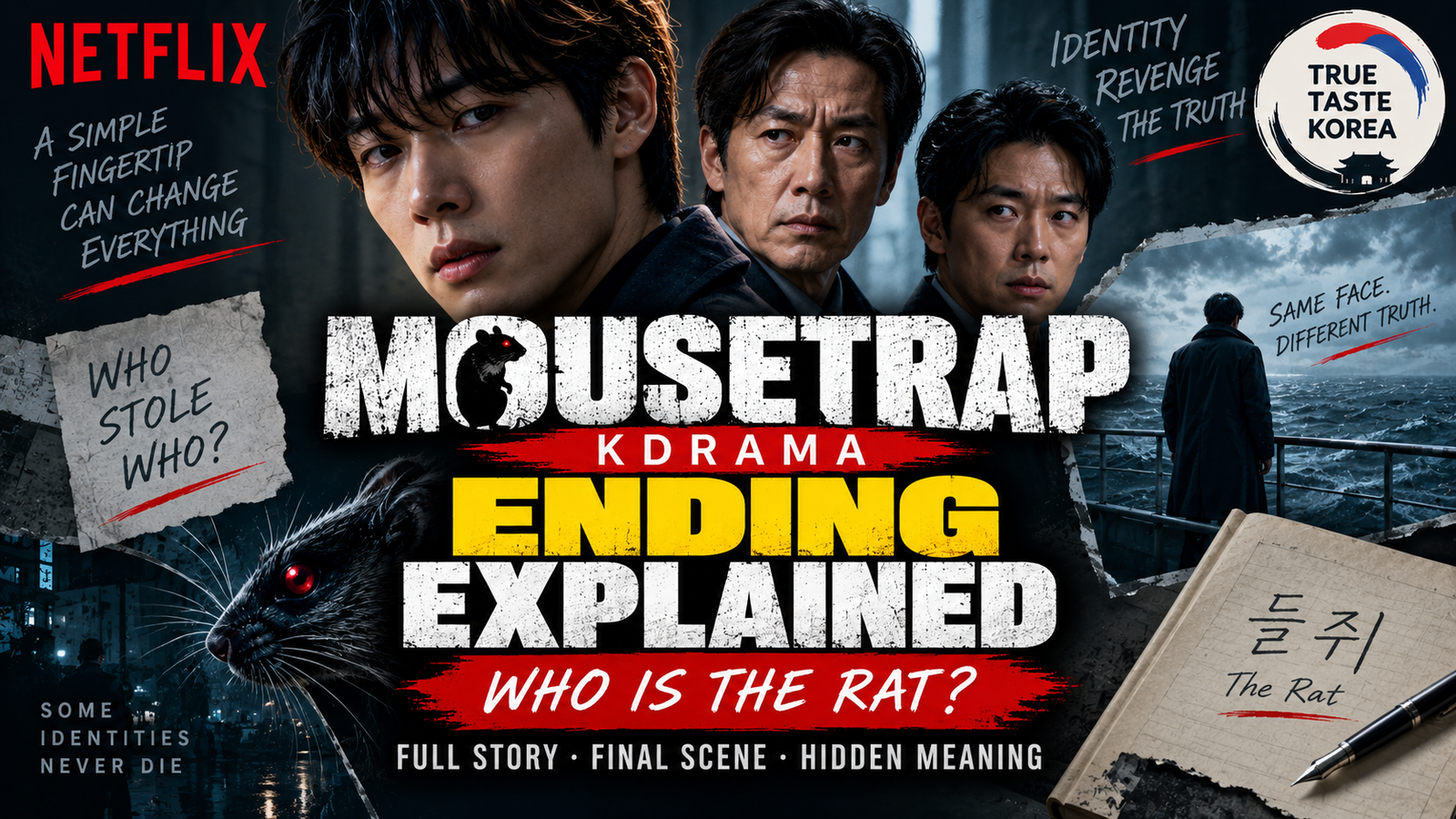
Warning: Major spoilers for all 10 episodes of Netflix’s Mousetrap (들쥐).
Netflix’s Korean thriller Mousetrap begins with a seemingly simple mystery: someone has stolen novelist Je Moon-jae’s identity.
But the final episode completely changes the question.
The finale reveals not only who the Rat is, but also that Moon-jae’s story about himself cannot be trusted. The man presented as the victim has his own history of stealing another person’s work, future and identity.
So, what really happened in the Mousetrap ending?
Here is the ending explained.
Who Is the Rat in Mousetrap?
The immediate answer is Seo Yu-min.
Yu-min is the man who takes over Moon-jae’s identity in the present-day story. He changes his appearance to resemble Moon-jae and systematically takes control of his life.
But that is only half of the twist.
The finale reveals that Moon-jae had wronged Yu-min years earlier.
Moon-jae stole Yu-min’s writing and used it to build his own career as a successful novelist. The story therefore reverses the roles we have been watching throughout the series.
Yu-min may be the literal “Rat” who steals Moon-jae’s identity in the present.
But thematically, Moon-jae was a Rat first.
Why Did Yu-min Steal Moon-jae’s Identity?
Yu-min’s actions are revenge.
Years earlier, Moon-jae, Yu-min and So Min-yeong were connected through a literary circle.
Yu-min was the talented writer. Moon-jae became jealous of him and ultimately appropriated Yu-min’s writing, using it to establish himself as an author.
The conflict also involved Min-yeong, whom Yu-min loved.
The events surrounding her and Moon-jae’s actions devastated Yu-min’s life. Yu-min eventually decides to make Moon-jae experience exactly what he believes Moon-jae did to him:
take away his identity, his achievements and his life.
That is why the revenge is so elaborate.
Yu-min does not simply want Moon-jae dead.
He wants to become Moon-jae.
Why Does the Korean Folktale Matter?
This is where the title Mousetrap — and the Korean title 들쥐 — becomes much more meaningful.
The series was inspired by the Korean folktale commonly known as the story of the rat that ate fingernails.
In the folktale, a rat eats a person’s discarded fingernails and can take on that person’s appearance.
Netflix explicitly describes the series as being inspired by this traditional story.
Mousetrap modernizes the idea.
Instead of a magical rat simply copying someone’s body, the drama asks:
If someone has your face, name, money, records and social identity, how do you prove that you are really you?
But the finale takes the metaphor one step further.
The story isn’t only about someone stealing Moon-jae’s identity.
It’s about people constructing their identities by taking things from others.
What Happens on the Ship?
The central confrontation occurs when Moon-jae finally reaches Yu-min aboard the ship.
There, Yu-min reveals the past from his perspective.
Much of what Moon-jae believed — or wanted to believe — about his own history is dismantled.
Moon-jae learns the full extent of what he did to Yu-min and Min-yeong.
The confrontation becomes violent.
Moon-jae eventually stabs Yu-min and sends him through a broken window into the sea.
Yu-min disappears into the water.
But importantly, the series does not provide the audience with the comfortable certainty that everything is finished.
Is Yu-min Dead?
This is deliberately ambiguous.
Yu-min falls into the sea after his confrontation with Moon-jae.
Later, however, Moon-jae sees Yu-min again.
The drama does not clearly establish whether this means Yu-min somehow survived or whether Moon-jae is seeing a manifestation of his guilt and deteriorating mental state.
That ambiguity is important.
Even if Yu-min physically died, Moon-jae cannot simply kill the truth about his past.
Yu-min has already succeeded in forcing him to confront it.
Why Can’t Moon-jae Write at the End?
This is one of the most important details in the finale.
Editor Han Ji-hye gives Moon-jae the unfinished second volume of The Rat, which Yu-min left behind.
The manuscript contains the story of what has happened.
Moon-jae realizes that if it is completed, the truth about him could be exposed.
So he tries to write his own version.
And he cannot.
He sits before the blank page without being able to produce anything.
That moment delivers perhaps the harshest punishment in the entire series.
Moon-jae built his identity around being a writer.
But the finale forces him to confront the possibility that the foundation of that identity was never truly his.
His name may have survived.
His career may have survived.
But his belief in himself has not.
So Who Is the “Real” Rat?
This is the cleverest part of the ending.
There are essentially two answers.
The literal Rat: Seo Yu-min
Yu-min is the person who steals Moon-jae’s identity and becomes his double.
The symbolic Rat: Moon-jae
Moon-jae stole Yu-min’s writing and benefited from another person’s talent and suffering.
That means the drama ultimately turns its original question upside down.
For most of the series we ask:
“Who stole Moon-jae’s life?”
By the finale, the more important question becomes:
“Whose life did Moon-jae steal first?”
What Does the Final Scene Mean?
Moon-jae’s problems are far from over.
He is haunted by images of field mice and by Yu-min’s presence.
Then comes the final interruption.
Someone arrives at Moon-jae’s door.
It is Seung-gyu, whose own unfinished business with Moon-jae remains unresolved.
The ending deliberately denies Moon-jae a clean escape.
He may have defeated Yu-min physically.
He may have regained control of his identity.
But he hasn’t escaped the consequences of everything that came before.
That’s the point.
Getting your name back does not erase what you did while wearing it.
Does Mousetrap Have a Happy Ending?
Not really.
Moon-jae survives, but survival is not presented as victory.
He ends the series isolated and psychologically destabilized, unable to simply return to the successful novelist he once believed himself to be.
Yu-min’s ultimate fate remains ambiguous.
And Seung-gyu’s arrival makes it clear that Moon-jae’s past is still pursuing him.
The physical identity theft may be over.
The identity crisis isn’t.
Why Is the Ending Called a Twist?
Because Mousetrap spends much of its story encouraging viewers to sympathize with Moon-jae.
Someone has his face.
Someone has his money.
Someone has his identity.
Naturally, we see him as the victim.
The finale deliberately destroys that simple interpretation.
Yu-min did steal Moon-jae’s life.
But Moon-jae had already taken something enormously valuable from Yu-min.
That doesn’t make Yu-min’s crimes justified.
Instead, it makes the distinction between victim and perpetrator deliberately uncomfortable.
And that’s what makes the ending work.
Mousetrap Ending FAQ
Who is the Rat in Mousetrap?
Seo Yu-min is the person who takes Moon-jae’s identity in the present-day story. However, the ending also presents Moon-jae himself as the symbolic “Rat” because of what he took from Yu-min in the past.
Does Yu-min die?
Moon-jae sends Yu-min into the sea during their final confrontation, but his later appearance is deliberately ambiguous. It may suggest survival or simply represent Moon-jae’s guilt.
What happens to Moon-jae?
Moon-jae survives and regains control of his life, but he ends psychologically trapped by the truth about his past and unable to simply resume his old identity as if nothing happened.
How many episodes does Mousetrap have?
Mousetrap has 10 episodes. Netflix lists it as a limited series.
Is Mousetrap based on a true story?
No. It is a fictional thriller inspired in part by the Korean “rat that ate fingernails” folktale and based on the webtoon Field Mouse. Netflix officially identifies the traditional folktale as a key inspiration.
Understanding who the Rat is only solves part of Mousetrap’s ending mystery. The drama’s title offers another way to interpret the final scene, especially the question of who has truly escaped and who remains trapped. Explore the hidden meaning of Mousetrap’s title and the identity of the mouse for a deeper look at the story’s final reversal.