Je Moon-jae

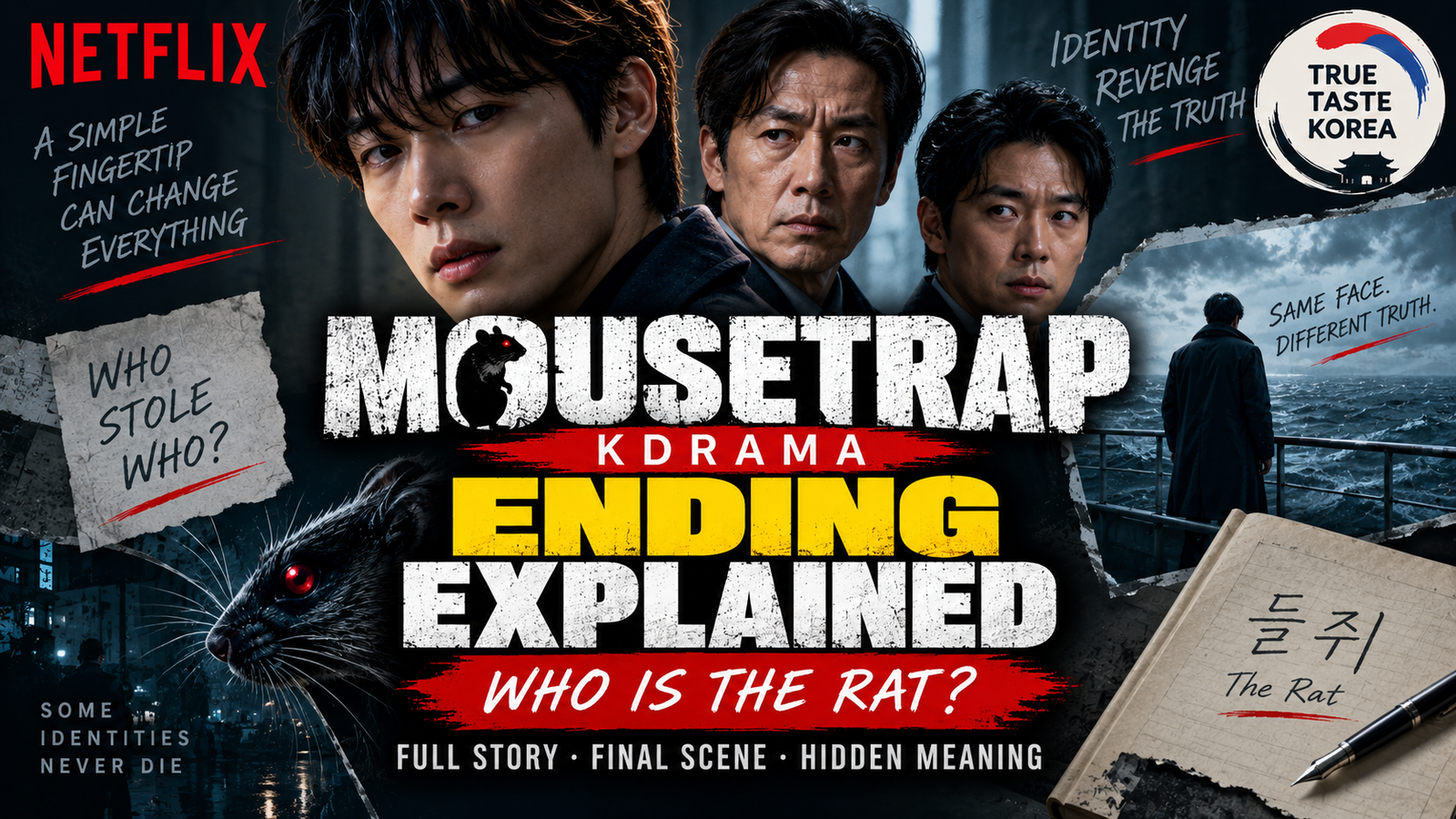
  • What Does Mousetrap Really Mean? Who Is the Mouse at the End? Title and Ending Explained

    Spoiler Warning: This article contains major spoilers for all 10 episodes of Netflix’s Mousetrap.

    Why is Netflix’s Korean thriller called Mousetrap?

    At first, the answer seems obvious.

    Je Moon-jae is hunting a mysterious identity thief known as “The Rat.”

    So Moon-jae sets traps to catch him.

    Simple enough.

    But after Episode 10, the title means something much darker.

    Because by the end of Mousetrap, it is no longer clear that Moon-jae is the person standing outside the trap.

    He may be the one inside it.

    And the key to understanding the title begins with an old Korean folktale about a rat that eats a person’s fingernails and becomes that person.

    The Korean Folktale Behind Mousetrap

    Netflix has officially explained that Mousetrap takes inspiration from an old Korean folktale.

    In the story, a rat eats a person’s clipped fingernails and transforms into that person.

    This creates a terrifying problem.

    If something looks exactly like you and begins living as you, how can anyone prove which one is real?

    That old story becomes the foundation of Mousetrap.

    Moon-jae does not simply lose money.

    He loses his name.

    His accounts.

    His property.

    His public identity.

    Eventually, another man even appears with his face.

    The horror is not simply:

    “Someone is stealing from me.”

    It is:

    “Someone is becoming me.”

    Why Is Seo Yu-min Called “The Rat”?

    Seo Yu-min is the most obvious connection to the folktale.

    He takes Moon-jae’s identity.

    He changes his appearance.

    He presents himself to the world as Je Moon-jae.

    He occupies Moon-jae’s public life.

    Just like the rat in the old story, Yu-min becomes another version of the person whose identity he has consumed.

    That is why “The Rat” is much more than a criminal nickname.

    Yu-min represents the nightmare at the center of the folktale:

    the copy that becomes more believable than the original.

    The Most Terrifying Part: People Believe the Rat

    Moon-jae knows that he is Moon-jae.

    But that is not enough.

    He has lived in isolation for years.

    Few people regularly see him.

    He uses a pen name.

    His connection to society is weak.

    So when another person begins living publicly as Je Moon-jae, Moon-jae faces a bizarre problem.

    The fake can actually become easier to believe than the original.

    That idea is central to the title.

    A mousetrap normally catches an animal through bait.

    But Moon-jae’s trap is different.

    The bait is his own identity.

    The more desperately he tries to prove that the life belongs to him, the deeper he is pulled into the mystery.

    At First, Moon-jae Thinks He Is Hunting the Mouse

    For much of the series, the roles seem clear.

    Moon-jae is the victim.

    The Rat is the criminal.

    Moon-jae and Noja are hunting him.

    Netflix’s own episode descriptions reinforce this structure.

    Moon-jae suspects that the Rat is connected to his past.

    He follows clues.

    He recovers memories.

    He searches for people who can prove who he really is.

    Everything appears to be moving toward one goal:

    Catch the Rat and get Moon-jae’s life back.

    But Episode 10 changes the meaning of the hunt.

    The Trap Was Built Long Before the Identity Theft

    Netflix describes the finale as Moon-jae standing at the center of “a trap a lifetime in the making.”

    That phrase is important.

    The trap was not created only when Yu-min stole Moon-jae’s identity.

    It was being built through Moon-jae’s past.

    His relationship with Yu-min.

    The stolen creative work.

    The tragedy involving Min-young.

    Moon-jae’s damaged memories.

    His isolation.

    His career.

    And the lies surrounding multiple identities.

    All of those things eventually close around him.

    Yu-min triggers the trap.

    But Moon-jae helped build it.

    Moon-jae and Yu-min Are Mirrors of Each Other

    This is where Mousetrap becomes more than an identity-theft thriller.

    Yu-min steals Moon-jae’s identity.

    But Moon-jae had previously taken Yu-min’s writing and ideas.

    Yu-min takes Moon-jae’s face and public life.

    Moon-jae’s career was built partly from something that belonged to Yu-min.

    The two men therefore become distorted reflections of each other.

    One steals a life.

    The other had already stolen part of a creative identity.

    That does not make their actions morally equal.

    Yu-min’s revenge becomes destructive and obsessive.

    But the parallel is deliberate.

    The drama gradually destroys the clean distinction between:

    the person

    and

    the impostor.

    So Who Is the Mouse in Mousetrap?

    There are actually several answers depending on where you are in the story.

    At the beginning: Moon-jae is the prey

    His identity is stolen.

    He is confused, powerless and hunted.

    He looks like the mouse trapped by a much larger scheme.

    In the middle: Yu-min is the Rat being hunted

    Once Moon-jae begins investigating, Yu-min becomes the target.

    Moon-jae and Noja try to identify and catch him.

    At the end: Moon-jae becomes the mouse inside the trap

    This is the final reversal.

    Moon-jae may survive.

    He may expose the truth.

    He may even eliminate Yu-min.

    But he does not escape the trap.

    Instead, he returns to isolation.

    And that is why the title becomes much more meaningful after the finale.

    Why Does Moon-jae Return to His Apartment?

    Moon-jae’s apartment is one of the most important symbols in the drama.

    At the beginning, it is his refuge.

    Moon-jae hides from society there.

    It protects him from the outside world.

    But that same isolation makes his identity easier to steal.

    Few people know the real Moon-jae.

    Few people see him.

    So the place that originally feels safe ultimately becomes part of his vulnerability.

    After everything that happens, Moon-jae ends up back inside.

    That creates the darkest visual metaphor in the finale.

    The safe place has become the cage.

    The apartment is the mousetrap.

    Why Can’t Moon-jae Write at the End?

    This is another clue to the meaning of the title.

    Moon-jae gets back something resembling his life.

    But he cannot simply return to being the successful writer he was before.

    Because now he knows the truth about that identity.

    His career is entangled with Yu-min’s creative work.

    So the blank page becomes another kind of trap.

    If Moon-jae cannot write without what he took from Yu-min, then what remains of “Je Moon-jae the novelist”?

    That question is far more frightening than losing a bank account.

    Moon-jae fought to recover his identity.

    Then he discovered that the identity he recovered may not be the person he believed himself to be.

    Why Is the Final Door Scene So Important?

    The ending brings the metaphor full circle.

    Moon-jae is once again inside.

    Someone else is outside.

    For most of the drama, Moon-jae was searching outside himself for the Rat.

    But by the finale, the direction has reversed.

    The person associated with the “rat” is now the one trapped inside.

    This is why many viewers interpret the ending as Moon-jae becoming the mouse or Rat himself.

    It does not mean he literally transforms into Yu-min.

    It means that he now occupies the symbolic position of the creature inside the mousetrap.

    Did Yu-min Win?

    Not exactly.

    If the goal was simply to steal Moon-jae’s identity forever, Yu-min does not achieve a clean victory.

    But revenge in Mousetrap is more psychological than practical.

    Yu-min forces Moon-jae to confront the past he had forgotten or suppressed.

    He destroys Moon-jae’s certainty about who he is.

    And that damage remains even after the physical confrontation ends.

    So Yu-min does not need to permanently live as Je Moon-jae to change Moon-jae forever.

    By the end, Moon-jae can no longer return to his old identity without questioning it.

    In that sense, part of Yu-min’s revenge survives.

    Is Yu-min Really Alive in the Final Scene?

    Mousetrap deliberately leaves Yu-min’s final appearance ambiguous.

    There are two major ways to interpret it.

    Yu-min survived

    If the figure is physically real, the thriller is not completely over.

    The Rat may still be alive.

    Moon-jae could still be trapped in an ongoing game.

    Yu-min exists inside Moon-jae’s mind

    This interpretation fits the psychological themes even better.

    Moon-jae no longer needs Yu-min to physically stand outside his apartment.

    The truth Yu-min revealed is already inside him.

    Moon-jae knows what happened.

    He knows the truth about his career.

    He knows what he did in the past.

    Yu-min therefore becomes a psychological presence that Moon-jae cannot escape.

    The Rat has entered the trap with him.

    Why the Title Is Mousetrap, Not Simply The Rat

    This distinction matters.

    The drama could have been called The Rat.

    In fact, the mysterious Rat drives much of the plot.

    But Mousetrap shifts attention away from the identity of the Rat and toward the structure surrounding everyone.

    The important question becomes not:

    Who is the Rat?

    but:

    Who is trapped?

    Yu-min is trapped by revenge.

    Moon-jae is trapped by his past and uncertain identity.

    Sun-yong is trapped by the hidden truth of his own name and childhood.

    Noja is trapped by the consequences of the life he has lived.

    Different characters enter different versions of the same trap.

    That is why the title works on more than one level.

    The Folktale Changes Meaning in the Modern World

    The old Korean story is about a rat physically becoming human after eating fingernails.

    Mousetrap updates that fear for a modern society.

    Today, identity is not just a face.

    It is also:

    your phone,

    your fingerprint,

    your bank account,

    your passwords,

    your legal documents,

    your online records,

    your reputation,

    and the people who recognize you.

    If someone controls enough of those things, what happens when society believes that person instead of you?

    That is the modern horror behind Mousetrap.

    The Rat no longer needs magic.

    He needs access.

    “Prove I’m Real, or I’m the Impostor”

    Netflix used a line in promoting the series that perfectly summarizes its central fear:

    If Moon-jae cannot prove who he is, then he becomes the fake.

    That idea reverses how we normally think about identity.

    We assume being ourselves is enough.

    Mousetrap says it may not be.

    Identity also exists in databases, documents and other people’s memories.

    If all of those point toward someone else, then simply saying

    “I am me”

    may accomplish nothing.

    That is the real trap Moon-jae enters.

    Is Moon-jae the Predator or the Prey?

    Netflix’s official description of Episode 10 asks exactly this question.

    And the answer may be:

    both.

    Moon-jae is prey when Yu-min steals his identity.

    But Moon-jae’s own past reveals that he was not always simply a victim.

    Yu-min becomes a predator through revenge, but he was also harmed by Moon-jae.

    The roles continually reverse.

    Predator becomes prey.

    Original becomes imitation.

    Hunter becomes mouse.

    That instability is the point.

    What Does the Ending of Mousetrap Really Mean?

    The ending is not saying that nothing happened and Moon-jae simply returned to where he started.

    Visually, he returns to the same place.

    Psychologically, however, everything has changed.

    At the beginning, Moon-jae hides inside his apartment because he believes he knows who he is and wants to avoid the world.

    At the end, he is inside because the world has forced him to question who he ever was.

    The room looks the same.

    The man inside it does not.

    That is why returning to the apartment is not a reset.

    It is the trap finally closing.

    FAQ

    Why is the drama called Mousetrap?

    The title refers both to the hunt for the identity thief known as the Rat and to the larger psychological trap surrounding Moon-jae. By the ending, Moon-jae himself appears to become the mouse trapped inside his own life.

    What Korean folktale inspired Mousetrap?

    Netflix says the series draws inspiration from an old Korean folktale in which a rat eats a person’s clipped fingernails and transforms into that person.

    Who is the Rat in Mousetrap?

    Seo Yu-min is the literal Rat behind the identity-theft scheme. However, the finale turns the Rat into a broader symbol connected to Moon-jae himself.

    Who is the mouse at the end of Mousetrap?

    Symbolically, Moon-jae is the mouse at the end. After spending the series hunting the Rat, he ends up isolated and trapped inside a life whose identity he can no longer fully trust.

    Is Moon-jae the villain?

    Not in a simple sense. He is both victim and morally compromised character. The finale deliberately complicates the distinction between predator and prey.

    Is Moon-jae’s apartment the mousetrap?

    Symbolically, yes. It begins as his safe hiding place but ends as a cage representing his isolation, guilt and inability to escape his past.

    Why does Moon-jae end up where he started?

    The physical setting is the same, but Moon-jae has changed. He now understands the lies and stolen identities underlying the life he was trying to reclaim.

    Final Thoughts

    The smartest thing about the title Mousetrap is that its meaning changes while we watch the drama.

    At first, we think Moon-jae is trying to catch the Rat.

    Then we learn that the Rat was created partly by Moon-jae’s own past.

    And finally, Moon-jae ends up back inside his apartment, unable to simply return to the identity he fought so hard to recover.

    The old Korean folktale asks a frightening question:

    What happens if a rat becomes you?

    Mousetrap asks an even darker one:

    What happens if the rat becomes more believable than you — and after you finally defeat him, you no longer know who you are without him?

    Moon-jae catches the Rat.

    But he never escapes the mousetrap.

    And that is why the title only fully makes sense after the final scene.
  • Why Are There Multiple Je Moon-jaes in Mousetrap? The Identity Twist Explained

    Spoiler Warning: This article contains major spoilers for all 10 episodes of Netflix’s Mousetrap.

    If you finished Netflix’s Mousetrap wondering how many Je Moon-jaes there actually are, you are not alone.

    At first, the mystery seems simple.

    There is Je Moon-jae, the reclusive novelist.

    Then another man appears with Moon-jae’s face and begins living under his identity.

    So the obvious question is:

    Which one is the real Je Moon-jae?

    But Mousetrap deliberately makes that question more complicated.

    By the final episodes, the name “Je Moon-jae” is connected to more than one person — including detective Park Sun-yong.

    That is not a random extra twist.

    It is the key to understanding what the drama is really saying about identity.

    So here is the simplest way to untangle the Moon-jae mystery.

    The Short Answer: Why Are There Multiple Je Moon-jaes?

    There are multiple “Je Moon-jaes” because the name itself has passed through different lives.

    The novelist we follow is the legal Je Moon-jae whose identity is stolen.

    Seo Yu-min becomes another public version of Je Moon-jae after changing his appearance and taking over Moon-jae’s life.

    And detective Park Sun-yong is connected to the name through his own childhood and adoption history.

    In other words, Mousetrap separates three things that we normally assume are the same:

    a name

    a face

    a person

    By the ending, they no longer belong neatly together.

    1. The Je Moon-jae We Follow: The Reclusive Novelist

    The main character played by Ryu Jun-yeol is the man viewers initially understand to be Je Moon-jae.

    He lives alone.

    He rarely leaves his apartment.

    He is known publicly as a successful novelist.

    Then his life begins disappearing piece by piece.

    His fingerprint no longer works.

    His accounts and property are no longer under his control.

    People insist they have recently met “Je Moon-jae,” even though Moon-jae has barely left his home.

    Eventually he discovers the impossible:

    another man is living as Je Moon-jae.

    This is the central identity-theft mystery that begins the series.

    And importantly, the protagonist is still the legal Je Moon-jae fighting to reclaim that identity.

    But being legally Je Moon-jae does not mean the story of that identity is simple.

    2. Seo Yu-min: The Man Who Becomes Je Moon-jae

    The second “Moon-jae” is Seo Yu-min.

    Yu-min is the Rat.

    He is connected to Moon-jae’s past and ultimately takes his revenge by stealing the very thing Moon-jae values most:

    his identity.

    Yu-min changes his appearance and presents himself to the outside world as Je Moon-jae.

    This creates one of the drama’s most disturbing paradoxes.

    The real Moon-jae has the name but cannot prove who he is.

    Yu-min is not Moon-jae, but the world increasingly accepts him as Moon-jae.

    That distinction matters.

    Identity in Mousetrap is not simply biological.

    It also depends on documents, memories, social recognition and what other people believe.

    Why Did Yu-min Choose Moon-jae’s Identity?

    Yu-min does not steal Moon-jae’s identity simply because he wants money.

    His revenge is personal.

    The finale reveals that Moon-jae and Yu-min’s past is much darker than Moon-jae initially remembers.

    Moon-jae’s literary success is tied to Yu-min’s writing and ideas.

    Their past involving Min-young also becomes central to Yu-min’s resentment.

    From Yu-min’s perspective, Moon-jae had already taken something fundamental from him.

    So Yu-min’s revenge becomes a twisted exchange:

    You took the life I could have had.

    Now I will take the life you have.

    That is why stealing Moon-jae’s identity is much more meaningful than simply killing him.

    Yu-min wants Moon-jae to experience what it feels like to watch another person possess something that should have been his.

    3. Park Sun-yong: Why Is the Detective Also Connected to Je Moon-jae?

    This is the twist that leaves many viewers confused.

    Detective Park Sun-yong spends much of the series investigating the Rat and the strange identity case surrounding Moon-jae.

    Then his own past becomes part of the mystery.

    Sun-yong discovers information connected to his childhood and adoption history.

    The revelation links him to the name Je Moon-jae as well.

    This means the detective investigating the identity of Je Moon-jae has his own buried connection to that same identity.

    And that changes the entire question.

    Until this point, viewers have been asking:

    Which man currently using the name is the real Moon-jae?

    The Sun-yong twist asks something deeper:

    What does “real Moon-jae” even mean?

    Was Park Sun-yong the Original Je Moon-jae?

    This is where the drama’s adoption twist becomes important.

    Sun-yong’s past indicates that the name Je Moon-jae had been connected to him during childhood before his life continued under the name Park Sun-yong.

    So when viewers discover another Moon-jae buried inside Sun-yong’s history, the series is not saying that the novelist suddenly becomes a completely fake person.

    Instead, it shows that the name itself has a history that predates the identity battle we have been watching.

    That is why the twist feels so disorienting.

    The audience has spent hours treating “Je Moon-jae” as if it were one fixed identity.

    It isn’t.

    So Who Is the “Real” Je Moon-jae?

    There is no single answer that solves every meaning of the question.

    If you mean:

    Who is the legal Je Moon-jae at the center of the identity theft?

    It is the reclusive novelist we follow through the series.

    Who publicly impersonates Je Moon-jae?

    Seo Yu-min.

    He changes his appearance and steals Moon-jae’s identity.

    Who has an earlier childhood connection to the name Je Moon-jae?

    Park Sun-yong.

    His adoption history reveals that the name is also connected to his past.

    That is why asking “Who is the real Je Moon-jae?” becomes increasingly difficult.

    Different characters can have legitimate connections to different parts of the identity.

    Why Doesn’t DNA Simply Solve Everything?

    This is another question viewers naturally ask.

    If there are multiple people claiming or being connected to one identity, why not just perform a DNA test?

    Because Mousetrap deliberately constructs the mystery so that identity cannot be reduced to one simple biological comparison.

    Adoption, altered identities, unreliable memories and missing or complicated family relationships make the evidence far less straightforward than it initially appears.

    More importantly, the series is interested in something beyond a forensic answer.

    A DNA test can help establish biological relationships.

    It cannot answer:

    Who owns a name?

    Who owns a reputation?

    Who owns a story?

    Who becomes the person society recognizes?

    Those are the questions Mousetrap ultimately cares about.

    Why Does Everyone Believe Yu-min Is Moon-jae?

    This is one of the cruelest parts of Moon-jae’s situation.

    The protagonist knows who he is.

    But knowing it himself is useless if nobody else can verify it.

    Yu-min has the appearance.

    He has access to the identity.

    He appears publicly.

    People meet him.

    The media sees him.

    Meanwhile, the real Moon-jae spent years isolated inside his apartment.

    That isolation becomes his greatest weakness.

    There are fewer people who can confidently say:

    “I know this man. This is the real Je Moon-jae.”

    So the man who hid from society becomes incredibly easy to erase from society.

    That is one of the smartest ideas in the drama.

    Moon-jae’s Face Doesn’t Even Completely Belong to Moon-jae Anymore

    Yu-min’s transformation creates another disturbing problem.

    Once the public has seen Yu-min presenting himself as the polished, recognizable Je Moon-jae, that image becomes part of Moon-jae’s public identity.

    So even if the legal Moon-jae gets his name back, the outside world’s idea of “Je Moon-jae” has already been altered.

    The fake has influenced the original.

    That is why the ending cannot simply reset everything.

    Moon-jae cannot return to the person he was before the identity theft.

    Someone else has already lived his identity for him.

    Why the Sun-yong Twist Matters So Much

    Without Sun-yong’s backstory, Mousetrap could remain a relatively straightforward revenge thriller.

    Moon-jae is the original.

    Yu-min is the fake.

    Moon-jae defeats Yu-min.

    Identity restored.

    End of story.

    But Sun-yong destroys that simplicity.

    His history demonstrates that identity existed before the current owner and can continue after that owner.

    Names can be given.

    Names can be lost.

    Faces can be changed.

    Memories can disappear.

    Documents can be manipulated.

    Other people can decide who they believe you are.

    Suddenly, “Je Moon-jae” stops functioning as one man’s name.

    It becomes something closer to a role that different people have occupied.

    The Three Moon-jae Identities Explained Simply

    The easiest way to remember the twist is this:

    The Novelist

    The legal Je Moon-jae at the center of the story.

    He is the man whose identity is stolen and the character we follow.

    Seo Yu-min

    The stolen/public Je Moon-jae.

    He becomes Moon-jae through appearance, impersonation and identity theft.

    Park Sun-yong

    The Je Moon-jae connected to the name’s earlier history.

    His childhood and adoption reveal that the name itself has a past beyond the novelist-versus-Rat conflict.

    Three different people.

    Three different relationships to one identity.

    Is Seo Yu-min the “Fake” Moon-jae?

    Legally and literally, yes.

    Yu-min steals another man’s identity.

    But thematically, the series intentionally makes the word “fake” uncomfortable.

    Moon-jae’s identity as a successful writer is itself complicated by what he took from Yu-min.

    Yu-min’s identity as Moon-jae is fraudulent, yet the public recognizes him.

    Sun-yong lives under another name even though Je Moon-jae is connected to his earlier history.

    So every character complicates the distinction between authentic and fake.

    That is exactly what the drama wants.

    What Does the Multiple Moon-jae Twist Actually Mean?

    At the beginning of Mousetrap, Moon-jae believes identity is something he possesses.

    His name.

    His face.

    His home.

    His money.

    His career.

    His books.

    Take those things away, and he assumes the solution is simply to get them back.

    But the series gradually dismantles that assumption.

    A face can be copied.

    A name can move between people.

    A reputation can be performed.

    A career can be built from someone else’s ideas.

    Memories can be incomplete.

    And society may recognize the impersonator more easily than the original.

    By Episode 10, Netflix itself frames Moon-jae as standing inside a trap built over a lifetime, surrounded by lies and stolen identities.

    The question is no longer simply:

    “Who stole Moon-jae’s identity?”

    It becomes:

    “Was there ever one completely pure and unquestionable Je Moon-jae identity to begin with?”

    FAQ

    How many Je Moon-jaes are there in Mousetrap?

    The drama connects three major characters to the Je Moon-jae identity in different ways: the reclusive novelist, Seo Yu-min and detective Park Sun-yong.

    Is the novelist the real Je Moon-jae?

    He is the legal Je Moon-jae whose identity is stolen and the protagonist we follow. However, the drama complicates the history and meaning of the name through Sun-yong’s past.

    Is Seo Yu-min Je Moon-jae?

    No. Seo Yu-min is the Rat who impersonates Moon-jae after changing his appearance and stealing his identity.

    Why is Park Sun-yong also connected to the name Je Moon-jae?

    The later episodes reveal a connection between Sun-yong’s childhood, adoption history and the name Je Moon-jae. The twist demonstrates that the identity has a history beyond the protagonist.

    Is Park Sun-yong the real Moon-jae?

    It depends on what “real” means. Sun-yong has an earlier connection to the name, while the novelist is the legal Je Moon-jae at the center of the present-day identity theft.

    Why are there so many Moon-jaes?

    Because Mousetrap uses the name to separate biological identity, legal identity, public identity and personal identity. Different characters possess different pieces of what viewers initially assume belongs to one person.

    Final Thoughts

    The multiple Je Moon-jae twist is confusing on purpose.

    Mousetrap begins with what appears to be a simple nightmare:

    Someone stole my identity.

    But by the finale, the nightmare has changed.

    Seo Yu-min can steal Moon-jae’s face.

    Moon-jae can build a career from Yu-min’s creative work.

    Park Sun-yong can discover that a name he thought belonged to someone else is connected to his own forgotten past.

    Everyone is carrying pieces of someone else’s identity.

    That is why the mystery cannot ultimately be solved by pointing at one character and saying:

    “There. That’s the real Je Moon-jae.”

    The novelist has the legal identity.

    Yu-min takes the public identity.

    Sun-yong carries part of the name’s buried history.

    And by the end, even Moon-jae himself is no longer certain what remains when all those layers are stripped away.

    That is the real identity twist at the center of Mousetrap.

    The existence of multiple Je Moon-jaes makes the identity mystery in Mousetrap even more disturbing. But the confusion over who owns a name also points toward the deeper meaning of the drama’s title. Explore what Mousetrap really means and who the mouse is at the end to see how the identity twist connects to the story’s central metaphor.

  • Why Did Moon-jae Become the Rat at the End of Mousetrap? The Final Twist Explained

    Spoiler Warning: This article contains major spoilers for all 10 episodes of Netflix’s Mousetrap.

    Netflix’s Mousetrap spends most of its story making us believe Je Moon-jae is the victim.

    Someone steals his identity.

    Someone wears his face.

    Someone lives his life.

    And Moon-jae desperately fights to prove that he is the “real” Je Moon-jae.

    But the finale turns that entire idea upside down.

    By the end, the most disturbing question is no longer:

    Who is the Rat?

    It becomes:

    Did Moon-jae himself become the Rat?

    The answer is essentially yes — but not because Moon-jae literally becomes Seo Yu-min.

    Moon-jae becomes “the Rat” symbolically because the man who spent the entire series trying to escape an identity thief ultimately ends up trapped inside a stolen life of his own.

    That is the final irony of Mousetrap.

    The Rat Was Seo Yu-min — At First

    For most of the mystery, the Rat is Seo Yu-min.

    Yu-min was Moon-jae’s friend from the literary club.

    He later changed his appearance and took over Moon-jae’s identity.

    But the finale reveals something crucial.

    Yu-min did not choose Moon-jae randomly.

    Years earlier, Moon-jae had already taken something from Yu-min.

    His writing.

    Moon-jae used Yu-min’s ideas and notebook to build the literary career that made him famous.

    Moon-jae also spread a damaging rumor involving Yu-min and Min-young, contributing to the tragedy that followed.

    So Yu-min’s revenge is built around a cruel idea:

    Moon-jae stole my work and my future, so I will steal his identity and his life.

    That makes Yu-min the literal identity thief.

    But Mousetrap does not stop there.

    Moon-jae Was Never the Completely Innocent Victim We Thought He Was

    This is the twist that changes how we understand the entire drama.

    For much of the series, viewers experience the story through Moon-jae.

    We see his fear.

    We see his confusion.

    We watch someone else apparently take everything from him.

    Naturally, we sympathize with him.

    But Moon-jae’s memory is incomplete.

    Once the truth about his past emerges, the victim-versus-villain relationship becomes much more complicated.

    Yu-min stole Moon-jae’s face and public identity.

    But Moon-jae had already stolen Yu-min’s creative identity.

    That does not make Yu-min’s revenge morally justified.

    It does, however, destroy the simple idea that Moon-jae is merely an innocent man trying to reclaim what belongs to him.

    Both men have taken something fundamental from the other.

    Why Does Moon-jae Become “the Rat” in the Ending?

    Because by the finale, Moon-jae has become trapped in almost exactly the kind of existence he feared.

    He fought desperately to prove:

    “I am Je Moon-jae.”

    But what does being Je Moon-jae actually mean anymore?

    His face?

    His legal identity?

    His books?

    His reputation?

    His memories?

    The people who recognize him?

    Almost every answer has become unstable.

    Even worse, Moon-jae discovers that the career at the center of his identity was never entirely his.

    When he tries to write again, he cannot.

    That moment matters enormously.

    Moon-jae spent years believing he was a writer.

    But once Yu-min and the stolen material are removed from his life, he struggles to create anything.

    The identity he fought so hard to recover suddenly feels hollow.

    He got his name back.

    But he no longer knows who the person behind that name really is.

    The Apartment Is the Real Mousetrap

    The final image of Moon-jae back inside his apartment is not simply the story returning to Episode 1.

    It is the completion of the metaphor.

    At the beginning, Moon-jae is a reclusive writer hiding from the world.

    Then someone steals his identity and forces him outside.

    He fights.

    He runs.

    He investigates.

    He nearly dies.

    He discovers the truth.

    And after all of that…

    he returns to the hole.

    That is why the apartment feels like a mousetrap.

    Moon-jae may technically have survived, but he has nowhere meaningful to go.

    His identity is compromised.

    His career is built on a painful truth.

    The people around him have moved on.

    And his past is still waiting outside the door.

    He escaped the physical danger.

    He did not escape himself.

    Why Does Seung-gyu Call Him “Rat” at the Door?

    The final doorbell makes the metaphor explicit.

    Moon-jae is inside.

    Seung-gyu is outside.

    And Moon-jae is addressed as the rat.

    The reversal is complete.

    For most of the drama, Moon-jae was hunting the Rat who stole his life.

    Now Moon-jae is the one hiding inside.

    The hunter has become the hunted.

    The victim has become the rat inside the trap.

    That does not necessarily mean Seung-gyu knows every philosophical truth behind Moon-jae’s identity.

    The importance is what the scene means to us as viewers.

    Moon-jae has finally reached the position occupied by the very figure he spent the entire series chasing.

    Why Does Moon-jae See Yu-min at the End?

    Another deliberately ambiguous moment is Yu-min’s apparent appearance outside.

    Moon-jae threw Yu-min from the ship into the sea.

    So is Yu-min actually alive?

    Mousetrap does not give us a definitive answer.

    The figure can be interpreted in two ways.

    1. Yu-min survived

    The thriller interpretation is straightforward.

    Yu-min may somehow have survived and could still be watching Moon-jae.

    That possibility keeps the ending open.

    2. Moon-jae is seeing Yu-min because of guilt

    The psychological interpretation is arguably more important.

    Yu-min no longer needs to physically exist to haunt Moon-jae.

    Moon-jae now knows what he did.

    He knows where his literary success came from.

    He knows what happened to Min-young.

    And he knows that defeating Yu-min cannot erase any of it.

    In that interpretation, Yu-min has become part of Moon-jae’s mind.

    Killing the Rat does not destroy the Rat.

    Because the Rat now lives inside Moon-jae.

    Why Can’t Moon-jae Write Volume 2?

    This may be one of the most important clues in the entire ending.

    Moon-jae finally has the opportunity to tell his own version of the story.

    But he cannot write.

    Why?

    Because Mousetrap has spent the finale dismantling the identity of “Je Moon-jae, the successful novelist.”

    Moon-jae’s success was connected to material that originated with Yu-min.

    Once Moon-jae is forced to confront that fact, the blank page becomes terrifying.

    It asks a brutal question:

    If you remove everything Moon-jae took from other people, what remains?

    That is why the inability to write is more than writer’s block.

    It is an identity crisis.

    Moon-jae recovered his legal identity but lost confidence in the identity he created for himself.

    So Was Moon-jae the Real Rat All Along?

    Not literally.

    Seo Yu-min is still the person who carries out the elaborate identity theft and revenge scheme.

    But thematically, the drama deliberately blurs the distinction.

    Yu-min steals Moon-jae’s face.

    Moon-jae steals Yu-min’s writing.

    Yu-min takes Moon-jae’s public life.

    Moon-jae builds his career from something that was not truly his.

    Both men cross the boundary between “me” and “someone else.”

    That is why asking who the “real Rat” is eventually becomes almost impossible.

    The series begins by asking:

    What if someone stole your identity?

    It ends by asking:

    What if the identity you were protecting was never completely yours in the first place?

    Why Didn’t Moon-jae Get a Happy Ending After Everything He Survived?

    This is one of the biggest frustrations viewers have expressed about the finale.

    Moon-jae spends nearly the entire series suffering.

    So after discovering the truth and surviving Yu-min, viewers naturally expect some kind of reward.

    Instead, he ends up isolated again.

    But that appears to be the point.

    Mousetrap is not ultimately a story about Moon-jae defeating an impostor and returning to his normal life.

    Because there is no normal life to return to.

    The truth destroys it.

    Moon-jae cannot simply become the man he was in Episode 1 because that man existed partly through denial, forgotten memories and a false understanding of his own success.

    The adventure changed what Moon-jae knows about himself.

    But knowledge does not automatically produce redemption.

    Sometimes it simply makes the cage visible.

    The Meaning of the Final Twist

    The ending works because the “mousetrap” is not just a physical trap.

    It is an identity trap.

    Moon-jae spends the series believing that if he can prove his name, expose the fake and reclaim his life, everything will return to normal.

    He succeeds in discovering the truth.

    But the truth reveals something worse.

    Getting his identity back cannot tell him who he is.

    His name survives.

    His apartment survives.

    His face survives.

    But his understanding of himself does not.

    That is why Moon-jae becomes the Rat.

    Not because he suddenly becomes the villain.

    Not because Yu-min secretly wins in a simple sense.

    But because Moon-jae ends the story hiding inside a life he can no longer fully believe belongs to him.

    He chased the Rat.

    He killed the Rat.

    And then he discovered that the trap had been built around himself.

    FAQ

    Is Moon-jae the Rat at the end of Mousetrap?

    Symbolically, yes. Seo Yu-min is the literal identity thief known as the Rat, but the ending turns Moon-jae into the “rat” trapped inside his own life and past.

    Is Seo Yu-min alive at the end?

    The drama deliberately leaves this ambiguous. Yu-min’s final appearance could mean he survived, or it could represent Moon-jae’s guilt and psychological collapse.

    Why can’t Moon-jae write at the end?

    His inability to write suggests that his identity as a successful novelist has collapsed after he learns how much of his career was connected to Yu-min’s stolen work and ideas.

    What is Moon-jae trapped by?

    Not just Seung-gyu or his enemies. He is trapped by his past, his guilt, his uncertain identity and the realization that reclaiming his name cannot restore his old life.

    What does the final “rat” line mean?

    It completes the reversal. Moon-jae began the series chasing the Rat who stole his identity. He ends the series hiding inside while someone outside calls him the rat.

    Final Thoughts

    The cruelest twist in Mousetrap is not simply that Moon-jae was hiding a dark past.

    It is that he wins the battle he thought mattered — and discovers that winning does not save him.

    He finds the man who stole his identity.

    He learns the truth.

    He survives.

    But when everything is over, Moon-jae is back inside his apartment, unable to write and unable to escape the consequences of who he used to be.

    The man who spent the entire story hunting a rat has finally become the one inside the trap.

    And that may be the real meaning of Mousetrap.

  • Who Is at the Door at the End of Mousetrap? The Final Scene Explained

    Warning: Major spoilers for Netflix’s Mousetrap (들쥐).

    Just when Mousetrap seems ready to end, someone arrives at Je Moon-jae’s door.

    Then comes the line:

    “Hey, Rat. Open the door.”

    It is one of the most unsettling moments in the finale.

    Moon-jae has survived his confrontation with Seo Yu-min.

    He has returned home.

    He appears to have reclaimed the identity that was stolen from him.

    But the final visitor immediately destroys any sense that Moon-jae is finally safe.

    So who is actually outside Moon-jae’s door?

    And why does the person call Moon-jae the Rat?

    That second question may be even more important than the first.

    The final knock suggests that the story of Mousetrap was never simply about Moon-jae hunting down the man who stole his identity.

    By the end, Moon-jae himself has become the Rat.


    What Happens in the Final Scene of Mousetrap?

    The ending initially appears to return Moon-jae to normal life.

    His confrontation with Yu-min is over.

    Yu-min has fallen into the sea.

    Moon-jae returns home and tries to resume the life he fought so hard to protect.

    But normality does not return.

    First, Moon-jae discovers that writing is no longer easy.

    He sits in front of the screen, but the words do not come.

    The identity of “Je Moon-jae, the successful writer” has already begun to collapse.

    Then comes another disturbance.

    Someone is outside.

    And Moon-jae hears the words:

    “Hey, Rat. Open the door.”

    The drama ends without giving viewers the comfortable closure they might expect.

    Instead, it leaves us with one final reversal.


    Who Is Outside Moon-jae’s Door?

    The finale deliberately makes the moment mysterious.

    The important point is not simply identifying a surprise visitor.

    It is understanding why that person has come to Moon-jae.

    Moon-jae spent most of the drama believing Yu-min was the Rat.

    Yu-min infiltrated his life.

    Yu-min took his identity.

    Yu-min manipulated the people around him.

    From Moon-jae’s perspective, Yu-min was the intruder who had to be removed.

    But the truth revealed about their past changes the meaning of the word “Rat.”

    Moon-jae was not simply an innocent victim.

    His own success was connected to something taken from Yu-min.

    And now someone has arrived at his door using the same accusation against him.


    Why Is Moon-jae Called “Rat”?

    This is the key to the ending.

    Throughout Mousetrap, the Rat represents someone who enters another person’s world and takes what does not belong to him.

    At first, that description seems to fit Yu-min perfectly.

    But the finale turns the metaphor around.

    Years before Yu-min invaded Moon-jae’s life, Moon-jae had already benefited from what belonged to Yu-min.

    Writing.

    Opportunity.

    Recognition.

    The foundation of a career.

    That makes the title much more complicated than it first appears.

    Yu-min may be the Rat in Moon-jae’s present.

    But from Yu-min’s perspective, Moon-jae was the Rat first.

    The final line forces Moon-jae—and the viewer—to confront that reversal.


    The Ending Changes Who We Think the Victim Is

    At the beginning of Mousetrap, the moral structure seems simple.

    Moon-jae is the victim.

    Yu-min is the attacker.

    Someone has stolen Moon-jae’s identity, and we want Moon-jae to take it back.

    But the drama gradually dismantles that simple division.

    Yu-min’s actions are extreme and destructive.

    That does not disappear.

    But his revenge has a history.

    The more we learn about that history, the harder it becomes to describe Moon-jae as completely innocent.

    That is why the final visitor matters.

    Moon-jae thinks the nightmare has ended because Yu-min is gone.

    But Yu-min was never the entire problem.

    The past itself is still alive.


    Why Doesn’t Mousetrap Simply End With Yu-min’s Death?

    Because that would turn the drama into a much simpler revenge thriller.

    If Yu-min dies and Moon-jae returns home safely, the story becomes:

    A man steals another man’s identity.

    The victim fights back.

    The identity thief is defeated.

    The victim gets his life back.

    But that is not what Mousetrap ultimately wants to say.

    Moon-jae gets his life back physically.

    The finale then spends its last moments showing us why that does not solve anything.

    He cannot simply return to writing.

    He cannot erase what he now knows.

    And he cannot lock the past outside his home.

    Eventually, it knocks.


    Is the Person at the Door Connected to Yu-min?

    That is one possible way to interpret the scene.

    Yu-min’s revenge does not depend entirely on Yu-min remaining physically present.

    He has already created consequences that can continue without him.

    His manuscript exists.

    The truth about Moon-jae’s past exists.

    Other people can discover that truth.

    So even if Yu-min really died after falling into the sea, the damage he created can keep spreading.

    That makes the person at the door less important as an individual villain and more important as proof of something larger:

    Moon-jae cannot end the consequences simply by getting rid of Yu-min.

    The truth has escaped.


    Could Yu-min Himself Be at the Door?

    The finale also leaves Yu-min’s fate ambiguous.

    His body is not clearly shown being recovered after he falls into the sea.

    Moon-jae later appears to see Yu-min again.

    That naturally creates another possibility:

    What if Yu-min survived?

    If Yu-min is physically alive, the final events could suggest that his revenge is continuing.

    But Mousetrap intentionally avoids giving viewers a simple confirmation.

    Yu-min’s later presence can also be interpreted psychologically—as Moon-jae’s guilt and fear taking physical form in his mind.

    That ambiguity is important.

    Because whether Yu-min survived or not, Moon-jae has failed to escape him.


    Why the Door Is Such an Important Symbol

    A door separates two spaces.

    Inside is Moon-jae’s private world.

    Outside is everything he wants to keep away.

    For most of the drama, Moon-jae desperately tries to regain control over that boundary.

    His home has been invaded.

    His identity has been invaded.

    His relationships have been invaded.

    After Yu-min disappears, Moon-jae might believe that boundary has finally been restored.

    Then someone knocks.

    The message is brutally simple:

    You cannot shut the truth outside.

    Moon-jae may close the door.

    He may refuse to open it.

    But the past already knows where he lives.


    Why “Open the Door” Is the Perfect Final Command

    The wording matters.

    The visitor does not politely ask Moon-jae to explain himself.

    The visitor demands that he open the door.

    For the entire story, Moon-jae has been trying to control access to his identity.

    Who is allowed inside?

    Who is the real Je Moon-jae?

    Who has the right to use that name?

    But by the finale, Moon-jae no longer controls the story.

    Someone else is now standing outside demanding entry.

    That mirrors what Yu-min did earlier.

    Only now Moon-jae understands what it feels like to be trapped inside your own identity while someone else controls the narrative outside.


    The Real Meaning of “Rat”

    This may be the biggest twist in the entire series.

    The question is not:

    “Who is the Rat?”

    The better question is:

    “How many Rats are there?”

    Yu-min steals Moon-jae’s identity.

    Moon-jae previously benefited from Yu-min’s work and opportunity.

    Each man believes the other took something fundamental from him.

    That creates the vicious cycle at the heart of Mousetrap.

    Victim becomes thief.

    Thief becomes victim.

    Revenge creates another act of revenge.

    And the distinction between the person chasing the Rat and the Rat himself eventually disappears.


    Did Moon-jae Really Get His Identity Back?

    Legally and physically, perhaps.

    Psychologically, no.

    That is why the final scenes are so important.

    Moon-jae gets his name back.

    But he cannot write.

    He gets his home back.

    But someone is knocking at the door.

    He gets rid of Yu-min.

    But he continues to see him.

    Every apparent victory is immediately undermined.

    Moon-jae has recovered the external pieces of his identity while losing confidence in the identity itself.

    That is a much darker ending than simply having Yu-min win.


    Who Is at the Door? Final Answer

    Mousetrap deliberately makes its final visitor part of the ending’s mystery rather than giving viewers a simple, comforting resolution.

    But the meaning of the scene is clearer than the visitor’s identity.

    Someone has come for Moon-jae.

    Someone knows enough about his past to call him the Rat.

    And that means Yu-min’s revenge—or at least the consequences of the truth Yu-min uncovered—is not over.

    The final knock tells us that Moon-jae cannot simply return to his old life.

    His past has followed him home.

    And the most important reversal is contained in just one word:

    Rat.

    For most of the series, Moon-jae believes he is fighting the Rat.

    At the very end, someone stands outside his door and calls Moon-jae by that name.

    That may be Mousetrap’s final answer to the question posed by its entire story.

    The Rat was never just one person.


    More Mousetrap Ending Questions

    Is Yu-min Really Dead?

    Yu-min falls into the sea, but the drama does not give viewers an unambiguous confirmation of his death. His later appearance leaves open both survival and psychological interpretations.

    Why Can’t Moon-jae Write at the End?

    The blank page represents more than writer’s block. Moon-jae can no longer separate his identity as a successful writer from what happened between him and Yu-min.

    Why Does Moon-jae Keep Seeing Yu-min?

    If Yu-min is dead, his presence can be read as Moon-jae’s guilt and fear. Moon-jae may have defeated Yu-min physically, but he has not escaped him psychologically.

    Together, these final scenes reveal the real punishment waiting for Moon-jae.

    He gets his life back.

    But he will never be able to live inside that life as comfortably as he did before.

    The mysterious knock at Moon-jae’s door is more than an unanswered question about someone’s identity. It also brings the story’s central theme of stolen identities full circle. To understand why this final moment is so unsettling, explore why Moon-jae becomes the Rat at the end of Mousetrap and what the twist reveals about his fate.

  • Why Can’t Moon-jae Write at the End of Mousetrap? The Blank Page Explained

    Warning: Major spoilers for Netflix’s Mousetrap (들쥐).

    At the end of Mousetrap, Je Moon-jae finally gets his life back.

    Yu-min is gone.

    Moon-jae returns home.

    His name, his identity and his place in the world appear to belong to him again.

    Then he sits down in front of his computer.

    And he cannot write.

    It looks like a simple case of writer’s block.

    It isn’t.

    Moon-jae’s blank page is one of the most important images in the entire ending of Mousetrap.

    Because after everything that happens, Moon-jae is forced to confront a terrifying question:

    Was the famous writer “Je Moon-jae” ever really his own creation?

    The short answer is that Moon-jae cannot write because Yu-min’s revenge has destroyed the identity on which his career was built.

    Here’s why.


    What Happens to Moon-jae at the End of Mousetrap?

    For most of Mousetrap, Moon-jae’s biggest fear is losing his identity.

    Another man enters his life.

    His home is taken.

    His relationships are threatened.

    Even the name “Je Moon-jae” seems capable of being stolen from him.

    So Moon-jae spends much of the story fighting to reclaim what he believes belongs to him.

    Eventually, he confronts Seo Yu-min aboard the ship.

    Their violent confrontation ends with Yu-min falling into the sea.

    Moon-jae survives.

    At first glance, that should be the end of his nightmare.

    But Mousetrap deliberately refuses to give Moon-jae a triumphant ending.

    He returns to the life he fought so desperately to recover.

    Then he tries to do the one thing that defines Je Moon-jae more than almost anything else.

    He tries to write.

    Nothing comes.


    Is Moon-jae Just Suffering From Writer’s Block?

    Not in the ordinary sense.

    Writers can obviously struggle to produce new work because of stress, exhaustion or trauma.

    Moon-jae has experienced all three.

    But the drama has spent too much time connecting Moon-jae, Yu-min and writing for the final blank page to be accidental.

    The problem is not simply:

    “Moon-jae has no idea what to write next.”

    The real problem is:

    “Moon-jae no longer knows whether he deserves to call himself the writer he became.”

    That difference is crucial.


    Moon-jae’s Success Was Never Entirely His Own

    The finale changes how we understand Moon-jae’s career.

    For years, Moon-jae has lived as a successful writer.

    That career is a huge part of his identity.

    But his past with Yu-min forces us to reconsider where that success began.

    Moon-jae benefited from writing and opportunities that were connected to Yu-min.

    What looked like Moon-jae’s talent and achievement becomes morally contaminated once the truth about their past is revealed.

    That is why Yu-min’s revenge is so effective.

    Yu-min does not merely try to steal Moon-jae’s current identity.

    He attacks the foundation beneath it.

    And once that foundation is exposed, Moon-jae can no longer look at himself in the same way.


    Why the Blank Screen Matters

    The blank screen is not just an empty document.

    It represents Moon-jae himself.

    Until this point, Moon-jae has been obsessed with proving:

    “I am Je Moon-jae.”

    But sitting in front of the empty page forces him to answer a different question:

    “Who is Je Moon-jae without Yu-min?”

    That question is much harder.

    A name can be legally restored.

    A house can be reclaimed.

    A stolen identity can be recovered.

    But creative legitimacy cannot be restored so easily.

    Moon-jae now knows that the story he told himself about his own success was incomplete.

    And once he knows that, writing becomes almost impossible.


    Why Yu-min Doesn’t Need to Be Alive to Defeat Moon-jae

    This is what makes the ending particularly cruel.

    Yu-min may be dead.

    He may have survived.

    The drama intentionally leaves room for both interpretations.

    But for this part of the ending, it almost does not matter.

    Yu-min has already entered Moon-jae’s mind.

    Moon-jae cannot sit at his computer without confronting what Yu-min represents.

    Every new sentence raises another uncomfortable question.

    Is this really mine?

    Was I ever as talented as I believed?

    Would I have become this successful without what happened to Yu-min?

    Am I the victim of identity theft—or did I build my own identity by taking something from someone else first?

    Yu-min’s revenge therefore continues even in his absence.


    The Biggest Irony of Mousetrap’s Ending

    The entire story begins with Moon-jae terrified that someone is taking his identity.

    That makes us instinctively sympathize with him.

    Someone else living as you is horrifying.

    But Mousetrap gradually turns that idea upside down.

    By the finale, the question is no longer only:

    Who stole Moon-jae’s identity?

    It becomes:

    How was Moon-jae’s identity created in the first place?

    That is the trap.

    Moon-jae spends the story trying to expose the fake version of himself.

    In doing so, he is forced to expose the uncomfortable truth behind the real version too.


    Why Writing Is the Perfect Punishment for Moon-jae

    Yu-min could have simply destroyed Moon-jae’s career.

    He could have exposed him publicly.

    He could have taken away his money, reputation or freedom.

    But Mousetrap chooses something more personal.

    Moon-jae keeps his life.

    And then he loses confidence in the thing that made that life meaningful.

    For a writer, the blank page becomes a form of punishment.

    Nobody has to stop Moon-jae from writing.

    Nobody has to confiscate his computer.

    Nobody has to cancel his books.

    Moon-jae stops himself.

    That is why the ending is psychologically stronger than a simple revenge story.

    Yu-min does not need to destroy Moon-jae from the outside.

    He makes Moon-jae destroy his certainty from within.


    Is Moon-jae Actually a Talented Writer?

    This is another question the ending deliberately complicates.

    The finale does not necessarily prove that Moon-jae has no talent at all.

    That interpretation would be too simple.

    Moon-jae has lived and worked as a writer for years.

    The more interesting issue is that he can no longer separate his genuine ability from the morally compromised beginning of his career.

    Perhaps some of his later success really was his own.

    Perhaps he developed into a legitimate writer.

    But that does not erase the past.

    Moon-jae himself can no longer tell where Yu-min ends and Je Moon-jae begins.

    And once that boundary disappears, so does his confidence.


    The Blank Page Mirrors Moon-jae’s Identity Crisis

    There is another way to understand the scene.

    A blank page contains nothing.

    It has no story.

    No identity.

    No meaning until someone creates one.

    That is exactly where Moon-jae finds himself at the end.

    The identity he spent years living inside has been stripped down.

    The famous novelist.

    The successful man.

    The victim whose life was stolen.

    All those labels have become unstable.

    Moon-jae has his name back.

    But psychologically, he is almost a blank page himself.

    Now he has to decide whether he can create a new version of himself without stealing from the past.

    The drama ends before giving us that answer.


    Did Yu-min Ultimately Win?

    In one sense, yes.

    Moon-jae survives their confrontation.

    He returns home.

    So physically, Moon-jae appears to win.

    But Yu-min’s real objective goes deeper than physically replacing him.

    He wants Moon-jae to understand what it feels like to have your identity taken away.

    By the end, Moon-jae understands that feeling completely.

    More importantly, Yu-min forces him to question whether the identity he is fighting to recover was morally his in the first place.

    That is why Moon-jae sitting helplessly before a blank screen may be Yu-min’s greatest victory.


    Why Can’t Moon-jae Write? Final Answer

    Moon-jae cannot write at the end of Mousetrap because his confrontation with Yu-min destroys the psychological foundation of his identity as a writer.

    It is more than ordinary writer’s block.

    The blank page represents:

    • Moon-jae’s guilt over his past with Yu-min.
    • His uncertainty about how much of his success was truly his.
    • The collapse of the identity he spent the entire drama trying to reclaim.
    • Yu-min’s continuing psychological control over him.
    • Moon-jae’s fear that without Yu-min, there may be nothing original left to write.

    That is the final irony.

    Moon-jae spends Mousetrap desperately trying to get his identity back.

    He succeeds.

    But when he finally gets it back, he can no longer believe in it.

    The man called Je Moon-jae survives.

    The writer called Je Moon-jae may not.

    And that blank page is how Mousetrap shows us the difference.


    More Questions About the Mousetrap Ending

    Is Yu-min Really Dead?

    Yu-min falls into the sea, but the drama does not give viewers definitive confirmation of his death. His later appearance can be interpreted either as survival or as a manifestation of Moon-jae’s guilt and fear.

    Why Does Moon-jae See Yu-min Again?

    If Yu-min is dead, his appearance suggests that Moon-jae can no longer psychologically escape him. Yu-min has become a permanent reminder of the truth behind Moon-jae’s identity.

    Who Really Is “The Rat”?

    The title becomes increasingly complicated by the finale. Yu-min may be the literal identity thief in the present, but the story also forces viewers to reconsider Moon-jae’s own actions in the past.

    That reversal is what makes Mousetrap much more than a conventional identity-theft thriller.

    Moon-jae’s inability to write is not simply a creative block. It raises a deeper question about whether reclaiming his name means he has truly recovered his identity. The finale takes that uncertainty even further. Explore why Moon-jae becomes the Rat at the end of Mousetrap to see how the blank page connects to the story’s final reversal.

  • Is Yu-min Really Dead in Mousetrap? The Final Scene Explained

    Warning: Major spoilers for the ending of Netflix’s Mousetrap (들쥐).

    If you finished Mousetrap and immediately wondered, “Is Yu-min really dead?”, you are not alone.

    The finale appears to give us a clear answer at first.

    Seo Yu-min falls into the sea after his violent confrontation with Je Moon-jae.

    But then Mousetrap does something important.

    It never gives us a body.

    And before the credits roll, Yu-min appears again.

    So is he actually alive?

    Or is Moon-jae simply seeing the man he can no longer escape?

    The most accurate answer is:

    Yu-min is presumed dead, but Mousetrap deliberately leaves his final fate ambiguous.

    And that ambiguity is essential to understanding the ending.


    What Happens to Yu-min in the Finale?

    Moon-jae eventually tracks Yu-min to the ship heading toward Jeju.

    The location matters because it connects the present confrontation with the past that destroyed Moon-jae, Yu-min and Min-young.

    There, Moon-jae finally learns the full truth about Yu-min’s revenge.

    Yu-min may have stolen Moon-jae’s identity in the present.

    But years earlier, Moon-jae had already taken something arguably even more important from Yu-min.

    His writing.

    His opportunity.

    And eventually, the future Yu-min believed should have been his.

    Their confrontation becomes violent.

    Moon-jae ultimately stabs Yu-min and sends him through a broken window into the sea.

    Yu-min disappears beneath the water.

    On the surface, that looks like his death.

    But the drama never actually confirms it.


    Is Yu-min’s Body Ever Found?

    No.

    This is the most important detail behind the question.

    The finale never shows Yu-min’s body being recovered.

    That means viewers never receive definitive visual confirmation that he died.

    In most thrillers, this is immediately suspicious.

    A character falls into the ocean.

    There is no body.

    Then that character appears again before the story ends.

    Mousetrap clearly wants us to question what we have just seen.

    However, that does not automatically mean Yu-min survived.

    The final scene makes the answer much more complicated.


    Why Does Moon-jae See Yu-min Again?

    After returning to his life, Moon-jae should theoretically have won.

    The man who stole his identity is gone.

    He has reclaimed his home.

    He has reclaimed his name.

    He has survived.

    But Moon-jae does not look like a man who has won anything.

    Instead, his life begins to collapse from the inside.

    Yu-min has left behind an unfinished manuscript connected to The Rat.

    The manuscript threatens to expose the truth about Moon-jae’s past.

    More importantly, Moon-jae now has to confront something he spent years avoiding:

    How much of “Je Moon-jae” actually belongs to him?

    Then Yu-min appears again outside.

    That creates two possible interpretations.


    Theory 1: Yu-min Survived

    The first possibility is the simplest.

    Yu-min may actually be alive.

    He falls into the sea, but his body is never recovered.

    The series has already established that Yu-min is exceptionally good at disappearing.

    He previously manipulated identities, faked his own death and returned in another form.

    So surviving another apparent death would fit the character.

    If the Yu-min we see near the end is physically real, then his revenge may not be finished.

    His warning to Moon-jae before falling into the sea would then become extremely literal:

    Moon-jae believed he had finally eliminated the Rat.

    But the Rat survived.

    There is, however, a problem with this interpretation.

    The drama never gives us independent confirmation that anyone other than Moon-jae sees Yu-min.

    That opens the door to a much darker explanation.


    Theory 2: Yu-min Is a Hallucination

    This is arguably the stronger interpretation.

    Yu-min may be dead.

    What Moon-jae sees could instead be a manifestation of his guilt, fear and deteriorating psychological state.

    By the finale, Moon-jae has recovered his identity legally and socially.

    Psychologically, however, he has lost control of it.

    He now knows the successful writer called Je Moon-jae was built partly on another person’s work.

    Killing Yu-min cannot erase that truth.

    So even if Yu-min’s body is at the bottom of the sea, Yu-min continues to exist inside Moon-jae’s mind.

    That makes his final appearance much more meaningful than a simple “he survived” twist.

    Moon-jae can kill the man.

    He cannot kill what the man knows about him.


    Why Moon-jae Can’t Write After Yu-min Disappears

    One of the smartest details in the finale comes after Moon-jae returns home.

    He sits down to write.

    And nothing comes.

    This echoes an earlier image of Moon-jae staring at a blank screen.

    The problem is no longer writer’s block in the ordinary sense.

    The finale forces Moon-jae to confront the possibility that the identity he built as a brilliant novelist was never entirely his own.

    Yu-min’s writing helped create the author the world knows as Je Moon-jae.

    Now Yu-min is gone.

    And Moon-jae is left alone with the blank page.

    That is why Yu-min does not need to physically survive in order to defeat him.

    His revenge has already worked.


    So Who Really Wins: Moon-jae or Yu-min?

    Physically, Moon-jae wins.

    He survives.

    He returns home.

    He keeps his identity.

    Yu-min disappears into the sea.

    But psychologically?

    Yu-min wins.

    Moon-jae wanted his life back.

    Instead, he gets that life back only to discover that he can no longer believe in it.

    His career is contaminated by what he stole.

    His past can still be exposed.

    He cannot write.

    And the man he thought he killed continues to appear before him.

    That is a much crueler punishment than simply losing his identity.


    What Does Yu-min’s Final Appearance Really Mean?

    Whether Yu-min is physically alive may actually be the wrong question.

    The deeper point is that Moon-jae can never completely get rid of Yu-min.

    At the beginning of Mousetrap, Moon-jae believes another man has stolen his identity.

    By the end, he discovers that his own identity was already built through theft, deception and borrowed talent.

    Yu-min therefore becomes more than the villain chasing him.

    He becomes evidence of everything Moon-jae wants to forget.

    That is why seeing Yu-min again matters.

    If Yu-min survived, Moon-jae remains physically hunted.

    If Yu-min died, Moon-jae remains psychologically hunted.

    Either way, Moon-jae cannot escape him.


    Is Yu-min Really Dead? Final Answer

    The drama does not definitively confirm Yu-min’s death.

    Here is what we actually know:

    • Moon-jae and Yu-min fight aboard the ship.
    • Yu-min falls into the sea.
    • His body is not shown being recovered.
    • Moon-jae later sees Yu-min again.
    • The series does not establish whether that appearance is real or psychological.

    So the safest answer is:

    Yu-min is presumed dead, but his fate is intentionally left ambiguous.

    Personally, the psychological interpretation fits the ending best.

    Yu-min does not need to survive.

    His real victory is forcing Moon-jae to understand that recovering his name cannot restore the person he believed himself to be.

    Moon-jae gets his identity back.

    But by the time he gets it back, he no longer knows whether it was ever truly his.

    And that may be the darkest twist in Mousetrap.


    More Mousetrap Questions

    If the ending left you confused, the biggest questions are all connected:

    Who is the real Rat?
    Yu-min is responsible for the present-day identity theft, but the finale turns the idea of “the Rat” back onto Moon-jae and his own history of taking what belonged to others.

    Why can’t Moon-jae write at the end?
    The blank page forces him to confront how much of his literary identity was built on Yu-min’s work.

    Who is at Moon-jae’s door in the final scene?
    The final visitor shows that even after Yu-min disappears, Moon-jae’s past and debts are still coming for him.

    Mousetrap is streaming on Netflix.

    Whether Yu-min survived remains one of Mousetrap’s most intriguing unanswered questions. But the uncertainty surrounding his fate also changes how we interpret Moon-jae’s final moments. Explore why Moon-jae becomes the Rat at the end of Mousetrap to see how the final twist connects Yu-min’s mystery to Moon-jae’s identity.

  • Mousetrap: 7 Clues You Missed Before the Ending Twist

    Warning: Major spoilers for all 10 episodes of Netflix’s Mousetrap (들쥐) follow.

    If you finished Mousetrap and immediately thought, “Wait — were the clues there all along?”, the answer is yes.

    The finale reveals that Yu-min is behind the present-day theft of Je Moon-jae’s identity. But that is only half of the twist.

    Moon-jae, the man we spent most of the series treating as the victim, had already taken Yu-min’s writing and built part of his own identity and career around something that was never truly his.

    Once you know the ending, several earlier details suddenly look very different.

    Here are 7 clues that make more sense after the Mousetrap ending.

    1. Moon-jae’s identity starts collapsing before he understands why

    At first, the premise seems simple.

    Moon-jae discovers that another person has his face, his name and access to his life.

    Naturally, we assume Moon-jae is the original and the other man is the impostor.

    But Mousetrap deliberately makes us accept Moon-jae’s version of himself before proving that his own identity was already built on appropriation.

    The first trick wasn’t simply hiding the Rat.

    It was making us trust the supposed victim.

    2. Moon-jae is strangely disconnected from his own past

    As the mystery develops, Moon-jae’s past becomes increasingly important.

    The finale eventually reveals why.

    Yu-min isn’t a random stranger who selected a successful novelist to impersonate.

    Their histories are connected.

    Moon-jae had taken Yu-min’s writing and used it in building his career, turning the present-day identity theft into a deliberate mirror of what happened years earlier.

    Yu-min doesn’t merely want Moon-jae’s money.

    He wants him to experience what it feels like when someone else takes ownership of your life.

    3. The real mystery was never just “Who has Moon-jae’s face?”

    This is one of the smartest pieces of misdirection in the drama.

    For much of Mousetrap, we ask:

    Which man is the real Je Moon-jae?

    But the finale changes the question to something much more uncomfortable:

    How much of Moon-jae’s life was actually his to begin with?

    His face and legal name may belong to him.

    But his reputation as a writer is tied to work taken from Yu-min.

    That is why the identity theme works beyond the literal doppelgänger mystery.

    4. Yu-min’s revenge copies Moon-jae’s original crime

    Yu-min could have exposed Moon-jae immediately.

    Instead, his revenge is far more personal.

    He takes Moon-jae’s identity.

    That structure is the clue.

    Moon-jae took Yu-min’s writing and benefited from another man’s talent.

    Years later, Yu-min takes the identity Moon-jae constructed from that success.

    The punishment is designed to resemble the original wrongdoing.

    You took my life. Now watch me take yours.

    The finale therefore makes victim and perpetrator much harder to separate neatly.

    5. The biggest clue comes after Moon-jae gets his identity back

    This may actually be the most important clue in the entire drama.

    Moon-jae survives.

    He returns home.

    His legal identity is effectively his again.

    So the identity-theft thriller should be over.

    Except Moon-jae now faces something much worse:

    he has to write.

    Yu-min leaves behind material connected to The Rat Vol. 2, and Moon-jae tries to produce his own version.

    He struggles to do it.

    The scene brutally exposes the weakness underneath the identity he has spent years protecting: the successful novelist may have reclaimed his name, but he cannot simply reclaim the talent on which that identity depended.

    6. The title “Mousetrap” has been pointing at two Rats

    For most of the series, Yu-min appears to be the Rat.

    And literally, he is the man stealing Moon-jae’s identity in the present.

    But symbolically, the ending turns the label back toward Moon-jae.

    Moon-jae took another person’s writing and incorporated it into his own success.

    So the finale leaves us with two different kinds of theft:

    Yu-min steals Moon-jae’s identity.

    Moon-jae had already stolen pieces of Yu-min’s life.

    That is why asking “Who is the Rat?” has no completely comfortable answer.

    7. The final door scene proves Moon-jae never really escaped

    The ending gives Moon-jae almost everything he thought he wanted.

    His name.

    His home.

    His life.

    And then someone pounds on his door.

    Seung-gyu has returned because of the unresolved money problem, while Moon-jae sees Yu-min when he looks outside.

    The scene does not clearly establish that Yu-min physically survived. A strong reading is that Yu-min has become part of Moon-jae’s guilt and paranoia.

    And that is the real trap.

    Moon-jae can recover his legal identity.

    He can remove the man who stole his face.

    But he cannot return to believing the story he once told himself about who he was.

    The Mousetrap Twist Was Hiding in Plain Sight

    Mousetrap initially looks like a thriller about a man desperately trying to prove:

    “I am the real Je Moon-jae.”

    By the finale, that question almost feels irrelevant.

    The more interesting question becomes:

    What makes an identity truly yours?

    Your face?

    Your legal name?

    Your memories?

    Your talent?

    Or the life you actually created yourself?

    Yu-min steals Moon-jae’s identity in the most literal way possible.

    But Moon-jae’s past makes the audience realize that identity theft began long before another man appeared wearing his face.

    That is why the ending works so well on a second look.

    The Rat wasn’t simply hiding from Moon-jae.

    Moon-jae was living inside the trap all along.

    The seven clues hidden throughout Mousetrap reveal how carefully the drama prepares viewers for its final twist. Yet the biggest clue may be hiding in the title itself. Explore what Mousetrap really means and who the mouse is at the end to discover how the story’s central metaphor gives these clues an even deeper meaning.

  • Mousetrap Ending Explained: Who Is the Rat and What Does the Final Scene Mean?

    Mousetrap Ending Explained: Who Is the Rat and What Does the Final Scene Mean?

    Warning: Major spoilers for all 10 episodes of Netflix’s Mousetrap (들쥐).

    Netflix’s Korean thriller Mousetrap begins with a seemingly simple mystery: someone has stolen novelist Je Moon-jae’s identity.

    But the final episode completely changes the question.

    The finale reveals not only who the Rat is, but also that Moon-jae’s story about himself cannot be trusted. The man presented as the victim has his own history of stealing another person’s work, future and identity.

    So, what really happened in the Mousetrap ending?

    Here is the ending explained.


    Who Is the Rat in Mousetrap?

    The immediate answer is Seo Yu-min.

    Yu-min is the man who takes over Moon-jae’s identity in the present-day story. He changes his appearance to resemble Moon-jae and systematically takes control of his life.

    But that is only half of the twist.

    The finale reveals that Moon-jae had wronged Yu-min years earlier.

    Moon-jae stole Yu-min’s writing and used it to build his own career as a successful novelist. The story therefore reverses the roles we have been watching throughout the series.

    Yu-min may be the literal “Rat” who steals Moon-jae’s identity in the present.

    But thematically, Moon-jae was a Rat first.


    Why Did Yu-min Steal Moon-jae’s Identity?

    Yu-min’s actions are revenge.

    Years earlier, Moon-jae, Yu-min and So Min-yeong were connected through a literary circle.

    Yu-min was the talented writer. Moon-jae became jealous of him and ultimately appropriated Yu-min’s writing, using it to establish himself as an author.

    The conflict also involved Min-yeong, whom Yu-min loved.

    The events surrounding her and Moon-jae’s actions devastated Yu-min’s life. Yu-min eventually decides to make Moon-jae experience exactly what he believes Moon-jae did to him:

    take away his identity, his achievements and his life.

    That is why the revenge is so elaborate.

    Yu-min does not simply want Moon-jae dead.

    He wants to become Moon-jae.


    Why Does the Korean Folktale Matter?

    This is where the title Mousetrap — and the Korean title 들쥐 — becomes much more meaningful.

    The series was inspired by the Korean folktale commonly known as the story of the rat that ate fingernails.

    In the folktale, a rat eats a person’s discarded fingernails and can take on that person’s appearance.

    Netflix explicitly describes the series as being inspired by this traditional story.

    Mousetrap modernizes the idea.

    Instead of a magical rat simply copying someone’s body, the drama asks:

    If someone has your face, name, money, records and social identity, how do you prove that you are really you?

    But the finale takes the metaphor one step further.

    The story isn’t only about someone stealing Moon-jae’s identity.

    It’s about people constructing their identities by taking things from others.


    What Happens on the Ship?

    The central confrontation occurs when Moon-jae finally reaches Yu-min aboard the ship.

    There, Yu-min reveals the past from his perspective.

    Much of what Moon-jae believed — or wanted to believe — about his own history is dismantled.

    Moon-jae learns the full extent of what he did to Yu-min and Min-yeong.

    The confrontation becomes violent.

    Moon-jae eventually stabs Yu-min and sends him through a broken window into the sea.

    Yu-min disappears into the water.

    But importantly, the series does not provide the audience with the comfortable certainty that everything is finished.


    Is Yu-min Dead?

    This is deliberately ambiguous.

    Yu-min falls into the sea after his confrontation with Moon-jae.

    Later, however, Moon-jae sees Yu-min again.

    The drama does not clearly establish whether this means Yu-min somehow survived or whether Moon-jae is seeing a manifestation of his guilt and deteriorating mental state.

    That ambiguity is important.

    Even if Yu-min physically died, Moon-jae cannot simply kill the truth about his past.

    Yu-min has already succeeded in forcing him to confront it.


    Why Can’t Moon-jae Write at the End?

    This is one of the most important details in the finale.

    Editor Han Ji-hye gives Moon-jae the unfinished second volume of The Rat, which Yu-min left behind.

    The manuscript contains the story of what has happened.

    Moon-jae realizes that if it is completed, the truth about him could be exposed.

    So he tries to write his own version.

    And he cannot.

    He sits before the blank page without being able to produce anything.

    That moment delivers perhaps the harshest punishment in the entire series.

    Moon-jae built his identity around being a writer.

    But the finale forces him to confront the possibility that the foundation of that identity was never truly his.

    His name may have survived.

    His career may have survived.

    But his belief in himself has not.


    So Who Is the “Real” Rat?

    This is the cleverest part of the ending.

    There are essentially two answers.

    The literal Rat: Seo Yu-min

    Yu-min is the person who steals Moon-jae’s identity and becomes his double.

    The symbolic Rat: Moon-jae

    Moon-jae stole Yu-min’s writing and benefited from another person’s talent and suffering.

    That means the drama ultimately turns its original question upside down.

    For most of the series we ask:

    “Who stole Moon-jae’s life?”

    By the finale, the more important question becomes:

    “Whose life did Moon-jae steal first?”


    What Does the Final Scene Mean?

    Moon-jae’s problems are far from over.

    He is haunted by images of field mice and by Yu-min’s presence.

    Then comes the final interruption.

    Someone arrives at Moon-jae’s door.

    It is Seung-gyu, whose own unfinished business with Moon-jae remains unresolved.

    The ending deliberately denies Moon-jae a clean escape.

    He may have defeated Yu-min physically.

    He may have regained control of his identity.

    But he hasn’t escaped the consequences of everything that came before.

    That’s the point.

    Getting your name back does not erase what you did while wearing it.


    Does Mousetrap Have a Happy Ending?

    Not really.

    Moon-jae survives, but survival is not presented as victory.

    He ends the series isolated and psychologically destabilized, unable to simply return to the successful novelist he once believed himself to be.

    Yu-min’s ultimate fate remains ambiguous.

    And Seung-gyu’s arrival makes it clear that Moon-jae’s past is still pursuing him.

    The physical identity theft may be over.

    The identity crisis isn’t.


    Why Is the Ending Called a Twist?

    Because Mousetrap spends much of its story encouraging viewers to sympathize with Moon-jae.

    Someone has his face.

    Someone has his money.

    Someone has his identity.

    Naturally, we see him as the victim.

    The finale deliberately destroys that simple interpretation.

    Yu-min did steal Moon-jae’s life.

    But Moon-jae had already taken something enormously valuable from Yu-min.

    That doesn’t make Yu-min’s crimes justified.

    Instead, it makes the distinction between victim and perpetrator deliberately uncomfortable.

    And that’s what makes the ending work.


    Mousetrap Ending FAQ

    Who is the Rat in Mousetrap?

    Seo Yu-min is the person who takes Moon-jae’s identity in the present-day story. However, the ending also presents Moon-jae himself as the symbolic “Rat” because of what he took from Yu-min in the past.

    Does Yu-min die?

    Moon-jae sends Yu-min into the sea during their final confrontation, but his later appearance is deliberately ambiguous. It may suggest survival or simply represent Moon-jae’s guilt.

    What happens to Moon-jae?

    Moon-jae survives and regains control of his life, but he ends psychologically trapped by the truth about his past and unable to simply resume his old identity as if nothing happened.

    How many episodes does Mousetrap have?

    Mousetrap has 10 episodes. Netflix lists it as a limited series.

    Is Mousetrap based on a true story?

    No. It is a fictional thriller inspired in part by the Korean “rat that ate fingernails” folktale and based on the webtoon Field Mouse. Netflix officially identifies the traditional folktale as a key inspiration.


    Understanding who the Rat is only solves part of Mousetrap’s ending mystery. The drama’s title offers another way to interpret the final scene, especially the question of who has truly escaped and who remains trapped. Explore the hidden meaning of Mousetrap’s title and the identity of the mouse for a deeper look at the story’s final reversal.