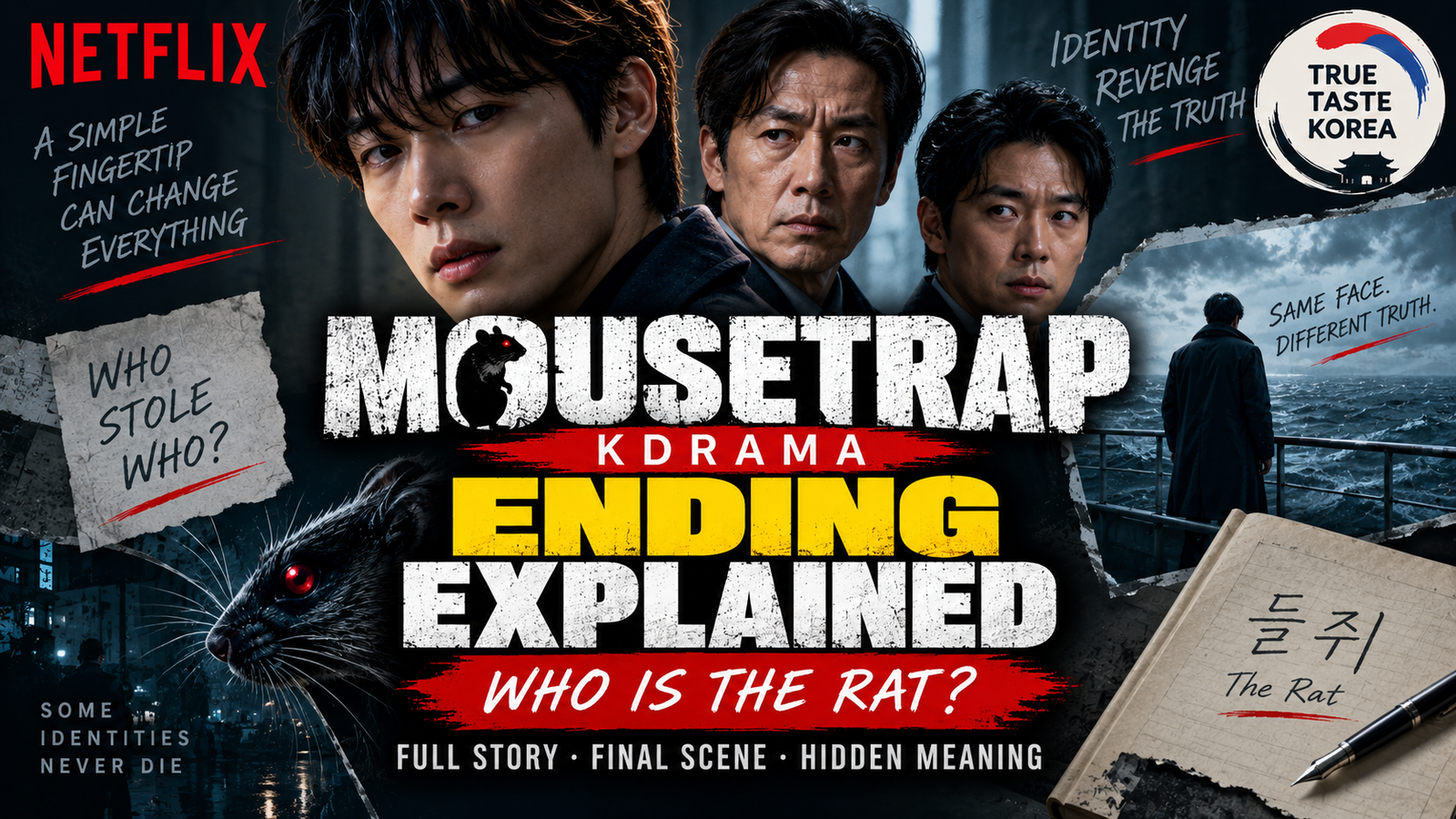
Mousetrap Kdrama

  • Mousetrap Ending Explained: Who Is the Rat and What Does the Final Scene Mean?

    Mousetrap Ending Explained: Who Is the Rat and What Does the Final Scene Mean?

    Warning: Major spoilers for all 10 episodes of Netflix’s Mousetrap (들쥐).

    Netflix’s Korean thriller Mousetrap begins with a seemingly simple mystery: someone has stolen novelist Je Moon-jae’s identity.

    But the final episode completely changes the question.

    The finale reveals not only who the Rat is, but also that Moon-jae’s story about himself cannot be trusted. The man presented as the victim has his own history of stealing another person’s work, future and identity.

    So, what really happened in the Mousetrap ending?

    Here is the ending explained.


    Who Is the Rat in Mousetrap?

    The immediate answer is Seo Yu-min.

    Yu-min is the man who takes over Moon-jae’s identity in the present-day story. He changes his appearance to resemble Moon-jae and systematically takes control of his life.

    But that is only half of the twist.

    The finale reveals that Moon-jae had wronged Yu-min years earlier.

    Moon-jae stole Yu-min’s writing and used it to build his own career as a successful novelist. The story therefore reverses the roles we have been watching throughout the series.

    Yu-min may be the literal “Rat” who steals Moon-jae’s identity in the present.

    But thematically, Moon-jae was a Rat first.


    Why Did Yu-min Steal Moon-jae’s Identity?

    Yu-min’s actions are revenge.

    Years earlier, Moon-jae, Yu-min and So Min-yeong were connected through a literary circle.

    Yu-min was the talented writer. Moon-jae became jealous of him and ultimately appropriated Yu-min’s writing, using it to establish himself as an author.

    The conflict also involved Min-yeong, whom Yu-min loved.

    The events surrounding her and Moon-jae’s actions devastated Yu-min’s life. Yu-min eventually decides to make Moon-jae experience exactly what he believes Moon-jae did to him:

    take away his identity, his achievements and his life.

    That is why the revenge is so elaborate.

    Yu-min does not simply want Moon-jae dead.

    He wants to become Moon-jae.


    Why Does the Korean Folktale Matter?

    This is where the title Mousetrap — and the Korean title 들쥐 — becomes much more meaningful.

    The series was inspired by the Korean folktale commonly known as the story of the rat that ate fingernails.

    In the folktale, a rat eats a person’s discarded fingernails and can take on that person’s appearance.

    Netflix explicitly describes the series as being inspired by this traditional story.

    Mousetrap modernizes the idea.

    Instead of a magical rat simply copying someone’s body, the drama asks:

    If someone has your face, name, money, records and social identity, how do you prove that you are really you?

    But the finale takes the metaphor one step further.

    The story isn’t only about someone stealing Moon-jae’s identity.

    It’s about people constructing their identities by taking things from others.


    What Happens on the Ship?

    The central confrontation occurs when Moon-jae finally reaches Yu-min aboard the ship.

    There, Yu-min reveals the past from his perspective.

    Much of what Moon-jae believed — or wanted to believe — about his own history is dismantled.

    Moon-jae learns the full extent of what he did to Yu-min and Min-yeong.

    The confrontation becomes violent.

    Moon-jae eventually stabs Yu-min and sends him through a broken window into the sea.

    Yu-min disappears into the water.

    But importantly, the series does not provide the audience with the comfortable certainty that everything is finished.


    Is Yu-min Dead?

    This is deliberately ambiguous.

    Yu-min falls into the sea after his confrontation with Moon-jae.

    Later, however, Moon-jae sees Yu-min again.

    The drama does not clearly establish whether this means Yu-min somehow survived or whether Moon-jae is seeing a manifestation of his guilt and deteriorating mental state.

    That ambiguity is important.

    Even if Yu-min physically died, Moon-jae cannot simply kill the truth about his past.

    Yu-min has already succeeded in forcing him to confront it.


    Why Can’t Moon-jae Write at the End?

    This is one of the most important details in the finale.

    Editor Han Ji-hye gives Moon-jae the unfinished second volume of The Rat, which Yu-min left behind.

    The manuscript contains the story of what has happened.

    Moon-jae realizes that if it is completed, the truth about him could be exposed.

    So he tries to write his own version.

    And he cannot.

    He sits before the blank page without being able to produce anything.

    That moment delivers perhaps the harshest punishment in the entire series.

    Moon-jae built his identity around being a writer.

    But the finale forces him to confront the possibility that the foundation of that identity was never truly his.

    His name may have survived.

    His career may have survived.

    But his belief in himself has not.


    So Who Is the “Real” Rat?

    This is the cleverest part of the ending.

    There are essentially two answers.

    The literal Rat: Seo Yu-min

    Yu-min is the person who steals Moon-jae’s identity and becomes his double.

    The symbolic Rat: Moon-jae

    Moon-jae stole Yu-min’s writing and benefited from another person’s talent and suffering.

    That means the drama ultimately turns its original question upside down.

    For most of the series we ask:

    “Who stole Moon-jae’s life?”

    By the finale, the more important question becomes:

    “Whose life did Moon-jae steal first?”


    What Does the Final Scene Mean?

    Moon-jae’s problems are far from over.

    He is haunted by images of field mice and by Yu-min’s presence.

    Then comes the final interruption.

    Someone arrives at Moon-jae’s door.

    It is Seung-gyu, whose own unfinished business with Moon-jae remains unresolved.

    The ending deliberately denies Moon-jae a clean escape.

    He may have defeated Yu-min physically.

    He may have regained control of his identity.

    But he hasn’t escaped the consequences of everything that came before.

    That’s the point.

    Getting your name back does not erase what you did while wearing it.


    Does Mousetrap Have a Happy Ending?

    Not really.

    Moon-jae survives, but survival is not presented as victory.

    He ends the series isolated and psychologically destabilized, unable to simply return to the successful novelist he once believed himself to be.

    Yu-min’s ultimate fate remains ambiguous.

    And Seung-gyu’s arrival makes it clear that Moon-jae’s past is still pursuing him.

    The physical identity theft may be over.

    The identity crisis isn’t.


    Why Is the Ending Called a Twist?

    Because Mousetrap spends much of its story encouraging viewers to sympathize with Moon-jae.

    Someone has his face.

    Someone has his money.

    Someone has his identity.

    Naturally, we see him as the victim.

    The finale deliberately destroys that simple interpretation.

    Yu-min did steal Moon-jae’s life.

    But Moon-jae had already taken something enormously valuable from Yu-min.

    That doesn’t make Yu-min’s crimes justified.

    Instead, it makes the distinction between victim and perpetrator deliberately uncomfortable.

    And that’s what makes the ending work.


    Mousetrap Ending FAQ

    Who is the Rat in Mousetrap?

    Seo Yu-min is the person who takes Moon-jae’s identity in the present-day story. However, the ending also presents Moon-jae himself as the symbolic “Rat” because of what he took from Yu-min in the past.

    Does Yu-min die?

    Moon-jae sends Yu-min into the sea during their final confrontation, but his later appearance is deliberately ambiguous. It may suggest survival or simply represent Moon-jae’s guilt.

    What happens to Moon-jae?

    Moon-jae survives and regains control of his life, but he ends psychologically trapped by the truth about his past and unable to simply resume his old identity as if nothing happened.

    How many episodes does Mousetrap have?

    Mousetrap has 10 episodes. Netflix lists it as a limited series.

    Is Mousetrap based on a true story?

    No. It is a fictional thriller inspired in part by the Korean “rat that ate fingernails” folktale and based on the webtoon Field Mouse. Netflix officially identifies the traditional folktale as a key inspiration.


    Understanding who the Rat is only solves part of Mousetrap’s ending mystery. The drama’s title offers another way to interpret the final scene, especially the question of who has truly escaped and who remains trapped. Explore the hidden meaning of Mousetrap’s title and the identity of the mouse for a deeper look at the story’s final reversal.
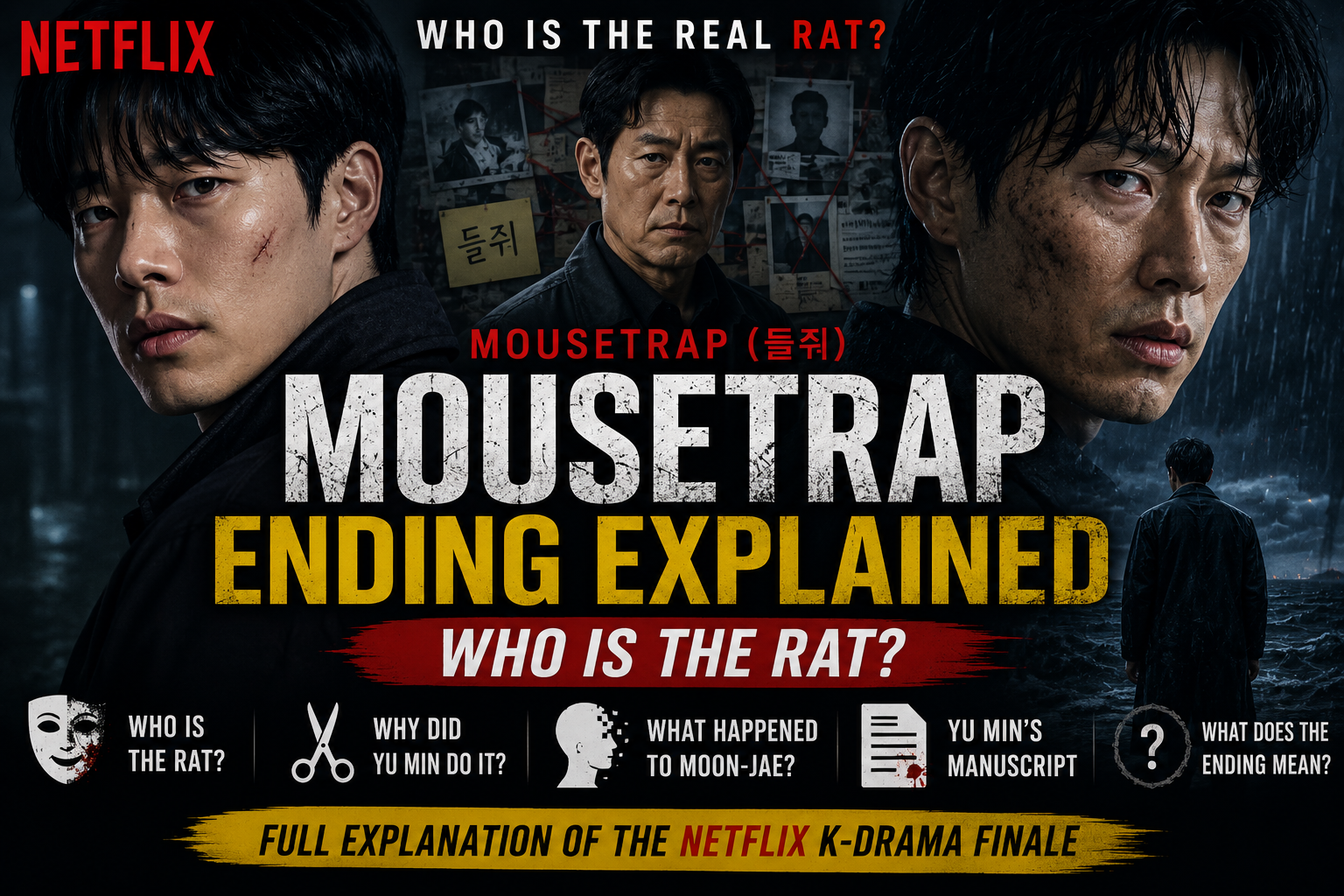
  • Mousetrap K-Drama Ending Explained: Who Is The Rat?

    Mousetrap K-Drama Ending Explained: Who Is The Rat?

    Warning: Major spoilers for all 10 episodes of Netflix’s Mousetrap (들쥐) follow.

    Netflix’s Korean thriller Mousetrap spends most of its 10 episodes making us believe Je Moon-jae is the victim of a terrifying identity theft.

    Someone has taken his name, his face, his money and seemingly his entire life.

    But the finale turns that premise upside down.

    The man chasing an impostor has spent much of his own life taking things that belonged to other people.

    And that is the key to understanding the ending of Mousetrap.


    Who Is The Rat in Mousetrap?

    The person behind the present-day theft of Moon-jae’s identity is Yu Min.

    But calling Yu Min simply “the villain” misses the biggest twist.

    Yu Min and Moon-jae knew each other years earlier.

    Moon-jae became jealous of Yu Min and ultimately took his writing and used it to build his own career as a successful novelist.

    In other words:

    Yu Min steals Moon-jae’s identity in the present — but Moon-jae had already stolen Yu Min’s work, experiences and future.

    The series therefore deliberately reverses our understanding of victim and perpetrator.

    Who Is the Real Villain in Mousetrap?

    If you’re wondering who the real villain is in Mousetrap, the answer is more complicated than it first appears.

    Yu Min is the antagonist behind the present-day identity theft, but Moon-jae may be the story’s real villain.

    For most of the series, Yu Min appears to be the obvious villain. He steals Moon-jae’s identity, takes control of his money and turns his life into a nightmare.

    But the finale changes how we understand their relationship.

    Years earlier, Moon-jae stole Yu Min’s writing and used it to help build his own successful career as a novelist.

    That means Yu Min’s actions are not random.

    They are revenge.

    This does not make everything Yu Min does morally justified. But it does blur the line between victim and villain.

    Yu Min is the person attacking Moon-jae in the present.

    Moon-jae, however, is the person whose earlier betrayal helped create the entire conflict.

    So who is the villain in Mousetrap?

    Yu Min is the immediate antagonist, but Moon-jae is arguably the deeper villain of the story.

    That reversal is one of the central ideas of Mousetrap: the man we initially believe is the victim gradually becomes someone whose own actions are impossible to ignore.


    Why Did Yu Min Steal Moon-jae’s Identity?

    This is where the revenge becomes much more meaningful.

    Yu Min isn’t simply trying to steal money.

    He wants Moon-jae to experience what it feels like to have his own existence taken away.

    Years earlier, Moon-jae stole Yu Min’s notebooks and writing and published the work under his own name.

    That helped Moon-jae become an acclaimed novelist.

    But the success was built partly on something that wasn’t truly his.

    Yu Min’s revenge therefore mirrors Moon-jae’s original wrongdoing:

    You stole my life. Now I will steal yours.

    This is why the drama’s identity-theft premise works on two levels.

    There is the literal theft of an identity.

    And there is the deeper theft of another person’s talent, story and future.


    What Happens Between Moon-jae and Yu Min?

    Their conflict finally reaches its climax aboard a ship heading toward Jeju.

    Yu Min intends to expose Moon-jae and disappear.

    Moon-jae, however, cannot allow the life and identity he has constructed to collapse.

    The confrontation becomes violent.

    Yu Min ultimately falls into the sea.

    His body is not recovered.

    This creates one of the finale’s most important ambiguities.

    Legally, Moon-jae has room to protect himself because there is no body providing definitive evidence of what happened.

    But morally, the situation is completely different.

    By this point, the audience knows enough about Moon-jae’s past to understand that the supposed victim we’ve followed throughout the series is far more complicated than he appeared.


    Does Yu Min Die in Mousetrap?

    The series leaves a small amount of ambiguity around Yu Min.

    He falls into the sea during the final confrontation and his body is not recovered.

    The most straightforward interpretation is that Yu Min is presumed dead.

    However, the final scene deliberately brings Yu Min back into Moon-jae’s psychological world.

    That doesn’t necessarily mean he physically survived.

    And this distinction becomes important at the very end.


    What Happens to Moon-jae?

    On paper, Moon-jae appears to win.

    He survives.

    He gets his identity back.

    He returns home.

    And he avoids an immediate legal reckoning for what happened aboard the ship.

    But this is not a happy ending.

    Moon-jae discovers that reclaiming his legal identity doesn’t solve his real problem.

    Because the central question was never simply:

    “Who legally owns the name Je Moon-jae?”

    The deeper question is:

    “Who is Je Moon-jae without the things he took from other people?”

    That’s much harder for him to answer.


    Why Can’t Moon-jae Write?

    This may be one of the most important details in the ending.

    Moon-jae’s successful career as an author was built in significant part on Yu Min’s writing.

    After everything that happens, Moon-jae is left facing something terrifying:

    He has to write as himself.

    And he struggles to do it.

    Yu Min’s final manuscript becomes especially cruel because it forces Moon-jae to confront how much of the successful writer “Je Moon-jae” was constructed from somebody else’s talent and story.

    The man who was terrified of having his identity stolen discovers that he may never have possessed a completely authentic identity in the first place.


    What Does Yu Min’s Manuscript Mean?

    Yu Min’s manuscript is more than another plot device.

    It functions almost like a final trap.

    The manuscript contains a story that reflects Moon-jae’s own past, including the plagiarism and deception behind his success.

    If the truth comes out, the identity Moon-jae fought so desperately to recover could collapse anyway.

    Moon-jae therefore faces an impossible situation.

    He has recovered the name.

    He has recovered the house.

    He has recovered the public identity.

    But he cannot recover the truth behind that identity.

    And he cannot easily create a new story to escape it.


    What Does the Final Scene Mean?

    This is where Mousetrap becomes psychological horror.

    Back in his apartment, Moon-jae hears violent pounding at the door.

    When he looks through the peephole, he sees Yu Min’s face.

    One interpretation supported by recent ending analyses is that this is not confirmation that Yu Min survived.

    Instead, Yu Min has become a manifestation of Moon-jae’s guilt, fear and paranoia.

    Moon-jae may have defeated Yu Min physically.

    But he cannot eliminate what Yu Min represents.

    His stolen writing.

    His stolen success.

    His lies.

    And the knowledge that his identity can collapse at any moment.

    That’s the real punishment.


    So Who Is the Real “Rat”?

    This is where the title becomes clever.

    For most of the drama, Yu Min appears to be The Rat because he steals Moon-jae’s identity.

    But by the ending, the meaning becomes less simple.

    Moon-jae has also spent his life taking pieces of other people’s identities and making them his own.

    So the question changes from:

    Who is The Rat?

    to:

    Who has really been stealing from whom?

    Some interpretations of the finale therefore see the title as ultimately pointing back toward Moon-jae himself rather than describing only Yu Min.


    The Korean Folktale Makes the Ending Even Better

    International viewers may miss one of the most interesting cultural layers.

    The Korean title 들쥐 means “field mouse.”

    The story draws inspiration from a Korean folktale about a mouse that eats a person’s discarded fingernail clippings and takes on that person’s appearance.

    The series modernizes that idea.

    Instead of asking whether a magical mouse can physically become a human being, Mousetrap asks:

    What actually makes you “you”?

    Your face?

    Your fingerprints?

    Your legal documents?

    Your memories?

    Your talent?

    Or the story other people believe about you?

    Yu Min can take Moon-jae’s external identity.

    But Moon-jae had already taken parts of Yu Min’s internal identity.

    That’s why the folktale fits the drama so well.


    Does Mousetrap Have a Happy Ending?

    No — at least not for Moon-jae.

    Technically, he survives and gets much of his life back.

    But psychologically he ends the story trapped.

    His career rests on stolen work.

    His past threatens his public identity.

    Yu Min continues to haunt him psychologically.

    And Moon-jae is left confronting the possibility that the successful person he spent years becoming was never entirely his own creation.

    So Moon-jae wins the battle over his identity…

    but loses the certainty of who he actually is.


    Mousetrap Ending Explained in 30 Seconds

    QuestionAnswer
    Who is The Rat?Yu Min is behind the present-day identity theft
    Why does he do it?Revenge for what Moon-jae took from him
    Did Moon-jae steal from Yu Min?Yes — including his writing
    What happens to Yu Min?He falls into the sea and is presumed dead
    Does Moon-jae survive?Yes
    Does Moon-jae get his identity back?Yes, legally
    Is it a happy ending?No
    What does the ending mean?Moon-jae regains his name but remains trapped by the identity he built through deception

    FAQ

    Who is the real Rat in Mousetrap?

    Yu Min is responsible for stealing Moon-jae’s identity in the present-day storyline. However, the finale complicates the label because Moon-jae himself previously stole Yu Min’s writing and built part of his life around what he took.

    Does Yu Min die?

    Yu Min falls into the sea during the final confrontation and his body isn’t recovered. He is therefore presumed dead, although the drama intentionally leaves some psychological ambiguity around his presence in the final scene.

    Does Moon-jae die?

    No. Moon-jae survives the finale and returns home.

    Why does Moon-jae see Yu Min at the end?

    A strong interpretation is that Yu Min’s appearance represents Moon-jae’s guilt and paranoia rather than proving Yu Min physically survived.

    What is the meaning of the Mousetrap ending?

    Moon-jae succeeds in reclaiming his legal identity but cannot escape the lies and stolen work on which that identity was built. The ending suggests that proving who you are legally is very different from knowing who you truly are.

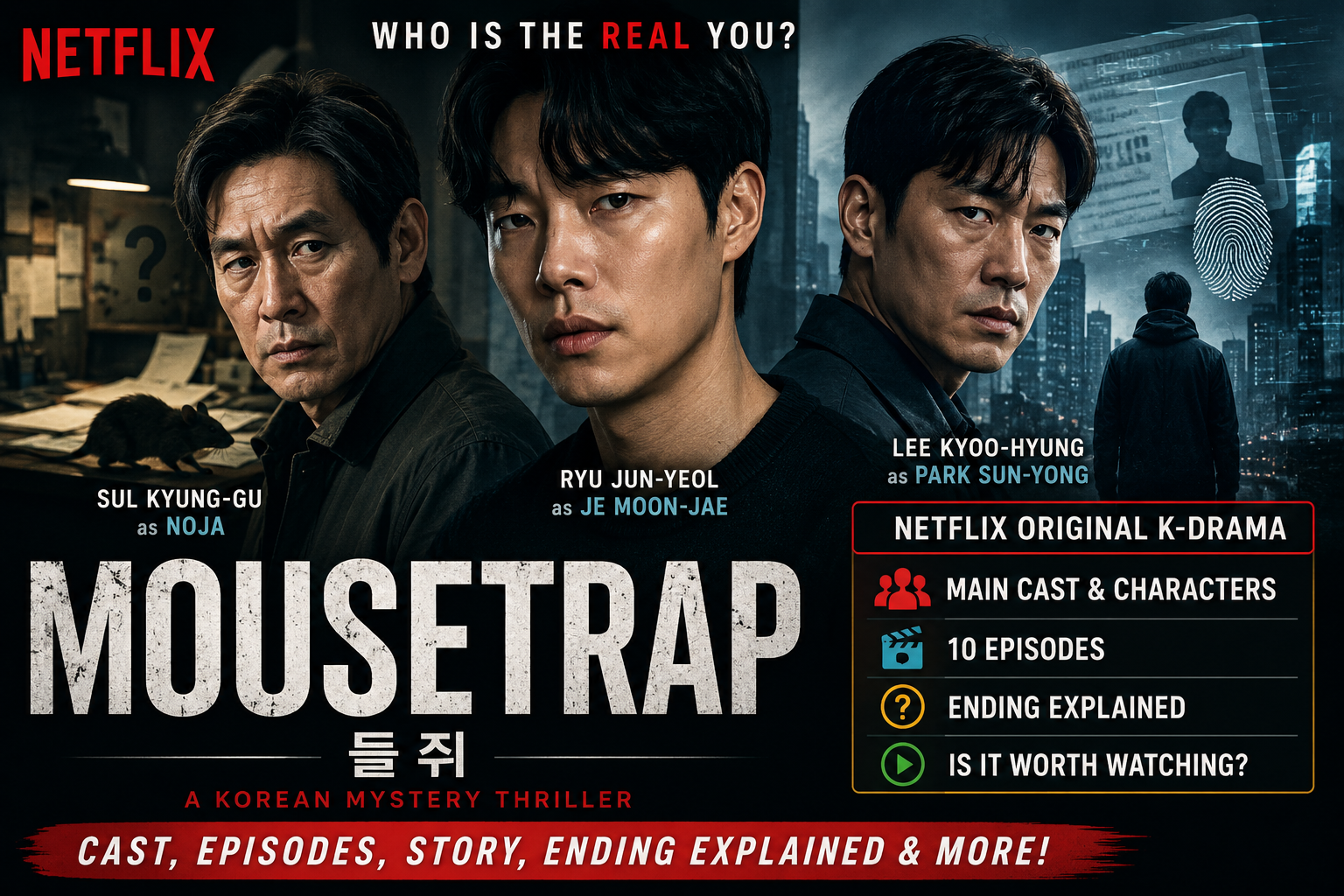
  • Mousetrap K-Drama Cast, Characters, Episodes & Ending Explained

    Mousetrap K-Drama Cast, Characters, Episodes & Ending Explained

    Netflix’s Mousetrap (들쥐) is one of the most intriguing Korean mystery thrillers of 2026.

    Released globally on Netflix on August 28, 2026, the 10-episode limited series stars Ryu Jun-yeol, Sul Kyung-gu and Lee Kyoo-hyung in a dark story about identity theft, memory, deception and a mysterious figure known as “The Rat.”

    But Mousetrap has something that makes it particularly interesting to Korean viewers.

    The story is inspired by an old Korean folktale about a field mouse that eats a person’s clipped fingernails and transforms into that person. Netflix confirms that this Korean folktale is the starting point for the series.

    That cultural background makes Mousetrap much more than a conventional identity-theft thriller.

    Mousetrap K-Drama Cast and Characters

    Ryu Jun-yeol as Je Moon-jae

    Ryu Jun-yeol plays Je Moon-jae, a genius novelist who lives almost completely isolated from society.

    His carefully controlled life begins to collapse when his fingerprint suddenly stops unlocking his phone, his passwords no longer work and he gradually discovers that his identity, money and even his name are being taken away from him.

    Eventually, another person appears claiming his identity.

    Moon-jae now faces an almost impossible question:

    How do you prove that you are really you?

    Ryu Jun-yeol previously appeared in Netflix titles including Revelations and The 8 Show.

    Sul Kyung-gu as Noja

    Sul Kyung-gu plays Noja, a ruthless loan shark who initially pursues Moon-jae because of money.

    But the two eventually form an unlikely alliance.

    Noja becomes one of the central figures in Moon-jae’s attempt to discover who stole his identity and uncover the truth behind “The Rat.”

    The relationship between the frightened, isolated writer and the intimidating loan shark is one of the most unusual dynamics in the series.

    Lee Kyoo-hyung as Park Sun-yong

    Lee Kyoo-hyung plays detective Park Sun-yong.

    While Moon-jae and Noja pursue The Rat from one direction, Sun-yong investigates the strange case from the perspective of law enforcement.

    As the investigation progresses, however, Sun-yong discovers disturbing connections involving his own past.


    What Is Mousetrap K-Drama About?

    The basic premise sounds simple.

    Someone steals Moon-jae’s identity.

    But this isn’t ordinary online identity theft.

    The mysterious person known as The Rat takes virtually everything that defines Moon-jae’s existence—his identity, property and place in society.

    Even worse, Moon-jae has spent years living as a recluse.

    That means relatively few people can personally confirm who he really is.

    The person pretending to be Moon-jae can therefore appear more convincing to the outside world than the real Moon-jae himself.

    Netflix describes the story as a chase thriller in which Moon-jae, Noja and detective Sun-yong pursue the true identity of The Rat.


    The Korean Folktale Behind Mousetrap

    This is something international viewers may easily miss.

    The Korean title of the drama is 들쥐, meaning “field mouse.”

    There is an old Korean folktale in which a mouse eats a person’s discarded fingernail clippings and takes on that person’s appearance.

    The Netflix series transforms that disturbing old idea into a modern question about identity:

    What happens if another person can become a more convincing version of you than you are?

    Netflix itself highlighted this folktale when introducing the series before its premiere.

    For international viewers, knowing this background makes the title and the central mystery much easier to understand.


    How Many Episodes Does Mousetrap Have?

    Mousetrap has 10 episodes.

    It is officially listed by Netflix as a Limited Series, rather than a conventional multi-season drama.

    Approximate episode lengths are:

    EpisodeRuntime
    Episode 156 min
    Episode 256 min
    Episode 350 min
    Episode 458 min
    Episode 555 min
    Episode 660 min
    Episode 763 min
    Episode 855 min
    Episode 949 min
    Episode 1064 min

    All 10 episodes are currently listed on Netflix.


    Is Mousetrap on Netflix?

    Yes.

    Mousetrap premiered globally on Netflix on August 28, 2026.

    Netflix currently lists the series with Korean original audio as well as English audio and English subtitles, making it particularly accessible to international viewers.

    Watch Mousetrap on Netflix


    Is Mousetrap Based on a Webtoon?

    Yes.

    Netflix categorizes Mousetrap as a K-drama based on a webtoon, and Netflix’s official announcement identifies the source as the webtoon Field Mouse.

    That source material itself draws on the unsettling Korean field-mouse folktale, giving the drama multiple layers: Korean folklore → webtoon → Netflix thriller.


    Is Mousetrap K-Drama Worth Watching?

    If you enjoy psychological thrillers, identity mysteries, dark Korean dramas and stories filled with twists, Mousetrap is certainly worth considering.

    The strongest element is its premise.

    Instead of simply asking:

    “Who is the criminal?”

    Mousetrap asks something more disturbing:

    “What if you could no longer prove who you are?”

    Early critical reaction has been mixed but interesting. Decider recommended streaming the series and highlighted its gripping premise and performances, while another review praised the ending and psychological-horror elements but criticized the middle section for having too many twists.

    So viewers who like straightforward thrillers may find parts of the story complicated.

    But viewers who enjoyed darker Korean mystery dramas built around unreliable identities and repeated revelations may find plenty to enjoy.


    Mousetrap Ending Explained

    ⚠️ Major spoilers for Episode 10 begin below.

    This is the section I would not fully write yet unless we deliberately make the article spoiler-heavy.

    There’s an SEO reason.

    People searching:

    mousetrap kdrama cast

    should be able to enter this article without immediately encountering the ending.

    At the same time, Search Console is already showing interest in:

    mousetrap kdrama explained

    So we should retain an ending section but clearly separate it with a spoiler warning.

    For now I’d place this teaser:

    The final episode brings Moon-jae to the center of a trap that has been built over many years, forcing the series to confront its central question of who is genuine, who is an impostor and who has really been manipulating the game. Netflix’s official Episode 10 description deliberately frames the conclusion around whether Moon-jae is the predator or the prey.

    Then we can create a separate deep-dive article:

    Mousetrap K-Drama Ending Explained: Who Is The Rat?

    and internally link the two.

    That is better SEO than stuffing the entire ending explanation into this article because we already have two different search intents showing up: cast and explained.


    Mousetrap K-Drama Quick Facts

    Korean Title들쥐
    English TitleMousetrap
    Release DateAugust 28, 2026
    StreamingNetflix
    Episodes10
    FormatLimited Series
    GenreMystery, Crime, Psychological Thriller
    Lead CastRyu Jun-yeol, Sul Kyung-gu, Lee Kyoo-hyung
    DirectorKim Hong-sun
    WriterLee Jae-gon
    Based OnField Mouse webtoon / Korean field-mouse folktale

    FAQ

    Who is in the Mousetrap K-drama cast?

    The main Mousetrap cast includes Ryu Jun-yeol as Je Moon-jae, Sul Kyung-gu as Noja and Lee Kyoo-hyung as detective Park Sun-yong.

    How many episodes are in Mousetrap?

    There are 10 episodes in the Netflix limited series.

    Is Mousetrap available on Netflix?

    Yes. All 10 episodes are listed on Netflix, following its August 28, 2026 premiere.

    What is Mousetrap called in Korean?

    The Korean title is 들쥐 (Deuljwi), literally meaning “field mouse.”

    Is Mousetrap based on a true story?

    No. It is based on the webtoon Field Mouse, with its central idea drawing inspiration from a Korean folktale about a mouse taking human form after eating a person’s clipped fingernails.

    Is Mousetrap worth watching?

    It is most likely to appeal to viewers who enjoy dark psychological mysteries, Korean thrillers and identity-based stories with multiple twists. Critical reaction so far has praised the premise and performances while being more divided about the amount of plot twists.


    Tags