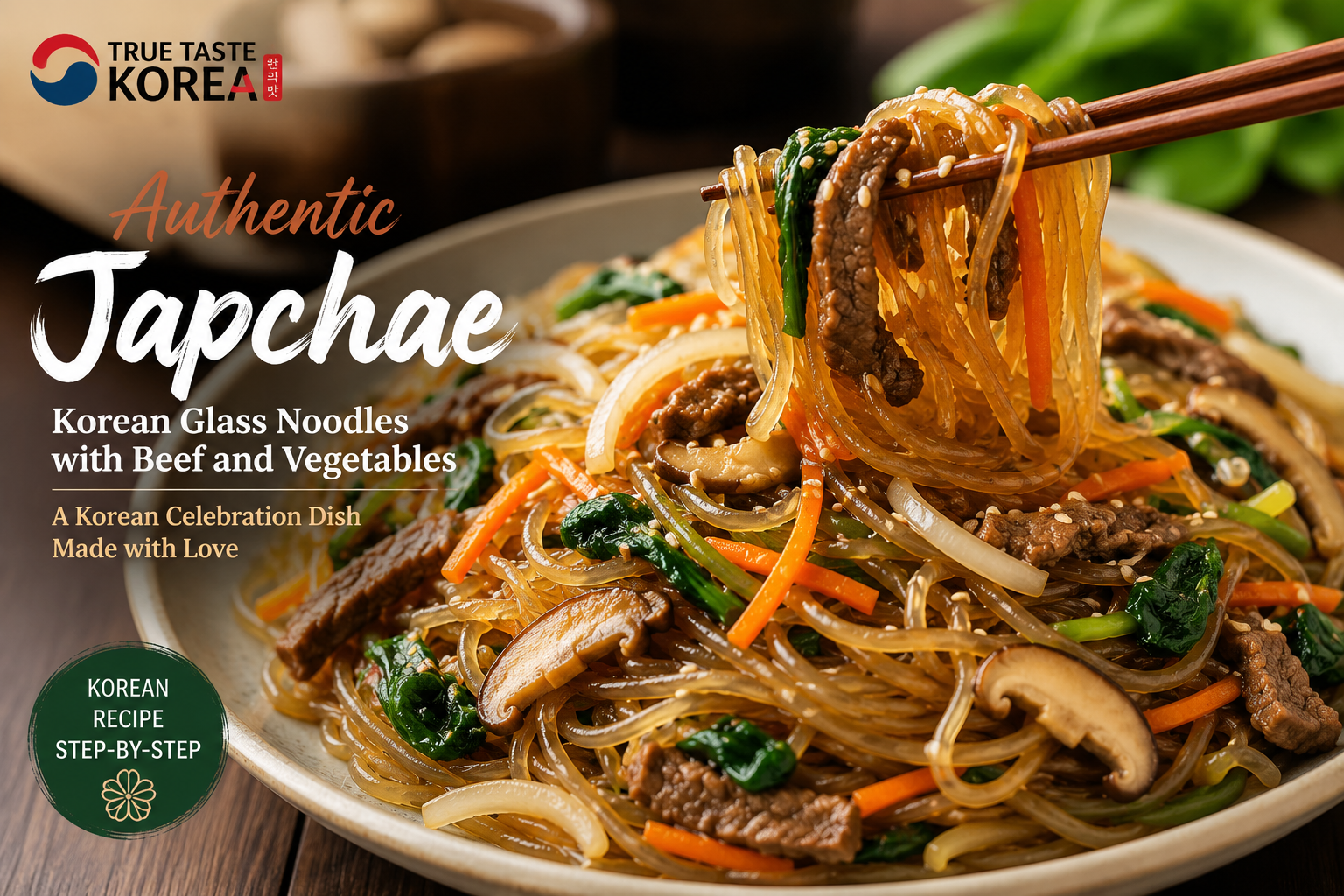
For many Koreans, japchae is more than a noodle dish. It is a taste of celebration and home.
Growing up in Korea, many people remember seeing a large plate of japchae on the family table when something special happened.
Birthdays, holidays, family gatherings, and celebrations often meant the same familiar combination: chewy glass noodles, tender beef, colorful vegetables, soy sauce, and the unmistakable aroma of sesame oil.
Sometimes, the strongest memory isn’t even the food itself. It’s watching a mother prepare a big batch in the kitchen, carefully cooking each ingredient before bringing everything together.
That is part of what makes japchae special.
Today, we’ll make a traditional Korean-style beef japchae with sweet potato glass noodles, spinach, carrots, onions, and mushrooms. This recipe serves four to five people and includes practical tips for getting the noodles chewy, the vegetables colorful, and the seasoning balanced.
1. What Is Japchae?
Japchae (잡채) is a popular Korean dish made by combining glass noodles with vegetables, seasonings, and often meat.
The noodles are called dangmyeon (당면). Modern Korean dangmyeon is generally made from sweet potato starch, which gives it a translucent appearance and a pleasantly chewy texture.
A typical homemade version includes:
Sweet potato glass noodles
Thinly sliced beef
Spinach
Carrots
Onions
Mushrooms
Soy sauce
Sesame oil
Garlic
Sesame seeds
The flavor is savory, slightly sweet, and nutty, with a satisfying contrast between the springy noodles and tender vegetables.
Japchae is often served as banchan, or a side dish, alongside rice and other Korean dishes. However, a generous serving can easily become a meal on its own.
2. Why Is Japchae a Celebration Food in Korea?
Japchae has long been associated with special occasions in Korea.
It is commonly served at birthdays, weddings, holidays, family gatherings, and other celebrations. The colorful ingredients and generous presentation make it particularly suitable for a table shared with family and guests.
For many people who grew up in Korean households, homemade japchae also brings back memories of their mothers preparing it for important family occasions.
Beef was often included to make the dish feel more generous and festive.
The emotional connection is simple:
Japchae was often something you ate when the family had a reason to celebrate.
That is why a plate of japchae can mean more than its ingredients. It can remind someone of a birthday, a holiday meal, or a familiar kitchen filled with the smell of sesame oil.
3. Japchae Wasn’t Originally Made with Glass Noodles
Here is an interesting part of japchae’s history.
The dish dates back to the Joseon Dynasty. Historical records connect early japchae with royal dining during the reign of King Gwanghaegun in the 17th century.
But the original version was quite different from the dish most people recognize today.
Early japchae did not use the sweet potato glass noodles that are now its defining ingredient. Historical recipes used a variety of vegetables and other ingredients, with different seasonings and preparation methods.
Research examining Korean cookbooks from the 1600s to the 1960s indicates that glass-noodle japchae appeared in the early 20th century and became increasingly popular around the 1950s.
In other words, the japchae served at modern Korean family gatherings is the result of a long culinary evolution.
The name also reflects the dish’s mixed ingredients: jap refers to a mixture or assortment, while chae is associated with vegetables.
So the dish’s identity has always been closely connected to bringing different ingredients together.
4. Authentic Korean Beef Japchae Recipe
<text>Servings: 4–5 people
Preparation time: About 25 minutes
Cooking time: About 20–25 minutes
Total time: Approximately 45–50 minutes</text>
Ingredients
Main ingredients
250 g Korean sweet potato glass noodles (dangmyeon)
150 g thinly sliced beef
150 g spinach
1 medium carrot
1 medium onion
100 g shiitake mushrooms or other mushrooms
2 green onions
1 tablespoon cooking oil
Sesame seeds for garnish
Beef marinade
1 tablespoon soy sauce
1 teaspoon sugar
1 teaspoon sesame oil
1 teaspoon minced garlic
A little black pepper
Japchae seasoning
4 tablespoons soy sauce
2 tablespoons sugar
2 tablespoons sesame oil
1 tablespoon minced garlic
You can reduce the sugar if you prefer a less sweet japchae. The final balance also depends on the saltiness of your soy sauce and the brand of noodles you use.
5. Step-by-Step Cooking Instructions
Step 1. Marinate the Beef
Slice the beef into thin strips if it isn’t already prepared.
Combine it with the soy sauce, sugar, sesame oil, minced garlic, and black pepper.
Mix well and leave it to marinate for approximately 15–20 minutes while you prepare the vegetables.
Thinly sliced beef is ideal because it cooks quickly and mixes easily with the noodles.
Step 2. Prepare the Vegetables
Cut the carrot, onion, and mushrooms into thin strips.
Try to keep the pieces a similar size. This makes the finished japchae easier to mix and gives it a more balanced appearance.
Wash the spinach thoroughly.
Bring a small pot of water to a boil and blanch the spinach briefly, just until it wilts. Transfer it to cold water to stop the cooking.
Drain and gently squeeze out excess water.
Season the spinach lightly with a pinch of salt and a little sesame oil.
Don’t squeeze it so hard that it becomes crushed. You want the leaves to remain tender and retain some texture.
Step 3. Stir-Fry the Vegetables and Beef Separately
Heat a little cooking oil in a frying pan.
Cook the onion until it becomes slightly translucent, then transfer it to a large mixing bowl.
Stir-fry the carrots until they are just tender but still have a little bite. Remove them.
Cook the mushrooms until softened and fragrant.
Finally, stir-fry the marinated beef until fully cooked.
Why cook the ingredients separately?
Because each ingredient has a different cooking time. Onions soften quickly, carrots need a little more time, and mushrooms release moisture as they cook.
Cooking them separately gives you better control over their texture and helps preserve the different colors.
This extra step takes a little longer, but it makes a noticeable difference in homemade japchae.
Step 4. Cook the Sweet Potato Glass Noodles
Bring a large pot of water to a boil.
Add the dangmyeon and cook according to the package instructions. Different brands and noodle thicknesses can require different cooking times, so the package directions are the best starting point.
The noodles should be soft enough to eat but still pleasantly chewy.
Drain them thoroughly.
If the noodles are very long, use clean kitchen scissors to cut them into shorter lengths.
The most important point is not to overcook the noodles. Overcooked dangmyeon can become too soft and lose the springy texture that makes japchae enjoyable.
Step 5. Season the Noodles
In a small bowl, mix the soy sauce, sugar, sesame oil, and minced garlic for the japchae seasoning.
Place the warm, drained noodles in a large pan or mixing bowl.
Add most of the seasoning and toss until the noodles are evenly coated.
Taste a small amount before adding the remaining seasoning. You may not need every drop, depending on the noodles and your preferred level of saltiness.
If the noodles begin sticking together, a small additional drizzle of sesame oil can help loosen them.
Step 6. Combine All the Ingredients
Add the cooked beef, onion, carrots, mushrooms, spinach, and green onions to the noodles.
Use tongs or clean hands to gently mix everything together.
Try to distribute the vegetables and beef evenly rather than leaving all the toppings on top.
Taste and adjust the seasoning with a little more soy sauce, sugar, or sesame oil if necessary.
Finish with sesame seeds.
Your homemade Korean beef japchae is ready to serve.
6. The Secrets to Making Better Japchae
A few small details can make the difference between ordinary japchae and a really satisfying homemade version.
Use Plenty of Vegetables
One common mistake is adding too many noodles and too few vegetables.
A good homemade japchae should have a generous mixture of beef, mushrooms, spinach, carrots, and onions throughout the noodles.
The vegetables contribute flavor, color, and texture. They should not feel like a small garnish.
Keep the Noodles Chewy
Dangmyeon should be springy, not mushy.
Follow the cooking time on the package and check the texture before draining.
Remember that the noodles will continue to soften slightly when mixed with the warm ingredients.
Don’t Overdo the Sesame Oil
Sesame oil gives japchae its familiar Korean aroma.
However, too much can make the dish heavy and overpower the other ingredients.
Start with the recommended amount and add a little more only if needed.
Control the Moisture
Spinach and mushrooms can release water.
Drain the spinach well after blanching, and cook the mushrooms until excess moisture has evaporated.
Too much liquid can dilute the seasoning and make the finished noodles less glossy.
Taste Before Serving
Japchae should be savory, slightly sweet, and fragrant.
There is no single sweetness level that suits everyone. Adjust the seasoning according to your taste, especially if you are using a particularly salty soy sauce.
7. Can You Make Japchae Without Beef?
Absolutely.
Although beef is common in celebratory Korean-style japchae, it is not essential.
For a vegetarian version, simply leave out the beef and increase the amount of mushrooms and vegetables.
Shiitake mushrooms are particularly useful because they add a rich, savory flavor.
For a vegan version, check that your soy sauce and other seasonings are suitable for a vegan diet.
You can also experiment with tofu or other plant-based ingredients if you want additional protein.
8. Can Japchae Be a Complete Meal?
Yes.
Japchae is often served as a side dish with rice, soup, and other Korean foods. However, it already contains noodles, vegetables, and often meat.
A generous portion can therefore be satisfying enough to eat without a separate bowl of rice.
If you want to serve it as a main meal, increase the amount of vegetables and protein rather than simply adding more noodles.
It is also a convenient dish for sharing because it can be prepared in a large batch.
One thing to remember: dangmyeon is primarily a source of carbohydrates, and traditional japchae also contains sesame oil and sugar. It should not automatically be considered a low-calorie diet food.
9. How to Store Leftover Japchae
Japchae tastes best freshly prepared, but leftovers can be stored.
Transfer the cooked japchae to a clean, airtight container and refrigerate it promptly.
For food safety, don’t leave cooked japchae at room temperature for more than two hours. Keep it refrigerated at 5°C or below, and avoid storing it for longer than necessary.
For the best quality, try to eat it within two to three days.
The noodles may become firmer in the refrigerator, and the vegetables may lose some of their original texture. This is normal.
If the dish has been left out for an extended period or shows unusual changes in smell or appearance, discard it rather than tasting it to check.
10. The Best Way to Reheat Japchae
The easiest way to restore the texture of refrigerated japchae is to warm it in a frying pan.
Place the japchae in a pan over medium-low heat.
Add a small splash of water.
Gently stir until the noodles loosen and become warm.
If needed, add a few drops of sesame oil before serving.
Avoid adding too much water. You only need enough to help soften the chilled noodles.
Reheating gently helps prevent the vegetables from becoming overly soft.
11. Frequently Asked Questions About Japchae
What Are Japchae Noodles Made From?
Modern Korean dangmyeon is generally made from sweet potato starch.
This gives the noodles their translucent appearance and characteristic chewy texture.
Is Japchae Spicy?
Usually, no.
Traditional japchae is savory and slightly sweet rather than spicy. It generally does not rely on chili paste or chili powder.
That makes it a good introduction to Korean food for people who prefer milder flavors.
Is Japchae Gluten-Free?
Sweet potato starch noodles are generally gluten-free, but that does not automatically make the entire dish gluten-free.
Regular soy sauce commonly contains wheat.
If you need a gluten-free dish, check the labels of every ingredient and use certified gluten-free soy sauce and other suitable seasonings.
Can I Make Japchae Ahead of Time?
Yes.
Japchae is often prepared for family gatherings and celebrations, so making it ahead can be convenient.
You can cook the ingredients, combine them, and refrigerate the finished dish. Reheat it gently before serving.
For the best texture, avoid leaving it at room temperature for extended periods.
Can I Eat Japchae Cold?
You can eat properly refrigerated japchae cold, although the noodles will usually be firmer than when freshly prepared.
Many people prefer it warm because the sesame oil aroma becomes more noticeable and the noodles feel softer.
12. More Than Korean Glass Noodles
Calling japchae simply “Korean glass noodles” doesn’t fully explain why the dish is so familiar to many Koreans.
For some, it brings back memories of a birthday table.
For others, it means a holiday gathering, relatives visiting, or a special meal prepared for someone they love.
And for many people, the memory begins in the kitchen: a mother preparing beef and vegetables, cooking each ingredient carefully, and mixing everything into one large bowl of glossy noodles.
The combination of chewy dangmyeon, savory beef, colorful vegetables, soy sauce, and sesame oil makes japchae delicious.
But the memories surrounding it are what make it special.
Sometimes food isn’t just about what is on the plate. It’s about remembering who prepared it, and why everyone was gathered around the table in the first place.
When people talk about Korean beauty, one phrase immediately comes to mind:
Glass Skin.
For years, K-Beauty introduced the world to a beauty ideal built around hydration, smooth texture and a healthy-looking glow.
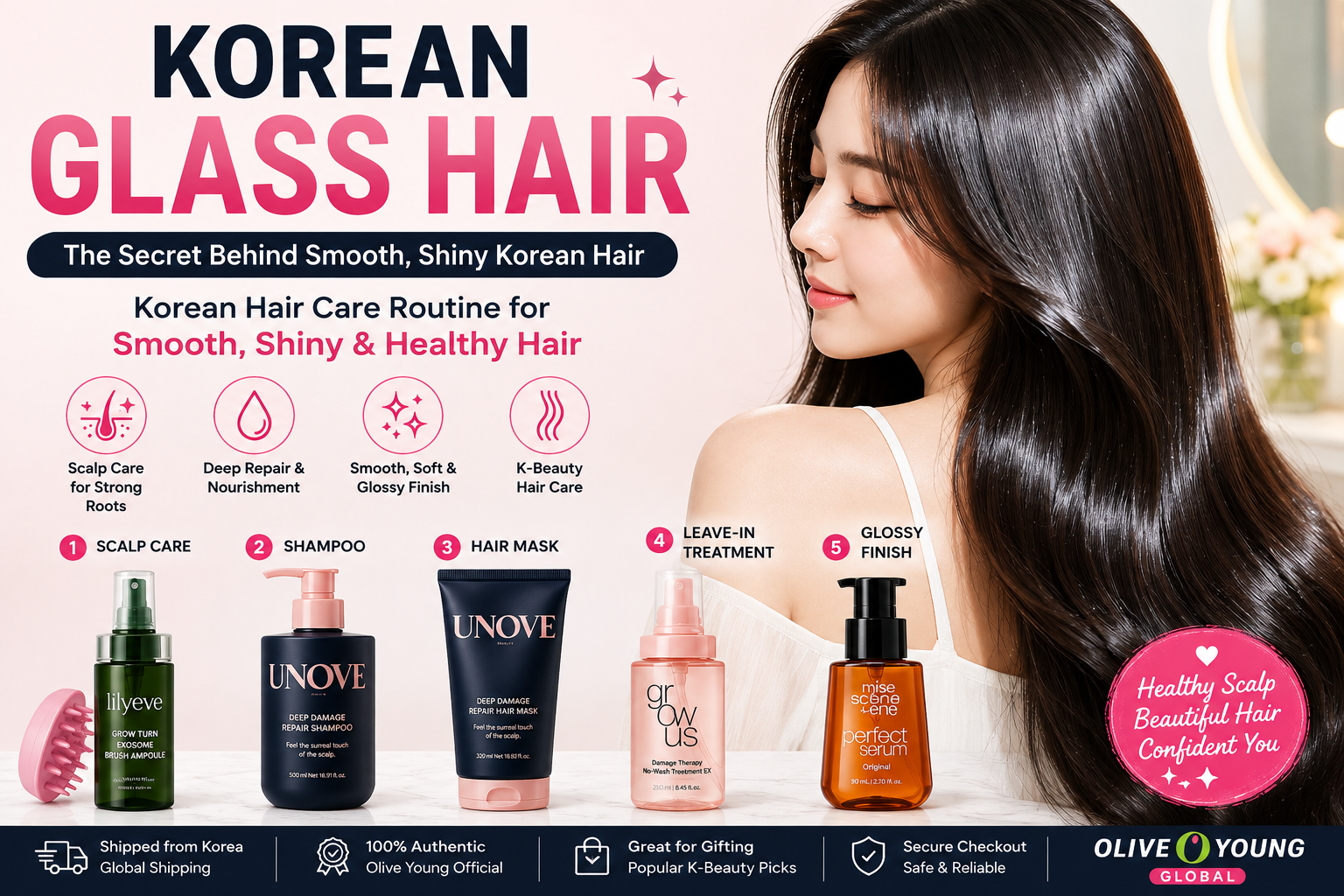
Now, a similar idea is attracting attention in hair care.
Smooth strands. Less visible frizz. Soft movement. And a glossy finish that reflects light.
It is called Glass Hair.
The idea is simple: hair that looks so smooth and polished that it almost resembles glass.
But achieving this appearance is not simply a matter of applying hair oil before going out.
The Korean hair-care approach increasingly connects scalp care, cleansing, conditioning, damage management and finishing products into one routine.
And that is where the growing interest in K-Haircare becomes particularly interesting.
1. What Is Korean Glass Hair?
Glass hair describes hair with an exceptionally smooth, sleek and glossy appearance.
The name comes from the way light reflects off a smooth hair surface.
Think of it as the hair equivalent of glass skin.
However, glass hair does not simply mean making your hair as shiny as possible.
The ideal appearance combines:
Smooth-looking hair strands
Reduced visible frizz
Softness and movement
A reflective, glossy finish
Hair that does not look excessively oily or weighed down
The trend is not limited to one haircut or hair length.
Straight, wavy and curly hair can all have a glossy, well-conditioned appearance.
The important point is the condition and finish of the hair, not forcing every hair type into the same style.
2. Why Is Glass Hair Becoming Part of the K-Beauty Conversation?
K-Beauty has traditionally been associated with facial skincare.
Cleansing, hydration, serums, moisturizers and sun protection became familiar concepts to consumers around the world.
Now, a similar approach is becoming increasingly visible in Korean hair care.
Instead of relying on one shampoo or one styling product, consumers can choose different products for different concerns:
Scalp oiliness and buildup
Dry or damaged lengths
Frizz and tangles
Hair affected by coloring or bleaching
Heat styling
Lack of shine and softness
This reflects a broader shift in beauty.
The focus is expanding from facial skincare to the scalp, hair and overall appearance.
Korean hair-care brands are also gaining international attention, while products such as hair masks, leave-in treatments and finishing serums are becoming more visible in overseas markets.
Glass hair fits naturally into this movement because it turns a familiar beauty goal—smooth, glossy hair—into a recognizable look.
3. Glass Skin vs. Glass Hair: What Is the Connection?
The two concepts share a similar beauty philosophy.
Glass skin is not usually achieved through one product. It involves a routine that supports hydration, smooth texture and a healthy-looking complexion.
Glass hair follows a comparable idea.
Glass Skin
Glass Hair
Gentle cleansing
Scalp-focused cleansing
Hydration
Conditioning
Targeted treatment
Hair masks and treatments
Moisturizing
Leave-in care
Healthy-looking glow
Glossy finishing serum
The comparison is useful, but there is one important difference.
Hair fibers are not living skin. Products can condition the hair, reduce friction, improve manageability and make the surface look smoother.
They cannot permanently restore every form of structural damage.
That is why a realistic glass-hair routine focuses on both appearance and preventing further damage.
4. Step One: Start With the Scalp
One of the most interesting parts of Korean hair care is the attention given to the scalp.
Many people concentrate only on the visible lengths of their hair.
But the scalp is where hair grows, and keeping it clean and comfortable is an important part of ordinary hair care.
Korean beauty retailers offer a wide range of scalp-focused products, including:
Scalp shampoos
Scalp scrubs and scalers
Scalp tonics
Scalp ampoules
Cooling scalp treatments
Some Korean head spas also use magnifying cameras to examine the scalp before a treatment.
However, scalp care should be chosen according to individual needs.
An oily scalp, a dry scalp and a sensitive scalp may require different products. Strong exfoliation or frequent use of harsh cleansing products can cause irritation rather than improve the condition.
Scalp cosmetics should also not be confused with medical treatment for hair loss.
If you are interested in this part of Korean beauty culture, read our related guide:
Korean Scalp Care: Why Everyone Is Talking About Korean Head Spas
5. Step Two: Choose a Shampoo for Your Hair and Scalp
Not everyone needs the same shampoo.
Someone with bleached, damaged hair may have very different needs from someone whose main concern is an oily scalp.
A useful starting point is to distinguish between the scalp and the hair lengths.
The scalp needs appropriate cleansing.
The lengths and ends often need more conditioning, especially when they have been exposed to coloring, bleaching or heat styling.
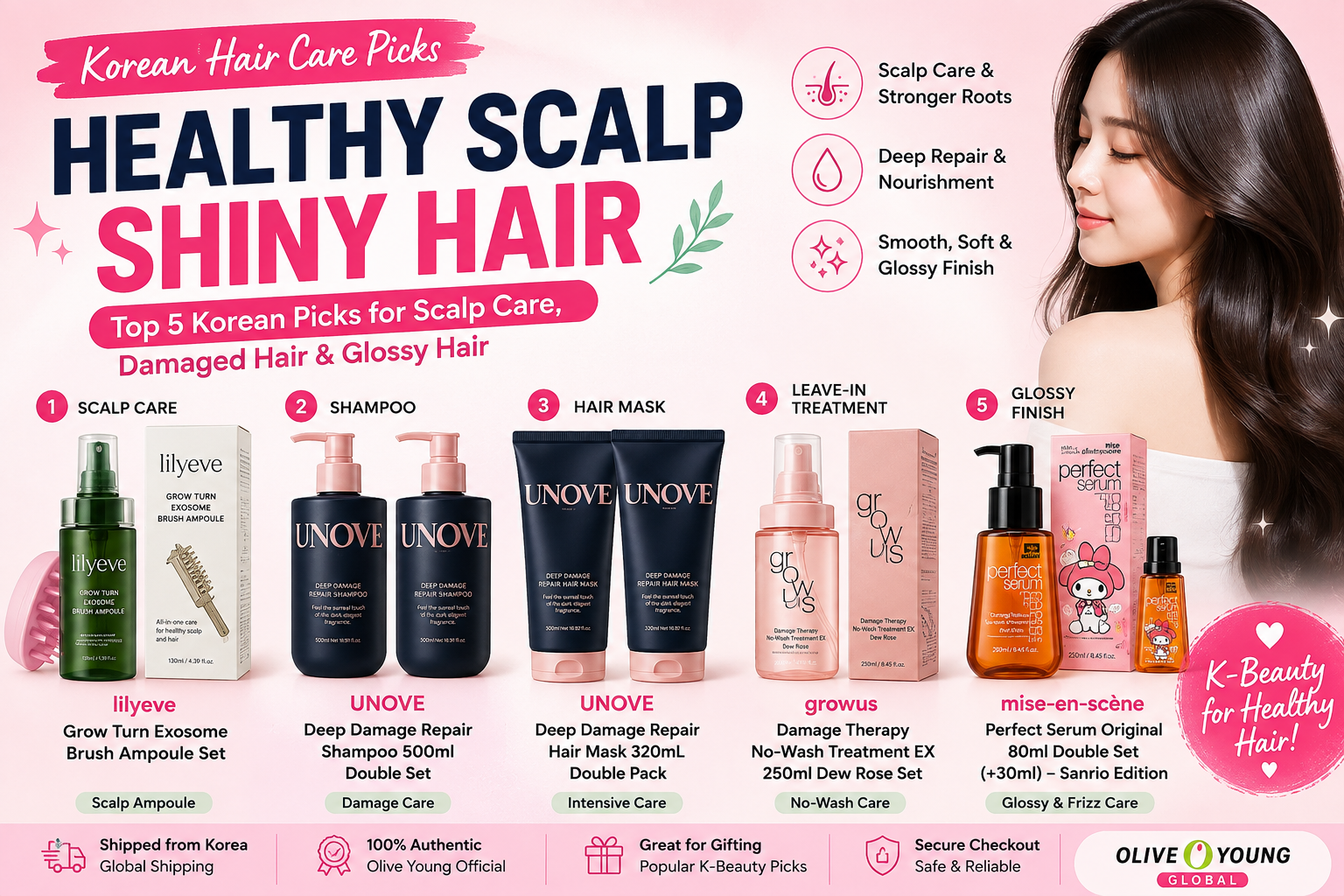
One recognizable Korean hair-care brand is UNOVE.
UNOVE Deep Damage Repair Shampoo
UNOVE’s Deep Damage Repair line is positioned around damaged-hair care.
Its shampoo is one option to consider if your hair feels rough or difficult to manage after repeated styling or chemical treatments.
The important thing is to choose a shampoo that cleanses your scalp without leaving your hair feeling unnecessarily dry.
Product to explore: UNOVE Deep Damage Repair Shampoo
6. Step Three: Use a Hair Mask for Damaged Lengths
A hair mask is often a useful addition when ordinary conditioner is not enough to make dry lengths feel manageable.
Hair masks are generally formulated as richer conditioning treatments.
They can help improve:
Softness
Detangling
Manageability
The appearance of dry or rough hair
Smoothness after washing
One product in this category is:
UNOVE Deep Damage Repair Hair Mask
The UNOVE Deep Damage Repair Hair Mask is designed for intensive conditioning of damaged-looking hair.
Apply it mainly to the lengths and ends, following the product instructions.
It is especially worth considering if your hair has been exposed to frequent coloring, bleaching or heat styling.
However, using more product does not automatically produce better results.
Fine hair may become weighed down by rich treatments, while thick or very dry hair may benefit from more conditioning.
Repeated exposure to high heat can make hair brittle, rough and more prone to breakage.
If you regularly use a hair dryer, curling iron or straightener, a few habits can help reduce unnecessary damage:
Allow hair to partially air-dry when practical.
Use a lower or medium heat setting.
Avoid repeatedly applying high heat to the same section.
Use a suitable heat-protection product.
Handle wet hair gently.
Avoid aggressively rubbing hair with a towel.
The American Academy of Dermatology also recommends limiting excessive heat and treating wet hair carefully because it is more vulnerable to breakage.
These habits may sound simple, but they matter just as much as choosing an expensive finishing serum.
11. Can Damaged Hair Really Be Repaired?
This is where beauty marketing needs a little explanation.
Hair that has grown beyond the scalp consists of non-living keratinized fibers.
That means cosmetic products cannot heal damaged hair in the same way that living skin repairs a wound.
However, conditioning products can make a noticeable difference to how hair looks and feels.
They can:
Smooth rough areas temporarily
Reduce friction between strands
Improve detangling
Reduce the appearance of frizz
Make hair feel softer
Improve shine
Some specialized treatments are also designed to improve the feel and strength of damaged hair.
But no shampoo, mask or serum can permanently reverse every form of damage.
The most realistic strategy is to improve the appearance of existing hair while reducing the damage caused by excessive heat, chemical treatments and rough handling.
12. Does Glass Hair Have to Be Straight?
Not at all.
This is one of the most important things to understand about the trend.
Glass hair is often shown in photographs as sleek, straight hair with a mirror-like finish.
But the underlying idea is not limited to straight hairstyles.
Wavy and curly hair can also look glossy, smooth and well-conditioned.
For naturally textured hair, the goal may be:
Defined curls
Reduced frizz
Soft movement
A healthy-looking shine
Trying to force every hair type into a perfectly straight style can require excessive heat and create additional damage.
Glass hair should complement your natural texture, not fight against it.
13. Where Can You Explore Korean Hair-Care Products?
If you visit Korea, OLIVE YOUNG is one of the easiest places to explore Korean hair-care products.
Its hair-care selection includes products for different needs, such as:
Shampoo and conditioner
Scalp care
Hair masks
Leave-in treatments
Hair oils and serums
Styling and finishing products
International shoppers can also browse products through:
Product availability, prices and promotional sets can change, so check the current product page before purchasing.
14. Is Glass Hair the Next Big K-Beauty Trend?
Glass skin helped make Korean beauty recognizable around the world.
It communicated a particular ideal through two simple words: clear, smooth and luminous-looking skin.
Glass hair uses a similar visual language.
But the growing interest in glossy hair is also part of a wider development in K-Beauty.
The conversation is expanding beyond facial skincare into:
Scalp care → Hair care → Body care → Beauty wellness
This does not mean that glass hair was invented in Korea. The sleek, glossy hair aesthetic has appeared in international beauty and styling trends for years.
What makes the current conversation interesting is how Korean brands, beauty retailers and hair-care routines are helping connect this look with the broader K-Beauty market.
The result is a new opportunity for Korean hair-care products to reach consumers who are already familiar with Korean skincare.
Final Thoughts: The Secret Is Not One Miracle Product
The secret behind Korean glass hair is not a single shampoo, hair mask or expensive serum.
It is the combination of appropriate cleansing, conditioning, damage prevention and careful finishing.
Start with the scalp.
Choose products according to your hair type.
Condition the lengths that need it.
Use leave-in care when appropriate.
And finish with just enough serum or oil to create a glossy appearance.
The goal is not simply to make hair shine under a bright light.
Just as glass skin became one of the most recognizable expressions of K-Beauty, glass hair is becoming another way to talk about the appeal of Korean beauty routines.
And perhaps the most useful lesson is this:
You do not need a complicated routine to achieve a polished look. You need to understand what your hair actually needs.
When people think about K-Beauty, glowing skin, sunscreen, sheet masks and serums usually come to mind.
But South Korea’s beauty philosophy is gradually moving beyond the face.
The scalp is becoming the next focus of Korean beauty care.
In Korea, healthy-looking hair is increasingly associated with more than a good haircut or an expensive styling product. Scalp cleanliness, hydration, comfort and hair texture are becoming important parts of a complete beauty routine.
This shift is attracting international attention.
Korean head spas, scalp treatments and specialized hair-care products are appearing more frequently in beauty travel itineraries, social media videos and international K-Beauty discussions.
One September 2026 report on Juno Seoul highlighted how international visitors had become a major part of its head-spa business. Foreign customers reportedly accounted for approximately 80% of its head-spa clientele, while foreign visitors across its salons had increased by 52% year over year.
These figures describe one company’s experience, rather than the entire Korean beauty industry. Nevertheless, they illustrate an interesting development: scalp care is becoming an experience that international visitors actively seek out in Korea.
So why is Korean scalp care attracting so much attention?
And what makes a Korean head spa different from an ordinary hair salon?
The answer reveals how K-Beauty is expanding into an entirely new area.
1. The Korean Beauty Philosophy: Why Scalp Care Starts at the Roots
For years, Korean skincare has promoted a foundation-first approach.
Rather than relying entirely on makeup to improve appearance, skincare routines emphasize cleansing, hydration, sun protection and maintaining the skin barrier.
A similar philosophy is increasingly appearing in Korean hair care.
Instead of concentrating exclusively on the visible hair strands, scalp-focused routines pay attention to the skin underneath.
This approach is often associated with the term skinification of hair care.
The idea is straightforward: the scalp is skin, so it deserves appropriate cleansing, hydration and care.
That does not mean the scalp should be treated exactly like facial skin. It has different characteristics, including a high concentration of hair follicles and sebaceous glands.
However, the underlying philosophy is similar.
A healthy-looking appearance begins with understanding the condition of the underlying surface rather than simply covering up visible problems.
This is why Korean hair-care routines increasingly include products such as:
Scalp-specific shampoos
Exfoliating scalp scalers
Hydrating scalp tonics
Scalp ampoules
Cooling scalp treatments
Hair masks and protein treatments
The result is a broader approach to beauty in which the scalp is no longer overlooked.
2. Why Korean Consumers Pay Attention to Scalp Health
Hair has a strong relationship with personal appearance and confidence.
Thinning hair, excessive oiliness, dryness, dandruff and scalp irritation can all influence how someone feels about their appearance.
These concerns are not limited to older adults.
Younger consumers also pay attention to hair condition, particularly when they frequently color, bleach, perm or heat-style their hair.
Environmental factors and individual scalp characteristics can also affect comfort and appearance.
There is another important issue: stress-related hair shedding.
The American Academy of Dermatology explains that significant physical or emotional stress can trigger a condition called telogen effluvium, in which more hairs than usual enter the shedding phase.
However, hair loss has many possible causes.
Genetics, hormonal changes, autoimmune conditions, medications and nutritional problems can all contribute.
This is why Korean scalp care should not be understood as a universal solution to hair loss.
Instead, its growing popularity reflects a broader consumer interest in maintaining scalp comfort, improving hair appearance and understanding individual hair-care needs.
3. What Exactly Happens During a Korean Head Spa?
A Korean head spa is a beauty and wellness service centered on scalp care.
The exact procedure differs between businesses, but many services follow a sequence designed to examine, cleanse and condition the scalp.
A typical experience may include:
Step 1: Scalp analysis
Some salons use a magnifying camera to examine the scalp.
Customers may be shown areas with visible oiliness, flakes, buildup or dryness.
This visual examination helps the stylist select appropriate cosmetic treatments.
Step 2: Scalp cleansing
A specialized cleansing product or shampoo is used to remove excess oil, sweat and styling-product residue.
Step 3: Exfoliation or scalp scaling
Some services include a scalp scaler designed to loosen accumulated dead skin cells and product residue.
The intensity depends on the product and the salon’s procedure.
Step 4: Shampoo and rinsing
The scalp and hair are washed, often with particular attention to comfortable cleansing and thorough rinsing.
Step 5: Hydration and treatment
A scalp tonic, ampoule or conditioning product may be applied depending on the service.
Step 6: Scalp massage
Massage is often an important part of the experience, helping customers relax while the treatment is performed.
Step 7: Hair conditioning and finishing
The service may finish with a hair mask, drying and styling.
Not every Korean head spa offers every step. Some specialize in relaxation, while others emphasize scalp analysis and cosmetic scalp treatments.
The combination of personalized care and a structured treatment experience is what makes the service attractive to many visitors.
4. Korean Head Spa vs. Ordinary Hair Salon: What Is the Difference?
Although both services involve hair washing, they have different priorities.
An ordinary hair salon generally focuses on the appearance and styling of the hair.
A head spa places more emphasis on the scalp.
Service
Main focus
Regular hair salon
Cutting, coloring, perming and styling
Hair treatment
Conditioning and improving hair texture
Korean head spa
Scalp cleansing, cosmetic scalp care and relaxation
Medical dermatology
Diagnosis and treatment of scalp and hair disorders
This distinction matters because the services are not interchangeable.
A hair salon can help improve the appearance of damaged hair. A head spa can provide a more specialized cosmetic cleansing and relaxation experience.
But neither should be confused with medical treatment for conditions such as alopecia, severe dermatitis or persistent scalp inflammation.
For international visitors, understanding this difference makes it easier to choose the right service.
5. Why Are Foreign Tourists Adding Korean Head Spas to Their Seoul Itineraries?
K-Beauty tourism has traditionally focused on shopping and skincare experiences.
Visitors often plan trips around Olive Young, Korean cosmetics brands, dermatology clinics, facial treatments and beauty salons.
Head spas are introducing another option.
Instead of purchasing a product to take home, visitors can experience an entire Korean beauty ritual during their trip.
The reported Juno Seoul figures provide an interesting example.
According to a September 2026 report, foreign customers represented approximately 80% of the company’s head-spa clientele. Its foreign salon visitors also reportedly increased by 52% compared with the previous year.
There are several possible reasons behind this interest.
First, the experience is easy to understand.
Visitors do not need extensive knowledge of Korean beauty terminology to appreciate scalp cleansing, massage and hair conditioning.
Second, the service is highly visual.
Scalp-camera examinations, cleansing procedures, foam treatments and the final hair finish create an experience that translates naturally into photographs and short-form videos.
Third, it combines beauty with relaxation.
Travelers often spend long days walking through Seoul. A head spa offers a different kind of beauty experience from shopping or sightseeing.
Finally, it feels distinctly connected to Korea’s broader beauty culture.
For visitors already interested in Korean skincare, discovering scalp-focused treatments feels like a natural extension of K-Beauty.
6. The Rise of Korean Glass Hair: From Glass Skin to Hair Shine
Korean beauty has become internationally associated with the idea of glass skin.
The term describes a smooth, hydrated and luminous-looking complexion.
A similar aesthetic is increasingly visible in hair trends.
Online beauty discussions often use expressions such as glass hair to describe smooth, shiny hair with a healthy-looking finish.
The concept is not simply about making hair look wet or glossy.
It emphasizes several visual qualities:
Smooth hair texture
Reduced appearance of frizz
Light-reflecting shine
Well-conditioned lengths
A polished overall appearance
Scalp care and hair conditioning contribute to different parts of this process.
Scalp treatments focus on the skin beneath the hair, while conditioners and hair masks primarily improve the appearance and manageability of the hair strands.
This distinction is important.
A clean scalp does not automatically produce shiny hair, and a glossy hair treatment does not necessarily improve scalp health.
However, combining appropriate scalp care with conditioning and careful styling creates a more complete hair-care routine.
This is where the Korean beauty approach becomes particularly interesting.
It connects the condition of the scalp with the final appearance of the hair without treating them as exactly the same thing.
7. Can a Korean Head Spa Actually Prevent Hair Loss?
This is probably the most important question for anyone considering a scalp treatment.
The honest answer is that a cosmetic head spa is not a proven treatment for hereditary hair loss or other medical causes of hair loss.
A head spa may help remove excess oil and product buildup, improve scalp cleanliness and provide a relaxing experience.
However, these benefits should not be confused with stimulating new hair growth or reversing hair loss.
The American Academy of Dermatology identifies several possible causes of excessive shedding.
For example, telogen effluvium can occur following significant stress, illness, surgery or childbirth.
Hereditary hair loss and autoimmune conditions require different approaches.
People experiencing sudden hair loss, bald patches, persistent itching, pain or severe scalp inflammation should seek professional medical evaluation.
There is also a practical consideration.
Aggressive exfoliation, excessive scratching or unsuitable cosmetic products can irritate the scalp.
A good scalp-care routine should be gentle and appropriate for the individual’s condition.
The most useful way to understand Korean head spas is therefore:
Cosmetic maintenance, scalp comfort and relaxation — not a guaranteed medical solution.
8. Which Korean Scalp-Care Products Are Worth Understanding?
You do not need to visit a Korean head spa to explore the scalp-care trend.
Many Korean beauty retailers already organize hair products according to specific concerns.
Olive Young Global, for example, offers categories covering scalp treatments, weakened hair, hydration, shine, thickening and hair-loss-related concerns.
Here are some common product types.
Scalp shampoo
Designed to cleanse the scalp while removing excess oil, sweat and everyday buildup.
The best choice depends on whether the scalp is oily, dry, sensitive or prone to irritation.
Scalp scaler
An exfoliating product designed to loosen accumulated residue and dead skin cells.
It should be used according to the product instructions rather than excessively.
Scalp tonic
A lightweight leave-on product intended to provide scalp-focused cosmetic care.
Some formulations include cooling or moisturizing ingredients.
Scalp ampoule
A concentrated cosmetic treatment designed for targeted scalp application.
Its ingredients and intended use vary between brands.
Hair masks and protein treatments
These primarily target the hair strands rather than the scalp.
They can improve softness, manageability and the appearance of damaged hair.
The important lesson is that these products are not interchangeable.
Choosing a shampoo for an oily scalp is different from choosing a moisturizing treatment for dry hair.
Understanding the specific purpose of each product is more useful than simply buying everything labeled Korean scalp care.
9. Why Korean Scalp Care Is Different From Simply Washing Your Hair
The most interesting development is not the introduction of another shampoo.
It is the growing attention to personalized routines.
Traditional hair washing is often treated as a basic daily activity.
A scalp-care routine takes a more detailed approach.
Instead of asking only whether the hair looks clean, consumers are increasingly asking:
Is my scalp excessively oily?
Do I have visible buildup?
Does my scalp feel dry or irritated?
Am I using products that suit my scalp condition?
Is my hair damaged by frequent coloring or heat styling?
This shift reflects the wider development of Korean beauty culture.
Skincare introduced consumers to the idea that different skin conditions require different routines.
Scalp care applies a similar consumer mindset to hair.
The goal is not necessarily to use more products.
It is to understand what the scalp and hair actually need.
10. Should You Try a Korean Head Spa During Your Trip to Seoul?
If you enjoy K-Beauty, a head spa can be an interesting addition to a Korean travel itinerary.
It may be particularly appealing if you:
Have never experienced a magnified scalp examination.
Want to explore Korean hair-care routines.
Frequently use styling products.
Color, bleach or perm your hair.
Enjoy beauty treatments that combine grooming and relaxation.
Want to experience something different from a conventional Korean hair salon.
Before booking, check what the service actually includes.
Some salons offer a short cleansing and massage session, while others provide longer treatments with scalp analysis and multiple cosmetic steps.
It is also worth checking:
Whether English-speaking staff are available.
Whether the consultation is included.
How long the treatment takes.
Whether the price includes drying and styling.
Whether additional products or treatments cost extra.
Do not assume that every service advertised as a Korean head spa includes the same procedure.
For travelers with medical scalp concerns, a dermatology consultation is more appropriate than relying on a beauty salon.
If you are interested in medical beauty services in Korea, see our related guide:
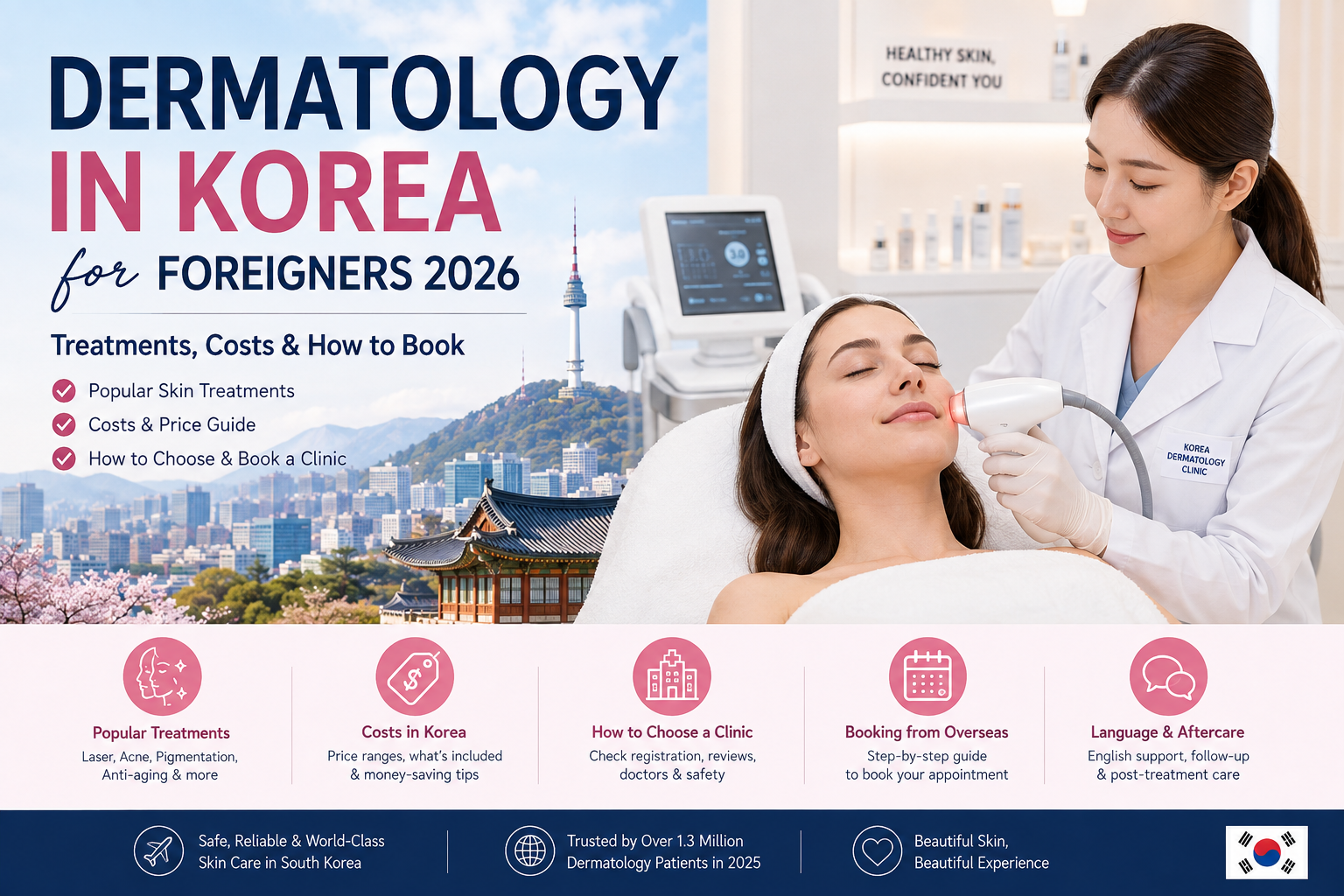
Dermatology in Korea for Foreigners 2026: Treatments, Costs & How to Book
11. Is Scalp Care the Next Chapter of K-Beauty?
The international success of Korean skincare did not happen because of one miracle product.
It developed through a combination of product innovation, beauty routines, accessible retail experiences and a growing global interest in Korean approaches to personal care.
Scalp care may be following a similar path.
There are several developments happening at once.
Korean beauty brands are expanding scalp-focused product categories.
Head spas are creating experiences that international visitors can enjoy during their trips.
Social media is making scalp examinations, cleansing rituals and glossy hair transformations more visible.
And consumers are becoming increasingly interested in the relationship between scalp condition and hair appearance.
None of this means that traditional hair salons or skincare products will become less important.
Instead, K-Beauty is expanding into another part of everyday personal care.
The face is no longer the only focus of a beauty routine.
The scalp is becoming part of the conversation.
Final Thoughts: The Next K-Beauty Experience May Begin at the Roots
Korean beauty has always been about more than following a particular product trend.
It is also about creating routines and experiences around personal care.
Glass skin helped introduce international audiences to Korean skincare philosophy.
Korean head spas are now offering another way to experience that philosophy.
For some visitors, the attraction is scalp cleansing.
For others, it is relaxation, personalized hair care or simply discovering a new Korean beauty experience.
And for international K-Beauty fans, the growing interest in scalp care offers another reason to explore Seoul beyond the usual cosmetics shopping destinations.
Perhaps the next chapter of K-Beauty will not begin with another facial serum.
It may begin at the roots — with a closer look at the scalp beneath the hair.
If you are visiting South Korea or shopping for Korean beauty products online, there is one store you will almost certainly hear about:
Olive Young.
Often described as Korea’s leading health and beauty retailer, Olive Young has become one of the most popular destinations for discovering Korean skincare, makeup, hair care, and wellness products.
But stepping inside an Olive Young store for the first time can be overwhelming.
Entire shelves are filled with sheet masks, toner pads, serums, moisturizers, sunscreens, and hair treatments. New products appear constantly, and familiar Korean beauty brands offer dozens of different formulas.
So, what is actually worth buying?
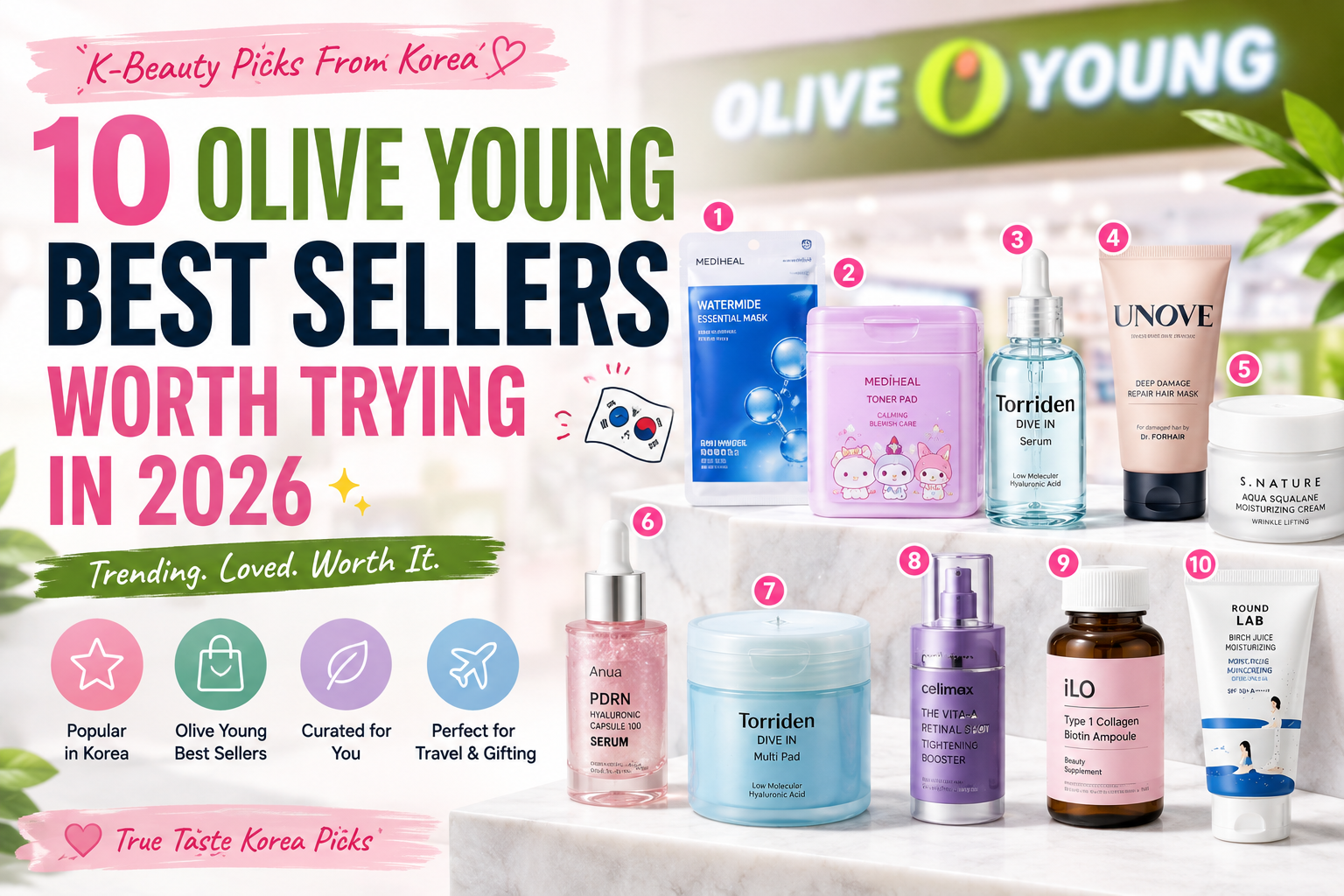
At True Taste Korea, we have selected 10 products that deserve attention in 2026, combining Olive Young bestseller visibility, recognizable Korean beauty brands, useful product functions, and appeal to international shoppers.
A note about rankings: Olive Young’s official bestseller page is updated daily using online and offline sales data from Korea. The ranking changes frequently, so this article is not a permanent number-one-to-number-ten sales ranking. It is a practical shopping guide featuring notable products available through Olive Young Global.
Some shopping links in this article may be affiliate links. If you purchase through them, True Taste Korea may earn a commission at no additional cost to you.
1. MEDIHEAL Essential Mask Sheet Set
<escape>Best for: First-time K-Beauty shoppers and sheet-mask enthusiasts</escape>
<escape>Why it stands out: A practical introduction to one of Korea’s most familiar skincare formats.</escape>
If you have ever explored Korean skincare, you have probably seen MEDIHEAL.
The brand is particularly well known for its sheet masks, and its Essential Mask Sheet 10+1 set is one of the most recognizable products in Olive Young’s mask category.
The set comes in several formula options, including Madecassoside, Rose PDRN, Collagen, Hyaluronate, Ceramide, Tea Tree, and Vitamin C.
That variety makes it easier to choose a mask according to your skincare preferences instead of buying a completely unfamiliar formula.
A sheet mask is also one of the simplest ways to experience Korean skincare. After cleansing, place the mask on your face, leave it on for the recommended time, and gently pat in the remaining essence.
Our recommendation: If you are buying Korean skincare for the first time, this is a convenient product to start with. Choose the formula that suits your preferences rather than assuming every version has the same purpose.
<escape>Best for: People who prefer quick and convenient skincare</escape>
<escape>Why it stands out: A practical example of Korea’s popular toner-pad routine.</escape>
Toner pads are one of the Korean skincare products that often surprise international visitors.
Instead of pouring toner onto a cotton pad, the pads come pre-soaked in skincare essence and are ready to use.
MEDIHEAL offers several toner-pad formulas designed for different skincare preferences. Depending on the version, the formula may focus on hydration, soothing care, or other skin concerns.
They can be used as a convenient step after cleansing. Some people also place a pad briefly on a specific area as a mini skincare pack, following the product instructions.
The biggest advantage is convenience. You do not need a separate cotton pad or an additional bottle of toner.
Our recommendation: Choose the formula based on its ingredients and your skin’s needs. Do not assume that all toner pads are interchangeable.
<escape>Best for: People looking for a hydration-focused serum</escape>
<escape>Why it stands out: A well-established Korean serum with a clear skincare purpose.</escape>
Torriden’s DIVE-IN line is built around hydration, making it one of the easiest Korean skincare ranges to understand.
The Low Molecular Hyaluronic Acid Serum features multiple types of hyaluronic acid, which help the formula attract and retain moisture in the skin.
The product also includes ingredients such as panthenol and allantoin, which are commonly used in moisturizing and soothing skincare formulas.
Its lightweight texture makes it an appealing option for people who want to add a hydrating serum without making their routine unnecessarily complicated.
Torriden’s DIVE-IN serum has also received recognition in Olive Young’s annual beauty awards, reinforcing its position as an established product rather than a short-lived social media trend.
Our recommendation: If your current routine feels too focused on cleansing and moisturizing, a hydrating serum can be a useful middle step.
<escape>Best for: Dry, rough, or damaged-feeling hair</escape>
<escape>Why it stands out: A reminder that Korean beauty is not limited to skincare.</escape>
K-Beauty is often associated with facial skincare, but Korean hair care deserves attention too.
UNOVE’s Deep Damage Repair Hair Mask is designed for hair that feels dry, rough, or difficult to manage.
It is a rinse-off treatment that can be added to a regular hair-washing routine. Rather than simply focusing on fragrance or appearance, the product is positioned around conditioning and improving the feel of damaged hair.
This makes it particularly interesting for people who frequently color, bleach, heat-style, or chemically treat their hair.
The product has also appeared among Olive Young Global’s featured best-selling hair-care selections.
Our recommendation: If you are interested in Korean hair care, UNOVE is a good brand to explore. Follow the directions on the package and pay attention to how your hair responds.
<escape>Best for: People who want a straightforward moisturizer</escape>
<escape>Why it stands out: A simple formula-focused option for daily moisture care.</escape>
Not every Korean skincare product needs an unusual ingredient or a complicated routine.
Sometimes, a reliable moisturizer is exactly what you need.
S.NATURE’s Aqua Squalane Moisturizing Cream focuses on hydration and moisture support. Its formula features ingredients such as squalane, panthenol, and Aquaxyl.
Squalane is commonly used in moisturizers because it helps support the skin’s moisture barrier and reduce the feeling of dryness.
The brand describes the cream as having a lightweight, non-sticky texture, which may appeal to people who dislike heavy moisturizers.
Our recommendation: Consider this product if you are building a basic Korean skincare routine and want a moisturizer without adding several unnecessary steps.
<escape>Best for: Shoppers interested in ingredient-focused Korean skincare</escape>
<escape>Why it stands out: It combines two ingredients receiving considerable attention in modern K-Beauty.</escape>
PDRN has become one of the most talked-about ingredients in Korean skincare.
ANUA’s PDRN Hyaluronic Capsule 100 Serum combines PDRN with hyaluronic acid and other moisturizing ingredients.
The formula is designed around hydration and skin-conditioning care. It also reflects a wider direction in Korean beauty: combining recognizable ingredients in products that are easy for consumers to identify and compare.
However, it is important to understand what PDRN skincare actually means.
A topical cosmetic product containing PDRN is not equivalent to a medical procedure or professional dermatological treatment. Marketing claims should not be confused with guaranteed clinical results.
If you want to understand the ingredient before purchasing, read our separate guide:
Our recommendation: This is an interesting choice for shoppers who already enjoy comparing skincare ingredients and want to explore one of the major K-Beauty trends of 2026.
<escape>Best for: People who want a convenient hydration step</escape>
<escape>Why it stands out: It brings Torriden’s hydration-focused approach into a ready-to-use pad format.</escape>
If you like the idea of toner pads but prefer a hydration-focused product, Torriden’s DIVE-IN Multi Pad is worth exploring.
The pads are soaked in a formula featuring multiple types of hyaluronic acid.
They are designed to provide a quick layer of moisture and can also be used as a short mini pack on dry areas, following the product instructions.
This is particularly useful for people who want to simplify their morning routine.
Torriden’s multi-pad products also demonstrate why toner pads have become such a recognizable part of Korean skincare culture.
They combine the convenience of a pre-soaked pad with the familiar function of a toner or essence step.
Our recommendation: If you already use Torriden’s DIVE-IN serum, this product may be an interesting companion. However, you do not need both products simply because they belong to the same line.
8. celimax The Vita-A Retinal Shot Tightening Booster
<escape>Best for: Experienced skincare users interested in vitamin A derivatives</escape>
<escape>Why it stands out: A more active skincare option for people who want to explore retinal.</escape>
Not every product in a beginner’s skincare routine should focus on hydration.
Some shoppers are interested in more targeted ingredients, and retinal is one of the ingredients attracting attention.
celimax’s The Vita-A Retinal Shot Tightening Booster is a product designed around retinal, a vitamin A derivative used in skincare formulations.
Unlike a basic moisturizer or hydrating serum, retinal products require more careful use.
People who are new to retinoids should introduce them gradually, follow the manufacturer’s instructions, and avoid combining multiple potentially irritating active ingredients without understanding how they interact.
Daily sunscreen is also important when using a retinoid-based skincare routine.
The product has appeared prominently in Olive Young Global’s bestseller listings, making it one of the more interesting active-skincare products to watch.
Our recommendation: This is not necessarily the best first purchase for a K-Beauty beginner. If you have sensitive skin or are unsure whether retinal is suitable for you, seek professional advice before use.
<escape>Best for: Shoppers looking for a daily moisturizing cream</escape>
<escape>Why it stands out: A recognizable Korean skincare product featured in Olive Young’s bestseller listings.</escape>
Dr. Althea’s 345 Relief Cream is another product worth considering when exploring Korean moisturizers.
Unlike products that focus on a single trendy ingredient, this cream is positioned as a multi-purpose skincare product for daily skin-conditioning and moisturizing care.
It is particularly interesting for shoppers who want to explore Korean cream formulations beyond the familiar brands they may already know.
The product has appeared near the top of Olive Young Global’s official bestseller listings, showing that interest in Korean moisturizers extends beyond lightweight serums and toner pads.
Our recommendation: If you are comparing Korean moisturizers, look at the full ingredient list and texture rather than choosing based on popularity alone.
<escape>Best for: Everyday sun protection</escape>
<escape>Why it stands out: A familiar Korean sunscreen line with a focus on daily wear.</escape>
If there is one skincare category worth prioritizing over chasing every new trend, it is sunscreen.
ROUND LAB’s Birch Juice Moisturizing Sunscreen has become a recognizable name among international K-Beauty shoppers.
The product is designed for daily UV protection while offering a moisturizing feel.
Korean sunscreens are often popular with international consumers because many formulas focus on comfortable textures that can fit into everyday skincare and makeup routines.
However, the most important factor is not whether a sunscreen feels lightweight. It is whether you apply enough product and reapply as directed.
Always check the specific product’s SPF and UVA protection information on its packaging.
Our recommendation: If you are visiting Korea and want to bring home a practical Korean beauty product, sunscreen is one of the most useful categories to explore.
Korean sunscreen products continue to attract international shoppers.
Rather than treating sunscreen as a seasonal purchase, many consumers now consider it a regular part of their morning routine.
Can You Buy Olive Young Products Outside Korea?
Yes.
International shoppers can use OLIVE YOUNG Global to explore Korean beauty products and order from overseas, subject to the service’s shipping availability.
The international store is particularly useful if you want to compare product options before visiting Korea.
However, keep a few things in mind:
Prices on Olive Young Global may differ from prices in Korean stores.
Discounts and promotional sets can change.
Some products may be temporarily out of stock.
Shipping availability and costs depend on your destination.
Limited-edition collaborations may sell out or disappear.
If you are planning a trip to Seoul, visiting a physical Olive Young store can be an experience in itself.
You can compare textures, check product packaging, and explore items that may not be featured on international shopping platforms.
What is the most popular product at Olive Young in 2026?
The answer changes as Olive Young updates its bestseller ranking. MEDIHEAL’s Essential Mask Sheet set has appeared at the top of the official listings, but shoppers should check the live bestseller page for the latest position.
Is Olive Young cheaper than buying Korean cosmetics overseas?
It depends on the product, promotion, and destination. Korean stores may offer different prices and discounts from Olive Young Global. Comparing the final price, including shipping and taxes, is the best way to decide.
What should a tourist buy at Olive Young?
Sheet masks, toner pads, hydrating serums, moisturizers, sunscreen, and hair treatments are practical categories to explore. Choose products according to your needs rather than buying everything that appears on a bestseller display.
Are Olive Young products authentic?
When purchasing through Olive Young’s official stores and website, you are buying through the retailer’s own sales channels. If shopping elsewhere, check the seller’s reputation and product details.
How often does Olive Young update its bestseller ranking?
Olive Young states that its official bestseller page is updated daily based on online and offline sales data in Korea. Rankings can therefore change frequently.
Final Thoughts: Discover Korean Beauty Beyond the Bestseller List
Olive Young is one of the best places to explore the variety of modern Korean beauty.
But the best shopping experience does not come from buying the most products or following every ranking.
It comes from understanding what each product does and choosing the ones that genuinely fit your routine.
A MEDIHEAL sheet mask may be a simple introduction to K-Beauty. Torriden may be a good place to start if hydration is your priority. UNOVE offers a different perspective on Korean hair care, while celimax and ANUA introduce shoppers to more ingredient-focused skincare.
The real appeal of Olive Young is the opportunity to discover how diverse Korean beauty has become.
Don’t just shop for what is popular. Discover what works for you.
True Taste Korea — Beyond the Headlines, Beyond the Trends.
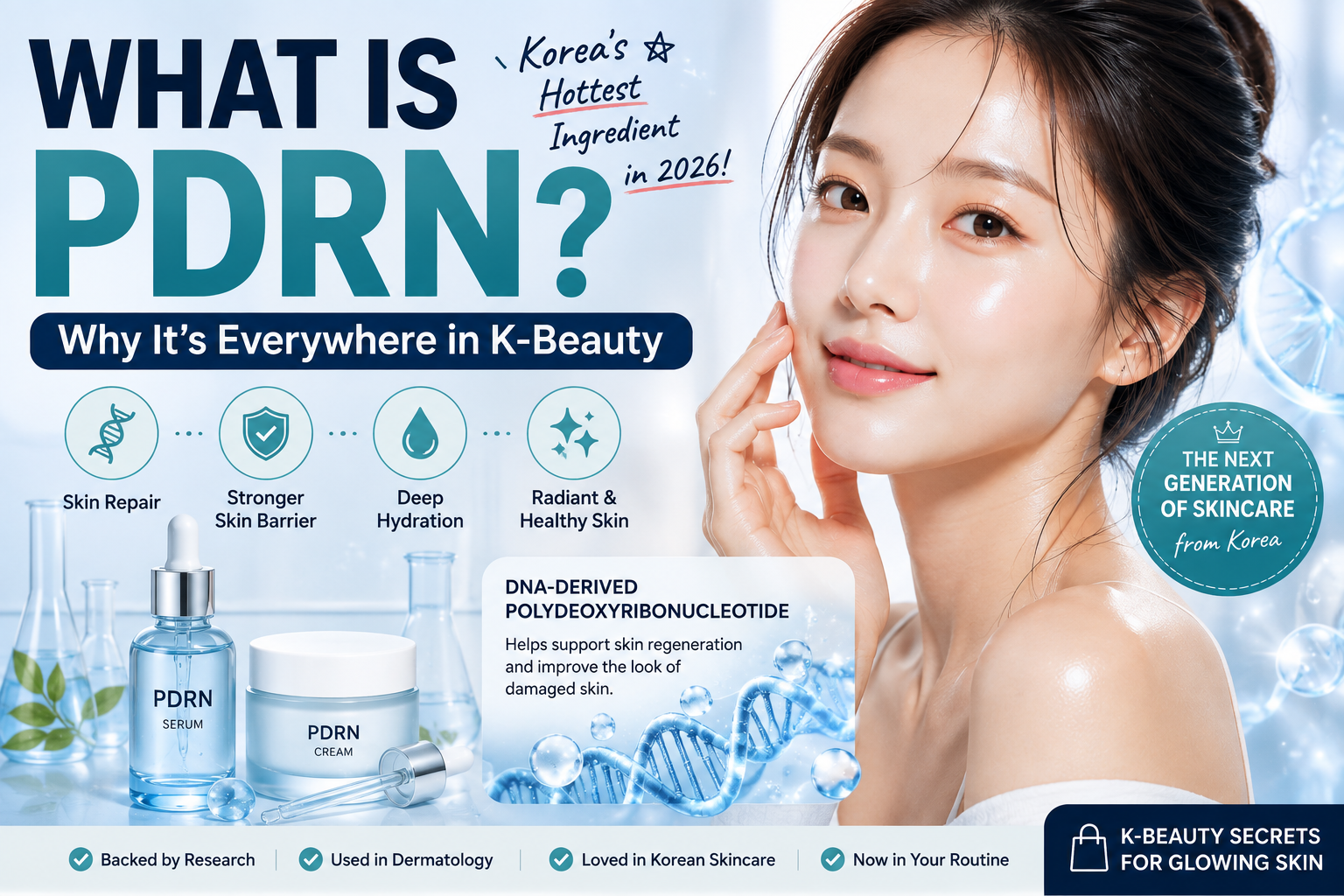
If you have been following Korean skincare in 2026, you have probably noticed four letters appearing on more and more product labels:
PDRN.
Serums, creams, masks and professional skin treatments are increasingly using the ingredient as a selling point. Some brands describe it as a regenerative skincare breakthrough, while others connect it to the growing popularity of Korean dermatology treatments.
But what exactly is PDRN?
Does it genuinely help skin, or is it another K-beauty ingredient being pushed beyond what the science can prove?
The answer is more interesting than either extreme. PDRN has a real scientific background, and recent research is expanding its potential applications. However, the evidence for a professional treatment is not automatically evidence that every PDRN serum will produce the same results.
Here is what consumers should understand before buying into the trend.
1. What Is PDRN?
PDRN stands for polydeoxyribonucleotide.
It is a mixture of DNA fragments that has been studied for its potential role in tissue repair, wound healing and regenerative processes.
PDRN is not a single, identical molecule found in every skincare product. Its characteristics can vary depending on its source, molecular size, manufacturing process and formulation.
In medical research, PDRN has been investigated for biological activities associated with tissue recovery. One proposed mechanism involves the adenosine A2A receptor, which is connected to processes such as inflammation regulation and tissue repair.
This scientific background explains why PDRN has attracted attention in dermatology and aesthetic medicine.
But there is an important distinction: an ingredient’s biological potential does not automatically establish the effectiveness of every cosmetic product containing it.
2. Why Has PDRN Become So Popular in Korean Skincare?
K-beauty has gradually moved beyond the idea that good skincare is simply about adding moisture.
Consumers are increasingly interested in products associated with:
Skin barrier care
Hydration and elasticity
Smoother-looking skin
Healthy-looking aging
Skin recovery and comfort
This has created demand for ingredients inspired by regenerative medicine and dermatological research.
PDRN fits naturally into this movement because it has a medical research background rather than being marketed only as a conventional moisturizing ingredient.
The trend is also moving from professional treatments into everyday consumer products. Ingredients once discussed mainly in clinics are now appearing in serums, creams and other at-home skincare formats.
Vogue included PDRN among the bio-regenerative actives expected to influence K-beauty in 2026. That reflects its growing cultural and commercial visibility, although popularity should not be confused with proof of effectiveness.
3. Is PDRN Really Made From Salmon?
This is one of the most common questions about the ingredient.
Traditionally, many medical PDRN preparations have been associated with DNA extracted from salmon or trout. This is why PDRN is sometimes described in beauty marketing as “salmon DNA.”
However, salmon is not the only possible source.
Research published in late 2025 and included in a 2026 journal issue investigated PDRN derived from Paeonia lactiflora, commonly known as Chinese peony. The researchers examined whether plant-derived DNA fragments could offer an alternative to traditionally used salmon-derived PDRN.
The study reported encouraging laboratory findings and preliminary results from small human evaluations.
This is an interesting development, but it does not mean all plant-derived PDRN products have been proven equivalent to established medical preparations.
The practical lesson is simple:
Do not assume that every product containing PDRN has the same source, composition or research evidence.
Check the manufacturer’s ingredient information and product specifications rather than relying on the phrase “salmon DNA” or “plant PDRN” alone.
4. What Does Scientific Research Actually Say About PDRN?
Research into PDRN and related polynucleotides has examined several areas:
Wound healing and tissue repair
Skin rejuvenation
Scar management
Inflammation-related processes
Changes in skin structure and elasticity
A 2026 systematic review examined randomized clinical trials involving polynucleotides and PDRN. It included seven trials with a total of 183 participants across skin rejuvenation, postoperative scar prevention and wound-healing applications.
The review reported encouraging results, particularly in wound-healing settings.
However, the authors also highlighted important limitations: the studies were relatively small, treatment methods varied, and outcome measurements were not standardized.
There is another detail worth understanding. The review examined both polynucleotides (PN) and polydeoxyribonucleotides (PDRN). These terms are related, but they do not necessarily describe identical materials or formulations.
Therefore, the review should not be interpreted as proof that every PDRN cosmetic serum works.
The current scientific picture is promising, but still developing.
5. Can a PDRN Serum Actually Improve Skin?
This is the question that matters most to ordinary skincare consumers.
Professional PDRN treatments and topical PDRN cosmetics are different forms of use. Their formulations, concentrations, delivery methods and exposure to the skin can differ substantially.
A notable 2026 study investigated a specific medium-length PDRN formulation called PDRN-850K.
The research included laboratory and skin-model experiments, as well as a randomized, double-blind, split-face clinical study comparing a 0.1% PDRN-850K eye cream with a 0.1% retinol eye cream over 28 days.
The researchers reported improvements in several measured periocular skin parameters, including wrinkles and dermal characteristics.
That is an interesting result because it provides clinical evidence involving a topical PDRN formulation rather than relying exclusively on injectable treatments.
But the limitations matter:
The study tested a particular formulation, not every PDRN product on the market.
The treatment period was only 28 days.
The findings need independent replication and longer-term evaluation.
Results from an eye cream cannot automatically be applied to unrelated serums or creams.
In other words, the study strengthens the case for further topical PDRN research. It does not establish that any product with PDRN on its label will deliver comparable results.
6. PDRN Cosmetics and Professional Treatments Are Not the Same
This distinction is essential when reading Korean beauty marketing.
PDRN cosmetics
These are products designed for topical use at home, including:
Serums
Creams
Ampoules
Sheet masks
Their intended role depends on the complete formulation and the product’s cosmetic claims.
Professional PDRN or polynucleotide treatments
These are procedures performed in clinical or professional settings. Depending on the product and procedure, they may involve different delivery methods and treatment protocols.
Clinical research involving an injectable or professionally administered preparation cannot automatically be used to support claims about an ordinary cosmetic serum.
The same applies in the opposite direction: a moisturizing effect from a topical product does not prove that it reproduces the biological effects investigated in medical treatments.
If you are considering a professional procedure in Korea, read our separate guide:
Dermatology in Korea for Foreigners 2026: Treatments, Costs & How to Book
7. How Should You Use a PDRN Serum?
If you choose to try a PDRN serum, follow the instructions for that specific product.
You do not need to replace your entire skincare routine just because PDRN is trending.
Introduce new products gradually, especially if you have sensitive skin or already use active ingredients such as retinoids or exfoliating acids.
Pay attention to the complete ingredient list. Fragrance, preservatives and other active ingredients can influence how a product feels on your skin.
If irritation develops, stop using the product and seek professional advice if symptoms persist.
8. Who Might Be Interested in PDRN Skincare?
PDRN products may appeal to consumers interested in:
Hydration and skin barrier care
Skin elasticity and firmness
Smoother-looking skin
Healthy-looking aging
Supporting a simple skincare routine
However, no single ingredient is suitable for everyone.
People with sensitive or reactive skin should consider the entire formulation rather than focusing only on PDRN.
It is also worth remembering that basic skincare habits remain important. Gentle cleansing, appropriate moisturizing and daily sun protection have a much more established role in maintaining skin health than chasing every new ingredient trend.
9. Is PDRN Better Than Retinol?
Not necessarily. They are different ingredients with different research histories and purposes.
Retinoids have a much longer history of dermatological research and use, particularly in the management of photoaging and acne.
PDRN is a developing area of interest in regenerative dermatology and cosmetic research.
The 2026 PDRN-850K study mentioned earlier compared one specific topical PDRN eye cream with a 0.1% retinol eye cream. The researchers reported more favorable changes for the PDRN formulation in several measured outcomes over 28 days.
That result is worth watching, but it does not establish that all PDRN products are superior to retinol.
A fair comparison requires looking at the exact formulation, concentration, study design, duration and measured outcome.
For consumers, the better question is not simply which ingredient is stronger.
It is which product is appropriate for their skin concerns and can be used consistently without irritation.
10. How to Choose a PDRN Skincare Product
Do not buy a product simply because the letters PDRN appear prominently on the package.
Before purchasing, check the following:
The complete ingredient list: Look for the actual ingredient declaration rather than relying only on front-label marketing.
The manufacturer’s information: Check whether the brand explains the source and characteristics of its PDRN ingredient.
The product’s purpose: A moisturizing serum and a product marketed for skin elasticity may have different supporting ingredients.
The full formulation: Hyaluronic acid, niacinamide, peptides and other ingredients may contribute to the product’s overall performance.
Your skin type: Consider fragrance, potential irritants and the other active ingredients already in your routine.
The retailer: Buy from an authorized brand store or a retailer you trust.
A high PDRN claim on the package does not, by itself, tell you how effective the finished product will be.
11. Why Anua PDRN Is Appearing in the K-Beauty Conversation
One example of PDRN moving into everyday Korean skincare is the Anua PDRN Hyaluronic Capsule 100 Serum.
The product is featured on Olive Young Global, showing how the ingredient has moved beyond professional treatment discussions and into the international K-beauty shopping market.
Anua’s official ingredient information lists Sodium DNA, the cosmetic ingredient name associated with DNA-derived material, at 100 ppm. The formulation also includes several forms of hyaluronic acid and other moisturizing ingredients.
This is an important detail for consumers.
The product is not simply a bottle of PDRN. It is a complete cosmetic formulation in which hydration-focused ingredients also play a role.
Its presence in Olive Young’s international product selection illustrates the commercial popularity of the trend. It does not independently demonstrate that the serum produces the same results as a clinical PDRN treatment.
You can also explore our Korea’s Hottest K-Beauty 10 Global Best Sellers collection in True Taste Korea Picks.
12. Is PDRN Worth Trying in 2026?
PDRN is more than an invented beauty buzzword.
It has a genuine scientific background, and research published in 2025 and 2026 has expanded interest in both traditional and alternative sources, as well as topical formulations.
At the same time, the evidence is not strong enough to support every claim appearing in skincare advertising.
The most important distinction is between:
Research on PDRN as a biological material
Clinical studies of specific professional treatments
Clinical studies of particular topical formulations
The performance of an individual commercial cosmetic
These are related questions, but they are not interchangeable.
If you are curious about PDRN, trying a well-formulated cosmetic product may be reasonable as part of an ordinary skincare routine. Just do not expect it to replace established treatments or deliver guaranteed regenerative results.
13. Frequently Asked Questions About PDRN
Is PDRN the same as salmon DNA?
Not exactly. Traditional PDRN preparations have often used DNA derived from salmon or trout, but research has also investigated alternative sources, including plants. Check the source and formulation of the individual product.
Does PDRN work immediately?
There is no universal timeline. Results depend on the formulation, intended use and individual skin characteristics. A product should not be expected to produce instant regenerative effects.
Can I use PDRN with retinol?
There is no universal rule that the ingredients cannot be used together. However, the complete formulation and your skin’s tolerance matter. Introduce products gradually and follow the manufacturer’s directions.
Is PDRN safe for sensitive skin?
PDRN itself does not determine whether a finished product will suit sensitive skin. Other ingredients in the formulation can cause irritation or reactions. Check the full ingredient list and patch-test new products.
Is a PDRN serum the same as a Korean PDRN skin treatment?
No. Topical cosmetics and professional treatments can differ in formulation, concentration and delivery method. Evidence for one should not automatically be applied to the other.
Is plant-derived PDRN better than salmon-derived PDRN?
Current research does not establish that one source is universally better. The source, molecular characteristics, formulation and quality of clinical evidence all matter.
14. The Real Story Behind Korea’s PDRN Trend
PDRN has become one of the most talked-about ingredients in Korean skincare because it sits at the intersection of two major developments: regenerative dermatology and the growing consumer demand for science-inspired beauty products.
The research is interesting. New topical studies are worth following, and plant-derived alternatives may open additional possibilities.
But the most responsible way to understand PDRN is to separate scientific progress from commercial promises.
A promising ingredient is not automatically a miracle product.
And a popular product is not automatically a clinically proven treatment.
For consumers exploring K-beauty in 2026, that distinction may be the most valuable skincare lesson of all.
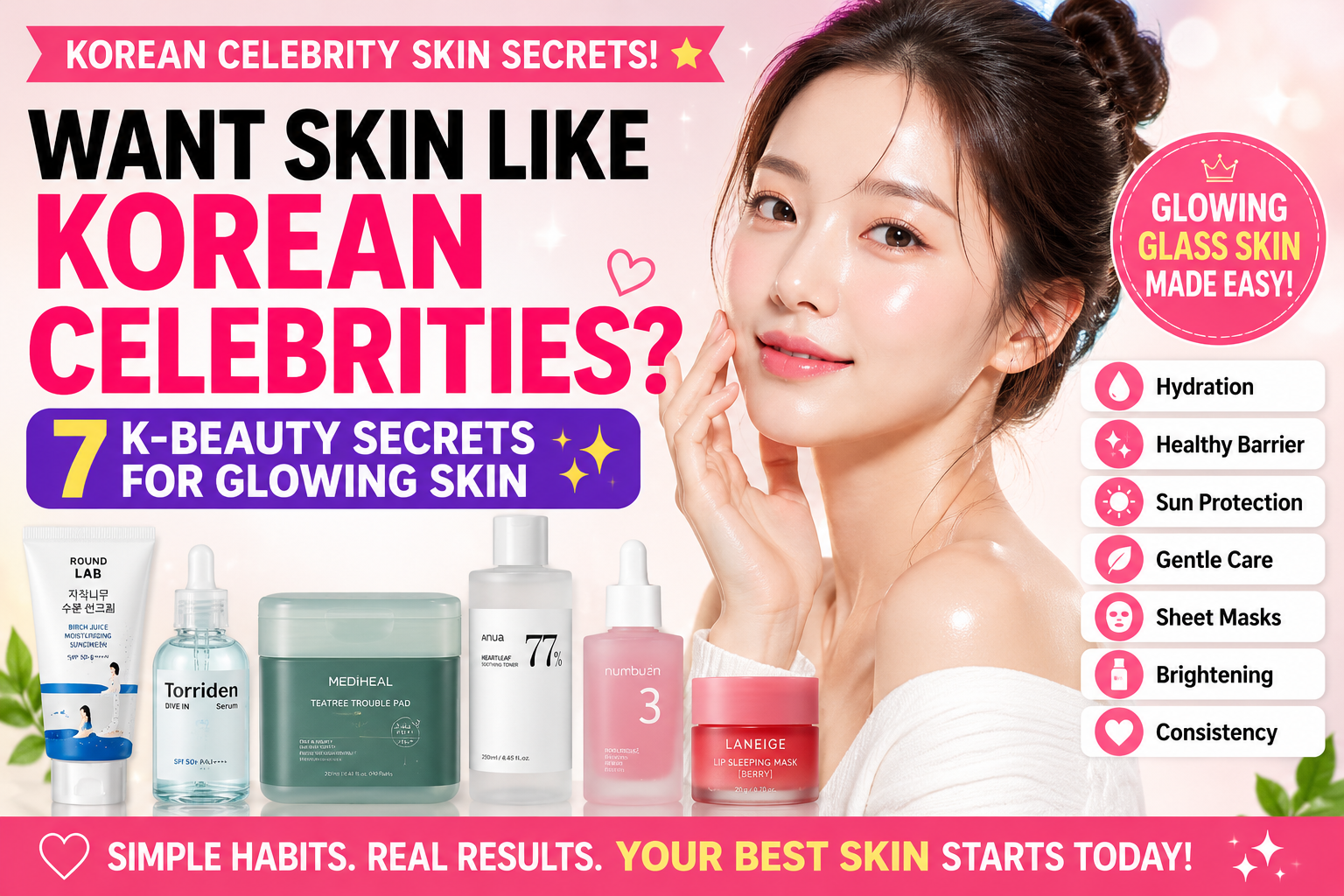
Have you ever watched a K-drama or K-pop performance and wondered:
How does their skin look so smooth, hydrated, and luminous?
Korean celebrities are often admired for their radiant-looking complexions. From K-drama actresses to K-pop idols, their skin has helped popularize the global beauty trend known as glass skin.
But is there really a secret Korean cream that can transform your skin overnight?
Not quite.
The reality is more interesting. Korean skincare is built around several practical ideas: gentle cleansing, hydration, protecting the skin barrier, daily sun protection, and choosing products that suit your individual skin.
Celebrity skincare routines can offer inspiration, but they are not universal formulas. Professional makeup, lighting, camera technology, genetics, and access to dermatological treatments can also influence how celebrities look on screen.
The useful lesson is not to copy everything a celebrity uses.
It is to understand the habits behind the routine and adapt them to your own skin.
Here are seven Korean skincare principles worth knowing.
1. Korean Skincare Is About Consistency, Not a 10-Step Rule
One of the biggest misconceptions about K-beauty is that everyone in Korea follows a complicated 10-step skincare routine every morning and night.
That is not how modern Korean skincare needs to work.
In a February 2026 Vogue article about the famous 10-step routine, K-beauty experts explained that Korean skincare is highly personalized. Depending on someone’s skin condition and concerns, a routine may contain only three products or considerably more.
The central idea is flexibility.
Some people need extra hydration during winter. Others need lightweight products because their skin becomes oily in humid weather. Someone dealing with sensitivity may benefit from simplifying their routine rather than adding more products.
Consistency is more useful than constantly changing products in search of an overnight transformation.
Jessica Jung discussed her detailed daily and nightly skincare habits in a 2016 Vogue interview. Her routine included cleansing products, toner, serum, creams, and lip care.
More recently, LE SSERAFIM’s Kazuha demonstrated a different approach in Vogue’s July 2026 Beauty Secrets feature. She described keeping her skincare relatively simple, even though she sometimes learns about new products from her bandmates.
These examples show that there is no single celebrity-approved formula.
The best skincare routine is one you can maintain without irritating your skin.
2. Clean Skin Comes First: Understanding Double Cleansing
Cleansing is one of the foundations of a Korean-inspired skincare routine.
Throughout the day, your face can accumulate sunscreen, makeup, excess oil, sweat, and environmental residue.
One method associated with K-beauty is double cleansing.
It involves two different cleansing steps.
First cleanse: Oil-based cleansing
An oil cleanser or cleansing balm helps dissolve oil-based substances such as makeup, sunscreen, and sebum.
Second cleanse: Water-based cleansing
A gentle facial cleanser removes remaining residue, sweat, and other impurities.
This method can be particularly useful for people who wear makeup or water-resistant sunscreen.
However, double cleansing is not compulsory for everyone.
If you wear little makeup and use a sunscreen that comes off easily with a gentle cleanser, one thorough cleanse may be enough.
Over-cleansing can leave the skin feeling tight, dry, or irritated.
The objective is not to wash your face as many times as possible.
It is to remove what needs to be removed without unnecessarily disturbing the skin’s natural protective barrier.
3. Hydration Is a Major Part of the Glass Skin Look
What makes glass skin look different from ordinary shiny skin?
The idea is not simply to make the face look oily.
Glass skin describes a complexion that appears smooth, hydrated, and luminous, with an even-looking surface.
Hydration is an important part of achieving this appearance.
Korean skincare products often include lightweight formulations designed to add moisture in different ways.
Common examples include:
Toners: Add a layer of hydration after cleansing.
Essences: Provide lightweight moisture and skin-conditioning ingredients.
Serums: Target particular concerns, depending on their ingredients.
Moisturizers: Help reduce moisture loss and support the skin barrier.
Sheet masks: Provide an additional temporary hydration step.
You do not need all five.
For someone with dry skin, a hydrating serum followed by a suitable moisturizer may be enough.
Someone with oily skin may prefer a lightweight gel moisturizer rather than a rich cream.
Ingredients such as glycerin and hyaluronic acid are commonly used in hydrating skincare formulations. However, no single ingredient guarantees perfect skin.
The important point is to choose products that suit your skin and use them consistently.
Glass skin is better understood as a skincare goal involving hydration and skin health, not a requirement to make your face look artificially reflective.
4. Sunscreen Is One of the Most Important Daily Habits
If there is one skincare habit worth prioritizing, it is sun protection.
Ultraviolet exposure contributes to sunburn, pigmentation, visible skin aging, and an increased risk of skin cancer.
That is why dermatologists consistently emphasize sunscreen.
Many Korean sunscreens have become popular internationally because of their lightweight textures and comfortable everyday formulations.
But the most important consideration is not whether a sunscreen is Korean.
It is whether it provides appropriate protection and whether you use enough of it.
When choosing sunscreen, look for:
Broad-spectrum protection against UVA and UVB rays
SPF 30 or higher
Water resistance when swimming or sweating
Apply it to exposed skin before going outdoors. Reapply approximately every two hours when outdoors, and after swimming or heavy sweating.
Sunscreen should not be reserved only for beach holidays.
Daily protection is a practical way to reduce cumulative UV exposure.
A complicated skincare routine cannot replace consistent sun protection.
5. Toner Pads and Sheet Masks: Useful Extras, Not Miracles
Walk into an Olive Young store in Korea and you will quickly notice two familiar products: toner pads and sheet masks.
They have become recognizable parts of the international K-beauty market.
However, these products do not all perform the same function.
Toner pads
Depending on their formulation, toner pads may provide hydration, soothing ingredients, or exfoliation.
Some contain ingredients such as hyaluronic acid and centella asiatica, while others include exfoliating acids such as AHA, BHA, or PHA.
That difference matters.
A hydrating pad and an exfoliating pad should not automatically be used with the same frequency.
If a pad contains exfoliating ingredients, start cautiously, particularly if your skin is sensitive.
Using multiple exfoliating products too frequently can cause irritation.
Sheet masks
Sheet masks are generally used as an additional skincare step to provide temporary hydration or soothing benefits.
They can be enjoyable before an event or whenever your skin feels dehydrated.
But a sheet mask cannot permanently change your skin or compensate for an unsuitable daily routine.
Think of these products as optional additions.
The foundation remains cleansing, moisturizing, and sun protection.
6. What Can We Learn From Korean Celebrities’ Real Skincare Routines?
Celebrity skincare videos are interesting because they show how different people approach their skin.
But they also reveal something important: not every celebrity uses an enormous collection of products.
A useful example is LE SSERAFIM’s Kazuha.
In a Vogue Beauty Secrets feature published in July 2026, she demonstrated her morning skincare and makeup routine.
Her skincare steps included:
Cleansing
Applying toner pads
Using a facial mist
Applying a hyaluronic acid serum
Applying moisturizer
Finishing with tinted sunscreen
She also explained that she generally prefers keeping her skincare simple, even though she learns about new products from other members.
This is a practical example of a routine that combines hydration with sun protection.
Jessica Jung offers a different example.
In her 2016 Vogue interview, she discussed following a daily and nightly routine consistently, including cleansing, toner, serum, and moisturizing products.
These interviews were conducted in different years and show different personal approaches.
They should not be treated as medical recommendations or proof that the products used by celebrities will produce identical results for everyone.
There is also an important difference between a celebrity’s actual skin and the final image viewers see.
Professional lighting, makeup artists, camera settings, image processing, and individual genetics all influence the appearance of skin.
The lesson is simple:
Learn from celebrity routines, but do not assume you need to reproduce them.
7. The New K-Beauty Conversation: Protecting the Skin Barrier
For years, the glass skin trend encouraged people to pursue an exceptionally smooth, reflective complexion.
This helped popularize multi-step routines, exfoliating products, hydrating layers, and countless new skincare launches.
But the conversation is evolving.
Recent K-beauty coverage increasingly emphasizes the importance of the skin barrier.
The skin barrier is the outermost protective layer of the skin. It helps limit moisture loss and protects against external irritants.
When this barrier becomes irritated or compromised, the skin may feel dry, tight, sensitive, or uncomfortable.
This is why adding more active ingredients is not always the answer.
A routine containing several exfoliating acids, retinoids, and other strong ingredients can be too aggressive for some people, especially when introduced all at once.
A more balanced approach includes:
Using a gentle cleanser.
Applying a suitable moisturizer.
Avoiding excessive exfoliation.
Introducing new active ingredients gradually.
Using sunscreen consistently.
Simplifying the routine when irritation develops.
This is an important shift in the way people can understand K-beauty.
Instead of chasing an unrealistic glass-like finish, the focus can be on maintaining comfortable, well-hydrated skin and protecting it over time.
8. Skincare Products and Dermatological Treatments Are Different
Korean cosmetics can support everyday skincare, but they should not be confused with medical treatment.
A moisturizer may help relieve dryness. A sunscreen can protect against UV exposure. Some cosmetic ingredients can improve the appearance of uneven skin tone or texture.
However, persistent acne, severe irritation, unusual pigmentation, scarring, or other skin conditions may require professional evaluation.
Korea is also known internationally for its dermatology and aesthetic treatment industry.
If you are considering a professional procedure, it is important to understand the treatment, possible side effects, recovery period, and qualifications of the medical professional providing it.
Do not choose a procedure simply because a celebrity or influencer recommends it.
The right approach depends on your skin condition and individual circumstances.
A Simple Korean-Inspired Skincare Routine for Beginners
You do not need ten products to start.
A basic routine can be enough to establish good skincare habits.
Morning Routine
Step 1. Gentle cleansing
Wash your face gently. Depending on your skin and how it feels in the morning, a simple water rinse may be sufficient for some people.
Step 2. Hydration
Use a hydrating toner or serum if your skin needs additional moisture.
Step 3. Moisturizer
Apply a moisturizer suitable for your skin type.
Step 4. Sunscreen
Finish with broad-spectrum SPF 30 or higher sunscreen.
Evening Routine
Step 1. Remove makeup and sunscreen
Use an appropriate cleansing product. Double cleansing may be helpful if you wear makeup or water-resistant sunscreen.
Step 2. Gentle cleansing
Cleanse without scrubbing or leaving your skin feeling tight.
Step 3. Targeted skincare
If needed, use a suitable serum or treatment product.
Step 4. Moisturizer
Finish by applying moisturizer to help reduce moisture loss.
Start with the basics. Add other products only when you have a clear reason to use them.
How to Choose Products for Your Skin Type
The same product does not work equally well for everyone.
Here is a simple starting point.
Dry skin
Look for moisturizing creams and hydrating products. Avoid cleansers that leave your face feeling tight.
Oily skin
Consider lightweight, non-comedogenic moisturizers. Oily skin still needs hydration.
Combination skin
You may need a lighter product on oily areas and a richer moisturizer on dry areas.
Sensitive skin
Choose simple formulations and introduce new products one at a time. Fragrance-free products may be worth considering if fragrance irritates your skin.
Acne-prone skin
Look for products labeled non-comedogenic. If acne is persistent or severe, consider consulting a dermatologist rather than continually buying new cosmetic products.
Before using a new product across your face, test it on a small area first. Stop using it if you develop significant irritation or an allergic reaction.
Korean Skincare FAQ
Do Korean celebrities really use 10-step skincare routines?
Some celebrities use many products, while others prefer simpler routines. There is no single routine followed by everyone.
What is glass skin?
Glass skin is a beauty term describing a complexion that appears smooth, hydrated, and luminous. It is an aesthetic goal rather than a medical skin condition.
Is double cleansing necessary every day?
Not necessarily. It can be useful for removing makeup and water-resistant sunscreen, but some people may only need one gentle cleanse.
Are Korean skincare products better than Western products?
Not automatically. Korean products are popular for their textures, formulations, and variety, but the best product is the one that suits your skin and has appropriate ingredients.
Do sheet masks give permanent results?
No. Sheet masks can provide temporary hydration and soothing benefits, but they do not permanently transform the skin.
Can oily skin use moisturizer?
Yes. Oily skin still needs moisture. A lightweight moisturizer may be more comfortable than a heavy cream.
How long does it take to see skincare results?
It depends on the product and the concern being addressed. Hydration may improve the appearance of dry skin relatively quickly, while changes involving acne, pigmentation, or texture can take longer. Some concerns require professional treatment.
So, What Is the Real Secret Behind Korean Glowing Skin?
There probably isn’t one miracle product.
The more useful explanation is a combination of everyday habits:
Gentle cleansing + hydration + skin barrier care + sun protection + consistency.
Celebrity routines can introduce interesting products and techniques, but they should be viewed as inspiration rather than instructions.
The real value of K-beauty is its emphasis on making skincare part of everyday life.
You do not need to buy ten products, follow every new trend, or spend a fortune at a beauty store.
Start with a few suitable products.
Give your skin time to adjust.
Pay attention to how it responds.
And remember that healthy-looking skin is not about achieving an impossible celebrity image.
It is about taking care of the skin you have, one day at a time.
South Korea has become one of the world’s most talked-about destinations for dermatology and aesthetic skin treatments.
International visitors come to Korea for consultations about acne, pigmentation, acne scars, skin texture, laser procedures, and other skin concerns. Some combine a dermatology appointment with a holiday in Seoul, while others travel specifically for medical treatment.
The scale of international demand is significant.
According to South Korea’s Ministry of Health and Welfare, 2,011,822 foreign patients from 201 countries visited Korea for medical care in 2025. Dermatology accounted for approximately 1.31 million department-level patient visits, or 62.9% of the reported total. The number of dermatology visits increased by 86.2% compared with 2024.
Seoul attracted 87.2% of all foreign patients.
These figures help explain why Korean dermatology has attracted so much international attention. But popularity alone is not a reason to undergo a medical procedure.
If you are considering skin treatment in Korea, you need to understand more than the advertised price. You should know how to identify an appropriately registered medical institution, what to ask during a consultation, how to compare treatment estimates, and how to plan for recovery before returning home.
This guide explains the practical steps international visitors should take before booking dermatology treatment in Korea in 2026.
Medical disclaimer: This article provides general information about medical travel in South Korea. It does not diagnose skin conditions, recommend individual procedures, or endorse specific clinics. Treatment suitability, risks, results, recovery time, and costs vary between individuals. Always consult a qualified medical professional before making a treatment decision.
1. Why Is Korean Dermatology Popular With Foreign Visitors?
Korea’s international reputation in beauty began partly through K-beauty products, skincare routines, and the global popularity of Korean entertainment.
However, cosmetic skincare products and medical dermatology are two different things.
A moisturizer or serum purchased at a beauty store is not equivalent to a medical procedure performed at a clinic.
Korea has developed a large market of medical institutions offering dermatology consultations and aesthetic treatments. Many institutions also have international patient coordinators and multilingual services.
The 2025 government statistics demonstrate how important dermatology has become in medical tourism.
Foreign patients from 201 countries: 2,011,822
Reported dermatology department visits: approximately 1.31 million
Dermatology’s share of reported department-level treatment: 62.9%
Year-over-year increase in dermatology visits: 86.2%
Foreign patients treated in Seoul: approximately 87.2% of the national total
An important statistical distinction: The dermatology figure refers to department-level patient counts. A person who visits more than one medical department can be counted in more than one department. It should not automatically be interpreted as 1.31 million unique individuals receiving dermatology treatment.
The numbers show strong demand, but they do not prove that every procedure is suitable, necessary, or effective for every visitor.
The most important decision is choosing medical care that matches your individual skin condition.
2. What Skin Conditions and Treatments Do Foreigners Research in Korea?
Korean dermatology clinics offer consultations and treatments for a wide range of skin concerns.
The exact procedures available depend on the medical institution, the physician, and the patient’s condition.
Here are some of the main categories international visitors commonly research.
Acne and Acne Scars
Acne treatment is not one-size-fits-all.
A dermatologist may need to distinguish between active acne, inflammation, post-acne pigmentation, and different types of acne scarring before discussing treatment options.
For example, a dark mark left after a blemish is not necessarily the same condition as a depressed acne scar.
The appropriate approach depends on the diagnosis, skin characteristics, and medical history.
If acne or scarring is your main concern, explain what you have experienced and what treatments you have already tried. Do not assume that a procedure advertised for acne scars will address every type of mark.
Pigmentation, Melasma, and Dark Spots
Visitors also research Korean dermatology for concerns involving freckles, sun-related pigmentation, melasma, and uneven skin tone.
These conditions can look similar in photographs but may have different causes and treatment considerations.
This is particularly important before undergoing laser treatment.
Ask the physician to explain what type of pigmentation you have and why the proposed treatment is appropriate. Some pigmentation conditions can worsen with unsuitable treatment or excessive irritation.
Laser and Energy-Based Treatments
Korean clinics offer different laser and energy-based technologies for concerns such as pigmentation, redness, hair removal, scars, and skin texture.
However, the name of a machine does not tell you whether it is appropriate for your skin.
Two clinics may advertise similar equipment but offer different treatment plans, settings, medical supervision, and aftercare.
Ask the physician:
What condition is this treatment intended to address?
Why is this device appropriate for my skin?
What are the possible side effects?
How many sessions might be required?
What results are realistic?
What recovery time should I expect?
Do not choose a procedure simply because a particular device is popular on social media.
Skin Texture and Pores
Treatments marketed for pores, rough texture, and overall skin appearance are also common in Korea.
Depending on the condition, a clinic may discuss topical treatment, prescription medication, laser procedures, or other medical approaches.
The important point is to understand what is causing the concern.
Visible pores, uneven texture, acne scarring, and skin dryness are not interchangeable problems. A consultation should establish which concern is being addressed before a treatment is selected.
Wrinkles, Skin Elasticity, and Lifting
International visitors may also research aesthetic treatments related to fine lines, wrinkles, facial contours, and skin elasticity.
These treatments can vary considerably in intensity, cost, and recovery requirements.
Some are relatively short outpatient procedures, while others require more preparation and follow-up.
Before agreeing to treatment, ask about the expected benefit, possible complications, alternatives, and whether the proposed procedure is appropriate for your medical history.
The key principle: Choose a treatment after understanding your skin condition, not before.
3. Dermatology Clinic or Beauty Clinic: What Should You Check?
This distinction is important when researching medical care in Korea.
English-language advertisements may use expressions such as:
Dermatology clinic
Skin clinic
Beauty clinic
Aesthetic clinic
Laser clinic
These descriptions do not, by themselves, tell you everything about the institution or the medical professional who will treat you.
Before booking, establish:
What type of medical institution are you contacting?
Is the institution registered to serve foreign patients?
Which physician will examine you?
Is that physician a board-certified dermatologist?
Who will perform the actual procedure?
Will a physician be available if a complication occurs?
If specialist dermatological expertise is important to your condition, ask directly whether a board-certified dermatologist will conduct the consultation and perform or supervise the treatment.
Do not assume that an English-language website or a fashionable clinic location answers these questions.
4. How to Check Whether a Korean Clinic Is Registered for Foreign Patients
South Korea operates an official registration system for medical institutions and businesses that attract international patients.
This is one of the most useful checks for foreigners planning treatment.
Under the registration system, medical institutions serving foreign patients must meet specified requirements. These include medical malpractice liability insurance for registered institutions.
You can search for registered medical providers through the official government platform:
When checking a clinic, make sure the name and location match the institution you intend to visit.
Do not rely only on a clinic’s advertisement saying that it serves international patients.
Does Registration Guarantee Good Treatment?
No.
Registration is an important administrative and patient-protection requirement, but it is not a guarantee that every treatment will be appropriate or that every patient will achieve a particular result.
It also does not replace your responsibility to understand the proposed treatment.
You should still check the physician’s qualifications, consultation process, treatment plan, risks, price, and follow-up arrangements.
If a clinic cannot clearly explain who will treat you or what procedure you are paying for, take time to reconsider before making a deposit.
5. Where Do Foreigners Usually Go for Dermatology in Korea?
Seoul is the main destination for international medical visitors.
In 2025, approximately 1.76 million foreign patients received treatment in Seoul, representing 87.2% of the national total.
This concentration means international visitors can find a wide range of medical institutions in the capital.
Several Seoul neighborhoods are commonly associated with dermatology and aesthetic medical services.
Gangnam
Gangnam is one of Seoul’s best-known medical and beauty districts.
It has a substantial concentration of clinics and medical businesses, making it a convenient area for visitors who want to compare multiple providers.
However, the number of clinics in an area does not establish the quality of any individual institution.
Sinsa and Apgujeong
These neighborhoods are also associated with cosmetic and aesthetic medical services.
Visitors may find clinics offering consultations for skin concerns, lasers, and other aesthetic procedures.
Check the specific physician and institution rather than choosing based on the neighborhood name.
Cheongdam
Cheongdam is another area known for cosmetic and aesthetic services.
Some visitors may prefer its location and surrounding accommodation options, but treatment suitability should remain the deciding factor.
Myeongdong
Myeongdong is convenient for international tourists because of its central location, hotels, shopping, and transport connections.
It may be practical for visitors who want to combine a medical appointment with sightseeing, provided their treatment and recovery requirements allow it.
What About Cities Outside Seoul?
Foreign patients also visit medical institutions in Busan, Incheon, Gyeonggi Province, Jeju, and other parts of Korea.
The official Medical Korea directory allows visitors to search registered institutions rather than limiting their search to famous Seoul neighborhoods.
Our advice: Choose the medical institution first, then select accommodation and transportation based on its location.
6. How Much Does Dermatology Cost in Korea?
Cost is one of the first questions international visitors ask.
Unfortunately, there is no reliable universal price for Korean dermatology.
A consultation, a laser procedure, a treatment for acne scars, and a more intensive aesthetic procedure can have very different costs.
Even two clinics offering a treatment with a similar name may quote different amounts.
The final price can depend on:
The medical diagnosis
The procedure selected
The treatment area
The device or technique used
The number of sessions
The physician’s involvement
Medication and prescription costs
Anesthesia or numbing
Additional examinations
Follow-up care
Promotional advertisements may show a starting price that applies only to a limited treatment area, a particular session, or specific conditions.
For this reason, we do not recommend relying on a single advertised price as a realistic estimate of your total medical expense.
Request a Written Price Estimate
Before booking your flight, ask the clinic for a written estimate based on the treatment you are considering.
Ask whether the price includes:
Cost item
What to confirm
Consultation
Is the initial medical consultation included?
Examination
Are additional tests or assessments charged separately?
Procedure
What exact treatment is included?
Anesthesia
Is numbing or anesthesia included?
Medication
Are prescriptions and medicines extra?
Follow-up
Is a follow-up consultation included?
Additional treatment
Could extra sessions or treatment areas increase the price?
Also ask whether the estimate is final or subject to change after the physician examines your skin.
Calculate the Total Cost of Your Medical Trip
The treatment price is only one part of medical travel.
Your actual budget may include:
Return flights
Accommodation
Local transportation
Medical interpretation
Meals
Medication
Additional recovery days
Travel insurance
Emergency expenses
A clinic with a lower advertised price may not necessarily produce a lower overall trip cost if it requires more visits or a longer stay.
For international visitors, comparing the complete treatment and travel budget is more useful than comparing promotional prices alone.
7. How to Book a Korean Dermatology Clinic From Overseas
You do not always need to wait until you arrive in Korea to make an inquiry.
Many institutions serving foreign patients provide online contact forms, email addresses, messaging services, or international patient coordinators.
A careful booking process can help you avoid misunderstandings.
Step 1: Describe Your Skin Concern
Start by explaining what you want a physician to evaluate.
For example:
Persistent acne
Acne scars
Dark spots
Melasma
Redness
Uneven skin texture
Fine lines
Hair or scalp concerns
You do not need to diagnose yourself or select a procedure in advance.
Your goal is to describe the concern accurately so the clinic can explain its consultation process.
Step 2: Shortlist Registered Clinics
Use the official Medical Korea directory to identify institutions registered to serve foreign patients.
Compare several providers rather than relying on the first advertisement you encounter.
Step 3: Contact the International Patient Coordinator
Ask whether the clinic accepts overseas patients and how consultations are arranged.
Confirm whether the coordinator can communicate in your preferred language.
Step 4: Provide Relevant Medical Information
Depending on your concern, the clinic may ask about:
Previous diagnoses
Previous skin treatments
Current medications
Allergies
Relevant medical conditions
Skin photographs
Previous test results
Provide accurate information. Do not hide previous treatments or medical conditions because you think they might affect the clinic’s willingness to book you.
Step 5: Request a Written Estimate
Ask for an estimated cost and a clear explanation of what is included.
A preliminary estimate may change after an in-person medical examination, so ask what could cause the final price to differ.
Step 6: Confirm the Treatment Schedule
Find out how long the consultation and procedure may take, whether multiple visits are necessary, and whether follow-up is required.
Step 7: Arrange Flights and Accommodation
Only after you understand the likely schedule and recovery requirements should you finalize your travel arrangements.
For more complicated treatments, consider discussing your travel dates with the medical institution before purchasing non-refundable tickets.
8. Can Foreigners Receive Dermatology Treatment Without Speaking Korean?
Yes, it may be possible.
Some medical institutions serving international patients provide multilingual coordinators or interpretation services.
However, language support varies considerably.
A clinic may have English-speaking reception staff without offering an interpreter during the actual medical consultation.
That difference matters.
You need to understand the proposed procedure, possible complications, consent documents, medication instructions, and aftercare.
Before booking, ask:
Is an English-speaking coordinator available on my appointment date?
Is medical interpretation available during the consultation?
Will the physician communicate directly with me?
Are consent forms available in a language I understand?
Can I contact the clinic in English after treatment?
Is interpretation included in the quoted price?
If you cannot understand the treatment explanation or consent process, do not feel pressured to proceed.
Understanding what you are agreeing to is more important than completing an appointment quickly.
For general assistance with medical travel in Korea, you can also visit the official Medical Korea website.
9. Ten Questions to Ask Before Paying a Deposit
Before paying a deposit or agreeing to a procedure, make sure you can answer these questions.
Who will examine my skin? Ask for the physician’s name and qualifications.
Who will perform the procedure? Do not assume the person conducting the consultation will perform the treatment.
Why is this treatment suitable for me? Ask for an explanation based on your condition.
What are the alternatives? Find out whether other medical or non-procedural options are available.
What are the possible side effects? Ask about common reactions as well as less common complications.
What is the total estimated price? Request a written breakdown.
How many sessions may be required? One appointment may not be sufficient.
How much recovery time should I plan for? Ask about redness, swelling, bruising, peeling, or other expected effects.
What happens if I experience a complication? Find out how urgent problems are handled.
Who can I contact after returning home? Confirm whether remote follow-up is available.
A good consultation should give you enough information to make a considered decision without feeling rushed.
10. Be Careful When Comparing Before-and-After Photos
Before-and-after photographs are common in aesthetic medicine advertising.
They may help you understand the type of change a treatment is intended to produce, but they should never be your only reason for choosing a clinic.
Photographs can be affected by:
Lighting
Camera angle
Facial expression
Makeup
Image editing
Time between photographs
Different skin conditions
Individual treatment responses
Another patient’s result does not guarantee yours.
Ask whether the photographs represent patients with a condition similar to yours and whether the treatment, number of sessions, and follow-up period are explained.
Remember that medical results vary. Be cautious of advertisements that promise perfect results or suggest that a procedure works equally well for everyone.
11. When Should You Schedule Treatment During Your Korea Trip?
The timing of your treatment can have a significant effect on your travel experience.
Some procedures may involve temporary redness, swelling, bruising, sensitivity, or peeling.
Others may require multiple appointments or a longer period of recovery.
This means there is no universally ideal day for dermatology treatment during a holiday.
Treatment on Your First Day
Booking immediately after arrival may leave little time to adjust to your travel schedule.
If the treatment requires follow-up, you will need to ensure that enough time remains in Korea.
Treatment on Your Last Day
Booking immediately before departure may also be unsuitable.
If an unexpected reaction occurs, you may already be traveling home before you have a chance to contact the clinic in person.
A More Practical Approach
Ask the medical provider:
How long should I remain in Korea after this treatment?
Is a follow-up appointment necessary?
When is it safe to fly?
What activities should I avoid?
What symptoms require medical attention?
Then plan your travel around the physician’s recommendations.
For more intensive procedures, avoid arranging your trip so tightly that there is no flexibility for recovery or follow-up.
12. Sun Exposure, Exercise, and Other Activities After Treatment
A Korea holiday often involves walking outdoors, shopping, sightseeing, and visiting popular attractions.
However, some dermatology procedures may require temporary restrictions.
Depending on the treatment, your provider may advise you to modify activities such as:
Direct sun exposure
Strenuous exercise
Swimming
Sauna visits
Hot baths
Alcohol consumption
Makeup application
Use of certain skincare products
The restrictions and their duration depend on the procedure and your individual response.
Do not assume that every laser treatment has the same recovery requirements.
Ask for written aftercare instructions before leaving the clinic, and follow those instructions rather than relying on general advice from travel websites or social media.
13. What Should You Bring to Your Dermatology Appointment?
Preparing a small medical information folder can make your consultation easier.
Consider bringing:
Passport or identification requested by the clinic
Appointment confirmation
Current medication list
Allergy information
Details of previous dermatology treatments
Relevant medical records
Photographs showing changes in your skin
Questions prepared in advance
Emergency contact information
If you have previously undergone laser procedures, injections, surgery, or prescription treatment, tell the physician.
If you are taking medication or have a medical condition that could affect treatment, disclose it before agreeing to a procedure.
Ask the clinic in advance whether any additional records or preparation are required.
14. What Happens If You Have a Problem After Returning Home?
Aftercare is one of the most important parts of medical tourism.
Your relationship with the medical provider should not end the moment you leave Korea.
Before treatment, ask:
Does the clinic offer remote follow-up?
Can I send photographs or describe symptoms after returning home?
Is there an emergency contact number?
Can the clinic provide a treatment summary?
Can it provide information for a physician in my home country?
If you experience an unexpected reaction after returning home, contact an appropriate local medical professional. Do not delay urgent medical care while waiting for an overseas clinic to respond.
You should also keep copies of your consultation notes, consent documents, receipts, prescriptions, and aftercare instructions.
These records may be useful if you need medical attention in your home country.
15. Where Can Foreign Patients Get Help in Korea?
The official Medical Korea platform provides information for international patients, including registered medical institutions and information about Korea’s medical tourism system.
The Medical Korea Information Center also provides support for foreign visitors.
Medical Korea Information Center
Telephone: +82-2-1577-7129
Seoul contact information and other official resources: Medical Korea
For general travel-related medical information, the Korea Tourism Organization also provides resources through VisitKorea.
Keep the contact information of your clinic and the relevant support services saved before your appointment.
These resources do not replace emergency medical care. If you experience a serious or urgent medical problem, seek immediate assistance from local emergency services.
16. Can You Combine Dermatology Treatment With a Korea Vacation?
Yes, but your medical schedule should determine your sightseeing plans.
It can be tempting to combine a dermatology appointment with shopping in Gangnam, a visit to Myeongdong, or a full day exploring Seoul.
That may be reasonable for some consultations or treatments, but not for every procedure.
Before planning activities, ask your physician whether you should avoid:
Long periods outdoors
Intensive walking
Exercise
Sauna or spa visits
Swimming
Direct sunlight
Activities that may interfere with recovery
If your treatment requires rest or follow-up, leave enough time in your itinerary.
A successful medical trip is not measured by how many tourist attractions you visit. It is measured by whether you receive appropriate care and have enough time to recover safely.
17. Is Korean Dermatology Worth Traveling For?
For some international visitors, Korea may be an attractive destination for dermatology consultations and skin treatments.
The country’s large medical tourism market, concentration of clinics in Seoul, and international-patient services make it a destination worth researching.
However, traveling abroad for treatment involves additional considerations.
You should compare:
Medical suitability
Physician qualifications
Medical institution registration
Treatment options
Total cost
Language support
Recovery time
Follow-up care
Travel and accommodation expenses
The lowest advertised price is not necessarily the best value.
Likewise, a famous clinic or a treatment that is popular online is not automatically the right choice for your skin.
The best treatment is the one that a qualified medical professional considers appropriate for your individual condition, after explaining its benefits, limitations, and risks.
Korean Dermatology for Foreigners: Pre-Travel Checklist
Before booking your trip, use this checklist to make sure you have considered the important details.
Clearly describe the skin concern you want evaluated.
Research the treatment rather than choosing a procedure from an advertisement.
Check the clinic in the official Medical Korea directory.
Confirm the physician’s qualifications.
Ask who will perform the procedure.
Confirm language and interpretation support.
Request a written price estimate.
Check what the quoted price includes.
Understand possible side effects and recovery time.
Confirm whether additional sessions are necessary.
Arrange accommodation near the medical institution if appropriate.
Leave enough time for recovery and follow-up.
Obtain written aftercare instructions.
Save the clinic’s contact information.
Prepare a plan for medical care after returning home.
Frequently Asked Questions About Dermatology in Korea
Is Korea a popular destination for dermatology treatment?
Yes. According to South Korean government statistics, dermatology accounted for approximately 62.9% of reported foreign-patient department visits in 2025. The number of dermatology visits increased by 86.2% compared with 2024.
Can foreigners visit Korean dermatology clinics?
Yes. International visitors can seek medical care at Korean medical institutions. If you are booking through a provider that attracts foreign patients, check whether it is registered under Korea’s foreign-patient registration system.
How much does dermatology treatment cost in Korea?
There is no single standard price. Costs depend on the diagnosis, procedure, treatment area, equipment, physician, medication, and follow-up requirements. Request a written estimate before arranging your trip.
Do Korean dermatology clinics offer English services?
Some clinics provide English-speaking coordinators or interpreters, but availability varies. Confirm that interpretation is available during the medical consultation, consent process, and aftercare discussions.
Is Gangnam the best place for dermatology in Korea?
Gangnam has a large concentration of medical and aesthetic clinics, but location does not guarantee treatment quality. Compare medical qualifications, registration, communication, treatment plans, and aftercare.
Can I get laser treatment and fly home the next day?
It depends on the specific treatment and your individual response. Some procedures involve temporary redness or swelling, while others may require longer recovery or follow-up. Ask the treating physician before booking your return flight.
How can I check whether a Korean clinic is registered for foreign patients?
South Korea is internationally known for K-pop, Korean food and K-beauty. But there is another reason why millions of international visitors are paying attention to the country: medical treatment.
In 2025, 2,011,822 foreign patients from 201 countries received medical care in South Korea, according to figures released by the Ministry of Health and Welfare in April 2026. This represented a 71.9% increase from 2024 and marked the first time the annual total exceeded two million.
From dermatology and plastic surgery to dental care, health screenings and treatment at major hospitals, Korea has developed a substantial medical service infrastructure for international patients.
However, traveling abroad for medical treatment involves more than choosing a clinic and booking a flight.
How can you find a properly registered hospital? What should you expect to pay? Is English-language assistance available? Do you need a medical visa? How long should you remain in Korea after treatment?
This guide explains how to plan medical tourism in Korea in 2026, from choosing a medical institution to arranging treatment, accommodation and follow-up care.
Important: This article provides general information, not medical advice. Treatment suitability, possible complications, recovery periods and costs depend on individual circumstances and the medical institution. Consult a qualified medical professional before making treatment decisions.
1. Why Are More Foreign Patients Choosing South Korea?
Korea’s medical tourism industry has expanded rapidly over the past several years.
According to the Ministry of Health and Welfare, the number of foreign patients increased from 605,768 in 2023 to 1,170,467 in 2024 and then reached 2,011,822 in 2025.
That represents a 71.9% increase in one year.
The largest groups of foreign patients in 2025 came from:
China: 618,973
Japan: 600,009
Taiwan: 185,715
United States: 173,363
Thailand: 58,124
China and Japan together accounted for approximately 60.6% of the total.
The growth reflects several factors, including international interest in Korean dermatology and cosmetic procedures, the popularity of Korean beauty culture, and the availability of medical services designed for overseas visitors.
But the numbers need to be understood correctly.
The total of 2,011,822 represents foreign patients, while department-level statistics can count the same person in more than one specialty. For example, someone who visits both a dermatology clinic and a plastic surgery department may appear in both department totals.
In 2025, dermatology accounted for 1,312,700 department-level patient counts, or 62.9% of the 2,087,400 total counts across departments. Plastic surgery accounted for 233,100, or 11.2%.
These figures show the strong demand for skin and cosmetic treatment, but they should not be interpreted as mutually exclusive shares of unique patients.
Another important detail is geography: 87.2% of foreign patients received treatment in Seoul in 2025. Seoul offers a particularly large concentration of medical institutions, international patient services, accommodation and transportation options.
Nevertheless, Busan, Jeju and other cities also serve international patients.
2. What Medical Treatments Are Popular in Korea?
The treatment you choose will determine where you should go, how long you need to stay, whether you need a companion and how much your trip may cost.
2.1 Dermatology and Skin Treatments
Dermatology is one of the largest areas of Korea’s foreign-patient market.
International visitors commonly look for medical consultations and procedures involving:
Acne and acne scars
Pigmentation and uneven skin tone
Skin texture and visible pores
Laser-based treatments
Certain cosmetic skin procedures
Medical treatment for specific skin conditions
Korean dermatology clinics offer different devices, techniques and treatment plans. However, a popular procedure is not automatically suitable for every skin type or medical condition.
Before booking, ask who will perform the procedure, whether a doctor will assess your skin, what risks are involved and whether additional sessions are necessary.
Do not choose a clinic simply because its social-media photographs look impressive or its advertised price is unusually low.
2.2 Plastic and Cosmetic Surgery
South Korea is also internationally recognized for cosmetic and reconstructive surgery.
Foreign patients may seek consultations for procedures involving the eyes, nose, face or body.
Surgery requires considerably more preparation than a short outpatient appointment.
You should understand:
The surgeon’s qualifications and relevant experience
The proposed procedure and available alternatives
Anesthesia arrangements
Possible complications
Expected recovery time
Follow-up appointments
What happens if a complication develops after returning home
Do not assume that a short stay is sufficient simply because the operation itself takes only a few hours.
Your surgeon should determine whether you are medically fit to fly and when travel is appropriate.
2.3 Comprehensive Health Checkups
Health screening is another reason international visitors consider Korea.
Some hospitals and specialized screening centers offer packages that combine several examinations during a scheduled visit.
Depending on the package, examinations may include blood tests, imaging, endoscopy or other assessments.
However, packages are not identical.
Compare the actual tests included, preparation requirements, consultation arrangements and how results will be explained. A more expensive package is not necessarily better for every patient.
Ask whether abnormal findings can be reviewed by a specialist and whether additional tests or treatment would require another visit.
2.4 Dentistry
Foreign visitors also travel to Korea for dental examinations and treatment.
Possible services include general dental care, restorative treatment, implants and other procedures, depending on the clinic.
The most important question is how many visits your treatment requires.
Some procedures cannot be completed in a single appointment. Others require healing time or additional adjustments.
Before traveling, request a treatment schedule and confirm whether the clinic can complete the necessary stages during your planned stay.
2.5 Major Hospital Treatment
Korea’s international medical services extend beyond cosmetic treatment.
Major hospitals provide services across specialties such as oncology, cardiology, neurosurgery, orthopedics, fertility treatment, rehabilitation and other areas of medical care.
Patients considering treatment for a serious condition should contact the hospital’s international patient center directly.
The hospital may request medical records, previous diagnoses, laboratory results, imaging files and a list of current medications before deciding whether it can provide an appropriate consultation.
For complex conditions, a remote review of medical records may be possible before travel, but it does not replace an in-person medical assessment.
3. How to Find a Reliable Hospital or Clinic in Korea
Choosing the right medical institution is one of the most important decisions in medical tourism.
A clinic appearing frequently on social media is not necessarily the best choice. Advertising popularity, online reviews and medical quality are different things.
Korea operates an official registration system for medical institutions and businesses that attract foreign patients.
The system is intended to help protect international patients and regulate organizations involved in attracting overseas medical visitors.
Registered medical institutions must meet specified requirements, including medical malpractice liability insurance covering foreign patients.
You can use the official Medical Korea website to search for institutions serving international patients:
Is the medical institution currently registered to attract foreign patients?
Does the registration information match the institution you intend to visit?
Does the hospital have experience with your particular treatment?
Are the doctor’s qualifications and relevant experience clear?
Is the treatment plan explained before payment?
Can the hospital provide written information about risks and follow-up care?
3.1 What Is KAHF Accreditation?
You may also encounter the term KAHF, which refers to the Korean Accreditation Program for Hospitals Serving Foreign Patients.
This is an evaluation and certification system for medical institutions that attract international patients.
Its assessment covers areas such as foreign-patient services, interpretation, patient rights, medication management, infection control and patient safety.
KAHF accreditation is an additional quality indicator. It is not the same as basic registration to attract foreign patients, and not every registered institution necessarily holds this accreditation.
You can check the official information and accredited institution list here:
A sensible approach is to check registration first, then look at accreditation, relevant specialist experience and the treatment plan.
4. Can Foreign Patients Receive Medical Assistance in English?
Many Korean institutions serving international patients offer foreign-language support.
However, the level of assistance differs.
Some hospitals have international patient centers with coordinators and interpreters. Others arrange interpretation only when requested or charge an additional fee.
Before confirming an appointment, ask:
Is an English-speaking coordinator available?
Is medical interpretation included in the quoted price?
Will an interpreter be present during consultation and treatment?
Can the hospital explain consent forms and possible complications in a language I understand?
Can I communicate with the hospital after returning home?
Do not assume that every doctor, nurse or staff member speaks English simply because the institution treats foreign patients.
4.1 Medical Korea Information Center
International visitors can also contact the Medical Korea Information Center for information and assistance.
The center provides guidance on medical institutions, medical services, travel and visa questions, reservations and complaints involving medical services.
Its Seoul contact number is:
+82-2-1577-7129
The listed operating hours are 09:00–18:00 Korea Standard Time, daily.
The center also operates at Incheon International Airport Terminal 1, where visitors can obtain information and assistance.
For current locations, operating hours and available languages, check:
Also ask whether the estimate is fixed or whether the final cost may change after an examination.
5.1 Calculate the Total Cost of Your Medical Trip
Medical expenses are only one part of the budget.
Your complete trip may include:
Medical treatment
International flights
Accommodation
Local transportation
Meals
Interpretation, if not provided
Companion expenses
Recovery-related purchases
Additional nights in Korea
Emergency expenses
For example, a procedure that appears affordable may become considerably more expensive if you need to extend your hotel stay or return for another examination.
Do not plan your budget around the lowest advertised treatment price.
The most useful comparison is the total expected cost of receiving appropriate care and completing the necessary follow-up.
6. How to Book Medical Treatment Before Traveling to Korea
For planned treatment, it is generally better to contact medical institutions before purchasing your flight.
A practical process looks like this:
6.1 Step 1: Identify the Treatment You Need
Research the medical condition or procedure first.
If you are uncertain which treatment is appropriate, seek an initial medical opinion rather than choosing a procedure based entirely on online advertising.
6.2 Step 2: Find Registered Medical Institutions
Use Medical Korea to identify institutions registered to serve foreign patients.
Create a shortlist rather than immediately choosing the first clinic you find.
6.3 Step 3: Contact the International Patient Center
Send an inquiry explaining your medical needs, preferred dates and language requirements.
Ask whether the institution accepts international patients for your particular condition or procedure.
6.4 Step 4: Provide Medical Records
Depending on the treatment, the institution may request:
Previous diagnoses
Medical history
Laboratory results
Imaging reports or scans
Current prescriptions
Information about allergies
Previous surgical records
Send sensitive medical information only through an appropriate, secure channel provided by the institution.
6.5 Step 5: Request a Written Treatment Plan
Ask what examinations are required, what the proposed treatment involves and what the estimated price includes.
If you are comparing several hospitals, make sure you are comparing similar treatment plans rather than different procedures with similar advertising names.
6.6 Step 6: Confirm Recovery and Follow-up Requirements
Ask how long you should remain in Korea.
Find out whether you need a follow-up appointment, whether you should avoid certain activities and when your doctor considers flying appropriate.
6.7 Step 7: Arrange Flights and Accommodation
Only after the medical schedule and expected recovery period are sufficiently clear should you finalize your travel arrangements.
Avoid booking a non-refundable return flight that leaves no room for medically necessary follow-up.
7. Do Foreign Patients Need a Medical Visa for Korea?
Visa requirements depend on nationality, the purpose of travel and the expected length of stay.
Korea has specific medical-tourism visa categories, including:
C-3-3 Medical Tourist Visa: Generally used for medical visits involving stays of 90 days or less.
G-1-10 Treatment and Recuperation Visa: Used for qualifying longer-term medical treatment or recuperation, with a stay period that can extend up to one year under the applicable conditions.
The exact eligibility requirements and application process depend on the patient’s circumstances.
Depending on the application route, documents may include:
Passport
Visa application
Medical diagnosis or relevant medical records
Confirmation of treatment or an appointment from a Korean medical institution
Evidence of financial ability to cover treatment and living expenses
Documents relating to an accompanying family member or caregiver, if applicable
Not every foreign patient needs to apply for a medical visa. Some nationalities may qualify for visa-free entry or another entry arrangement, depending on current rules and the purpose of the visit.
Do not assume that a tourist entry permission automatically covers every medical-travel situation.
Before booking, check the requirements for your nationality with the Korean embassy or consulate and the official Korea Visa Portal.
Seoul is the main destination for international medical patients.
Because 87.2% of foreign patients received treatment in Seoul in 2025, the city offers a large selection of medical institutions, international patient services and accommodation.
However, the best place to stay is not necessarily the most famous tourist neighborhood.
For medical travel, convenience and recovery should come first.
8.1 Stay Close to Your Hospital
If you have several appointments or need follow-up examinations, staying near the hospital can reduce unnecessary travel.
This is particularly important after surgery or procedures that affect mobility.
8.2 Check the Building and Room Facilities
Consider:
Elevator access
Comfortable bathroom facilities
A quiet room
Kitchen or laundry facilities for longer stays
Easy access to food and basic supplies
These details may seem minor before treatment but can become important during recovery.
8.3 Consider Transportation
Check the distance between your accommodation and the hospital.
After a procedure, long subway journeys or crowded public transportation may be uncomfortable.
Ask the medical institution whether it can recommend appropriate transportation or accommodation options.
8.4 Plan for an Extended Stay
Do not assume that you will be able to leave Korea immediately after your scheduled procedure.
Your doctor may recommend additional observation or follow-up appointments.
Keep enough flexibility in your accommodation booking to allow for medically necessary changes.
9. What Should You Prepare Before Leaving Home?
Create a medical travel folder before departure.
It should include:
Passport and visa documents, if required
Appointment confirmation
Medical history
Previous diagnoses and test results
Current medication list
Information about allergies
Emergency contact details
Travel insurance documents
Hospital and international patient center contact information
Written treatment and cost estimates
If you regularly take medication, ask your doctor whether anything needs to change before treatment.
The Korean medical institution may also provide instructions about fasting, medication, supplements or other preparation.
Follow medical instructions from qualified professionals. Do not stop prescribed medication or change your routine on your own.
If you are bringing prescription medication into Korea, check the applicable customs and import requirements in advance, particularly for controlled or restricted substances.
10. What Happens After Medical Treatment?
Recovery planning is just as important as booking the procedure.
Before leaving the hospital or clinic, make sure you understand:
Which medications should I take?
What symptoms are expected during recovery?
Which symptoms require urgent medical attention?
When is my next follow-up appointment?
When can I safely fly?
Who should I contact if a problem develops?
Can the hospital provide medical documents for my doctor at home?
For significant surgery, ask whether you need a companion during the first stage of recovery.
You should also ask how follow-up care will work after returning to your home country.
A clinic that offers an attractive initial price but cannot explain its aftercare arrangements may not be the right choice.
Treatment comes first. Tourism comes second.
Do not schedule an intensive sightseeing itinerary immediately after a medical procedure.
11. What If Something Goes Wrong?
Every international patient should consider the possibility of complications or disagreements before treatment.
Before paying, ask the institution how it handles:
Medical complications
Emergency treatment
Unexpected additional expenses
Follow-up appointments
Medical records and documentation
Complaints or disputes
Korea has support resources for foreign patients who experience difficulties while using medical services.
The Medical Korea Information Center provides consultation relating to medical complaints and disputes, as well as guidance on connecting with the Korea Medical Dispute Mediation and Arbitration Agency.
The center also provides information about illegal medical brokerage.
You can contact the Medical Korea Support Center at:
Keep copies of your treatment agreement, receipts, medical records and communications with the institution.
Knowing where to seek assistance before treatment is much better than trying to find help after a problem occurs.
12. Is Medical Tourism in Korea Worth It?
There is no universal answer.
Korea may be an attractive destination for patients interested in areas where the country has developed substantial international medical services, including dermatology, cosmetic procedures and health screening.
Major hospitals also provide services for international patients seeking specialist consultations and treatment for more complex medical conditions.
However, traveling abroad adds costs and risks that may not exist when receiving care close to home.
Consider the full picture:
Is the proposed treatment medically appropriate?
Does the institution have relevant experience?
Is the doctor qualified for the procedure?
Are the risks and alternatives clearly explained?
Is the total cost affordable?
Can you remain in Korea long enough for recovery?
Is follow-up care available after returning home?
The most important question is not simply:
“Is medical treatment cheaper in Korea?”
A better question is:
“Does the medical suitability, treatment plan, total cost, travel burden and follow-up care make Korea the right choice for my particular situation?”
Make your decision based on medical advice and verifiable information, not advertising alone.
13. Medical Tourism in Korea: Quick Checklist
Before booking your trip, confirm the following:
The hospital or clinic is currently registered to serve foreign patients.
You have checked the doctor’s qualifications and relevant experience.
You understand the proposed treatment and its risks.
You have received a written treatment estimate.
You know which services are included in the price.
Language support has been confirmed.
Your visa and entry requirements have been checked.
Your accommodation is suitable for recovery.
You know how long you should remain in Korea.
Follow-up care has been arranged.
You understand what to do if complications develop.
You have copies of your medical records and payment documents.
14. Final Thoughts: Plan Your Treatment Before Your Trip
More than two million foreign patients received medical care in South Korea in 2025, demonstrating how quickly the country’s international medical sector has expanded.
But successful medical travel requires more than finding a well-known clinic and purchasing a plane ticket.
Research the treatment first. Verify the medical institution. Compare complete treatment estimates. Confirm language support and visa requirements. Most importantly, allow enough time for recovery and follow-up care.
For international visitors, Korea can offer a wide range of medical services, but the right choice depends on individual medical needs and circumstances.
True Taste Korea will continue developing practical guides for international visitors considering medical treatment in Korea, including dermatology, health checkups, hospital selection, treatment costs, accommodation and medical assistance.
For your first step, use the official Medical Korea website to find information about registered medical institutions and services for foreign patients.