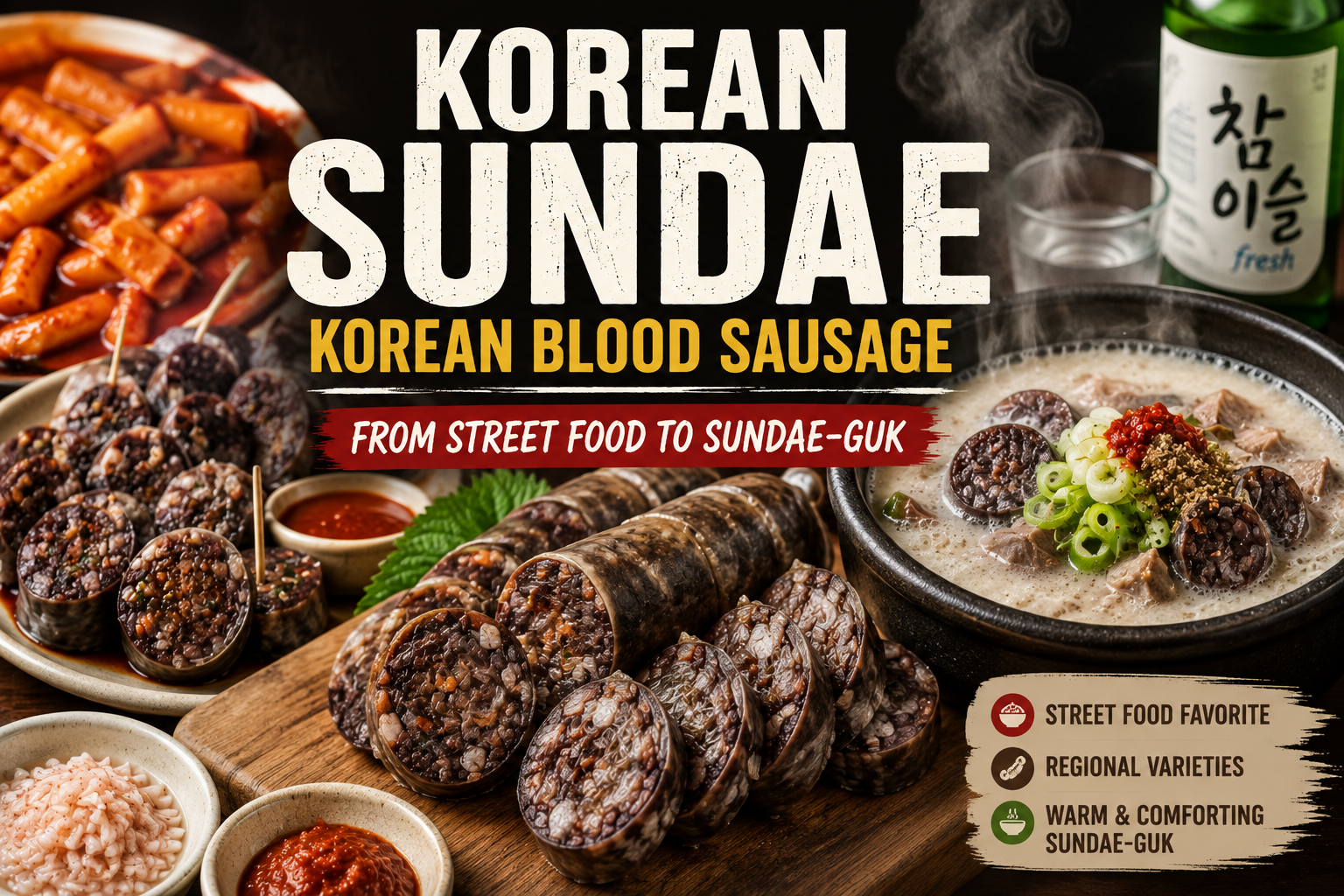
For many international visitors, Korean sundae (순대) is an unfamiliar food with an intimidating English translation: blood sausage.
But that translation tells only part of the story.
In Korea, sundae can be an inexpensive snack shared by students after school, a regional specialty shaped by migration and local ingredients, a sizzling dish eaten with friends, or the centerpiece of a steaming bowl of soup after a long working day.
The same word describes foods that can look and taste remarkably different.
A plate of ordinary street-stall sundae is not the same experience as the large, rice-filled Abai sundae of Sokcho. Sillim-dong’s famous baek sundae is not covered in the familiar red chili seasoning. And ojingeo sundae replaces the usual animal-intestine casing with squid.
These differences reveal something important about Korean food culture: traditional dishes are not always fixed recipes. They evolve as people move, ingredients change, markets develop, and local communities create their own identities.
To understand Korean sundae, it helps to look beyond what goes into the sausage. The more interesting question is how one humble food became part of so many different Korean experiences.
1. What Exactly Is Korean Sundae?
Korean sundae is a traditional stuffed sausage. A common modern version uses pork intestine as its casing, filled with ingredients such as glass noodles, vegetables, seasonings, and pork blood.
The filling varies considerably.
Some versions contain more noodles, while others emphasize rice, vegetables, meat, or other ingredients. The casing, proportions, seasoning, and cooking method can also differ by region and producer.
This is why describing every Korean sundae as simply a glass-noodle sausage is misleading.
The familiar street-food version is usually steamed and sliced into bite-sized rounds. Its dark filling and soft, slightly springy texture make it visually distinctive.
The flavor is often milder than first-time visitors expect. Rather than being intensely spicy or strongly flavored, ordinary steamed sundae is generally savory, with its character depending on the filling and accompanying condiments.
There is also a pronunciation issue worth knowing. Korean sundae is pronounced approximately soon-deh. It has nothing to do with the frozen dessert called a sundae in English.
2. How Old Is Sundae? What Historical Records Actually Tell Us
Sundae is often described as an ancient Korean food, but its history needs careful explanation.
Korea.net reports that blood-sausage traditions are believed to date back to the Goryeo period (918–1392). It also identifies recipes in historical Korean cookbooks, including the 1809 text Gyuhap Chongseo and the late nineteenth-century Siuijeonseo.
These records are valuable because they show that stuffed preparations involving animal intestines and blood were known in Korean culinary traditions long before modern street-food culture.
However, they do not prove that today’s familiar glass-noodle sundae was already being eaten in exactly the same form centuries ago.
Recipes change. Ingredients become more accessible or less expensive, cooking techniques develop, and household preferences shift.
The modern version commonly encountered at Korean snack shops is therefore better understood as part of a changing food tradition rather than a recipe that has remained identical for hundreds of years.
Historical records establish an older culinary background. They do not establish one unchanging national recipe.
That distinction matters when discussing traditional food. A dish can have a long history without every modern ingredient or preparation method being equally old.
3. Why Did Sundae Become an Everyday Korean Food?
One reason sundae became familiar across Korea is its ability to fit different eating situations.
It can be sold in small portions, served as a side dish, combined with other street foods, or turned into a filling meal.
Its ingredients also reflect a practical approach to cooking.
Traditional sausage-making uses parts of an animal that are not always the centerpiece of more expensive meat dishes. Intestines provide a natural casing, while blood, vegetables, grains, and other ingredients contribute to the filling.
This is part of a broader culinary principle: making use of different ingredients rather than treating only premium cuts as valuable.
It would be too simplistic to claim that this alone explains sundae’s popularity. Taste, price, local food habits, and the development of markets all matter.
But the dish illustrates how practical cooking can become a lasting cultural tradition.
A food that begins with accessible ingredients can eventually become something people actively seek out, defend, and associate with home.
4. Sundae and Bunsik: The After-School Food Culture
For many Koreans, the most familiar setting for sundae is a bunsikjip (분식집), a casual snack shop.
Bunsik culture includes foods such as tteokbokki, gimbap, ramyeon, fried snacks, and sundae. These are generally informal meals and snacks rather than elaborate restaurant dishes.
The relationship between sundae and bunsik is especially important because it connects the food with everyday social life.
Imagine a group of students stopping at a small shop after school. One orders tteokbokki, another wants gimbap, and someone asks for a plate of sundae to share.
Nobody needs a special occasion.
The food is affordable, arrives quickly, and can be divided among friends.
This casual setting helped make sundae familiar to generations of Koreans. Its cultural importance does not come only from its ingredients or history. It also comes from the repeated experience of eating it with other people.
For international visitors, this is a useful distinction: Korean street food is often as much about the social setting as the recipe itself.
5. Why Sundae and Tteokbokki Work So Well Together
The combination of sundae and tteokbokki is one of Korea’s most recognizable snack-shop pairings.
The two foods balance each other.
Tteokbokki brings a strong, sweet-spicy sauce and a chewy rice-cake texture. Steamed sundae is usually milder and more savory.
Dip a piece of sundae into the red sauce and the flavor changes immediately. The sauce adds sweetness, chili heat, and seasoning to a food that might otherwise taste relatively gentle.
The contrast is more interesting than simply eating two popular dishes together.
It combines different textures and levels of seasoning in one meal.
Other common companions include:
Eomuk: Korean fish cakes, often served in a warm broth.
Twigim: Deep-fried vegetables or other ingredients.
Gimbap: Rice and fillings wrapped in seaweed.
Ramyeon: Korean-style instant noodles, often served with a spicy broth.
For a first-time visitor, ordering sundae with tteokbokki is an approachable introduction. The familiar spicy sauce can make the first taste less intimidating.
6. The Regional Sundae Debate: What Should You Dip It In?
There is no single nationwide answer to the question of how sundae should be seasoned.
In Seoul and many central areas, salt is a common accompaniment. Other regions and restaurants may offer different sauces or seasonings.
Some people prefer the straightforward taste of salt. Others enjoy ssamjang or another seasoned dipping sauce.
At a bunsik shop, tteokbokki sauce may be the favorite option.
This variation is a small example of how Korean food habits differ across regions.
It is also a reminder not to treat one restaurant’s serving style as the only authentic way to eat a dish.
If you visit Korea, try the condiment supplied by the restaurant first. Then experiment with the alternatives.
The disagreement itself can become part of the experience.
7. Beyond the Sausage: Liver and Other Accompaniments
A traditional plate of sundae may include more than the sliced sausage.
Some markets and snack shops serve steamed pork liver and other offal alongside it.
These ingredients have very different textures.
Sundae is generally soft and slightly chewy. Cooked liver is denser and can have a dry, crumbly texture.
For visitors unfamiliar with organ meats, this can be surprising. There is no requirement to eat every item on the plate, but trying a small piece can help explain the broader role of offal in Korean food traditions.
Sundae is not an isolated example. Korean cuisine includes many dishes that use different parts of an animal, from soups and stews to grilled or steamed preparations.
The important point is that Korean food culture often treats ingredients beyond premium muscle meat as meaningful parts of a meal.
8. Sundae Bokkeum: When a Snack Becomes a Shared Griddle Meal
Steamed sundae is only one expression of the dish.
Another popular preparation is sundae bokkeum (순대볶음), or stir-fried sundae.
Sliced sundae is cooked on a hot griddle with vegetables and seasoning. Depending on the style, ingredients can include cabbage, onions, carrots, green onions, perilla leaves, and other components.
Red versions commonly use chili-based seasoning.
The result is a much stronger dish than ordinary steamed sundae.
The vegetables contribute freshness and crunch, while the sausage provides a soft, chewy center. Perilla leaves add a distinctive herbal aroma, and sesame or perilla seed powder can bring a nutty finish.
Sundae bokkeum is often ordered for sharing.
That changes the way the food is experienced. Instead of buying a small plate as a quick snack, people gather around a large serving and eat together.
It is a good example of how one ingredient can move from street snack to restaurant-style shared meal without losing its everyday character.
9. Sillim-dong Sundae Town: How a Local Food Became a Neighborhood Identity
One of Seoul’s best-known destinations for sundae bokkeum is Sillim-dong Sundae Town in Gwanak-gu.
Its development offers a useful example of how food businesses can shape the identity of a neighborhood.
According to the official Seoul tourism guide, sundae restaurants and street vendors operated in and around Sillim-dong from the late 1960s. In 1992, many of these businesses gathered in the Minsok Sundae Town building.
The area gradually became associated with a concentration of restaurants specializing in sundae dishes.
This is more than a collection of places selling the same food.
When similar businesses gather in one area, customers gain a reason to visit the neighborhood specifically for that experience. Competition also encourages restaurants to distinguish themselves through recipes, sauces, ingredients, and serving styles.
Sillim-dong became known for a particular style of sundae bokkeum, especially baek sundae.
For visitors interested in Korean food beyond the most famous tourist dishes, the area offers a look at a local restaurant culture built around one humble ingredient.
10. Baek Sundae: Why Is This Stir-Fried Sundae White?
The word baek (백) means white.
Unlike the familiar red version of sundae bokkeum, baek sundae (백순대) is stir-fried without the usual red chili-paste seasoning.
Sundae, vegetables, and other ingredients are cooked with seasonings such as salt and soy sauce. Sesame oil and perilla seed powder contribute aroma and richness.
The finished dish is often served with a separate spicy dipping sauce.
This creates an interesting contrast: the main dish is relatively mild, while each bite can be made more intense with the sauce.
The cooking method also changes the experience. Instead of being dominated by a thick red seasoning, the individual ingredients remain more noticeable.
Sillim-dong is particularly associated with this preparation. The Korea Tourism Organization also identifies baek sundae as a signature dish of the neighborhood.
For visitors, comparing red sundae bokkeum with baek sundae is a worthwhile way to understand how different seasoning methods can transform the same central ingredient.
11. Byeongcheon Sundae: A Regional Style Known for Its Lighter Filling
Travel south to Byeongcheon in Cheonan, Chungcheongnam-do, and another regional identity comes into view.
Byeongcheon sundae (병천순대) is known for a filling that can include vegetables, sticky rice, and glass noodles.
The Korea Tourism Organization describes the use of pork small intestine and notes that the combination of vegetables and other ingredients gives the dish a relatively clean, light flavor.
That description helps explain why Byeongcheon sundae has a distinct reputation.
Rather than relying only on a strong seasoning, the filling itself contributes to the character of the sausage.
The area is also associated with sundae-gukbap and restaurants specializing in regional sundae dishes.
For travelers, this is a reminder that a regional food name can refer to more than a place where a dish happens to be sold. It can represent a recognizable combination of ingredients, preparation, and local reputation.
12. Abai Sundae: A Food Connected to the Korean War and Displacement
Some regional foods are especially meaningful because they preserve the memory of people who moved under difficult circumstances.
Abai sundae (아바이순대), associated with Sokcho’s Abai Village, is one such example.
Abai Village was established by refugees from North Korea, particularly people from Hamgyeong Province who could not return home after the Korean War.
The word abai comes from a regional dialect and is used as a familiar term for an older man, similar to addressing someone as grandfather.
The food is associated with the culinary traditions carried by displaced people from the north.
The Korea Tourism Organization describes Abai sundae as a Hamgyeong-style dish made by filling pork large intestine with ingredients including blood and sweet rice before steaming.
Compared with many small street-food pieces, Abai sundae is often larger and has a different filling and texture.
Its significance, however, goes beyond size.
The dish represents how displaced communities carried food memories into new places. Ingredients and cooking methods became part of maintaining a connection with a home that many people could no longer visit.
This makes Abai sundae different from a regional specialty known only for its flavor.
It is also a reminder of modern Korean history.
Visitors to Abai Village can therefore understand the dish in two ways: as a local food worth tasting and as part of a community’s story of migration, survival, and cultural continuity.
13. Ojingeo Sundae: When Squid Replaces the Traditional Casing
Not every Korean dish called sundae uses pork intestine.
Ojingeo sundae (오징어순대) is made by stuffing a squid body with a seasoned filling, cooking it, and slicing it into pieces.
The squid serves as the casing.
This creates a completely different eating experience. The outside has the characteristic texture of squid, while the inside contains a mixture of filling ingredients.
Ojingeo sundae is strongly associated with Gangwon Province, particularly Sokcho.
It is frequently encountered alongside other regional specialties in Abai Village.
The existence of ojingeo sundae also shows why the English translation “blood sausage” is useful but incomplete.
It describes an important and familiar category of sundae, but it cannot explain every dish that carries the same Korean name.
The broader idea of stuffing a casing with a seasoned mixture has produced different regional interpretations.
14. Other Regional Varieties: Sundae Is Not Just a Seoul or Sokcho Story
The regional diversity does not end with Sillim-dong, Byeongcheon, and Abai Village.
For example, Yonggung sundae (용궁순대) is associated with Yonggung-myeon in Yecheon, Gyeongsangbuk-do.
The Korea Tourism Organization identifies tripe as a distinguishing feature of this variety, in contrast with the pork intestines commonly used in many other forms of sundae.
Its filling includes ingredients such as glutinous rice, glass noodles, and vegetables.
This example reinforces an important point: regional sundae traditions can differ in the casing itself, not merely in seasoning.
For a food traveler, the most interesting approach is not to search for one universally “best” sundae.
It is to compare how different communities have developed their own versions.
15. Sundae-guk: How a Sausage Becomes a Comforting Korean Meal
If street-food sundae represents the casual side of Korean food culture, sundae-guk (순댓국) represents its more substantial, everyday meal tradition.
Sundae-guk is a hot soup containing sliced sundae, often accompanied by pork meat and offal.
The broth varies by restaurant. Some versions are pale and relatively mild, while others have a richer or more pronounced pork flavor.
Rice is served alongside the soup or added directly to the bowl.
The appeal is straightforward.
It is warm, filling, and suitable for a quick meal. Restaurants specializing in sundae-guk can be found throughout Korea, from traditional markets to ordinary neighborhood streets.
It is not exclusively a winter food, although a steaming bowl can feel especially comforting on a cold evening.
The dish also illustrates how Korean food culture often turns individual ingredients into complete meals through broth, rice, vegetables, and condiments.
Sundae is no longer simply something to dip into sauce. It becomes part of a bowl designed to satisfy hunger.
16. The Art of Seasoning Sundae-guk
A bowl of sundae-guk may arrive with several condiments on the table.
Common options include:
Saeujeot: Salted and fermented small shrimp, used to add saltiness and fermented depth.
Perilla seed powder: Adds a nutty aroma and a thicker, more rounded impression.
Dadaegi: A spicy seasoning mixture, often based on chili powder and other ingredients.
Green onions: Add freshness and a mild onion flavor.
Black pepper: Provides a familiar finishing seasoning.
One useful tip for first-time visitors is to taste the broth before adding everything.
The soup may already be seasoned.
Add a little saeujeot if it needs more saltiness. Try perilla seed powder for a nuttier flavor. Add dadaegi gradually if you want heat.
There is no need to empty every condiment dish into the bowl.
Customizing the soup is part of the experience, and different diners often prefer different combinations.
17. Is Sundae-guk Always Spicy?
No.
This is a common misunderstanding among visitors who associate Korean food with red chili seasoning.
Some sundae-guk arrives with a relatively mild broth. The red color and stronger heat may come from dadaegi, which can be added at the table.
The spice level therefore depends on the restaurant and the diner’s choices.
If you prefer mild food, ask for the seasoning separately or simply avoid adding the spicy mixture.
Sundae itself is not automatically spicy, and neither is every bowl of sundae-guk.
18. How to Make an Easy Sundae-guk at Home
A traditional restaurant-style broth may require considerable preparation and a variety of pork ingredients.
For a simpler home version, packaged Korean beef-bone broth can provide a convenient base.
This recipe is an approximation of the everyday flavor profile, not a replacement for a restaurant that prepares its broth from scratch.
Ingredients for Two Servings
300 g cooked Korean sundae
150 g thinly sliced pork
500 ml packaged Korean beef-bone broth (sagol-gomtang)
Approximately 200 ml water
1/2 green onion
A handful of garlic chives
1 tablespoon minced garlic
1–2 tablespoons perilla seed powder
Saeujeot, to taste
Black pepper
Green chili, optional
Steamed rice, for serving
Simple Dadaegi Seasoning
Mix the following ingredients:
1 tablespoon Korean chili powder (gochugaru)
1/2 tablespoon minced garlic
A small amount of saeujeot
1–2 tablespoons hot broth
Adjust the seasoning gradually according to your preference.
Step 1: Prepare the Broth
Pour the packaged beef-bone broth and water into a pot.
Bring it to a simmer. Add the thinly sliced pork and cook thoroughly.
Add the minced garlic and allow the broth to simmer until the pork is fully cooked.
Step 2: Add the Sundae Near the End
Most packaged Korean sundae is already cooked.
Add it near the end of the cooking process and heat it through according to the package instructions.
Avoid vigorous boiling for an extended period, which can cause the casing to split and the filling to fall apart.
Step 3: Add Vegetables and Finish
Add the green onion and garlic chives.
Transfer the soup to serving bowls.
Serve the condiments separately so each person can adjust the flavor.
Step 4: Serve with Rice
Enjoy the soup with steamed rice.
Alternatively, add some rice directly to the broth.
The result is a simple, filling meal inspired by one of Korea’s familiar neighborhood dishes.
19. How Should a First-Time Visitor Try Korean Sundae?
If you have never eaten sundae, there is no need to begin with the most unusual regional variety.
A gradual introduction makes the experience easier.
First: Try ordinary steamed sundae.
Order a small plate at a bunsik shop. Taste one piece with salt to understand its natural flavor.
Second: Try it with tteokbokki sauce.
The spicy-sweet sauce provides a familiar and flavorful contrast.
Third: Explore sundae bokkeum.
Try the stir-fried version to experience the combination of sausage, vegetables, and seasoning.
Fourth: Compare regional varieties.
If you travel to Sokcho, look for Abai sundae or ojingeo sundae. In Cheonan, try Byeongcheon sundae.
Finally: Order sundae-guk.
This is a different experience altogether. The broth, rice, and condiments turn sundae into a complete meal.
One practical note: traditional sundae often contains pork blood and may include other animal-derived ingredients. Travelers with dietary restrictions should ask about the filling and broth before ordering.
20. What Sundae Reveals About Korean Food Culture
Sundae is an interesting case study because it connects several parts of Korean everyday life.
Its historical recipes show that stuffed preparations involving blood and intestines existed in Korean culinary traditions long before modern snack shops.
Its presence in bunsik restaurants shows how a traditional food became part of affordable, informal eating.
Its regional varieties reveal the influence of local ingredients, migration, and community identity.
Its transformation into sundae-guk shows how a relatively simple sausage can become a filling meal through broth, rice, and seasoning.
And its continued popularity demonstrates that traditional food does not need to remain unchanged to remain meaningful.
In fact, its ability to adapt may be one reason it has survived.
For international visitors, this is a more useful way to approach Korean food than simply asking whether a dish is unusual or familiar.
The better question is what the food tells us about the people who made it part of their lives.
Conclusion: More Than a Plate of Blood Sausage
A plate of sundae at a small snack shop and a bowl of sundae-guk at a neighborhood restaurant may look like two different meals.
But they share a culinary tradition that has adapted to different places, generations, and eating habits.
In Seoul, sundae may be associated with tteokbokki and the busy atmosphere of a bunsik shop.
In Sillim-dong, it becomes the center of a distinctive restaurant district and the famous baek sundae experience.
In Byeongcheon, it reflects a regional food identity.
In Sokcho, Abai sundae carries memories of displacement and the Korean War.
And in a bowl of sundae-guk, it becomes the kind of ordinary comfort food that people return to without needing a special reason.
That is what makes Korean sundae worth understanding.
It is not simply a sausage that Koreans happen to eat. It is a food that has found a place in Korea’s markets, neighborhoods, regional histories, and everyday memories.
Frequently Asked Questions
1. What is Korean sundae made of?
A common version uses pork intestine as a casing, filled with ingredients such as glass noodles, vegetables, seasonings, and pork blood. Recipes vary by region and style.
2. Is Korean sundae the same as Western blood sausage?
They belong to the broader family of blood sausages, but Korean sundae has its own ingredients, preparation methods, and regional varieties. It should not be assumed to taste exactly like European blood sausages.
3. Is sundae spicy?
Ordinary steamed sundae is generally not spicy. Sundae bokkeum can be spicy, while baek sundae is a milder stir-fried version commonly served with a separate spicy dipping sauce.
4. What is the difference between sundae and sundae-guk?
Sundae is the stuffed sausage itself. Sundae-guk is a Korean soup that contains sliced sundae and often pork meat or offal in a broth.
5. What is Abai sundae?
Abai sundae is a regional style associated with Sokcho’s Abai Village. It is connected to the food traditions of refugees from Hamgyeong Province who settled there after the Korean War.
6. What is baek sundae?
Baek sundae is a stir-fried sundae dish associated with Sillim-dong in Seoul. It is cooked without the usual red chili-paste seasoning and is often served with a separate spicy sauce.
7. Where can I try famous Korean sundae?
Sillim-dong Sundae Town in Seoul is known for sundae bokkeum and baek sundae. Byeongcheon in Cheonan is known for Byeongcheon sundae, while Sokcho’s Abai Village is associated with Abai sundae and ojingeo sundae.
Imagine spending an entire autumn day making kimchi.
Cabbages are stacked across the kitchen. Red seasoning covers the table. Family members work together, preparing enough kimchi to last through the winter.
Nearby, a large pot of pork is slowly simmering.
When the work is finished, someone takes the warm pork out of the pot and slices it. A piece of freshly seasoned kimchi is placed on the table. You add a slice of pork, perhaps a little salted shrimp and garlic, and wrap everything in a cabbage leaf.
Sometimes, there is a fresh oyster, too.
One bite brings together warm meat, crisp cabbage, spicy seasoning and the salty depth of fermented seafood.
For many Koreans, this is one of the most memorable rewards of Kimjang Day.
The dish is called Bossam (보쌈), and understanding it means understanding more than Korean boiled pork. It means understanding the Korean tradition of wrapping food, the relationship between pork and kimchi, and the communal culture behind preparing food for winter.
1. What Is Bossam?
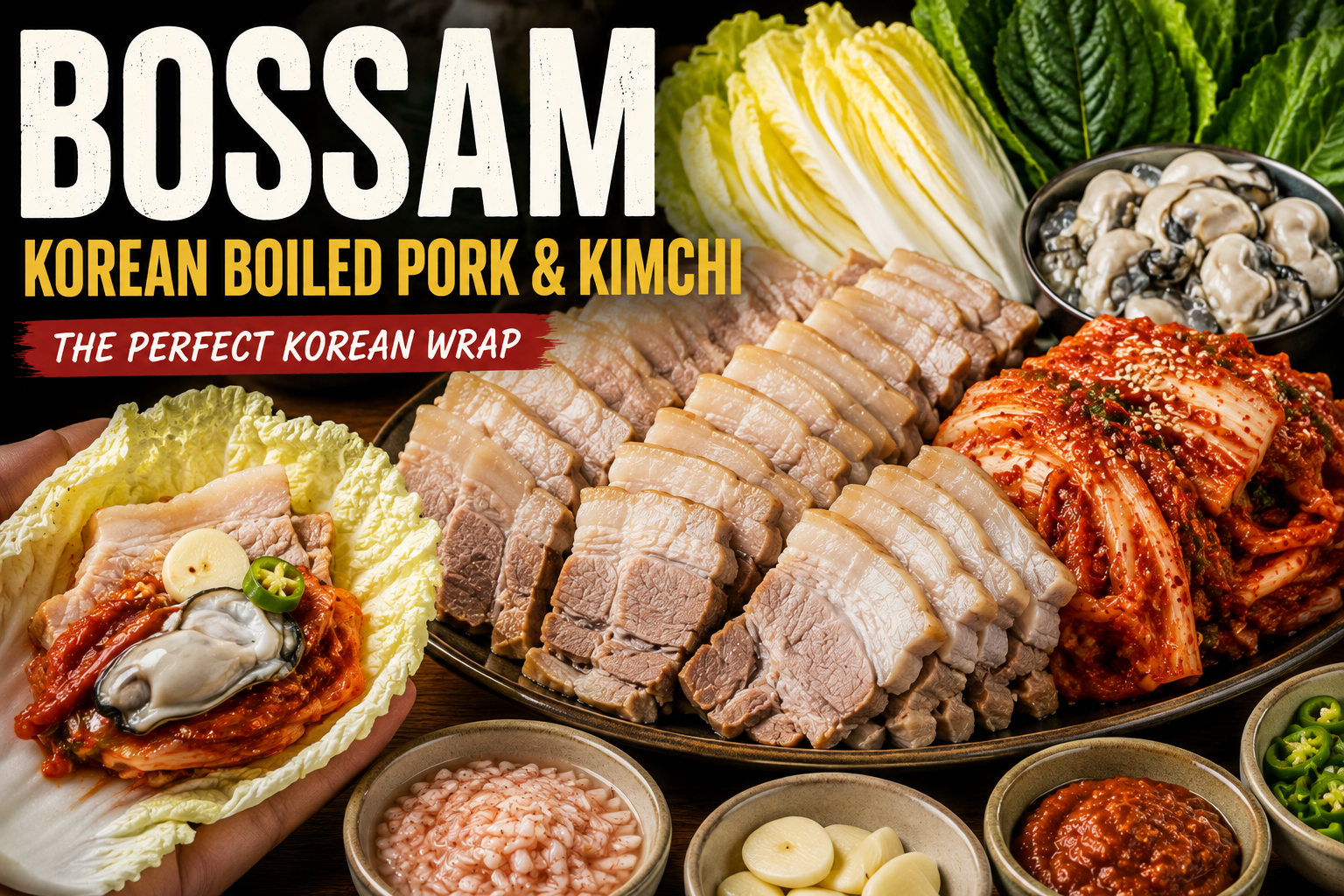
Bossam is a Korean pork dish made by gently boiling or simmering pork until tender, slicing it, and serving it with kimchi, vegetables and Korean condiments.
The most commonly used cuts are:
Pork belly (samgyeopsal): Rich, juicy and layered with fat
Pork shoulder: Meatier and generally less fatty
The pork is usually served warm on a large platter. Around it are ingredients such as kimchi, seasoned radish, napa cabbage, lettuce, garlic, salted shrimp and ssamjang.
But Bossam is not simply a plate of boiled pork.
Its defining pleasure comes from combining the ingredients into a single wrap.
Place a slice of pork on a cabbage or lettuce leaf. Add kimchi, a little salted shrimp, garlic or ssamjang. Fold the leaf around the ingredients and eat everything together.
The pork provides richness. The vegetables add freshness and crunch. The fermented seasonings contribute saltiness, acidity and depth.
That balance is what makes Bossam such a satisfying Korean meal.
2. Bossam Is More Than Korean Boiled Pork
English-language menus often translate Bossam as Korean boiled pork.
The translation is useful, but incomplete.
The pork is only one part of the experience. The dish is designed around the relationship between meat, vegetables and fermented accompaniments.
A slice of pork eaten by itself tastes very different from the same slice wrapped with fresh kimchi, garlic and salted shrimp.
This is where the Korean concept of ssam (쌈) becomes important.
Ssam means food wrapped in a leaf or another edible wrapping. Koreans use lettuce, napa cabbage, perilla leaves and other vegetables to create individual bites.
Bossam is one of the best-known examples of this eating style.
The important idea is not simply to put food inside a leaf. It is to combine several contrasting flavors and textures in one bite.
3. Suyuk vs. Bossam: What Is the Difference?
Suyuk (수육) and Bossam are closely related, but they do not mean exactly the same thing.
Suyuk generally refers to meat that has been boiled or simmered and sliced for serving.
The word can be used for different kinds of cooked meat, although pork is especially common in everyday restaurant settings.
Bossam refers to a broader pork dish and its traditional accompaniments.
It usually includes sliced pork served with kimchi, vegetables and condiments, often eaten as a wrap.
An easy way to remember the distinction is:
Suyuk: The cooked meat itself
Bossam: The pork meal served with the ingredients used to wrap and accompany it
The distinction is not always strict in restaurant language. Some menus use the terms in overlapping ways.
However, understanding the difference makes Korean menus easier to navigate.
4. Why Is Bossam Closely Associated With Kimjang?
To understand the cultural connection between Bossam and kimchi, you need to know about Kimjang (김장).
Kimjang is the Korean tradition of preparing and sharing large quantities of kimchi before winter.
Traditionally, late autumn was the season when families and neighbors gathered to salt napa cabbage, prepare seasoning and make enough kimchi to sustain their households through the colder months.
This was a major communal activity.
Preparing kimchi in large quantities required considerable time and labor. Family members and neighbors shared tasks, exchanged recipes and helped one another.
Kimjang was therefore about more than preserving vegetables. It was also a way of maintaining relationships and passing food knowledge between generations.
In 2013, UNESCO inscribed Kimjang: Making and Sharing Kimchi in the Republic of Korea on its Representative List of the Intangible Cultural Heritage of Humanity.
UNESCO highlighted the tradition’s role in strengthening family cooperation, community solidarity and a shared sense of identity.
This cultural background explains why freshly cooked pork became such a natural companion to Kimjang.
5. Fresh Kimchi and Warm Pork: The Kimjang Day Tradition
After hours of preparing kimchi, families often enjoy a meal together.
One traditional choice is freshly cooked pork served with the kimchi that has just been prepared.
Korea.net describes families preparing boiled or steamed pork during Kimjang and eating it with newly made kimchi.
The combination makes culinary sense.
Freshly seasoned kimchi is crisp, spicy and full of vibrant seasoning. Warm pork is tender, savory and rich.
The kimchi cuts through the richness of the pork, while the meat softens the intensity of the seasoning.
The contrast is particularly enjoyable because the ingredients have different temperatures and textures:
Warm, tender pork
Crisp, freshly seasoned cabbage
Spicy and slightly sweet kimchi seasoning
Salty fermented condiments
This is why the first serving of pork with freshly made kimchi is so memorable for many families.
It is not just a meal after hard work. It is part of the experience of Kimjang itself.
6. Why Does Freshly Made Kimchi Taste Different?
Kimchi does not need to ferment for weeks before it can be enjoyed.
On Kimjang Day, freshly seasoned cabbage can be eaten immediately.
This fresh version is often called geotjeori (겉절이) when prepared as a fresh, lightly seasoned kimchi-style salad.
Unlike fully fermented kimchi, freshly made cabbage generally has a crisp texture and a brighter, more immediate seasoning flavor.
As fermentation progresses, the taste changes. Acidity develops, the texture softens and the flavors become more integrated.
Both stages have their own appeal.
But when eating Bossam during Kimjang, the contrast between freshly seasoned cabbage and warm pork is especially appealing.
It brings together two very different experiences: the freshness of newly prepared vegetables and the richness of slowly cooked meat.
7. Why Are Oysters Sometimes Served With Bossam?
Another ingredient often associated with winter Bossam is the oyster.
Koreans enjoy oysters in many forms, including raw, grilled, steamed and mixed into kimchi.
During the colder season, some families add fresh oysters to their Kimjang kimchi.
The combination of pork, kimchi and oysters is also featured in Korean food culture as a seasonal winter meal.
Oysters contribute a briny, ocean-like flavor that contrasts with the richness of pork.
A Bossam wrap with an oyster might contain:
A slice of warm pork
Freshly seasoned kimchi
A fresh oyster
A little garlic or salted shrimp
The result is richer and more complex than a pork-and-cabbage wrap alone.
However, raw oysters require care. They should come from a reliable source, be properly refrigerated and handled hygienically. People at higher risk of severe foodborne illness should avoid raw oysters and choose fully cooked seafood instead.
8. What Is Gul Bossam?
Gul Bossam (굴보쌈) is a popular variation of Bossam served with oysters.
The Korean word gul means oyster.
The basic combination is simple: boiled pork, oysters, kimchi and vegetables.
Depending on the restaurant, oysters may be served separately, seasoned with kimchi ingredients or placed directly inside the wrap.
Gul Bossam is particularly associated with the colder months, when oysters are a familiar seasonal ingredient in Korean cooking.
It is also a good example of how Bossam can change depending on the ingredients available.
Some restaurants emphasize the pork. Others make the oysters and spicy radish kimchi equally important.
If you enjoy seafood, Gul Bossam is one of the most interesting versions of the dish to try.
9. What Is the Difference Between Bossam Kimchi and Gaeseong Bossam Kimchi?
The term Bossam Kimchi (보쌈김치) can cause confusion because it is used in more than one context.
In restaurants, the kimchi served with Bossam often refers to a seasoned cabbage or radish preparation designed to complement boiled pork.
However, there is also a distinctive traditional dish called Gaeseong Bossam Kimchi (개성 보쌈김치).
This is a regional kimchi style associated with Gaeseong. Rather than simply serving ordinary kimchi alongside pork, ingredients are wrapped together in cabbage leaves to create a distinctive bundle.
Korea.net specifically distinguishes the kimchi commonly served with boiled pork from the separate traditional Gaeseong Bossam Kimchi.
The difference is worth remembering:
Restaurant Bossam kimchi: Kimchi or seasoned vegetables served with pork
Gaeseong Bossam Kimchi: A distinctive traditional wrapped kimchi preparation
Not every Bossam restaurant serves the traditional Gaeseong version.
10. How to Eat Bossam Like a Korean
When a Bossam platter arrives, there is no complicated rule to follow.
The goal is to create a balanced bite.
Start with a piece of napa cabbage or lettuce.
Place a slice of pork in the center. Add a little kimchi or seasoned radish.
Then choose your extras:
Saeujeot: Salted fermented shrimp
Ssamjang: A thick Korean dipping paste
Garlic: Fresh or lightly pickled
Green chili pepper: For extra heat
Oyster: If the restaurant serves Gul Bossam
Fold the leaf around the ingredients and eat the wrap in one bite if possible.
A common mistake for first-time visitors is eating each ingredient separately.
There is nothing wrong with doing that, but the combination is the point.
The pork, kimchi and condiments are designed to work together.
11. Why Is Saeujeot Served With Bossam?
The small dish of pinkish or pale salted shrimp served beside Bossam is called Saeujeot (새우젓).
It is made by salting and fermenting small shrimp.
Its flavor is intensely salty and savory, so only a little is needed.
A small amount added to a piece of pork can make a noticeable difference.
The fermented flavor contrasts with the relatively mild taste of boiled pork and helps bring out its savory character.
Saeujeot is also commonly served with Jokbal, another popular Korean pork dish.
It is not necessary to use it in every wrap, but it is one of the classic accompaniments worth trying.
12. Easy Korean Bossam Recipe at Home
Bossam looks impressive when served on a large platter, but the basic pork preparation is relatively simple.
The most important factors are choosing the right cut, cooking gently and allowing the meat to rest before slicing.
Pork belly gives Bossam a rich, juicy texture because it contains layers of meat and fat.
Pork shoulder is a good alternative if you prefer a meatier and less fatty result.
Choose a piece with an even thickness so that it cooks more consistently.
Step 2: Prepare the Cooking Liquid
Place the pork in a large pot.
Add the onion, green onion, garlic, ginger and black peppercorns.
Add enough water to cover the pork, then mix in the doenjang.
The soybean paste adds a savory depth and helps give the cooking liquid a familiar Korean flavor.
Some households also add ingredients such as coffee, bay leaves, cooking wine or additional aromatics. There is no single universal Bossam recipe.
Step 3: Simmer Until Tender
Bring the pot to a boil, then reduce the heat to maintain a gentle simmer.
For a piece weighing around 700–800 g, approximately 45–60 minutes may be a useful starting point.
However, cooking time depends on the thickness and shape of the pork.
Check that the center is fully cooked. For a reliable food-safety check, use a food thermometer and follow the recommended safe internal temperature for the specific cut and cooking method.
The pork should be tender enough to slice comfortably without falling apart.
Step 4: Rest and Slice
Remove the pork from the cooking liquid.
Allow it to rest briefly before slicing.
This helps the juices settle and makes the meat easier to handle.
Cut the pork into slices that are thin enough to fit inside a cabbage leaf but thick enough to retain their texture.
Step 5: Prepare the Bossam Table
Arrange the sliced pork on a serving plate.
Place kimchi, cabbage or lettuce, seasoned radish, saeujeot, ssamjang, garlic and chili peppers in separate dishes.
If you are serving oysters, keep them properly chilled until serving.
The meal is ready when everyone can build their own wraps.
13. Bossam vs. Jokbal: What Is the Difference?
Bossam and Jokbal (족발) often appear together on Korean restaurant menus.
Both are pork dishes served in slices, and both are popular sharing foods.
But their preparation and textures are quite different.
Bossam
Usually made with pork belly or shoulder
Gently boiled or simmered
Soft, tender and meaty
Commonly served with kimchi and fresh vegetables
Jokbal
Made from pig’s trotters
Usually braised with soy sauce and aromatic ingredients
Known for its chewy skin and gelatin-rich texture
Often served with saeujeot, garlic and spicy accompaniments
Bossam is generally about tender meat and the balance of kimchi and vegetables.
Jokbal is about the distinctive texture of the skin and the rich flavor created by braising.
Some restaurants offer a combination platter, allowing customers to enjoy both styles at the same table.
14. Is Bossam Spicy?
The pork itself is not normally spicy.
The heat comes from the ingredients served with it, such as:
Spicy kimchi
Seasoned radish
Ssamjang
Fresh chili peppers
This makes Bossam a flexible choice for people who do not enjoy very spicy food.
You can simply use less kimchi seasoning and leave out the chili peppers.
The pork, cabbage and a small amount of saeujeot can make a delicious wrap without much heat.
15. Is Bossam the Same as Samgyeopsal?
No. Both dishes can use pork belly, but their cooking methods are different.
Samgyeopsal (삼겹살) is Korean grilled pork belly. The meat is cooked on a grill or pan, producing browned edges and a distinctive roasted flavor.
Bossam is made by boiling or simmering the pork, creating a softer and more gently cooked texture.
Both can be eaten as ssam, wrapped in lettuce or other leaves.
The difference is in the way the pork is prepared:
Samgyeopsal celebrates the flavor of grilled meat.
Bossam celebrates tender pork and its combination with kimchi and fermented accompaniments.
16. When Is the Best Time to Eat Bossam?
Bossam is available throughout the year in Korea.
It is commonly eaten at restaurants, ordered for delivery, shared with family or served as anju with drinks.
But late autumn and winter offer a particularly meaningful way to experience it.
This is Kimjang season.
Freshly prepared kimchi becomes available, and oysters are a popular seasonal ingredient.
The connection between warm pork, newly seasoned cabbage and winter seafood becomes especially clear during this time.
If you visit Korea in late autumn or winter, ordering Bossam during the Kimjang season is a wonderful way to experience the dish in its cultural context.
17. Bossam Is More Than Korean Boiled Pork
Calling Bossam Korean boiled pork is not wrong.
It simply leaves out the most interesting part.
Bossam is the warm slice of pork, the crisp cabbage leaf, the spicy kimchi, the salty fermented shrimp and the garlic tucked inside a single wrap.
Sometimes, it is also a fresh oyster.
Behind the dish is a broader Korean food tradition: the practice of preparing food together, sharing it with others and preserving ingredients for the winter.
Kimjang gives Bossam a cultural setting that goes beyond the restaurant table.
So when you try Bossam, do not eat the pork alone.
Build the wrap. Add the kimchi. Try the saeujeot. Experiment with the ingredients until you find your favorite combination.
Because with Bossam, the perfect bite is not one ingredient.
It is everything inside the wrap.
FAQ
What is Bossam?
Bossam (보쌈) is a Korean dish of tender boiled or simmered pork served with kimchi, vegetables and condiments. The pork is commonly wrapped in napa cabbage or lettuce and eaten with ingredients such as garlic, ssamjang and salted shrimp.
What is the difference between Bossam and Suyuk?
Suyuk generally refers to boiled or simmered meat itself. Bossam usually describes the broader meal of sliced pork served with kimchi, vegetables and condiments, often eaten as a wrap.
How do you eat Bossam?
Place a slice of pork on a cabbage or lettuce leaf. Add kimchi, seasoned radish, garlic or a little saeujeot and ssamjang. Fold the leaf around the ingredients and eat them together.
Why do Koreans eat Bossam during Kimjang?
Families traditionally prepare boiled or steamed pork to eat with freshly made kimchi after working together on Kimjang. The combination is a familiar seasonal food tradition in Korea.
What is Gul Bossam?
Gul Bossam is Bossam served with oysters. The oysters may be served separately or combined with kimchi and pork in a wrap. It is particularly popular during the colder season.
What is Gaeseong Bossam Kimchi?
Gaeseong Bossam Kimchi is a traditional regional kimchi preparation in which ingredients are wrapped together in cabbage leaves. It is different from the ordinary kimchi or seasoned radish commonly served with restaurant Bossam.
What is saeujeot, and why is it served with Bossam?
Saeujeot is salted and fermented shrimp. Its strong salty and savory flavor complements the mild richness of boiled pork. A small amount is usually enough.
Is Bossam spicy?
The pork itself is not spicy. The heat usually comes from kimchi, seasoned radish, ssamjang or chili peppers. You can adjust the spice level by choosing different accompaniments.
Can I make Bossam with pork shoulder instead of pork belly?
Yes. Pork shoulder is a common choice and produces a meatier, generally less fatty result. Pork belly is richer and juicier because of its layers of fat.
What is the difference between Bossam and Jokbal?
Bossam is usually made with pork belly or shoulder and has a tender, meaty texture. Jokbal is made from pig’s trotters and is known for its chewy skin and gelatin-rich texture.
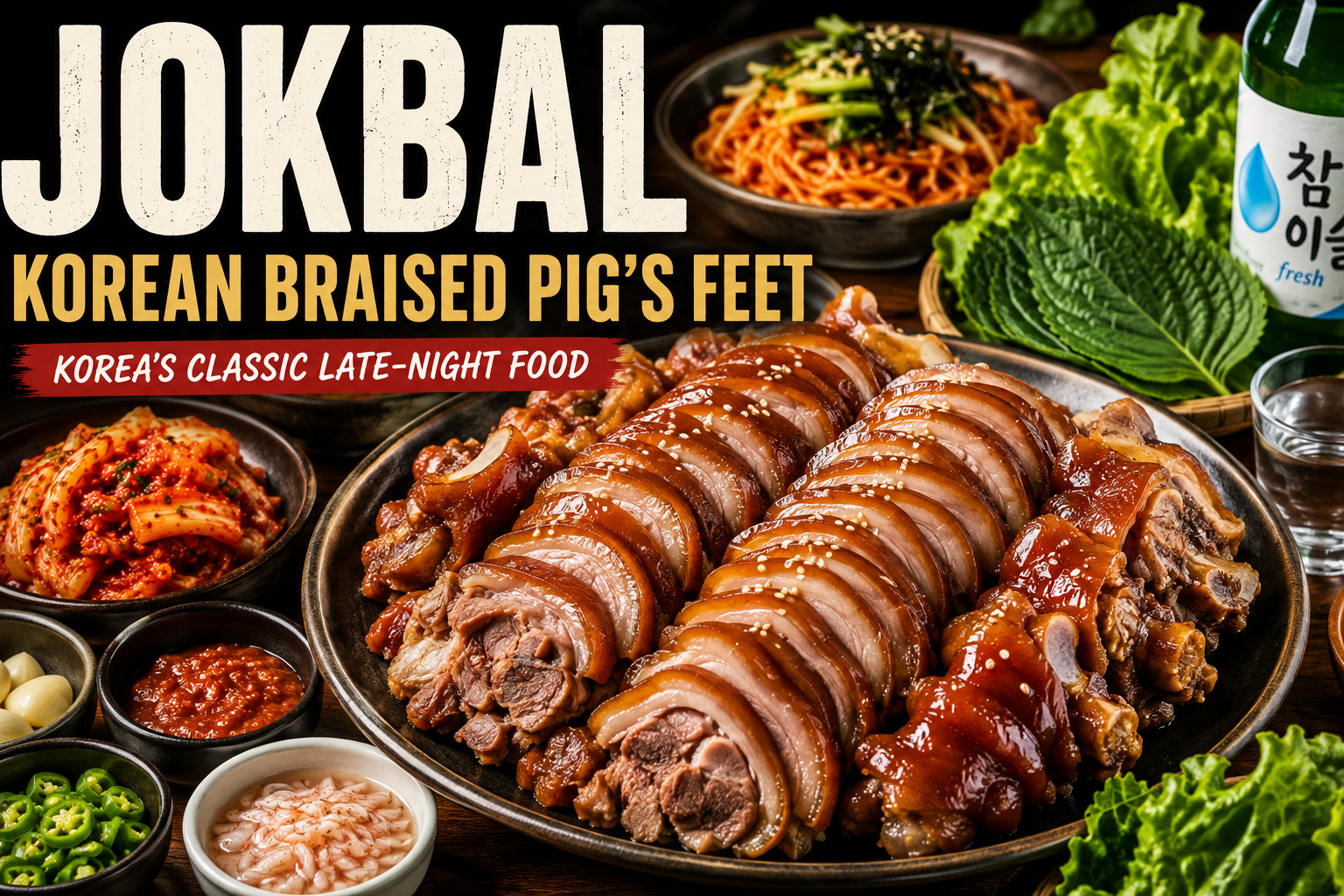
When Koreans order food for a late-night gathering, fried chicken is only one possibility. Another classic choice is jokbal (족발): glossy slices of braised pig’s feet served with lettuce, garlic, chili peppers, salted shrimp and dipping sauces.
At first glance, the dish may seem unusual to visitors unfamiliar with eating pork skin. But jokbal’s appeal lies in a combination of textures and flavors: tender meat, soft and springy skin, savory seasoning, and sharp accompaniments that balance its richness.
It is also more than an individual dish. Jokbal is traditionally served in a large platter for sharing, making it a familiar part of Korean dining, drinking and late-night food culture.
Here is what makes jokbal distinctive, how Koreans eat it, and why Seoul’s Jangchung-dong became famous for it.
1. What Is Jokbal?
Jokbal is a Korean dish made by slowly braising pig’s trotters in a seasoned cooking liquid until the meat becomes tender. The cooked trotters are deboned or sliced around the bones, then arranged on a platter and served with vegetables and dipping sauces.
The seasoning varies by restaurant, but soy sauce is commonly used to create the dish’s deep brown color and savory flavor. Aromatic ingredients may also be added to the cooking liquid, giving each restaurant its own interpretation.
The most recognizable feature is the contrast between the meat and skin.
Meat: tender, moist and savory.
Skin: soft, springy and slightly chewy.
Connective tissue: gelatinous, adding to the rich mouthfeel.
This texture is what makes jokbal different from familiar pork dishes such as grilled pork belly or boiled pork slices.
The Korea Tourism Organization describes jokbal as a popular Korean food, while Seoul’s official food guide also identifies it as a well-known late-night dish.
2. Why Does Jokbal Have Such a Distinctive Texture?
The answer lies in the part of the pig used to make it.
Pig’s trotters contain skin, connective tissue, tendons and cartilage. During extended cooking, collagen-rich connective tissues soften and contribute to the gelatinous texture that jokbal is known for.
That is why the dish is not simply supposed to be chewy. Good jokbal combines different sensations in one bite: tender meat, soft skin and a gentle springiness.
Koreans often describe this texture as 쫄깃쫄깃 (jjolgit-jjolgit). The expression suggests something pleasantly chewy and elastic rather than hard or difficult to bite.
For first-time diners, the skin may be the biggest surprise. People who enjoy pork skin or gelatinous meat dishes may find it especially appealing, while those who prefer lean, firm meat may need a little time to get used to it.
3. Why Is Jokbal a Classic Korean Late-Night Food?
Jokbal has a natural place in Korea’s yasik (야식) culture. Yasik means food eaten late at night, often after the usual evening meal.
Korean late-night dining is not limited to quick snacks. People may order a substantial meal while watching television, meeting friends, working late or spending time at home.
Jokbal fits this setting for several reasons.
First, it is usually sold as a large platter that can be shared. Second, it can be eaten without a separate bowl of rice. Third, its combination of meat, vegetables, sauces and noodles gives a group several ways to enjoy the same order.
Jokbal is also commonly served as anju (안주), meaning food eaten with alcoholic drinks. It is often associated with soju, although it can be enjoyed without alcohol.
The important point is that jokbal is not exclusively a drinking food. Families and groups also order it as an ordinary shared dinner or a delivery meal.
4. Jokbal and Soju: Why the Combination Works
Jokbal is rich and savory, so its accompaniments play an important role.
A typical table may include:
Saeujeot (새우젓): fermented salted shrimp.
Ssamjang (쌈장): a thick dipping paste made from fermented soybean paste and other seasonings.
Garlic: raw sliced garlic for a sharp, pungent flavor.
Chili peppers: fresh green peppers for a crisp, sometimes spicy bite.
Lettuce and perilla leaves: fresh leaves used to wrap the pork.
Soju is a familiar drink alongside this combination, but the appeal is not simply that the food is salty. The freshness of the vegetables, the fermented flavor of the dipping sauce and the richness of the pork create a more balanced meal.
5. How to Eat Jokbal Like a Korean
One of the best ways to try jokbal is to make a Korean-style ssam (쌈), or leafy wrap.
A simple combination works well:
Place a lettuce or perilla leaf in your hand.
Add one slice of jokbal.
Add a little saeujeot or ssamjang.
Include garlic or a slice of chili pepper if you like.
Fold the leaf around the ingredients and eat it as a wrap.
There is no strict rule about which sauce or vegetable must be used. Some people prefer the clean, salty taste of saeujeot; others enjoy the stronger flavor of ssamjang.
You can also eat jokbal on its own before trying the different combinations. That makes it easier to notice the seasoning and texture of the pork itself.
For visitors, one useful tip is to start with a small amount of saeujeot. It is intensely salty, so a little is usually enough.
6. What Is Saeujeot, and Why Is It Served With Jokbal?
Saeujeot is a Korean condiment made by salting and fermenting small shrimp. It has a concentrated salty flavor and a distinctive fermented aroma.
It is often served in a small dish beside jokbal because its sharp taste contrasts with the pork’s richness. Rather than covering the meat in a thick sauce, diners can dip each slice lightly.
Saeujeot is also used in other Korean dishes, including kimchi seasoning and various pork preparations. Its role at a jokbal table is part of a broader Korean cooking habit: pairing rich or mild ingredients with fermented seasonings that add saltiness and depth.
If you are trying jokbal for the first time, taste a slice without sauce first. Then try a second piece with just a little saeujeot. The difference is easy to notice.
7. Why Do Korean Restaurants Serve Spicy Noodles With Jokbal?
Many jokbal restaurants offer cold or spicy noodles as a side dish. Two names you may see are makguksu (막국수) and jaengban-guksu (쟁반국수).
Makguksu is a buckwheat noodle dish often served cold, with a seasoned sauce or broth depending on the style. Jaengban-guksu generally refers to a large shared platter of noodles mixed with vegetables and a spicy, sweet-and-sour dressing.
These noodles provide a contrast to the pork.
Jokbal is rich and savory, while cold noodles can be refreshing, tangy and spicy. Eating them alternately keeps the meal from feeling too heavy.
Not every restaurant serves the same noodle dish, so check the menu rather than assuming that all jokbal sets include makguksu.
8. Why Is Jangchung-dong Famous for Jokbal?
When people talk about famous jokbal areas in Seoul, Jangchung-dong (장충동) is one of the best-known names.
The neighborhood is home to Jangchung-dong Jokbal Street, a food area associated with restaurants specializing in braised pig’s feet.
According to the Korea Tourism Organization, the street’s development began around 50 years ago, when two jokbal restaurants opened in the area. More restaurants followed, particularly in the late 1970s and early 1980s.
That history matters because Jangchung-dong did not become famous overnight. A small number of restaurants helped establish a recognizable food destination, and the concentration of similar businesses made the neighborhood known for one particular dish.
Today, visitors can still find jokbal restaurants along the main road and nearby alleys.
9. How Jangchung Arena Helped Make Jokbal Street Famous
Food districts often develop because of more than the food itself. Location and the movement of people can be just as important.
Jangchung Arena, now known as Jangchung Gymnasium, helped bring crowds into the neighborhood for sporting events, concerts and other gatherings.
The Seoul tourism guide explains that people attending events often visited nearby jokbal restaurants afterward. Over time, this helped the area become associated with the dish.
The connection offers a useful way to understand how a local food street develops:
Restaurants establish a recognizable specialty.
A nearby venue brings a steady flow of visitors.
Customers discover the restaurants after events.
More businesses open, strengthening the area’s identity.
Jangchung-dong’s story is therefore not just about a traditional recipe. It also shows how food, entertainment and urban geography can shape a neighborhood’s reputation.
10. Jokbal Has More Than One Style
Traditional jokbal is usually served in slices with its original savory seasoning, but Korean restaurants offer several variations.
Traditional Jokbal (족발)
The classic version, braised until tender and served sliced. It is a good starting point for anyone trying the dish for the first time.
Spicy Jokbal (매운족발)
This version is coated or mixed with a spicy sauce. The heat level varies by restaurant, so it is worth asking how spicy it is before ordering.
Buljokbal (불족발)
A fiery variation known for its intense spicy seasoning. Some restaurants use high-heat grilling or finishing techniques to add a smoky, roasted character.
Naengchae Jokbal (냉채족발)
A chilled version served with vegetables and a sharp mustard-based dressing. It offers a cooler, more refreshing experience than the traditional warm or room-temperature platter.
Naengchae jokbal is particularly associated with Busan’s jokbal dining scene. The Korea Tourism Organization describes a well-known Busan version served with cucumber, jellyfish and mustard sauce.
These styles show how the same main ingredient can produce very different dishes depending on temperature, seasoning and accompaniments.
11. Is Jokbal Spicy?
Traditional jokbal is generally not spicy. Its main flavor comes from the seasoned braising liquid, with soy sauce commonly contributing to its savory taste and dark color.
The heat usually comes from separate sauces or specific variations such as maeun jokbal and buljokbal.
This makes the original version a reasonable choice for people who do not enjoy spicy food. However, if you are sensitive to chili, check the side dishes and dipping sauces as well.
12. Jokbal vs. Korean Fried Chicken: Two Different Late-Night Favorites
Jokbal and Korean fried chicken are both popular choices for sharing, but they offer very different eating experiences.
Feature
Jokbal
Korean Fried Chicken
Main texture
Tender meat and chewy skin
Crispy coating and juicy meat
Main flavor
Savory, rich and often soy-seasoned
Varies from plain to sweet, spicy or garlicky
Common sides
Lettuce, garlic, saeujeot and noodles
Pickled radish and dipping sauces
Typical experience
Shared platter and leafy wraps
Shared pieces, often eaten by hand
Familiar drink pairing
Soju
Beer
The contrast is not absolute: both dishes can be enjoyed with different drinks and side dishes. But jokbal is especially distinctive because its skin and connective tissue are central to the experience.
If fried chicken represents the crunchy side of Korean late-night dining, jokbal offers something softer, richer and more gelatinous.
13. Why Do Jokbal Restaurants Also Sell Bossam?
Many Korean restaurants that specialize in jokbal also offer bossam (보쌈). The two dishes are often ordered together because both are pork-based meals served on large platters with vegetables and condiments.
However, they are made from different cuts and have different textures.
Jokbal is prepared from pig’s trotters, so its skin and connective tissue give it a springy, gelatin-rich bite.
Bossam is usually made from pork cuts such as belly or shoulder that are boiled until tender and sliced. Its texture is generally more meat-focused and less chewy.
Their accompaniments also differ.
Bossam is often eaten with kimchi, seasoned radish or other vegetables. Jokbal is commonly paired with saeujeot, ssamjang, garlic and fresh leaves.
Ordering a jokbal-and-bossam combination platter is a practical way for a group to compare the two dishes.
14. What Should You Order for Your First Jokbal Meal?
If you are visiting Korea and have never tried jokbal, start with the traditional version rather than choosing the spiciest variation immediately.
A simple first order could include:
Original jokbal: to experience the meat and skin without extra heat.
Saeujeot: to try the classic salty dipping combination.
Lettuce or perilla leaves: to make ssam wraps.
Spicy noodles: if you want a refreshing contrast.
Bossam: optional, especially if you are dining with a group.
Try the pork by itself first. Then taste it with saeujeot, and finally make a leafy wrap with garlic and ssamjang.
These small changes show why the accompaniments are not merely decoration. They are part of how the dish is meant to be enjoyed.
15. Is Jokbal Similar to Pig’s Feet Dishes in Other Countries?
Jokbal is not the only food culture to make use of pig’s feet. Different countries have their own braised, boiled or roasted preparations using trotters.
For example, Germany has dishes such as Eisbein, while Chinese regional cuisines include several styles of braised pig’s trotters.
The ingredients may be similar, but the seasoning and serving traditions differ.
What makes the Korean experience distinctive is the way jokbal is presented and eaten: sliced on a shared platter, accompanied by fermented shrimp, leafy vegetables, garlic, dipping sauces and often cold noodles.
The dish is not defined by the pork alone. Its table setting and combinations are part of its identity.
16. Jokbal Is More Than Braised Pig’s Feet
Calling jokbal “braised pig’s feet” explains the main ingredient, but it does not fully capture why the dish has become such a familiar part of Korean dining.
Its appeal comes from several things working together: tender pork, springy skin, the sharp saltiness of saeujeot, fresh vegetable wraps and the contrast of cold, spicy noodles.
Its popularity also has a social dimension. A large platter encourages people to share, talk and build their own combinations at the table. In places such as Jangchung-dong, that everyday eating habit helped create a food district recognized by visitors and locals alike.
For anyone exploring Korean food beyond barbecue, kimchi and fried chicken, jokbal is worth trying. Start with one slice, taste it with a little salted shrimp, and then make a lettuce wrap.
That is when the dish begins to make sense.
17. Frequently Asked Questions About Jokbal
What is jokbal?
Jokbal (족발) is a Korean dish made by slowly braising pig’s trotters in a seasoned liquid, then slicing and serving the meat with vegetables and dipping sauces.
What does jokbal taste like?
Jokbal is savory and rich, with tender meat and soft, springy skin. Its exact flavor varies depending on the restaurant’s braising liquid and seasoning.
Why is jokbal chewy?
Pig’s trotters contain skin and connective tissue. Extended cooking softens these collagen-rich parts and gives the dish its characteristic gelatinous, springy texture.
Is jokbal spicy?
Traditional jokbal is generally not spicy. Spicy versions such as maeun jokbal and buljokbal are also available, but they are separate variations.
What is saeujeot?
Saeujeot is fermented salted shrimp. It is served as a condiment and is commonly used to add a concentrated salty flavor to jokbal.
How do Koreans eat jokbal?
People commonly eat it on its own, dip it lightly in saeujeot, or wrap it in lettuce or perilla leaves with garlic, chili pepper and ssamjang.
What is the difference between jokbal and bossam?
Jokbal is made from pig’s trotters and is known for its chewy skin and gelatinous texture. Bossam is usually made from pork belly or shoulder that is boiled and sliced, giving it a softer, meatier texture.
Where is jokbal famous in Seoul?
Jangchung-dong in central Seoul is one of the city’s best-known jokbal areas. Its food street developed after two restaurants opened around 50 years ago, with more businesses appearing in the late 1970s and early 1980s.
What noodles are served with jokbal?
Some restaurants serve makguksu, a buckwheat noodle dish, or jaengban-guksu, a large platter of seasoned noodles and vegetables. The exact side dish varies by restaurant.
What is naengchae jokbal?
Naengchae jokbal is a chilled version of jokbal served with vegetables and a tangy mustard-based dressing. A well-known Busan style includes cucumber and jellyfish.
Imagine visiting Korea in the middle of summer. The air is humid, the temperature is high, and even a short walk can leave you exhausted.
You might expect people to look for iced drinks, cold noodles, or air-conditioned cafés.
But on some of the hottest days of the year, many Koreans line up for something completely different: a steaming-hot pot of whole chicken soup.
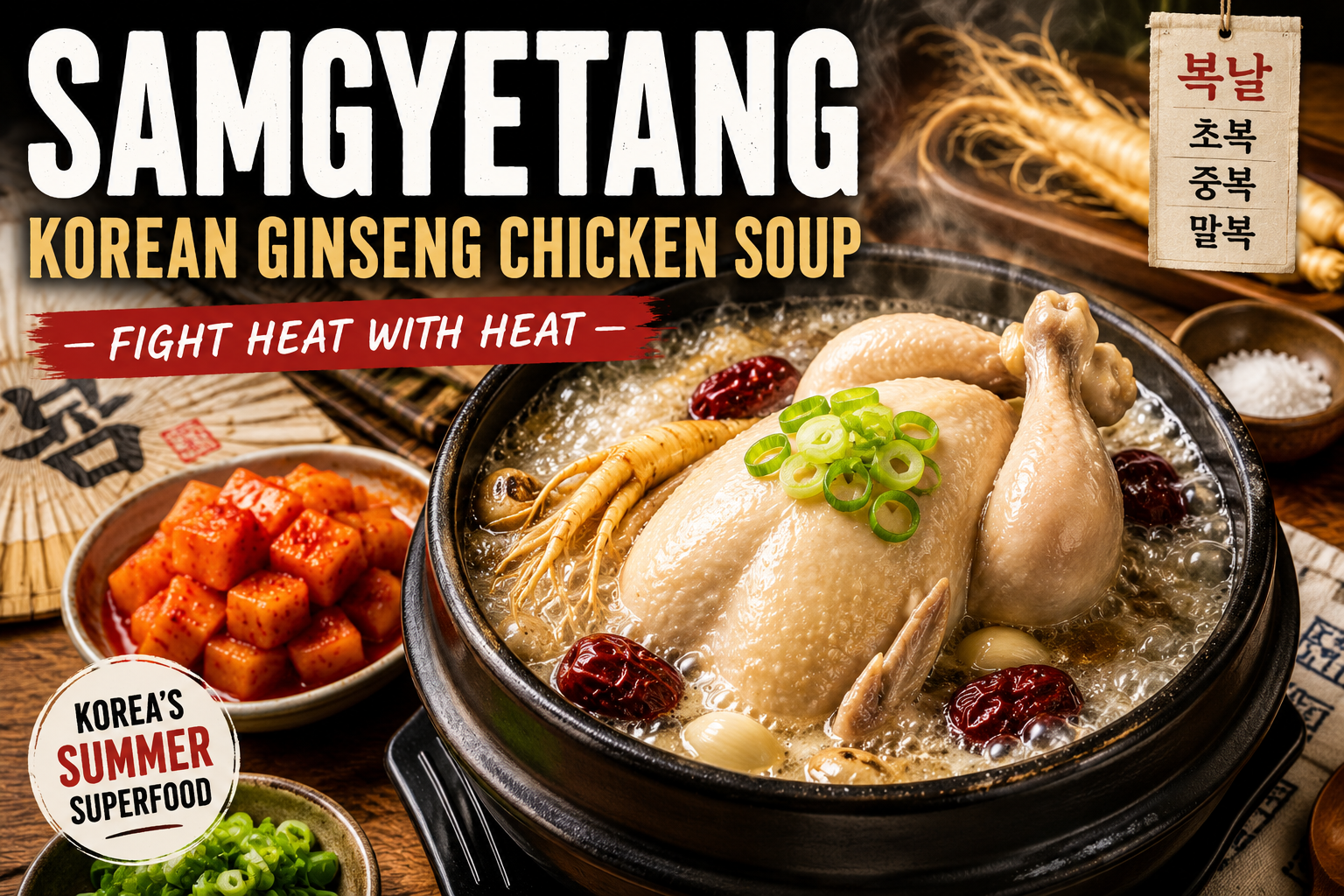
This dish is Samgyetang (삼계탕), Korea’s famous ginseng chicken soup.
The custom may seem surprising to visitors, but it is closely connected to a traditional seasonal practice known as Boknal (복날) and the Korean expression Iyeolchiyeol (이열치열), meaning “fighting heat with heat.”
Why do Koreans deliberately eat hot soup when the weather is already scorching? The answer reveals how food, seasonal customs, and traditional ideas about nourishment come together in Korean culture.
1. What Is Samgyetang?
Samgyetang is a Korean soup made by slowly simmering a small whole chicken with ginseng, glutinous rice, garlic, and jujubes.
The chicken is traditionally stuffed with rice and other ingredients before being cooked in broth. As it simmers, the meat becomes tender and the rice absorbs the chicken’s flavor.
A typical serving includes:
A small whole chicken: Usually a young chicken prepared as an individual portion
Glutinous rice: Placed inside the chicken cavity
Ginseng: Adds a distinctive herbal aroma
Garlic: Gives the broth a deeper savory flavor
Jujubes: Dried Korean dates that contribute a gentle sweetness
Some recipes also include chestnuts, ginkgo nuts, and hwanggi (황기), or astragalus root.
Unlike many well-known Korean dishes, traditional Samgyetang is not usually spicy. Its flavor comes from the chicken broth and aromatic ingredients rather than chili seasoning.
The result is a mild, comforting soup served with tender chicken and soft, flavorful rice.
2. Why Do Koreans Eat Hot Soup in the Middle of Summer?
The expression that best explains this custom is:
Iyeolchiyeol (이열치열, 以熱治熱)
It means “fighting heat with heat.”
In traditional Korean food culture, people believed that eating warm, nourishing food during the hottest season could help replenish energy and support the body through the exhausting summer.
Instead of avoiding hot dishes entirely, they deliberately chose substantial soups and other nourishing meals.
Samgyetang became one of the most recognizable foods associated with this custom.
This does not mean that hot soup scientifically lowers the body’s temperature or prevents heat-related illness. Iyeolchiyeol is best understood as a traditional cultural belief about seasonal eating, not a medical treatment.
The interesting part is the contrast: while visitors may look for something cold, Koreans may consider a steaming bowl of chicken soup exactly the right meal for the season.
3. What Is Boknal? Korea’s Three Summer Days
Samgyetang is especially associated with Boknal (복날), the three traditional summer days collectively called Sambok (삼복).
The three days are:
Chobok (초복): The first Boknal day
Jungbok (중복): The middle Boknal day
Malbok (말복): The final Boknal day
These days are traditionally regarded as some of the hottest periods of the Korean summer.
An important detail for international readers is that Sambok dates are not simply fixed dates on the lunar calendar. They are calculated using the traditional sexagenary calendar and seasonal markers.
Chobok is generally the third Gyeong day after the summer solstice, Jungbok the fourth Gyeong day after the solstice, and Malbok the first Gyeong day after the beginning of autumn, known as Ipchu (입추).
This is why the dates change from year to year.
During Boknal, many Koreans choose foods traditionally associated with nourishment. Samgyetang is now the most recognizable choice, and restaurants specializing in ginseng chicken soup can become particularly busy.
The custom is not limited to eating one specific dish, however. Other regional and seasonal foods have also been associated with Boknal.
4. Why Is Samgyetang Called a Summer Health Food?
Another expression helps explain the dish’s cultural meaning:
Boyangsik (보양식) refers broadly to food traditionally eaten for nourishment or to replenish one’s strength.
Samgyetang is one of Korea’s best-known examples.
The idea is connected to the belief that the summer heat can leave people feeling drained, so eating a substantial meal is a way to restore energy.
Chicken provides protein, while rice supplies carbohydrates. Ginseng, garlic, and other ingredients contribute distinctive flavors and aromas.
However, it is important not to confuse traditional food culture with proven medical effects. Eating Samgyetang does not guarantee protection from heat exhaustion, improve a particular illness, or replace proper hydration and medical care.
For Koreans, the dish’s significance is also cultural: it is a familiar seasonal meal that people associate with summer, family gatherings, and the annual Boknal tradition.
5. What Goes Inside Traditional Samgyetang?
The exact recipe varies by household and restaurant, but several ingredients appear repeatedly.
Ingredient
Role in the dish
Young whole chicken
The main ingredient and source of the broth
Glutinous rice
Stuffed inside the chicken and cooked until soft
Ginseng
Adds a distinctive herbal aroma
Garlic
Gives the broth savory depth
Jujubes
Add a mild sweetness
Hwanggi (astragalus root)
Used in some traditional broth recipes
Chestnuts
Optional ingredient that adds a gentle nutty flavor
Ginkgo nuts
Included in some regional or household recipes
The rice is particularly important.
As it cooks inside the chicken, it absorbs the broth and becomes soft and rich. Some restaurants serve the chicken whole in the pot, allowing diners to open it and discover the rice filling themselves.
The ginseng also gives Samgyetang a flavor that distinguishes it from ordinary chicken soup. Its aroma can be earthy and slightly bitter, which is part of the dish’s character.
6. Samgyetang vs. Baeksuk: What Is the Difference?
Visitors sometimes confuse Samgyetang with Baeksuk (백숙) because both are Korean dishes made by simmering chicken.
They are related, but they are not identical.
Samgyetang is usually made with a small whole chicken stuffed with glutinous rice and cooked with ginseng, garlic, jujubes, and other ingredients.
Baeksuk is a broader category of meat or poultry boiled in water, often with relatively simple seasoning. Chicken baeksuk commonly features a whole chicken simmered with garlic and other ingredients, without necessarily being stuffed with rice or ginseng.
The distinction is not absolute because recipes vary. Some baeksuk preparations include herbs and rice, and some restaurants serve rice porridge made from the remaining broth.
A useful way to remember the difference is that Samgyetang is the more specifically defined ginseng-and-rice chicken soup, while Baeksuk refers to a broader style of boiled chicken preparation.
7. Samgyetang vs. Naengmyeon: Two Opposite Korean Summer Traditions
One of the most interesting aspects of Korean summer food culture is that two very different dishes can be equally popular during hot weather.
Samgyetang (삼계탕) is served steaming hot.
Naengmyeon (냉면) is served cold, often with chilled broth or a spicy dressing.
The two dishes offer almost opposite experiences:
Feature
Samgyetang
Naengmyeon
Temperature
Hot
Cold or chilled
Main ingredients
Chicken, rice, ginseng
Buckwheat or other noodles
Flavor
Mild, savory, herbal
Refreshing, tangy or spicy
Cultural association
Boknal and nourishing summer food
Cooling summer meals
Typical serving
Individual pot
Individual noodle bowl
There is no contradiction in enjoying both. Korean summer dining includes different ways to respond to the season: some people want a cold, refreshing meal, while others enjoy a substantial hot soup.
Samgyetang is usually served in a small individual pot, often while the broth is still bubbling.
If it is your first time, there is no complicated eating ritual to learn.
First, taste the broth.
The soup is often lightly seasoned. Salt and black pepper are commonly provided separately so diners can adjust the flavor.
Next, separate the chicken meat.
The chicken should be tender enough to pull apart with chopsticks, a spoon, or a fork.
Then, open the chicken.
Inside, you will find the glutinous rice and sometimes garlic, jujubes, or other ingredients. Mix the rice with a little broth and enjoy it alongside the meat.
Finally, adjust the seasoning.
Some people add salt directly to the broth, while others dip individual pieces of chicken into a small amount of salt.
The rice filling is an important part of the meal. Once mixed with the broth, it can become almost like a soft chicken-and-rice porridge.
9. Why Are Kimchi and Kkakdugi Served With Samgyetang?
Samgyetang is mild and rich, so its side dishes provide an important contrast.
Two common accompaniments are:
Kimchi (김치): Fermented vegetables, most commonly napa cabbage, seasoned with chili, garlic, and other ingredients.
Kkakdugi (깍두기): A type of kimchi made from cubed radish.
Kkakdugi is particularly satisfying with Samgyetang because its crunchy texture and tangy flavor contrast with the soft chicken and warm broth.
The combination works in several ways:
The soup is mild and savory.
The chicken is tender.
The rice is soft and filling.
The radish kimchi adds acidity and crunch.
Some restaurants also serve fresh green chili peppers, raw garlic, or other small side dishes.
These accompaniments are not just decoration. They help create a balanced meal and give diners different textures and flavors throughout the meal.
10. Traditional Samgyetang Recipe: How to Make It at Home
You do not need to visit Korea to enjoy Samgyetang. With a small whole chicken and a few ingredients, you can make a traditional-style version at home.
Ingredients (2 servings)
2 small whole chickens, approximately 400–500 g each
100 g glutinous rice
2 small ginseng roots
8–10 garlic cloves
4 dried jujubes
1.5–2 liters of water, or enough to cover the chickens
1–2 green onions
Salt and black pepper
Optional ingredients:
Astragalus root (hwanggi)
Chestnuts
Ginkgo nuts
A packaged Korean Samgyetang herbal ingredient mix
Step 1: Soak the Glutinous Rice
Wash the glutinous rice thoroughly and soak it in water for at least one hour. Some traditional recipes recommend soaking it for several hours.
Drain the rice before using it.
Soaking helps the rice cook more evenly, particularly when it is placed inside the chicken.
Step 2: Prepare the Chicken
Remove any remaining internal parts and excess fat from the chicken cavity.
Rinse and handle the raw poultry carefully. Wash your hands, utensils, and work surfaces after they come into contact with raw chicken.
Step 3: Stuff the Chicken
Place some of the soaked rice inside each chicken.
Add ginseng, garlic, and jujubes.
Do not overfill the cavity. The rice expands as it cooks, so leave enough room for it to swell.
Step 4: Secure the Chicken
Cross the chicken legs and secure them through a small opening in the skin if possible.
Alternatively, use kitchen twine to hold the legs together and help keep the filling inside.
Step 5: Prepare the Broth
Place the chickens in a large pot and add enough water to cover them.
If using astragalus root or a packaged herbal mix, add it according to the recipe or package instructions.
Bring the water to a boil.
Step 6: Simmer Until Fully Cooked
Once the water boils, reduce the heat and simmer gently.
Small whole chickens may take approximately 60–90 minutes, depending on their size, the amount of filling, and the cooking temperature.
Do not rely on cooking time alone. Use a food thermometer to check that the thickest part of the chicken and the center of the rice stuffing reach at least 74°C (165°F).
The chicken should also be tender enough to separate easily from the bones.
Step 7: Serve With Green Onion, Salt, and Pepper
Remove large herbal ingredients that are not intended to be eaten.
Slice the green onion and add it to the broth.
Serve the Samgyetang hot, with salt and black pepper on the side so everyone can season it to taste.
11. An Easier Samgyetang Recipe for Beginners
Fresh ginseng and traditional herbs may not be easy to find outside Korea.
Fortunately, Korean grocery stores often sell packaged Samgyetang herbal ingredient mixes.
These packets contain dried ingredients intended for chicken soup and can make preparation easier.
For a simpler version, prepare:
1 small whole chicken
1 Samgyetang herbal ingredient packet
6–8 garlic cloves
Glutinous rice
Green onion
Salt and pepper
Follow the packet instructions and simmer the chicken until fully cooked.
If stuffing rice inside the chicken feels difficult, cook the rice separately and serve it with the broth.
This is a convenient alternative for beginners. It may differ from the traditional preparation, but it still gives you the familiar flavor of Korean-style ginseng chicken soup.
12. What Is Ogolgye Samgyetang?
You may occasionally see Ogolgye Samgyetang (오골계 삼계탕) on a Korean restaurant menu.
Ogolgye refers to a distinctive black-boned chicken associated with silkie-type poultry.
Its dark skin and bones give the dish a very different appearance from ordinary Samgyetang. Depending on the restaurant, it may be prepared with glutinous rice, garlic, jujubes, and other ingredients.
A related dish is Ogolgye Baeksuk (오골계백숙), which uses silkie chicken in a boiled chicken preparation.
These dishes are generally specialty menu items rather than the standard Samgyetang served in most restaurants.
13. What Is Haesintang? A More Elaborate Korean Chicken Soup
Another dish worth knowing is Haesintang (해신탕).
While Samgyetang focuses on chicken, Haesintang often combines chicken with seafood such as abalone and octopus.
Depending on the restaurant, the pot may also contain ginseng, garlic, jujubes, and other aromatic ingredients.
It is generally a more elaborate and more expensive meal than ordinary Samgyetang.
The name and exact ingredients can vary by restaurant, so it is best to check the menu rather than assume that every Haesintang contains the same seafood.
For visitors interested in Korea’s traditional nourishing soups, Haesintang offers a different experience by combining ingredients from both land and sea.
14. Is Samgyetang Spicy?
Traditional Samgyetang is generally not spicy.
Its flavor comes from chicken broth, ginseng, garlic, and other aromatic ingredients. It does not normally rely on gochujang or large amounts of chili.
Restaurants usually serve salt and pepper separately, allowing diners to adjust the seasoning.
This makes Samgyetang a good choice for visitors who want to explore Korean food but do not enjoy spicy dishes.
However, individual restaurants may offer seasoned or spicy variations, so check the menu if you are particularly sensitive to chili.
15. When Is the Best Time to Eat Samgyetang?
You can eat Samgyetang throughout the year, but the most culturally significant time is the Korean summer, especially around Chobok, Jungbok, and Malbok.
During these three Boknal days, many Koreans make a point of eating Samgyetang or another traditional nourishing dish.
Restaurants can become especially busy because the custom is shared across generations.
If you visit Korea during summer, try going to a restaurant specializing in ginseng chicken soup around Boknal. You may see people waiting for a table despite the heat outside.
That experience offers a glimpse of how deeply seasonal food traditions remain connected to everyday Korean life.
16. Samgyetang Is More Than Just Ginseng Chicken Soup
The English translation, “ginseng chicken soup,” explains the ingredients, but it does not fully explain the dish’s cultural meaning.
Samgyetang brings together several parts of Korean food culture:
Boknal: The three traditional summer days associated with seasonal eating.
Iyeolchiyeol: The belief in fighting heat with heat.
Boyangsik: The idea of eating nourishing food to replenish energy.
Seasonal ingredients: Chicken, glutinous rice, ginseng, garlic, and jujubes.
Shared customs: A familiar summer meal enjoyed by families, friends, and coworkers.
For many Koreans, Samgyetang is not simply a bowl of chicken soup. It is a taste associated with the hottest part of the year and a tradition that returns every summer.
Sometimes Koreans choose icy Naengmyeon to enjoy the heat. Other times, they sit down to a steaming pot of Samgyetang.
One country. Two very different bowls. Two beloved expressions of Korean summer food culture.
17. Frequently Asked Questions About Samgyetang
Why do Koreans eat Samgyetang on the hottest days?
Samgyetang is traditionally eaten during Boknal, the three summer days known as Chobok, Jungbok, and Malbok. The custom is associated with Iyeolchiyeol, the traditional idea of fighting heat with heat.
What is inside Samgyetang?
Traditional Samgyetang usually contains a small whole chicken stuffed with glutinous rice, ginseng, garlic, and jujubes. Some recipes also include chestnuts, ginkgo nuts, and astragalus root.
Is Samgyetang spicy?
No. Traditional Samgyetang is generally mild. Salt and pepper are usually served separately so diners can adjust the seasoning.
What is the difference between Samgyetang and Baeksuk?
Samgyetang is usually a small whole chicken stuffed with glutinous rice and cooked with ginseng and other ingredients. Baeksuk is a broader category of boiled meat or poultry dishes and does not necessarily include the same stuffing or herbs.
Can foreigners eat Samgyetang?
Yes. Traditional Samgyetang is not usually spicy, and many restaurants serve it as an individual portion. It is a good introduction to Korean chicken soup for visitors who prefer mild flavors.
What should I eat with Samgyetang?
Kimchi and kkakdugi are popular side dishes. Their crunchy texture and tangy flavor complement the mild chicken broth and soft rice.
What does Boknal mean?
Boknal refers to the three traditional summer days called Chobok, Jungbok, and Malbok. Together, they are known as Sambok and are associated with seasonal food customs in Korea.
What does Iyeolchiyeol mean?
Iyeolchiyeol (이열치열) means “fighting heat with heat.” It describes the traditional idea of eating hot food during hot weather, a belief closely associated with Samgyetang.
Can I make Samgyetang without ginseng?
Yes. Ginseng is a characteristic ingredient, but you can make a simpler chicken soup using a small whole chicken, glutinous rice, garlic, and jujubes. The flavor will be different from traditional Samgyetang, but it can still be a satisfying Korean-style chicken soup.
At first, spicy sauce and icy broth might sound like an unusual combination.
But Korean food often uses contrasts to create a satisfying meal.
Think of grilled meat served with cold noodles, or spicy bibim naengmyeon enjoyed during summer.
Buldak Naengmyeon takes that contrast in another direction.
The Buldak sauce delivers an immediate spicy kick. The chilled broth, cucumber, and other fresh toppings provide a refreshing contrast.
The cold broth does not remove the heat, but it changes the overall eating experience.
You get a mouthful of spicy noodles, followed by a sip of cold broth.
Then you want another bite.
That contrast is the main appeal of this dish.
3. Buldak Naengmyeon Ingredients
This recipe makes one serving.
3.1 Main Ingredients
1 pack of Buldak ramen
300–400 ml chilled naengmyeon broth
Buldak liquid sauce, adjusted to taste
1/4 cucumber, thinly sliced
1/2 boiled egg
Buldak seasoning flakes from the package
Ice cubes, optional
3.2 Optional Toppings
Korean pickled radish
A small splash of vinegar
Korean mustard
Kimchi or yeolmu kimchi
Toasted sesame seeds
Thinly sliced grilled beef or pork
You do not need every topping.
For a simple first attempt, Buldak noodles, cold broth, cucumber, and boiled egg are enough.
Important: Check the Buldak package before using its seasoning flakes. Some varieties include additional spicy seasoning, so adjust the amount according to your preferred heat level.
4. How to Make Buldak Naengmyeon
4.1 Step 1: Chill the Naengmyeon Broth
Place the naengmyeon broth in the refrigerator until thoroughly cold.
For an extra-refreshing version, put it in the freezer briefly until it becomes slightly slushy.
Do not let it freeze completely if you want to pour it easily over the noodles.
A properly chilled broth makes a noticeable difference.
4.2 Step 2: Cook the Buldak Noodles
Boil the Buldak noodles according to the package instructions.
Because you will rinse them in cold water afterward, cook them until they are properly tender while still retaining their chewy texture.
Avoid overcooking them.
The noodles should hold their shape after cooling.
4.3 Step 3: Rinse the Noodles in Cold Water
Drain the noodles immediately after cooking.
Rinse them several times under cold running water or in a bowl of ice water.
Gently separate the noodles with your fingers or chopsticks as you rinse.
This process:
Stops the cooking process
Removes excess surface starch
Cools the noodles quickly
Helps create a cleaner, chewier texture
Drain thoroughly before adding the sauce.
Excess water can dilute the Buldak flavor.
4.4 Step 4: Mix in the Buldak Sauce
Place the cold noodles in a serving bowl.
Add part of the Buldak liquid sauce and mix thoroughly.
Do not automatically use the entire sauce packet.
Start with about one-third to one-half, depending on your spice tolerance.
Taste the noodles before adding more.
The cold broth will change the overall flavor balance, but Buldak sauce can still be extremely spicy.
4.5 Step 5: Add the Ice-Cold Broth
Pour approximately 300–400 ml of chilled naengmyeon broth around the noodles.
Use closer to 300 ml if you prefer a stronger spicy flavor.
Add more if you want a lighter, more broth-focused bowl.
A few ice cubes are optional, but remember that they will gradually melt and dilute the broth.
If your broth is already very cold, you may not need them.
4.6 Step 6: Add the Toppings
Finish the bowl with:
Thinly sliced cucumber
Half a boiled egg
Buldak seasoning flakes, as desired
Korean pickled radish
Toasted sesame seeds
Your Buldak Naengmyeon is ready.
Serve immediately while the broth and noodles are still cold.
5. The Most Important Tip: Add the Sauce Gradually
Buldak sauce is known for its intense heat.
For someone who is not accustomed to Korean spicy food, using the entire packet can make the dish overwhelming.
The easiest approach is:
Start with less. Taste. Then add more.
Cold broth provides a refreshing contrast, but it does not make the sauce harmless or eliminate its spiciness.
If you are preparing this dish for friends or family, you can mix the noodles with a smaller amount of sauce and serve extra sauce separately.
That way, everyone can adjust the heat.
6. Want a More Refreshing, Tangy Flavor?
Naengmyeon is often enjoyed with a little acidity.
A small splash of vinegar can brighten the broth and balance the richness of the spicy sauce.
Korean mustard is another option.
It adds a sharp, distinctive kick that works particularly well with cold noodles.
However, both ingredients can quickly change the flavor.
Add a little at a time and taste before adding more.
7. Enjoy Buldak Naengmyeon With Korean BBQ
If you want to turn this simple noodle dish into a more satisfying meal, try serving it with grilled meat.
Thinly sliced beef, pork belly, or another favorite cut can work well.
Take a piece of hot grilled meat and eat it with a small bundle of cold Buldak noodles.
The combination creates an interesting contrast.
The savory, fatty meat balances the sharp spicy flavor, while the cold noodles refresh your palate between bites.
This also reflects a familiar Korean food combination: grilled meat served with cold noodles, particularly bibim naengmyeon.
8. Try Buldak Naengmyeon With Yeolmu Kimchi
Another topping worth trying is yeolmu kimchi (열무김치), a Korean young radish leaf kimchi.
It has a crisp texture and a refreshing, tangy flavor that works well with cold noodles.
Add a small amount on top of your Buldak Naengmyeon.
Its acidity and freshness provide another layer of contrast without completely covering the Buldak flavor.
If you enjoy Korean kimchi, this is an easy way to make the dish taste more like a Korean summer meal.
9. How Spicy Is Buldak Naengmyeon?
The spice level depends mainly on how much Buldak sauce you use.
Here is a simple guide:
Mild
Use about one-third of the sauce packet and add more broth if needed.
Medium
Start with approximately half the packet and adjust after tasting.
Very Spicy
Use most or all of the packet if you are already comfortable with Buldak’s heat.
There is no reason to force yourself to eat the spiciest version.
The goal is to enjoy the contrast between the spicy noodles and cold broth, not simply to see how much heat you can tolerate.
10. Can You Make It Without Buldak Ramen?
Yes.
If you can find Buldak sauce separately, you can use actual Korean naengmyeon noodles instead of instant ramen.
This creates a texture closer to traditional cold noodles while retaining the distinctive Buldak flavor.
Buckwheat noodles can also be used, although the texture and taste will be different.
Keep in mind that different noodles require different cooking times.
Follow the package instructions and rinse them thoroughly in cold water before assembling the dish.
Think of Buldak Naengmyeon as a flexible modern fusion recipe rather than a traditional dish with one fixed preparation method.
11. Buldak Naengmyeon vs. Bibim Naengmyeon
These two dishes may look similar, but their flavors come from different places.
Bibim Naengmyeon uses a Korean spicy-sweet-tangy seasoning made for cold noodles. It is part of Korea’s established naengmyeon tradition.
Buldak Naengmyeon gets its defining heat and flavor from Buldak-style sauce.
The difference is important.
Bibim naengmyeon has a more traditional cold-noodle flavor profile.
Buldak Naengmyeon is a modern fusion idea inspired by contemporary Korean spicy-noodle culture.
Both can be delicious, but they offer different experiences.
12. Why Buldak Naengmyeon Represents Modern K-Food
Buldak Naengmyeon brings together two different sides of Korean food culture.
Naengmyeon represents a long-established culinary tradition, with regional styles associated with places such as Pyongyang and Hamhung.
Buldak represents the modern global popularity of Korean spicy noodles.
Combining them reflects how Korean food continues to evolve.
Traditional dishes are not always left untouched. Home cooks, restaurants, and food enthusiasts experiment with familiar flavors and create new combinations.
Buldak Naengmyeon is one example of that creativity.
It does not need to replace traditional naengmyeon.
It simply offers another way to enjoy Korean noodles.
13. Buldak Naengmyeon Recipe at a Glance
Prep time: About 5 minutes, excluding broth chilling
Cooking time: About 5 minutes, depending on the noodle package
Rinse the noodles in cold water and drain them well.
Add the Buldak sauce gradually.
Follow these steps and you will have a refreshing bowl of spicy Korean cold noodles.
14. Buldak Naengmyeon FAQ
What is Buldak Naengmyeon?
It is a modern Korean-inspired fusion dish combining Buldak-style spicy noodles with chilled naengmyeon broth.
Is Buldak Naengmyeon traditionally Korean?
No. It is a modern fusion recipe, not a traditional regional naengmyeon variety.
Can I use regular Buldak ramen?
Yes. Cook the noodles according to the package instructions, rinse them thoroughly in cold water, and combine them with chilled naengmyeon broth.
Does cold broth reduce the spiciness of Buldak sauce?
The cold broth creates a refreshing contrast, but it does not remove the chili heat. Adjust the sauce amount to your tolerance.
Can I use real naengmyeon noodles instead of instant ramen?
Yes. Use separately purchased Buldak sauce and prepare the naengmyeon noodles according to their package instructions.
What toppings go well with Buldak Naengmyeon?
Cucumber, boiled egg, Korean pickled radish, yeolmu kimchi, sesame seeds, and grilled meat are all good options.
Can I prepare Buldak Naengmyeon ahead of time?
It is best assembled just before eating. You can chill the broth and prepare the toppings in advance, but cooked noodles may lose their texture if left sitting too long.
15. Final Tip: Enjoy the Contrast
Do not think of this recipe as simply cold Buldak ramen.
The goal is contrast.
You want the noodles spicy, the broth ice-cold, the cucumber crisp, and the toppings fresh.
On a hot summer day, that combination creates a completely different Buldak experience.
And if Buldak Naengmyeon is your first introduction to Korean cold noodles, do not stop here.
Try traditional mul naengmyeon, bibim naengmyeon, Pyongyang naengmyeon, and Hamhung naengmyeon too.
Buldak may bring the fire.
But the much older story of Korean cold noodles is even more interesting.
Walk into a Korean restaurant on a hot summer afternoon and you may see something that looks almost contradictory: people eating bowls of noodles surrounded by icy broth, sometimes with so much ice that the soup resembles a frozen drink.
This is naengmyeon (냉면), one of Korea’s best-known noodle dishes.
But there is a surprising detail behind this familiar summer meal.
Naengmyeon was traditionally associated with winter, not summer. Its roots lie in northern Korean food culture, where buckwheat, winter radish kimchi, cold storage, and heated rooms shaped the way people ate.
Its modern identity was also shaped by a major historical event. After the Korean War, people displaced from northern cities brought their regional noodle traditions south. In Seoul, those traditions developed into restaurant cultures that still influence how Koreans eat naengmyeon today.
That history helps explain why two bowls of Korean cold noodles can be so different.
Pyongyang naengmyeon is known for buckwheat aroma and restrained broth. Hamhung naengmyeon is associated with thin, elastic starch noodles and spicy seasoning, often accompanied by seasoned fish.
These are not simply two flavors of the same dish. They represent different regional food traditions.
To understand naengmyeon, it helps to look beyond the temperature of the broth. Its story is about agriculture, preservation, migration, changing technology, and the way food carries memories of home.
1. What Is Naengmyeon? Understanding Korea’s Cold Noodle Tradition
The Korean word naengmyeon (냉면) literally means “cold noodles.”
It generally describes noodles served in one of two ways:
Mul naengmyeon (물냉면): Noodles served in chilled broth.
Bibim naengmyeon (비빔냉면): Noodles mixed with a seasoned sauce, usually spicy, sweet, and tangy.
However, these two categories do not fully explain the dish.
Naengmyeon is also shaped by the ingredients used to make the noodles, the regional tradition behind the recipe, and the way the broth or sauce is prepared.
A restaurant serving Pyongyang-style naengmyeon may emphasize buckwheat and a carefully balanced broth. A restaurant serving Hamhung-style naengmyeon may focus on chewy starch noodles and a stronger seasoning sauce.
Even the word mul does not automatically mean that the dish follows the traditional Pyongyang method. Modern restaurants have developed many variations.
For first-time visitors, the easiest way to understand the menu is to separate two questions:
How are the noodles served? With broth or with sauce?
What regional noodle tradition does the restaurant follow? Pyongyang-style, Hamhung-style, or a modern adaptation?
Once these questions are separated, the differences become much easier to understand.
2. Why Was Naengmyeon Traditionally a Winter Food?
Today, cold noodles seem like an obvious choice for hot weather. Historically, however, winter was an important season for naengmyeon.
This was not simply because people enjoyed eating cold food in cold weather. Several practical conditions made winter especially suitable.
Dongchimi Provided a Seasonal Broth
One important ingredient was dongchimi (동치미), a type of water kimchi made primarily with Korean radish.
During winter, families traditionally stored dongchimi in large earthenware jars. The fermented liquid became a refreshing ingredient that could be used as a base for cold noodle broth.
Before household refrigerators were common, maintaining a consistently chilled liquid during warmer months was difficult.
Winter naturally provided the conditions needed to preserve and serve cold food.
Buckwheat Was Connected to the Agricultural Calendar
Buckwheat was another important part of the story.
It grows relatively quickly and was useful in regions where rice cultivation was more difficult. Its late-season harvest also made it a practical ingredient for traditional noodle production.
Buckwheat has a distinctive aroma, but its storage characteristics differ from those of some other grains. Historically, the timing of harvesting and storing ingredients influenced when certain foods were prepared.
The Contrast With Ondol Heating
There was also a cultural reason.
Traditional Korean houses used ondol (온돌), an underfloor heating system that kept rooms warm during winter.
Imagine sitting on a heated floor while eating cold noodles with chilled dongchimi broth.
The contrast between a warm room and a cold bowl was part of the pleasure.
This is an important detail because it challenges the assumption that traditional Korean food was always designed to match the outside temperature.
Naengmyeon was not simply a way to cool down. It was a seasonal dish shaped by ingredients, storage, and domestic life.
3. What Do Historical Records Tell Us About Naengmyeon?
The exact origin of naengmyeon is difficult to establish. It is more accurate to describe it as a food tradition that developed over time than to assign it a single inventor or creation date.
One important historical reference appears in Dongguk Sesigi (동국세시기), a record of Korean seasonal customs published in 1849.
The book describes naengmyeon as a food eaten around the winter season, including the eleventh month of the lunar calendar.
This matters because it shows that cold noodles were already recognized as a seasonal food during the late Joseon period.
The historical record also helps distinguish traditional naengmyeon from the modern restaurant categories familiar today.
People in the nineteenth century did not necessarily think about the dish through the same menu labels used by contemporary restaurants.
The relationship between noodles, dongchimi, meat broth, and toppings changed as cooking practices developed.
A 2025 academic study examining late Joseon cookbooks also explored how dongchimi evolved from a winter-preserved food into a broth used with noodles, contributing to the development of mul naengmyeon.
This is an important distinction: the history of naengmyeon is not simply the history of one recipe. It is the history of how a seasonal preserved ingredient became part of a recognizable noodle dish.
4. How Did a Winter Dish Become a Summer Favorite?
Naengmyeon’s transformation into a popular summer meal was closely connected to changes in technology and urban food culture.
Before refrigeration became widely available, serving cold broth consistently throughout the year was difficult.
As commercial ice storage, refrigeration, and modern restaurant facilities developed, restaurants became less dependent on winter temperatures.
They could prepare and store chilled broth more reliably.
This changed the practical meaning of the dish.
A food once strongly connected to winter ingredients and seasonal storage could now be served whenever customers wanted it.
The broth also evolved. Restaurants increasingly developed meat-based broths and other recipes that could be prepared consistently for commercial service.
Urban restaurant culture helped spread these versions to a wider audience.
The transformation was not simply a change in customer preference.
It involved several developments:
Food preservation: Refrigeration made year-round cold serving easier.
Restaurant production: Commercial kitchens could prepare larger quantities more consistently.
Urbanization: More people encountered regional dishes outside their original areas.
Migration: People moving from northern Korea introduced their hometown food traditions to southern cities.
The result was a change in the dish’s identity.
Naengmyeon did not lose its winter history. Instead, modern technology gave it a second life as a summer favorite.
5. Pyongyang Naengmyeon: Why Buckwheat and Broth Matter
Pyongyang naengmyeon (평양냉면) is one of the most recognized regional styles of Korean cold noodles.
Its traditional identity is built around two elements: buckwheat-based noodles and a restrained broth.
The noodles are generally made with buckwheat, often combined with starch or other ingredients to help create the desired texture.
The exact proportions vary by restaurant.
Unlike some chewy starch noodles, traditional Pyongyang-style noodles often have a softer, more delicate bite. They are valued for their buckwheat aroma rather than extreme elasticity.
The broth may combine beef stock, dongchimi liquid, or other ingredients.
The balance differs from restaurant to restaurant. Some versions emphasize savory meat flavor, while others have a lighter, more noticeable fermented-radish character.
Why Does Pyongyang Naengmyeon Taste So Mild?
For someone expecting strong Korean seasoning, the first taste can be surprising.
There may be no heavy chili sauce, and the broth may seem almost understated.
But that is part of the appeal.
The goal is not necessarily to create an intense first impression. The flavor is built around the relationship between the noodles and the liquid.
The buckwheat contributes its own aroma. The broth provides savory depth without completely covering that character.
This explains why enthusiasts pay so much attention to details that might seem minor to a first-time visitor:
How strongly the buckwheat aroma comes through
Whether the broth tastes more like meat stock or dongchimi
How much salt is used
Whether the noodles retain their texture
How the flavor changes as the broth warms slightly
The dish rewards slow tasting.
Someone who expects a bold, spicy flavor may initially find it disappointing. Someone who enjoys subtle differences in ingredients may discover that the bowl has more complexity than it first appears.
Pyongyang naengmyeon is less about powerful seasoning and more about balance.
6. Hamhung Naengmyeon: How Starch Noodles Created a Different Experience
Hamhung naengmyeon (함흥냉면) developed around a different noodle tradition.
Its noodles are associated with starch, traditionally including potato starch. Modern restaurants may also use sweet potato starch or other combinations.
Compared with many Pyongyang-style noodles, Hamhung-style noodles are generally thinner and more elastic.
That texture is central to the experience.
Rather than focusing mainly on a delicate broth, Hamhung-style naengmyeon is especially associated with seasoned noodles and spicy sauce.
One famous variation is hoe naengmyeon (회냉면).
It is served with seasoned raw or cured fish, commonly pollock or other fish depending on the restaurant and recipe.
The fish adds texture and savory flavor, while the sauce provides sweetness, acidity, and heat.
This combination produces a much more assertive taste than the restrained broth associated with traditional Pyongyang naengmyeon.
Why Is the Texture So Different?
The difference begins with the ingredients.
Buckwheat and starch behave differently when made into noodles.
Starch-based noodles can develop a highly elastic, chewy structure. This makes them especially suitable for dishes in which the noodles are mixed with a thick sauce.
The seasoning also plays a different role.
In Pyongyang-style naengmyeon, the broth and noodles are central to the experience.
In Hamhung-style hoe naengmyeon, the sauce, fish, and chewy noodles work together.
Neither approach is inherently better.
They reflect different regional food traditions and different ideas about what makes a satisfying bowl of cold noodles.
7. Pyongyang vs. Hamhung: The Differences at a Glance
Feature
Pyongyang-style
Hamhung-style
Main noodle ingredient
Buckwheat, often with added starch
Starch-based, traditionally associated with potato starch
Texture
Often softer and less elastic
Thin and distinctly chewy
Typical presentation
Frequently served in chilled broth
Frequently served with spicy seasoning
Famous variation
Mul naengmyeon
Hoe naengmyeon
Main flavor focus
Buckwheat aroma and broth balance
Chewy noodles, sauce, and fish
Eating experience
Subtle and restrained
Bold, spicy, and tangy
These are traditional tendencies, not absolute rules.
Modern restaurants adapt their recipes, and some menus combine characteristics from different styles.
It is also important not to assume that every bowl of mul naengmyeon is Pyongyang-style or that every bibim naengmyeon is Hamhung-style.
The names describe different aspects of the dish.
Regional tradition, serving method, and ingredients overlap, but they are not identical categories.
8. How the Korean War Brought Northern Noodle Traditions South
The Korean War changed the geography of Korean food.
Before the division of the peninsula, Pyongyang and Hamhung were important centers of northern food culture.
When war and displacement forced people to leave their homes, many brought their cooking knowledge and food preferences with them.
For those who settled in South Korea, familiar dishes became a way to maintain a connection to the places they had left behind.
But recreating a hometown dish in a new environment was not always easy.
Ingredients, customers, suppliers, and restaurant conditions were different.
Some recipes had to be adapted. Others developed new local characteristics.
This is particularly important when looking at Hamhung-style naengmyeon in Seoul.
The dish did not simply move south unchanged.
It became part of a new restaurant culture shaped by migration, local ingredients, and the tastes of southern customers.
A bowl of naengmyeon could therefore serve two purposes at once:
It was a meal that customers could enjoy, and it was a reminder of a hometown that many people could no longer visit.
That emotional dimension is easy to overlook when naengmyeon is introduced simply as a refreshing summer dish.
9. Why Is Ojang-dong in Seoul Associated With Hamhung Naengmyeon?
One of Seoul’s best-known areas associated with Hamhung-style naengmyeon is Ojang-dong, in Jung-gu.
Its restaurant history is connected to northern migrants who settled in Seoul after the Korean War.
The neighborhood became known for restaurants serving noodles inspired by the food traditions of Hamgyeong Province.
One of the best-known examples is Ojangdong Heungnamjip, whose history is traced to the early postwar years. Another prominent restaurant, Ojangdong Hamheung Naengmyeon, also became part of the neighborhood’s identity.
Historical accounts differ in some details about individual founders and opening dates, so it is better not to reduce the entire neighborhood’s history to one restaurant or one person.
What is clear is that Ojang-dong became an important center for Hamhung-style naengmyeon.
The area once had many more restaurants serving this regional specialty. Redevelopment and changing commercial conditions reduced their number over time.
Yet the neighborhood remains closely associated with the dish.
Why Does This History Matter?
Ojang-dong shows how migration can transform a local food into a wider national tradition.
The restaurants were not simply selling noodles from a different region.
They were recreating a taste associated with home, adapting it to a new city, and introducing it to customers who might never have visited Hamhung.
Over time, the dish became familiar to people across South Korea.
That is one reason why food history is also social history.
A regional recipe can survive because people carry it with them, rebuild it in a new place, and pass it on to the next generation.
10. Mul Naengmyeon vs. Bibim Naengmyeon: Which One Should You Order?
For most first-time visitors, the immediate question is simple:
Do you want broth or spicy sauce?
Mul Naengmyeon: Cold Noodles in Broth
Mul naengmyeon is served with chilled liquid poured over the noodles.
Common toppings include:
Sliced cucumber
Pickled radish
Boiled egg
Sliced beef or other meat
Sometimes pear or other seasonal garnish
The broth may be based on beef stock, dongchimi liquid, or a combination.
Some restaurants serve it very cold, with partially frozen broth.
The flavor can range from savory and meaty to light and refreshing.
If you want to understand the relationship between noodles and broth, this is a good place to start.
Bibim Naengmyeon: Noodles With Spicy Sauce
Bibim naengmyeon is mixed with a seasoned red sauce rather than served in a large amount of broth.
The sauce often includes chili-based ingredients, vinegar, sweetness, garlic, and other seasonings.
The exact recipe varies.
Some restaurants make it intensely spicy. Others emphasize sweetness and acidity.
It is often served with cucumber, pickled radish, and boiled egg.
If you already enjoy Korean dishes such as bibimbap with spicy sauce or spicy noodles, bibim naengmyeon may feel more familiar.
Which Is Better for a First-Time Visitor?
There is no universal answer.
Choose mul naengmyeon if you want to explore cold broth and the character of the noodles.
Choose bibim naengmyeon if you prefer strong seasoning and a more intense combination of sweet, spicy, and tangy flavors.
If you are dining with someone else, ordering one of each and sharing them is an easy way to compare the two.
11. Why Do Koreans Eat Naengmyeon With Korean Barbecue?
Naengmyeon is a familiar menu item at many Korean barbecue restaurants.
This pairing is not just a convenient way to add another dish to the meal. The flavors and textures complement each other.
Grilled beef or pork often has a rich, savory, and sometimes fatty character.
Cold noodles create a contrast.
Mul naengmyeon offers chilled broth and a lighter finish. Bibim naengmyeon adds acidity, sweetness, and spice.
The combination can make a heavy barbecue meal feel more balanced.
Some diners eat naengmyeon after finishing their grilled meat. Others wrap a small portion of noodles around a piece of meat and eat them together.
Both approaches are common.
Restaurants may also offer a smaller serving of noodles, sometimes called sari, so customers can add noodles without ordering another full bowl.
The important point is that naengmyeon has become part of a broader Korean dining experience.
It is not limited to specialist noodle restaurants.
12. Why Are Vinegar and Mustard Served With Naengmyeon?
Many Korean naengmyeon restaurants place vinegar and mustard on the table.
They are optional seasonings, not ingredients that every diner must add.
Vinegar increases acidity and can make the broth taste brighter.
Mustard adds a sharp, pungent sensation that changes the overall flavor.
The best approach is to taste the broth before adding anything.
This is especially useful when eating traditional Pyongyang-style naengmyeon, where the balance of the broth is a major part of the dish.
Adding too much vinegar or mustard immediately can cover the flavor that the restaurant intended to highlight.
With bibim naengmyeon, the sauce may already contain enough acidity and seasoning.
A small adjustment is usually better than adding large amounts at once.
There is no single correct way to season every bowl. The choice depends on the recipe and personal preference.
13. Why Do Korean Restaurants Give Customers Scissors?
If you order naengmyeon in Korea, the staff may bring metal scissors to your table.
This can surprise visitors who are accustomed to eating noodles with chopsticks alone.
Some naengmyeon noodles are very long and difficult to handle, especially elastic starch-based varieties.
Cutting them into shorter portions makes them easier to pick up and eat.
It is particularly useful when noodles are tightly packed in a bowl or mixed with thick sauce.
But cutting is not compulsory.
Some diners prefer to keep the noodles long, while others ask the staff to cut them several times.
If you are unfamiliar with the custom, simply use the scissors when they are provided.
It is an ordinary part of eating certain types of Korean noodles, not a sign that you are expected to follow a strict dining rule.
14. What Is Myeonsu, the Warm Drink Sometimes Served With Cold Noodles?
At some traditional naengmyeon restaurants, customers receive a small cup of warm liquid before the cold noodles arrive.
This may be myeonsu (면수), the water left from cooking the noodles.
Depending on the restaurant, it may carry some of the flavor and aroma of buckwheat.
Other restaurants serve a separate warm broth instead.
The practice is not universal, and the drink differs from place to place.
But it creates an interesting contrast:
A warm drink before a bowl of cold noodles.
For visitors, it is another example of how naengmyeon is not simply a cold dish. The meal can include different temperatures, aromas, and textures.
15. Naengmyeon and Samgyetang: Two Different Ideas of Korean Summer Food
Korean summer food culture contains an interesting contrast.
On one side is naengmyeon: chilled noodles served in cold broth or mixed with spicy sauce.
On the other is samgyetang (삼계탕), a hot chicken soup traditionally prepared with ingredients such as ginseng, garlic, and glutinous rice.
Why would people eat hot soup during hot weather?
One traditional expression is iyeol chiyeol (이열치열), often translated as “fight heat with heat.”
The expression is associated with the idea of eating hot food during the hottest season.
Naengmyeon and samgyetang represent different approaches to summer dining.
One emphasizes a cold, refreshing sensation. The other is a warm and substantial meal.
They should not be treated as two sides of a single medical rule. Rather, they illustrate the variety of seasonal eating traditions in Korea.
Korean food culture is not built around one simple principle of matching food temperature to outdoor temperature.
Ingredients, habit, personal taste, and cultural beliefs all influence what people choose to eat.
16. How Naengmyeon Entered Korean Pop Culture
Naengmyeon has also become part of Korean entertainment.
One memorable example came in 2009, when Park Myung-soo and Girls’ Generation member Jessica performed the song “Naengmyeon” as the project duo MyungCa Drive on the television variety show Infinite Challenge.
The song became a recognizable summer-themed pop-culture moment.
Its appeal came partly from the humor of turning an everyday food into a catchy entertainment concept.
This connection is revealing.
Naengmyeon is not only a traditional dish associated with regional history. It is also part of ordinary contemporary life.
People eat it after barbecue, during summer outings, with family, and with friends.
It is familiar enough to become the subject of a playful television song.
That is one way a traditional food remains relevant across generations.
17. Can You Make Korean Naengmyeon at Home?
Yes. Making traditional restaurant-style naengmyeon from scratch can require time and preparation, especially when producing the broth.
However, packaged naengmyeon makes it possible to prepare a convenient version at home.
Korean supermarkets commonly sell refrigerated or dried noodles with ready-made broth or seasoning sauce.
Ingredients for Simple Mul Naengmyeon
Packaged naengmyeon noodles
Chilled naengmyeon broth
Cucumber
Pickled radish
Boiled egg
Sliced beef, if desired
Vinegar and Korean mustard
How to Prepare It
Step 1: Chill the broth.
Place the packaged broth in the refrigerator before cooking. If you prefer a partially frozen texture, chill it in the freezer for a short period while checking that it does not freeze solid.
Step 2: Cook the noodles.
Follow the package instructions. Different noodle products require different cooking times.
Step 3: Rinse the noodles thoroughly.
Drain the noodles and rinse them under cold running water. Gently separate them while rinsing to remove excess surface starch and stop the cooking process.
Step 4: Prepare the toppings.
Slice the cucumber, prepare the pickled radish, and cut the boiled egg in half. Add sliced beef if desired.
Step 5: Assemble the bowl.
Place the noodles in a bowl, pour over the chilled broth, and arrange the toppings.
Serve immediately.
For bibim naengmyeon, use the seasoning sauce supplied with the noodles or prepare a separate sauce according to your taste.
One important point: do not overcook the noodles.
Their texture is a defining part of the dish, and cooking times can vary significantly between refrigerated and dried products.
18. Which Naengmyeon Should You Try First?
The best choice depends on what you enjoy eating.
Your preference
A good starting point
Delicate broth and subtle flavor
Pyongyang-style mul naengmyeon
Strong, spicy seasoning
Bibim naengmyeon
Thin and chewy noodles
Hamhung-style naengmyeon
Seasoned fish with spicy noodles
Hoe naengmyeon
Cold noodles after grilled meat
Mul or bibim naengmyeon
Comparing different styles
Order mul and bibim together
If you are visiting Korea for the first time, trying two different styles is more informative than assuming all cold noodles taste alike.
A bowl of Pyongyang-style naengmyeon can introduce you to the aroma of buckwheat and the character of the broth.
A bowl of Hamhung-style hoe naengmyeon can show you how starch noodles, fish, and spicy sauce create a completely different experience.
The contrast is part of what makes the dish interesting.
19. What Makes Naengmyeon Different From Other Cold Noodle Dishes?
Cold noodles exist in many food cultures.
What makes Korean naengmyeon distinctive is not simply that it is served cold.
Its identity comes from the combination of several elements:
Buckwheat and starch-based noodle traditions
Dongchimi and meat-based broth preparations
The regional differences associated with Pyongyang and Hamhung
The use of spicy seasoning and fish in certain varieties
Its historical connection to northern Korean food culture
Its transformation through migration and modern restaurant technology
The contrast between Pyongyang and Hamhung styles is especially important.
One tradition often emphasizes the relationship between noodles and broth. Another highlights the elasticity of the noodles and the flavor of the sauce.
Modern restaurants have also created variations that do not fit neatly into either category.
That is why naengmyeon should be understood as a broad food tradition rather than one fixed recipe.
20. Naengmyeon Is More Than a Bowl of Cold Noodles
Naengmyeon’s story begins with the agricultural and seasonal conditions of northern Korea.
Dongchimi, buckwheat, winter storage, and ondol heating helped shape the original eating experience.
Later, changing technology and restaurant culture made it possible to serve cold noodles throughout the year.
The Korean War and the movement of people from northern regions brought regional traditions south, where they developed new identities in cities such as Seoul.
Ojang-dong became one of the places where Hamhung-style naengmyeon found a lasting home.
Today, the dish appears in specialist noodle restaurants, barbecue restaurants, supermarkets, and Korean pop culture.
That journey explains why naengmyeon means more than “cold noodles.”
It carries traces of regional identity, migration, changing technology, and the memories of people who brought familiar food into unfamiliar places.
The next time someone asks whether you want mul naengmyeon or bibim naengmyeon, you will be choosing more than broth or sauce.
You will be exploring two different approaches to one of Korea’s most distinctive noodle traditions.
And if you enjoy the combination of cold noodles and intense Korean spice, another modern variation is worth discovering: Buldak Naengmyeon, where traditional cold noodle culture meets the fiery flavor of Buldak.
Manager Kim, starring So Ji-sub, is a Korean action drama about an ordinary-looking father with an extraordinary past.
At first, Kim appears to be a quiet office worker trying to raise his teenage daughter and live a peaceful life. But when his daughter suddenly disappears, he is forced to reveal a secret he has spent years hiding.
The man everyone knows as Manager Kim was once a highly trained covert operative.
Now, he must use the skills of his former life to find his daughter — even if doing so brings dangerous people back into his world.
Released in South Korea as 김부장 and internationally titled Agent Kim Reactivated, the series combines family drama, espionage, action and comedy.
Here is a complete guide to the drama, including So Ji-sub’s character, cast, story, original webtoon, episode count and where to watch.
1. What Is the Manager Kim K-Drama About?
Manager Kim follows an apparently ordinary middle-aged father whose peaceful life is suddenly destroyed when his daughter goes missing.
Kim works at a small savings bank and tries to maintain a quiet existence. He is also raising his teenage daughter, Kim Min-ji, after the death of his wife.
Their relationship is not always easy. Min-ji is strong-willed and does not hesitate to stand up for herself, while her father prefers to avoid confrontation.
But when Min-ji disappears, Kim discovers evidence suggesting that she has been kidnapped.
He then makes a decision that changes everything.
The mild-mannered office worker reveals the identity he has kept hidden: he is a former special operative with a dangerous history and extraordinary combat skills.
The story becomes a race to rescue his daughter while confronting enemies connected to his past.
2. So Ji-sub Stars as Manager Kim
So Ji-sub plays the central character, Kim, commonly known as Manager Kim.
At first, he looks like an ordinary employee and a somewhat reserved father.
He avoids unnecessary conflict and appears to have left his dangerous former life behind.
But his ordinary appearance hides a very different identity.
Kim is a former covert operative who participated in numerous special missions. His existence is particularly sensitive because of his past connections to operations involving North Korea.
When his daughter disappears, he has no choice but to reactivate the skills that once made him a formidable agent.
This contrast is one of the drama’s biggest attractions.
So Ji-sub moves between two very different sides of the same character: a father struggling to communicate with his daughter and a highly trained operative prepared to confront dangerous enemies.
3. Manager Kim Cast and Characters
The series brings together several familiar Korean actors, with the central story connecting three fathers who have much more in common than their current ordinary lives suggest.
So Ji-sub — Manager Kim
Kim is a former covert operative who now works at a small savings bank.
His greatest priority is raising his daughter, Min-ji. When she disappears, he is forced to reveal his hidden identity and return to the dangerous world he left behind.
Choi Dae-hoon — Seong Han-soo
Seong Han-soo is one of Kim’s former agent companions.
He now runs a neighborhood taekwondo studio and lives a seemingly ordinary life.
His background as a former elite operative becomes important when Kim needs help finding his daughter.
Yoon Kyung-ho — Park Jin-cheol
Park Jin-cheol is another former operative who has left his dangerous past behind.
He is now known as a devoted father, and his relationship with his family contrasts with the formidable reputation he once had.
He joins Kim and Han-soo as the search for Min-ji becomes increasingly dangerous.
Joo Sang-wook — Ju Gang-chan
Ju Gang-chan is an important figure in the conflict surrounding Kim.
His actions contribute to the danger that Kim and his allies must overcome.
Son Na-eun — Jung Sang-a
Jung Sang-a is connected to the world of special operations.
Her involvement becomes particularly important as the search for Min-ji develops and the conflict expands beyond Kim’s personal rescue mission.
Seo Su-min — Kim Min-ji
Kim Min-ji is Manager Kim’s daughter.
She is a strong-willed teenager who does not easily accept unfair treatment. Her relationship with her father is complicated, but she is the person Kim is determined to protect above everything else.
Her disappearance sets the entire story in motion.
Kim Sung-kyu and Other Supporting Cast
Kim Sung-kyu also appears in the series, alongside actors including Won Hyun-jun, Jo Bok-rae and Lee Jae-yong.
Their characters help expand the world of former agents, hidden operations and the enemies connected to Kim’s past.
4. Manager Kim Story Explained
The drama begins with a father who appears to have left his former life behind.
Kim works at a bank, raises his daughter and tries to avoid trouble.
His relationship with Min-ji is not perfect. She has a strong personality, while Kim struggles to understand the problems she faces as a teenager.
After a confrontation involving Min-ji and other students, their relationship becomes even more strained.
Then she fails to return home.
As Kim begins investigating her disappearance, he discovers signs that she may have been kidnapped.
That is when his former identity becomes impossible to hide.
The man who once carried out dangerous covert missions is forced back into action.
But he cannot handle everything alone.
He reconnects with Han-soo and Jin-cheol, two former agents who have also built ordinary lives as fathers.
Together, they enter a dangerous world involving old enemies, secret organizations and unfinished business.
The central conflict is not simply whether Kim can defeat the people responsible.
It is whether he can save his daughter without losing the ordinary life he wanted to protect.
5. Why the Three Fathers Are Important
One of the most distinctive elements of Manager Kim is its focus on three fathers with extraordinary pasts.
Kim, Han-soo and Jin-cheol have all moved away from their former lives.
They now have ordinary responsibilities and people they want to protect.
But their previous experience has not disappeared.
When Kim’s daughter goes missing, the three men are drawn back into a world they thought they had left behind.
This creates an interesting contrast.
They may appear to be ordinary middle-aged men in everyday settings, but their pasts make them extremely dangerous when the situation demands it.
The series uses this contrast to combine action with humor and family-centered storytelling.
6. Is Manager Kim Based on a Webtoon?
Yes.
The drama is adapted from the Naver webtoon Manager Kim, written by Toy and illustrated by Jeong Jong-taek.
The original webtoon is part of the wider PTJ Comics Universe, which also includes works such as Lookism, Viral Hit and My Life as a Loser.
This connection is interesting for viewers who already follow the broader webtoon universe.
However, the television adaptation presents the story in its own dramatic format, bringing the characters and action sequences to life through a live-action cast.
For viewers unfamiliar with the original webtoon, no prior knowledge is required to understand the central story of the drama.
7. How Many Episodes Does Manager Kim Have?
Manager Kim, internationally titled Agent Kim Reactivated, has 10 episodes.
The Korean broadcast began on June 26, 2026, with the series airing on Fridays and Saturdays.
The finale was released on July 25, 2026.
Each episode runs for approximately one hour, although the exact runtime varies.
The series is complete, so viewers can watch the full story without waiting for additional weekly episodes.
8. Where Can You Watch Manager Kim?
The drama originally aired on SBS in South Korea.
For international viewers, the series is available on Netflix under the English title:
Agent Kim Reactivated
The international title is worth remembering because searching Netflix for only “Manager Kim” may not always bring up the series immediately.
Streaming availability, audio options and subtitles can vary by country.
Check the Netflix listing in your region for the latest viewing options.
9. What Makes Manager Kim Different From a Typical Office Drama?
Despite its Korean title, Manager Kim is not primarily a workplace drama about corporate promotions, retirement or generational conflict.
Its central premise is an action story built around a father with a hidden identity.
The office setting establishes Kim’s ordinary public life.
The contrast between his quiet appearance and his former career creates much of the drama’s appeal.
The series also explores familiar family themes:
A father trying to understand his teenage daughter
The difficulty of communicating across generations
The responsibilities of raising a child alone
The consequences of keeping secrets
The struggle to protect family while confronting the past
These themes give the action a personal motivation.
Kim is not returning to his former life because he misses being an agent.
He is doing it because his daughter needs him.
10. What Should You Watch for in Manager Kim?
There are several elements worth paying attention to while watching the series.
The contrast in Kim’s personality
Notice how differently Kim behaves as an office worker and as a former operative. The difference is central to So Ji-sub’s performance.
The relationship between Kim and Min-ji
Their relationship is not immediately perfect. The story uses their communication problems to establish the emotional stakes behind the rescue mission.
The three former agents
Kim’s reunion with Han-soo and Jin-cheol introduces a different kind of friendship: men who have left dangerous careers behind but still share a history that connects them.
The connection between family and action
The action scenes are not simply displays of combat skills. They are connected to the characters’ responsibilities as fathers and the people they want to protect.
The wider world of the original webtoon
Fans of the PTJ Comics Universe may also enjoy noticing how the television adaptation relates to the larger world of the original work.
11. Manager Kim Quick Guide
Detail
Information
Korean Title
김부장
International Title
Agent Kim Reactivated
Country
South Korea
Release Year
2026
Genre
Action, Crime, Thriller, Comedy, Family
Lead Actor
So Ji-sub
Main Character
Manager Kim
Main Cast
So Ji-sub, Choi Dae-hoon, Yoon Kyung-ho, Joo Sang-wook, Son Na-eun
Supporting Cast
Seo Su-min, Kim Sung-kyu, Won Hyun-jun, Jo Bok-rae, Lee Jae-yong
Original Source
Naver Webtoon Manager Kim
Original Creators
Toy and Jeong Jong-taek
Broadcaster
SBS
Episodes
10
Korean Premiere
June 26, 2026
Finale
July 25, 2026
International Streaming
Netflix
12. Is Manager Kim Worth Watching?
If you enjoy Korean action dramas with a strong family story, Manager Kim is worth considering.
Its central idea is easy to understand:
An ordinary father discovers that his daughter has disappeared, and the only way to save her is to return to the dangerous life he left behind.
So Ji-sub’s casting is particularly fitting because the character requires both a restrained everyday personality and convincing action presence.
The supporting cast also gives the story a wider group of characters whose former lives become important as the rescue mission develops.
For international viewers, the drama offers a combination of Korean family relationships, covert operations, action and humor.
Ultimately, Manager Kim is not about a middle-aged employee wondering what happens after his corporate career ends.
It is about a father discovering how far he is willing to go when the person he loves most is in danger.
The real question is not whether Manager Kim can become Agent Kim again. It is whether he can bring his daughter home and still return to being the father she needs.