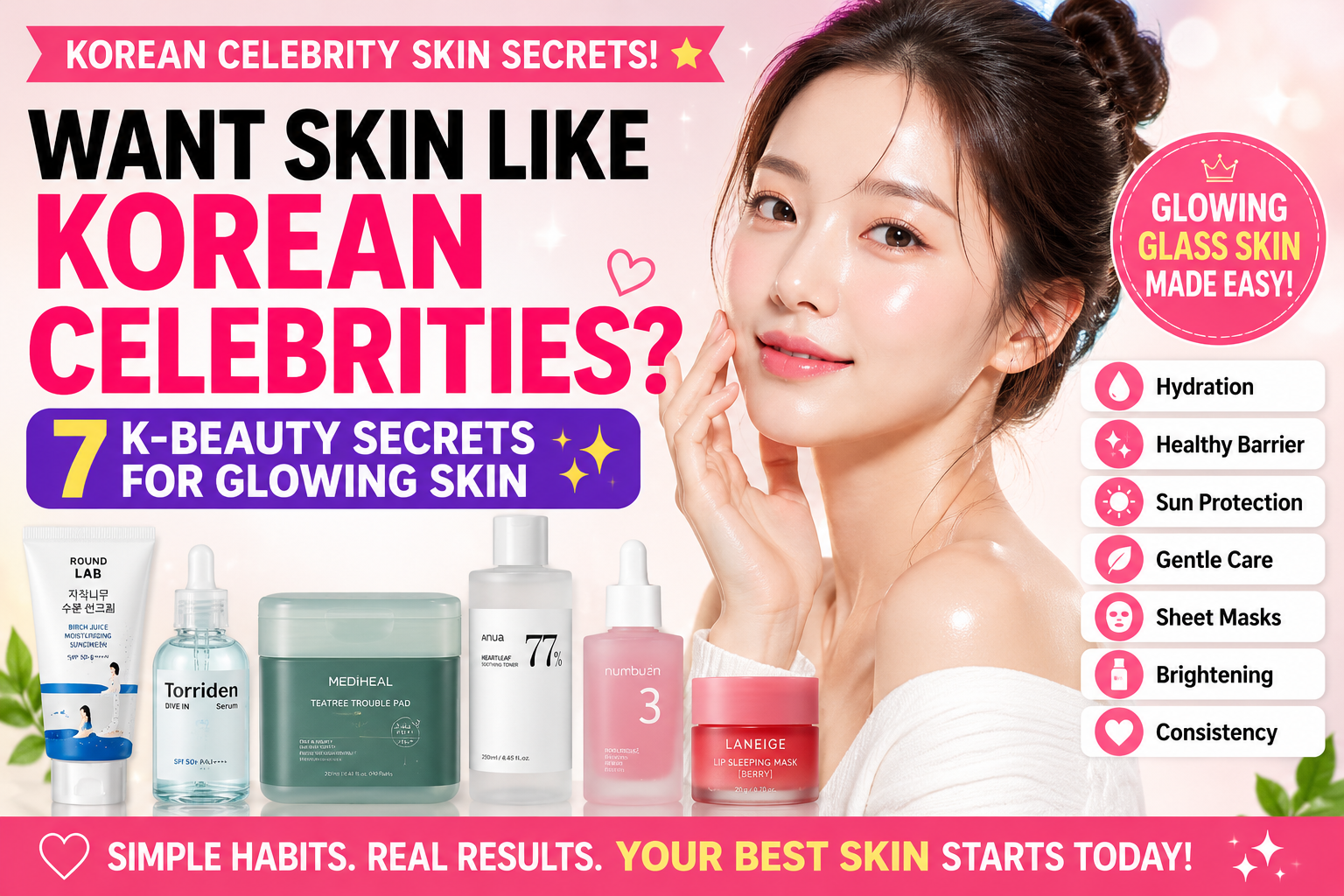
Have you ever watched a K-drama or K-pop performance and wondered:
How does their skin look so smooth, hydrated, and luminous?
Korean celebrities are often admired for their radiant-looking complexions. From K-drama actresses to K-pop idols, their skin has helped popularize the global beauty trend known as glass skin.
But is there really a secret Korean cream that can transform your skin overnight?
Not quite.
The reality is more interesting. Korean skincare is built around several practical ideas: gentle cleansing, hydration, protecting the skin barrier, daily sun protection, and choosing products that suit your individual skin.
Celebrity skincare routines can offer inspiration, but they are not universal formulas. Professional makeup, lighting, camera technology, genetics, and access to dermatological treatments can also influence how celebrities look on screen.
The useful lesson is not to copy everything a celebrity uses.
It is to understand the habits behind the routine and adapt them to your own skin.
Here are seven Korean skincare principles worth knowing.
1. Korean Skincare Is About Consistency, Not a 10-Step Rule
One of the biggest misconceptions about K-beauty is that everyone in Korea follows a complicated 10-step skincare routine every morning and night.
That is not how modern Korean skincare needs to work.
In a February 2026 Vogue article about the famous 10-step routine, K-beauty experts explained that Korean skincare is highly personalized. Depending on someone’s skin condition and concerns, a routine may contain only three products or considerably more.
The central idea is flexibility.
Some people need extra hydration during winter. Others need lightweight products because their skin becomes oily in humid weather. Someone dealing with sensitivity may benefit from simplifying their routine rather than adding more products.
Consistency is more useful than constantly changing products in search of an overnight transformation.
Jessica Jung discussed her detailed daily and nightly skincare habits in a 2016 Vogue interview. Her routine included cleansing products, toner, serum, creams, and lip care.
More recently, LE SSERAFIM’s Kazuha demonstrated a different approach in Vogue’s July 2026 Beauty Secrets feature. She described keeping her skincare relatively simple, even though she sometimes learns about new products from her bandmates.
These examples show that there is no single celebrity-approved formula.
The best skincare routine is one you can maintain without irritating your skin.
2. Clean Skin Comes First: Understanding Double Cleansing
Cleansing is one of the foundations of a Korean-inspired skincare routine.
Throughout the day, your face can accumulate sunscreen, makeup, excess oil, sweat, and environmental residue.
One method associated with K-beauty is double cleansing.
It involves two different cleansing steps.
First cleanse: Oil-based cleansing
An oil cleanser or cleansing balm helps dissolve oil-based substances such as makeup, sunscreen, and sebum.
Second cleanse: Water-based cleansing
A gentle facial cleanser removes remaining residue, sweat, and other impurities.
This method can be particularly useful for people who wear makeup or water-resistant sunscreen.
However, double cleansing is not compulsory for everyone.
If you wear little makeup and use a sunscreen that comes off easily with a gentle cleanser, one thorough cleanse may be enough.
Over-cleansing can leave the skin feeling tight, dry, or irritated.
The objective is not to wash your face as many times as possible.
It is to remove what needs to be removed without unnecessarily disturbing the skin’s natural protective barrier.
3. Hydration Is a Major Part of the Glass Skin Look
What makes glass skin look different from ordinary shiny skin?
The idea is not simply to make the face look oily.
Glass skin describes a complexion that appears smooth, hydrated, and luminous, with an even-looking surface.
Hydration is an important part of achieving this appearance.
Korean skincare products often include lightweight formulations designed to add moisture in different ways.
Common examples include:
- Toners: Add a layer of hydration after cleansing.
- Essences: Provide lightweight moisture and skin-conditioning ingredients.
- Serums: Target particular concerns, depending on their ingredients.
- Moisturizers: Help reduce moisture loss and support the skin barrier.
- Sheet masks: Provide an additional temporary hydration step.
You do not need all five.
For someone with dry skin, a hydrating serum followed by a suitable moisturizer may be enough.
Someone with oily skin may prefer a lightweight gel moisturizer rather than a rich cream.
Ingredients such as glycerin and hyaluronic acid are commonly used in hydrating skincare formulations. However, no single ingredient guarantees perfect skin.
The important point is to choose products that suit your skin and use them consistently.
Glass skin is better understood as a skincare goal involving hydration and skin health, not a requirement to make your face look artificially reflective.
4. Sunscreen Is One of the Most Important Daily Habits
If there is one skincare habit worth prioritizing, it is sun protection.
Ultraviolet exposure contributes to sunburn, pigmentation, visible skin aging, and an increased risk of skin cancer.
That is why dermatologists consistently emphasize sunscreen.
Many Korean sunscreens have become popular internationally because of their lightweight textures and comfortable everyday formulations.
But the most important consideration is not whether a sunscreen is Korean.
It is whether it provides appropriate protection and whether you use enough of it.
When choosing sunscreen, look for:
- Broad-spectrum protection against UVA and UVB rays
- SPF 30 or higher
- Water resistance when swimming or sweating
Apply it to exposed skin before going outdoors. Reapply approximately every two hours when outdoors, and after swimming or heavy sweating.
Sunscreen should not be reserved only for beach holidays.
Daily protection is a practical way to reduce cumulative UV exposure.
A complicated skincare routine cannot replace consistent sun protection.
5. Toner Pads and Sheet Masks: Useful Extras, Not Miracles
Walk into an Olive Young store in Korea and you will quickly notice two familiar products: toner pads and sheet masks.
They have become recognizable parts of the international K-beauty market.
However, these products do not all perform the same function.
Toner pads
Depending on their formulation, toner pads may provide hydration, soothing ingredients, or exfoliation.
Some contain ingredients such as hyaluronic acid and centella asiatica, while others include exfoliating acids such as AHA, BHA, or PHA.
That difference matters.
A hydrating pad and an exfoliating pad should not automatically be used with the same frequency.
If a pad contains exfoliating ingredients, start cautiously, particularly if your skin is sensitive.
Using multiple exfoliating products too frequently can cause irritation.
Sheet masks
Sheet masks are generally used as an additional skincare step to provide temporary hydration or soothing benefits.
They can be enjoyable before an event or whenever your skin feels dehydrated.
But a sheet mask cannot permanently change your skin or compensate for an unsuitable daily routine.
Think of these products as optional additions.
The foundation remains cleansing, moisturizing, and sun protection.
6. What Can We Learn From Korean Celebrities’ Real Skincare Routines?
Celebrity skincare videos are interesting because they show how different people approach their skin.
But they also reveal something important: not every celebrity uses an enormous collection of products.
A useful example is LE SSERAFIM’s Kazuha.
In a Vogue Beauty Secrets feature published in July 2026, she demonstrated her morning skincare and makeup routine.
Her skincare steps included:
- Cleansing
- Applying toner pads
- Using a facial mist
- Applying a hyaluronic acid serum
- Applying moisturizer
- Finishing with tinted sunscreen
She also explained that she generally prefers keeping her skincare simple, even though she learns about new products from other members.
This is a practical example of a routine that combines hydration with sun protection.
Jessica Jung offers a different example.
In her 2016 Vogue interview, she discussed following a daily and nightly routine consistently, including cleansing, toner, serum, and moisturizing products.
These interviews were conducted in different years and show different personal approaches.
They should not be treated as medical recommendations or proof that the products used by celebrities will produce identical results for everyone.
There is also an important difference between a celebrity’s actual skin and the final image viewers see.
Professional lighting, makeup artists, camera settings, image processing, and individual genetics all influence the appearance of skin.
The lesson is simple:
Learn from celebrity routines, but do not assume you need to reproduce them.
7. The New K-Beauty Conversation: Protecting the Skin Barrier
For years, the glass skin trend encouraged people to pursue an exceptionally smooth, reflective complexion.
This helped popularize multi-step routines, exfoliating products, hydrating layers, and countless new skincare launches.
But the conversation is evolving.
Recent K-beauty coverage increasingly emphasizes the importance of the skin barrier.
The skin barrier is the outermost protective layer of the skin. It helps limit moisture loss and protects against external irritants.
When this barrier becomes irritated or compromised, the skin may feel dry, tight, sensitive, or uncomfortable.
This is why adding more active ingredients is not always the answer.
A routine containing several exfoliating acids, retinoids, and other strong ingredients can be too aggressive for some people, especially when introduced all at once.
A more balanced approach includes:
- Using a gentle cleanser.
- Applying a suitable moisturizer.
- Avoiding excessive exfoliation.
- Introducing new active ingredients gradually.
- Using sunscreen consistently.
- Simplifying the routine when irritation develops.
This is an important shift in the way people can understand K-beauty.
Instead of chasing an unrealistic glass-like finish, the focus can be on maintaining comfortable, well-hydrated skin and protecting it over time.
8. Skincare Products and Dermatological Treatments Are Different
Korean cosmetics can support everyday skincare, but they should not be confused with medical treatment.
A moisturizer may help relieve dryness. A sunscreen can protect against UV exposure. Some cosmetic ingredients can improve the appearance of uneven skin tone or texture.
However, persistent acne, severe irritation, unusual pigmentation, scarring, or other skin conditions may require professional evaluation.
Korea is also known internationally for its dermatology and aesthetic treatment industry.
If you are considering a professional procedure, it is important to understand the treatment, possible side effects, recovery period, and qualifications of the medical professional providing it.
Do not choose a procedure simply because a celebrity or influencer recommends it.
The right approach depends on your skin condition and individual circumstances.
A Simple Korean-Inspired Skincare Routine for Beginners
You do not need ten products to start.
A basic routine can be enough to establish good skincare habits.
Morning Routine
Step 1. Gentle cleansing
Wash your face gently. Depending on your skin and how it feels in the morning, a simple water rinse may be sufficient for some people.
Step 2. Hydration
Use a hydrating toner or serum if your skin needs additional moisture.
Step 3. Moisturizer
Apply a moisturizer suitable for your skin type.
Step 4. Sunscreen
Finish with broad-spectrum SPF 30 or higher sunscreen.
Evening Routine
Step 1. Remove makeup and sunscreen
Use an appropriate cleansing product. Double cleansing may be helpful if you wear makeup or water-resistant sunscreen.
Step 2. Gentle cleansing
Cleanse without scrubbing or leaving your skin feeling tight.
Step 3. Targeted skincare
If needed, use a suitable serum or treatment product.
Step 4. Moisturizer
Finish by applying moisturizer to help reduce moisture loss.
Start with the basics. Add other products only when you have a clear reason to use them.
How to Choose Products for Your Skin Type
The same product does not work equally well for everyone.
Here is a simple starting point.
Dry skin
Look for moisturizing creams and hydrating products. Avoid cleansers that leave your face feeling tight.
Oily skin
Consider lightweight, non-comedogenic moisturizers. Oily skin still needs hydration.
Combination skin
You may need a lighter product on oily areas and a richer moisturizer on dry areas.
Sensitive skin
Choose simple formulations and introduce new products one at a time. Fragrance-free products may be worth considering if fragrance irritates your skin.
Acne-prone skin
Look for products labeled non-comedogenic. If acne is persistent or severe, consider consulting a dermatologist rather than continually buying new cosmetic products.
Before using a new product across your face, test it on a small area first. Stop using it if you develop significant irritation or an allergic reaction.
Korean Skincare FAQ
Do Korean celebrities really use 10-step skincare routines?
Some celebrities use many products, while others prefer simpler routines. There is no single routine followed by everyone.
What is glass skin?
Glass skin is a beauty term describing a complexion that appears smooth, hydrated, and luminous. It is an aesthetic goal rather than a medical skin condition.
Is double cleansing necessary every day?
Not necessarily. It can be useful for removing makeup and water-resistant sunscreen, but some people may only need one gentle cleanse.
Are Korean skincare products better than Western products?
Not automatically. Korean products are popular for their textures, formulations, and variety, but the best product is the one that suits your skin and has appropriate ingredients.
Do sheet masks give permanent results?
No. Sheet masks can provide temporary hydration and soothing benefits, but they do not permanently transform the skin.
Can oily skin use moisturizer?
Yes. Oily skin still needs moisture. A lightweight moisturizer may be more comfortable than a heavy cream.
How long does it take to see skincare results?
It depends on the product and the concern being addressed. Hydration may improve the appearance of dry skin relatively quickly, while changes involving acne, pigmentation, or texture can take longer. Some concerns require professional treatment.
So, What Is the Real Secret Behind Korean Glowing Skin?
There probably isn’t one miracle product.
The more useful explanation is a combination of everyday habits:
Gentle cleansing + hydration + skin barrier care + sun protection + consistency.
Celebrity routines can introduce interesting products and techniques, but they should be viewed as inspiration rather than instructions.
The real value of K-beauty is its emphasis on making skincare part of everyday life.
You do not need to buy ten products, follow every new trend, or spend a fortune at a beauty store.
Start with a few suitable products.
Give your skin time to adjust.
Pay attention to how it responds.
And remember that healthy-looking skin is not about achieving an impossible celebrity image.
It is about taking care of the skin you have, one day at a time.