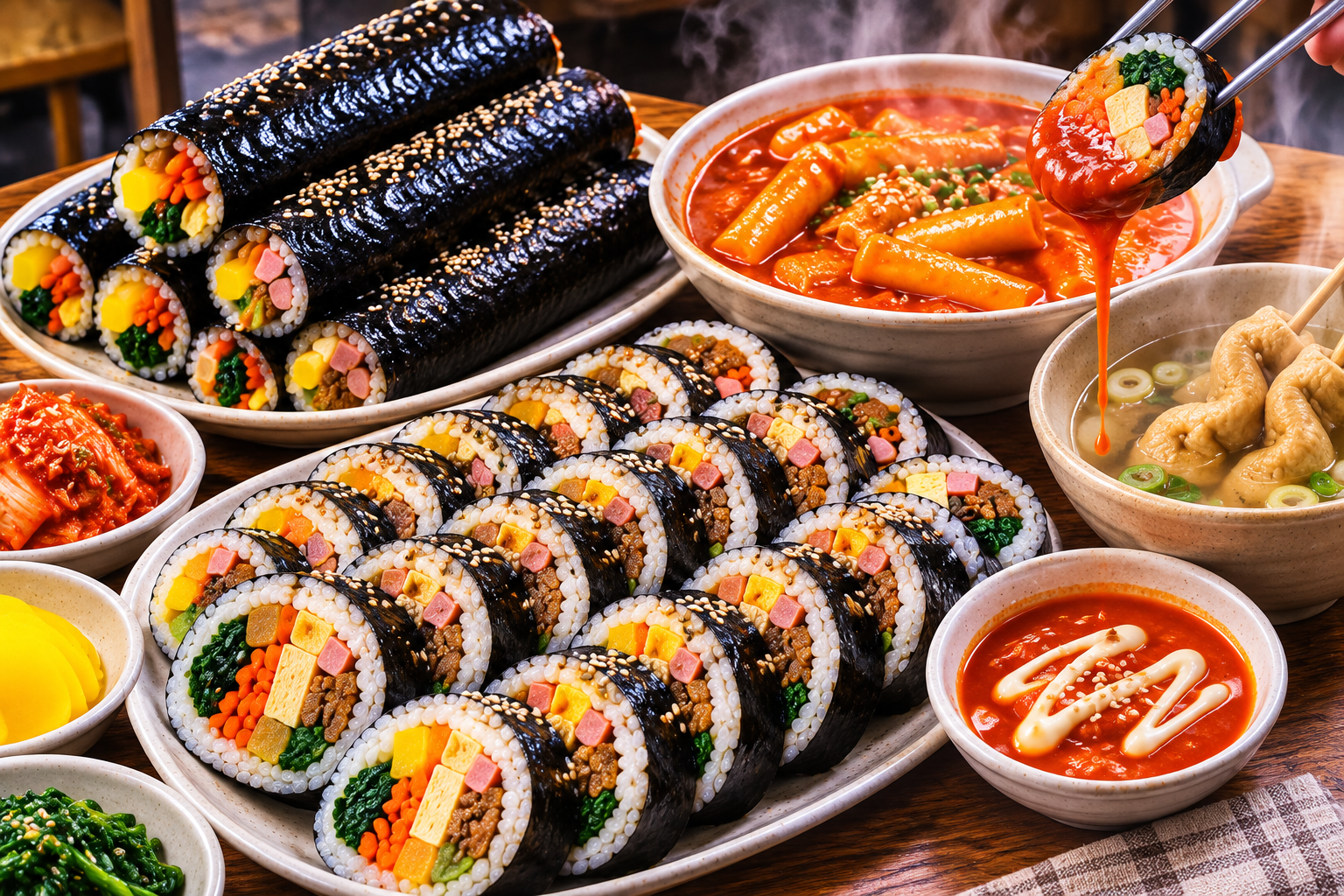
I once told my girlfriend that I knew the best way in the world to eat gimbap.
The secret?
Don’t slice it.
Pick up the entire roll with both hands and start eating from one end.
Of course, sliced gimbap is delicious. In fact, that is how most people in Korea usually eat it. But eating a whole roll feels different. It is casual, slightly messy, and surprisingly satisfying.
We also had another way of enjoying gimbap.
We would slice one roll, place the pieces between us, and play rock-paper-scissors. The winner got to eat one piece. Then we played again.
Was this a traditional Korean custom? No. It was simply our own little game.
But it taught me something about Korean food: sometimes, the experience surrounding a meal becomes just as memorable as the food itself.
Gimbap is a perfect example. It is not just rice wrapped in seaweed. It is a portable meal, a familiar lunchbox memory, a quick restaurant order, and a food that can be shared in countless ways.
To understand why Koreans love it, we need to look beyond the recipe.
1. What Is Gimbap? More Than Rice Wrapped in Seaweed
The Korean word gimbap combines two simple words:
- Gim (김): Dried seaweed, also known as laver.
- Bap (밥): Cooked rice.
A sheet of dried seaweed is covered with seasoned rice and filled with ingredients such as vegetables, eggs, pickled radish, fish cake, meat, or tuna. The ingredients are rolled together and usually cut into bite-sized pieces.
The result is a compact meal containing several different flavors and textures in one bite.
What makes gimbap particularly interesting is its structure.
A typical Korean meal often includes rice, soup, and several side dishes. Gimbap brings many of those elements together in a single roll. Instead of placing rice and side dishes in separate bowls, the cook arranges them in layers and makes them portable.
That is why gimbap is so convenient. You do not need a dining table, multiple plates, or even chopsticks.
You can eat it during a picnic, on a train, at school, during a work break, or while walking between destinations.
Gimbap is not simply a smaller version of a traditional Korean meal. It is a different way of organizing one.
2. The History of Gimbap: An Interesting Combination of Korean Tradition and Modern Change
The history of gimbap is more complicated than many people expect.
Some descriptions connect it directly to Japanese sushi rolls. Others emphasize older Korean customs of wrapping rice in seaweed.
The historical evidence suggests that both discussions matter, but they refer to different stages of the food’s development.
2.1 Korea Had a Tradition of Wrapping Rice in Seaweed
Long before modern gimbap became popular, Koreans were familiar with eating rice wrapped in seaweed.
Historical references to gimssam and bokssam describe the practice of wrapping rice and side dishes in seaweed or leaves.
The word bokssam is particularly interesting. It is associated with eating wrapped food during the first full moon of the lunar year, with the idea of symbolically eating good fortune.
The tradition shows that the basic idea of combining rice, vegetables, and seaweed was already familiar in Korean food culture.
However, this does not mean that the modern sliced roll existed in exactly the same form centuries ago.
2.2 Modern Gimbap Developed Through Historical Exchange
Today’s familiar gimbap also has a documented connection to Japanese norimaki, or seaweed rice rolls.
During the Japanese colonial period, Japanese-style rolled sushi influenced the development of modern Korean gimbap. Korean recipes and ingredients gradually changed the dish.
Historical Korean cookbooks and newspaper records show that the filling combinations and seasoning methods were not fixed.
For example, a 1946 Korean cookbook described a rolled rice dish with egg, fish-based filling, and seasoned mushrooms. The recipe also explained that Japanese-style seasoning did not need to be followed exactly.
This is an important detail.
Modern gimbap did not appear in a completely isolated culinary environment. It developed through cultural exchange, adaptation, and changes in Korean eating habits.
By the 1950s and 1960s, gimbap was becoming increasingly familiar as a meal sold by restaurants and prepared for group occasions.
In other words, its history is not a simple story of one country inventing a food and another copying it. It is a story of an older Korean wrapping tradition meeting a modern rolled-food format and developing into a distinctly familiar Korean meal.
2.3 How Ham and Pickled Radish Became Familiar Fillings
The ingredients inside gimbap also tell a story about modern Korean food.
Earlier recipes included ingredients such as seasoned beef, mushrooms, egg, spinach, and vegetables.
Pickled radish became an increasingly familiar filling during the mid-20th century. Ham also became more common as Korea’s processed meat industry developed.
By the 1980s and 1990s, the combination of ham, egg, carrot, spinach, and yellow pickled radish had become recognizable as a standard style.
This explains why modern gimbap often looks so colorful.
The colors are not simply decoration. They reflect the combination of different ingredients that became practical and popular in Korean households and restaurants.
3. Gimbap vs. Japanese Sushi Rolls: What Is the Real Difference?
Foreign visitors often describe gimbap as Korean sushi.
The comparison is understandable. Both foods use rice and seaweed, and both can be rolled and sliced into pieces.
But their flavor profiles and typical ingredients are different.
| Feature | Korean Gimbap | Japanese Norimaki |
|---|---|---|
| Rice seasoning | Usually sesame oil and salt | Usually seasoned rice vinegar, sugar, and salt |
| Common fillings | Cooked vegetables, egg, ham, fish cake, beef, tuna | Varies widely; may include raw or cooked seafood and vegetables |
| Flavor profile | Nutty, savory, and often varied | Often slightly sweet and tangy from seasoned rice |
| Common eating context | Lunchboxes, picnics, casual meals | Meals, sushi restaurants, and packed food |
| Typical presentation | Often sliced into colorful bite-sized pieces | Varies by roll and style |
The biggest everyday difference is the rice seasoning.
Gimbap rice is commonly mixed with sesame oil and salt. This gives it a nutty aroma and a savory taste.
Sushi rice, by contrast, is generally seasoned with vinegar, sugar, and salt.
The fillings also differ in many common versions. Korean gimbap frequently uses cooked or seasoned ingredients, while Japanese rolls have a wider range of fillings, including raw seafood.
These are general patterns, not strict rules. Both cuisines have many variations.
The important point is that gimbap should be appreciated as its own food rather than treated as a Korean copy of sushi.
4. Why Do Korean Gimbap Ingredients Work So Well Together?
A good gimbap roll is not just a collection of ingredients placed inside seaweed.
Each filling has a particular job.
Understanding those roles makes it easier to prepare a balanced roll.
4.1 Rice: The Foundation
Korean short-grain rice is ideal because it is moist and slightly sticky.
It holds the ingredients together without requiring an excessive amount of pressure.
Seasoning it with sesame oil and salt gives it a gentle savory flavor.
The key is moderation. Too much sesame oil can make the rice greasy and overpower the other ingredients.
4.2 Danmuji: Sweetness and Acidity
Yellow pickled radish, or danmuji, provides a sweet and slightly sour taste.
It also adds a crisp texture.
Without it, a roll containing rice, egg, ham, and vegetables can feel heavy and monotonous.
4.3 Spinach and Carrot: Freshness and Texture
Spinach adds a soft vegetable texture, while carrot contributes sweetness and a slight firmness.
Lightly seasoning each vegetable separately helps preserve its individual flavor.
This is one reason homemade gimbap can taste different from a mass-produced roll.
4.4 Egg: A Gentle, Savory Center
Egg strips add softness and a mild savory flavor.
They also help balance stronger ingredients such as seasoned beef or spicy fillings.
4.5 Ham, Fish Cake, or Beef: The Main Savory Element
These ingredients provide depth and make gimbap more substantial.
Ham is common in everyday versions, while seasoned beef and fish cake are popular alternatives.
There is no single correct combination.
A good roll is one in which the ingredients complement each other rather than compete for attention.
5. Classic Korean Gimbap Recipe: How to Make Four Rolls
Now that we understand the structure of gimbap, let’s make a classic version.
This recipe makes approximately four rolls.
Ingredients
- 4 sheets of dried seaweed for gimbap
- 3 cups cooked Korean short-grain rice
- 4 strips yellow pickled radish (danmuji)
- 1 medium carrot
- 1 small bunch of spinach
- 2 eggs
- 4 strips of ham
- 4 strips of fish cake (eomuk)
- Sesame oil
- Salt
- Sesame seeds
- A little cooking oil
You can replace the ham or fish cake with seasoned beef, tuna, cheese, or other fillings.
5.1 Season the Rice
Cook the rice and allow it to cool until warm rather than steaming hot.
Gently mix in a small amount of sesame oil and salt.
Avoid crushing the grains. The rice should remain recognizable rather than becoming a sticky paste.
5.2 Prepare the Vegetables
Cut the carrot into thin strips.
Lightly stir-fry it with a little cooking oil and salt.
Briefly blanch the spinach, drain it, and squeeze out excess water. Season it lightly with salt and sesame oil.
Removing excess moisture is important. Wet fillings can make the seaweed soft and cause the roll to fall apart.
5.3 Prepare the Eggs
Beat the eggs with a small pinch of salt.
Cook them in a thin layer in a lightly oiled pan.
Allow the egg to cool before cutting it into long strips.
5.4 Cook the Ham and Fish Cake
Cut the ham and fish cake into long strips.
Lightly pan-fry them to improve their aroma and texture.
Allow the ingredients to cool before rolling.
5.5 Roll the Gimbap
Place a sheet of seaweed on a bamboo rolling mat, with the rough side facing upward.
Spread a thin layer of rice over the seaweed, leaving a small strip uncovered at the top.
Arrange the fillings horizontally across the lower part of the rice.
Lift the bamboo mat and begin rolling from the bottom.
Keep the ingredients together as you roll, applying enough pressure to make a firm cylinder without squeezing the fillings out.
A little practice makes a big difference.
5.6 Finish and Slice
Lightly brush the outside of the roll with sesame oil.
Sprinkle sesame seeds over the surface.
Use a sharp knife to cut the roll into bite-sized pieces. Wiping the blade with a damp cloth between cuts helps create cleaner slices.
Your classic Korean gimbap is ready.
6. How to Eat Gimbap: Three Ways to Enjoy It
Making gimbap is only half the experience.
How you eat it can change the way you enjoy the same ingredients.
6.1 Eat It as a Whole Roll
This is my personal favorite.
Instead of cutting the gimbap into pieces, pick up the entire roll and eat from one end.
It is not the usual restaurant presentation in Korea, but it is a fun way to enjoy homemade gimbap.
You can experience the layers of rice and fillings together in every bite.
Just make sure the roll is small enough to handle comfortably.
6.2 Try the Rock-Paper-Scissors Game
This is a personal memory rather than a traditional Korean food custom.
Slice a roll into pieces and place them on a plate between two people.
Play rock-paper-scissors.
The winner gets one piece.
Then play again.
It is a simple game, but it turns an ordinary meal into a shared experience.
You can try it with your partner, children, family, or friends.
The point is not who wins. It is making the meal a little more memorable.
6.3 Dip It in Tteokbokki Sauce
One of the most enjoyable combinations in Korean casual dining is gimbap with tteokbokki.
The mild, savory rice roll works beautifully with the spicy-sweet sauce.
The contrast is what makes the combination satisfying.
Gimbap absorbs some of the sauce, while its rice and fillings soften the intensity of the chili flavor.
If you visit a Korean bunsik restaurant, this is one combination worth ordering.
7. What Should You Eat with Gimbap? Three Classic Combinations
Gimbap can be a complete light meal by itself, but Korean casual restaurants often serve it alongside other dishes.
These combinations are not random. Each one creates a different balance of flavor and temperature.
7.1 Gimbap and Eomuk Soup
Eomuk soup is a light Korean fish cake broth.
Its warm, savory flavor complements the sesame aroma of gimbap without overpowering it.
This is a particularly comforting combination on a cold day.
The broth also gives the meal a different texture from the relatively dry, compact rice roll.
7.2 Gimbap and Korean Ramyeon
Gimbap and ramyeon are another familiar pairing.
The spicy broth and soft noodles contrast with the mild rice and crunchy fillings.
Take a bite of gimbap, then enjoy a spoonful of hot broth.
The combination is simple, filling, and especially popular as a casual meal.
7.3 Gimbap and Udon
If you prefer something milder, try udon.
Its warm broth and thick noodles create a softer, more comforting meal.
This is a good option for people who do not enjoy very spicy food.
8. The Korean Bunsik Culture: Why Gimbap Is Almost Never Alone
To understand gimbap in Korea, it helps to understand bunsik.
Bunsik refers to casual, affordable Korean foods. The term originally related to wheat-based foods, but its modern meaning includes dishes such as gimbap, tteokbokki, sundae, fried snacks, and ramyeon.
Bunsik culture expanded significantly during the 1960s and 1970s.
At the time, government policies encouraged people to reduce rice consumption and increase the use of wheat-based foods. Affordable flour-based meals became more common, and casual eateries developed around accessible dishes.
Gimbap eventually became an important part of this everyday food environment.
However, it did not begin as an ordinary restaurant snack for everyone.
For many Korean families, gimbap was originally associated with preparing food at home for school picnics, outings, and trips.
It was a meal that required preparation and care.
By the 1990s, specialized gimbap restaurants and franchises helped turn it into an everyday restaurant menu item.
The spread of affordable gimbap shops made it possible for office workers, students, and travelers to buy a quick meal without preparing one at home.
This is why gimbap is so often paired with tteokbokki, eomuk soup, or ramyeon.
The combination reflects the logic of bunsik: affordable dishes that can be ordered quickly, shared easily, and combined according to personal taste.
Gimbap is not just a food that happens to go well with other dishes. It became part of a dining culture built around convenient combinations.
9. Different Types of Gimbap You Should Know
One of the most interesting things about gimbap is how easily it changes.
The basic structure remains recognizable, but the fillings, shape, and serving style can be completely different.
9.1 Chungmu Gimbap
Chungmu gimbap is associated with Tongyeong, a coastal city in South Gyeongsang Province.
Unlike regular gimbap, the rice rolls are usually small and contain no elaborate fillings.
They are served with seasoned squid and radish kimchi on the side.
The contrast between plain rice and strongly seasoned side dishes is the defining feature.
9.2 Tuna Gimbap
Tuna gimbap commonly combines canned tuna with mayonnaise and vegetables.
The tuna adds richness, while the vegetables provide freshness and texture.
It is one of the familiar modern variations found in Korean gimbap shops.
9.3 Cheese Gimbap
Cheese gimbap adds a creamy, salty element to the traditional combination.
It is especially popular among people who enjoy richer flavors.
9.4 Beef Gimbap
Seasoned beef adds a deeper savory taste.
It can make the roll more substantial and gives it a flavor profile closer to a full meal.
9.5 Mayak Gimbap
Mayak gimbap is a small, bite-sized style associated with Gwangjang Market in Seoul.
The name mayak literally means narcotic, but in this food name it is a playful expression suggesting that the rolls are so addictive that people keep reaching for another one.
They are usually served with a mustard-based dipping sauce.
9.6 Modern Gimbap
Contemporary gimbap shops experiment with ingredients such as pork cutlet, spicy pork, cheese, chicken, and low-carbohydrate alternatives.
Some versions replace rice with thinly sliced egg or other ingredients.
This flexibility is one reason gimbap continues to evolve.
10. Why Gimbap Is More Than a Convenient Korean Meal
There is a deeper reason gimbap has remained popular.
It solves several everyday problems at once.
It is portable. It can be prepared in advance. It combines different ingredients in one serving. It can be made inexpensively or upgraded with premium fillings.
But there is also a social dimension.
For many Koreans, gimbap is associated with school trips, family picnics, childhood lunches, and early-morning preparation before a long journey.
The food carries memories because it is often prepared for someone else.
A parent choosing ingredients for a child’s lunchbox, friends sharing a roll during a trip, or coworkers buying gimbap before a busy day are all part of its everyday story.
Even the variety of homemade gimbap reflects this personal element. Different households use different fillings, seasoning levels, and rolling techniques.
There is no single recipe that represents every Korean family.
That is part of its appeal.
Gimbap is standardized enough to be familiar, but flexible enough to feel personal.
11. The True Taste Korea Secret: The Best Way to Eat Gimbap Is Your Own
So, what is the best way to eat gimbap?
Sliced neatly on a plate?
Dipped into tteokbokki sauce?
Paired with a bowl of hot eomuk soup?
Or eaten as one whole roll, just for fun?
There is no single correct answer.
Gimbap has changed over time, from older seaweed-wrapping traditions to modern lunchbox food and today’s creative restaurant variations.
Its history reflects cultural exchange, changing ingredients, urban lifestyles, and the development of Korea’s casual dining culture.
Yet its appeal remains surprisingly simple.
Rice, seaweed, and a handful of ingredients become a meal that is easy to carry, easy to share, and easy to make your own.
For me, the best memory is still the simplest one: sharing sliced gimbap with someone special and playing rock-paper-scissors for the next piece.
Maybe that is the real secret of Korean food.
The best way to enjoy a dish is not always written in a recipe. Sometimes, it is created by the people sitting around the table.