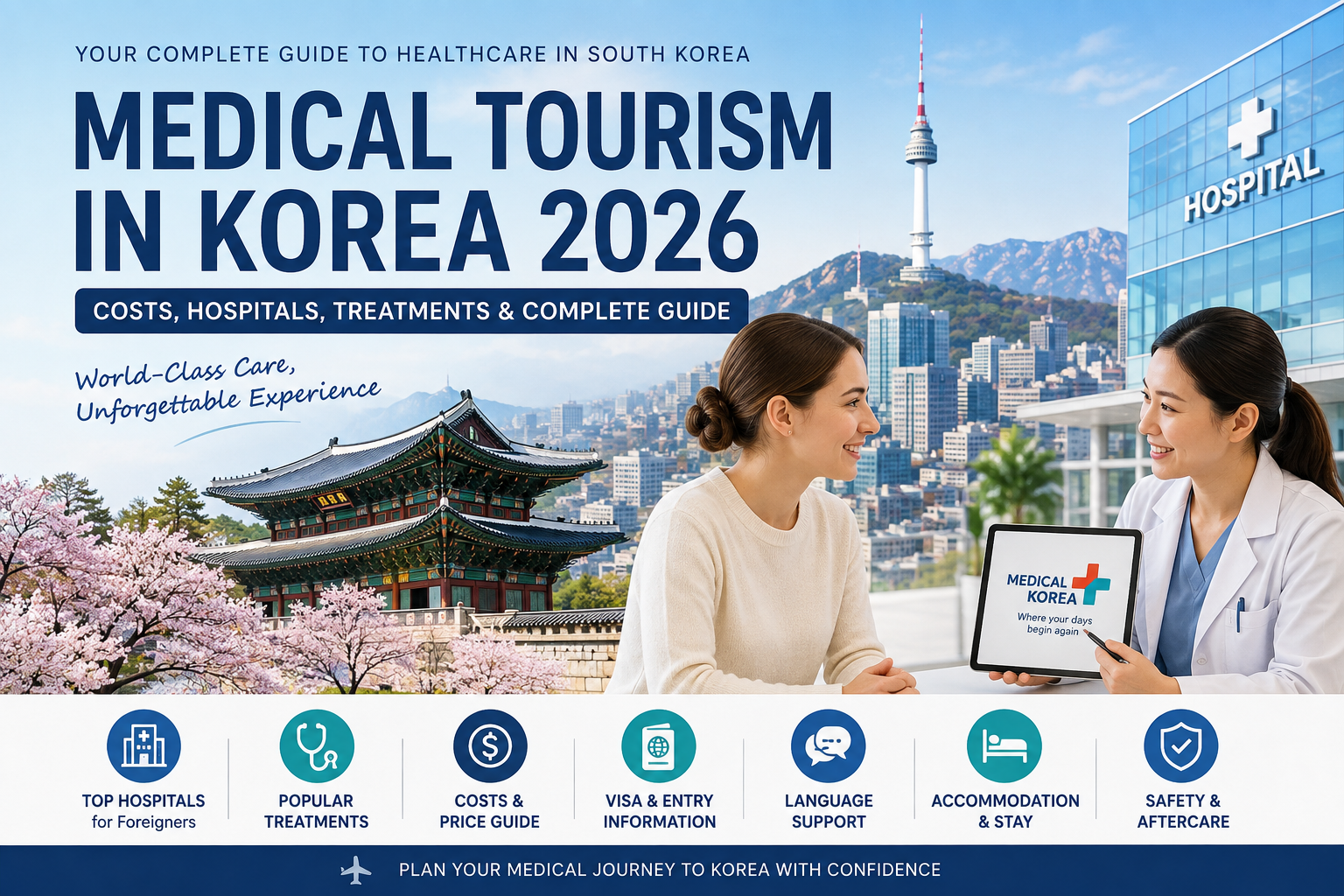
South Korea is internationally known for K-pop, Korean food and K-beauty. But there is another reason why millions of international visitors are paying attention to the country: medical treatment.
In 2025, 2,011,822 foreign patients from 201 countries received medical care in South Korea, according to figures released by the Ministry of Health and Welfare in April 2026. This represented a 71.9% increase from 2024 and marked the first time the annual total exceeded two million.
From dermatology and plastic surgery to dental care, health screenings and treatment at major hospitals, Korea has developed a substantial medical service infrastructure for international patients.
However, traveling abroad for medical treatment involves more than choosing a clinic and booking a flight.
How can you find a properly registered hospital? What should you expect to pay? Is English-language assistance available? Do you need a medical visa? How long should you remain in Korea after treatment?
This guide explains how to plan medical tourism in Korea in 2026, from choosing a medical institution to arranging treatment, accommodation and follow-up care.
Important: This article provides general information, not medical advice. Treatment suitability, possible complications, recovery periods and costs depend on individual circumstances and the medical institution. Consult a qualified medical professional before making treatment decisions.
1. Why Are More Foreign Patients Choosing South Korea?
Korea’s medical tourism industry has expanded rapidly over the past several years.
According to the Ministry of Health and Welfare, the number of foreign patients increased from 605,768 in 2023 to 1,170,467 in 2024 and then reached 2,011,822 in 2025.
That represents a 71.9% increase in one year.
The largest groups of foreign patients in 2025 came from:
- China: 618,973
- Japan: 600,009
- Taiwan: 185,715
- United States: 173,363
- Thailand: 58,124
China and Japan together accounted for approximately 60.6% of the total.
The growth reflects several factors, including international interest in Korean dermatology and cosmetic procedures, the popularity of Korean beauty culture, and the availability of medical services designed for overseas visitors.
But the numbers need to be understood correctly.
The total of 2,011,822 represents foreign patients, while department-level statistics can count the same person in more than one specialty. For example, someone who visits both a dermatology clinic and a plastic surgery department may appear in both department totals.
In 2025, dermatology accounted for 1,312,700 department-level patient counts, or 62.9% of the 2,087,400 total counts across departments. Plastic surgery accounted for 233,100, or 11.2%.
These figures show the strong demand for skin and cosmetic treatment, but they should not be interpreted as mutually exclusive shares of unique patients.
Another important detail is geography: 87.2% of foreign patients received treatment in Seoul in 2025. Seoul offers a particularly large concentration of medical institutions, international patient services, accommodation and transportation options.
Nevertheless, Busan, Jeju and other cities also serve international patients.
2. What Medical Treatments Are Popular in Korea?
The treatment you choose will determine where you should go, how long you need to stay, whether you need a companion and how much your trip may cost.
2.1 Dermatology and Skin Treatments
Dermatology is one of the largest areas of Korea’s foreign-patient market.
International visitors commonly look for medical consultations and procedures involving:
- Acne and acne scars
- Pigmentation and uneven skin tone
- Skin texture and visible pores
- Laser-based treatments
- Certain cosmetic skin procedures
- Medical treatment for specific skin conditions
Korean dermatology clinics offer different devices, techniques and treatment plans. However, a popular procedure is not automatically suitable for every skin type or medical condition.
Before booking, ask who will perform the procedure, whether a doctor will assess your skin, what risks are involved and whether additional sessions are necessary.
Do not choose a clinic simply because its social-media photographs look impressive or its advertised price is unusually low.
2.2 Plastic and Cosmetic Surgery
South Korea is also internationally recognized for cosmetic and reconstructive surgery.
Foreign patients may seek consultations for procedures involving the eyes, nose, face or body.
Surgery requires considerably more preparation than a short outpatient appointment.
You should understand:
- The surgeon’s qualifications and relevant experience
- The proposed procedure and available alternatives
- Anesthesia arrangements
- Possible complications
- Expected recovery time
- Follow-up appointments
- What happens if a complication develops after returning home
Do not assume that a short stay is sufficient simply because the operation itself takes only a few hours.
Your surgeon should determine whether you are medically fit to fly and when travel is appropriate.
2.3 Comprehensive Health Checkups
Health screening is another reason international visitors consider Korea.
Some hospitals and specialized screening centers offer packages that combine several examinations during a scheduled visit.
Depending on the package, examinations may include blood tests, imaging, endoscopy or other assessments.
However, packages are not identical.
Compare the actual tests included, preparation requirements, consultation arrangements and how results will be explained. A more expensive package is not necessarily better for every patient.
Ask whether abnormal findings can be reviewed by a specialist and whether additional tests or treatment would require another visit.
2.4 Dentistry
Foreign visitors also travel to Korea for dental examinations and treatment.
Possible services include general dental care, restorative treatment, implants and other procedures, depending on the clinic.
The most important question is how many visits your treatment requires.
Some procedures cannot be completed in a single appointment. Others require healing time or additional adjustments.
Before traveling, request a treatment schedule and confirm whether the clinic can complete the necessary stages during your planned stay.
2.5 Major Hospital Treatment
Korea’s international medical services extend beyond cosmetic treatment.
Major hospitals provide services across specialties such as oncology, cardiology, neurosurgery, orthopedics, fertility treatment, rehabilitation and other areas of medical care.
Patients considering treatment for a serious condition should contact the hospital’s international patient center directly.
The hospital may request medical records, previous diagnoses, laboratory results, imaging files and a list of current medications before deciding whether it can provide an appropriate consultation.
For complex conditions, a remote review of medical records may be possible before travel, but it does not replace an in-person medical assessment.
3. How to Find a Reliable Hospital or Clinic in Korea
Choosing the right medical institution is one of the most important decisions in medical tourism.
A clinic appearing frequently on social media is not necessarily the best choice. Advertising popularity, online reviews and medical quality are different things.
Korea operates an official registration system for medical institutions and businesses that attract foreign patients.
The system is intended to help protect international patients and regulate organizations involved in attracting overseas medical visitors.
Registered medical institutions must meet specified requirements, including medical malpractice liability insurance covering foreign patients.
You can use the official Medical Korea website to search for institutions serving international patients:
Medical Korea – Official Information and Hospital Search
When comparing hospitals, check the following:
- Is the medical institution currently registered to attract foreign patients?
- Does the registration information match the institution you intend to visit?
- Does the hospital have experience with your particular treatment?
- Are the doctor’s qualifications and relevant experience clear?
- Is the treatment plan explained before payment?
- Can the hospital provide written information about risks and follow-up care?
3.1 What Is KAHF Accreditation?
You may also encounter the term KAHF, which refers to the Korean Accreditation Program for Hospitals Serving Foreign Patients.
This is an evaluation and certification system for medical institutions that attract international patients.
Its assessment covers areas such as foreign-patient services, interpretation, patient rights, medication management, infection control and patient safety.
KAHF accreditation is an additional quality indicator. It is not the same as basic registration to attract foreign patients, and not every registered institution necessarily holds this accreditation.
You can check the official information and accredited institution list here:
Medical Korea – KAHF Accreditation
A sensible approach is to check registration first, then look at accreditation, relevant specialist experience and the treatment plan.
4. Can Foreign Patients Receive Medical Assistance in English?
Many Korean institutions serving international patients offer foreign-language support.
However, the level of assistance differs.
Some hospitals have international patient centers with coordinators and interpreters. Others arrange interpretation only when requested or charge an additional fee.
Before confirming an appointment, ask:
- Is an English-speaking coordinator available?
- Is medical interpretation included in the quoted price?
- Will an interpreter be present during consultation and treatment?
- Can the hospital explain consent forms and possible complications in a language I understand?
- Can I communicate with the hospital after returning home?
Do not assume that every doctor, nurse or staff member speaks English simply because the institution treats foreign patients.
4.1 Medical Korea Information Center
International visitors can also contact the Medical Korea Information Center for information and assistance.
The center provides guidance on medical institutions, medical services, travel and visa questions, reservations and complaints involving medical services.
Its Seoul contact number is:
+82-2-1577-7129
The listed operating hours are 09:00–18:00 Korea Standard Time, daily.
The center also operates at Incheon International Airport Terminal 1, where visitors can obtain information and assistance.
For current locations, operating hours and available languages, check:
Medical Korea – Information and Convenient Services
5. How Much Does Medical Treatment in Korea Cost?
This is one of the most frequently asked questions, but there is no single price for medical tourism in Korea.
Treatment costs vary according to:
- The medical institution
- The doctor’s qualifications and experience
- The patient’s diagnosis and condition
- The procedure or medical technique
- Medical devices and materials
- Anesthesia
- Laboratory tests and imaging
- Medication
- Follow-up appointments
- Additional treatment that may become necessary
A price advertised online may represent only one part of the complete treatment.
For example, an advertised procedure price may not include the initial consultation, diagnostic tests, medication, anesthesia or follow-up care.
Before traveling, request a written estimate from the medical institution.
Ask for a breakdown covering:
Consultation + Examinations + Procedure + Anesthesia + Medication + Follow-up Care
Also ask whether the estimate is fixed or whether the final cost may change after an examination.
5.1 Calculate the Total Cost of Your Medical Trip
Medical expenses are only one part of the budget.
Your complete trip may include:
- Medical treatment
- International flights
- Accommodation
- Local transportation
- Meals
- Interpretation, if not provided
- Companion expenses
- Recovery-related purchases
- Additional nights in Korea
- Emergency expenses
For example, a procedure that appears affordable may become considerably more expensive if you need to extend your hotel stay or return for another examination.
Do not plan your budget around the lowest advertised treatment price.
The most useful comparison is the total expected cost of receiving appropriate care and completing the necessary follow-up.
6. How to Book Medical Treatment Before Traveling to Korea
For planned treatment, it is generally better to contact medical institutions before purchasing your flight.
A practical process looks like this:
6.1 Step 1: Identify the Treatment You Need
Research the medical condition or procedure first.
If you are uncertain which treatment is appropriate, seek an initial medical opinion rather than choosing a procedure based entirely on online advertising.
6.2 Step 2: Find Registered Medical Institutions
Use Medical Korea to identify institutions registered to serve foreign patients.
Create a shortlist rather than immediately choosing the first clinic you find.
6.3 Step 3: Contact the International Patient Center
Send an inquiry explaining your medical needs, preferred dates and language requirements.
Ask whether the institution accepts international patients for your particular condition or procedure.
6.4 Step 4: Provide Medical Records
Depending on the treatment, the institution may request:
- Previous diagnoses
- Medical history
- Laboratory results
- Imaging reports or scans
- Current prescriptions
- Information about allergies
- Previous surgical records
Send sensitive medical information only through an appropriate, secure channel provided by the institution.
6.5 Step 5: Request a Written Treatment Plan
Ask what examinations are required, what the proposed treatment involves and what the estimated price includes.
If you are comparing several hospitals, make sure you are comparing similar treatment plans rather than different procedures with similar advertising names.
6.6 Step 6: Confirm Recovery and Follow-up Requirements
Ask how long you should remain in Korea.
Find out whether you need a follow-up appointment, whether you should avoid certain activities and when your doctor considers flying appropriate.
6.7 Step 7: Arrange Flights and Accommodation
Only after the medical schedule and expected recovery period are sufficiently clear should you finalize your travel arrangements.
Avoid booking a non-refundable return flight that leaves no room for medically necessary follow-up.
7. Do Foreign Patients Need a Medical Visa for Korea?
Visa requirements depend on nationality, the purpose of travel and the expected length of stay.
Korea has specific medical-tourism visa categories, including:
C-3-3 Medical Tourist Visa: Generally used for medical visits involving stays of 90 days or less.
G-1-10 Treatment and Recuperation Visa: Used for qualifying longer-term medical treatment or recuperation, with a stay period that can extend up to one year under the applicable conditions.
The exact eligibility requirements and application process depend on the patient’s circumstances.
Depending on the application route, documents may include:
- Passport
- Visa application
- Medical diagnosis or relevant medical records
- Confirmation of treatment or an appointment from a Korean medical institution
- Evidence of financial ability to cover treatment and living expenses
- Documents relating to an accompanying family member or caregiver, if applicable
Not every foreign patient needs to apply for a medical visa. Some nationalities may qualify for visa-free entry or another entry arrangement, depending on current rules and the purpose of the visit.
Do not assume that a tourist entry permission automatically covers every medical-travel situation.
Before booking, check the requirements for your nationality with the Korean embassy or consulate and the official Korea Visa Portal.
Useful official resources:
8. Where Should Medical Tourists Stay in Korea?
Seoul is the main destination for international medical patients.
Because 87.2% of foreign patients received treatment in Seoul in 2025, the city offers a large selection of medical institutions, international patient services and accommodation.
However, the best place to stay is not necessarily the most famous tourist neighborhood.
For medical travel, convenience and recovery should come first.
8.1 Stay Close to Your Hospital
If you have several appointments or need follow-up examinations, staying near the hospital can reduce unnecessary travel.
This is particularly important after surgery or procedures that affect mobility.
8.2 Check the Building and Room Facilities
Consider:
- Elevator access
- Comfortable bathroom facilities
- A quiet room
- Kitchen or laundry facilities for longer stays
- Easy access to food and basic supplies
These details may seem minor before treatment but can become important during recovery.
8.3 Consider Transportation
Check the distance between your accommodation and the hospital.
After a procedure, long subway journeys or crowded public transportation may be uncomfortable.
Ask the medical institution whether it can recommend appropriate transportation or accommodation options.
8.4 Plan for an Extended Stay
Do not assume that you will be able to leave Korea immediately after your scheduled procedure.
Your doctor may recommend additional observation or follow-up appointments.
Keep enough flexibility in your accommodation booking to allow for medically necessary changes.
9. What Should You Prepare Before Leaving Home?
Create a medical travel folder before departure.
It should include:
- Passport and visa documents, if required
- Appointment confirmation
- Medical history
- Previous diagnoses and test results
- Current medication list
- Information about allergies
- Emergency contact details
- Travel insurance documents
- Hospital and international patient center contact information
- Written treatment and cost estimates
If you regularly take medication, ask your doctor whether anything needs to change before treatment.
The Korean medical institution may also provide instructions about fasting, medication, supplements or other preparation.
Follow medical instructions from qualified professionals. Do not stop prescribed medication or change your routine on your own.
If you are bringing prescription medication into Korea, check the applicable customs and import requirements in advance, particularly for controlled or restricted substances.
10. What Happens After Medical Treatment?
Recovery planning is just as important as booking the procedure.
Before leaving the hospital or clinic, make sure you understand:
- Which medications should I take?
- What symptoms are expected during recovery?
- Which symptoms require urgent medical attention?
- When is my next follow-up appointment?
- When can I safely fly?
- Who should I contact if a problem develops?
- Can the hospital provide medical documents for my doctor at home?
For significant surgery, ask whether you need a companion during the first stage of recovery.
You should also ask how follow-up care will work after returning to your home country.
A clinic that offers an attractive initial price but cannot explain its aftercare arrangements may not be the right choice.
Treatment comes first. Tourism comes second.
Do not schedule an intensive sightseeing itinerary immediately after a medical procedure.
11. What If Something Goes Wrong?
Every international patient should consider the possibility of complications or disagreements before treatment.
Before paying, ask the institution how it handles:
- Medical complications
- Emergency treatment
- Unexpected additional expenses
- Follow-up appointments
- Medical records and documentation
- Complaints or disputes
Korea has support resources for foreign patients who experience difficulties while using medical services.
The Medical Korea Information Center provides consultation relating to medical complaints and disputes, as well as guidance on connecting with the Korea Medical Dispute Mediation and Arbitration Agency.
The center also provides information about illegal medical brokerage.
You can contact the Medical Korea Support Center at:
+82-2-1577-7129
Official information:
Medical Korea – Support and Patient Information
For formal medical dispute mediation, you can also consult:
Korea Medical Dispute Mediation and Arbitration Agency
Keep copies of your treatment agreement, receipts, medical records and communications with the institution.
Knowing where to seek assistance before treatment is much better than trying to find help after a problem occurs.
12. Is Medical Tourism in Korea Worth It?
There is no universal answer.
Korea may be an attractive destination for patients interested in areas where the country has developed substantial international medical services, including dermatology, cosmetic procedures and health screening.
Major hospitals also provide services for international patients seeking specialist consultations and treatment for more complex medical conditions.
However, traveling abroad adds costs and risks that may not exist when receiving care close to home.
Consider the full picture:
- Is the proposed treatment medically appropriate?
- Does the institution have relevant experience?
- Is the doctor qualified for the procedure?
- Are the risks and alternatives clearly explained?
- Is the total cost affordable?
- Can you remain in Korea long enough for recovery?
- Is follow-up care available after returning home?
The most important question is not simply:
“Is medical treatment cheaper in Korea?”
A better question is:
“Does the medical suitability, treatment plan, total cost, travel burden and follow-up care make Korea the right choice for my particular situation?”
Make your decision based on medical advice and verifiable information, not advertising alone.
13. Medical Tourism in Korea: Quick Checklist
Before booking your trip, confirm the following:
- The hospital or clinic is currently registered to serve foreign patients.
- You have checked the doctor’s qualifications and relevant experience.
- You understand the proposed treatment and its risks.
- You have received a written treatment estimate.
- You know which services are included in the price.
- Language support has been confirmed.
- Your visa and entry requirements have been checked.
- Your accommodation is suitable for recovery.
- You know how long you should remain in Korea.
- Follow-up care has been arranged.
- You understand what to do if complications develop.
- You have copies of your medical records and payment documents.
14. Final Thoughts: Plan Your Treatment Before Your Trip
More than two million foreign patients received medical care in South Korea in 2025, demonstrating how quickly the country’s international medical sector has expanded.
But successful medical travel requires more than finding a well-known clinic and purchasing a plane ticket.
Research the treatment first. Verify the medical institution. Compare complete treatment estimates. Confirm language support and visa requirements. Most importantly, allow enough time for recovery and follow-up care.
For international visitors, Korea can offer a wide range of medical services, but the right choice depends on individual medical needs and circumstances.
True Taste Korea will continue developing practical guides for international visitors considering medical treatment in Korea, including dermatology, health checkups, hospital selection, treatment costs, accommodation and medical assistance.
For your first step, use the official Medical Korea website to find information about registered medical institutions and services for foreign patients.
코멘트
One response to “Medical Tourism in Korea 2026: Costs, Hospitals, Treatments & Complete Guide”
[…] Medical Tourism in Korea 2026: Costs, Hospitals, Treatments & Complete Guide […]