kkneoqkr@gmail.com

  • Jajangmyeon: The Noodles Behind So Many Korean Memories

    Jajangmyeon: The Noodles Behind So Many Korean Memories

    There are foods Koreans remember not because they were expensive or luxurious, but because they were simply there at important moments in life.

    Jajangmyeon is one of those foods.

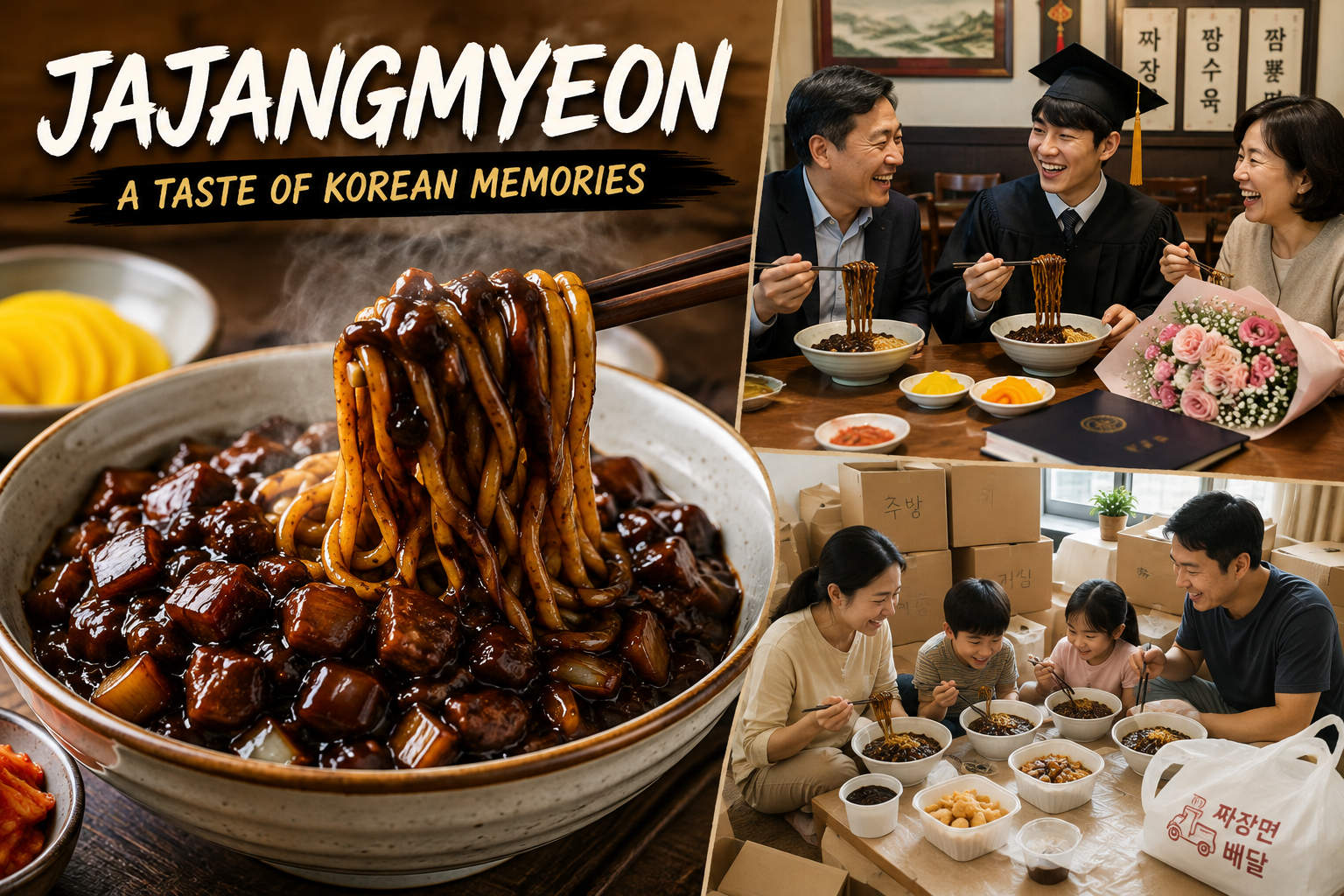
    A graduation day.
    A family moving into a new home.
    An evening when nobody wants to cook.
    A quick delivery meal.
    Or a sudden craving so strong that you already know exactly which restaurant you want to order from.

    For many Koreans, jajangmyeon is more than noodles covered in black bean sauce.

    It tastes like everyday life—and sometimes, like an old memory.

    What Is Jajangmyeon?

    Jajangmyeon is one of Korea’s most beloved noodle dishes.

    It is made with chewy noodles covered in a thick, dark sauce usually made from chunjang, a Korean-style fermented black bean paste, along with onions, pork and vegetables.

    The sauce is rich, savory and slightly sweet.

    Although jajangmyeon developed from Chinese culinary roots, it evolved in Korea into a distinctive dish and became deeply connected with Korean everyday food culture.

    Today, walk into a Korean Chinese restaurant and jajangmyeon will almost certainly be one of the first dishes people think about ordering.

    But its importance in Korea goes far beyond the recipe.

    Graduation Day Meant Jajangmyeon

    For generations of Koreans, graduation day was one of the days associated with jajangmyeon.

    After the ceremony, families would go out together to celebrate.

    And for many students, that celebration meant sitting down at a Korean Chinese restaurant for a bowl of jajangmyeon.

    It wasn’t an extravagant meal.

    That was part of its charm.

    A simple bowl of black bean noodles could become part of the memory of finishing school, taking family photographs and beginning the next chapter of life.

    Years later, the taste can bring those memories back.

    Moving Day? Order Jajangmyeon

    There is another scene that feels unmistakably Korean.

    Imagine moving into a new home.

    Boxes are everywhere. Furniture hasn’t been arranged. Pots and dishes are still packed away, and nobody wants to start cooking.

    So what do you eat?

    For countless Korean families, the traditional answer has been simple:

    Order jajangmyeon.

    Delivery arrives, everyone finds somewhere to sit among the boxes, and the family eats together before returning to unpacking.

    It is such an ordinary moment.

    But that is exactly why jajangmyeon became part of Korean life.

    Sometimes food becomes a tradition without anyone deliberately deciding that it should.

    The Perfect Food When You Don’t Want to Cook

    Jajangmyeon isn’t only connected to special memories.

    It is also wonderfully ordinary.

    There are evenings when you come home tired and simply don’t want to cook.

    You don’t necessarily want an expensive restaurant meal either.

    You just want something filling, comforting and satisfying.

    That’s when jajangmyeon works perfectly.

    Go to the neighborhood Korean Chinese restaurant, sit down and have one bowl.

    Or stay home and order delivery.

    This combination of affordability, convenience and comfort helped jajangmyeon become one of Korea’s classic everyday meals.

    You Can Smell Jajangmyeon Before You Taste It

    One of the most irresistible things about jajangmyeon is its aroma.

    Sometimes you don’t even need to see it.

    You smell it first.

    The aroma of black bean sauce cooking with onions and pork can suddenly make you hungry—even if you weren’t thinking about food a moment earlier.

    Then the bowl arrives.

    Dark, glossy sauce covers the noodles. Steam rises as you begin mixing everything together.

    And somehow your appetite becomes even stronger.

    For many Koreans, the craving for jajangmyeon begins before the first bite.

    Everyone Has Their Favorite Jajangmyeon Restaurant

    Jajangmyeon looks like a simple dish.

    Noodles and black bean sauce.

    But making a truly memorable bowl isn’t nearly as simple as it looks.

    The texture of the noodles matters.

    So does the way the chunjang is cooked, the sweetness of the onions, the amount of pork, the balance between savory and sweet flavors, and the thickness of the sauce.

    That’s why two jajangmyeon restaurants can taste surprisingly different.

    And that’s also why many Koreans have their own favorite place.

    I sometimes suddenly remember the jajangmyeon from a particular restaurant in another area.

    When that craving hits, I will even get in my car and drive there just to eat that one bowl.

    It might seem strange to travel for such an inexpensive and simple-looking food.

    But sometimes you don’t crave jajangmyeon.

    You crave the jajangmyeon from that one particular restaurant.

    Jajangmyeon or Jjamppong? Koreans Found a Solution

    Visit a Korean Chinese restaurant and eventually you may face one of Korea’s classic food dilemmas:

    Jajangmyeon or jjamppong?

    Jajangmyeon gives you rich, savory-sweet black bean noodles.

    Jjamppong gives you spicy noodles and a hot, flavorful broth.

    Sometimes you want both.

    Korean restaurants came up with a wonderfully practical solution: jjamjjamyeon.

    A divided bowl serves jajangmyeon on one side and jjamppong on the other.

    Take a bite of rich jajangmyeon, then have a spoonful of hot, spicy jjamppong broth.

    Sweet and savory. Then hot and spicy.

    Sometimes the best choice is not to choose at all.

    Jjapagetti: When Koreans Want Jajang Flavor at Home

    Restaurant-style jajangmyeon can take some effort to make from scratch.

    You need chunjang, meat, vegetables, noodles, and time to properly cook the sauce.

    But what happens when you’re at home and suddenly crave that familiar black bean noodle flavor?

    Koreans have another famous option:

    Jjapagetti.

    Jjapagetti is an instant noodle inspired by Korean-style black bean noodles.

    It isn’t the same as freshly made restaurant jajangmyeon, and it shouldn’t be expected to be.

    It is something different: quick, convenient and deeply familiar to many Koreans.

    Jajangmyeon is the dish you order. Jjapagetti is the craving you can solve in minutes.

    Can’t Find Jajangmyeon? Try Jjapagetti

    If you live outside Korea, authentic Korean-style jajangmyeon may not be easy to find.

    In that case, Jjapagetti can be a fun introduction to Korea’s love for black bean noodles.

    One simple way to make it richer is to avoid using too much water.

    Cook the noodles with a relatively small amount of water and allow the liquid to reduce as the noodles cook. Add the seasoning so the sauce becomes thick and coats the noodles rather than becoming watery.

    Finish with the included oil once the sauce has thickened.

    Then make it your own.

    Try adding a soft fried egg, thin cucumber strips, green onions or a little cheese.

    For something more substantial, add grilled beef or pork.

    And if you can find Korean kimchi—especially green onion kimchi—try eating it alongside the noodles.

    The fresh, spicy acidity works beautifully against the rich black bean flavor.

    From Jjapagetti to Jjapaguri

    There is another Korean instant noodle combination that became famous around the world.

    Jjapaguri.

    It combines Jjapagetti with Neoguri, a spicy seafood-flavored instant noodle with thicker noodles.

    International audiences discovered it through Bong Joon-ho’s movie Parasite, where the noodles are served with expensive beef.

    That small addition transforms a humble instant noodle combination into something much more luxurious.

    The Jjapagetti brings dark, savory-sweet flavor, while Neoguri adds spice and a different noodle texture.

    Add pieces of seared beef, and a simple instant meal becomes something surprisingly indulgent.

    It is another example of how Koreans enjoy adapting familiar foods rather than always following one fixed recipe.

    How to Make Authentic Korean Jajangmyeon at Home

    If you want to go beyond instant noodles, you can make Korean-style jajangmyeon from scratch.

    The most important ingredient is chunjang, Korean black bean paste.

    And one of the most important steps is cooking that paste properly.

    Ingredients — About 3 Servings

    Main ingredients

    • 3 servings fresh Korean/Chinese-style wheat noodles
    • 250 g pork, cut into small pieces
    • 100–120 g chunjang
    • 1 large onion
    • About 200 g cabbage
    • 1 green onion
    • 1 small zucchini, optional
    • 1 small potato, optional
    • Cooking oil

    For the sauce

    • 2–3 tbsp sugar, adjusted to taste
    • 1 tbsp soy sauce
    • 1 tbsp oyster sauce
    • About 500 ml water or light stock
    • Black pepper, optional
    • 1/2 tbsp sesame oil for finishing

    For thickening

    • 2 tbsp potato or corn starch
    • 2 tbsp water

    Optional garnish

    • Thin cucumber strips
    • Fried egg
    • Green peas

    Step 1: Fry the Chunjang

    This is one of the secrets to better jajangmyeon.

    Heat a generous amount of cooking oil over low to medium-low heat and gently fry the chunjang for several minutes, stirring frequently.

    This mellows its harsh edge and develops a rounder, richer flavor.

    Don’t burn it.

    Once fragrant and glossy, remove the cooked paste and keep it nearby.

    Step 2: Cook the Pork and Vegetables

    Add chopped green onion to the pan and let it become fragrant.

    Add the pork and cook until the outside is nicely browned.

    Then add the onions, cabbage and any other vegetables you are using.

    Cook over relatively high heat so the ingredients develop flavor rather than simply steaming.

    The onions are particularly important.

    Their natural sweetness becomes part of the character of the sauce.

    Step 3: Build the Black Bean Sauce

    Add the fried chunjang back to the pan.

    Mix it thoroughly with the pork and vegetables.

    Add sugar, soy sauce and oyster sauce, adjusting the sweetness to your preference.

    Pour in the water or light stock and bring everything to a simmer.

    Cook until the vegetables are tender and the flavors come together.

    Step 4: Thicken the Sauce

    Mix the starch with an equal amount of cold water.

    Add it gradually while stirring the sauce.

    Don’t pour it all in at once.

    Stop when the sauce becomes glossy and thick enough to cling beautifully to the noodles.

    Finish with a small amount of sesame oil.

    Step 5: Cook the Noodles

    Boil the noodles according to the package directions.

    Fresh noodles generally cook quickly, so watch them carefully.

    Drain and rinse briefly to remove excess surface starch, then drain thoroughly.

    Place the noodles in a large bowl and spoon a generous amount of hot jajang sauce over the top.

    Add cucumber strips if you like.

    Now comes the best part.

    Mix everything thoroughly.

    The pale noodles should almost disappear beneath the glossy black sauce.

    Then eat it while it’s hot.

    Gan-Jajang and Yuni-Jajang

    Once you start exploring Korean Chinese restaurants, you’ll discover that jajangmyeon doesn’t have just one form.

    Gan-jajang is generally stir-fried with less added liquid, giving it a thicker, more intensely stir-fried character.

    Yuni-jajang uses finely chopped or minced ingredients, creating a smoother sauce that coats the noodles easily.

    Different restaurants develop their own styles, which is another reason finding a favorite jajangmyeon restaurant can become such a personal thing.

    True Taste Korea Tip

    Don’t judge jajangmyeon by how simple it looks.

    A great bowl depends on small details.

    The noodles should have a pleasant chew.

    The sauce should be rich but not overwhelmingly sweet.

    The onions should bring natural sweetness.

    The chunjang should taste deep and savory rather than harsh.

    And there should be enough sauce to coat every strand of noodle generously.

    When it arrives at the table, mix it well.

    Jajangmyeon is supposed to be messy, glossy and delicious.

    FAQ

    Is jajangmyeon Chinese or Korean?

    Jajangmyeon has Chinese culinary roots, but the dish evolved significantly in Korea and became a distinctive part of Korean Chinese cuisine and everyday Korean food culture.

    Is jajangmyeon spicy?

    Usually, no.

    Traditional jajangmyeon is more savory and slightly sweet than spicy, making it approachable for people who find many Korean dishes too hot.

    What is chunjang?

    Chunjang is the dark fermented bean paste used to make Korean jajang sauce. It gives jajangmyeon its distinctive dark color and deep savory flavor.

    Is Jjapagetti the same as jajangmyeon?

    No.

    Jjapagetti is an instant noodle inspired by Korean black bean noodles. It offers some familiar flavors but is different from freshly cooked restaurant jajangmyeon.

    What should I eat with jajangmyeon?

    In Korean Chinese restaurants, danmuji (yellow pickled radish) is a classic companion. Its sweet, tangy crunch cuts through the rich sauce.

    Jajangmyeon is also commonly enjoyed alongside dishes such as tangsuyuk, Korean-style sweet-and-sour pork.

    More Than a Bowl of Black Noodles

    To someone seeing it for the first time, jajangmyeon might simply look like noodles covered in a very dark sauce.

    But for many Koreans, that bowl can contain much more.

    A graduation.

    A moving day.

    A family sitting together among unpacked boxes.

    A night when nobody wanted to cook.

    The smell coming from a neighborhood Chinese restaurant.

    Or a particular restaurant you suddenly remember years later—and decide is worth driving across town to visit.

    That’s why jajangmyeon has remained so close to everyday Korean life.

    It doesn’t need to be expensive.

    It doesn’t need to be elegant.

    Sometimes the foods we remember most are simply the foods that were there when life was happening.

    And for many Koreans, jajangmyeon is one of those foods.
  • Bulgogi: Korea’s Celebration Food for Someone Special

    Bulgogi: Korea’s Celebration Food for Someone Special

    There are foods you eat because you are hungry.

    And there are foods that tell you something.

    “Congratulations.”

    “You did well.”

    “Today is a special day.”

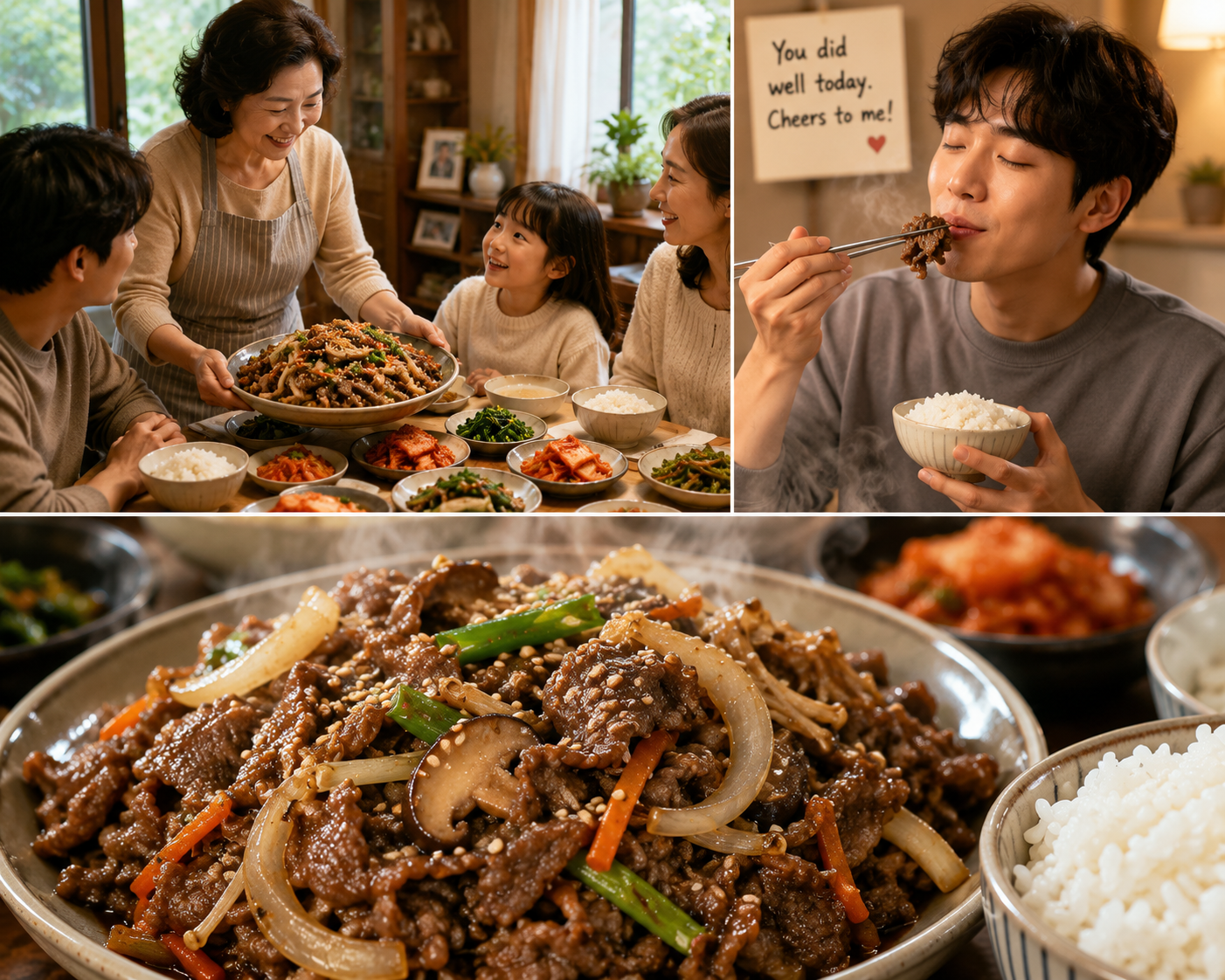
    For many Koreans, bulgogi has carried memories like these.

    Today, beef is much easier to find in Korea than it once was. But for ordinary families in the past, beef was relatively expensive and was not necessarily something eaten every day.

    So when something good happened in the family, bulgogi could make an appearance.

    A graduation.

    Passing an important exam.

    Getting into college.

    Starting a new job.

    A birthday.

    A family gathering.

    Or an important guest coming to the house.

    A mother might buy beef, prepare a sweet and savory soy sauce marinade, and put bulgogi on the table.

    The message did not always have to be spoken.

    The special meal said it for her.


    What Is Bulgogi?

    Bulgogi (불고기) literally means “fire meat.”

    Today, when Koreans simply say bulgogi, they are often referring to thinly sliced beef seasoned with a soy sauce-based marinade.

    The classic flavor is savory and gently sweet, with garlic, sesame oil, and other seasonings adding aroma and depth.

    Unlike spicy Korean dishes built around gochujang or gochugaru, traditional beef bulgogi is usually not spicy.

    That makes it one of the easiest Korean dishes to introduce to someone trying Korean food for the first time.

    Tender beef.

    Sweet and savory sauce.

    Hot rice.

    It is a simple combination that is very difficult not to like.


    Bulgogi Was Food for a Good Day

    Imagine coming home after receiving some wonderful news.

    You passed an important examination.

    You graduated.

    You got the job you had been hoping for.

    And waiting at home is the smell of beef cooking with soy sauce, garlic, onions, and sesame oil.

    For some Korean families, food has long been one way of expressing emotions that are not always spoken directly.

    Preparing a special meal can mean:

    “I’m proud of you.”

    “You worked hard.”

    “Let’s celebrate together.”

    And because beef once felt more special than an ordinary everyday ingredient, bulgogi was well suited to those moments.

    It was not merely beef for dinner.

    Sometimes, it was a celebration served with rice.


    Every Family Can Have Its Own Bulgogi

    Ask several Korean home cooks for their bulgogi recipe and you may receive several different answers.

    One family likes it sweeter.

    Another uses more garlic.

    Someone adds grated Korean pear.

    Another remembers a stronger sesame oil aroma.

    Some families add plenty of onions and mushrooms, while others prefer to keep the dish focused on the beef.

    That means there can be something called “our family’s bulgogi.”

    And taste has a remarkable relationship with memory.

    Years later, the aroma of soy sauce, garlic, beef, and sesame oil hitting a hot pan can suddenly remind someone of a family table from childhood.

    A recipe can tell you how many tablespoons of soy sauce to use.

    But it cannot completely reproduce the memory of the person who used to make it for you.

    That is part of what makes home cooking special.


    Sometimes, You Can Celebrate Yourself

    The meaning of celebration has changed too.

    Today, many people live alone.

    People work long hours, deal with pressure, and sometimes experience important moments without a family gathering waiting for them at home.

    Maybe nobody knows how difficult your week was.

    Maybe you completed something that seemed small to everyone else but was important to you.

    Maybe nothing extraordinary happened at all.

    You simply survived a difficult day.

    On a day like that, perhaps you can make bulgogi for yourself.

    You do not need a birthday.

    You do not need a graduation.

    You do not need to wait for someone else to decide that today deserves a special meal.

    Make some hot rice.

    Cook the beef.

    Sit down.

    And give yourself the message that Korean mothers once expressed through a special dinner:

    “You did well today.”

    Sometimes the person who deserves your congratulations is you.


    Two Delicious Ways to Enjoy Bulgogi

    Bulgogi does not always arrive at the table in exactly the same form.

    Two styles are particularly useful for understanding how Koreans enjoy it.

    Pan-Cooked Bulgogi

    This is an easy style for home cooking.

    Thin slices of marinated beef are cooked with onions, green onions, mushrooms, and other vegetables.

    The sauce coats the meat, and the edges can become slightly caramelized as the liquid reduces.

    Put it over steaming rice and some of the sauce will soak into the grains.

    For a simple Korean home meal, you may not need much more.

    Bulgogi with Broth

    Another style keeps more liquid around the beef.

    Vegetables, mushrooms, and sometimes glass noodles can cook alongside the meat in a savory-sweet broth.

    The experience becomes somewhere between grilled or pan-cooked bulgogi and a comforting hot-pot meal.

    And there is an important rule when delicious bulgogi broth remains:

    Do not waste it.

    Let your rice absorb some of that sweet and savory broth.

    Sometimes the sauce left behind is almost as good as the beef itself.


    Why Korean Pear Is Used in Bulgogi

    One ingredient that may surprise people outside Korea is pear.

    Korean cooks have long used pear in meat marinades.

    Grated Korean pear or pear juice contributes gentle sweetness and fresh fruit flavor, and it can also help create a more tender eating experience.

    Korean pear is not always easy to find overseas.

    That is okay.

    You can still make excellent bulgogi without it.

    For an easy home version, pear juice can be convenient, or you can simply make the marinade without pear and rely on thinly sliced, tender beef.

    The important lesson is this:

    Bulgogi should be tender enough to eat comfortably with rice, but flavorful enough that the rice keeps disappearing.


    How to Make Korean Beef Bulgogi at Home

    Here is a practical version designed for home cooking.

    Ingredients — 2 to 3 Servings

    • Thinly sliced beef — 500 g
    • Onion — 1/2
    • Green onion — 1
    • Carrot — 1/3
    • Mushrooms — 100 g

    Shiitake, oyster, or other mushrooms can work well.

    Bulgogi Marinade

    • Soy sauce — 6 tbsp
    • Sugar — 2 tbsp
    • Honey or corn syrup — 1 tbsp
    • Minced garlic — 1 tbsp
    • Grated Korean pear or pear juice — 3 tbsp
    • Mirin or cooking wine — 2 tbsp
    • Sesame oil — 1 tbsp
    • Black pepper — a few pinches
    • Toasted sesame seeds — 1 tbsp

    This gives you a classic sweet-savory starting point.

    If your soy sauce is particularly salty or you prefer a lighter flavor, reduce it slightly.


    Step 1: Prepare the Beef

    Bulgogi works best with beef sliced thinly across the grain.

    Thin slices cook quickly and allow the marinade to coat more of the meat.

    If there is excess surface moisture, gently pat the beef with a paper towel.

    Separate the slices carefully so the marinade can reach the meat evenly.


    Step 2: Make the Marinade

    Combine the soy sauce, sugar, honey or corn syrup, garlic, pear, cooking wine, sesame oil, black pepper, and sesame seeds.

    Taste the marinade.

    It should be clearly savory but also gently sweet.

    Remember that the flavor will become less intense once it is mixed with the beef and vegetables.


    Step 3: Marinate the Beef

    Add the beef to the marinade and mix gently.

    Allow it to marinate for about 30 minutes.

    You can marinate it longer in the refrigerator if convenient, but thinly sliced beef does not necessarily need hours and hours to become flavorful.

    While the beef marinates, slice the vegetables.


    Step 4: Cook Over High Enough Heat

    Heat a large frying pan.

    Add the marinated beef without overcrowding the pan.

    This matters.

    If you put too much cold meat into a small pan, the temperature drops and the beef can release a large amount of liquid.

    Instead of developing delicious browned edges, it may simply boil in its own juices.

    If necessary, cook the beef in two batches.

    Let some of the sauce reduce and coat the meat.


    Step 5: Add the Vegetables

    Add the onions, carrots, mushrooms, and green onions.

    Cook until the vegetables are tender but still have some texture.

    The onions should become sweet, the mushrooms should absorb some of the bulgogi sauce, and the beef should remain tender.

    Finish with a small drizzle of sesame oil and toasted sesame seeds if desired.

    The aroma should tell you that dinner is ready.


    The Easiest Way to Eat Bulgogi

    You do not need an elaborate Korean table.

    Start with a bowl of steaming white rice.

    Put hot bulgogi beside it or directly over the rice.

    Spoon a little of the sauce over the top.

    Take a bite of beef.

    Then rice.

    Then another bite.

    You will quickly understand why bulgogi and rice work so well together.


    Try Bulgogi as a Lettuce Wrap

    Bulgogi can also be enjoyed as ssam, a Korean lettuce wrap.

    Take a lettuce leaf and add:

    • A little rice
    • Bulgogi
    • Garlic, if you like
    • A small amount of ssamjang
    • Green chili, optional

    Fold the leaf around everything and eat it in one bite.

    The fresh lettuce provides contrast to the sweet, savory beef.


    Turn Leftover Bulgogi Into Tomorrow’s Meal

    Do not worry if you make too much.

    Leftover bulgogi is useful.

    Put it over rice with a fried egg for an easy bulgogi rice bowl.

    Add it to fried rice.

    Put it into a sandwich.

    Or use it as a filling for kimbap.

    A little leftover bulgogi, seasoned rice, seaweed, and vegetables can become tomorrow’s lunch.

    Yesterday’s celebration can become today’s easy meal.


    True Taste Korea Tip: Don’t Make It Too Sweet

    Bulgogi should have sweetness.

    But sweetness should not be the only thing you taste.

    Good bulgogi has balance.

    Soy sauce brings saltiness and savory depth.

    Garlic adds aroma.

    Pear can contribute gentle sweetness.

    Sesame oil adds its distinctive nutty fragrance.

    And the beef still needs to taste like beef.

    If your first thought after tasting the sauce is simply “sugar,” you have probably gone too far.

    Sweetness should support the meat, not hide it.


    Bulgogi FAQ

    What does bulgogi mean?
    Bulgogi literally means “fire meat” in Korean. Today, the word commonly refers to thinly sliced marinated beef cooked on a grill or in a pan.

    Is bulgogi spicy?
    Traditional beef bulgogi is generally not spicy. Its characteristic flavor is sweet, savory, garlicky, and slightly nutty from sesame oil.

    What kind of beef should I use?
    Tender beef that can be sliced thinly works best. Ribeye, sirloin, or other suitable thin-cut beef can be used depending on what is available where you live.

    Do I need Korean pear?
    No. Korean pear is a traditional and delicious addition, but you can make good bulgogi without it.

    How long should I marinate bulgogi?
    About 30 minutes is enough for a simple home version using very thinly sliced beef. Longer refrigeration is also possible.

    Can I make bulgogi without a grill?
    Absolutely. A frying pan is one of the easiest ways to make bulgogi at home.

    What should I eat with bulgogi?
    Steamed rice is the simplest choice. Lettuce wraps, kimchi, vegetables, and other Korean side dishes also pair well with it.


    A Meal That Says, “You Did Well”

    Bulgogi may be famous around the world today as Korean marinated beef.

    But food can carry meanings that do not appear on a restaurant menu.

    For one person, the smell of bulgogi may bring back a graduation dinner.

    For another, it may recall relatives gathered around a table.

    Someone else may remember the particular sweetness of their mother’s marinade.

    Those memories are difficult to measure with tablespoons.

    And perhaps we can create new ones.

    You do not always need to wait for someone else to celebrate you.

    Maybe you finished something difficult.

    Maybe you took one small step forward.

    Maybe today was simply harder than anyone else knows.

    Cook something special.

    Fill a bowl with hot rice.

    Put bulgogi on top.

    And before you take the first bite, tell yourself:

    “You did well today.”

    Sometimes the person who deserves your congratulations is you.

  • Kimchi Jjigae: Korea’s Humble Stew That’s Hard to Master

    Kimchi Jjigae: Korea’s Humble Stew That’s Hard to Master

    Kimchi jjigae looks simple.

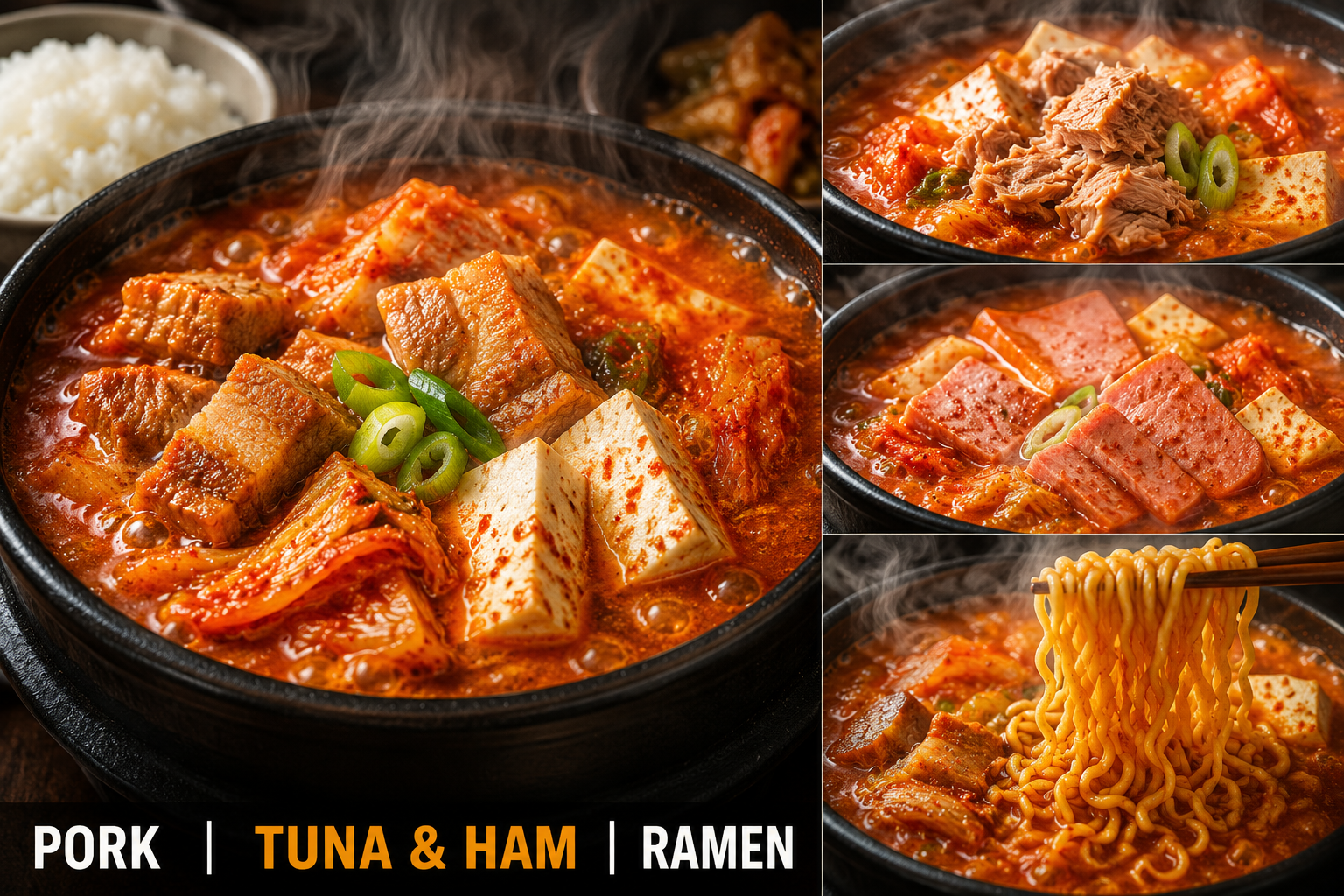
    Put kimchi in a pot, add some meat or tuna, pour in water or broth, and let everything simmer.

    Almost anyone can make it.

    But making a really delicious kimchi jjigae is another story.

    In Korea, kimchi jjigae is such a familiar home-cooked dish that a good bowl can sometimes say a lot about the person who made it.

    The ingredients are inexpensive. The cooking method looks easy. Yet getting the balance of sourness, saltiness, richness, and savory flavor just right can be surprisingly difficult.

    Why?

    Because the most important ingredient is alive and constantly changing.

    Kimchi.

    Fresh kimchi, slightly fermented kimchi, and deeply sour kimchi can produce completely different stews.

    That is why great kimchi jjigae is not simply about following a recipe.

    It begins with understanding your kimchi.


    What Is Kimchi Jjigae?

    Kimchi jjigae (김치찌개) is a Korean stew made primarily with fermented kimchi.

    It is commonly cooked with ingredients such as pork, tofu, green onion, and onion, although there are countless variations.

    Tuna is popular.

    Ham works beautifully.

    Some Koreans cook it with mackerel or saury.

    And when there is delicious broth left in the pot, ramen or udon noodles can sometimes find their way in too.

    That flexibility is part of the beauty of kimchi jjigae.

    The kimchi remains at the center, but the personality of the stew changes depending on what you cook with it.


    Simple to Make, Difficult to Master

    There is a reason kimchi jjigae can be frustrating even for Korean home cooks.

    Every kimchi tastes different.

    One batch may already be quite salty.

    Another may be strongly sour.

    One may have a pronounced garlic flavor, while another may carry more sweetness or the savory character of fermented seafood seasonings.

    So imagine following exactly the same kimchi jjigae recipe with two completely different batches of kimchi.

    The result may not be the same.

    That is why one of the most important lessons in making kimchi jjigae is surprisingly simple:

    Taste your kimchi first.

    Then decide what your stew needs.

    A recipe gives you a starting point.

    Your tongue finishes the recipe.


    The First Secret: Don’t Use Kimchi That Is Too Fresh

    Freshly made kimchi can be wonderful with hot rice.

    But for kimchi jjigae, kimchi that has had some time to ferment is usually a better choice.

    It does not have to be extremely sour.

    Even slightly fermented kimchi can develop more character in a stew than freshly made kimchi.

    As fermentation progresses, kimchi develops the tangy acidity and deeper flavors that give kimchi jjigae its distinctive personality.

    This is why Koreans often reach for older kimchi when it is time to make a pot of stew.

    Kimchi that may have become a little too sour to eat exactly as it is can suddenly become an excellent cooking ingredient.

    Yesterday’s aging kimchi can become today’s great jjigae.


    The Science Behind Great Kimchi Jjigae: Acidity Matters

    One of the keys to understanding kimchi jjigae is acidity.

    As kimchi ferments, lactic acid bacteria transform its flavor and produce the characteristic tang associated with fermented kimchi.

    That acidity becomes especially interesting when kimchi is cooked with fatty pork.

    The pork gives the broth richness and savory depth, while the tanginess of the fermented kimchi helps balance that richness.

    This creates one of the classic flavor combinations of Korean cooking:

    sour fermented kimchi + rich pork + hot savory broth.

    But more sour is not automatically better.

    The goal is balance.

    If your kimchi is already very salty, be careful with additional soy sauce or salt.

    If it is intensely sour, you may want a little sweetness or richness to round out the flavor.

    If it is only lightly fermented, the stew may need more help developing depth.

    This is where cooking experience begins to matter.


    Pork or Tuna? Koreans Have Their Favorite

    Ask people in Korea about kimchi jjigae and you will quickly discover that everyone has preferences.

    One of the classic choices is:

    Pork or tuna?

    Pork Kimchi Jjigae

    Pork makes kimchi jjigae rich and hearty.

    Pork belly is particularly delicious because some of its fat renders into the broth as it cooks.

    That richness combines with the acidity of fermented kimchi and creates a deep, satisfying flavor.

    Pork shoulder can also work well if you prefer something a little leaner.

    For many people, this is the classic kimchi jjigae.

    Tuna Kimchi Jjigae

    Then there are the tuna lovers.

    Canned tuna makes kimchi jjigae incredibly convenient.

    Open a can, add it to the pot, and you can quickly create a savory stew without preparing raw meat.

    Tuna has its own distinctive flavor, so the result is quite different from pork kimchi jjigae.

    Neither version is the “correct” one.

    Often, the best kimchi jjigae is simply the version you grew up loving.


    Don’t Forget Ham

    There is another easy ingredient that tastes surprisingly good with kimchi:

    ham.

    The salty, savory flavor of ham works naturally with fermented kimchi.

    It is especially useful when you want something quick and comforting without preparing fresh meat.

    And if you begin adding sausages, ham, noodles, and other ingredients, you may notice the meal starting to move toward another famous Korean dish:

    budae jjigae, often called Korean army stew.

    That is another example of how flexible Korean stew culture can be.


    Kimchi Jjigae Can Even Become a Fish Dish

    Kimchi jjigae is not limited to meat.

    Koreans also cook fermented kimchi with fish such as mackerel or saury.

    These strongly flavored, oily fish have enough personality to stand up to fermented kimchi.

    As the fish simmers, its richness enters the broth while the spicy, tangy kimchi provides contrast.

    It is a very different experience from pork or tuna kimchi jjigae.

    Instead of serving grilled fish and kimchi separately, you can let them cook together in one bubbling pot.

    The same kimchi can therefore become the foundation for pork, tuna, ham, or fish.

    Change one main ingredient, and the personality of the entire pot changes.


    A Humble Stew That Filled Korean Tables

    Kimchi jjigae has never needed expensive ingredients to feel satisfying.

    That is an important part of its place in Korean food culture.

    For generations, it has been familiar everyday food: affordable, practical, hearty, and full of flavor.

    A little fermented kimchi, some pork or another protein, tofu, green onion, and rice can make a complete and comforting meal.

    Kimchi jjigae can be eaten as part of an everyday meal.

    A bubbling pot can also become anju (안주)—food enjoyed alongside a drink.

    That versatility has helped kimchi jjigae remain at home on ordinary Korean tables.

    It is inexpensive food that never has to feel like a poor meal.


    One Pot Can Fill the Whole Table

    A Korean meal traditionally often includes rice, soup or stew, and several side dishes.

    But kimchi jjigae has an unusual strength.

    One good pot can do several jobs at once.

    There is hot broth.

    There is kimchi.

    If you make the pork version, there is meat.

    There may also be tofu, onions, green onions, mushrooms, or other vegetables.

    Put the pot in the middle of the table and add bowls of steaming rice.

    Suddenly, you do not need many other side dishes.

    This is one of the quiet strengths of kimchi jjigae:

    One humble pot can make a simple table feel abundant.


    How to Make Pork Kimchi Jjigae

    Here is a practical home version.

    The measurements are a starting point.

    Remember the most important rule:

    Taste your kimchi before you season the broth.

    Ingredients — 2 to 3 Servings

    • Fermented kimchi — 300 g
    • Pork belly or pork shoulder — 200 g
    • Tofu — 150 g
    • Onion — 1/2
    • Green onion — 1
    • Water or light broth — 500 ml
    • Kimchi juice — 3 to 4 tbsp, if available
    • Gochugaru — 1 tbsp
    • Minced garlic — 1 tsp
    • Soup soy sauce or regular soy sauce — about 1 tsp, as needed
    • Sugar — 1/2 tsp, optional

    If your kimchi is already strongly seasoned, you may need less additional seasoning.


    Step 1: Taste the Kimchi

    Before doing anything else, taste it.

    Is it salty?

    Is it sour?

    Is it only slightly fermented?

    This small step will help you decide how much seasoning the stew actually needs.


    Step 2: Cook the Pork and Kimchi

    Cut the pork and kimchi into comfortable bite-sized pieces.

    Place the pork in a pot and cook it briefly over medium heat.

    Add the kimchi and cook them together for a few minutes.

    This begins building the rich base of the stew.


    Step 3: Add the Broth

    Add about 500 ml of water or light broth.

    If you have kimchi juice from the container, add a few tablespoons.

    Bring everything to a boil, then lower the heat and allow it to simmer.

    Kimchi jjigae benefits from enough cooking time for the flavors of the kimchi, pork, and broth to come together.


    Step 4: Season Carefully

    Add the garlic and gochugaru.

    Taste the broth before adding soy sauce.

    If it already tastes salty enough, you may not need much additional seasoning.

    If the kimchi is extremely sour, a very small amount of sugar can soften the sharp edge.

    But do not try to remove all the acidity.

    That tang is part of what makes kimchi jjigae taste like kimchi jjigae.


    Step 5: Add Tofu and Green Onion

    Add sliced tofu toward the later part of cooking so it keeps its shape.

    Finish with green onion.

    Taste once more.

    This final tasting is more important than blindly following another spoonful from the recipe.

    Serve the stew bubbling hot with steamed rice.


    Easy Tuna Kimchi Jjigae

    For an easier version, replace the pork with canned tuna.

    Use:

    • Fermented kimchi — 300 g
    • Canned tuna — 1 can
    • Tofu — 150 g
    • Onion — 1/2
    • Water or broth — about 500 ml
    • Kimchi juice — 3 to 4 tbsp
    • Gochugaru — 1 tbsp
    • Garlic — 1 tsp
    • Green onion — 1

    Cook the kimchi first with a little of the tuna oil if you enjoy a richer flavor.

    Add the broth and seasonings and simmer.

    Add the tuna, tofu, and green onion and cook until everything is hot and the flavors have come together.

    This is one of the easiest ways to turn kimchi and a can of tuna into a satisfying Korean meal.


    Don’t Waste the Broth: Add Noodles

    Now imagine that dinner is almost finished.

    The pork is mostly gone.

    There are only a few pieces of kimchi left.

    But there is still delicious red broth bubbling in the pot.

    Do not throw it away.

    Add ramen noodles.

    The noodles absorb the spicy, sour, savory broth and transform the end of the meal into something new.

    You can also add udon noodles if you prefer something thicker and chewier.

    If the remaining broth has become too salty or concentrated, add a small splash of water before cooking the noodles.

    The first half of dinner was kimchi jjigae.

    The ending can become a bowl of delicious noodles.


    True Taste Korea Tip: Learn the Flavor, Not Just the Recipe

    If you make kimchi jjigae only by measuring ingredients, you can make a good stew.

    But if you want to become good at making kimchi jjigae, learn to taste.

    Taste the kimchi.

    Taste the broth halfway through cooking.

    Taste it again before serving.

    Ask yourself:

    Is it too salty?

    Does it need more savory depth?

    Is the sourness pleasant or overpowering?

    Does it need more richness?

    This is why kimchi jjigae is simultaneously one of Korea’s easiest and most difficult dishes.

    The recipe is simple. The balance takes practice.


    Kimchi Jjigae FAQ

    Can I use fresh kimchi for kimchi jjigae?
    You can, but slightly fermented or sour kimchi generally gives the stew more of the tangy depth associated with kimchi jjigae.

    Which pork is best?
    Pork belly gives the broth plenty of richness, while pork shoulder is another good choice if you prefer less fat.

    Can I make kimchi jjigae without pork?
    Absolutely. Tuna, ham, mackerel, saury, or tofu can all lead to different versions.

    Is kimchi jjigae very spicy?
    It can be spicy, but the intensity depends on the kimchi and the amount of gochugaru you add.

    Can I add ramen noodles?
    Yes. Ramen noodles are particularly delicious cooked in the remaining broth. Udon noodles are another option.

    Why does my kimchi jjigae taste too salty?
    Your kimchi may already contain plenty of salt. Avoid automatically adding the full amount of soy sauce or other salty seasonings before tasting.

    Do I need many side dishes with kimchi jjigae?
    No. One of its attractions is that a hearty pot with kimchi, broth, protein, and tofu can make a simple bowl of rice feel like a complete meal.


    Simple Ingredients, Abundant Flavor

    Kimchi jjigae does not need to be luxurious.

    That has never been its purpose.

    It takes something already found in countless Korean homes—fermented kimchi—and turns it into a hot, generous meal.

    Add pork and it becomes rich and hearty.

    Add tuna and it becomes quick and savory.

    Add ham and it becomes another kind of comfort food.

    Cook it with mackerel or saury and it takes on the character of a fish dish.

    Add ramen to the remaining broth and the meal changes once again.

    Yet underneath all those variations is the same humble pot of kimchi.

    That may be the real beauty of kimchi jjigae.

    Simple ingredients can create abundant flavor.

    And one bubbling pot can make even a simple table feel full.

  • Bibimbap: Where People and Flavors Come Together

    Bibimbap: Where People and Flavors Come Together

    Bibimbap is often introduced as one of Korea’s most colorful dishes.

    A bowl of rice is topped with vegetables, meat, egg, and gochujang, then everything is mixed together before eating.

    That description is correct.

    But it does not completely explain what bibimbap means in everyday Korean life.

    Bibimbap can be a carefully prepared dish served with beautifully arranged vegetables. It can also be something you make when you open the refrigerator and find a little spinach, some kimchi, leftover meat, and an egg.

    Sometimes it is served beautifully in an individual bowl.

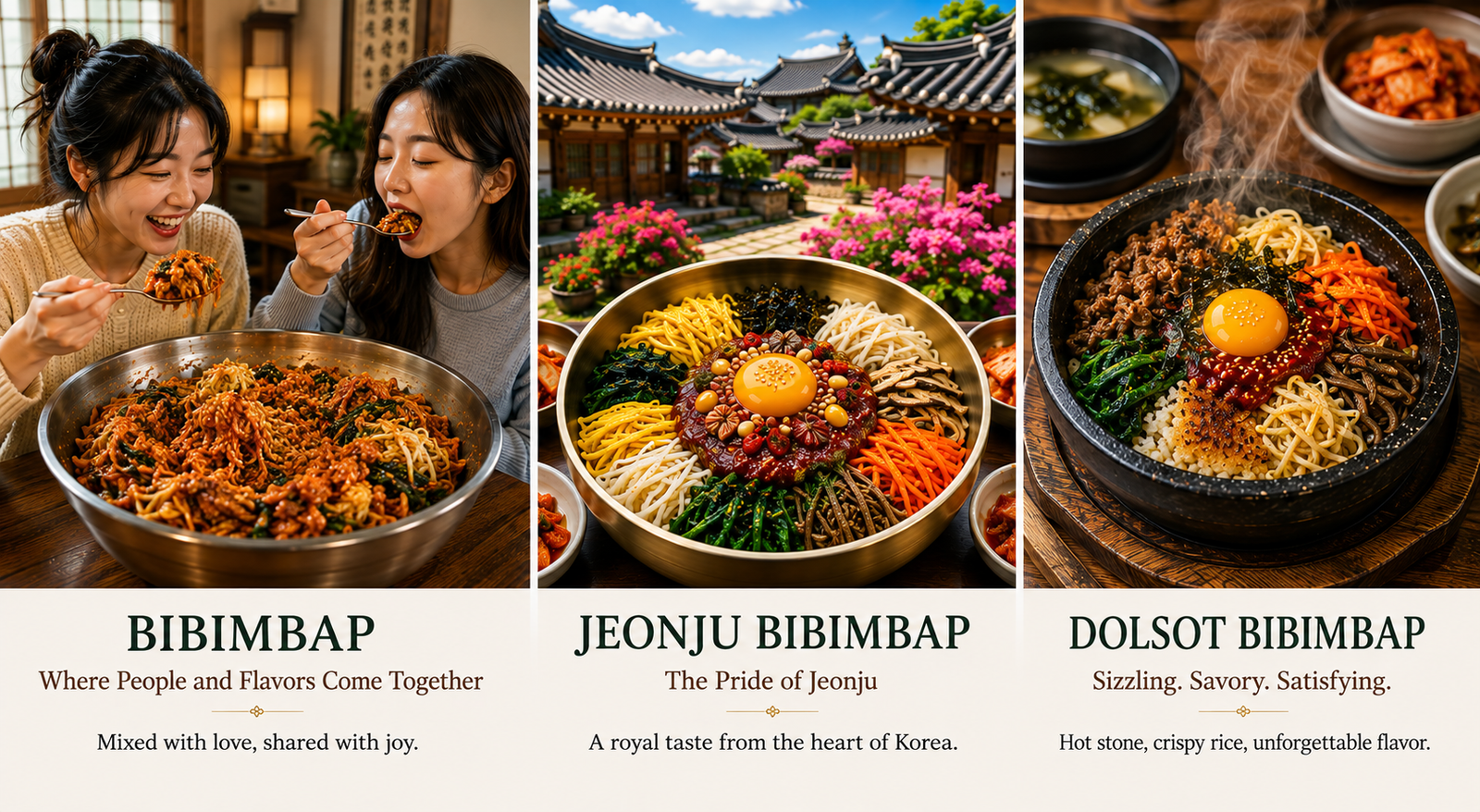
    Sometimes two close friends sit in front of one enormous bowl, mix everything together, and eat while talking and laughing.

    That freedom is part of what makes bibimbap special.

    Different ingredients come together.

    Different flavors come together.

    And sometimes, people come together around the same bowl.

    Bibimbap is where people and flavors come together.


    What Is Bibimbap?

    The word bibimbap (비빔밥) is wonderfully simple.

    “Bibim” means mixing, and “bap” means cooked rice.

    So bibimbap literally means mixed rice.

    Rice forms the base, and different ingredients are placed on top. Common additions include spinach, bean sprouts, carrots, mushrooms, zucchini, beef, egg, and kimchi.

    Gochujang gives the bowl its spicy, savory flavor, while sesame oil adds its unmistakable nutty aroma.

    Then comes the most important step.

    You mix everything.

    And you really mix it.

    The beautiful arrangement you saw when the bowl arrived disappears, but something better takes its place: all those individual ingredients become one meal.


    There Is No Single Perfect Bibimbap

    One of the best things about bibimbap is that it does not have to follow one strict formula.

    Open a Korean refrigerator and you may already have the beginning of bibimbap.

    Some spinach left from yesterday?

    Add it.

    A little kimchi?

    Add it.

    Carrots, mushrooms, cucumber, or bean sprouts?

    Use them.

    Leftover bulgogi or samgyeopsal?

    Even better.

    You can add tuna, ham, chicken, cheese, or almost anything else you enjoy.

    This is why the everyday version of bibimbap can be very different from the beautifully arranged bowl you might see in a Korean restaurant.

    Bibimbap is not about having every “correct” ingredient.

    It is about making different ingredients work together.


    The Big Bowl Bibimbap Koreans Make at Home

    There is another kind of bibimbap that you may not always see in Korean restaurants.

    It starts with a very big bowl.

    Imagine a stressful day when you do not want to cook another complicated meal.

    You open the refrigerator.

    There are a few vegetables here, some side dishes there, perhaps some kimchi and an egg.

    Instead of preparing a new dish, everything goes into the bowl.

    Add a generous serving of rice, a spoonful of gochujang and a drizzle of sesame oil.

    Then mix.

    Sometimes this kind of bibimbap is less about following a recipe and more about satisfying a sudden craving.

    Two close friends might share a big bowl while talking about their day, laughing, complaining, and telling stories.

    The bibimbap may not look as perfect as a restaurant version.

    But that is not the point.

    Sometimes the best bibimbap is the one eaten comfortably with someone who knows you well.


    Bibimbap, Sharing, and Korean Jeong

    There is a Korean word that is difficult to translate perfectly into English: jeong (정).

    Jeong can describe the affection, attachment, warmth, and connection that gradually grows between people.

    Food is one of the places where you can see it.

    A big bowl of bibimbap shared between people can be a very simple expression of that closeness.

    Everyone may like different things.

    One person wants more kimchi.

    Another loves meat.

    Someone wants extra gochujang.

    Someone else cannot handle much spice.

    Yet everything can still come together around the same meal.

    In that sense, bibimbap feels surprisingly symbolic.

    Different ingredients do not need to become identical to belong in the same bowl.

    They simply need to find a way to taste good together.

    Perhaps people are not so different.


    When You Don’t Know What to Cook, Make Bibimbap

    Bibimbap is especially useful on those days when you look into the refrigerator and think:

    “What am I supposed to make with all of this?”

    You do not necessarily need another recipe.

    You may just need a bowl of rice.

    Leftover vegetables can become toppings.

    Yesterday’s meat can become today’s bibimbap.

    A fried egg can turn a very simple bowl into a satisfying meal.

    Add gochujang and sesame oil, mix everything together, and dinner is ready.

    It is one of the reasons bibimbap remains such a practical home meal in Korea.


    A Clever Way to Help Kids Enjoy Vegetables

    Some children are not excited when vegetables are served separately.

    Bibimbap can make those same ingredients feel completely different.

    Vegetables can be chopped into smaller pieces and mixed with rice, egg, meat, tuna, or another ingredient the child enjoys.

    And bibimbap does not have to be spicy.

    For children who do not eat gochujang, a mild version can be made with a little soy sauce and sesame oil instead.

    The important thing is not to force one fixed recipe on everyone.

    A child’s bibimbap can be different from an adult’s bibimbap.

    That is exactly the beauty of this dish.


    Winter Comfort: Dolsot Bibimbap

    Bibimbap has another delicious personality in winter.

    Dolsot bibimbap (돌솥비빔밥) is served in a hot stone bowl.

    When the rice touches the heated stone, you can hear it sizzling.

    The vegetables stay warm, the egg cooks with the heat, and the bottom layer of rice gradually becomes golden and crispy.

    That crispy rice is one of the best parts.

    Do not be in too much of a hurry to scrape everything from the bottom.

    Give the rice a little time against the hot stone and let the crust develop.

    On a cold Korean day, the sound of bibimbap sizzling in a stone bowl can be almost as satisfying as the first bite.


    Jeonju: The Korean City of Bibimbap

    If you visit Korea and want to experience bibimbap beyond your own kitchen, remember the city of Jeonju.

    Jeonju is famous for traditional Korean culture, its hanok architecture, and its association with bibimbap.

    Walking through the traditional streets and then sitting down to a beautifully prepared bowl of Jeonju bibimbap can be a memorable Korean food experience.

    The contrast is interesting.

    At home, bibimbap might be made spontaneously from whatever is available in the refrigerator.

    In Jeonju, you can encounter a much more elaborate presentation, with colorful ingredients carefully prepared and arranged.

    They look very different.

    But the basic idea remains the same.

    Many ingredients come together to create one bowl.

    Bibimbap Beyond the Dinner Table

    Bibimbap’s connection with Jeonju goes beyond restaurants.

    The city has celebrated bibimbap through food festivals and cultural activities, showing how deeply a local dish can become connected with the identity of a place.

    For a traveler, that makes bibimbap more than something to taste.

    It can become a way to experience Korean food, history, local culture, and community together.

    True Taste Korea Tip: If you travel to Jeonju, combine a walk through the hanok area with a traditional Jeonju bibimbap meal. Don’t just photograph the bowl—mix it thoroughly and eat it the Korean way.


    How to Make Bibimbap at Home

    You do not need a dozen perfectly prepared toppings to make good bibimbap.

    Start with a basic version and make it your own.

    Ingredients — 2 Servings

    Rice

    • 2 bowls cooked short-grain rice

    Vegetables

    • Spinach — 100 g
    • Bean sprouts — 100 g
    • Carrot — 1/2
    • Zucchini — 1/2
    • Mushrooms — 100 g

    Other toppings

    • Beef — 150 g
    • Eggs — 2
    • Sesame oil
    • Toasted sesame seeds

    You can replace the beef with pork, chicken, tuna, ham, tofu, or leftovers from another meal.

    Simple Bibimbap Sauce

    • Gochujang — 2 tbsp
    • Sesame oil — 1 tbsp
    • Sugar — 1 tsp
    • Rice vinegar — 1 tsp
    • Minced garlic — 1/2 tsp
    • Sesame seeds — 1 tsp

    Mix everything together.

    If you prefer a milder sauce, reduce the gochujang.


    How to Make It

    Prepare the vegetables separately so each one keeps some of its own texture and flavor.

    Lightly blanch the spinach and bean sprouts.

    Thinly slice the carrot, zucchini, and mushrooms and sauté them briefly.

    Cook the beef in a pan until browned.

    Fry the eggs, preferably leaving the yolks slightly soft if you like them that way.

    Put hot rice into each bowl.

    Arrange the vegetables and meat over the rice and place the egg in the center.

    Add bibimbap sauce and a little sesame oil.

    Then do the thing that gives bibimbap its name:

    Mix everything thoroughly.

    Do not worry about destroying the beautiful presentation.

    Bibimbap is supposed to be mixed.


    Easy Refrigerator Bibimbap

    Here is an even easier version.

    Take one bowl of hot rice.

    Look inside your refrigerator.

    Choose three or four things you already have.

    Kimchi + fried egg + leftover pork?

    Perfect.

    Tuna + cucumber + carrot + egg?

    Perfect.

    Ham + kimchi + cheese?

    Why not?

    Add gochujang and sesame oil and mix.

    Rice + what you have + sauce = bibimbap.

    That may be closer to the spirit of everyday bibimbap than trying to reproduce a perfect restaurant photograph.


    True Taste Korea Tip: Use Yesterday’s Dinner

    Leftovers can become excellent bibimbap toppings.

    If you have some samgyeopsal left from Korean barbecue, cut it into small pieces and add it to your bowl.

    Leftover bulgogi works beautifully.

    Chicken works.

    Even a small amount of meat can add plenty of flavor when it is mixed throughout the rice.

    Korean food does not always have to begin again from zero.

    Sometimes today’s meal begins with yesterday’s dinner.


    Bibimbap FAQ

    Does bibimbap have to contain beef?
    No. Beef is popular, but bibimbap can be made without meat or with pork, chicken, tuna, ham, tofu, or whatever you enjoy.

    Does bibimbap have to be spicy?
    No. Gochujang is traditional and popular, but you can use less of it or make a mild version with soy sauce and sesame oil.

    What is the difference between bibimbap and dolsot bibimbap?
    Regular bibimbap is served in a normal bowl. Dolsot bibimbap is served in a heated stone bowl, which keeps the food hot and creates crispy rice on the bottom.

    Do I need all the traditional vegetables?
    No. Use what you have. A simpler bibimbap can still be delicious.

    Can I use leftover rice?
    Yes. Reheat it thoroughly so it is hot before assembling your bibimbap.

    Should I mix bibimbap before eating it?
    Yes. Mixing is the whole idea. Mix the rice, toppings, sauce, and sesame oil until the flavors are distributed throughout the bowl.


    Where People and Flavors Come Together

    A bowl of bibimbap can be carefully prepared with many colorful ingredients.

    Or it can begin with a simple question:

    “What do we have in the refrigerator?”

    It can be eaten alone when you do not feel like cooking.

    It can be shared from a big bowl while two friends talk for an hour.

    It can help turn vegetables into something a child enjoys.

    It can arrive sizzling in a stone bowl on a cold winter day.

    And in Jeonju, it can become part of an entire city’s food culture.

    There is no single perfect bibimbap.

    Different vegetables, different meats, different tastes, and different people can all find their place.

    Bibimbap is not about making everything the same.

    It is about discovering how different things can become better when they come together.

  • Samgyeopsal: Why Koreans Love Eating Pork Belly Together

    Samgyeopsal: Why Koreans Love Eating Pork Belly Together

    Samgyeopsal Is Better When Shared

    Koreans often believe that truly delicious food becomes even more special when it is shared with other people.

    Samgyeopsal is one of the best examples.

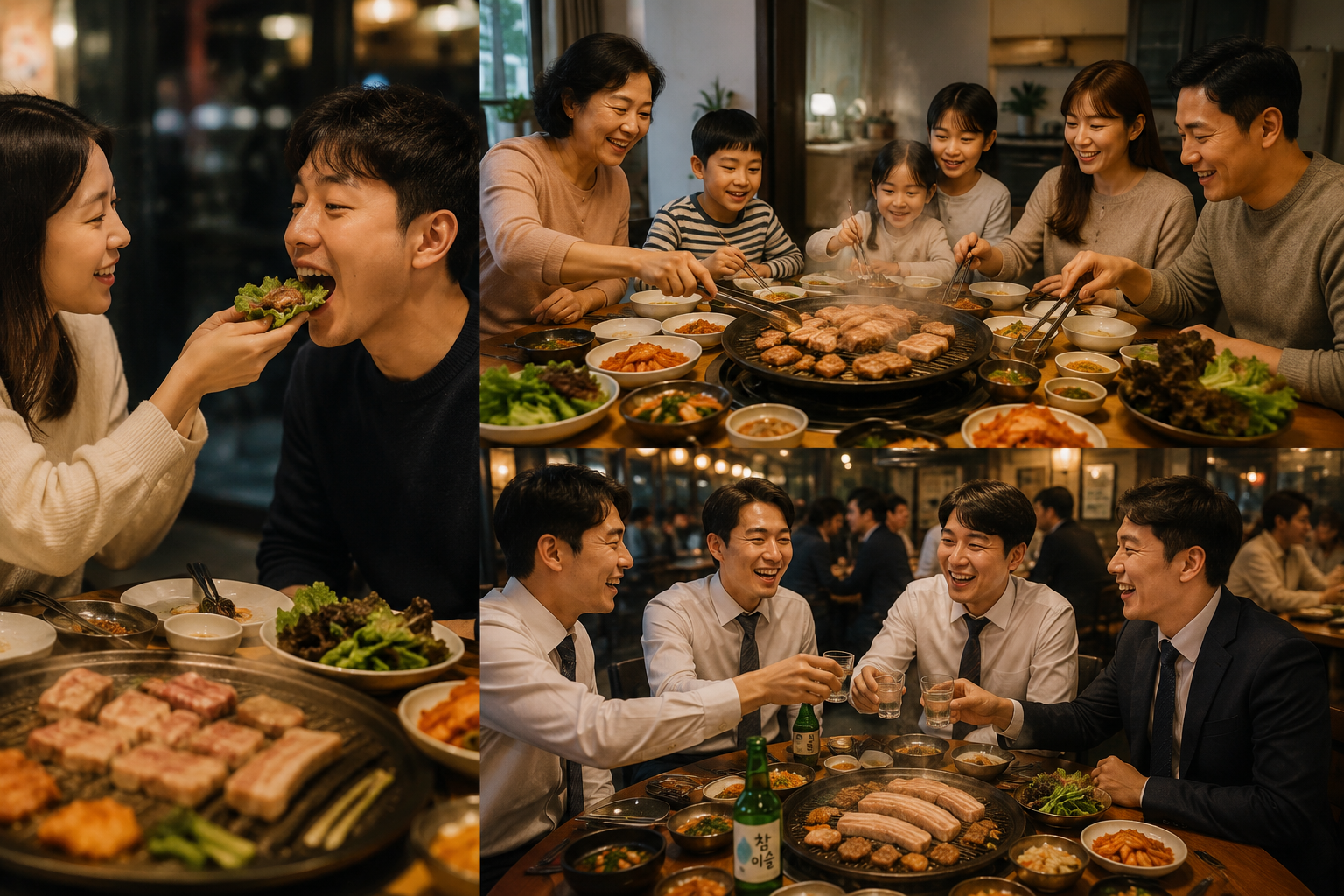
    A hot grill is placed in the middle of the table. Thick slices of pork belly begin to sizzle. Someone turns the meat, someone else cuts it into bite-sized pieces, and another person passes a perfectly cooked piece to someone across the table.

    Nobody owns the grill.

    Everyone cooks, waits, eats, and talks together.

    A piece of pork belly can be wrapped in lettuce with garlic, ssamjang, and kimchi. Sometimes you make the perfect ssam and eat it yourself. Sometimes you hand it to a friend, a family member, or someone you love.

    For Koreans, this is part of the taste.

    Good food fills your stomach. But food shared with people you care about can become a memory.

    That is why samgyeopsal is more than Korean pork belly.

    It is food made for sharing.

    One Grill, One Family

    In Korea, a samgyeopsal dinner often begins with one grill in the center of the table.

    The family gathers around it.

    One person places the pork belly on the hot grill. Someone turns the meat with tongs. When it is perfectly browned, another person cuts it into bite-sized pieces with kitchen scissors.

    Garlic and kimchi may be sizzling beside the pork, soaking up some of the flavor from the grill.

    Then the sharing begins.

    Parents may place a well-cooked piece of pork on their children’s plates. Someone makes a lettuce wrap with pork belly, garlic, kimchi, and ssamjang and hands it to another family member.

    Everyone is eating from the same grill, but everyone is also looking after the people sitting around it.

    The grill becomes the center of the table—and, for a little while, the center of the family.

    This is one reason samgyeopsal feels different from simply cooking a piece of pork and eating it alone.

    You are not only sharing the food.

    You are sharing the moment.

    A Ssam for Someone You Love

    There is another small scene you may notice at a Korean barbecue table.

    Someone takes a fresh lettuce leaf and carefully builds a ssam.

    A piece of perfectly grilled samgyeopsal goes in first. Then perhaps a little ssamjang, garlic, kimchi, or green onion.

    But instead of eating it, they hold it out to the person sitting beside them.

    Couples sometimes make a ssam for each other and feed it directly to one another.

    It is playful, affectionate, and very simple.

    There is no expensive gift and no grand romantic gesture.

    Just one carefully made bite of food.

    And perhaps that is what makes the moment so charming.

    Sometimes saying “this delicious bite is for you” is another way of saying “I care about you.”

    Samgyeopsal creates many of these little moments because everyone is cooking and sharing from the same grill.

    The best piece does not always have to be the one you eat yourself.

    Sometimes the best piece is the one you give to someone you love.

    After Work: Samgyeopsal and Soju

    Walk through a Korean neighborhood in the evening, and you may hear the familiar sound of pork belly sizzling on a grill.

    For many Korean workers, samgyeopsal and soju have long been a familiar way to end a hard day.

    Coworkers gather around the grill after work. Jackets come off, glasses are filled, and the first pieces of pork begin to cook.

    At first, they may talk about work.

    Then the conversation changes.

    They complain about a difficult day, tell stories, laugh, and sometimes talk about things they would never discuss at the office.

    A glass of soju is poured for the person beside you. Someone turns the pork. Someone else cuts it. Another person makes sure nobody misses the best pieces.

    The meal becomes a place to relax.

    Of course, you do not need alcohol to enjoy samgyeopsal. But the familiar combination of samgyeopsal and soju has become an iconic part of Korean dining culture.

    After a stressful day, the sound of sizzling pork, a table full of coworkers or friends, and good conversation can make the day feel a little lighter.

    Sometimes Koreans do not go out for samgyeopsal simply because they are hungry.

    They go because they want to sit together, talk, laugh, and leave the stress of the day around the grill.

    Why Samgyeopsal Tastes Better Outdoors

    Ask Koreans what food they want to cook on a camping trip, and samgyeopsal will often be near the top of the list.

    There is something special about grilling pork belly outdoors.

    The grill gets hot. The pork begins to sizzle. Fat drips from the meat, and the smell of grilled pork fills the air.

    Put some kimchi and garlic beside the meat and let them cook together.

    Then take a hot piece of samgyeopsal, place it inside a lettuce leaf with ssamjang, and eat it right beside the grill.

    Somehow, it tastes even better outside.

    Maybe it is the fresh air.

    Maybe it is the sound of the grill.

    Or maybe it is simply because everyone is gathered together with nowhere else they need to be.

    At a campsite, people naturally gather around the fire and the food. Someone grills, someone prepares the lettuce, and someone keeps asking:

    “Is the meat ready yet?”

    When the first batch is finally cooked, everyone reaches toward the grill.

    That moment is part of the fun.

    For many Koreans, samgyeopsal is not just something you bring camping. It is part of the camping experience itself.

    Samgyeopsal on a Rainy Day

    There is something about a rainy day that makes hot food taste even better.

    Outside, the streets are wet and the sound of rain fills the air.

    Inside, samgyeopsal hits a hot grill.

    Sssssss.

    The pork begins to brown, the fat starts to sizzle, and the table becomes warm with the smell of grilled meat.

    Add kimchi to the grill and let it cook in a little of the pork fat. Grill some garlic beside it.

    Then wrap everything together in a fresh lettuce leaf.

    Hot pork, grilled kimchi, garlic, ssamjang, and crisp lettuce—all in one bite.

    Outside it may be cold and rainy.

    But around the grill, everyone is warm.

    There does not have to be a special reason to eat samgyeopsal on a rainy evening.

    Sometimes the weather itself is enough.

    Rain outside. A hot grill inside. And people you enjoy eating with.

    Sometimes that is all you need for a good evening.

    How Koreans Really Eat Samgyeopsal

    Eating samgyeopsal in Korea is not simply about grilling pork belly and putting it on a plate.

    The grill is part of the meal.

    Place thick slices of samgyeopsal on a hot grill and let one side develop a golden-brown crust before turning it over.

    As the pork cooks, use kitchen scissors to cut it into bite-sized pieces.

    But do not leave the grill empty around the meat.

    Add whole garlic cloves.

    Put kimchi beside the pork and let it slowly grill in the rendered pork fat.

    Mushrooms and onions can go on the grill too.

    Now comes the best part.

    Take a fresh lettuce leaf and place a piece of hot samgyeopsal inside. Add a little ssamjang, grilled garlic, and kimchi.

    Fold the lettuce around everything and eat the whole ssam in one bite.

    You can also enjoy the pork simply dipped in salt, sesame oil sauce, or ssamjang.

    There is no single correct bite.

    Try different combinations until you find your favorite.

    True Taste Korea Tip:
    Do not rush to turn the pork again and again. Let it stay on the hot grill long enough to develop a delicious golden crust.

    And do not forget the kimchi.

    Kimchi grilled beside samgyeopsal is almost a dish of its own.

    How to Make the Perfect Ssam

    Ssam (쌈) means “wrap” in Korean, and it is one of the most delicious ways to enjoy samgyeopsal.

    Start with a fresh lettuce leaf in your hand.

    Then build your perfect bite.

    1. Add one piece of freshly grilled samgyeopsal.
    2. Add a small amount of ssamjang.
    3. Add a piece of grilled garlic.
    4. Add some grilled kimchi or green onion salad if you like.
    5. Fold the lettuce around everything.
    6. Eat the whole wrap in one bite.

    That last step is important.

    A ssam is usually meant to be eaten in one bite so you can taste everything together—the juicy pork, fresh lettuce, salty-sweet ssamjang, garlic, and kimchi.

    But do not make it so large that you can barely eat it!

    Start simple.

    Lettuce + samgyeopsal + ssamjang.

    Then experiment.

    Add garlic. Add kimchi. Add green chili. Try perilla leaves instead of lettuce.

    There is no single perfect ssam.

    The perfect ssam is the one you want to eat again.

    The Meal Isn’t Over: Korean Fried Rice

    You may think the meal is finished when the last piece of samgyeopsal disappears.

    Not yet.

    For many Koreans, there is still one important step left.

    Fried rice.

    Leave a few small pieces of pork and some grilled kimchi on the hot pan.

    Cut them into smaller pieces, add cooked rice, and mix everything together.

    Add some seaweed flakes and a little sesame oil.

    Then spread the rice across the hot pan and let the bottom cook until it becomes slightly crispy.

    After eating rich, juicy pork belly, you might wonder how anyone could still be hungry.

    And then you smell the fried rice.

    Suddenly, everyone finds a little more room.

    This final fried rice absorbs the flavors left behind on the grill—the pork, the kimchi, and all those delicious browned bits.

    Sometimes people say they are already full.

    Then someone asks:

    “Should we order fried rice?”

    And somehow, the answer is often yes.

    In Korea, finishing the meat does not always mean finishing the meal.

    Sometimes the best ending is still sizzling on the grill.

    How to Make Korean Samgyeopsal at Home

    The good news is that samgyeopsal is one of the easiest Korean foods to cook at home.

    You do not need a complicated marinade.

    In fact, traditional samgyeopsal is often cooked without any marinade at all.

    The flavor comes from well-browned pork belly and everything you eat with it.

    Ingredients

    For 2 people:

    • Pork belly – 500 g
    • Lettuce – 1 small bunch
    • Garlic – 6–8 cloves
    • Kimchi – about 150 g
    • Ssamjang – for dipping
    • Green chili peppers – optional

    For a simple sesame oil dipping sauce:

    • Sesame oil – 1 tbsp
    • Salt – a small pinch
    • Black pepper – a small pinch

    1. Heat the Pan

    Heat a heavy frying pan or grill over medium-high heat.

    You usually do not need to add cooking oil. Pork belly will release plenty of its own fat as it cooks.

    2. Grill the Pork Belly

    Place the pork belly on the hot pan.

    Let the first side cook until it develops a beautiful golden-brown crust.

    Turn it over and cook the other side.

    Use kitchen scissors or a knife to cut the pork into bite-sized pieces.

    Continue cooking until the edges are browned and slightly crisp while the inside remains juicy.

    3. Grill the Garlic and Kimchi

    As the pork releases its fat, add garlic and kimchi to the pan.

    Let them cook beside the meat.

    The garlic becomes soft and golden, while the kimchi absorbs some of the savory pork flavor.

    4. Make Your Ssam

    Take a lettuce leaf.

    Add one piece of hot samgyeopsal, a little ssamjang, grilled garlic, and kimchi.

    Fold it.

    Eat it in one bite.

    Then make another one—with a different combination if you like.

    5. Share It Straight from the Grill

    Do not worry about putting all the pork on individual plates.

    Part of the Korean samgyeopsal experience is eating the meat while it is still hot, directly from the shared grill.

    Cook a little.

    Eat a little.

    Talk.

    Then cook some more.

    That is how a simple piece of pork belly becomes a Korean samgyeopsal dinner.

    Extra Tip: Try Samgyeopsal with Other Korean Favorites

    Samgyeopsal does not always have to be eaten only with lettuce and ssamjang.

    Some Koreans love eating hot, rich pork belly together with naengmyeon, Korea’s cold noodles. The cool noodles and grilled pork make a surprisingly satisfying combination.

    If you love spicy food, try a piece of samgyeopsal with Buldak noodles. The juicy pork can balance the intense spicy flavor of the noodles.

    And if you have leftover samgyeopsal, do not throw it away.

    The next day, cut the pork into smaller pieces and use it as a filling for kimbap.

    Add whatever else you have—kimchi, egg, cheese, or vegetables—and roll everything together with seasoned rice and seaweed.

    Yesterday’s Korean barbecue can become today’s kimbap.

    True Taste Korea Tip:
    Korean food does not always have to stay inside one recipe. Mix dishes, use leftovers, and find combinations you enjoy.

    Samgyeopsal FAQ

    What is samgyeopsal?

    Samgyeopsal (삼겹살) is Korean pork belly, usually grilled at the table without a marinade.

    The name refers to the layers of meat and fat found in the pork belly.

    Is samgyeopsal the same as bacon?

    No.

    Although both come from pork belly, samgyeopsal is usually fresh and unseasoned, while bacon is typically cured and often smoked.

    Do I need to marinate samgyeopsal?

    No.

    One of the best things about samgyeopsal is its simplicity. Good pork belly can be grilled without marinade and enjoyed with ssamjang, salt, garlic, kimchi, and fresh vegetables.

    What is ssamjang?

    Ssamjang is a thick Korean dipping sauce commonly eaten with grilled meat.

    Put just a little inside a lettuce wrap with your samgyeopsal. It adds salty, savory, slightly sweet flavor to the bite.

    What vegetables are eaten with samgyeopsal?

    Lettuce and perilla leaves are popular for making ssam.

    Garlic, green chili peppers, green onion salad, onions, mushrooms, and kimchi are also commonly enjoyed with grilled pork belly.

    What do Koreans drink with samgyeopsal?

    Soju is one of the most famous pairings, especially at restaurants and after-work gatherings.

    But alcohol is not necessary. The real heart of samgyeopsal is sharing the grill and the meal with other people.

    Samgyeopsal Is About the People Around the Grill

    A piece of pork belly is simple.

    Put it on a hot grill and it becomes delicious.

    But gather your family around that grill, and it becomes dinner together.

    Share it with friends at a campsite, and it becomes a memory.

    Eat it with coworkers after a difficult day, and the table becomes a place to talk and relax.

    Make a perfect ssam and give it to someone you love, and one bite of food becomes a small gesture of affection.

    Perhaps that is why samgyeopsal has such a special place in Korean food culture.

    The grill may be in the center of the table, but the people around it are what really matter.

    Because sometimes the most delicious food is not the food you eat alone.

    It is the food you share.

  • Tteokbokki: Korea’s Iconic Spicy Rice Cakes – Story, Culture & Authentic Recipe

    Tteokbokki: Korea’s Iconic Spicy Rice Cakes – Story, Culture & Authentic Recipe

    If you walk through a busy street in Korea, there is one dish that is almost impossible to miss: tteokbokki.

    Chewy rice cakes simmer in a bright red, spicy-sweet sauce, often surrounded by fish cakes and the comforting aroma of a bubbling pan. For many Koreans, tteokbokki is more than just a popular street food. It is a taste connected to school days, neighborhood snack shops, late-night cravings, and memories shared with friends.

    But tteokbokki has not always been the fiery red dish we know today. Its story reaches much further back into Korean food history.

    Let’s discover the story behind tteokbokki—and then make an authentic Korean version at home.

    What Is Tteokbokki?

    Tteokbokki (떡볶이) is one of Korea’s most recognizable street foods. At its heart is tteok, Korean rice cake, cooked until soft and chewy in a flavorful sauce.

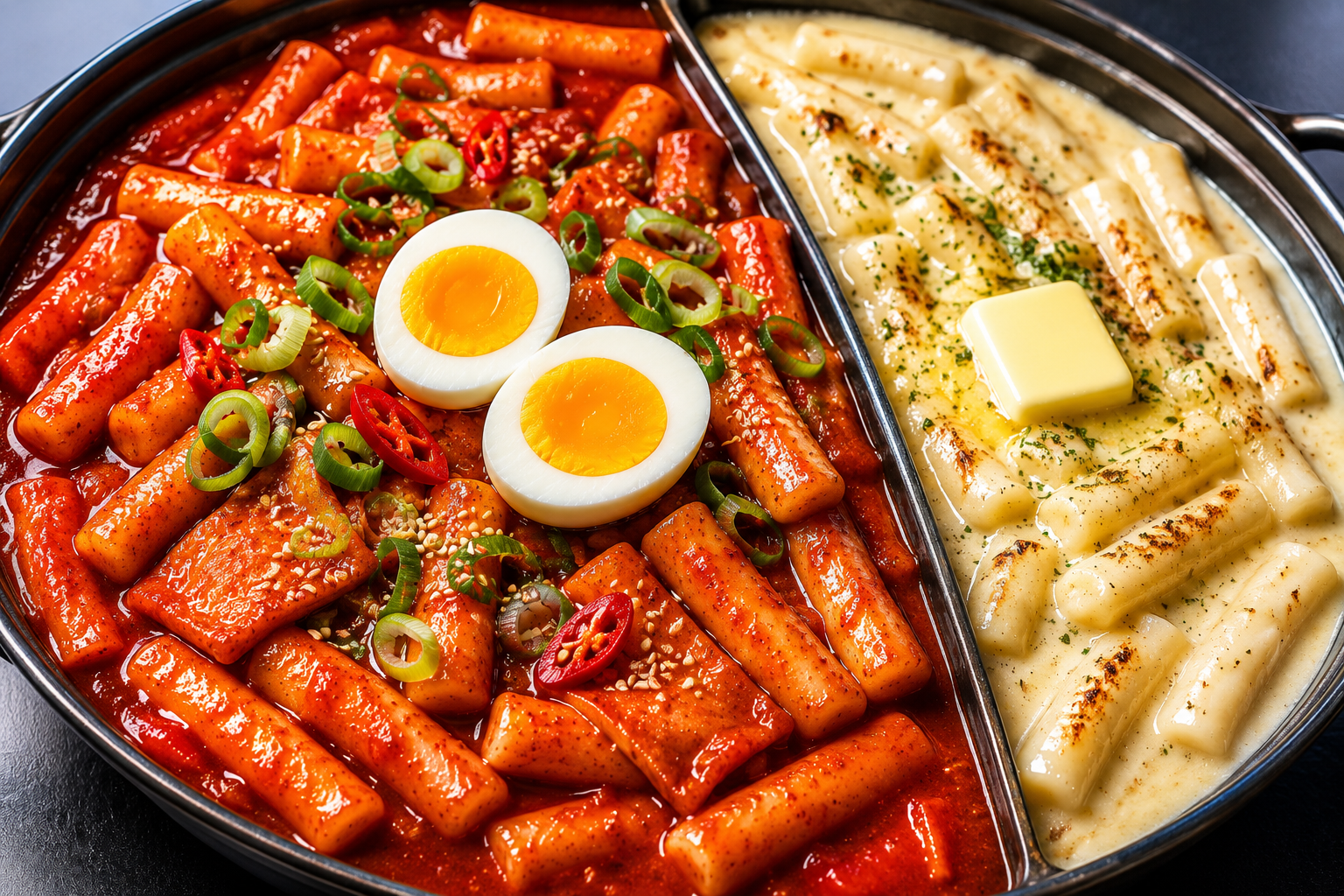
    The version most people recognize today is made with a spicy-sweet red sauce based on gochujang (Korean red chili paste) and gochugaru (Korean chili flakes). Fish cakes, green onions, boiled eggs, and other ingredients are often added, but there is no single combination that every Korean follows.

    That is part of the charm of tteokbokki. It can be a simple snack from a small neighborhood shop, a quick meal shared with friends, or a dish customized with ramen noodles, cheese, dumplings, or whatever sounds good that day.

    And just like many beloved foods, tteokbokki has continued to change with each generation.

    Tteokbokki Wasn’t Always Red

    Here is something that surprises many people: tteokbokki was not originally the fiery red dish we know today.

    An older style of tteokbokki is known today as gungjung tteokbokki (궁중떡볶이), or royal court tteokbokki. Instead of gochujang, it is seasoned primarily with soy sauce and commonly prepared with ingredients such as beef and vegetables. The result is savory, slightly sweet, and completely different from modern spicy street-style tteokbokki.

    The bright red tteokbokki familiar to Koreans today developed much later and became closely associated with bunsikjip (분식집)—casual Korean snack shops selling inexpensive favorites such as tteokbokki, kimbap, fish cakes, and fried snacks.

    Over time, this spicy, affordable dish became deeply woven into everyday Korean life.

    Today, both styles tell an interesting story. One reflects an older form of Korean cooking, while the other became one of the country’s most beloved everyday comfort foods.

    More Than Street Food: A Taste of Korean Memories

    For many Koreans, tteokbokki is not something first discovered at a famous restaurant. It is a food remembered from childhood.

    For generations of students, the small bunsikjip near school was an important part of everyday life. After classes ended, friends would gather around a steaming pan of red tteokbokki and share an inexpensive plate together.

    And the sauce was never something to waste.

    Fried dumplings, seaweed rolls, and other crispy snacks could be dipped into the spicy-sweet tteokbokki sauce. A piece of fish cake might disappear from a friend’s plate, followed by a playful argument over who ate it.

    That ordinary scene helps explain why tteokbokki means so much to many Koreans.

    It does not need to be expensive or beautifully presented. Sometimes the best tteokbokki is simply a hot plate shared with someone beside you.

    That is why tteokbokki is more than Korean street food.

    For many Koreans, it tastes like an old memory.

    How Koreans Really Enjoy Tteokbokki

    Tteokbokki rarely has to be eaten alone.

    Walk into a Korean bunsikjip, and you may see people ordering tteokbokki together with fish cake, fried dumplings, seaweed rolls, boiled eggs, or kimbap.

    One of the best parts is the sauce left in the bowl.

    Try dipping a crispy fried dumpling or seaweed roll into the spicy-sweet sauce. A boiled egg can be broken open and mixed with the sauce, while a piece of kimbap dipped lightly into tteokbokki sauce creates a completely different combination of flavors and textures.

    There is no complicated rule for eating it. Dip, mix, share, and find the combination you like.

    This casual way of eating is part of the fun of Korean bunsik culture.

    If you are new to Korean food, try tteokbokki with kimbap. Spicy, chewy tteokbokki and mild, savory kimbap are one of Korea’s classic snack-shop combinations.

    Authentic Korean Tteokbokki Recipe

    Now that you know the story behind tteokbokki, it is time to make it.

    The goal of this recipe is not to make tteokbokki complicated. It is to recreate the familiar spicy, sweet, and savory flavor of Korean street-style tteokbokki with ingredients you can prepare at home.

    Ingredients

    Main Ingredients

    • Korean rice cakes (tteok) – 400 g
    • Korean fish cakes (eomuk) – 150 g
    • Green onion – 1
    • Boiled eggs – 2

    For the Sauce

    • Gochujang (Korean red chili paste) – 2 tbsp
    • Gochugaru (Korean chili flakes) – 1 tbsp
    • Soy sauce – 1 tbsp
    • Sugar – 1½ tbsp
    • Minced garlic – 1 tsp

    For the Broth

    • Water – 500 ml
    • Dried anchovies – 8–10
    • Dried kelp (dashima) – 1 small piece

    The anchovy and kelp broth gives tteokbokki a deeper savory flavor, but do not worry if you cannot find these ingredients. Later in this guide, I will show you an easier version using ingredients that are easier to find outside Korea.

    Step-by-Step Instructions

    1. Make the broth

    Add 500 ml of water, dried anchovies, and dried kelp to a pot. Bring it to a gentle boil and simmer for about 10 minutes. Remove the anchovies and kelp.

    2. Prepare the rice cakes

    If your rice cakes are fresh and soft, you can use them immediately. If they are refrigerated or firm, soak them in cold water for about 10 minutes, then drain.

    3. Make the tteokbokki sauce

    Add the gochujang, gochugaru, soy sauce, sugar, and minced garlic to the broth. Stir until the gochujang has completely dissolved.

    4. Add the rice cakes

    Add the rice cakes and bring the sauce to a gentle boil. Cook over medium heat, stirring occasionally so the rice cakes do not stick to the bottom of the pot.

    5. Add the fish cakes

    When the rice cakes begin to soften, add the fish cakes and boiled eggs. Continue cooking until the sauce becomes thicker and coats the rice cakes.

    6. Finish with green onion

    Add the sliced green onion during the last minute of cooking.

    Turn off the heat when the rice cakes are soft and chewy and the sauce is thick enough to cling to them.

    Serve immediately while the tteokbokki is hot.

    Tip: Do not reduce the sauce too much. A little extra sauce is one of the best parts of tteokbokki—you will want it for dipping kimbap, fried dumplings, or other Korean snacks.

    Easy Tteokbokki for Beginners

    Can’t find every traditional Korean ingredient? That should not stop you from making tteokbokki.

    For this easy version, keep the two most important things: rice cakes and a flavorful red sauce.

    Easy Ingredients

    • Korean rice cakes – 400 g
    • Water – 500 ml
    • Gochujang – 2 tbsp
    • Soy sauce – 1 tbsp
    • Sugar – 1½ tbsp
    • Minced garlic – 1 tsp
    • Green onion – optional
    • Boiled eggs – optional

    If you have gochugaru, add 1 tablespoon for more chili flavor and heat. If you prefer a milder tteokbokki, use less or leave it out.

    No anchovies? Skip them.

    No dried kelp? Skip it.

    No Korean fish cakes? You can still make tteokbokki.

    The result will not have exactly the same depth of flavor as the traditional broth version, but it will still give you the spicy, sweet, chewy experience that makes tteokbokki so satisfying.

    The Simple Method

    Mix the water, gochujang, soy sauce, sugar, and garlic in a pan and bring it to a boil.

    Add the rice cakes and cook over medium heat, stirring occasionally.

    As the rice cakes cook, starch from their surface will help thicken the sauce.

    When the rice cakes are soft and chewy and the sauce has become glossy and slightly thick, taste it.

    Want it sweeter? Add a little sugar.

    Want it hotter? Add gochugaru.

    Want it richer? Add a boiled egg or whatever ingredient you enjoy.

    Start with the basics. Then make the tteokbokki yours.

    Tteokbokki Never Stopped Changing

    One reason tteokbokki has remained so popular is that Koreans never stopped changing it.

    Add ramen noodles and it becomes rabokki, a filling combination of ramen and tteokbokki.

    Add cheese and the spicy sauce becomes richer and milder.

    Creamy rose tteokbokki became another popular variation, combining the familiar spicy sauce with a smooth, creamy flavor.

    And today, Korea’s love of intense spicy flavors has created even more possibilities.

    One of the most exciting combinations is Buldak Tteokbokki—chewy Korean rice cakes combined with the fiery flavor that made Buldak famous around the world.

    We will make that version separately in our next recipe.

    But these variations all begin with the same humble rice cake.

    That may be the real beauty of tteokbokki: there is tradition, but there is always room to play.

    Your First Bite of Tteokbokki

    If you try tteokbokki for the first time, do not expect it to taste like any ordinary rice dish.

    The rice cakes are soft and chewy. The sauce is spicy, sweet, savory, and slightly sticky. Then comes another bite, perhaps with fish cake or a piece of boiled egg covered in red sauce.

    And if it feels a little too spicy, grab a piece of kimbap.

    That is part of the experience.

    Tteokbokki does not have to be perfect, expensive, or complicated. It can be made in a street stall, a neighborhood snack shop, or your own kitchen.

    Start with the traditional version. Learn the basic flavor.

    Then change it.

    Add ramen. Add cheese. Make it milder. Make it hotter.

    Because Korean food is not only about preserving tradition. It is also about enjoying food together and making it fit the people eating it.

    That is the true taste of Korea.


    Tteokbokki FAQ

    Is tteokbokki very spicy?

    It can be, but the level of heat varies. If you are making it at home, reduce the gochugaru for a milder version. You can also add a boiled egg or cheese to soften the spicy flavor.

    What kind of rice cakes should I use?

    Cylinder-shaped Korean rice cakes called tteokbokki-tteok are the most common choice. Fresh rice cakes can usually be cooked immediately, while refrigerated or firm rice cakes benefit from a short soak in cold water before cooking.

    Can I make tteokbokki without fish cakes?

    Yes. Fish cakes add flavor and texture, but they are not required. Rice cakes and the sauce are the heart of the dish.

    What can I eat with tteokbokki?

    Koreans commonly enjoy tteokbokki with kimbap, fried dumplings, seaweed rolls, fish cakes, and boiled eggs. Dipping fried foods or kimbap into the remaining tteokbokki sauce is especially delicious.

    Can I add ramen noodles?

    Absolutely. Tteokbokki with ramen noodles is commonly called rabokki. The noodles absorb the spicy-sweet sauce and turn the snack into a more filling meal.

  • How to Eat Gimbap: A Korean Recipe and the Best Ways to Enjoy It

    How to Eat Gimbap: A Korean Recipe and the Best Ways to Enjoy It

    I used to tell my girlfriend that I knew the best way in the world to eat gimbap.

    The secret?

    Don’t slice it.

    Pick up the whole roll with both hands and start eating from one end.

    Of course, sliced gimbap tastes great too. But somehow, eating a whole roll this way makes it feel different — more casual, more fun, and somehow even more delicious.

    There was another way we used to enjoy gimbap together.

    We would slice one roll, put the pieces between us, and play rock-paper-scissors.

    The winner got to eat one piece.

    Then we played again.

    Was this really the best way in the world to eat gimbap? Maybe not.

    But food often tastes better when there’s a good memory attached to it.

    That’s one of the things I want to share through True Taste Korea. Korean food isn’t only about recipes. Sometimes, how you eat it — and who you eat it with — makes it taste even better.

    What Is Gimbap?

    Gimbap (김밥) is one of Korea’s most familiar and loved foods.

    “Gim” means dried seaweed, and “bap” means rice.

    Rice and various ingredients are placed on a sheet of seaweed, rolled tightly, and usually sliced into bite-sized pieces.

    You can find gimbap almost everywhere in Korea — at small neighborhood restaurants, convenience stores, markets, train stations, and picnic tables.

    It’s simple, portable, affordable, and endlessly customizable.

    Although gimbap may look similar to Japanese sushi rolls, the flavor is quite different. Gimbap rice is usually seasoned with sesame oil and salt rather than sushi vinegar, and the fillings often include cooked and seasoned ingredients.

    Classic Korean Gimbap Ingredients

    For about 4 rolls of classic gimbap, prepare:

    • 4 sheets of dried seaweed (gim)
    • 3 cups cooked Korean short-grain rice
    • 4 strips of yellow pickled radish (danmuji)
    • 1 medium carrot
    • 1 small bunch of spinach
    • 2 eggs
    • 4 strips of ham
    • 4 strips of fish cake (eomuk)
    • Sesame oil
    • Salt
    • Sesame seeds
    • A little cooking oil

    These are common ingredients for a classic Korean gimbap, but there is no single filling combination you have to follow.

    Once you know the basic method, you can make many different versions with ingredients such as beef, tuna, cheese, kimchi, or spicy pork.

    How to Make Gimbap

    1. Season the Rice

    Cook Korean short-grain rice and let it cool slightly.

    While the rice is still warm, gently mix it with a little sesame oil and salt.

    Don’t use too much sesame oil. You want its aroma without making the rice greasy.

    2. Prepare the Vegetables

    Cut the carrot into thin strips and lightly stir-fry it with a small amount of cooking oil and salt.

    Blanch the spinach briefly, squeeze out the excess water, and season it lightly with salt and sesame oil.

    3. Cook the Eggs

    Beat the eggs with a small pinch of salt.

    Cook them in a thin layer, let them cool, and cut them into long strips.

    4. Prepare the Ham and Fish Cake

    Cut the ham and fish cake into long strips and lightly pan-fry them.

    5. Roll the Gimbap

    Place one sheet of dried seaweed on a bamboo rolling mat with the rough side facing upward.

    Spread a thin, even layer of rice over the seaweed, leaving a small empty strip at the top.

    Arrange the fillings horizontally across the rice.

    Roll firmly from the bottom while keeping the ingredients together. Don’t squeeze so hard that the fillings come out.

    6. The Final Touch

    Lightly brush the outside of the finished roll with sesame oil and sprinkle sesame seeds on top.

    Now you have a choice.

    You can slice it into bite-sized pieces…

    or try eating the whole roll first.

    3 Fun Ways to Enjoy Gimbap

    Making gimbap is only half the story.

    Now let’s enjoy it.

    1. Eat the Whole Roll

    Before slicing your gimbap, try picking up the whole roll with both hands and eating it from one end.

    No knife. No perfectly arranged little pieces.

    Just one whole gimbap.

    It’s simple, casual, and surprisingly fun.

    2. Play Rock-Paper-Scissors Gimbap

    This one is much better with someone else.

    Slice one roll of gimbap and put the pieces between you.

    Play rock-paper-scissors.

    The winner gets one piece.

    Then play again for the next piece.

    This isn’t a traditional Korean custom. It’s simply a fun way I used to enjoy gimbap with someone special.

    Try it with your partner, family, or friends. Sometimes a little competition makes food taste even better.

    3. Dip Your Gimbap

    Gimbap is delicious on its own, but dipping it into a sauce can create a completely different experience.

    One of the best combinations to try is gimbap dipped in tteokbokki sauce.

    The spicy-sweet sauce coats the mild rice and savory fillings, creating a combination that many people find hard to stop eating.

    And don’t stop there.

    Try different sauces and discover your own favorite way to eat gimbap.

    Sometimes the best food combinations are the ones you discover yourself.

    What Soup Goes Best With Gimbap?

    Gimbap is delicious on its own, but a warm bowl of soup can turn it into a much more satisfying meal.

    Here are three combinations worth trying.

    1. Eomuk Soup (Korean Fish Cake Soup)

    My first recommendation is eomuk soup (어묵국).

    Its light, savory broth goes perfectly with gimbap without overpowering its flavor.

    Gimbap with hot eomuk soup also gives you the feeling of eating at a Korean bunsik restaurant — a casual Korean eatery known for foods such as gimbap, tteokbokki, eomuk, and noodles.

    2. Korean Ramyeon

    Gimbap and hot Korean ramyeon make another great combination.

    Take a bite of gimbap, then eat some spicy noodles or have a spoonful of the hot broth.

    The mild gimbap and spicy ramyeon balance each other beautifully.

    3. Udon

    If you want something milder, try gimbap with a bowl of hot udon.

    The warm, light broth makes this an especially comforting combination on a cold day.

    Try This Korean-Style Combination

    Want to enjoy gimbap like a full Korean bunsik meal?

    Try:

    Gimbap + Tteokbokki + Eomuk Soup

    First, enjoy a piece of gimbap on its own.

    Then dip the next piece into the spicy-sweet tteokbokki sauce.

    Finally, have a spoonful of warm eomuk broth.

    Three simple foods come together to create one of the most enjoyable ways to experience Korean bunsik.

    The True Taste Korea Secret

    Recipes matter. Ingredients matter.

    But sometimes, the best part of food isn’t written in the recipe.

    Try eating a whole roll of gimbap without slicing it.

    Dip another piece into tteokbokki sauce.

    Or put one roll between two people and decide who gets each bite with rock-paper-scissors.

    Food doesn’t always have to be serious.

    Sometimes the secret to making something taste better is simply finding a more enjoyable way to eat it — and sharing that experience with someone you care about.

    That’s the kind of Korean food experience we want to share at True Taste Korea.

  • 10 Korean Foods You Should Try — And the Korean Secrets That Make Them Taste Better

    10 Korean Foods You Should Try — And the Korean Secrets That Make Them Taste Better

    You’ve probably seen Korean food before. Maybe you’ve even tried it.

    But have you ever wondered how Koreans really enjoy it?

    At True Taste Korea, we want to show you a different side of Korean food — not just the dishes you see on a typical menu, but the special ways Koreans cook, combine, and enjoy them.

    Sometimes, a small change can make a familiar dish taste completely different.

    We’ll share those little secrets with you, one dish at a time.

    10 Korean Foods to Discover

    Here are 10 Korean dishes we’ll explore together:

    1. Gimbap — Korea’s beloved rice and seaweed roll
    2. Tteokbokki — Spicy, sweet, and addictive rice cakes
    3. Samgyeopsal — Korean pork belly barbecue
    4. Bibimbap — Rice mixed with vegetables, meat, and sauce
    5. Kimchi Jjigae — A comforting and flavorful kimchi stew
    6. Bulgogi — Sweet and savory Korean marinated beef
    7. Jajangmyeon — Noodles in a rich black bean sauce
    8. Naengmyeon — Refreshing cold noodles loved by Koreans
    9. Korean Fried Chicken — Crispy chicken with unforgettable sauces
    10. Sundae — A traditional Korean sausage with a unique flavor

    But this is only the beginning.

    We’ll take each dish and go deeper — exploring how it is made, how Koreans really eat it, and the little secrets that can make it taste even better.

    And perhaps what you learn here will become more than just a way to enjoy Korean food.

    You might use these ideas to create Korean dishes in your own country, develop your own Korean-fusion recipes, or even dream of opening a Korean restaurant of your own.

    Discover the true taste of Korea with us.