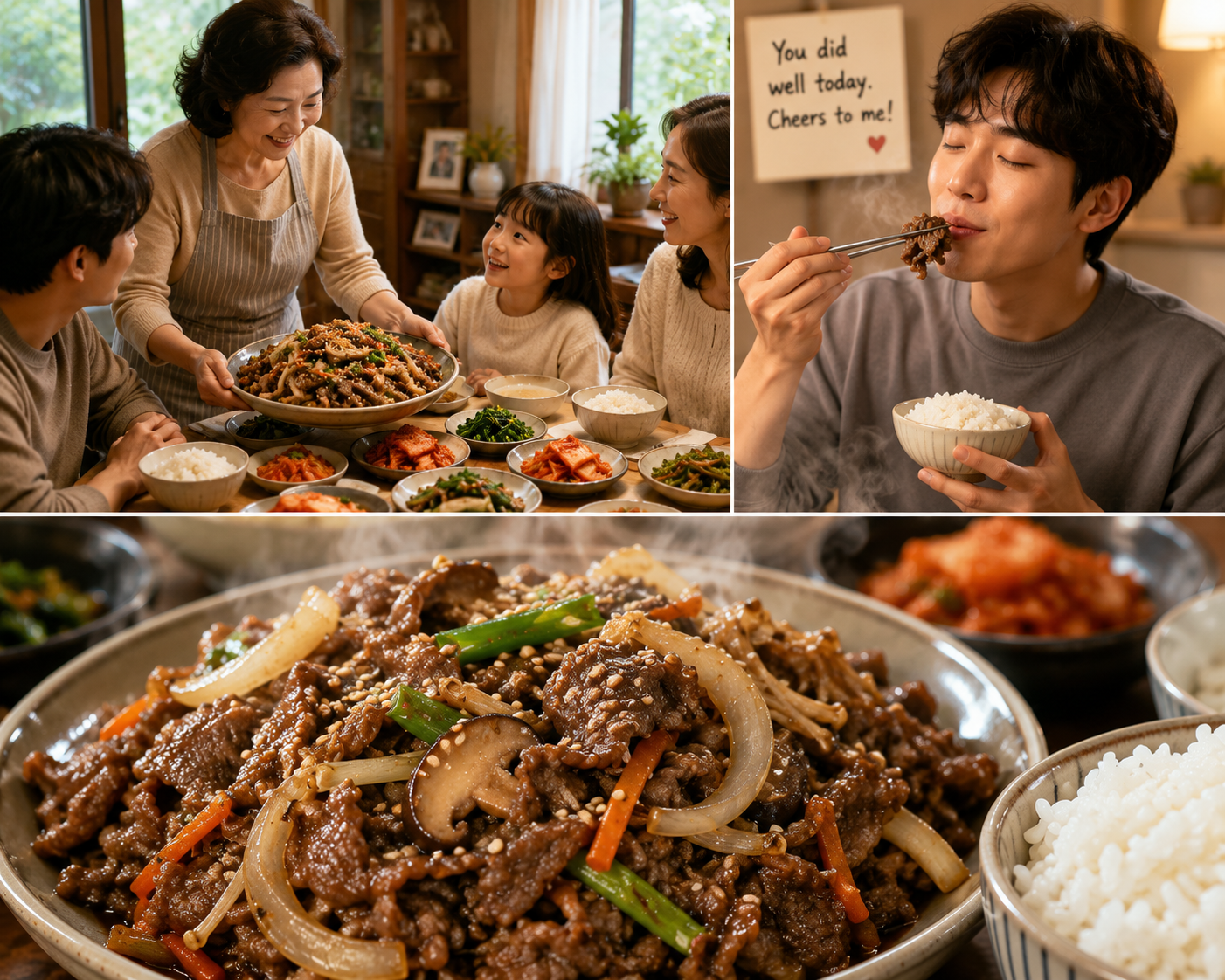
There are Korean meals you eat because you are hungry. And there are meals that make an ordinary day feel important.
Bulgogi often belongs to the second category.
A family might prepare it for a birthday, a graduation, a holiday gathering, or the return of someone who has been away. A restaurant might serve it when relatives meet for a special dinner. A parent might cook it simply because a child has worked hard and deserves something delicious.
But there is more to bulgogi than its reputation as a celebratory beef dish.
Its history reveals how Korean meat cuisine changed alongside society. Its regional varieties show that the same name can describe very different cooking techniques. And its familiar combination of soy sauce, garlic, sesame oil, and thinly sliced beef reflects a distinctive approach to balancing flavor.
Perhaps the most interesting thing about bulgogi is that it has never been just one fixed recipe.
It has been grilled over charcoal, cooked on special pans with broth, served in restaurants, prepared in family kitchens, and adapted for international audiences.
To understand bulgogi, we need to look beyond the sweet marinade. We need to understand how a traditional meat dish became one of Korea’s most recognizable expressions of hospitality and everyday celebration.
1. What Is Bulgogi? Understanding Korea’s Famous Marinated Beef
Bulgogi (불고기) is a Korean beef dish generally made with thinly sliced meat seasoned with a mixture based on soy sauce, garlic, sugar, sesame oil, and other ingredients.
The word is commonly translated as “fire meat.”
Although the name suggests direct grilling, modern bulgogi is prepared in several ways. Some versions are grilled over charcoal, while others are cooked in a frying pan or on a specially designed bulgogi pan.
The meat is usually thin enough to cook quickly and absorb seasoning efficiently.
A typical marinade combines several flavors:
- Soy sauce: Provides saltiness and savory depth.
- Garlic: Adds a strong, familiar aroma.
- Sugar or fruit: Contributes sweetness and helps balance the saltiness.
- Sesame oil: Adds a nutty fragrance.
- Black pepper: Provides a mild finishing spice.
- Onion and green onion: Add sweetness and aromatic depth.
Some recipes also use Korean pear, apple, cooking wine, or other ingredients.
Traditional beef bulgogi is generally not spicy. This makes it approachable for people who are unfamiliar with Korean food or prefer dishes without chili heat.
However, there is an important distinction: not every Korean dish called bulgogi is prepared in the same way. Regional traditions and restaurant styles have created several different interpretations.
2. Is Bulgogi Really an Ancient Korean Dish?
Bulgogi is often introduced as a dish with roots stretching back to ancient Korea. There is a historical basis for connecting it to older Korean meat-roasting traditions, but the story needs some care.
A frequently mentioned predecessor is maekjeok (맥적), a meat-roasting preparation associated in later historical discussions with the Goguryeo period.
Another important term is seoryamyeok (설야멱), a meat dish documented in Joseon Dynasty royal records.
Then there is neobiani (너비아니), a preparation of seasoned, sliced beef associated with traditional Korean cooking.
These foods are relevant to the history of bulgogi, but they should not simply be described as identical versions of today’s dish.
A 2019 study in the Journal of the Korean Society of Food Culture examined the historical relationship between maekjeok, seoryamyeok, neobiani, and modern bulgogi. It found a continuing tradition of seasoning meat before roasting, while also identifying changes in ingredients and preparation over time.
The distinction matters.
Modern bulgogi did not suddenly appear in ancient Korea with exactly the same recipe used in today’s restaurants. Instead, it developed through a longer history of Korean meat preparation.
That is a more interesting story than claiming that one modern recipe has remained unchanged for centuries.
3. Neobiani: The Traditional Relative of Modern Bulgogi
To understand the difference between traditional Korean grilled beef and modern bulgogi, it helps to know about neobiani.
Neobiani is commonly associated with carefully prepared, seasoned beef sliced relatively wide and grilled.
The word is connected to the idea of meat being cut into broad pieces.
The Encyclopedia of Korean Culture describes traditional bulgogi as having been called neobiani in earlier culinary usage, particularly in the context of royal and upper-class dining in Seoul.
However, historical research has also pointed out that the documentary evidence for neobiani’s exact status as an official royal dish is more complicated than popular descriptions sometimes suggest.
What matters culinarily is the preparation.
Neobiani generally emphasizes the beef itself, its slicing, seasoning, and controlled grilling.
Modern bulgogi often uses thinner slices and can be cooked more quickly in a pan, sometimes with vegetables and broth.
The relationship is therefore one of culinary development rather than simple identity.
Neobiani helps explain the older tradition of seasoned Korean beef. Modern bulgogi shows how that tradition became more adaptable to restaurants and home kitchens.
4. How Bulgogi Changed During the Twentieth Century
One of the most revealing aspects of bulgogi’s history is how much its cooking method changed during the twentieth century.
A 2013 study published in Korea Journal examined the evolution of bulgogi over approximately 100 years.
The researchers identified several important stages.
During the early twentieth century, grilled beef influenced by neobiani became increasingly associated with commercial restaurants.
From the 1960s through the 1990s, another style gained popularity: beef cooked with broth on specially designed pans.
This helped establish the familiar Seoul-style bulgogi that many people recognize today.
The change was not simply about taste.
Restaurants needed cooking methods that could serve customers efficiently. Families also needed dishes that could be prepared conveniently at home.
Thinly sliced beef, seasoning, vegetables, and broth created a flexible meal that could be cooked and shared at the table.
The result was a dish that could be both a restaurant specialty and a practical family dinner.
Bulgogi’s history therefore reflects changes in Korean eating habits, restaurant culture, and household cooking.
5. Why Bulgogi Became Associated With Special Occasions
Bulgogi is not the only Korean dish served at celebrations, and it would be inaccurate to claim that every Korean family treats it as a mandatory birthday or graduation meal.
But beef has often carried a special significance in Korean dining.
For much of modern Korean history, beef was not an everyday ingredient that every household could purchase without considering the cost.
That made a beef-centered meal feel more substantial than an ordinary dinner for many families.
Bulgogi offered a particularly convenient way to prepare beef for several people.
Thin slices could be seasoned together, cooked relatively quickly, and served with rice and side dishes.
The meal could be expanded with mushrooms, onions, noodles, or vegetables, making it suitable for family gatherings.
This combination of perceived value, convenience, and shareability helped bulgogi become associated with occasions when people wanted to prepare something a little more special.
Its emotional meaning developed through repeated experiences.
A child remembers the bulgogi served after an examination. A family remembers making it for relatives visiting during a holiday. Someone living abroad remembers the taste of a parent’s home cooking.
The dish becomes connected to the occasion, even when the recipe itself is relatively simple.
6. Seoul Bulgogi: The Famous Beef Dish With Broth
When many international visitors imagine bulgogi, they picture thinly sliced beef cooking in a shallow pan with onions, mushrooms, and a little liquid.
This is closely associated with Seoul-style bulgogi.
Unlike direct charcoal grilling, the meat cooks in a pan that allows juices and seasoning to collect around it.
The broth becomes part of the dish.
Some versions include glass noodles, which absorb the savory-sweet liquid as they cook.
The result is softer and more stew-like than grilled bulgogi.
This style is particularly convenient for shared meals. People can take beef, vegetables, and noodles from the same pan while the broth continues to simmer.
It also explains why bulgogi can taste different depending on where you eat it.
A visitor expecting smoky grilled beef might be surprised to receive a dish with plenty of broth.
Neither version is automatically more authentic. They represent different branches of the same evolving food tradition.
7. Eonyang Bulgogi: The Smoky Charcoal-Grilled Tradition
Travel to Ulsan and you encounter a different interpretation.
Eonyang bulgogi (언양불고기) is one of Korea’s best-known regional grilled beef styles.
Unlike broth-based Seoul bulgogi, Eonyang bulgogi is cooked directly over charcoal.
The local tradition developed in an area associated with cattle markets, beef production, and charcoal.
The Korean Ministry of Culture, Sports and Tourism explains that the region’s access to cattle, charcoal, and fresh ingredients contributed to the development of its local beef cuisine.
The dish became especially well known as workers and travelers passed through the area during the twentieth century.
Its cooking method creates a very different experience.
The beef is seasoned and shaped or arranged for grilling, then cooked over charcoal to develop a smoky aroma.
The seasoning is generally used to complement the meat rather than overwhelm it.
A good piece of Eonyang bulgogi should have a noticeable charcoal fragrance, a savory beef flavor, and enough seasoning to bring everything together.
This is a style worth trying if you want to understand how different direct-fire cooking can be from pan-cooked bulgogi.
8. Gwangyang Bulgogi: A Different Approach to Direct Grilling
Another famous regional style is Gwangyang bulgogi (광양불고기) from Jeollanam-do.
Like Eonyang bulgogi, it is associated with direct charcoal grilling.
However, Gwangyang bulgogi is commonly prepared by seasoning thin slices of beef and grilling them on a gridiron.
The meat is cooked quickly over charcoal, creating a combination of savory seasoning and smoky aroma.
The style is often discussed alongside Eonyang bulgogi as one of Korea’s major charcoal-grilled regional varieties.
The distinction between regional styles is not always absolute. Individual restaurants may use different cuts, marinades, and techniques.
But the comparison is useful:
- Seoul-style bulgogi: Often cooked with broth and vegetables.
- Eonyang-style bulgogi: Associated with seasoned beef grilled over charcoal.
- Gwangyang-style bulgogi: Known for thinly sliced, seasoned beef grilled directly over charcoal.
For visitors, trying these styles side by side reveals that the word bulgogi describes a broader culinary family rather than one universal cooking method.
9. Why Korean Pear Appears in Bulgogi Marinades
One ingredient that often surprises international cooks is Korean pear.
Some bulgogi recipes include grated pear or pear juice in the marinade.
Why?
First, pear provides natural sweetness and a mild fruit aroma. It can help create a more rounded flavor without relying entirely on refined sugar.
Second, pear contains enzymes that can contribute to meat tenderization.
However, pear is not a mandatory ingredient in every traditional or modern bulgogi recipe.
The result also depends on the beef cut, slicing thickness, and marinating time.
Too much fruit or an excessively long marinade can change the meat’s texture rather than improve it.
For home cooking, a moderate amount is usually enough.
And if Korean pear is difficult to find, apple or a smaller amount of another suitable sweet ingredient can be used as an alternative.
The important principle is balance: the marinade should support the beef rather than turn the dish into a sweet sauce.
10. Why Thinly Sliced Beef Matters
Bulgogi is not simply ordinary beef covered in soy sauce.
The thickness of the meat affects the final dish.
Thin slices allow the seasoning to spread across a larger surface area. They also cook quickly, which is useful when preparing a meal for several people.
But there is a trade-off.
Very thin beef can overcook quickly. If the pan is overcrowded, the meat may release liquid and simmer instead of developing the browned edges that add flavor.
This is particularly important when preparing bulgogi at home.
A wide pan and manageable portions help maintain heat.
For direct-grilled styles, the cooking surface and timing become even more important because the marinade can burn if the heat is too aggressive.
The best bulgogi is not necessarily the one with the most elaborate marinade.
It is the one in which the meat, seasoning, and cooking method work together.
11. How to Make Korean Beef Bulgogi at Home
This recipe is designed for a practical home kitchen. It uses a pan rather than requiring a charcoal grill.
<escape>### Ingredients — 2 to 3 Servings</escape>
- Thinly sliced beef: 500 g
- Onion: 1/2
- Green onion: 1
- Carrot: 1/3
- Mushrooms: 100 g
- Steamed rice, for serving
- Sesame seeds, for garnish
Bulgogi Marinade
- Soy sauce: 5–6 tablespoons
- Sugar: 1–2 tablespoons
- Honey or corn syrup: 1 tablespoon
- Minced garlic: 1 tablespoon
- Grated Korean pear: 3 tablespoons
- Cooking wine or mirin: 2 tablespoons
- Sesame oil: 1 tablespoon
- Black pepper: a few pinches
The amount of sugar can be adjusted according to your taste and the sweetness of the pear.
Step 1: Prepare the Beef
Choose tender beef suitable for thin slicing.
Separate the slices gently so that they do not remain stuck together.
If the meat has excess surface moisture, pat it lightly with paper towels.
This helps the marinade coat the beef more evenly.
Step 2: Make the Marinade
Combine soy sauce, sugar, honey, garlic, grated pear, cooking wine, sesame oil, and black pepper.
Mix until the sugar is dissolved.
Taste a small amount of the marinade. It should be savory first, with sweetness supporting the flavor.
Step 3: Marinate the Beef
Add the beef and mix gently until every slice is coated.
Cover and refrigerate for approximately 30 minutes.
Very thinly sliced beef does not necessarily require several hours of marinating.
Meanwhile, slice the onion, carrot, mushrooms, and green onion.
Step 4: Heat the Pan Properly
Place a wide frying pan over medium-high to high heat.
A pan that is too small may become overcrowded, causing the beef to release liquid and cook unevenly.
If necessary, prepare the meat in batches.
Step 5: Cook the Beef
Add the marinated beef to the hot pan.
Spread it out rather than leaving it in one large pile.
Cook until the beef is fully done, stirring and turning the slices as needed.
Allow some of the sauce to reduce and coat the meat.
Step 6: Add the Vegetables
Add the onions, carrots, mushrooms, and green onions.
Continue cooking until the vegetables are tender but still retain some texture.
The onions should become slightly sweet, and the mushrooms should absorb the seasoning.
Step 7: Finish and Serve
Turn off the heat.
Add a small amount of sesame oil if desired and sprinkle with sesame seeds.
Serve immediately with hot rice and Korean side dishes.
The result should be savory, gently sweet, and fragrant without being overwhelmingly sugary.
12. How Koreans Eat Bulgogi: Rice, Lettuce Wraps, and Side Dishes
Bulgogi is flexible enough to be enjoyed in several ways.
12.1 Bulgogi With Rice
The simplest approach is to serve bulgogi beside a bowl of steamed rice.
The sauce can be spooned over the rice, allowing the grains to absorb its flavor.
This combination is one reason bulgogi works so well as a family meal.
12.2 Bulgogi Ssam: The Korean Lettuce Wrap
Another popular way to enjoy bulgogi is as ssam (쌈), a Korean-style wrap.
Take a lettuce leaf or another suitable leafy vegetable and add:
- A small amount of rice
- A piece of bulgogi
- A little ssamjang
- Garlic or green chili, if desired
Fold the leaf around the ingredients and eat it in one bite.
The freshness of the vegetables balances the rich beef and savory-sweet seasoning.
Ssam is not exclusive to bulgogi, but it is an excellent way to enjoy the dish.
12.3 Bulgogi With Korean Side Dishes
Bulgogi is often served with banchan, the small side dishes that accompany a Korean meal.
Kimchi, seasoned vegetables, pickled vegetables, and other side dishes provide different textures and flavors.
Their role is not simply decoration.
They create contrast with the main dish, making a meal built around one rich ingredient feel more balanced.
13. Bulgogi as a Shared Meal: Why It Fits Family Gatherings
One reason bulgogi has remained popular is its ability to serve different generations.
Children often enjoy its mild sweetness. Adults appreciate the savory beef flavor. Older family members may associate it with familiar home cooking or traditional restaurant meals.
It can be served in a large dish at the center of the table, allowing everyone to share.
This is different from a meal where every person orders a completely separate main course.
Bulgogi encourages a shared dining experience.
That makes it particularly suitable for gatherings when people want to talk, celebrate, and spend time together.
It is also adaptable.
A restaurant can serve it as a premium beef dish. A home cook can prepare a simpler version with affordable ingredients. A lunch restaurant can serve it over rice.
The same food can fit very different budgets and occasions.
That flexibility is part of its cultural importance.
14. Bulgogi Beyond Korea: How It Became an International Food
Bulgogi’s international popularity is closely connected to the growth of Korean restaurants and the global interest in Korean cuisine.
Its flavor profile is relatively approachable for many first-time diners.
Soy sauce, garlic, sesame oil, and grilled beef are ingredients and flavors that people in many countries already recognize.
The thinly sliced meat also works in several international food formats.
Bulgogi can appear in:
- Rice bowls
- Korean barbecue meals
- Burgers
- Sandwiches
- Tacos
- Fusion dishes
But international adaptation creates an interesting question.
When does a dish remain recognizably bulgogi, and when does it become a new fusion creation?
There is no single answer.
A bulgogi taco, for example, may use the familiar marinated beef but combine it with tortillas, salsa, and other ingredients that are not part of a traditional Korean meal.
That does not necessarily make it a bad interpretation.
It shows how food travels. A dish can retain its central flavor while changing its presentation to fit a different dining culture.
For Korean cuisine, this kind of adaptation can introduce new audiences to the original dish.
15. Leftover Bulgogi: Turning One Special Meal Into Several Easy Dishes
Bulgogi can also be useful the next day.
If you have leftover cooked beef, refrigerate it promptly in a covered container and reheat it thoroughly before eating.
Here are several ways to use it:
Bulgogi Rice Bowl
Place the beef over steamed rice and add vegetables or a fried egg.
Bulgogi Fried Rice
Chop the leftover beef and stir-fry it with rice and vegetables.
Bulgogi Sandwich
Add the beef to bread with lettuce and fresh vegetables.
Bulgogi Kimbap
Use the beef as a filling with rice, seaweed, and vegetables.
These ideas show another side of bulgogi: it can be a special meal on one day and a convenient ingredient for the next.
16. True Taste Korea’s Guide: What Makes Good Bulgogi?
A good bulgogi should not taste like sugar-coated beef.
The seasoning needs to complement the meat.
Look for these qualities:
Balanced seasoning: Soy sauce, sweetness, garlic, and sesame oil should work together.
Tender but recognizable meat: The beef should be easy to chew without losing its natural texture.
Aroma: Sesame oil, garlic, and, in grilled versions, charcoal smoke should contribute to the overall experience.
Proper cooking: The meat should be cooked thoroughly without becoming unnecessarily dry.
Good contrast: Rice, fresh vegetables, and side dishes should balance the richness of the beef.
One common home-cooking mistake is using too much sugar or cooking too much meat in a small pan.
Both can weaken the final result.
The goal is not to make the strongest marinade possible. It is to let the beef remain the center of the dish.
Conclusion: A Korean Dish That Turns an Ordinary Day Into an Occasion
Bulgogi is famous around the world as Korean marinated beef.
But its cultural importance is larger than its recipe.
Its history connects older Korean meat-roasting traditions with the development of modern restaurant cuisine.
Its regional varieties show how different communities have interpreted the same broad idea through charcoal grilling, pan cooking, and broth.
Its place at family tables reflects the value people attach to preparing a special meal for someone else.
And its international adaptations demonstrate how a traditional dish can travel without remaining completely unchanged.
Perhaps this is why bulgogi continues to feel familiar even as Korean food becomes increasingly global.
For one person, it is a restaurant meal in Seoul. For another, it is the smoky taste of Eonyang charcoal grilling. For someone else, it is a family recipe prepared for a graduation or birthday.
And sometimes, it is simply a good dinner after a difficult week.
You do not need a special occasion to make it.
Prepare the beef, cook some rice, and sit down to enjoy the meal.
Because sometimes, the most meaningful way to celebrate someone is not with an expensive gift or a grand event.
It is with a meal prepared with care.
Frequently Asked Questions
1. What does bulgogi mean in Korean?
Bulgogi is commonly translated as “fire meat.” The name reflects its association with cooking meat over fire, although modern versions are also prepared in pans and with broth.
2. Is bulgogi traditionally spicy?
Traditional beef bulgogi is generally not spicy. Its flavor is based on soy sauce, garlic, sweetness, sesame oil, and other seasonings.
3. What is the difference between bulgogi and neobiani?
Neobiani is an older Korean preparation associated with carefully sliced and seasoned beef. Modern bulgogi developed through changing ingredients, slicing methods, cooking techniques, and restaurant culture.
4. What is the difference between Seoul and Eonyang bulgogi?
Seoul-style bulgogi is often cooked in a pan with broth, vegetables, and sometimes glass noodles. Eonyang bulgogi is associated with seasoned beef grilled directly over charcoal.
5. What makes Gwangyang bulgogi different?
Gwangyang bulgogi is known for thinly sliced, seasoned beef grilled directly over charcoal. The smoky aroma and quick grilling are important parts of its character.
6. Why do Koreans use pear in bulgogi marinade?
Korean pear adds natural sweetness and contains enzymes that can help tenderize meat. It is a common ingredient in some recipes, but it is not essential.
7. What beef is best for bulgogi?
Tender cuts suitable for thin slicing work well. Ribeye and sirloin are common options, although the best choice depends on the cooking method and budget.
8. Can bulgogi be made without a grill?
Yes. A wide frying pan works very well for home-style bulgogi. Direct charcoal grilling is used for particular regional styles, but it is not necessary for every version.
9. What do Koreans eat with bulgogi?
Steamed rice, kimchi, seasoned vegetables, and lettuce wraps are common accompaniments. Bulgogi can also be served with noodles or other Korean side dishes.
Sources and Further Reading
- The Academy of Korean Studies — The Evolution of Bulgogi over the Past 100 Years, Korea Journal (2013)
- Journal of the Korean Society of Food Culture — Study on the Historical Genealogy of Bulgogi (2019)
- Encyclopedia of Korean Culture — Bulgogi
- Ministry of Culture, Sports and Tourism — Eonyang Bulgogi: Beef Marinated in History
- Ulsan Tourism — Eonyang and Bonggye Korean Beef Bulgogi Special Zone
- Busan Metropolitan City — Korean Bulgogi and Its Regional Styles
- Korea Tourism Organization — Grilled Bulgogi