Samgyeopsal Is Better When Shared
Koreans often believe that truly delicious food becomes even more special when it is shared with other people.
Samgyeopsal is one of the best examples.
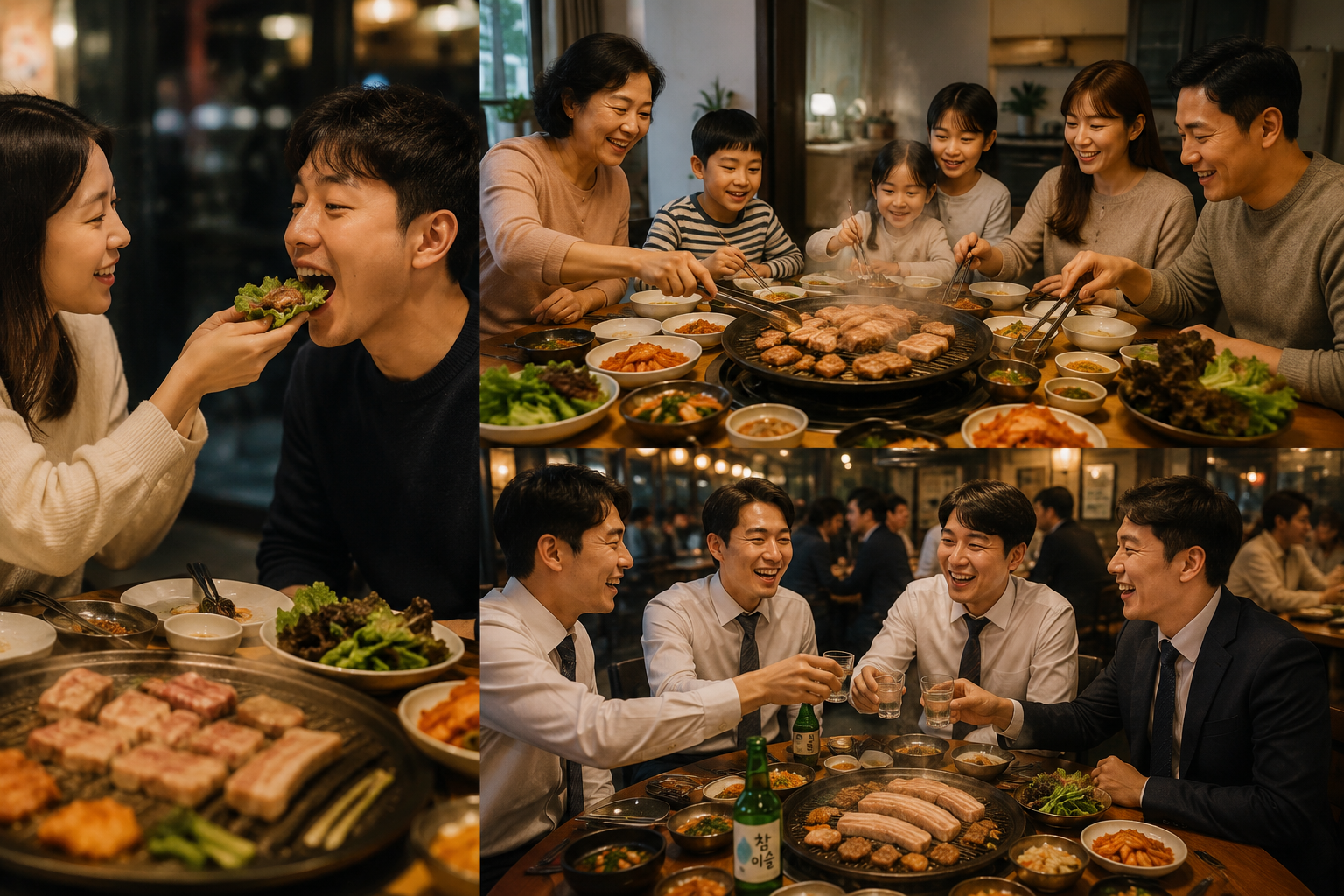
A hot grill is placed in the middle of the table. Thick slices of pork belly begin to sizzle. Someone turns the meat, someone else cuts it into bite-sized pieces, and another person passes a perfectly cooked piece to someone across the table.
Nobody owns the grill.
Everyone cooks, waits, eats, and talks together.
A piece of pork belly can be wrapped in lettuce with garlic, ssamjang, and kimchi. Sometimes you make the perfect ssam and eat it yourself. Sometimes you hand it to a friend, a family member, or someone you love.
For Koreans, this is part of the taste.
Good food fills your stomach. But food shared with people you care about can become a memory.
That is why samgyeopsal is more than Korean pork belly.
It is food made for sharing.
One Grill, One Family
In Korea, a samgyeopsal dinner often begins with one grill in the center of the table.
The family gathers around it.
One person places the pork belly on the hot grill. Someone turns the meat with tongs. When it is perfectly browned, another person cuts it into bite-sized pieces with kitchen scissors.
Garlic and kimchi may be sizzling beside the pork, soaking up some of the flavor from the grill.
Then the sharing begins.
Parents may place a well-cooked piece of pork on their children’s plates. Someone makes a lettuce wrap with pork belly, garlic, kimchi, and ssamjang and hands it to another family member.
Everyone is eating from the same grill, but everyone is also looking after the people sitting around it.
The grill becomes the center of the table—and, for a little while, the center of the family.
This is one reason samgyeopsal feels different from simply cooking a piece of pork and eating it alone.
You are not only sharing the food.
You are sharing the moment.
A Ssam for Someone You Love
There is another small scene you may notice at a Korean barbecue table.
Someone takes a fresh lettuce leaf and carefully builds a ssam.
A piece of perfectly grilled samgyeopsal goes in first. Then perhaps a little ssamjang, garlic, kimchi, or green onion.
But instead of eating it, they hold it out to the person sitting beside them.
Couples sometimes make a ssam for each other and feed it directly to one another.
It is playful, affectionate, and very simple.
There is no expensive gift and no grand romantic gesture.
Just one carefully made bite of food.
And perhaps that is what makes the moment so charming.
Sometimes saying “this delicious bite is for you” is another way of saying “I care about you.”
Samgyeopsal creates many of these little moments because everyone is cooking and sharing from the same grill.
The best piece does not always have to be the one you eat yourself.
Sometimes the best piece is the one you give to someone you love.
After Work: Samgyeopsal and Soju
Walk through a Korean neighborhood in the evening, and you may hear the familiar sound of pork belly sizzling on a grill.
For many Korean workers, samgyeopsal and soju have long been a familiar way to end a hard day.
Coworkers gather around the grill after work. Jackets come off, glasses are filled, and the first pieces of pork begin to cook.
At first, they may talk about work.
Then the conversation changes.
They complain about a difficult day, tell stories, laugh, and sometimes talk about things they would never discuss at the office.
A glass of soju is poured for the person beside you. Someone turns the pork. Someone else cuts it. Another person makes sure nobody misses the best pieces.
The meal becomes a place to relax.
Of course, you do not need alcohol to enjoy samgyeopsal. But the familiar combination of samgyeopsal and soju has become an iconic part of Korean dining culture.
After a stressful day, the sound of sizzling pork, a table full of coworkers or friends, and good conversation can make the day feel a little lighter.
Sometimes Koreans do not go out for samgyeopsal simply because they are hungry.
They go because they want to sit together, talk, laugh, and leave the stress of the day around the grill.
Why Samgyeopsal Tastes Better Outdoors
Ask Koreans what food they want to cook on a camping trip, and samgyeopsal will often be near the top of the list.
There is something special about grilling pork belly outdoors.
The grill gets hot. The pork begins to sizzle. Fat drips from the meat, and the smell of grilled pork fills the air.
Put some kimchi and garlic beside the meat and let them cook together.
Then take a hot piece of samgyeopsal, place it inside a lettuce leaf with ssamjang, and eat it right beside the grill.
Somehow, it tastes even better outside.
Maybe it is the fresh air.
Maybe it is the sound of the grill.
Or maybe it is simply because everyone is gathered together with nowhere else they need to be.
At a campsite, people naturally gather around the fire and the food. Someone grills, someone prepares the lettuce, and someone keeps asking:
“Is the meat ready yet?”
When the first batch is finally cooked, everyone reaches toward the grill.
That moment is part of the fun.
For many Koreans, samgyeopsal is not just something you bring camping. It is part of the camping experience itself.
Samgyeopsal on a Rainy Day
There is something about a rainy day that makes hot food taste even better.
Outside, the streets are wet and the sound of rain fills the air.
Inside, samgyeopsal hits a hot grill.
Sssssss.
The pork begins to brown, the fat starts to sizzle, and the table becomes warm with the smell of grilled meat.
Add kimchi to the grill and let it cook in a little of the pork fat. Grill some garlic beside it.
Then wrap everything together in a fresh lettuce leaf.
Hot pork, grilled kimchi, garlic, ssamjang, and crisp lettuce—all in one bite.
Outside it may be cold and rainy.
But around the grill, everyone is warm.
There does not have to be a special reason to eat samgyeopsal on a rainy evening.
Sometimes the weather itself is enough.
Rain outside. A hot grill inside. And people you enjoy eating with.
Sometimes that is all you need for a good evening.
How Koreans Really Eat Samgyeopsal
Eating samgyeopsal in Korea is not simply about grilling pork belly and putting it on a plate.
The grill is part of the meal.
Place thick slices of samgyeopsal on a hot grill and let one side develop a golden-brown crust before turning it over.
As the pork cooks, use kitchen scissors to cut it into bite-sized pieces.
But do not leave the grill empty around the meat.
Add whole garlic cloves.
Put kimchi beside the pork and let it slowly grill in the rendered pork fat.
Mushrooms and onions can go on the grill too.
Now comes the best part.
Take a fresh lettuce leaf and place a piece of hot samgyeopsal inside. Add a little ssamjang, grilled garlic, and kimchi.
Fold the lettuce around everything and eat the whole ssam in one bite.
You can also enjoy the pork simply dipped in salt, sesame oil sauce, or ssamjang.
There is no single correct bite.
Try different combinations until you find your favorite.
True Taste Korea Tip:
Do not rush to turn the pork again and again. Let it stay on the hot grill long enough to develop a delicious golden crust.
And do not forget the kimchi.
Kimchi grilled beside samgyeopsal is almost a dish of its own.
How to Make the Perfect Ssam
Ssam (쌈) means “wrap” in Korean, and it is one of the most delicious ways to enjoy samgyeopsal.
Start with a fresh lettuce leaf in your hand.
Then build your perfect bite.
- Add one piece of freshly grilled samgyeopsal.
- Add a small amount of ssamjang.
- Add a piece of grilled garlic.
- Add some grilled kimchi or green onion salad if you like.
- Fold the lettuce around everything.
- Eat the whole wrap in one bite.
That last step is important.
A ssam is usually meant to be eaten in one bite so you can taste everything together—the juicy pork, fresh lettuce, salty-sweet ssamjang, garlic, and kimchi.
But do not make it so large that you can barely eat it!
Start simple.
Lettuce + samgyeopsal + ssamjang.
Then experiment.
Add garlic. Add kimchi. Add green chili. Try perilla leaves instead of lettuce.
There is no single perfect ssam.
The perfect ssam is the one you want to eat again.
The Meal Isn’t Over: Korean Fried Rice
You may think the meal is finished when the last piece of samgyeopsal disappears.
Not yet.
For many Koreans, there is still one important step left.
Fried rice.
Leave a few small pieces of pork and some grilled kimchi on the hot pan.
Cut them into smaller pieces, add cooked rice, and mix everything together.
Add some seaweed flakes and a little sesame oil.
Then spread the rice across the hot pan and let the bottom cook until it becomes slightly crispy.
After eating rich, juicy pork belly, you might wonder how anyone could still be hungry.
And then you smell the fried rice.
Suddenly, everyone finds a little more room.
This final fried rice absorbs the flavors left behind on the grill—the pork, the kimchi, and all those delicious browned bits.
Sometimes people say they are already full.
Then someone asks:
“Should we order fried rice?”
And somehow, the answer is often yes.
In Korea, finishing the meat does not always mean finishing the meal.
Sometimes the best ending is still sizzling on the grill.
How to Make Korean Samgyeopsal at Home
The good news is that samgyeopsal is one of the easiest Korean foods to cook at home.
You do not need a complicated marinade.
In fact, traditional samgyeopsal is often cooked without any marinade at all.
The flavor comes from well-browned pork belly and everything you eat with it.
Ingredients
For 2 people:
- Pork belly – 500 g
- Lettuce – 1 small bunch
- Garlic – 6–8 cloves
- Kimchi – about 150 g
- Ssamjang – for dipping
- Green chili peppers – optional
For a simple sesame oil dipping sauce:
- Sesame oil – 1 tbsp
- Salt – a small pinch
- Black pepper – a small pinch
1. Heat the Pan
Heat a heavy frying pan or grill over medium-high heat.
You usually do not need to add cooking oil. Pork belly will release plenty of its own fat as it cooks.
2. Grill the Pork Belly
Place the pork belly on the hot pan.
Let the first side cook until it develops a beautiful golden-brown crust.
Turn it over and cook the other side.
Use kitchen scissors or a knife to cut the pork into bite-sized pieces.
Continue cooking until the edges are browned and slightly crisp while the inside remains juicy.
3. Grill the Garlic and Kimchi
As the pork releases its fat, add garlic and kimchi to the pan.
Let them cook beside the meat.
The garlic becomes soft and golden, while the kimchi absorbs some of the savory pork flavor.
4. Make Your Ssam
Take a lettuce leaf.
Add one piece of hot samgyeopsal, a little ssamjang, grilled garlic, and kimchi.
Fold it.
Eat it in one bite.
Then make another one—with a different combination if you like.
5. Share It Straight from the Grill
Do not worry about putting all the pork on individual plates.
Part of the Korean samgyeopsal experience is eating the meat while it is still hot, directly from the shared grill.
Cook a little.
Eat a little.
Talk.
Then cook some more.
That is how a simple piece of pork belly becomes a Korean samgyeopsal dinner.
Extra Tip: Try Samgyeopsal with Other Korean Favorites
Samgyeopsal does not always have to be eaten only with lettuce and ssamjang.
Some Koreans love eating hot, rich pork belly together with naengmyeon, Korea’s cold noodles. The cool noodles and grilled pork make a surprisingly satisfying combination.
If you love spicy food, try a piece of samgyeopsal with Buldak noodles. The juicy pork can balance the intense spicy flavor of the noodles.
And if you have leftover samgyeopsal, do not throw it away.
The next day, cut the pork into smaller pieces and use it as a filling for kimbap.
Add whatever else you have—kimchi, egg, cheese, or vegetables—and roll everything together with seasoned rice and seaweed.
Yesterday’s Korean barbecue can become today’s kimbap.
True Taste Korea Tip:
Korean food does not always have to stay inside one recipe. Mix dishes, use leftovers, and find combinations you enjoy.
Samgyeopsal FAQ
What is samgyeopsal?
Samgyeopsal (삼겹살) is Korean pork belly, usually grilled at the table without a marinade.
The name refers to the layers of meat and fat found in the pork belly.
Is samgyeopsal the same as bacon?
No.
Although both come from pork belly, samgyeopsal is usually fresh and unseasoned, while bacon is typically cured and often smoked.
Do I need to marinate samgyeopsal?
No.
One of the best things about samgyeopsal is its simplicity. Good pork belly can be grilled without marinade and enjoyed with ssamjang, salt, garlic, kimchi, and fresh vegetables.
What is ssamjang?
Ssamjang is a thick Korean dipping sauce commonly eaten with grilled meat.
Put just a little inside a lettuce wrap with your samgyeopsal. It adds salty, savory, slightly sweet flavor to the bite.
What vegetables are eaten with samgyeopsal?
Lettuce and perilla leaves are popular for making ssam.
Garlic, green chili peppers, green onion salad, onions, mushrooms, and kimchi are also commonly enjoyed with grilled pork belly.
What do Koreans drink with samgyeopsal?
Soju is one of the most famous pairings, especially at restaurants and after-work gatherings.
But alcohol is not necessary. The real heart of samgyeopsal is sharing the grill and the meal with other people.
Samgyeopsal Is About the People Around the Grill
A piece of pork belly is simple.
Put it on a hot grill and it becomes delicious.
But gather your family around that grill, and it becomes dinner together.
Share it with friends at a campsite, and it becomes a memory.
Eat it with coworkers after a difficult day, and the table becomes a place to talk and relax.
Make a perfect ssam and give it to someone you love, and one bite of food becomes a small gesture of affection.
Perhaps that is why samgyeopsal has such a special place in Korean food culture.
The grill may be in the center of the table, but the people around it are what really matter.
Because sometimes the most delicious food is not the food you eat alone.
It is the food you share.