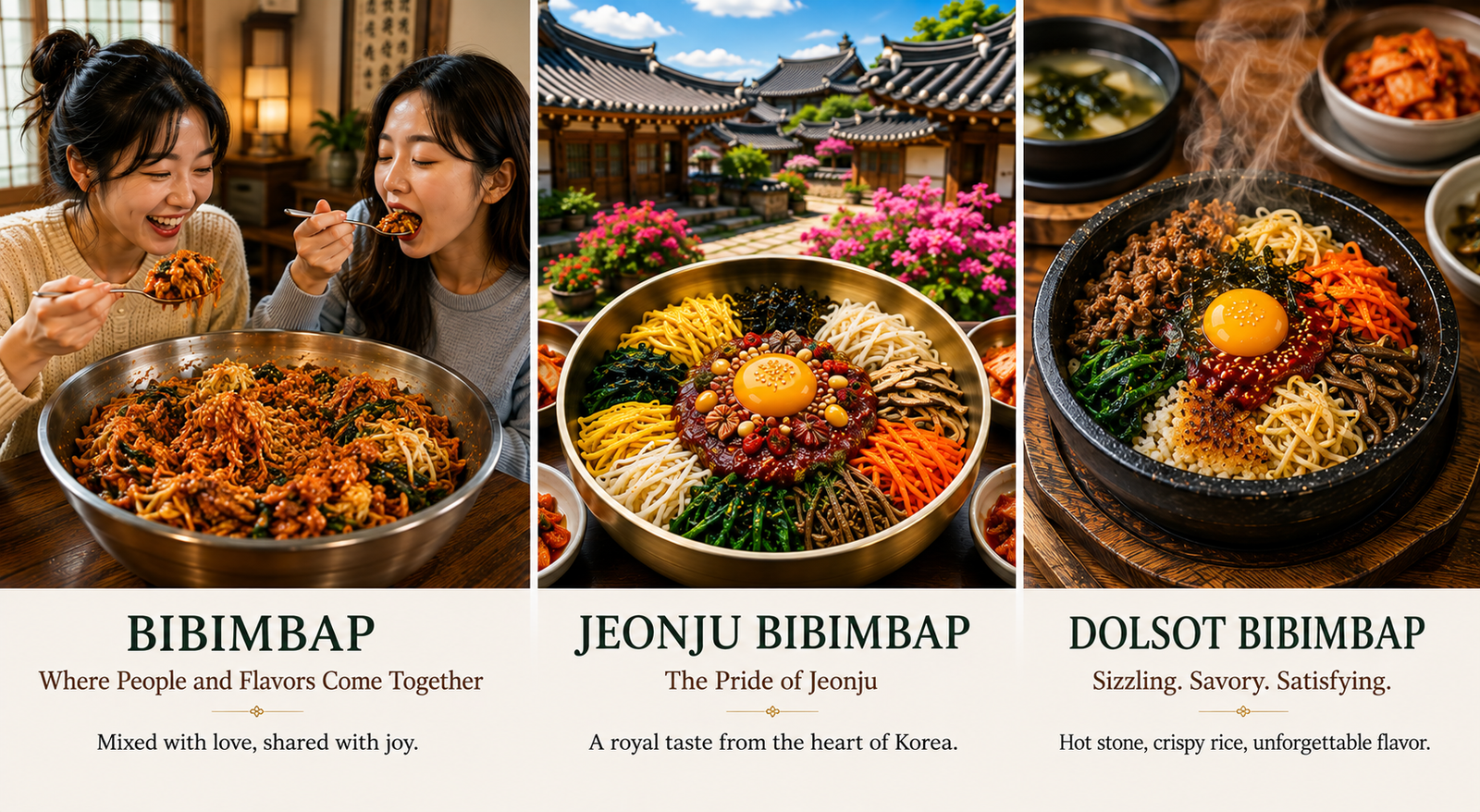
Bibimbap is often introduced as one of Korea’s most recognizable dishes: a bowl of rice topped with colorful vegetables, meat, an egg, and gochujang. Everything is mixed together before eating.
That description is accurate, but it misses something important.
In Korea, bibimbap is not just a carefully arranged restaurant dish. It is also one of the most practical ways to turn leftover side dishes into a satisfying meal. A little spinach, some bean sprouts, yesterday’s bulgogi, a spoonful of kimchi, and a fried egg can become a completely new dish.
Its ingredients can be elaborate or surprisingly simple. It can be served in an individual bowl or, in some homes and casual meals, prepared in a large bowl for people to share.
That flexibility is part of its appeal.
Bibimbap brings different ingredients together without requiring them to lose their individual character. Each vegetable keeps its own texture, each seasoning contributes something different, and the sauce connects everything.
Perhaps that is why the dish feels like more than a combination of rice and toppings.
Bibimbap is where people and flavors come together.
1. What Does Bibimbap Actually Mean?
The Korean word bibimbap (비빔밥) is made up of two parts:
- Bibim (비빔): Mixing or combining
- Bap (밥): Cooked rice
Together, the word literally means mixed rice.
The basic idea is straightforward. Cooked rice is topped with several ingredients, and everything is mixed before eating.
Common ingredients include:
- Spinach
- Bean sprouts
- Carrots
- Zucchini
- Mushrooms
- Beef
- Egg
- Gochujang
- Sesame oil
The ingredients are often prepared separately before being arranged over the rice. This allows each vegetable to retain its own texture and seasoning.
Gochujang adds a spicy, savory depth, while sesame oil brings a nutty aroma. When the ingredients are mixed, their individual flavors become part of a more balanced whole.
There is an interesting contrast here: the bowl may look carefully organized when it arrives at the table, but its intended final form is completely mixed.
The beauty of bibimbap is not in keeping the ingredients separate. It is in discovering how well they work together.
2. There Is No Single Perfect Bibimbap
Unlike dishes that depend on a fixed combination of ingredients, bibimbap is remarkably adaptable.
A traditional restaurant version may include several carefully prepared vegetables, seasoned beef, an egg, and a specially balanced sauce.
An everyday homemade version can be much simpler.
Imagine opening the refrigerator and finding:
- A small portion of leftover spinach
- Some kimchi
- A few bean sprouts
- Half a carrot
- A little leftover meat
You do not need to prepare an entirely new meal. Put some rice in a bowl, add the ingredients, and finish with gochujang and sesame oil.
You can also use tuna, chicken, pork, tofu, ham, or other ingredients you enjoy.
This practical flexibility is one reason bibimbap fits so naturally into Korean home cooking.
It is not necessary to have every traditional topping. What matters is finding a combination that tastes good.
There is also room for personal preference. Someone who enjoys spicy food may add extra gochujang, while someone who prefers milder flavors may use soy sauce and sesame oil instead.
Bibimbap is less about following one perfect recipe and more about making different ingredients work together.
3. The Big-Bowl Bibimbap: A Different Kind of Korean Meal
There is another side of bibimbap that visitors may not always encounter in restaurants.
Sometimes, it begins with an unusually large mixing bowl.
At home, someone may gather several side dishes from the refrigerator, add rice, vegetables, kimchi, and perhaps leftover meat, then mix everything together in one large container.
This is not necessarily a formal recipe. It is often an easy and satisfying way to use what is already available.
In some households and casual meals, people may share this large bowl rather than preparing separate portions. Close friends or family members can sit together, mix the ingredients, and eat while talking about their day.
The experience is different from ordering individual bowls at a restaurant.
A restaurant version may emphasize presentation, ingredient selection, and precise seasoning. A homemade large-bowl version may emphasize convenience, abundance, and the comfort of eating together.
Neither is more authentic than the other.
They simply show two different ways bibimbap fits into everyday Korean life.
4. Bibimbap and the Korean Idea of Jeong
One Korean word that helps explain the emotional side of food culture is jeong (정).
Jeong is difficult to translate into a single English word. Depending on the situation, it can describe affection, attachment, familiarity, warmth, or the emotional connection that develops between people over time.
It is often expressed through ordinary actions rather than dramatic gestures.
Preparing extra food for someone, remembering what another person likes, or inviting a friend to share a meal can all be expressions of jeong.
A large bowl of bibimbap can fit naturally into this kind of experience.
One person may prefer more kimchi. Another may want extra meat. Someone else may want a generous amount of gochujang.
The preferences are different, but everyone can still enjoy the same meal.
This does not mean bibimbap has a special historical connection to jeong. Rather, the dish provides a useful everyday image for understanding how food can create a sense of closeness.
Different ingredients do not have to become identical to belong in the same bowl.
In a small way, that idea also reflects the comfort of sharing food with people whose personalities and preferences are different from our own.
5. Why Bibimbap Is a Practical Korean Home Meal
Bibimbap is particularly useful when there is no clear plan for dinner.
Many Korean meals include several side dishes, known as banchan (반찬). These may be served in small portions alongside rice and soup.
When some of those side dishes remain after a meal, they can become ingredients for bibimbap.
Instead of eating the same side dishes in exactly the same way again, you can combine them into something new.
For example:
- Leftover spinach and bean sprouts provide vegetables.
- Kimchi adds acidity and a stronger fermented flavor.
- Leftover bulgogi provides savory meat.
- A fried egg adds richness.
- Gochujang and sesame oil bring everything together.
This is one reason bibimbap is so useful in a home kitchen.
It reduces the need to prepare several new dishes and gives leftover ingredients another purpose.
It also demonstrates a practical feature of Korean food culture: ingredients prepared for one meal can often become part of another.
6. A Mild Bibimbap Can Help Children Enjoy Vegetables
Bibimbap can also be adapted for children who are not enthusiastic about eating vegetables.
When vegetables are served separately, some children may reject them immediately. Mixed with rice, egg, meat, or another familiar ingredient, the same vegetables may become easier to enjoy.
The sauce can also be adjusted.
Gochujang is popular in many bibimbap recipes, but it is not essential for every version. For children or anyone who dislikes spicy food, a mild mixture of soy sauce and sesame oil can work well.
You can also:
- Chop vegetables into smaller pieces.
- Use familiar ingredients such as egg or chicken.
- Add a small amount of cheese if the child enjoys it.
- Let children choose some of their own toppings.
The goal is not to force every person to eat the same combination.
One person may enjoy a spicy beef bibimbap, while another prefers a mild version with egg and vegetables.
That flexibility is one of the dish’s greatest strengths.
7. Dolsot Bibimbap: The Pleasure of Crispy Rice
One of the most satisfying variations is dolsot bibimbap (돌솥비빔밥).
Unlike ordinary bibimbap, which is served in a regular bowl, dolsot bibimbap arrives in a heated stone bowl.
The hot bowl keeps the ingredients warm throughout the meal. More importantly, the rice touching the bottom gradually becomes toasted and crispy.
You may hear a gentle sizzling sound when the dish reaches the table.
As the rice continues to heat against the stone, it develops a golden crust known as nurungji (누룽지).
For many people, this crispy layer is the highlight of the meal.
There is also a difference in how you eat it.
With ordinary bibimbap, you can mix everything immediately. With dolsot bibimbap, some people prefer to let the rice sit against the hot surface for a little while before mixing, allowing more of the bottom layer to crisp.
The result is a combination of soft rice, seasoned vegetables, warm toppings, and crunchy rice at the bottom.
It is particularly comforting during colder weather.
8. Jeonju: A City Closely Associated With Bibimbap
If you want to experience bibimbap as part of a regional food culture, Jeonju is one of the most important places to know.
Located in Jeollabuk-do, Jeonju is widely associated with traditional Korean cuisine, hanok architecture, and its distinctive style of bibimbap.
Jeonju bibimbap is known for its carefully prepared ingredients and colorful presentation. Depending on the restaurant, the bowl may include seasoned vegetables, beef, egg, and other toppings arranged with particular attention to balance and appearance.
The city’s food identity is closely connected with its broader culinary traditions.
For visitors, this makes Jeonju an interesting destination because the experience goes beyond simply ordering a famous dish. You can explore traditional streets, visit the hanok village, and discover how local food contributes to the identity of the city.
There is a meaningful contrast between the two sides of bibimbap.
At home, it may be an improvised meal made from whatever remains in the refrigerator.
In Jeonju, it can be a carefully prepared regional specialty.
Both versions share the same central idea: bringing different ingredients together in one bowl.
Bibimbap Beyond the Dinner Table
Jeonju has also promoted bibimbap through local food events and cultural activities.
This illustrates how a dish can become part of a city’s identity. A local specialty is not simply something served in restaurants. It can also represent regional pride, culinary traditions, and the way a community introduces itself to visitors.
True Taste Korea Tip: If you visit Jeonju, consider combining a walk through Jeonju Hanok Village with a traditional bibimbap meal. Pay attention to the variety of ingredients before mixing them. Then mix the bowl thoroughly and experience how the flavors come together.
9. How to Make Bibimbap at Home
You do not need a dozen ingredients to make a satisfying bowl of bibimbap.
The following recipe makes two servings and can be adjusted according to what you have available.
Ingredients — 2 Servings
Rice
- Cooked short-grain rice — 2 bowls
Vegetables
- Spinach — 100 g
- Bean sprouts — 100 g
- Carrot — 1/2
- Zucchini — 1/2
- Mushrooms — 100 g
Other toppings
- Beef — 150 g
- Eggs — 2
- Sesame oil
- Toasted sesame seeds
You can replace the beef with pork, chicken, tuna, tofu, or leftover meat.
Simple Bibimbap Sauce
- Gochujang — 2 tablespoons
- Sesame oil — 1 tablespoon
- Sugar — 1 teaspoon
- Rice vinegar — 1 teaspoon
- Minced garlic — 1/2 teaspoon
- Sesame seeds — 1 teaspoon
Mix all the sauce ingredients in a small bowl.
If you prefer a milder flavor, reduce the gochujang or add a little water to soften the sauce.
Step-by-Step Preparation
1. Prepare the vegetables.
Wash the spinach and bean sprouts. Blanch them briefly in boiling water, drain, and season lightly with salt and sesame oil.
2. Cook the remaining vegetables.
Thinly slice the carrot, zucchini, and mushrooms. Sauté each separately with a little oil and a small amount of salt.
Cooking them separately helps preserve their individual textures and flavors.
3. Cook the beef.
Season the beef lightly with soy sauce, garlic, and a little sesame oil if desired. Cook in a pan until browned and fully cooked.
4. Fry the eggs.
Prepare one egg for each serving. A slightly runny yolk can add richness when mixed with the rice.
5. Assemble the bowls.
Place hot rice in two bowls. Arrange the vegetables and beef over the rice, then place an egg in the center.
6. Add the sauce and sesame oil.
Add the bibimbap sauce according to your taste. Finish with a small drizzle of sesame oil and toasted sesame seeds.
7. Mix everything together.
This is the most important step.
Mix the rice, vegetables, meat, egg, and sauce until the ingredients are evenly distributed.
The original arrangement will disappear, but that is exactly how bibimbap is meant to be enjoyed.
10. Easy Refrigerator Bibimbap: Use What You Already Have
If preparing several vegetables feels like too much work, try a simpler version.
Start with one bowl of hot rice and choose three or four ingredients from your refrigerator.
Here are a few combinations:
Kimchi and Pork Bibimbap
- Kimchi
- Leftover pork
- Fried egg
- Gochujang
Tuna Bibimbap
- Canned tuna
- Cucumber
- Carrot
- Fried egg
Ham and Cheese Bibimbap
- Ham
- Kimchi
- Cheese
- Sesame oil
Vegetable Bibimbap
- Spinach
- Bean sprouts
- Mushrooms
- Carrot
Add sauce, mix, and enjoy.
There is no need to reproduce a restaurant photograph at home.
A simple bowl made with ingredients you already have can be just as satisfying.
11. A Useful Tip: Turn Yesterday’s Dinner Into Today’s Meal
One of the easiest ways to make bibimbap is to use leftovers.
If you had Korean barbecue the previous evening, a little leftover samgyeopsal can become an excellent topping. Cut the pork into small pieces and add it to rice with kimchi and vegetables.
Leftover bulgogi works particularly well because its sweet and savory seasoning blends naturally with the other ingredients.
Roasted chicken, tofu, and cooked vegetables can also be reused.
The important thing is to store leftovers safely and reheat cooked ingredients thoroughly before serving.
Bibimbap is a reminder that a good meal does not always require starting from scratch.
Sometimes, yesterday’s dinner is the beginning of something completely different.
12. Bibimbap FAQ
Does bibimbap have to contain beef?
No. Beef is a popular topping, but it is not essential. Pork, chicken, tuna, tofu, ham, and vegetables can all be used.
Does bibimbap have to be spicy?
No. Gochujang is a common sauce, but you can reduce it or replace it with a mild soy sauce and sesame oil mixture.
What is the difference between bibimbap and dolsot bibimbap?
Regular bibimbap is served in an ordinary bowl. Dolsot bibimbap is served in a heated stone bowl, which keeps the food hot and creates crispy rice at the bottom.
Do I need all the traditional vegetables?
No. You can use the vegetables available to you. A simpler combination can still make an excellent meal.
Can I use leftover rice?
Yes. Refrigerated rice can be reheated thoroughly before serving. Make sure it is steaming hot, and handle cooked rice safely by refrigerating it promptly after cooking rather than leaving it at room temperature for extended periods.
Should I mix bibimbap before eating?
Yes. Mixing is central to the dish. Combine the rice, toppings, sauce, and sesame oil so that the flavors are distributed throughout the bowl.
Can bibimbap be vegetarian?
Absolutely. Leave out the meat and use vegetables, mushrooms, tofu, and egg if you eat eggs. For a fully vegan version, omit the egg and check that the gochujang and other seasonings contain no animal-derived ingredients.
Where People and Flavors Come Together
Bibimbap can be an elaborate dish with carefully prepared vegetables and beautifully arranged toppings.
It can also begin with a simple question:
“What do we have in the refrigerator?”
It is practical enough for a quick weekday meal, flexible enough to suit different tastes, and special enough to represent a city’s culinary identity.
It can be enjoyed alone, shared with family, or eaten with friends around a large bowl. It can arrive in a regular dish or in a sizzling stone bowl with crispy rice at the bottom.
And in Jeonju, it becomes part of a wider experience of Korean food and local culture.
There is no single perfect combination.
The vegetables do not have to be identical. The toppings do not have to be elaborate. And the people eating together do not have to like exactly the same things.
That is the lasting appeal of bibimbap.
It is not about making everything the same.
It is about discovering how different things can become better when they come together.