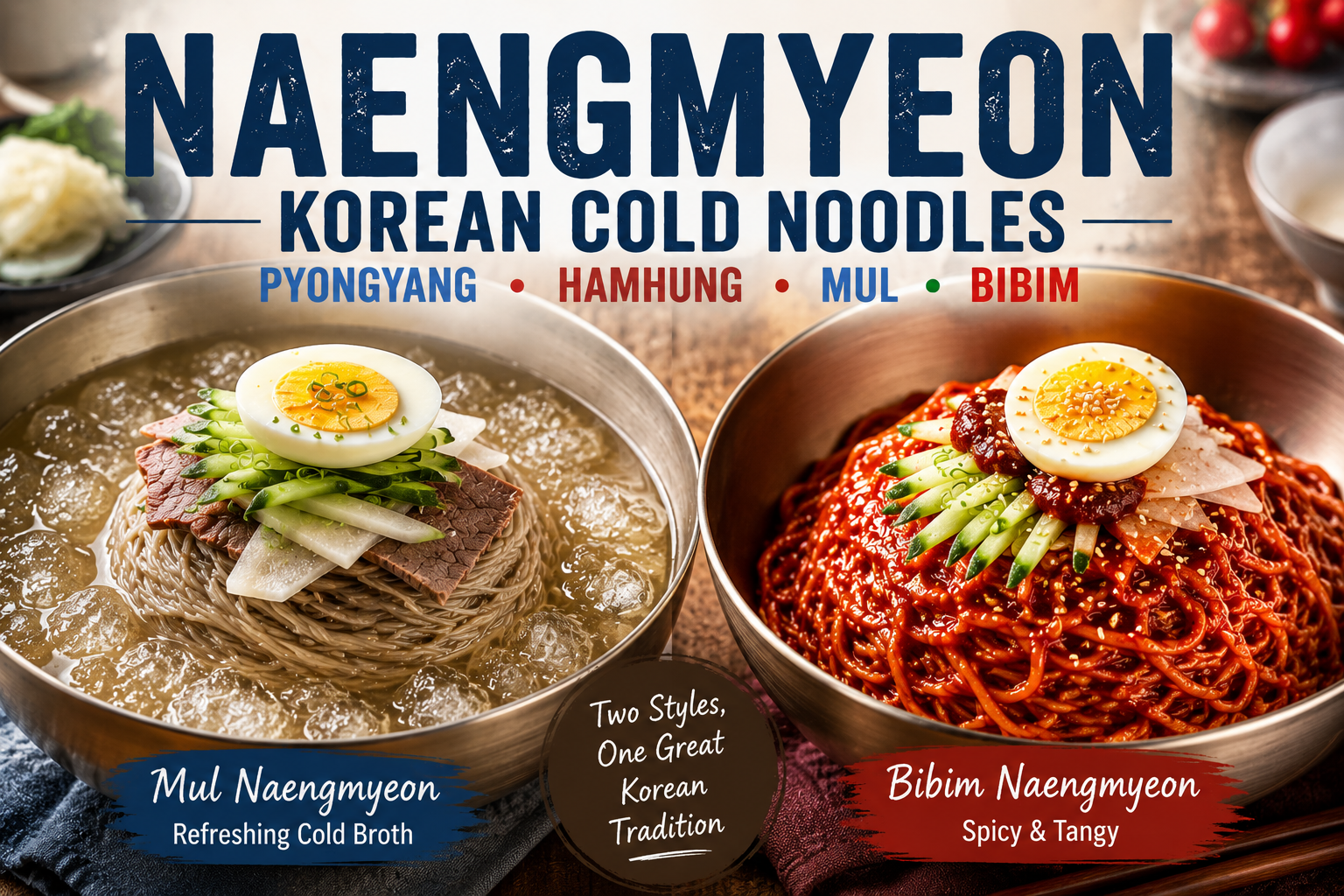
Walk into a Korean restaurant on a hot summer afternoon and you may see something that looks almost contradictory: people eating bowls of noodles surrounded by icy broth, sometimes with so much ice that the soup resembles a frozen drink.
This is naengmyeon (냉면), one of Korea’s best-known noodle dishes.
But there is a surprising detail behind this familiar summer meal.
Naengmyeon was traditionally associated with winter, not summer. Its roots lie in northern Korean food culture, where buckwheat, winter radish kimchi, cold storage, and heated rooms shaped the way people ate.
Its modern identity was also shaped by a major historical event. After the Korean War, people displaced from northern cities brought their regional noodle traditions south. In Seoul, those traditions developed into restaurant cultures that still influence how Koreans eat naengmyeon today.
That history helps explain why two bowls of Korean cold noodles can be so different.
Pyongyang naengmyeon is known for buckwheat aroma and restrained broth. Hamhung naengmyeon is associated with thin, elastic starch noodles and spicy seasoning, often accompanied by seasoned fish.
These are not simply two flavors of the same dish. They represent different regional food traditions.
To understand naengmyeon, it helps to look beyond the temperature of the broth. Its story is about agriculture, preservation, migration, changing technology, and the way food carries memories of home.
1. What Is Naengmyeon? Understanding Korea’s Cold Noodle Tradition
The Korean word naengmyeon (냉면) literally means “cold noodles.”
It generally describes noodles served in one of two ways:
- Mul naengmyeon (물냉면): Noodles served in chilled broth.
- Bibim naengmyeon (비빔냉면): Noodles mixed with a seasoned sauce, usually spicy, sweet, and tangy.
However, these two categories do not fully explain the dish.
Naengmyeon is also shaped by the ingredients used to make the noodles, the regional tradition behind the recipe, and the way the broth or sauce is prepared.
A restaurant serving Pyongyang-style naengmyeon may emphasize buckwheat and a carefully balanced broth. A restaurant serving Hamhung-style naengmyeon may focus on chewy starch noodles and a stronger seasoning sauce.
Even the word mul does not automatically mean that the dish follows the traditional Pyongyang method. Modern restaurants have developed many variations.
For first-time visitors, the easiest way to understand the menu is to separate two questions:
How are the noodles served? With broth or with sauce?
What regional noodle tradition does the restaurant follow? Pyongyang-style, Hamhung-style, or a modern adaptation?
Once these questions are separated, the differences become much easier to understand.
2. Why Was Naengmyeon Traditionally a Winter Food?
Today, cold noodles seem like an obvious choice for hot weather. Historically, however, winter was an important season for naengmyeon.
This was not simply because people enjoyed eating cold food in cold weather. Several practical conditions made winter especially suitable.
Dongchimi Provided a Seasonal Broth
One important ingredient was dongchimi (동치미), a type of water kimchi made primarily with Korean radish.
During winter, families traditionally stored dongchimi in large earthenware jars. The fermented liquid became a refreshing ingredient that could be used as a base for cold noodle broth.
Before household refrigerators were common, maintaining a consistently chilled liquid during warmer months was difficult.
Winter naturally provided the conditions needed to preserve and serve cold food.
Buckwheat Was Connected to the Agricultural Calendar
Buckwheat was another important part of the story.
It grows relatively quickly and was useful in regions where rice cultivation was more difficult. Its late-season harvest also made it a practical ingredient for traditional noodle production.
Buckwheat has a distinctive aroma, but its storage characteristics differ from those of some other grains. Historically, the timing of harvesting and storing ingredients influenced when certain foods were prepared.
The Contrast With Ondol Heating
There was also a cultural reason.
Traditional Korean houses used ondol (온돌), an underfloor heating system that kept rooms warm during winter.
Imagine sitting on a heated floor while eating cold noodles with chilled dongchimi broth.
The contrast between a warm room and a cold bowl was part of the pleasure.
This is an important detail because it challenges the assumption that traditional Korean food was always designed to match the outside temperature.
Naengmyeon was not simply a way to cool down. It was a seasonal dish shaped by ingredients, storage, and domestic life.
3. What Do Historical Records Tell Us About Naengmyeon?
The exact origin of naengmyeon is difficult to establish. It is more accurate to describe it as a food tradition that developed over time than to assign it a single inventor or creation date.
One important historical reference appears in Dongguk Sesigi (동국세시기), a record of Korean seasonal customs published in 1849.
The book describes naengmyeon as a food eaten around the winter season, including the eleventh month of the lunar calendar.
This matters because it shows that cold noodles were already recognized as a seasonal food during the late Joseon period.
The historical record also helps distinguish traditional naengmyeon from the modern restaurant categories familiar today.
People in the nineteenth century did not necessarily think about the dish through the same menu labels used by contemporary restaurants.
The relationship between noodles, dongchimi, meat broth, and toppings changed as cooking practices developed.
A 2025 academic study examining late Joseon cookbooks also explored how dongchimi evolved from a winter-preserved food into a broth used with noodles, contributing to the development of mul naengmyeon.
This is an important distinction: the history of naengmyeon is not simply the history of one recipe. It is the history of how a seasonal preserved ingredient became part of a recognizable noodle dish.
4. How Did a Winter Dish Become a Summer Favorite?
Naengmyeon’s transformation into a popular summer meal was closely connected to changes in technology and urban food culture.
Before refrigeration became widely available, serving cold broth consistently throughout the year was difficult.
As commercial ice storage, refrigeration, and modern restaurant facilities developed, restaurants became less dependent on winter temperatures.
They could prepare and store chilled broth more reliably.
This changed the practical meaning of the dish.
A food once strongly connected to winter ingredients and seasonal storage could now be served whenever customers wanted it.
The broth also evolved. Restaurants increasingly developed meat-based broths and other recipes that could be prepared consistently for commercial service.
Urban restaurant culture helped spread these versions to a wider audience.
The transformation was not simply a change in customer preference.
It involved several developments:
- Food preservation: Refrigeration made year-round cold serving easier.
- Restaurant production: Commercial kitchens could prepare larger quantities more consistently.
- Urbanization: More people encountered regional dishes outside their original areas.
- Migration: People moving from northern Korea introduced their hometown food traditions to southern cities.
The result was a change in the dish’s identity.
Naengmyeon did not lose its winter history. Instead, modern technology gave it a second life as a summer favorite.
5. Pyongyang Naengmyeon: Why Buckwheat and Broth Matter
Pyongyang naengmyeon (평양냉면) is one of the most recognized regional styles of Korean cold noodles.
Its traditional identity is built around two elements: buckwheat-based noodles and a restrained broth.
The noodles are generally made with buckwheat, often combined with starch or other ingredients to help create the desired texture.
The exact proportions vary by restaurant.
Unlike some chewy starch noodles, traditional Pyongyang-style noodles often have a softer, more delicate bite. They are valued for their buckwheat aroma rather than extreme elasticity.
The broth may combine beef stock, dongchimi liquid, or other ingredients.
The balance differs from restaurant to restaurant. Some versions emphasize savory meat flavor, while others have a lighter, more noticeable fermented-radish character.
Why Does Pyongyang Naengmyeon Taste So Mild?
For someone expecting strong Korean seasoning, the first taste can be surprising.
There may be no heavy chili sauce, and the broth may seem almost understated.
But that is part of the appeal.
The goal is not necessarily to create an intense first impression. The flavor is built around the relationship between the noodles and the liquid.
The buckwheat contributes its own aroma. The broth provides savory depth without completely covering that character.
This explains why enthusiasts pay so much attention to details that might seem minor to a first-time visitor:
- How strongly the buckwheat aroma comes through
- Whether the broth tastes more like meat stock or dongchimi
- How much salt is used
- Whether the noodles retain their texture
- How the flavor changes as the broth warms slightly
The dish rewards slow tasting.
Someone who expects a bold, spicy flavor may initially find it disappointing. Someone who enjoys subtle differences in ingredients may discover that the bowl has more complexity than it first appears.
Pyongyang naengmyeon is less about powerful seasoning and more about balance.
6. Hamhung Naengmyeon: How Starch Noodles Created a Different Experience
Hamhung naengmyeon (함흥냉면) developed around a different noodle tradition.
Its noodles are associated with starch, traditionally including potato starch. Modern restaurants may also use sweet potato starch or other combinations.
Compared with many Pyongyang-style noodles, Hamhung-style noodles are generally thinner and more elastic.
That texture is central to the experience.
Rather than focusing mainly on a delicate broth, Hamhung-style naengmyeon is especially associated with seasoned noodles and spicy sauce.
One famous variation is hoe naengmyeon (회냉면).
It is served with seasoned raw or cured fish, commonly pollock or other fish depending on the restaurant and recipe.
The fish adds texture and savory flavor, while the sauce provides sweetness, acidity, and heat.
This combination produces a much more assertive taste than the restrained broth associated with traditional Pyongyang naengmyeon.
Why Is the Texture So Different?
The difference begins with the ingredients.
Buckwheat and starch behave differently when made into noodles.
Starch-based noodles can develop a highly elastic, chewy structure. This makes them especially suitable for dishes in which the noodles are mixed with a thick sauce.
The seasoning also plays a different role.
In Pyongyang-style naengmyeon, the broth and noodles are central to the experience.
In Hamhung-style hoe naengmyeon, the sauce, fish, and chewy noodles work together.
Neither approach is inherently better.
They reflect different regional food traditions and different ideas about what makes a satisfying bowl of cold noodles.
7. Pyongyang vs. Hamhung: The Differences at a Glance
| Feature | Pyongyang-style | Hamhung-style |
|---|---|---|
| Main noodle ingredient | Buckwheat, often with added starch | Starch-based, traditionally associated with potato starch |
| Texture | Often softer and less elastic | Thin and distinctly chewy |
| Typical presentation | Frequently served in chilled broth | Frequently served with spicy seasoning |
| Famous variation | Mul naengmyeon | Hoe naengmyeon |
| Main flavor focus | Buckwheat aroma and broth balance | Chewy noodles, sauce, and fish |
| Eating experience | Subtle and restrained | Bold, spicy, and tangy |
These are traditional tendencies, not absolute rules.
Modern restaurants adapt their recipes, and some menus combine characteristics from different styles.
It is also important not to assume that every bowl of mul naengmyeon is Pyongyang-style or that every bibim naengmyeon is Hamhung-style.
The names describe different aspects of the dish.
Regional tradition, serving method, and ingredients overlap, but they are not identical categories.
8. How the Korean War Brought Northern Noodle Traditions South
The Korean War changed the geography of Korean food.
Before the division of the peninsula, Pyongyang and Hamhung were important centers of northern food culture.
When war and displacement forced people to leave their homes, many brought their cooking knowledge and food preferences with them.
For those who settled in South Korea, familiar dishes became a way to maintain a connection to the places they had left behind.
But recreating a hometown dish in a new environment was not always easy.
Ingredients, customers, suppliers, and restaurant conditions were different.
Some recipes had to be adapted. Others developed new local characteristics.
This is particularly important when looking at Hamhung-style naengmyeon in Seoul.
The dish did not simply move south unchanged.
It became part of a new restaurant culture shaped by migration, local ingredients, and the tastes of southern customers.
A bowl of naengmyeon could therefore serve two purposes at once:
It was a meal that customers could enjoy, and it was a reminder of a hometown that many people could no longer visit.
That emotional dimension is easy to overlook when naengmyeon is introduced simply as a refreshing summer dish.
9. Why Is Ojang-dong in Seoul Associated With Hamhung Naengmyeon?
One of Seoul’s best-known areas associated with Hamhung-style naengmyeon is Ojang-dong, in Jung-gu.
Its restaurant history is connected to northern migrants who settled in Seoul after the Korean War.
The neighborhood became known for restaurants serving noodles inspired by the food traditions of Hamgyeong Province.
One of the best-known examples is Ojangdong Heungnamjip, whose history is traced to the early postwar years. Another prominent restaurant, Ojangdong Hamheung Naengmyeon, also became part of the neighborhood’s identity.
Historical accounts differ in some details about individual founders and opening dates, so it is better not to reduce the entire neighborhood’s history to one restaurant or one person.
What is clear is that Ojang-dong became an important center for Hamhung-style naengmyeon.
The area once had many more restaurants serving this regional specialty. Redevelopment and changing commercial conditions reduced their number over time.
Yet the neighborhood remains closely associated with the dish.
Why Does This History Matter?
Ojang-dong shows how migration can transform a local food into a wider national tradition.
The restaurants were not simply selling noodles from a different region.
They were recreating a taste associated with home, adapting it to a new city, and introducing it to customers who might never have visited Hamhung.
Over time, the dish became familiar to people across South Korea.
That is one reason why food history is also social history.
A regional recipe can survive because people carry it with them, rebuild it in a new place, and pass it on to the next generation.
10. Mul Naengmyeon vs. Bibim Naengmyeon: Which One Should You Order?
For most first-time visitors, the immediate question is simple:
Do you want broth or spicy sauce?
Mul Naengmyeon: Cold Noodles in Broth
Mul naengmyeon is served with chilled liquid poured over the noodles.
Common toppings include:
- Sliced cucumber
- Pickled radish
- Boiled egg
- Sliced beef or other meat
- Sometimes pear or other seasonal garnish
The broth may be based on beef stock, dongchimi liquid, or a combination.
Some restaurants serve it very cold, with partially frozen broth.
The flavor can range from savory and meaty to light and refreshing.
If you want to understand the relationship between noodles and broth, this is a good place to start.
Bibim Naengmyeon: Noodles With Spicy Sauce
Bibim naengmyeon is mixed with a seasoned red sauce rather than served in a large amount of broth.
The sauce often includes chili-based ingredients, vinegar, sweetness, garlic, and other seasonings.
The exact recipe varies.
Some restaurants make it intensely spicy. Others emphasize sweetness and acidity.
It is often served with cucumber, pickled radish, and boiled egg.
If you already enjoy Korean dishes such as bibimbap with spicy sauce or spicy noodles, bibim naengmyeon may feel more familiar.
Which Is Better for a First-Time Visitor?
There is no universal answer.
Choose mul naengmyeon if you want to explore cold broth and the character of the noodles.
Choose bibim naengmyeon if you prefer strong seasoning and a more intense combination of sweet, spicy, and tangy flavors.
If you are dining with someone else, ordering one of each and sharing them is an easy way to compare the two.
11. Why Do Koreans Eat Naengmyeon With Korean Barbecue?
Naengmyeon is a familiar menu item at many Korean barbecue restaurants.
This pairing is not just a convenient way to add another dish to the meal. The flavors and textures complement each other.
Grilled beef or pork often has a rich, savory, and sometimes fatty character.
Cold noodles create a contrast.
Mul naengmyeon offers chilled broth and a lighter finish. Bibim naengmyeon adds acidity, sweetness, and spice.
The combination can make a heavy barbecue meal feel more balanced.
Some diners eat naengmyeon after finishing their grilled meat. Others wrap a small portion of noodles around a piece of meat and eat them together.
Both approaches are common.
Restaurants may also offer a smaller serving of noodles, sometimes called sari, so customers can add noodles without ordering another full bowl.
The important point is that naengmyeon has become part of a broader Korean dining experience.
It is not limited to specialist noodle restaurants.
12. Why Are Vinegar and Mustard Served With Naengmyeon?
Many Korean naengmyeon restaurants place vinegar and mustard on the table.
They are optional seasonings, not ingredients that every diner must add.
Vinegar increases acidity and can make the broth taste brighter.
Mustard adds a sharp, pungent sensation that changes the overall flavor.
The best approach is to taste the broth before adding anything.
This is especially useful when eating traditional Pyongyang-style naengmyeon, where the balance of the broth is a major part of the dish.
Adding too much vinegar or mustard immediately can cover the flavor that the restaurant intended to highlight.
With bibim naengmyeon, the sauce may already contain enough acidity and seasoning.
A small adjustment is usually better than adding large amounts at once.
There is no single correct way to season every bowl. The choice depends on the recipe and personal preference.
13. Why Do Korean Restaurants Give Customers Scissors?
If you order naengmyeon in Korea, the staff may bring metal scissors to your table.
This can surprise visitors who are accustomed to eating noodles with chopsticks alone.
Some naengmyeon noodles are very long and difficult to handle, especially elastic starch-based varieties.
Cutting them into shorter portions makes them easier to pick up and eat.
It is particularly useful when noodles are tightly packed in a bowl or mixed with thick sauce.
But cutting is not compulsory.
Some diners prefer to keep the noodles long, while others ask the staff to cut them several times.
If you are unfamiliar with the custom, simply use the scissors when they are provided.
It is an ordinary part of eating certain types of Korean noodles, not a sign that you are expected to follow a strict dining rule.
14. What Is Myeonsu, the Warm Drink Sometimes Served With Cold Noodles?
At some traditional naengmyeon restaurants, customers receive a small cup of warm liquid before the cold noodles arrive.
This may be myeonsu (면수), the water left from cooking the noodles.
Depending on the restaurant, it may carry some of the flavor and aroma of buckwheat.
Other restaurants serve a separate warm broth instead.
The practice is not universal, and the drink differs from place to place.
But it creates an interesting contrast:
A warm drink before a bowl of cold noodles.
For visitors, it is another example of how naengmyeon is not simply a cold dish. The meal can include different temperatures, aromas, and textures.
15. Naengmyeon and Samgyetang: Two Different Ideas of Korean Summer Food
Korean summer food culture contains an interesting contrast.
On one side is naengmyeon: chilled noodles served in cold broth or mixed with spicy sauce.
On the other is samgyetang (삼계탕), a hot chicken soup traditionally prepared with ingredients such as ginseng, garlic, and glutinous rice.
Why would people eat hot soup during hot weather?
One traditional expression is iyeol chiyeol (이열치열), often translated as “fight heat with heat.”
The expression is associated with the idea of eating hot food during the hottest season.
Naengmyeon and samgyetang represent different approaches to summer dining.
One emphasizes a cold, refreshing sensation. The other is a warm and substantial meal.
They should not be treated as two sides of a single medical rule. Rather, they illustrate the variety of seasonal eating traditions in Korea.
Korean food culture is not built around one simple principle of matching food temperature to outdoor temperature.
Ingredients, habit, personal taste, and cultural beliefs all influence what people choose to eat.
16. How Naengmyeon Entered Korean Pop Culture
Naengmyeon has also become part of Korean entertainment.
One memorable example came in 2009, when Park Myung-soo and Girls’ Generation member Jessica performed the song “Naengmyeon” as the project duo MyungCa Drive on the television variety show Infinite Challenge.
The song became a recognizable summer-themed pop-culture moment.
Its appeal came partly from the humor of turning an everyday food into a catchy entertainment concept.
This connection is revealing.
Naengmyeon is not only a traditional dish associated with regional history. It is also part of ordinary contemporary life.
People eat it after barbecue, during summer outings, with family, and with friends.
It is familiar enough to become the subject of a playful television song.
That is one way a traditional food remains relevant across generations.
17. Can You Make Korean Naengmyeon at Home?
Yes. Making traditional restaurant-style naengmyeon from scratch can require time and preparation, especially when producing the broth.
However, packaged naengmyeon makes it possible to prepare a convenient version at home.
Korean supermarkets commonly sell refrigerated or dried noodles with ready-made broth or seasoning sauce.
Ingredients for Simple Mul Naengmyeon
- Packaged naengmyeon noodles
- Chilled naengmyeon broth
- Cucumber
- Pickled radish
- Boiled egg
- Sliced beef, if desired
- Vinegar and Korean mustard
How to Prepare It
Step 1: Chill the broth.
Place the packaged broth in the refrigerator before cooking. If you prefer a partially frozen texture, chill it in the freezer for a short period while checking that it does not freeze solid.
Step 2: Cook the noodles.
Follow the package instructions. Different noodle products require different cooking times.
Step 3: Rinse the noodles thoroughly.
Drain the noodles and rinse them under cold running water. Gently separate them while rinsing to remove excess surface starch and stop the cooking process.
Step 4: Prepare the toppings.
Slice the cucumber, prepare the pickled radish, and cut the boiled egg in half. Add sliced beef if desired.
Step 5: Assemble the bowl.
Place the noodles in a bowl, pour over the chilled broth, and arrange the toppings.
Serve immediately.
For bibim naengmyeon, use the seasoning sauce supplied with the noodles or prepare a separate sauce according to your taste.
One important point: do not overcook the noodles.
Their texture is a defining part of the dish, and cooking times can vary significantly between refrigerated and dried products.
18. Which Naengmyeon Should You Try First?
The best choice depends on what you enjoy eating.
| Your preference | A good starting point |
|---|---|
| Delicate broth and subtle flavor | Pyongyang-style mul naengmyeon |
| Strong, spicy seasoning | Bibim naengmyeon |
| Thin and chewy noodles | Hamhung-style naengmyeon |
| Seasoned fish with spicy noodles | Hoe naengmyeon |
| Cold noodles after grilled meat | Mul or bibim naengmyeon |
| Comparing different styles | Order mul and bibim together |
If you are visiting Korea for the first time, trying two different styles is more informative than assuming all cold noodles taste alike.
A bowl of Pyongyang-style naengmyeon can introduce you to the aroma of buckwheat and the character of the broth.
A bowl of Hamhung-style hoe naengmyeon can show you how starch noodles, fish, and spicy sauce create a completely different experience.
The contrast is part of what makes the dish interesting.
19. What Makes Naengmyeon Different From Other Cold Noodle Dishes?
Cold noodles exist in many food cultures.
What makes Korean naengmyeon distinctive is not simply that it is served cold.
Its identity comes from the combination of several elements:
- Buckwheat and starch-based noodle traditions
- Dongchimi and meat-based broth preparations
- The regional differences associated with Pyongyang and Hamhung
- The use of spicy seasoning and fish in certain varieties
- Its historical connection to northern Korean food culture
- Its transformation through migration and modern restaurant technology
The contrast between Pyongyang and Hamhung styles is especially important.
One tradition often emphasizes the relationship between noodles and broth. Another highlights the elasticity of the noodles and the flavor of the sauce.
Modern restaurants have also created variations that do not fit neatly into either category.
That is why naengmyeon should be understood as a broad food tradition rather than one fixed recipe.
20. Naengmyeon Is More Than a Bowl of Cold Noodles
Naengmyeon’s story begins with the agricultural and seasonal conditions of northern Korea.
Dongchimi, buckwheat, winter storage, and ondol heating helped shape the original eating experience.
Later, changing technology and restaurant culture made it possible to serve cold noodles throughout the year.
The Korean War and the movement of people from northern regions brought regional traditions south, where they developed new identities in cities such as Seoul.
Ojang-dong became one of the places where Hamhung-style naengmyeon found a lasting home.
Today, the dish appears in specialist noodle restaurants, barbecue restaurants, supermarkets, and Korean pop culture.
That journey explains why naengmyeon means more than “cold noodles.”
It carries traces of regional identity, migration, changing technology, and the memories of people who brought familiar food into unfamiliar places.
The next time someone asks whether you want mul naengmyeon or bibim naengmyeon, you will be choosing more than broth or sauce.
You will be exploring two different approaches to one of Korea’s most distinctive noodle traditions.
And if you enjoy the combination of cold noodles and intense Korean spice, another modern variation is worth discovering: Buldak Naengmyeon, where traditional cold noodle culture meets the fiery flavor of Buldak.