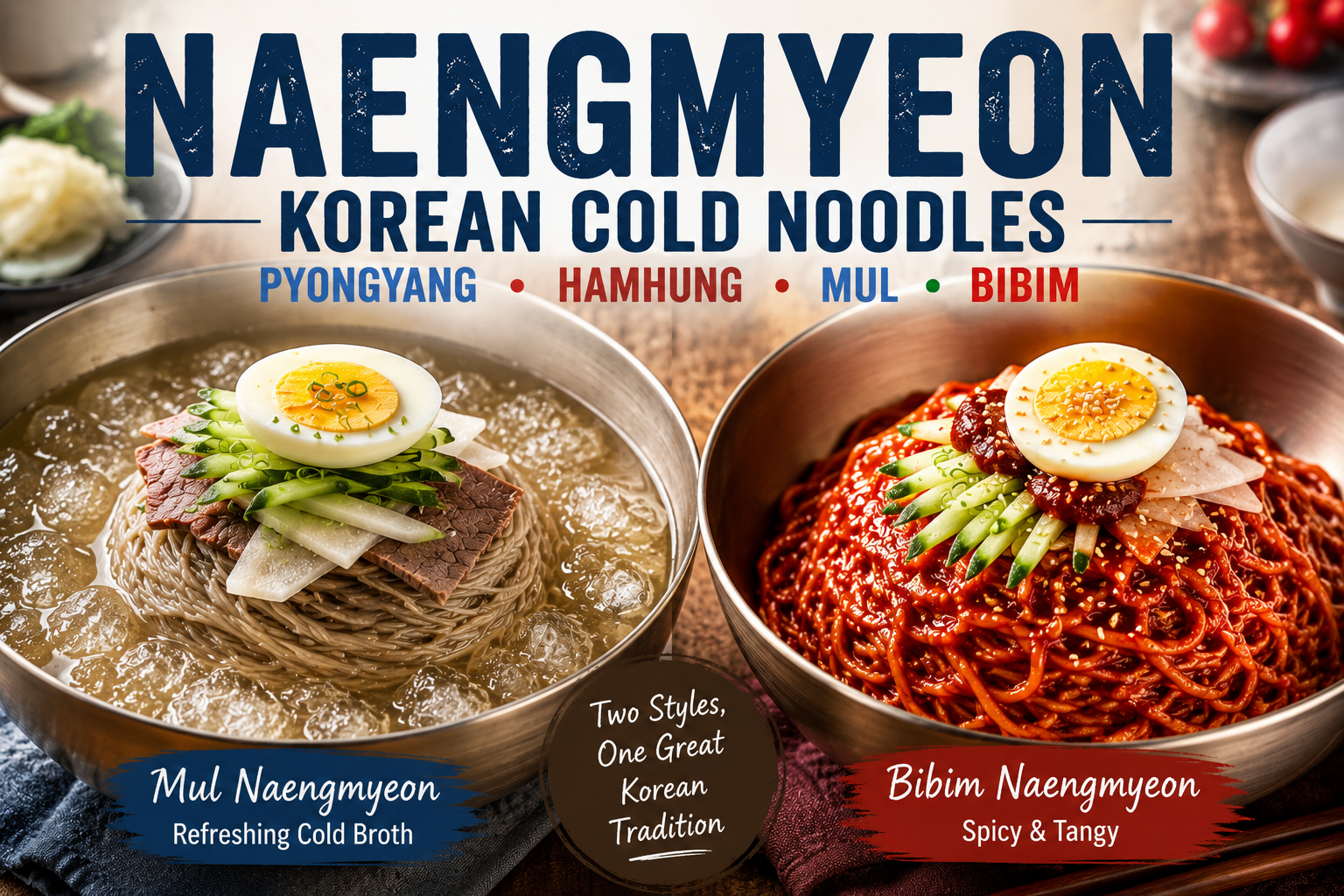
Walk through Korea on a hot and humid summer day and you may see people lining up for something unusual: a bowl of noodles served in an ice-cold broth.
This is naengmyeon (냉면), one of Korea’s most distinctive noodle dishes.
For someone trying Korean food for the first time, the idea can be surprising. The broth may arrive extremely cold, sometimes with visible ice or slush floating around the noodles.
But there is much more to naengmyeon than simply “cold noodles.”
There are mild and spicy versions, soft buckwheat noodles and extremely chewy starch noodles, and even versions topped with seasoned raw fish.
And behind that bowl is a fascinating story involving Korea’s seasons, regional food traditions, war, migration and even K-pop.
Here is what you should know before eating naengmyeon in Korea.
What Is Naengmyeon?
The Korean word naengmyeon (냉면) literally means “cold noodles.”
Today, the two varieties most visitors encounter are:
Mul naengmyeon (물냉면) — noodles served in chilled broth.
Bibim naengmyeon (비빔냉면) — noodles mixed with a spicy, sweet and tangy red sauce.
But those two names only tell part of the story.
To really understand naengmyeon, you need to know about two famous regional traditions: Pyongyang naengmyeon and Hamhung naengmyeon.
And surprisingly, the story begins not with Korea’s hot summers — but with its freezing winters.
Naengmyeon Was Originally a Winter Food
Today, Koreans strongly associate naengmyeon with summer.
When the temperature climbs, an icy bowl of mul naengmyeon can feel almost like air conditioning you can eat.
Historically, however, naengmyeon was closely associated with winter in the northern Korean Peninsula.
Before modern refrigeration, winter naturally provided the cold environment needed for chilled broth. Dongchimi — a refreshing radish water kimchi traditionally prepared for winter — could provide the cold liquid used with noodles.
Korea Tourism Organization also notes this unusual history: naengmyeon was once enjoyed during freezing winters, even while people sat on warm ondol, Korea’s traditional heated floors.
That creates one of the great ironies of Korean food:
One of Korea’s most famous summer foods began as a winter dish.
Koreans Were Eating Naengmyeon Centuries Ago
Naengmyeon is not a recent invention.
One important historical reference appears in Gyegokjip (계곡집), a collection associated with Joseon scholar Jang Yu (1587–1638) and published in 1643.
His writing contains an early known reference to naengmyeon, describing cold noodles with a purple-colored broth associated with omija.
Historical sources from later periods provide additional evidence of cold noodles being eaten in northern Korea.
So when you sit down for a bowl today, you are eating a dish with roots stretching back centuries.
Pyongyang Naengmyeon: Subtle, Buckwheat and Brothy
Pyongyang naengmyeon (평양냉면) is perhaps the most famous traditional style.
The noodles traditionally contain a significant amount of buckwheat.
That matters because buckwheat behaves very differently from starch.
Rather than being extremely elastic and chewy, traditional Pyongyang-style noodles tend to be softer and easier to bite through.
The other defining element is the broth.
Pyongyang naengmyeon is known for a clean, restrained broth traditionally associated with dongchimi and/or meat stock.
For foreigners accustomed to strongly seasoned Korean foods such as bulgogi, kimchi or tteokbokki, the first spoonful can therefore be surprising.
Some first-time diners may even wonder:
“Is this supposed to taste this mild?”
Yes.
That subtlety is part of its appeal.
Instead of overwhelming the noodles with seasoning, good Pyongyang naengmyeon lets you notice the buckwheat aroma and delicate broth.
It is a food that many people appreciate more deeply after eating it several times.
Hamhung Naengmyeon: Chewy, Spicy and Intense
Now move from Pyongyang to the Hamhung tradition and the experience changes dramatically.
Hamhung naengmyeon (함흥냉면) is famous for thin, remarkably chewy starch-based noodles.
Instead of emphasizing a mild broth, Hamhung-style noodles are strongly associated with spicy seasoning.
One particularly famous variation is:
Hoe naengmyeon (회냉면).
This combines chewy noodles with spicy seasoned raw or cured fish.
The coastal environment around Hamhung influenced this style, and versions of the dish later evolved as people from the North settled in South Korea.
Today, the contrast is easy to remember:
Pyongyang → buckwheat + delicate broth
Hamhung → starch noodles + chewy texture + spicy seasoning
How Hamhung Naengmyeon Came to Seoul
Naengmyeon also carries the story of modern Korean history.
After the Korean War, many people who had lived in northern Korea settled in the South.
They brought their food traditions with them.
Recipes inevitably changed as cooks adapted to ingredients available in their new homes.
One place where this history remains visible is Ojang-dong in Seoul, which became particularly associated with Hamhung-style naengmyeon.
The Korea Tourism Organization describes one famous Ojang-dong restaurant as originating with a woman who migrated from Hamgyongnam-do to Seoul during the Korean War and began selling Hamhung-style starch noodles.
So for some older Koreans and displaced families, naengmyeon represents more than food.
A bowl of noodles could also carry the memory of a hometown they could no longer return to.
That is why understanding naengmyeon also means understanding a small piece of modern Korean history.
Mul Naengmyeon vs. Bibim Naengmyeon
For most visitors to Korea, however, the immediate decision at a restaurant is much simpler:
Mul or bibim?
Mul Naengmyeon
Choose mul naengmyeon when you want something genuinely refreshing.
The noodles arrive submerged in cold broth, and modern versions are sometimes served with partially frozen broth or crushed ice.
Typical toppings may include cucumber, pickled radish, sliced meat and half a boiled egg.
On a hot Korean summer day, drinking the cold broth is part of the experience.
Don’t think of the broth as something that simply accompanies the noodles.
The broth is one of the main reasons people order mul naengmyeon.
Bibim Naengmyeon
Choose bibim naengmyeon when you want something much more intense.
There is little or no broth.
Instead, the noodles are mixed with a red sauce that can combine spicy, sweet, savory and sour flavors.
The result is bold and refreshing in a completely different way.
And there is one Korean way of eating it that visitors should definitely try.
Try Bibim Naengmyeon Wrapped in Korean BBQ
If you order bibim naengmyeon at a Korean barbecue restaurant, don’t necessarily wait until all the meat is gone.
Take a piece of grilled meat.
Pick up a small bundle of spicy noodles.
Eat them together in one bite.
The rich, savory meat balances the spicy and tangy noodles, while the cold noodles cut through the fattiness of the meat.
This is why naengmyeon and Korean BBQ make such a natural combination.
Many Koreans also order naengmyeon toward the end of a meal after eating galbi or other grilled meats.
So if you see naengmyeon on a Korean barbecue menu, it isn’t there by accident.
How Koreans Season Naengmyeon
You will often find vinegar and mustard on the table at a naengmyeon restaurant.
But don’t immediately pour large amounts into your bowl.
Try the broth or noodles first.
Then add a small amount according to your taste.
Vinegar adds acidity and freshness, while mustard provides a sharp kick.
With spicy Hamhung-style noodles, these condiments can make the flavor even more intense.
Why Are You Served Something Hot With Cold Noodles?
Here is another interesting contradiction.
Some traditional naengmyeon restaurants give you something hot to drink before or alongside your freezing-cold noodles.
At some Pyongyang-style restaurants, you may encounter myeonsu (면수) — warm water from cooking the noodles, carrying some of the aroma of buckwheat.
Hamhung-style restaurants may instead serve a cup of warm savory broth.
So the experience can involve:
warm broth → freezing cold noodles → warm broth again.
It may sound unusual, but it is part of the pleasure of eating naengmyeon.
Korea’s Summer Paradox: Naengmyeon vs. Samgyetang
Korean summer food culture contains an even bigger contradiction.
On one scorching summer day, Koreans may eat ice-cold naengmyeon to cool themselves down.
On another, they may sit in front of a bubbling-hot bowl of samgyetang, a chicken soup traditionally prepared with ingredients such as ginseng, garlic and glutinous rice.
Why eat extremely hot soup when the weather is already hot?
Korea has an expression:
Iyeol chiyeol (이열치열) — roughly, “fight heat with heat.”
The idea is that nourishing hot food can help restore energy during exhausting summer weather.
So two seemingly opposite dishes became Korean summer classics:
Naengmyeon cools you down.
Samgyetang heats you up.
Yet Koreans enjoy both as ways of getting through the hottest part of the year.
Naengmyeon Is Also Part of Korean Pop Culture
Naengmyeon even made its way into Korean pop culture.
In 2009, Girls’ Generation member Jessica teamed up with entertainer Park Myung-soo as the project duo MyungCa Drive (명카드라이브).
Their summer song was appropriately called:
“Naengmyeon (냉면).”
The catchy song became associated with summer in Korea — another example of how an everyday Korean food can become part of popular culture.
For K-pop fans visiting Korea, listening to Naengmyeon while actually eating naengmyeon on a hot summer day might be one of the more unusual Korean food experiences.
Can You Make Naengmyeon at Home?
Yes.
Traditional restaurant-style naengmyeon can require considerable work, especially when making broth from scratch.
But modern Korean supermarkets sell packaged naengmyeon noodles and chilled broth, making an easy home version possible.
A simple bowl can be made with:
- Naengmyeon noodles
- Chilled naengmyeon or dongchimi broth
- Cucumber
- Pickled radish
- Boiled egg
- Vinegar and Korean mustard
Cook the noodles according to the package directions, then rinse them thoroughly under very cold water.
This step matters.
Removing excess starch while rapidly cooling the noodles helps create the clean, springy texture associated with naengmyeon.
Pour over very cold broth — slightly slushy broth is particularly refreshing — and add your toppings.
For bibim naengmyeon, replace most or all of the broth with spicy bibim sauce.
Which Naengmyeon Should You Try First?
If this is your first experience, choose according to what you normally enjoy.
Want something cold and refreshing?
Start with mul naengmyeon.
Love spicy Korean food?
Try bibim naengmyeon.
Interested in subtle traditional flavors?
Look for Pyongyang naengmyeon.
Love chewy noodles and strong flavors?
Try Hamhung-style bibim or hoe naengmyeon.
Eating Korean BBQ?
Order bibim naengmyeon and try a bite wrapped with grilled meat.
And if two people are eating together, there is an even easier solution:
Order one mul and one bibim and share.
Naengmyeon Is More Than Korean Cold Noodles
Calling naengmyeon simply “Korean cold noodles” is accurate.
But it doesn’t tell the whole story.
Inside one bowl you can find the cold winters of northern Korea, buckwheat and dongchimi, regional differences between Pyongyang and Hamhung, the memories of people displaced by war, Korea’s modern summer culture and even a little K-pop.
Today, eating a freezing-cold bowl of naengmyeon during a hot Korean summer feels completely natural.
Yet centuries of history lie behind that simple experience.
So when you visit Korea and someone asks:
“Mul naengmyeon or bibim naengmyeon?”
you’ll know there’s much more behind the question than choosing between broth and spicy sauce.
And if ordinary naengmyeon isn’t spicy enough for you, there is a modern Korean twist waiting next:
Buldak Naengmyeon — ice-cold noodles with the fiery flavor of Buldak.
That’s our next recipe.