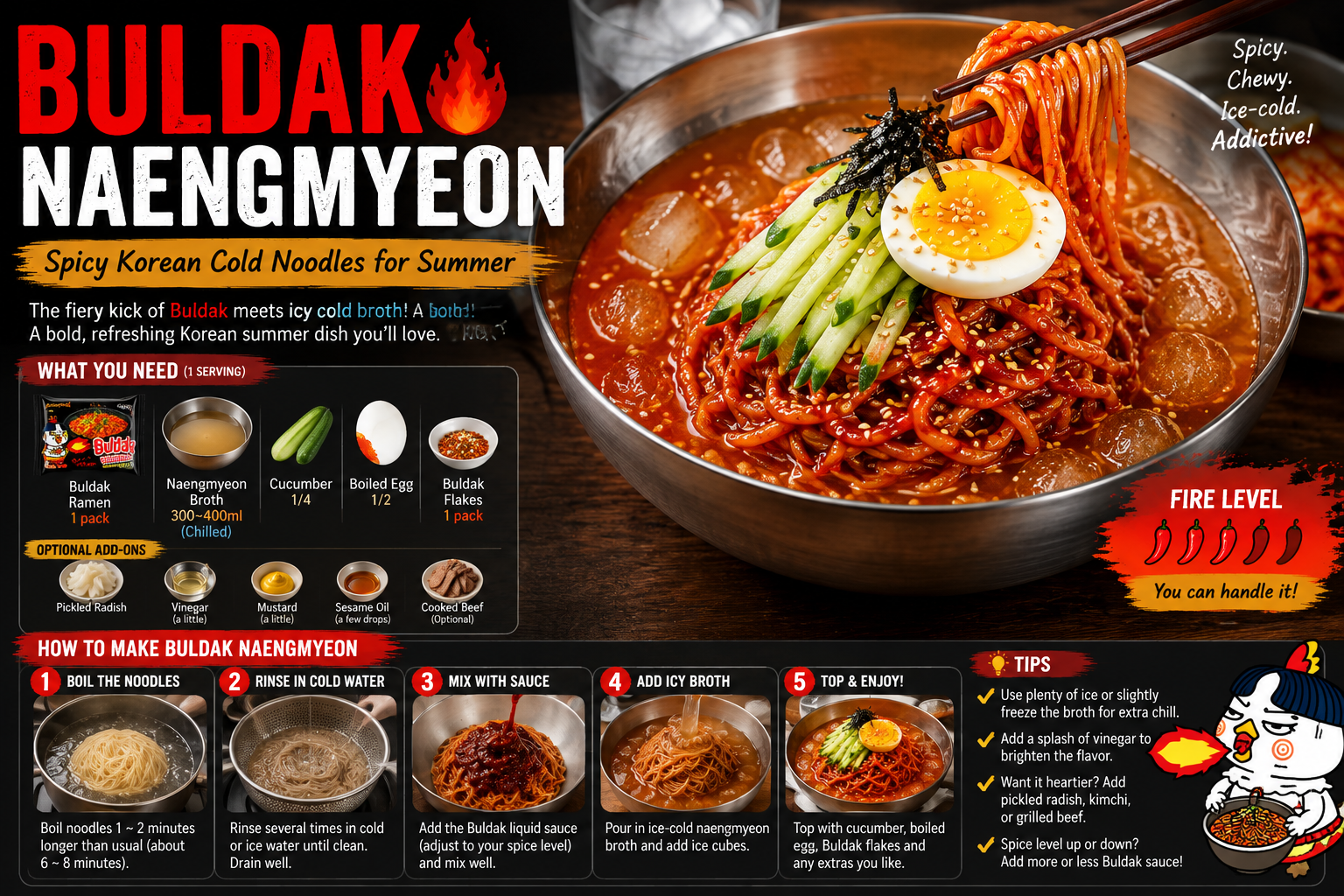
Imagine taking one of Korea’s hottest noodle flavors and dropping it into an ice-cold bowl.
That’s Buldak Naengmyeon.
It combines the fiery, addictive flavor associated with Buldak noodles with one of Korea’s most refreshing summer foods: naengmyeon, or Korean cold noodles.
The result sounds contradictory.
It’s hot.
It’s cold.
It’s spicy.
It’s refreshing.
And somehow, it works.
If you already love Buldak but want something different for summer, this may be one of the easiest Korean fusion noodle recipes to try at home.
What Is Buldak Naengmyeon?
Buldak Naengmyeon (불닭냉면) is a modern spicy variation of Korean cold noodles.
Traditional naengmyeon has a much longer history and includes famous styles such as Pyongyang and Hamhung naengmyeon.
Buldak Naengmyeon is different.
Instead of trying to recreate a traditional dish, we’re combining the intense spicy flavor of Buldak with chilled naengmyeon broth.
If you’re new to Korean cold noodles, read our complete Naengmyeon: Korean Cold Noodles Explained guide first.
Then come back when you’re ready to turn up the heat.
Why Buldak and Cold Broth Work Together
At first, spicy sauce and icy broth might sound like an odd combination.
But Korean food often plays with contrasts.
Hot grilled meat is eaten with cold noodles.
Spicy bibim naengmyeon can be served as a refreshing summer meal.
And intensely spicy dishes are frequently balanced with cool or mild accompaniments.
Buldak Naengmyeon takes that contrast further.
The Buldak sauce gives you an immediate spicy kick, while the chilled broth and cucumber provide a cooling sensation.
Then another spicy bite arrives.
That’s what makes the dish fun.
Buldak Naengmyeon Ingredients
For 1 Serving
- 1 pack Buldak ramen
- 300–400 ml chilled naengmyeon broth
- Buldak liquid sauce, to taste
- 1/4 cucumber, thinly sliced
- 1/2 boiled egg
- Buldak flakes from the package
- Ice cubes, optional
Optional Toppings
- Pickled Korean radish
- A little vinegar
- Korean mustard
- Kimchi or yeolmu kimchi
- Sesame seeds
- Sliced grilled beef or pork
You don’t need every topping.
Buldak noodles + cold broth + cucumber + egg are enough to make a simple version.
How to Make Buldak Naengmyeon
Step 1: Chill the Broth
Put your naengmyeon broth in the refrigerator until very cold.
For an even more refreshing version, place it in the freezer long enough for it to become slightly slushy rather than completely frozen.
This makes a big difference on a hot summer day.
Step 2: Cook the Buldak Noodles
Boil the noodles according to the package directions.
Because the noodles will be rinsed in cold water afterward, avoid leaving them overly firm.
You want them cooked through while still retaining their chewiness.
Step 3: Rinse in Very Cold Water
Drain the noodles immediately.
Rinse them several times under cold running water or in ice water.
Gently rub and separate the noodles while rinsing.
This removes surface starch, stops the cooking process and gives the noodles a cleaner texture.
Drain thoroughly.
This step is important.
Warm noodles will quickly ruin the refreshing character of the dish.
Step 4: Add the Buldak Sauce
Place the cold, drained noodles in your serving bowl.
Add some of the Buldak liquid sauce first rather than automatically using the entire packet.
Mix thoroughly.
Taste before adding more.
Remember that you’re going to add broth, so the flavor will become somewhat diluted.
You can always add more sauce.
You can’t take it back out.
Step 5: Add the Ice-Cold Broth
Pour approximately 300–400 ml of chilled naengmyeon broth around the noodles.
Start closer to 300 ml if you want a stronger Buldak flavor.
Add more if you prefer something lighter and more refreshing.
A few ice cubes can make the bowl even colder.
Step 6: Add the Toppings
Finish with:
- Cucumber
- Half a boiled egg
- Buldak flakes
- Pickled radish, if available
- Sesame seeds
And that’s it.
Your Buldak Naengmyeon is ready.
The Most Important Tip: Don’t Add All the Sauce Immediately
Buldak sauce can be extremely spicy, especially for people who aren’t accustomed to Korean spicy food.
The safest method is simple:
Start with less. Taste. Then add more.
The chilled broth changes the overall intensity, but don’t assume cold automatically makes Buldak mild.
If you’re making this for friends, letting everyone adjust their own spice level is even better.
Want More Sourness?
Naengmyeon and acidity work very well together.
Try adding a small splash of vinegar.
Don’t pour in too much at once.
A little acidity can brighten the spicy sauce and make the cold broth taste cleaner.
Traditional Korean mustard can also be added if you want an additional sharp kick.
Again, taste first.
Make It Even Better With Korean BBQ
Here’s the version I’d recommend if you’re really hungry.
Grill some thinly sliced beef, pork belly or another favorite cut of meat.
Then take:
one piece of hot grilled meat + a small bundle of ice-cold Buldak noodles.
Eat them together.
The contrast is excellent.
The fatty, savory meat softens the sharp spicy-sour flavor while the cold noodles refresh your mouth between bites.
This idea also comes from the way Koreans commonly enjoy bibim naengmyeon with grilled meat.
Buldak Naengmyeon With Yeolmu Kimchi
Another good addition is yeolmu kimchi (열무김치), young radish kimchi.
Its crisp texture and refreshing sourness work particularly well with cold noodles.
Add a small amount on top rather than mixing in too much from the beginning.
You want the Buldak flavor to remain the star.
How Spicy Is Buldak Naengmyeon?
That depends almost entirely on how much Buldak sauce you use.
Mild(er)
Use about one-third of the sauce packet and more broth.
Medium
Start around half the packet and adjust after tasting.
Very Spicy
Use most or all of the packet.
But if this is your first experience with Buldak, there is no prize for suffering.
Start low.
Can I Make It Without Buldak Ramen?
Yes.
If Buldak sauce is available separately where you live, you can use actual naengmyeon noodles instead.
This creates a texture closer to Korean cold noodles while retaining the Buldak flavor.
You can also experiment with buckwheat noodles, although the result will have a different character.
Think of Buldak Naengmyeon as a flexible modern Korean fusion dish rather than a recipe with centuries-old rules.
Buldak Naengmyeon vs. Bibim Naengmyeon
They may look similar, but they aren’t the same dish.
Traditional bibim naengmyeon uses a Korean spicy-sweet-tangy seasoning developed specifically for cold noodles.
Buldak Naengmyeon gets its defining heat and flavor from Buldak-style sauce.
Bibim naengmyeon belongs to Korea’s established naengmyeon tradition.
Buldak Naengmyeon is a modern twist inspired by contemporary Korean spicy-noodle culture.
Both can be delicious.
Just don’t confuse the two.
Why This Is Such a Korean Combination
Buldak Naengmyeon brings together two very different sides of Korean food culture.
Naengmyeon represents tradition.
Its history stretches back centuries, with famous regional traditions connected to Pyongyang and Hamhung.
Buldak represents modern global K-food culture.
Put them together and you get something that would have sounded strange generations ago but feels perfectly at home in today’s experimental Korean food scene.
Buldak Naengmyeon Recipe at a Glance
Prep time: About 5 minutes
Cooking time: About 5 minutes
Servings: 1
Difficulty: Easy
Spice level: Adjustable
The basic formula is:
Cook → Chill → Mix → Add icy broth → Top → Eat.
The most important points are to rinse the noodles thoroughly, keep the broth extremely cold and add the Buldak sauce gradually.
Final Tip
Don’t think of this recipe as simply cold Buldak ramen.
The goal is contrast.
You want the noodles spicy, the broth ice-cold, the cucumber crisp and the toppings fresh.
On a hot day, that combination creates a completely different Buldak experience.
And if Buldak Naengmyeon is your first introduction to Korean cold noodles, don’t stop here.
Try traditional mul naengmyeon, bibim naengmyeon, Pyongyang naengmyeon and Hamhung naengmyeon too.
Buldak may bring the fire.
But the much older story of Korean cold noodles is even more interesting.