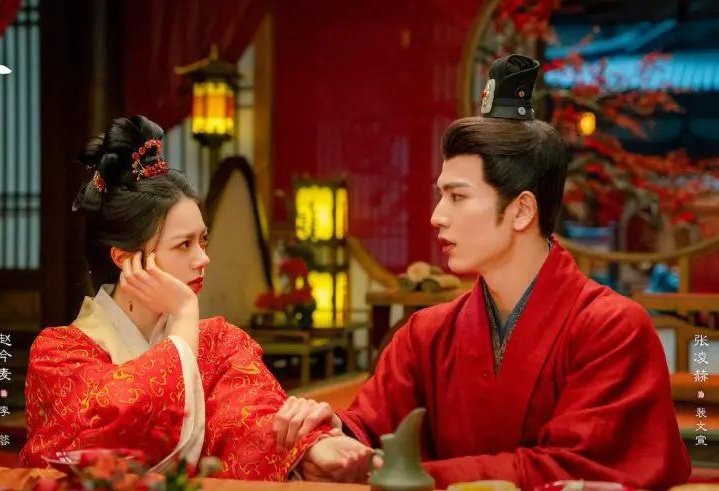
What if you could return to the beginning of a marriage that had already destroyed your life? In The Princess Royal (2024), Li Rong and Pei Wenxuan receive another chance after twenty years of resentment, political manipulation, and mutual betrayal. But knowing how a relationship failed does not necessarily mean knowing how to repair it.
1. They Already Know How Their Marriage Ends
Most romantic dramas begin with two people who do not know what the future holds.
The Princess Royal begins somewhere very different.
Li Rong and Pei Wenxuan have already spent approximately twenty years together. Their marriage, originally arranged for political reasons, has gradually become a relationship filled with resentment, misunderstanding, and emotional distance.
Eventually, political conspiracies push them toward a fatal confrontation. Each believes the other has become an enemy, and both die without resolving the truth behind their relationship.
Then something extraordinary happens.
They awaken as their younger selves, returning to the period before their marriage.
The premise immediately changes the usual rules of romantic storytelling.
These are not strangers meeting for the first time. They are two people who remember what it feels like to love, disappoint, distrust, and ultimately lose each other.
Their second chance is therefore not simply an opportunity to fall in love again.
It is an opportunity to discover whether two people who already know how badly they can hurt each other are capable of choosing differently.
2. The Past Is Not Just a Memory. It Is an Emotional Burden.
The most interesting part of the second-life premise is that neither character returns emotionally untouched.
They remember the consequences of their previous decisions.
Li Rong remembers a marriage in which affection gradually disappeared. Pei Wenxuan remembers the pain of loving a woman who eventually became suspicious enough to order his death.
Those memories influence every interaction.
A casual remark can carry the weight of an old argument. A moment of kindness can feel suspicious because the characters know how easily affection once turned into resentment.
This creates a different kind of romantic tension.
In an ordinary romance, the characters must discover whether they can trust each other.
Here, they must decide whether their memories are reliable enough to guide their new relationship.
The past gives them information, but it also creates emotional prejudice.
They know what happened before, yet they do not necessarily understand every reason it happened.
That distinction becomes central to the story.
3. Li Rong: A Powerful Princess Who Could Not Protect Her Marriage
Li Rong is not an ordinary heroine.
As the Grand Princess of the Xia kingdom, she possesses political influence, authority, and access to the imperial court.
She can command people, investigate powerful families, and intervene in political disputes.
Yet her first life reveals a contradiction.
A woman who possesses enormous political power cannot necessarily control what happens inside her own marriage.
Her relationship with Pei Wenxuan deteriorates despite the authority she holds.
This is one of the most interesting aspects of her character.
Political power and emotional understanding are two different abilities.
Li Rong knows how to negotiate with powerful families, but she struggles to recognize the emotional consequences of her own decisions.
Her second life gives her an opportunity to reconsider the difference between controlling circumstances and understanding another person.
The question is whether she can become a better partner, not merely a more successful political strategist.
4. Pei Wenxuan: The Husband Who Remembers Being Betrayed
Pei Wenxuan’s second chance is equally complicated.
In the previous life, he spends years living beside Li Rong while their relationship gradually loses its foundation.
His eventual death is not simply a political defeat.
It is the final consequence of a marriage in which trust has collapsed.
When he returns to the past, he carries the knowledge of how much he once suffered.
This gives him a different perspective from Li Rong.
He is not simply trying to win her affection again. He must decide whether he is willing to enter a relationship that once ended in betrayal.
His character becomes particularly appealing when he demonstrates emotional restraint and practical intelligence.
He does not always agree with Li Rong, but he often understands the motivations of people around them.
Some Reddit viewers praised his judgment, emotional awareness, and loyalty, particularly when he is willing to challenge Li Rong rather than blindly follow her decisions.
One viewer argued that Pei Wenxuan understood people and their motivations better than the princess herself, and criticized the later episodes for giving him less narrative attention.
That reaction reveals an important point: Pei Wenxuan is not simply the man who loves Li Rong.
He is also one of the few people capable of recognizing when her judgment is incomplete.
5. Why Their Second Marriage Is Different From the First
The second marriage is not built on the same assumptions as the first.
In their previous life, political necessity determines their relationship.
They marry because the arrangement serves the interests of the royal family and the surrounding political structure.
In the new timeline, both characters understand the risks of repeating that arrangement.
Their early interactions therefore contain a strange combination of familiarity and uncertainty.
They know each other’s habits, but they must rediscover what those habits mean.
They know each other’s weaknesses, but they cannot assume that the same weaknesses will produce the same outcomes.
This creates an interesting romantic dynamic.
Their relationship gradually moves from suspicion toward cooperation.
Instead of treating marriage as a finished political arrangement, they begin to treat it as something that must be actively maintained.
That is one of the drama’s strongest ideas.
A successful relationship cannot depend entirely on the fact that two people once loved each other.
It requires new decisions in the present.
6. The Broken Guqin: A Marriage That Cannot Be Repaired by One Person Alone
One of the most memorable emotional moments discussed by viewers involves Pei Wenxuan’s guqin.
In a Reddit discussion, a viewer interpreted his comments about the broken instrument as a metaphor for their damaged relationship.
The strings had already broken, and repeated attempts to repair them had not restored the original sound.
The image carries a deeper meaning.
A relationship can survive years of shared experiences while becoming emotionally exhausted.
Two people may remain married, continue performing their social roles, and even protect each other in public, yet no longer know how to communicate privately.
The broken instrument also reveals something about Pei Wenxuan.
He has tried to repair the relationship before.
His willingness to try again does not mean he has forgotten how painful the previous attempts were.
This is why reconciliation requires more than a romantic confession.
It requires both people to recognize the damage they contributed to.
7. The Real Challenge: Can Li Rong Admit That She Was Wrong?
Li Rong’s political intelligence is one of her defining qualities.
But intelligence can become a weakness when a person assumes that their interpretation of events must be correct.
In her first life, she makes decisions based on incomplete information and personal assumptions.
The consequences are severe.
Her second life gives her access to knowledge that could prevent many disasters. However, knowing the outcome of previous events does not automatically make her judgment flawless.
She must also reconsider how she interprets people.
This becomes especially important in her relationship with Pei Wenxuan.
If she continues to assume that she understands his motives without listening to him, the marriage can deteriorate again even under different circumstances.
A second chance is meaningful only when it changes the way a person thinks.
Otherwise, it merely gives someone another opportunity to repeat an old mistake.
8. Su Rongqing: The Past That Refuses to Disappear
Su Rongqing is one of the most controversial characters in the drama.
His connection with Li Rong is shaped by the first timeline, in which he becomes an important presence in her life.
In the second timeline, he remains emotionally connected to her while pursuing his own political interests.
This creates a complicated triangle.
Li Rong must reconsider what she believed about Su Rongqing, while Pei Wenxuan has to confront the possibility that their relationship could be damaged by the same person again.
Su Rongqing is not merely a romantic rival.
He represents the danger of allowing old emotional assumptions to determine present decisions.
His continued influence also creates a problem for the drama’s narrative balance.
The more attention the story gives him, the more difficult it becomes to preserve the central relationship between Li Rong and Pei Wenxuan.
This tension became especially visible in the audience reaction to the later episodes.
9. Why Su Rongqing Became a Source of Viewer Frustration
The Reddit finale discussion revealed a particularly strong disagreement about Su Rongqing’s role.
Some viewers complained that he received too much screen time at the expense of Pei Wenxuan.
Others argued that several schemes and important developments that should have strengthened the male lead’s story were instead given to Su Rongqing.
One viewer even complained that Pei Wenxuan had effectively become a secondary character in his own story during the later episodes.
A separate Reddit discussion attempting to defend Su Rongqing acknowledged that many viewers were frustrated by the amount of attention given to him and the time required to resolve Li Rong’s feelings toward him.
This criticism is more significant than a simple complaint about a disliked character.
It concerns the structure of the drama itself.
A secondary character can be important without becoming the center of a story that was originally built around another relationship.
When the narrative repeatedly redirects attention toward a rival, viewers may begin to question whose emotional journey they are actually watching.
The problem is not that Su Rongqing exists.
It is that his importance sometimes appears to compete with the central story rather than strengthen it.
10. The Political Conflict: Can a Princess Change the System That Created Her Power?
The political dimension of The Princess Royal gives Li Rong a purpose beyond her marriage.
She is not merely trying to secure a happy romantic future.
She is also confronting the aristocratic families whose influence shapes the kingdom.
The concentration of wealth and political authority among powerful noble houses creates structural problems.
These families possess advantages that ordinary people cannot easily challenge.
Li Rong’s position gives her the ability to confront this imbalance, but the drama does not always explore the institutional consequences as deeply as its premise suggests.
This is an important limitation.
Removing one corrupt official does not necessarily reform a political system.
Defeating a powerful family does not automatically change the rules that allowed that family to dominate.
A genuine reform requires institutions, incentives, and a redistribution of power.
The drama raises these questions through Li Rong’s political ambitions, but its romantic structure sometimes takes priority over the harder work of explaining how the system could actually change.
11. Why the Original Novel Matters to the Ending
The difference between the drama and its source novel became part of the Reddit discussion.
One viewer who had read the novel argued that the series did not resolve the aristocratic-family problem as satisfactorily as the original story.
The discussion specifically referred to a reform involving the status of illegitimate children within noble families.
In the novel, this change gradually weakens the concentration of wealth and influence within a small number of powerful houses by allowing resources and status to become more widely distributed.
Whether viewers agree with every detail of that interpretation or not, the comparison identifies a meaningful adaptation issue.
The novel’s political solution addresses the structure that produces inequality.
A drama adaptation may simplify or shorten such developments because it must allocate time to romance, action, and character relationships.
But when a story establishes political reform as one of its major themes, removing the mechanism of reform can weaken the ending.
The audience may see the old political order defeated without fully understanding what replaces it.
That is a different kind of unfinished resolution from a romantic subplot.
12. The Final Episodes: When the Supporting Character Takes Over
The later episodes attempt to resolve several major conflicts simultaneously.
Li Rong and Pei Wenxuan must confront the political forces surrounding the throne.
Su Rongqing’s position becomes increasingly dangerous.
The imperial family faces its own internal crisis.
And the story must finally establish what kind of future the kingdom will have.
The result is an ending with considerable dramatic activity.
However, the Reddit finale discussion shows that not all viewers felt the narrative balance was successful.
Some praised the performances and emotional moments but felt the last episodes left a disappointing impression because of the way the central characters were handled.
Others specifically criticized the amount of attention given to Su Rongqing.
This suggests that the problem was not a lack of events.
It was the distribution of emotional attention.
A finale can contain many important developments and still leave the audience feeling that the central relationship has not received enough space.
13. Li Rong’s Final Political Achievement Is Bigger Than Her Marriage
The ending gives Li Rong an extraordinary political position.
After the imperial crisis, she eventually becomes the ruler of the kingdom, with Pei Wenxuan serving as her right chancellor.
This is a significant conclusion because the heroine does not simply leave the political world to enjoy a private romantic life.
She assumes responsibility for governing.
Her relationship with Pei Wenxuan also changes in meaning.
He is no longer merely the husband whose affection she once failed to preserve.
He becomes a political partner who can support her decisions while maintaining his own judgment.
This is a stronger ending for Li Rong than simply becoming a princess who finally receives the love she wants.
She gains the opportunity to exercise authority in her own right.
Yet the ending also invites a question.
Does becoming ruler mean that she has solved the political problems that shaped her first life, or has she merely inherited the responsibility of confronting them?
The distinction matters because political power is not the same as political reform.
14. The Unresolved Questions That the Finale Leaves Behind
The final episode delivers a reunion and a marriage, but some viewers continued to question details that were not clearly explained.
One Reddit discussion specifically raised the issue of Li Rong’s pregnancy and the apparent three-year time jump.
Viewers wondered why the child was not mentioned in the final moments after the pregnancy had become important in the preceding episodes.
Others questioned the resolution of Su Rongqing’s story and the consequences of his final actions.
These questions demonstrate how a time jump can create narrative problems.
A time jump can efficiently show that the characters have reached a new stage of life.
But it can also skip the very consequences that viewers want to understand.
The audience is not simply asking whether the couple is happy.
It wants to know what their new life actually looks like.
The series offers a symbolic conclusion, but some practical and emotional details remain open to interpretation.
15. The Happy Ending: Did the Couple Actually Repair Their Marriage?
The final reunion between Li Rong and Pei Wenxuan provides the romantic closure the story has been building toward.
They survive the political crisis, reunite, and eventually marry again.
But the significance of the ending goes beyond the wedding.
The couple’s second relationship is different because they have learned to communicate more honestly and recognize the damage caused by their earlier decisions.
Their first marriage was shaped by political arrangements and emotional assumptions.
Their second marriage has a greater possibility of becoming a conscious partnership.
Still, the ending should not be interpreted as proof that every problem has disappeared.
A marriage does not become healthy simply because two people have survived a crisis.
It becomes healthier when both recognize their responsibilities and change the way they treat each other.
That is the emotional achievement the story wants viewers to recognize.
The wedding is the visible conclusion.
The real resolution is the possibility that they will no longer repeat the same mistakes.
16. A Second Chance Cannot Heal People Who Refuse to Change
The central idea of The Princess Royal is not simply that love can survive two lifetimes.
It is that a second chance only becomes meaningful when people reconsider the choices that destroyed their first opportunity.
Li Rong must learn that political intelligence does not guarantee emotional understanding.
Pei Wenxuan must decide whether he can trust someone who once betrayed him.
Su Rongqing demonstrates how unresolved attachment and political ambition can distort the present.
And the kingdom itself reveals that changing individual rulers does not automatically change the structures of power.
The drama is most compelling when these personal and political questions are connected.
Its weaker moments emerge when the narrative gives too much attention to secondary conflicts and too little time to the central relationship and the political reforms it promises.
Ultimately, The Princess Royal offers a valuable distinction between returning to the past and genuinely changing the future.
A second life can give people another opportunity.
It cannot make them wiser automatically.
It cannot erase the consequences of old decisions.
And it cannot repair a broken marriage unless the people inside that marriage are willing to understand why it broke in the first place.
A second chance is not the same as a new beginning. It becomes a new beginning only when people stop repeating the choices that destroyed the first one.