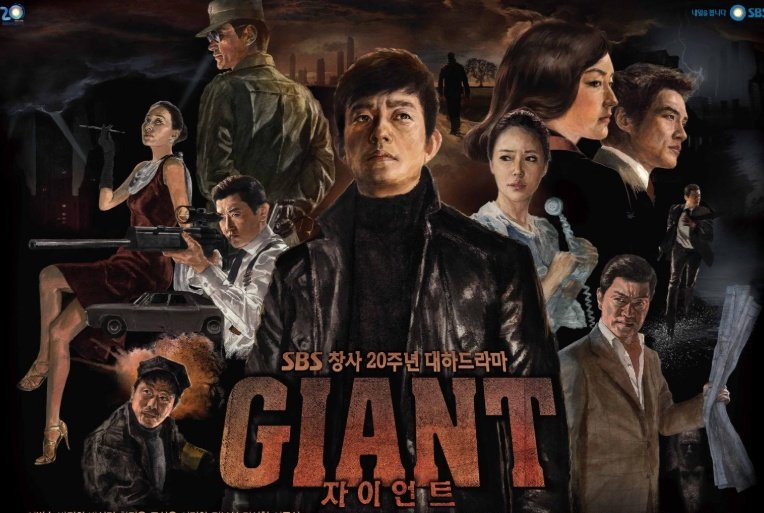
Some dramas tell stories about people who want revenge. Others tell stories about people who want money, power, or a better future. Giant (2010) brings all three ambitions together against the backdrop of South Korea’s rapid transformation during the 1970s and 1980s.
At first glance, it is a family revenge drama about three siblings separated by tragedy. But its deeper question is more complicated: When a person rises from poverty in a society built on corruption and unequal power, can that person achieve success without becoming part of the system that destroyed their family?
That question gives Giant a larger meaning than its revenge plot.
1. A Family Story Set Against the Growth of a Nation
Giant follows Lee Kang-mo, Lee Sung-mo, and Lee Mi-joo, three siblings whose childhood is shattered by violence, betrayal, and the loss of their parents.
Their separation is not simply a personal tragedy. It is connected to powerful people who use political influence, money, and violence to protect their interests.
As the siblings grow older, their lives take different directions. Their individual struggles unfold alongside South Korea’s rapid urban and economic development.
The series uses the family’s story to examine a period when land, construction, political connections, and business opportunities could transform lives.
The city grows. Fortunes are made. But the people who pay the price for that growth are not always the people who benefit from it.
2. Kang-mo’s Promise: Never Be Poor Again
One of the most important moments in Kang-mo’s development is his determination to escape poverty.
After losing his family and experiencing the insecurity of having nothing, he makes a promise to himself: he will never live that way again.
This ambition is understandable. Poverty in Giant is not presented as a simple lack of money. It means vulnerability, humiliation, and having no power when powerful people decide your fate.
Kang-mo’s desire for wealth begins as a desire for security.
But the drama gradually asks whether the pursuit of security can become an obsession. When money is treated as the only protection against injustice, success can become more important than the principles that once guided a person.
Kang-mo’s ambition is therefore both his greatest strength and a source of moral tension.
3. The City Becomes Another Main Character
The title Giant can be understood as more than a reference to an individual or a powerful corporation.
The expanding city itself is the giant.
Land development, construction projects, political decisions, and business competition shape the characters’ lives. Buildings rise, neighborhoods change, and property becomes a source of enormous wealth.
This setting matters because the drama does not treat economic growth as an abstract national achievement.
For some people, development creates opportunity. For others, it creates displacement, exploitation, and new forms of inequality.
The city offers the possibility of a better life, but access to that possibility is not equally distributed.
That contrast gives the series its social dimension.
4. Jo Pil-yeon: A Villain Who Understands the System
Jo Pil-yeon, played by Jeong Bo-seok, is central to the drama’s moral conflict.
He is not simply an antagonist who commits crimes because he enjoys cruelty. He understands how power operates and knows how to use political connections, intimidation, and information to protect himself.
His greatest weapon is not physical strength. It is his ability to make other people operate according to his interests.
This is why he is such an effective opponent for Kang-mo and Sung-mo.
The siblings are trying to overcome the consequences of one man’s actions, but Pil-yeon represents something larger: a system in which powerful people can manipulate institutions and make accountability difficult.
His character also explains why revenge alone cannot easily resolve the conflict.
Removing one powerful individual does not automatically remove the conditions that allowed him to become powerful.
5. Sung-mo: The Cost of Living for Revenge
Lee Sung-mo’s path is different from Kang-mo’s.
Where Kang-mo pursues economic success, Sung-mo becomes deeply involved in the world of political power and intelligence. His life is shaped by the desire to expose and punish the people responsible for his family’s destruction.
His revenge is not merely emotional. It becomes a long-term mission that influences his identity and relationships.
But this commitment comes at a terrible cost.
Sung-mo’s tragedy is that the mission gives his life direction while gradually taking away the possibility of living an ordinary one.
He is not simply a brother who wants justice. He is someone who has allowed the pursuit of justice to consume nearly everything else.
The contrast between the brothers is one of the series’ strongest ideas: one tries to defeat the system through business, while the other tries to defeat it through political and personal struggle.
Neither path is free.
6. Mi-joo: A Different Kind of Survival
Mi-joo’s story adds another perspective to the family narrative.
Her path is not defined by the same direct competition for corporate or political power. Instead, she must navigate a world in which personal relationships, social position, and public identity can determine a person’s opportunities.
Her development also reminds viewers that the siblings do not experience the same tragedy in the same way.
The brothers often express their struggles through ambition, confrontation, and revenge. Mi-joo’s experiences reveal the emotional and personal consequences of a family being torn apart.
She is not merely a supporting figure connecting the two brothers.
Her life is another part of the story’s central question: what does survival mean when the people who should protect you are no longer there?
7. Why Kang-mo and Min-woo Represent Different Ideas of Success
The rivalry between Kang-mo and Jo Min-woo is more than a conventional competition between two men.
Both operate in the business world, but their approaches to power and success are different.
Kang-mo’s ambition is rooted in his experience of poverty. He wants to build something that cannot easily be taken away from him.
Min-woo, on the other hand, is deeply shaped by the powerful family environment in which he grows up. His relationship with his father and his position within the business world influence his decisions.
Their conflict raises a question that remains relevant in modern business culture:
Is success the result of what a person builds, or does it depend on the advantages and connections that person already possesses?
The drama does not present business competition as a fair contest between equally equipped individuals.
The starting point matters. Family background matters. Political influence matters.
And the ability to recover from failure is not distributed equally.
8. The Relationship Between Money and Political Power
One of the most interesting aspects of Giant is how closely business and politics are connected.
Construction projects and land development are not simply commercial activities. They are influenced by government decisions, personal connections, and the distribution of political power.
The drama portrays a world in which money can help people gain influence, while political influence can create opportunities to accumulate even more money.
This creates a cycle that is difficult for outsiders to break.
The story’s historical setting is important here. South Korea’s rapid economic growth created extraordinary opportunities, but the process also involved political and social conflicts.
Giant turns that broad historical background into personal drama.
Instead of asking viewers to memorize economic history, it shows how large decisions can change the lives of ordinary families.
9. Revenge Is Not the Same as Justice
The siblings have a legitimate reason to seek revenge.
Their family was destroyed by people who used power to protect themselves. Their desire to expose the truth is understandable.
But the drama also reveals the limitations of revenge.
Revenge focuses on the person who caused the suffering. Justice must go further. It must establish what happened, expose responsibility, and prevent similar abuses from continuing.
This distinction is especially important in a story where the antagonist has political and institutional connections.
Even if Pil-yeon is punished, the larger question remains: what happens to the world that allowed him to operate for so long?
The series is at its most interesting when it moves beyond the satisfaction of seeing an enemy defeated and asks what meaningful justice would actually look like.
10. Why the Villain Can Sometimes Dominate the Story
Jo Pil-yeon is such a powerful presence that he can overshadow the protagonists.
This is not necessarily a weakness. A convincing antagonist can give a long-running drama its momentum.
Pil-yeon creates the pressure that forces the siblings to make difficult decisions. His influence connects the personal, political, and business conflicts.
However, there is a storytelling risk.
When a villain becomes the center of every major conflict, the heroes can begin to feel as though their lives exist only in reaction to him.
The most compelling moments in Giant are therefore not simply the moments when Pil-yeon makes another move.
They are the moments when Kang-mo, Sung-mo, or Mi-joo make decisions that reveal who they have become independently of their enemy.
11. The Romance Is Secondary to the Family’s Struggle
Giant contains romantic relationships and emotional conflicts, but romance is not the main structure holding the series together.
The central relationship is the bond between the separated siblings.
Their individual experiences create different ideas of loyalty, sacrifice, and responsibility. Even when they are physically apart, their shared history remains the emotional foundation of the drama.
This is one reason the series feels closer to a family saga than a conventional romantic melodrama.
Love matters, but it exists inside a much larger struggle involving survival, ambition, revenge, and the desire to recover what was lost.
The romantic storylines provide emotional contrast without replacing the central family conflict.
12. Why the First Half and Second Half Can Feel Different
A long drama faces a difficult structural challenge: it must maintain momentum after its original conflicts have been established.
A contemporary review of Giant praised its ambitious storytelling and character development, but also argued that the ten-episode extension weakened the momentum of the second half.
That observation is worth considering.
The early story has a clear emotional engine: the destruction of a family and the gradual emergence of three separate lives.
As the story expands, more business rivalries, political schemes, and personal conflicts enter the narrative.
The larger world gives the drama scale, but it also creates the possibility of repetition and slower pacing.
This is an important distinction when evaluating a 60-episode series. A drama can be ambitious and memorable without every episode maintaining the same level of tension.
13. The Historical Background Makes the Story More Than Fiction
The series is set during a period of major transformation in South Korea.
Its world includes political authoritarianism, rapid industrialization, urban expansion, and the growing influence of construction and business interests.
The Korea Times described the drama before its premiere as a story about the country’s boom years, with politics, money, and urban development at the center of its narrative.
The historical setting gives the characters’ ambitions a wider meaning.
Kang-mo does not simply want to become rich. He wants to escape a society in which poverty can make a person powerless.
Sung-mo does not simply want revenge against one individual. His struggle is connected to political structures that protect powerful people.
The siblings’ lives become a way of examining the price of a country’s transformation.
14. What Does the Title Giant Really Mean?
The title can be interpreted in several ways.
It can refer to the enormous city being built around the characters. It can refer to the corporations and political forces that dominate their lives. It can also describe the scale of the ambitions that drive the protagonists.
But there is another interpretation.
Perhaps the real giant is the historical force that individuals cannot control.
Economic development, political change, and the concentration of wealth are larger than any single family. The characters can fight, build businesses, expose corruption, and pursue revenge, but they cannot simply step outside the period in which they live.
The title therefore captures both possibility and helplessness.
People can grow powerful, but they are still living inside a much larger world.
15. Why Viewers Still Remember Giant
The limited Reddit discussion available does not support the claim that Giant has become a major international online phenomenon.
However, the small number of references that do exist are revealing.
In a 2021 discussion asking for older Korean dramas that had aged well, one viewer described Giant as their favorite drama. In a 2025 discussion about older K-dramas, another user included it among the titles worth recommending.
These comments are not enough to establish a broad audience consensus. But they suggest that the series remains memorable for at least some viewers years after its original broadcast.
Its appeal may come from the combination of several elements: a family separated by tragedy, a large-scale revenge story, a memorable antagonist, and a historical setting that gives personal ambition national significance.
Unlike dramas built around a single romantic relationship, Giant offers a world that continues to expand beyond its main characters.
That scale is part of its identity.
16. The Real Question: Can You Build a Better Life Without Repeating the Past?
Kang-mo begins with a simple promise: he will never be poor again.
But the meaning of that promise changes as he becomes more powerful.
At the beginning, wealth represents protection from humiliation and helplessness. Later, it becomes connected to competition, responsibility, and the moral choices required to succeed in a world shaped by corruption.
Sung-mo’s journey reveals a different danger: allowing revenge to become the only purpose of life.
Mi-joo’s experiences remind us that the consequences of injustice are not limited to the people who directly fight against it.
Together, the siblings represent different responses to the same historical wound.
That is why Giant is more than a story about revenge or business success.
It is a drama about people trying to build a future after their past has been destroyed. And it asks whether escaping poverty, defeating an enemy, or becoming powerful is enough to create a genuinely better life.
A person may become a giant in a growing city. But the harder question is whether that person can become greater than the world that once crushed them.
Editorial Note
This analysis draws on the limited Reddit references available, alongside contemporary coverage of the drama and its historical setting. Reddit comments are treated as individual viewer responses, not as proof of universal audience opinion.
Sources
- Reddit: Older Korean dramas that actually aged well
- Reddit: Favorite older K-dramas
- The Korea Times: Drama ‘Giant’ to show Korea’s boom years
- A Koala’s Playground: 2010 Year End K-Drama Reviews