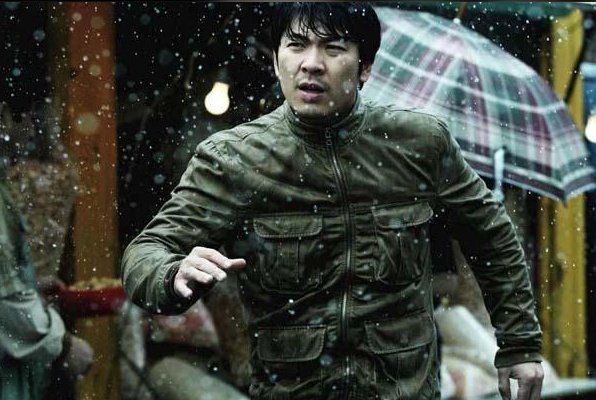
What would you do if the person who kidnapped and killed your child walked free for 15 years—and the law was about to make it impossible to punish him?
In the Korean thriller Montage (2013), Ha-kyung has spent 15 years searching for the person responsible for her daughter’s death. The police investigation failed, the evidence disappeared, and the statute of limitations is about to expire.
Then a flower appears at the original crime scene.
Soon afterward, another child is kidnapped using almost exactly the same method.
Detective Cheong-ho, who investigated the original case, realizes that the past may have returned. But the new kidnapping is not what it first appears to be. Someone has deliberately recreated the old crime, and the person behind it has a deeply personal reason.
Directed by Jeong Geun-seop and starring Uhm Jung-hwa, Kim Sang-kyung, and Song Young-chang, Montage is more than a mystery about identifying a kidnapper. It is a story about grief, guilt, revenge, and the dangerous belief that suffering can somehow settle a debt.
The biggest twist is that the man who appears to be the latest victim of a kidnapping has been hiding the truth about the original crime for 15 years.
Here is the complete story and ending explained.
1. What Is Montage (2013) About?
Fifteen years ago, a young girl named Seo-jin was kidnapped and murdered.
Her mother, Ha-kyung, never recovered from the loss. Detective Oh Cheong-ho, who led the original investigation, also carries guilt because he failed to catch the criminal.
As the statute of limitations approaches its expiration, someone leaves a flower at the location connected to the old case.
Cheong-ho recognizes the significance of the gesture. Only a small number of people know the details of the original crime scene.
Then another child, Bom, disappears.
The new kidnapping follows several details of Seo-jin’s case, including the methods used to communicate with the family and arrange the ransom exchange.
The police suspect that the original kidnapper has returned.
But the truth is much more complicated.
2. Why Does Someone Leave a Flower at the Old Crime Scene?
The flower is the first major clue that the past has not disappeared.
It appears just before the statute of limitations expires, suggesting that the person who left it knows exactly how much time remains.
Cheong-ho understands that this is not an ordinary act of remembrance.
The location is connected to a crime scene known only to the people involved in the original investigation.
The flower therefore suggests that the person responsible may be returning to confront the past.
But the gesture has another meaning.
It is connected to guilt, memory, and the desire to believe that an old crime has somehow been settled.
By the end of the film, the audience learns that the flower is not an expression of genuine remorse. It is part of a private ritual through which the kidnapper tries to convince himself that he has already paid for what he did.
3. Why Is Ha-kyung Still Searching After 15 Years?
Ha-kyung has spent 15 years refusing to accept that her daughter’s case will remain unsolved.
She has collected information, followed possible leads, and kept records of people who might be connected to the kidnapping.
Her home reflects how completely the crime has taken over her life.
For most people, 15 years is a long period in which memories gradually become less immediate.
For Ha-kyung, the passage of time has not brought closure.
Her daughter is still missing from her everyday life, and the person responsible has never been punished.
When Cheong-ho tells her that the statute of limitations is about to expire, she reacts with anger and disbelief.
She cannot accept that the law may soon close the case while the person who destroyed her family remains free.
Her obsession is not simply about identifying a criminal.
It is about refusing to let the world treat her daughter’s death as something that can eventually be forgotten.
4. Why Does Detective Cheong-ho Feel Guilty?
Cheong-ho was the detective responsible for the original kidnapping investigation.
He worked on the case intensely but never identified the criminal.
The failure has stayed with him for 15 years.
When the new kidnapping occurs, he is brought back into the investigation because the method resembles the old case.
He recognizes details that younger investigators might overlook.
But his involvement is emotional as well as professional.
He knows what happened to Seo-jin, remembers Ha-kyung’s suffering, and understands that the new case may be his final opportunity to correct the failure.
The film presents him as a detective who has never completely left the original crime behind.
His guilt is different from Ha-kyung’s grief, but both are trapped in the same past.
5. Why Does the New Kidnapping Look Exactly Like the Old One?
The new kidnapping appears to repeat the methods used 15 years earlier.
The criminal communicates with the family, gives instructions for the ransom exchange, and uses details that remind investigators of the original case.
The police begin comparing the two crimes.
The similarities are too specific to dismiss as coincidence.
But the audience should ask a different question:
Why would the original kidnapper repeat a method that has already attracted police attention?
The answer is that the second kidnapping is not simply an attempt to collect money.
It is a deliberate reconstruction of the first crime.
Someone wants another person to experience the same fear and helplessness that Ha-kyung experienced when Seo-jin disappeared.
6. Who Is Han-cheol?
Han-cheol is an elderly grandfather whose granddaughter, Bom, is kidnapped while he is looking after her.
At first, he appears to be another devastated family member.
He is desperate to get Bom back and cooperates with the police investigation.
His emotional reactions make him appear completely believable as a victim.
But the film quietly plants clues that his story does not fully add up.
The circumstances surrounding Bom’s disappearance contain inconsistencies.
His behavior and the timing of certain events become increasingly important as the investigation develops.
The central mystery gradually changes from identifying the person who kidnapped Bom to understanding why Han-cheol’s family is connected to the old case.
7. Why Does the Police Investigation Focus on Han-cheol?
The investigators begin examining the details surrounding Bom’s disappearance.
One important inconsistency concerns the timing.
Han-cheol’s family does not report the kidnapping immediately, and the investigators begin questioning the explanation for the delay.
The police also discover details connecting the location and circumstances of the new crime to the original kidnapping.
Meanwhile, Ha-kyung is conducting her own investigation.
She has spent years collecting information and has become increasingly familiar with the people and circumstances surrounding the old case.
Her investigation leads her toward Han-cheol.
The clues begin to reveal that he may not simply be a grandfather whose granddaughter has been taken.
He may be the person who took Seo-jin 15 years earlier.
8. What Is the Connection Between Han-cheol and Seo-jin?
The major revelation is that Han-cheol was the original kidnapper.
Fifteen years earlier, he abducted Seo-jin to obtain ransom money.
His motive was connected to his own daughter, who urgently needed heart surgery.
He needed money to save her life and chose to obtain it by kidnapping another family’s child.
This is the uncomfortable truth at the center of the film.
Han-cheol was not motivated by the desire to hurt Seo-jin.
He wanted money.
But his desperation does not change what he did.
He turned an innocent child into a bargaining tool, and the consequences were irreversible.
The man who now appears to be a grandfather suffering through a kidnapping is the same person who once caused Ha-kyung to lose her daughter.
9. Why Did Han-cheol Kidnap Seo-jin?
Han-cheol explains that his daughter was seriously ill and needed an expensive heart operation.
He believed that the ransom money would allow him to save her.
He insists that he never intended to kill Seo-jin.
His justification is that he only wanted the money and planned to release the child afterward.
This explanation reveals his moral blindness.
He viewed the kidnapping as a desperate solution to his own family’s emergency.
He focused entirely on the child he wanted to save and ignored the life he was destroying in another family.
In his mind, he was a father trying to protect his daughter.
But to Ha-kyung, he was the man who took away hers.
The film does not deny the desperation behind his decision. It asks whether desperation can ever justify making an innocent child pay the price.
10. Did Han-cheol Intend to Kill Seo-jin?
This is an important distinction in the ending.
Han-cheol insists that he did not plan to murder Seo-jin.
During the kidnapping, Seo-jin tried to escape.
She panicked and ran, eventually falling to her death.
According to Han-cheol, her death was an accident rather than the result of a deliberate plan to kill her.
But this explanation does not make him innocent.
He created the situation that placed a child in danger.
He abducted her, deprived her of her freedom, and forced her into a terrifying situation from which she attempted to escape.
Even if he did not intend the fatal fall, he was responsible for the circumstances that led to it.
This is why the film’s moral conflict is more complicated than a simple distinction between an intentional murderer and an innocent man.
Han-cheol wants the audience to judge him by what he intended.
Ha-kyung judges him by what he did and what she lost.
11. Why Does Ha-kyung Kidnap Bom?
After discovering Han-cheol’s identity, Ha-kyung decides to recreate the crime.
She kidnaps Bom, Han-cheol’s granddaughter, using methods that resemble the original abduction.
Her purpose is not simply to collect ransom money.
She wants Han-cheol to experience the terror of not knowing where a child is, whether she is alive, or whether she will ever come home.
She believes that making him suffer the same way may force him to confess.
This is the film’s central reversal.
The grieving mother becomes a kidnapper.
The original kidnapper becomes a desperate grandfather.
The roles have been reversed, but the suffering has not disappeared.
Ha-kyung is no longer waiting for the police to deliver justice. She has decided to create her own version of it.
12. Why Doesn’t Ha-kyung Kill Han-cheol?
Ha-kyung has opportunities to confront Han-cheol directly.
She even reaches a point where she could use violence against him.
But her objective is not simply to kill him.
She wants him to admit what he did.
She wants him to experience the fear and uncertainty that she endured for 15 years.
More importantly, she wants the truth to become impossible to deny.
Killing him would end his life, but it would not necessarily produce the confession she has spent years seeking.
By taking Bom, Ha-kyung forces him to confront the same emotional situation he once created for another parent.
Her plan is cruel and morally wrong, but the film makes the emotional motivation understandable.
That tension is what makes her character so difficult to judge.
13. Why Does Cheong-ho Confront Han-cheol About the Flower?
Cheong-ho eventually confronts Han-cheol with the truth.
He remembers the flower placed at the original crime scene.
He interprets it not as genuine remorse but as an attempt by Han-cheol to congratulate himself for escaping the past.
Cheong-ho accuses him of believing that leaving a flower somehow settled his debt.
The confrontation is one of the film’s most important moral moments.
Han-cheol has apparently convinced himself that he has already paid for his crime.
He saved his daughter, the original case remained unsolved, and years passed without punishment.
The flower allows him to imagine that he can acknowledge the past without accepting responsibility for it.
Cheong-ho rejects this idea.
A symbolic gesture cannot undo the suffering of the victim’s family.
And forgiveness is not something the person responsible can simply grant to himself.
14. Why Does Han-cheol Finally Confess?
When Cheong-ho confronts Han-cheol, he does not merely accuse him of kidnapping Seo-jin.
He exposes the contradiction in Han-cheol’s self-image.
Han-cheol sees himself as a father who did whatever was necessary to save his daughter.
But he refuses to see himself as the cause of another family’s destruction.
Cheong-ho forces him to confront that contradiction.
Han-cheol eventually admits that he kidnapped Seo-jin to obtain the ransom money for his daughter’s heart surgery.
He also admits that Seo-jin died after attempting to escape.
His confession finally reveals the truth that Ha-kyung and Cheong-ho have been seeking for 15 years.
But there is another problem.
Bom is still missing.
The confession alone cannot bring her home.
15. How Is Bom Rescued, and What Happens to Han-cheol?
After obtaining Han-cheol’s confession, Cheong-ho learns where Bom is being held.
He receives information about a hidden room at a reservoir warehouse.
The police move to rescue her.
This creates a final conflict between the emotional demands of justice and the immediate need to protect an innocent child.
Ha-kyung’s plan has forced Han-cheol to confess, but Bom must not become another victim of the cycle of revenge.
The police find her and bring her back safely.
Han-cheol is subsequently sentenced to 15 years in prison for the original kidnapping.
His punishment comes after 15 years of avoiding responsibility.
But the film does not present the sentence as a perfect restoration of justice.
Seo-jin cannot return.
Ha-kyung cannot recover the childhood she lost with her daughter.
And Bom has been placed in danger because of the actions of adults.
The truth has finally emerged, but the damage cannot be undone.
16. Montage Ending Explained: Why Does Ha-kyung Take a Photograph of Bom?
The final scene is quiet compared with the tension of the kidnapping and police investigation.
Ha-kyung visits the place connected to her daughter Seo-jin’s memory.
She speaks to Seo-jin and then asks Bom to stand beside her so they can take a photograph.
This moment is easy to misunderstand.
Ha-kyung is not simply replacing her daughter with another child.
Bom is the granddaughter of the man who kidnapped Seo-jin, but she is also an innocent child who has become caught in the revenge of adults.
By bringing Bom into the final scene, the film creates a contrast between two generations.
Seo-jin was the child Ha-kyung lost.
Bom is the child who was returned.
The photograph does not erase the past or make Ha-kyung’s grief disappear.
Instead, it suggests that she can recognize the humanity of a child who is connected to the person who destroyed her family.
There is also an important difference between Ha-kyung and Han-cheol.
Han-cheol used the ransom money to save his own daughter and convinced himself that the debt was settled.
Ha-kyung has an opportunity to continue the cycle of revenge, but the final image suggests that she is choosing not to define Bom by her grandfather’s crime.
The photograph becomes a small gesture of closure.
It is not forgiveness for Han-cheol.
It is a moment in which Ha-kyung allows a child to remain a child, rather than another instrument of revenge.
Is There a Post-Credits Scene in Montage?
There is no additional narrative scene after the credits that changes the story.
The final photograph of Ha-kyung and Bom is part of the film’s actual ending.
It is the emotional conclusion to the story, not a separate post-credits reveal.
What Does the Title Montage Mean?
The title has two connected meanings.
In filmmaking, a montage combines separate images or moments to create a larger sequence.
That idea reflects the structure of this film.
The audience receives fragments of the past and present. Some scenes appear to be happening at the same time, but their actual chronological relationship is not immediately clear.
As new information emerges, the audience must rearrange those fragments to understand what really happened.
The title also reflects the investigation itself.
Cheong-ho and the other investigators must assemble scattered clues, memories, and inconsistencies into a complete picture of the crime.
But the deeper meaning is emotional.
Ha-kyung, Cheong-ho, and Han-cheol have each been living with fragments of the same event for 15 years.
Only when the truth is assembled can they begin to understand the full consequences of what happened.
The Real Question Behind Montage
Montage begins with a question about an unsolved kidnapping.
But it ends with a much more difficult question:
Can someone who committed a terrible crime ever convince themselves that their actions were justified simply because they were trying to save someone they loved?
Han-cheol believed he was protecting his daughter.
Ha-kyung believed that making him suffer would finally bring justice.
Both acted out of love for a child, but their choices endangered another innocent child.
The film does not suggest that their motives make their actions equal. Han-cheol caused the original tragedy, and Ha-kyung’s revenge was a response to that injustice.
But it shows how easily grief and desperation can create another cycle of harm.
The most meaningful image is not Han-cheol being sentenced to prison.
It is Ha-kyung standing beside Bom and taking a photograph.
After 15 years, she still cannot recover Seo-jin.
But she can decide that another child should not have to pay for the sins of an adult.
That is the quietest—and perhaps the most important—resolution in Montage.