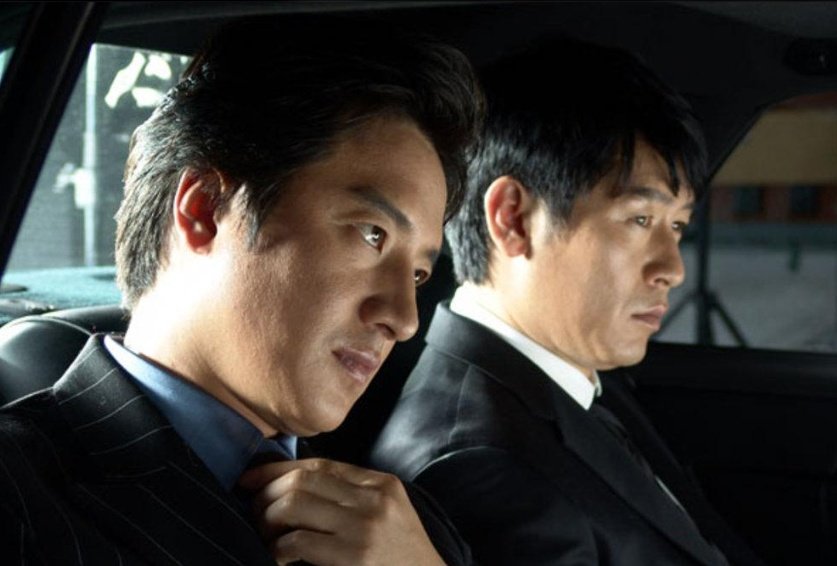
“Don’t you know? Money is stronger than the law.”
That statement captures the worldview of Han Sang-woo, the wealthy chairman of an influential educational foundation in the Korean crime drama Another Public Enemy (2005).
To him, money is not simply a way to enjoy a comfortable life. It is a weapon that can purchase influence, silence opposition, and turn the legal system into something he believes he can control.
But Kang Chul-jung, a prosecutor who would rather chase criminals in the streets than sit behind a desk, refuses to accept that idea.
Their conflict is personal as well as professional. They attended the same high school, know each other’s history, and have followed very different paths.
Directed by Kang Woo-suk and starring Sul Kyung-gu and Jung Joon-ho, Another Public Enemy changes the original film’s formula. Instead of a corrupt detective pursuing a serial killer, this story follows a prosecutor confronting a powerful businessman whose wealth and social position appear to place him beyond the reach of justice.
The central question is not simply whether Kang can arrest Han.
It is whether the law can still function when the person being investigated has enough money and influence to manipulate the people enforcing it.
Here is the story, the hidden conflict between the two former classmates, and the ending explained.
1. Who Is Kang Chul-jung in Another Public Enemy?
Kang Chul-jung, played by Sul Kyung-gu, is a prosecutor who does not behave like the typical image of a government official.
He dislikes sitting in an office reading documents. He prefers visiting crime scenes, conducting stakeouts, and confronting suspects directly.
He is loud, impatient, physically aggressive, and often difficult for his colleagues to manage.
But he has one defining principle: he does not want criminals to escape simply because they have money or connections.
His methods are sometimes questionable, but his commitment to pursuing wrongdoing is genuine.
This time, however, he is not chasing an ordinary criminal.
His target is Han Sang-woo, a former high school classmate who has become the chairman of the Myung-sun Foundation.
2. Who Is Han Sang-woo?
Han Sang-woo, played by Jung Joon-ho, is a wealthy businessman who is about to inherit control of his family’s educational foundation.
He presents himself as a respectable and sophisticated executive.
Unlike street criminals, he does not need to threaten people personally or carry a weapon. His influence comes from money, political connections, and the authority attached to his family’s institution.
But beneath that respectable image is a man who believes other people exist to serve his interests.
He is connected to suspicious deaths, financial misconduct, and attempts to protect his position through bribery and intimidation.
His greatest weakness is also his greatest confidence: he believes that his wealth makes him untouchable.
3. Why Are Kang and Han Enemies Despite Being Old Classmates?
Kang and Han attended the same high school for three years.
They knew each other before either man entered the world of law enforcement or business.
Han was already accustomed to receiving special treatment because of his family’s wealth and influence.
Kang, by contrast, never accepted the idea that social status should determine how people are treated.
Their old relationship gives the conflict an additional dimension.
Kang is not investigating a stranger whose background he knows only through documents. He remembers the person Han was at school and recognizes the same sense of entitlement in the man he has become.
For Han, the investigation is not merely a legal inconvenience.
It is an attack by someone who once knew him and now refuses to show him the respect he believes his position deserves.
4. Why Does Kang Investigate the Myung-sun Foundation?
The case begins with suspicious circumstances surrounding the death of the foundation’s eldest son.
The eldest son was expected to inherit control of the family institution.
But after an accident leaves him critically injured, Han becomes the likely successor. When the elder brother eventually dies, questions arise about the circumstances of his accident and the interests surrounding the succession.
Kang senses that something is wrong.
Although the investigation is not initially his direct responsibility, he becomes increasingly involved.
The foundation’s financial activities and the suspicious deaths connected to its leadership create a much larger picture than a simple family dispute.
Kang realizes that the case may involve a criminal structure protected by wealth and influence.
5. What Happened to Han Sang-woo’s Father and Brother?
The family succession is central to Han’s rise.
His father founded the educational institution, and the eldest son was expected to inherit control.
But the father’s death and the elder brother’s fatal accident create an opportunity for Han to take over.
The timing raises serious questions.
Han’s position becomes stronger precisely as the people who stood between him and control disappear.
The film gradually presents him as someone willing to remove obstacles rather than accept the limits imposed by family, law, or morality.
His ambition is not simply to become chairman.
He wants complete control over the foundation and the wealth attached to it.
6. Why Does Han Believe Money Is Stronger Than the Law?
Han’s famous statement about money and the law is not merely a boast.
It describes the way he understands society.
He believes that legal institutions are operated by people, and people can be influenced by money, favors, fear, and personal ambition.
If a politician can be bribed, a public official can be pressured, and a witness can be silenced, then the law becomes something that can be negotiated.
Han sees no reason to respect rules that he believes can be manipulated.
This is the central ideological conflict of the film.
Kang believes the law must be applied regardless of the suspect’s social position.
Han believes social position determines whether the law can reach someone at all.
7. Why Does Han Kill the Street Cleaner?
One of the film’s most revealing scenes involves an elderly street cleaner.
Han throws a cigarette butt from his car. The cleaner politely warns him that the cigarette could start a fire among the fallen leaves.
Instead of accepting the warning, Han becomes irritated.
He deliberately drives into the elderly man and kills him.
What makes the scene especially disturbing is Han’s attitude afterward.
He does not behave like someone who has committed a terrible crime. He treats the victim as an insignificant person who dared to inconvenience him.
The scene reveals the logic behind Han’s character.
He does not simply want money.
He believes that people with less wealth and status have less value.
The street cleaner’s death is a small but powerful example of what happens when someone views social hierarchy as a justification for cruelty.
8. Is Kang Investigating Han for Justice or Personal Revenge?
This is one of the film’s more interesting questions.
Kang’s investigation is based on legitimate suspicions, but his personal history with Han complicates his motives.
They were classmates.
Kang remembers Han’s behavior and has little respect for the privileged world he represents.
As the investigation becomes more intense, Kang’s determination sometimes looks less like detached prosecutorial work and more like a personal confrontation.
This creates a moral tension.
Can a prosecutor remain objective when the suspect is someone he already dislikes?
The film does not pretend that Kang is a perfectly neutral investigator.
His personality is emotional and confrontational.
But the important distinction is that Han’s crimes are not invented simply because Kang dislikes him. The investigation uncovers serious wrongdoing that demands legal accountability.
9. Why Does Han Use His Political Connections?
Han understands that the investigation cannot be stopped through ordinary intimidation alone.
He has relationships with influential people and uses money to protect his position.
His connection to a powerful political figure, the vice president, becomes particularly important.
Through bribery and pressure, Han attempts to influence decisions that should be made independently by the legal system.
The film shows how corruption can operate without looking like an obvious criminal transaction.
A powerful businessman does not always need to order someone to break the law.
Sometimes he only needs to make the right person believe that helping him is more profitable than opposing him.
10. Why Does Kang’s Investigation Become Dangerous?
As Kang gets closer to the truth, the people around him become targets.
The investigation threatens not only Han’s personal freedom but also the network of interests protecting him.
Kang’s colleagues face pressure, and the people assisting the investigation discover that their professional positions do not necessarily protect them.
The death of prosecutor Kang Seok-shin is especially important.
He is attacked after Han’s side arranges an assault intended to disrupt the investigation.
His death demonstrates that the conflict has moved beyond a courtroom dispute.
Han is willing to use violence when money and influence are no longer enough.
For Kang, the case has now become personal in a different way: his colleagues are paying for his decision to keep pursuing the truth.
11. Why Does Han Think He Can Escape?
Han’s confidence comes from his belief that every problem has a price.
He has money, political connections, and people willing to carry out dangerous orders for him.
Even when the investigation begins to close in, he believes he can still escape.
His relationship with the vice president becomes a major part of his plan.
He uses his influence to remove the restrictions that might prevent him from leaving the country.
In Han’s mind, the investigation is simply another obstacle that can be overcome through negotiation.
He does not fully understand that some people in the prosecution service are prepared to risk their careers to stop him.
12. Why Does Kang’s Own Department Struggle to Support Him?
Kang’s methods create problems inside the prosecution service.
He is not the kind of prosecutor who quietly follows the hierarchy.
He confronts superiors, ignores conventional procedures, and creates situations that other officials must explain.
Some colleagues worry about his methods.
Others recognize that the case is too important to abandon.
This tension is important because the film does not portray the justice system as a single unified institution.
There are people who want to protect their careers, people who fear political consequences, and people who believe that the law must be enforced even when powerful individuals are involved.
The final confrontation becomes possible because some of Kang’s colleagues eventually decide that protecting the investigation matters more than protecting their own positions.
13. Why Does Han’s Own Subordinate Become Important?
Song Jung-hoon, one of the people working for Han, becomes a crucial part of the final sequence.
For much of the story, Han treats the people around him as useful tools.
They are valuable only as long as they protect his interests.
But when Han’s position becomes dangerous, the limits of that loyalty become clear.
Song’s information about Han’s plan to leave the country becomes decisive.
This is one of the film’s most important ironies.
Han believes money can buy loyalty, but his treatment of the people around him has created a situation in which they have little reason to protect him.
The person he considers useful becomes one of the reasons his escape fails.
14. Why Does Kang Confront Han at His Home?
When Kang discovers that Han may escape, he realizes that the investigation is running out of time.
Han has managed to influence the political connections necessary to remove his travel restriction.
Kang cannot simply wait for the normal process to catch up.
He goes directly to Han’s home and confronts him.
The two men fight physically, but the confrontation is also a battle over time.
Kang knows that if Han reaches the airport, the investigation may lose its most important suspect.
He keeps Han occupied while other prosecutors work to secure the necessary legal authorization.
It is an unconventional move, but it creates the opportunity for the authorities to act.
15. Another Public Enemy Ending Explained: How Is Han Sang-woo Finally Arrested?
The final arrest is not achieved by Kang alone.
While Kang confronts Han at his home, other prosecutors work to restore the legal measures necessary to stop his departure.
The crucial information about Han’s plan to leave the country comes from Song Jung-hoon.
That testimony helps expose Han’s attempt to escape and gives the prosecution the opportunity to act.
Senior prosecutors also take steps to obtain the necessary authorization.
The authorities arrive, and Han is arrested before he can leave the country.
This is important because the ending does not simply show Kang beating Han in a physical fight.
Kang’s confrontation buys time, but the arrest depends on cooperation within the legal system.
Han’s confidence that money can control everyone finally collapses.
His own network of influence cannot protect him when enough people decide to act against him.
16. What Does the Ending Really Mean? Is Money Stronger Than the Law?
The ending answers Han’s famous statement, but not in a simplistic way.
Money can influence people.
It can buy access, create political relationships, and delay investigations. Han’s ability to manipulate the system for much of the film demonstrates that corruption is not an imaginary threat.
But money cannot guarantee permanent protection.
Han makes one critical mistake: he assumes that everyone around him will continue to serve his interests.
He treats his employees as disposable, uses political figures for his own protection, and believes that people who oppose him can always be intimidated.
Eventually, the people who can expose his escape plan and authorize his arrest act against him.
The film’s message is not that the legal system always works perfectly.
It is that the system cannot function if everyone inside it gives up.
Kang is an imperfect prosecutor. He is aggressive, emotional, and often reckless. Yet his refusal to accept Han’s worldview forces other people in the institution to make a choice.
The final arrest becomes a collective victory rather than the achievement of one heroic individual.
Han Sang-woo believed that money could make him stronger than the law. But his downfall begins when he discovers that not everyone can be bought—and not everyone is willing to remain silent.
Is There a Post-Credits Scene in Another Public Enemy?
There is no widely documented additional narrative scene after the credits that changes the ending.
The main resolution is Han’s arrest and the defeat of his attempt to escape prosecution.
The film also includes brief appearances by familiar characters from the original Public Enemy, but these are part of the main film rather than a separate post-credits story.
Why Another Public Enemy Is Different From the First Film
The first Public Enemy focused on a violent individual criminal and the detective pursuing him.
The sequel changes the scale of the conflict.
Han Sang-woo is dangerous not simply because he is personally violent, but because he operates through institutions, money, and political influence.
Director Kang Woo-suk explained before the film’s release that he wanted to move beyond the idea of an individual psychopath and portray someone whose greed harms society.
That distinction explains the title.
A public enemy is not necessarily the person who commits the most visibly brutal crime.
Sometimes the greater danger is someone whose respectable position allows him to damage many lives while appearing untouchable.
And that is the real question left by Another Public Enemy:
When money can influence the people who enforce the law, who protects ordinary people from those who believe they are above it?