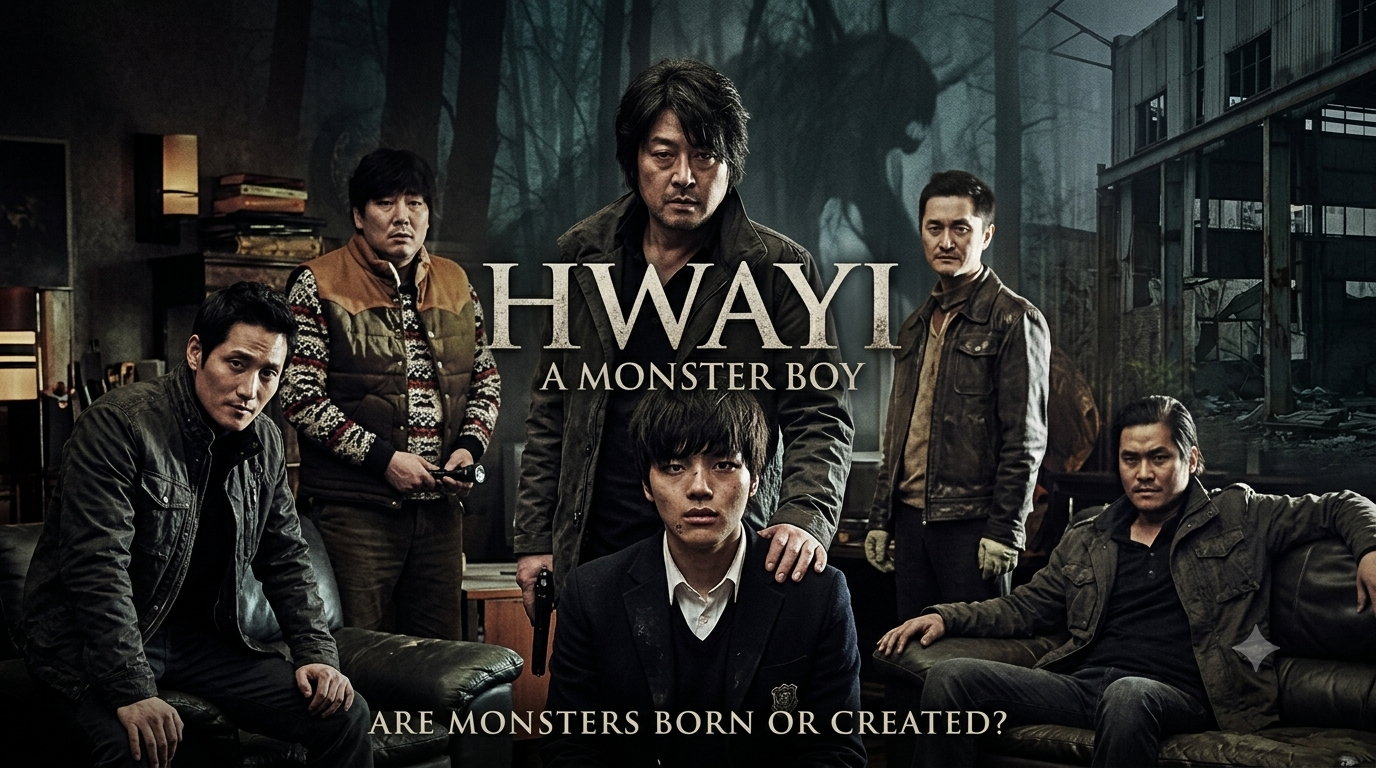
1. A Boy Raised by Five Criminals
At the center of Hwayi: A Monster Boy (2013) is a disturbing question: What happens when a child grows up surrounded by people who teach him that violence is a normal part of life?
Hwayi is kidnapped as a young boy and raised by five criminals. Each man becomes a father figure, but none of them offers him the kind of childhood that allows a child to develop a healthy understanding of the world.
Instead, Hwayi grows up inside a distorted family. He receives attention, instruction, and a form of protection, but the environment surrounding him is built on crime, fear, and violence.
The film initially appears to be a crime thriller about a boy raised by dangerous men. Yet its deeper subject is the formation of human identity.
Hwayi has not simply been taught how to survive. He has been taught what survival means by people whose own lives have been shaped by violence.
This creates the film’s central dilemma: if a child learns the rules of life from monsters, how much of the monster eventually becomes part of the child?
2. Five Fathers, Five Different Lessons About Violence
The five men who raise Hwayi are not interchangeable criminals. Each represents a different personality and a different relationship with violence.
Their differences matter because Hwayi does not receive his worldview from one single authority. He grows up absorbing several competing versions of masculinity, morality, and survival.
Some forms of violence are presented as necessary for protection. Others are connected to professional criminal activity, emotional control, or the ability to dominate another person.
Together, these men create an unusual educational environment.
In an ordinary family, parents help children understand the boundaries between acceptable and unacceptable behavior. In Hwayi’s family, those boundaries are constantly distorted.
The men may believe that they are preparing him for a dangerous world. But what they are actually doing is teaching him to interpret that world through their own damaged experiences.
The tragedy is not simply that Hwayi has five criminal fathers. It is that each father contributes something to the psychological structure of the person Hwayi becomes.
3. When Protection Becomes a Form of Control
One of the film’s most uncomfortable ideas is that the people who claim to protect Hwayi are also the people who have taken away his freedom.
The five men provide him with food, shelter, instruction, and a place within their group. These things can resemble the basic responsibilities of a family.
But genuine protection should increase a child’s ability to live independently. It should allow the child to develop confidence, make choices, and eventually build relationships beyond the family.
Hwayi’s situation is the opposite.
His world is controlled by the men who raised him. They determine what he learns, how he understands danger, and which parts of his past remain hidden.
This creates a fundamental contradiction: the men who present themselves as his family are also responsible for the conditions that prevent him from understanding his own identity.
Protection becomes a justification for control.
The film asks viewers to look beyond the language of affection and examine what the adults actually do to the child in their care.
4. Hwayi’s Monster: A Psychological Image of Fear
The monster that Hwayi sees is one of the film’s most important visual elements.
It appears as a terrifying presence connected to his fear and psychological distress. Rather than functioning only as a conventional horror device, it gives the audience a way to experience the inner conflict that Hwayi cannot easily express.
Children do not always have the language to explain trauma, confusion, or overwhelming fear. Their emotional experiences can appear through images, behavior, and recurring anxieties.
Hwayi’s monster can therefore be interpreted as a representation of something that has become too difficult for him to confront directly.
It is important, however, not to reduce the monster to a simple symbol with only one meaning.
The film leaves room for several interpretations. It can represent fear, suppressed memories, the violence surrounding Hwayi, or the part of himself that he cannot yet understand.
Its significance lies in the fact that the danger is not only outside him.
The monster makes the psychological consequences of his upbringing visible. Hwayi is surrounded by violence, but he is also struggling with the possibility that violence has entered his own sense of identity.
5. Nature Versus Nurture: The Question at the Heart of the Film
One of the oldest questions in psychology and philosophy concerns the relationship between nature and nurture.
Are people born with certain tendencies, or are their personalities primarily shaped by the environments in which they grow up?
Hwayi: A Monster Boy turns this question into a personal crisis.
Hwayi is raised by criminals, taught criminal skills, and surrounded by people who repeatedly demonstrate that violence can solve problems.
It would be easy to conclude that his future is determined by his upbringing.
But that conclusion would make the film much less interesting.
If Hwayi were simply a product of his environment, he would have no meaningful internal conflict. He would become exactly what his fathers intended him to become.
Instead, the film presents a character whose identity is shaped by his surroundings but not completely explained by them.
His reactions, fears, and decisions reveal a struggle between what he has learned and what he might become.
The important question is not whether upbringing influences identity. Clearly, it does. The question is whether a person can recognize the influence of that upbringing and begin to make choices beyond it.
6. The Difference Between Teaching a Skill and Teaching a Moral Code
The men who raise Hwayi teach him practical abilities that help him function in their dangerous world.
But technical ability and moral judgment are two very different things.
A person can learn how to fight without understanding when violence is justified. A person can learn how to recognize danger without developing the ability to trust others. A person can become highly capable while remaining emotionally isolated.
This distinction is central to Hwayi’s development.
His fathers may believe that they are giving him the tools necessary to survive. Yet survival skills do not automatically produce wisdom.
In fact, the more successfully Hwayi learns their methods, the more disturbing the situation becomes.
The adults are proud of the abilities he develops, but they rarely confront the moral consequences of the world they have created for him.
The film therefore raises a question about education itself: what is the value of teaching someone to become powerful if you never teach that person how to use power responsibly?
7. Seok-tae and the Destructive Logic of Authority
Kim Yun-seok’s Seok-tae is particularly important because he represents the commanding force within Hwayi’s unusual family.
He is not simply another criminal who happens to live with the boy. His authority helps define the rules governing the entire group.
Seok-tae’s relationship with Hwayi is shaped by control, expectation, and a complicated sense of responsibility.
This makes their relationship more disturbing than a straightforward conflict between a villain and a victim.
Authority can create emotional dependence. A child may seek approval from the very person who causes his fear. The need for acceptance does not necessarily disappear simply because the person offering it is dangerous.
That contradiction gives Seok-tae’s role much of its psychological weight.
He represents the possibility that a person can exercise authority over a child while convincing himself that his actions are part of raising or protecting that child.
The film exposes the danger of confusing obedience with affection and control with care.
8. The Father’s Responsibility Cannot Be Replaced by Good Intentions
A recurring problem in stories about dysfunctional families is the temptation to judge parents according to what they believe they are doing rather than what their actions actually produce.
The five men may have their own explanations for raising Hwayi as they do. They may believe that their methods are necessary, or that their relationship with him contains genuine affection.
But intention cannot erase responsibility.
A parent is responsible not only for providing material necessities but also for the emotional and psychological environment in which a child develops.
This responsibility becomes especially serious when the adults possess greater knowledge, freedom, and power than the child.
Hwayi cannot choose the circumstances of his childhood. He cannot independently determine which information is hidden from him or which relationships are safe.
The men who control those circumstances therefore carry a responsibility that cannot be transferred to the boy.
The film challenges viewers to distinguish between loving someone and treating that person in a way that genuinely supports their development.
9. A Family Can Exist Without Being a Healthy Family
The relationship between Hwayi and the five men is complicated because it contains elements that resemble family life.
They share a home, routines, memories, and experiences. Hwayi knows them as the people who have raised him.
But the existence of emotional attachment does not automatically make a family healthy.
A family can create loyalty while also producing fear. It can offer a sense of belonging while restricting personal freedom. It can provide affection while teaching destructive values.
This is why Hwayi’s situation is so psychologically complicated.
He cannot simply look at the five men as strangers. They are deeply connected to his memories and his understanding of himself.
Yet recognizing that connection does not require him to accept their behavior.
The film suggests that family should not be defined only by the length of time people have lived together or the emotional bonds they claim to share.
The more important question is whether those relationships allow individuals to grow without being controlled, manipulated, or harmed.
10. The Truth About the Past Changes the Meaning of the Present
As Hwayi’s understanding of his own history begins to change, the meaning of his relationship with the five men also changes.
Information that was hidden from him becomes increasingly important. The identity he has accepted throughout his childhood is no longer sufficient to explain his experiences.
This is a powerful narrative turning point because the revelation does more than provide new information.
It forces Hwayi to reconsider the foundation of his entire life.
People often understand themselves through stories told by family members. These stories explain where they came from, why certain events happened, and what relationships mean.
But what happens when the people who created those stories were also responsible for hiding the truth?
The result is not merely surprise. It is a crisis of identity.
Hwayi must confront the possibility that the people who taught him how to understand the world also manipulated his understanding of himself.
The film uses this crisis to transform a crime thriller into a story about the psychological consequences of concealed history.
11. Can a Victim Become Responsible for His Own Violence?
This is one of the most difficult moral questions raised by the film.
Hwayi is clearly shaped by circumstances he did not choose. His childhood is controlled by adults who expose him to a destructive environment.
But as he grows older, he also becomes capable of making decisions.
The film’s moral tension exists between these two realities.
If we judge Hwayi only by his actions, we risk ignoring the conditions that shaped him. If we judge him only as a victim, we risk denying his developing ability to make choices.
Neither extreme is sufficient.
A person’s past can explain why certain behaviors develop, but explanation is not the same as justification.
At the same time, responsibility should not be discussed as if everyone begins life with equal opportunities, knowledge, and freedom.
Hwayi’s story makes this distinction especially important. His actions cannot be understood without examining the people who shaped his world, but his identity cannot be reduced entirely to their influence either.
The film’s strongest moral question emerges from this tension: how does someone take responsibility for a life that was shaped by decisions made before he was old enough to understand them?
12. Violence Becomes a Language When Other Forms of Communication Disappear
In Hwayi’s world, violence is not an occasional interruption of ordinary life. It is a language that the adults around him understand and repeatedly use.
Threats communicate authority. Physical force settles conflicts. Fear becomes a method of controlling relationships.
When a child grows up in such an environment, violence can begin to appear normal.
This does not mean that every child exposed to violence will become violent. Human development is more complicated than that.
But repeated exposure can distort a person’s understanding of conflict, trust, and personal boundaries.
The film illustrates how an environment can teach destructive responses long before a person has the emotional tools to question them.
It also suggests that violence damages more than the immediate victim. It changes the relationships surrounding the event and can influence the next generation.
This is how violence reproduces itself.
One person uses force to solve a problem. A child observes the result. Later, that child may understand force as an ordinary method of dealing with the world.
The cycle continues unless someone recognizes that the inherited language is not the only language available.
13. Why the Film’s Twist Is More Than a Thriller Device
The revelations in Hwayi: A Monster Boy are important not simply because they surprise the audience.
A conventional thriller twist changes what viewers know about the plot. A more meaningful twist changes how viewers understand the characters and their relationships.
That is the more interesting way to approach this film.
When new information changes the meaning of Hwayi’s past, the audience must reconsider the apparent family structure that has shaped the story.
Earlier scenes acquire different emotional implications. Relationships that once seemed understandable become more disturbing. The audience is forced to question how much of Hwayi’s identity was built on incomplete or manipulated information.
This is why the film should not be reduced to a simple discussion of whether its ending is shocking.
The deeper question is what the revelation does to the meaning of childhood, family, and responsibility.
A good twist surprises the viewer. A meaningful twist also makes the viewer reinterpret everything that came before it.
14. The Real Monster May Be the Environment That Created Him
The title A Monster Boy invites viewers to consider whether Hwayi himself is becoming a monster.
But there is another possibility: perhaps the film is asking us to examine the environment that produced the fear and violence surrounding him.
The monster can be understood as an image of the psychological damage created by that environment. The five fathers represent different forms of influence, and their combined presence creates a world in which violence is constantly normalized.
This does not mean that Hwayi has no responsibility for his choices.
Rather, it means that judging the boy without examining the adults would be an incomplete interpretation of the story.
The film directs attention toward the people who had the power to shape his childhood and the decisions they made.
Its most unsettling idea is that the monster may not appear from nowhere. It may develop gradually through repeated experiences, distorted relationships, and the absence of a healthy alternative.
A society often focuses on the dangerous individual who eventually emerges. It pays less attention to the environment that helped create that individual.
Hwayi’s story challenges that habit.
15. Are Monsters Born, or Created by the People Who Raise Them?
Hwayi: A Monster Boy is ultimately a film about the complicated relationship between identity, upbringing, and responsibility.
Hwayi is raised by five criminals who each contribute to his understanding of the world. They teach him how to survive, but they also surround him with violence and conceal important truths about his life.
Their influence shapes him, yet it does not completely determine who he must become.
This is what makes the character more than a simple product of his environment.
His struggle is not only against the people who raised him. It is also against the possibility that their values have become part of his own identity.
The film’s title becomes more meaningful when viewed from this perspective.
The question is not simply whether Hwayi has become a monster. It is how a child comes to recognize the difference between the world he inherited and the person he chooses to be.
The five men may have given him the skills to survive in their world. But they cannot automatically decide what kind of human being he must remain.
Perhaps the most disturbing truth in the film is that monsters do not always appear fully formed.
Sometimes they are created through years of ordinary decisions made by people who believe they know what is best for a child.
And sometimes the hardest part of escaping that world is learning that the lessons that once helped you survive may be the very things you must unlearn.