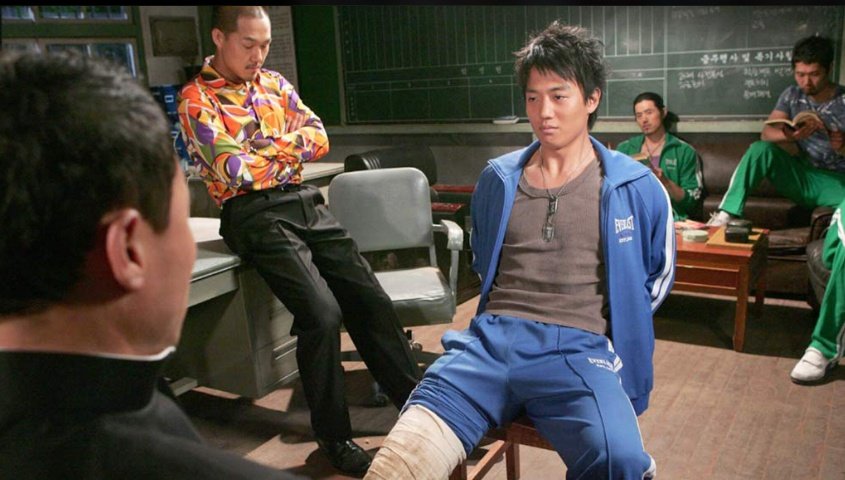
Mr. Socrates (2005) is a South Korean crime-action comedy built around one outrageous idea: What if a criminal organization kidnapped a street thug and forced him to become a police detective?
Starring Kim Rae-won as Ku Dong-hyuk, the film follows a man with almost no conscience who is kidnapped and subjected to brutal training. His captors do not want to turn him into a better person. They want to place him inside the police force as their own undercover connection.
But their plan creates an unexpected problem.
The longer Dong-hyuk works as a police officer, the more he begins to understand what it means to be responsible for someone other than himself.
The film’s ending asks a bigger question than whether a gangster can pass a police examination: Can someone who was trained to serve criminals eventually choose to serve justice?
Here is the plot, the character motivations, and the ending of Mr. Socrates explained.
1. What Is Mr. Socrates (2005) About?
Directed by Choi Jin-won, Mr. Socrates was released in South Korea on November 10, 2005. It runs for approximately 109 minutes and combines crime, action, and dark comedy.
The story follows Ku Dong-hyuk, a violent street thug who steals from friends, threatens people, and has little respect for anyone.
One night, a mysterious criminal organization kidnaps him.
Instead of simply killing him or recruiting him as another gangster, the organization puts him through an extreme educational and physical training program.
Its objective is unusual: Dong-hyuk must become a police detective and work inside the police force as the organization’s secret connection.
2. Who Is Ku Dong-hyuk?
Ku Dong-hyuk is introduced as a deeply selfish man.
He does not have a strong sense of responsibility, and his relationships are based largely on what he can gain from other people.
He even treats his imprisoned father as a source of money rather than someone deserving respect.
Dong-hyuk is not a criminal mastermind. He is a street-level thug whose violent instincts have allowed him to survive without thinking much about the consequences of his actions.
That makes him an interesting choice for the organization.
He already knows the criminal world, but he has no meaningful loyalty to the police or any established moral code.
The organization believes that a man like this can be shaped into a useful tool.
3. Why Does the Criminal Organization Kidnap Him?
The organization is looking for someone who can enter the police force and provide information from inside.
A conventional gangster might attract suspicion. A person with no police background would also struggle to become a detective.
But the organization believes it can solve both problems by taking control of Dong-hyuk’s life and forcing him through an intensive training process.
The plan is simple in theory:
- Kidnap Dong-hyuk.
- Force him to study and train.
- Make him pass the necessary examinations.
- Place him inside the police organization.
- Use him as an informant and connection.
The irony is that the organization is effectively manufacturing a police officer for criminal purposes.
4. Who Is Beom-pyo, and Why Does He Train Dong-hyuk?
Beom-pyo, played by Kang Shin-il, is the man responsible for Dong-hyuk’s education and training.
He is not a conventional teacher.
His methods are violent, intimidating, and often absurd. Dong-hyuk is forced to study under conditions designed to break his resistance.
Beom-pyo understands that simply threatening Dong-hyuk will not be enough.
He must turn an undisciplined thug into someone capable of passing examinations and surviving inside a police department.
Their relationship becomes one of the film’s central comic elements.
Dong-hyuk hates Beom-pyo, but the man who terrorizes him is also the person who gives him the knowledge and discipline he never had.
5. Why Does Dong-hyuk Have to Study So Hard?
The training is not just about physical strength.
Dong-hyuk must acquire the knowledge required to enter the police force. He has to study subjects that he previously had no interest in, while also learning how to behave in a completely different environment.
The organization is not interested in educating him for personal development.
It needs a functioning police officer who can be controlled.
That distinction makes the training particularly disturbing.
Dong-hyuk is being educated, but he has no freedom to decide what kind of person he wants to become.
The film turns the familiar idea of studying hard to achieve a dream into a criminal organization’s forced recruitment program.
6. Why Does Dong-hyuk Keep Trying to Escape?
Dong-hyuk initially sees the training as another form of imprisonment.
He does not understand why he has been chosen, and he certainly does not want to become a police officer.
His attempts to escape repeatedly fail.
Each failure leads to harsher treatment and more intense training.
The situation is darkly comic because Dong-hyuk is a man accustomed to using violence against others, but now he is completely powerless against the people controlling him.
For the first time, he experiences what it means to be trapped by someone else’s decisions.
7. How Does Dong-hyuk Become a Police Detective?
After enduring the training, Dong-hyuk succeeds in entering the police force.
He is assigned to work under Detective Shin Tae-seop, played by Lee Jong-hyuk.
From the organization’s perspective, the mission has succeeded.
Dong-hyuk now has access to police information and can potentially help the criminals avoid investigation.
But becoming a police officer changes the environment around him.
He is no longer dealing only with gangsters who understand violence and intimidation. He is also surrounded by people who operate according to professional duties, investigations, and the law.
The difference gradually forces him to reconsider his position.
8. Who Is Detective Shin Tae-seop?
Shin Tae-seop is Dong-hyuk’s superior inside the police force.
He represents the professional police environment that Dong-hyuk has entered.
Unlike Beom-pyo, who trains Dong-hyuk for the criminal organization’s purposes, Shin expects him to function as a real detective.
Their relationship is complicated because Dong-hyuk is hiding the reason he became a police officer.
Shin does not simply accept him as a trustworthy colleague.
As the investigation develops, he begins to suspect that Dong-hyuk has a connection to the criminals they are pursuing.
This suspicion eventually becomes central to the final confrontation.
9. Who Is Han-doo, and What Is His Connection to Dong-hyuk?
Han-doo, played by Park Sung-woong, is connected to the criminal organization surrounding Dong-hyuk.
He is one of the people who helped shape Dong-hyuk’s training and understands the criminal world from which Dong-hyuk came.
Their relationship becomes particularly important when Dong-hyuk needs information about the organization.
The man who once had power over Dong-hyuk eventually becomes someone Dong-hyuk can use to uncover the criminal group’s operations.
This reversal reflects how much Dong-hyuk’s position has changed.
He is no longer merely a victim of the organization’s control.
He has begun using the skills and knowledge he gained to act against the people who trained him.
10. Why Does Dong-hyuk Become Involved in the Investigation Against Tae-chun?
The criminal investigation eventually focuses on Jang Tae-chun and his organization.
Dong-hyuk is placed in a difficult position.
The gang expects him to protect its interests from inside the police force, but his work increasingly brings him into direct conflict with the criminals.
Beom-pyo also leaves him an important clue involving drugs disguised as Viagra.
This information becomes part of the effort to expose the organization.
The situation puts Beom-pyo in serious danger, showing that the criminal group is willing to eliminate even people who once helped build its operation.
Dong-hyuk must now decide whether he will continue following the organization’s orders or use his position to help bring it down.
11. Why Does Dong-hyuk Turn Against the Organization?
Dong-hyuk’s transformation is not a sudden moment in which he becomes a completely different person.
He has spent most of his life treating other people as tools.
But his experiences inside the police force gradually expose him to another way of living.
He begins to understand that the consequences of criminal behavior do not disappear simply because someone is powerful enough to avoid punishment.
The organization that kidnapped him also expects absolute obedience.
It gave him education and a police identity, but only because it wanted to use him.
Dong-hyuk eventually recognizes that he has no reason to remain loyal to people who never respected his freedom.
His decision to turn against the organization is therefore both a moral change and an act of personal independence.
12. Why Does Dong-hyuk’s Younger Brother Become Involved?
Dong-hyuk’s younger brother, Dong-pil, is another important part of the ending.
Dong-hyuk has experienced the organization’s extreme training firsthand.
By the end of the film, he asks Beom-pyo to take his younger brother through a similar transformation.
This is a surprising development.
The same training that Dong-hyuk once hated is now being offered to another member of his family.
The difference is that Dong-hyuk has experienced a change in how he sees the world.
He believes that his brother might also be given a different direction in life through discipline and education.
The ending plays this idea for comedy, but it also suggests that Dong-hyuk has begun to think beyond his own immediate needs.
13. What Happens During the Final Police Operation?
Dong-hyuk and Detective Shin move against Tae-chun’s criminal operation.
They attempt to arrest the people behind the organization and use the evidence they have gathered to bring the case to a conclusion.
But the operation becomes complicated when Jo Dae-su, the organization’s lawyer, intervenes.
Dae-su challenges the attempt to arrest Tae-chun and argues against the police action.
Dong-hyuk responds by scattering the drug evidence, creating a chaotic situation that makes the confrontation even more dangerous.
Shin begins to suspect that Dong-hyuk has a hidden relationship with Dae-su and the criminals.
The tension between the two officers reaches its breaking point.
14. Why Does Dong-hyuk Shoot Detective Shin?
Shin points his gun at Dong-hyuk because he suspects that the younger detective is connected to the criminal organization.
Dong-hyuk responds by shooting Shin.
The scene is deliberately confusing because the audience has to consider whether Dong-hyuk has finally revealed his true loyalty.
However, the situation is not simply a straightforward betrayal.
The confrontation takes place during a chaotic operation in which the characters are trying to control one another and survive.
Shin is not permanently killed. He survives the incident and later helps Dong-hyuk as the situation reaches its conclusion.
The scene shows how difficult it has become for Dong-hyuk to operate between the criminal organization and the police.
He cannot easily prove his intentions to people who have every reason to distrust him.
15. Mr. Socrates Ending Explained: How Does Dong-hyuk Defeat the Criminal Organization?
The final confrontation brings Dong-hyuk face to face with the people who originally controlled him.
Jo Dae-su attempts to use Dong-hyuk as a hostage while escaping the police operation.
But Dong-hyuk finds a way to turn the situation against him.
During the escape, Dong-hyuk deliberately causes a car accident. Dae-su, who is not wearing a seat belt, is injured and captured.
The criminal organization’s internal power struggle also collapses.
Dae-su turns against Tae-chun and eliminates him, hoping to take control of the organization himself. Instead, the attempt to escape ends with Dae-su being arrested.
Dong-hyuk survives, and the criminal operation is brought to an end.
The man who was originally planted inside the police force to protect criminals has helped destroy the organization that created him.
16. Why Does the Movie End with “Socrates”?
The final scene brings Dong-hyuk and his younger brother to visit their father in prison.
Their father sees the two brothers and is surprised by the fact that they have become police officers.
He asks what kind of standards are now being used to recruit police officers.
Dong-pil answers that it is a matter of one’s outlook on life.
His father then asks whether he even has such an outlook.
Dong-pil responds with the familiar Korean expression:
“Even an unjust law is still a law.”
Dong-hyuk answers with one word:
“Socrates.”
This exchange gives the film its title and delivers its final joke.
The brothers have been transformed from people who lived outside the law into police officers who now speak in the language of law and philosophy.
But there is another layer to the joke.
The phrase “An unjust law is still a law” is commonly attributed to Socrates in Korea, yet it is not an authenticated quotation from him. Scholars have challenged this attribution for decades.
The film uses the familiar phrase as a punchline, not as a reliable explanation of Socrates’ actual philosophy.
That makes the ending more interesting: Dong-hyuk may have become a police officer, but the film does not suddenly turn him into a philosopher.
He has learned to recognize the language of morality and law, even if the world around him remains absurd.
Is There a Post-Credits Scene in Mr. Socrates?
There is no reliably documented post-credits scene that changes the story.
The final prison visit and the exchange about Socrates provide the film’s closing punchline.
The ending is designed to leave viewers with the image of two former troublemakers who have somehow become police officers.
Final Verdict: Can a Criminal Become a Real Police Officer?
Mr. Socrates begins with a ridiculous premise: a criminal organization kidnaps a thug and forces him to become a police detective.
But beneath the comedy and action, the film explores a more serious question.
A person’s identity is not necessarily fixed by the environment that created them.
Dong-hyuk begins as a man who has little interest in justice. The organization sees him as a useful instrument, while Beom-pyo sees him as someone who can be disciplined and reshaped.
Eventually, Dong-hyuk discovers that he can make choices that go beyond the orders given to him.
He does not become a perfect hero. His methods remain violent and morally complicated.
But he makes a decisive break with the people who tried to control his life.
The organization trained Dong-hyuk to become a police officer for its own protection. Its greatest mistake was giving him the opportunity to discover what being a real police officer could mean.