At the beginning of A Dream of Splendor (2022), three women are trying to build lives in a society that has already decided what they are worth.
Zhao Pan’er is a former courtesan who runs a small teahouse. Song Yinzhang is a talented musician trapped in an abusive marriage. Sun Sanniang has been abandoned by her husband and separated from her child.
Their circumstances are different, but they share one problem: their futures are largely controlled by other people.
When they arrive in the capital, Bianjing, they begin building a business together. Their story initially appears to be about something rarely given enough attention in historical romance dramas: women creating economic independence through their own skills, cooperation, and determination.
But as the series progresses, its focus changes. Romance, political intrigue, and misunderstandings increasingly compete with the original story of female survival.
This creates a more interesting question than whether the drama is good or bad:
Did A Dream of Splendor genuinely tell a story about women’s independence, or did it gradually turn that ambition into a beautiful romantic fantasy?
1. Three Women Who Were Never Supposed to Win
The central premise of A Dream of Splendor is not simply that three women become friends.
It is that three women who have been socially disadvantaged attempt to create a future without waiting for someone to rescue them.
Zhao Pan’er possesses business experience and practical intelligence. Song Yinzhang has musical talent but lacks the freedom to control her own life. Sun Sanniang has domestic and culinary skills, yet her marriage has left her emotionally and socially vulnerable.
None of them begins with the kind of power that would make success easy.
Their decision to establish a teahouse in Bianjing is therefore more than a business venture. It is an attempt to change the terms on which society allows them to live.
The early episodes are compelling because the women’s goals are concrete. They need money, a place to live, customers, trust, and a way to protect one another.
Their independence is not an abstract slogan. It is something they must build every day.
2. Zhao Pan’er: A Woman Who Understands the Value of Money
Zhao Pan’er, played by Liu Yifei, is the character who most clearly connects the drama’s personal and economic themes.
She understands that good intentions cannot protect someone who has no resources.
Her experience as a former courtesan has taught her to read people, negotiate, recognize danger, and adapt to changing circumstances.
These abilities make her an unusually capable businesswoman.
But Pan’er’s ambition is not simply about becoming wealthy. She wants the ability to make decisions without being controlled by men who believe they have authority over her.
That distinction matters.
For Pan’er, financial independence means having the freedom to refuse an unwanted relationship, leave a harmful situation, and choose her own future.
The problem is that the drama sometimes presents her as almost impossibly competent.
She is intelligent, morally upright, emotionally perceptive, and frequently able to solve problems that other characters cannot.
This makes her admirable, but it also raises a question: does an idealized heroine make the struggle for women’s independence more convincing, or less realistic?
3. The Teahouse Is More Important Than It First Appears
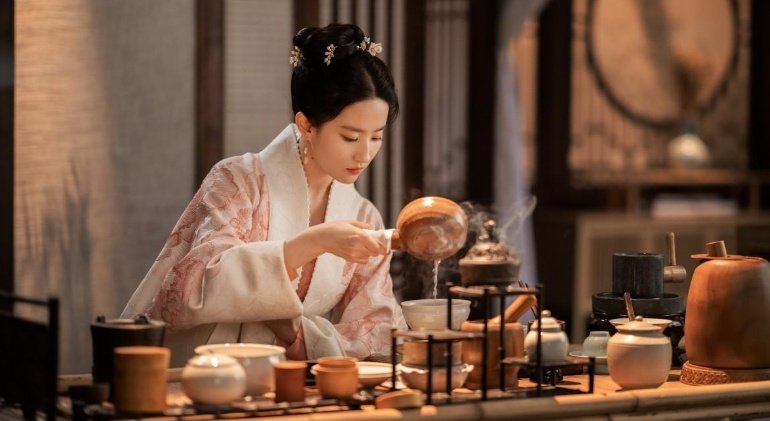
The teahouse is the physical center of the women’s new life.
It gives them a place to work, a source of income, and a public identity that is not defined by their previous relationships.
This is one of the strongest elements of the series.
In a society where a woman’s reputation can determine her opportunities, operating a successful establishment becomes a form of social transformation.
The women are no longer simply people with difficult pasts. They become business owners, employers, and recognizable figures in the city.
Their success also depends on cooperation.
Pan’er contributes business judgment and tea-making skills. Yinzhang brings musical talent. Sanniang contributes practical knowledge and cooking ability.
Their individual strengths become more valuable when combined.
The teahouse therefore represents a different model of power: not political authority inherited through family connections, but economic influence created through shared work.
4. The Original Play Makes the Adaptation More Interesting
One of the most important details about A Dream of Splendor is its literary source.
The series is based on the Yuan dynasty playwright Guan Hanqing’s work commonly known as Zhao Pan’er Rescues a Courtesan.
The original story centers on Zhao Pan’er’s effort to rescue Song Yinzhang from an abusive marriage.
This is significant because the adaptation is not simply inventing a modern feminist theme and placing it in a historical setting.
It is reinterpreting a much older story about women’s vulnerability, solidarity, and survival.
However, the modern television version changes the emotional and social framework of the original.
A 2022 essay published by Sixth Tone, titled “Sanitizing a Chinese Shakespeare,” criticized the series for making its female characters more idealized and socially respectable than the women in Guan Hanqing’s work.
The essay argued that the adaptation softened the original’s more complicated treatment of class, gender, and social judgment.
That criticism opens a fascinating possibility: in trying to make its heroine an inspirational symbol, the drama may have made her less radical than the woman who inspired her.
5. The Contradiction of Respectability
Pan’er wants to escape the stigma attached to her past.
That desire is understandable. A society that judges women according to their sexual history can make ordinary survival extraordinarily difficult.
But there is a deeper question.
Does a woman deserve dignity only after she proves that she is respectable?
The distinction is important because the drama sometimes presents Pan’er as someone who must overcome the negative assumptions associated with her background while maintaining an unusually high standard of personal virtue.
The result is a heroine who can be accepted by society partly because she is portrayed as exceptional.
But what about women who are less intelligent, less disciplined, less fortunate, or less capable of defending themselves?
A truly radical story about women’s independence would not require every woman to become morally perfect before she deserves respect.
This is where the adaptation’s idealism becomes controversial.
6. Song Yinzhang: Talent Is Not the Same as Freedom
Song Yinzhang’s story reveals another dimension of women’s independence.
She possesses musical talent and has the potential to build a successful career.
Yet talent alone cannot protect her from an abusive relationship.
Her situation demonstrates the difference between having an ability and having control over one’s life.
A woman may be talented, admired, and professionally valuable while remaining vulnerable inside her household.
Yinzhang’s struggle is therefore not merely about escaping a bad marriage.
It is about reclaiming the right to decide how her abilities should be used and what kind of life she wants.
Her relationship with Pan’er and Sanniang also shows the importance of support networks.
Sometimes independence does not begin with standing alone. It begins with having someone who refuses to abandon you when society has already turned away.
7. Sun Sanniang: The Pain of Losing a Place in the Family
Sun Sanniang’s story is particularly important because her suffering is connected to motherhood and domestic life.
She has been abandoned by her husband and separated from her child.
Her experience challenges the assumption that a woman who performs her family responsibilities has necessarily secured a stable position within the family.
She can cook, care for others, and fulfill domestic expectations, yet these abilities do not guarantee that she will be treated fairly.
Sanniang’s new life with Pan’er and Yinzhang gives her an opportunity to rediscover her own value outside marriage.
Her contribution to the business is practical and visible.
But her emotional story also reminds viewers that economic independence cannot automatically erase personal loss.
A successful business can provide security. It cannot simply restore every relationship that has been taken away.
8. Female Friendship as an Alternative to Competition
One of the most warmly received elements of A Dream of Splendor is the relationship among its female characters.
In many romantic dramas, women are positioned against one another because they are competing for the attention of the same man.
This series initially offers a different arrangement.
Pan’er, Yinzhang, and Sanniang do not need to destroy one another to survive.
They recognize each other’s abilities and provide practical support.
Reddit discussions reflect this appeal. In a 2022 appreciation thread, viewers praised the combination of Pan’er and Gu Qianfan’s romance with the friendship among the three women. Some specifically appreciated that the female characters were not constantly fighting over the male lead. <Cite refs={[“turn803060reddit16″,”turn803060reddit17”]}/>
This response points to something important.
The women’s friendship is not merely a pleasant addition to the romance. For many viewers, it is one of the reasons the series feels different from more conventional costume dramas.
The question is whether the series gives that friendship enough narrative importance throughout all forty episodes.
9. Gu Qianfan: Love as Protection or Another Form of Dependence?
Gu Qianfan, played by Chen Xiao, is not a conventional romantic hero.
He is a powerful official operating in a dangerous political environment. His relationship with Pan’er develops through mutual suspicion, respect, attraction, and emotional vulnerability.
Their chemistry was widely appreciated by viewers.
Some Reddit discussions highlighted the playful dialogue and gradual development of their relationship, particularly in the early episodes. <Cite refs={[“turn803060reddit15″,”turn803060reddit17”]}/>
But Gu Qianfan’s role also creates a tension within the drama’s central theme.
Pan’er wants to build a life in which she does not have to depend on a man for survival.
Yet Gu Qianfan has access to resources, protection, and social influence that she does not possess.
When he offers financial security and material reassurance, his intentions may be loving. For Pan’er, however, accepting that support complicates the meaning of independence.
This does not automatically make their relationship unequal or unhealthy.
The more interesting question is whether a woman can accept help from someone she loves without surrendering the ability to make her own decisions.
The drama does not need to portray independence as rejecting every form of support. But it does need to distinguish support from control.
10. The Romance Changes the Story’s Center of Gravity
The early episodes have a relatively clear direction.
Pan’er travels to Bianjing, reunites with the women who become her companions, and begins building a new business.
The romance with Gu Qianfan develops alongside that journey.
As the series progresses, however, the romantic relationship increasingly becomes a major source of conflict.
The couple’s misunderstandings, separations, and emotional sacrifices begin to occupy more of the narrative.
This is not inherently a problem. Romance is one of the drama’s main genres.
The difficulty is that the shift changes what the audience is being asked to care about.
A story that initially asks whether three women can build an independent life begins asking whether its central couple can overcome political and emotional obstacles.
Some viewers enjoyed the romance but felt that the original business and friendship themes became less central.
Others thought the series lost momentum after the leads became a couple.
The result is a drama with two competing identities: a story of women’s economic independence and a historical romance.
11. Why Some Viewers Felt the Second Half Was Weaker
The debate over the second half is one of the clearest divisions in Reddit discussions.
In a July 2022 discussion, viewers criticized the series for losing a consistent central direction. Some felt that it moved between the heroine’s personal journey and the main romance without fully committing to either.
Other comments argued that the relationship lost some of its early spark after the leads became a couple.
There were also complaints about misunderstandings, separation, and the increasing number of secondary conflicts. <Cite refs={[“turn803060reddit14″,”turn803060reddit17”]}/>
However, not everyone agreed.
A separate appreciation thread praised the production, relationships, atmosphere, and overall romantic experience. Some viewers even preferred the later episodes. <Cite refs={[“turn803060reddit16”]}/>
The disagreement is revealing.
The issue is not simply that the second half is objectively bad. It is that viewers came to the drama with different expectations.
Those who were most interested in romance could continue enjoying the central couple.
Those who were attracted by the women’s business story may have felt that the series had moved away from its original promise.
12. The Problem of the Perfect Heroine
Pan’er’s intelligence and moral strength are essential to the drama’s appeal.
But the same qualities can make her difficult to challenge.
Some Reddit viewers described her as a Mary Sue, a character whose abilities and moral qualities make her unusually successful and difficult to criticize.
This criticism appeared in the 2022 discussion about the show’s direction. <Cite refs={[“turn803060reddit14″,”turn803060reddit19”]}/>
The label can be reductive, but it points to a real storytelling question.
A heroine does not become more empowering simply because she is always right.
In fact, a character who makes mistakes, acts selfishly, misjudges people, and faces the consequences can sometimes offer a more convincing portrait of independence.
Real independence requires the ability to make difficult choices without always receiving approval.
It also requires the possibility of failure.
Pan’er is most interesting when her intelligence helps her navigate a difficult world, not when the story makes her seem naturally superior to everyone around her.
13. The Emperor and the Limits of Individual Power
The political story introduces another contradiction.
The women are trying to improve their lives within a society shaped by rigid social hierarchies.
Yet the drama’s political conflicts repeatedly suggest that major injustices can be resolved through the intervention of powerful individuals.
This is particularly relevant to the role of the emperor and the imperial court.
The Sixth Tone essay criticized the adaptation for relying too heavily on the idea of a benevolent ruler who can correct the injustices of the age.
The concern is not that a historical drama must portray every institution as irredeemably corrupt.
It is that a story about people overcoming structural inequality risks weakening its own argument if the final solution depends mainly on someone at the top deciding to behave well.
If a woman needs a powerful man or ruler to recognize her worth before she can live freely, how independent is that freedom?
This is one of the most important questions raised by the adaptation.
14. The Beauty of the Song Dynasty Can Hide the Harder Questions
Visually, A Dream of Splendor is one of the drama’s strongest achievements.
Its teahouses, waterways, costumes, food, music, and urban scenery create an attractive image of Song dynasty life.
The series also draws attention to traditional tea culture and the commercial atmosphere of Bianjing.
A contemporary report carried by the MCLC Resource Center noted the drama’s popularity and highlighted Pan’er’s independence, her journey to the capital, and the women’s work in establishing their teahouse. <Cite refs={[“turn803060search5”]}/>
But visual beauty can have an unintended effect.
It can make social inequality appear less severe than it was.
The audience sees elegant streets, beautiful interiors, refined clothing, and talented women building a successful business.
The historical reality behind questions of class, gender, and social status is much harder.
The drama’s aesthetic world is compelling, but it should not be mistaken for a complete picture of historical women’s lives.
Its beauty is part of its storytelling, not proof of historical accuracy.
15. Why the Ending Cannot Completely Resolve the Debate
A Dream of Splendor gives its main characters a broadly satisfying conclusion.
The women have moved beyond the circumstances that initially defined them. Their business has grown, their relationships have changed, and the central romance reaches a positive resolution.
But a happy ending does not necessarily resolve the questions raised by the beginning.
The most important question is not whether Pan’er eventually finds love or whether the women achieve commercial success.
It is whether the world around them has changed enough for other women to have similar opportunities.
A successful business proves that these particular women can survive.
It does not prove that the society that disadvantaged them has become fair.
This is why the ending can be emotionally satisfying while still leaving room for criticism.
The story completes its characters’ journeys more clearly than it completes its examination of the social structures around them.
16. Did A Dream of Splendor Lose Its Way?
The answer depends on what viewers believe the series promised.
As a historical romance, A Dream of Splendor has considerable strengths.
Liu Yifei and Chen Xiao create a memorable central relationship. The production is visually attractive, the female characters have appealing chemistry, and the story offers a welcome alternative to dramas in which women are constantly positioned as rivals.
As a story about women’s independence, however, it is more complicated.
Its strongest early episodes present independence as something practical: earning money, building a business, supporting friends, and refusing to accept an abusive or humiliating situation.
But the series gradually gives more space to romance and political conflict.
Its heroine also becomes so idealized that some of the difficult questions surrounding women’s social status become easier to avoid.
The original play makes this tension even more significant. A modern adaptation inspired by a story about rescuing a vulnerable woman could have explored the uncomfortable realities of gender and class more directly.
Instead, it often chooses a more polished and reassuring version of female empowerment.
That does not make the series unsuccessful. It makes its achievement incomplete.
Perhaps the greatest irony of A Dream of Splendor is that it begins by showing women building a world of their own, but gradually becomes more interested in how that world fits into the traditional structures of romance and power.
The women succeed. The love story finds its resolution. The teahouse becomes a symbol of achievement.
But the question remains:
If women’s independence is only celebrated when it leads to a beautiful romance and a socially acceptable happy ending, have we really seen independence in its fullest form?
Editorial Note
This article examines A Dream of Splendor as both a historical romance and an adaptation of Guan Hanqing’s Yuan dynasty play. Reddit discussions are used to illustrate differing viewer responses, not to claim that all viewers share the same opinion. The central argument also draws on contemporary criticism of the series’ treatment of gender, class, and its literary source.
Sources
- Reddit — Does anyone else dislike A Dream of Splendor?
- Reddit — Dream of Splendor appreciation
- Reddit — Dream of Splendor appreciation and clarification
- Sixth Tone — Sanitizing a Chinese Shakespeare
- MCLC Resource Center — Liu Yifei stars in A Dream of Splendor
- CPOP HOME — A Dream of Splendor: Cast, Story and Details