kkneoqkr@gmail.com

  • BTSが企画参加「ARIH」が日本上陸!セブンイレブン限定16商品・値段・発売日まとめ

    BTSが企画参加「ARIH」が日本上陸!セブンイレブン限定16商品・値段・発売日まとめ

    BTSが企画段階から参加した韓国発のフード&ビバレッジブランド**「ARIH(アリ)」**が、ついに日本に上陸しました。

    2026年8月20日から、全国のセブン‐イレブン(一部店舗を除く)限定で順次販売されています。

    「BTSの名前が付いただけの商品なの?」

    と思う人もいるかもしれません。

    しかしARIHでは、BTSが企画段階から参加し、ブランド名やフレーバー、パッケージデザインなどにもアイデアが反映されています。

    今回は、日本で発売されたARIHについて、発売日、販売場所、商品の種類、値段などをまとめて紹介します。

    BTSが参加した「ARIH(アリ)」とは?

    ARIHは、韓国の食品企業hyとPALDOが展開するグローバルフード&ビバレッジブランドです。

    コンセプトは、韓国の食文化を現代的に再解釈した**「モダンKフード」**。

    ブランド名「ARIH」は、「美しい」「麗しい」を意味する韓国の古語「아리(アリ)」と、

    Harmony(調和)
    Happiness(幸福)
    Health(健康)

    の頭文字「H」を組み合わせて作られています。

    そして大きな特徴が、BTSが企画段階から参加していること。

    ブランド名だけではなく、フレーバーやパッケージデザインなどにもBTSのアイデアが反映されています。

    ARIHは日本のどこで買える?

    日本では2026年8月20日から全国のセブン‐イレブン限定で順次販売されています。

    ただし、一部取り扱いのない店舗があります。

    発売直後ということもあり、店舗によって商品の入荷状況や在庫が異なる可能性があります。

    「ARIHを買いたい」という人は、近くのセブン‐イレブンをチェックしてみるとよいでしょう。

    日本では全部で16商品を展開

    ARIHの商品は、大きく3つのカテゴリーに分かれています。

    1.モダンヌードル

    韓国らしい味わいにグローバルな食材やソースを組み合わせた、新感覚の汁なしタイプのヌードルです。

    ラーメンとパスタ、それぞれの魅力を組み合わせたような商品で、幅広の平打ち麺が特徴。

    カップタイプと袋タイプがあります。

    2.ポストバイオティク・エナジードリンク

    日常生活の中で、すっきりとした活力を楽しむことをコンセプトにしたドリンクです。

    3.デュアルバイオティク・ソーダ

    軽やかな飲み心地を楽しめる炭酸飲料です。

    これらを合わせて、日本では3カテゴリー・計16商品が展開されます。

    ARIHの発売日は2段階

    ARIHの商品は一度にすべて発売されたわけではありません。

    第1弾:2026年8月20日

    カップタイプのモダンヌードルやデュアルバイオティク・ソーダなどが順次発売。

    第2弾:2026年8月27日

    袋タイプのモダンヌードルやポストバイオティク・エナジードリンクなどが順次発売されています。

    つまり現在は、第2弾の商品も含めて探せるタイミングです。

    モダンヌードルの値段は?

    モダンヌードルの希望小売価格は、

    カップ麺:338円(税別)

    袋麺:230円(税別)

    となっています。

    普通のインスタントラーメンと比べると少し高めに感じるかもしれません。

    しかし、ARIHは一般的な韓国ラーメンとは異なり、パスタとラーメンの特徴を組み合わせた新しいスタイルの商品として開発されています。

    実はアメリカでも話題になっていた

    ARIHの日本発売が注目される理由は、BTSだけではありません。

    ARIHは2026年4月にアメリカのウォルマートで先行発売され、発売後3日でベストセラーを達成したと発表されています。

    その後、6月には韓国でも販売を開始。

    そして8月、日本のセブン‐イレブンにも上陸しました。

    アメリカ、韓国、日本へと販売地域を広げていることから、今後さらに注目が集まる可能性があります。

    BTSファンならパッケージにも注目

    ARIHではBTSがブランド名、味だけでなく、パッケージデザインの企画にも参加しています。

    そのため、単純に「韓国ラーメンを食べてみたい」という人だけではなく、BTSファンにとっても気になる商品になりそうです。

    商品を見つけたら、味だけでなくパッケージにも注目してみてください。

    ARIHはどこで買える?まとめ

    日本でARIHを探すなら、まずセブン‐イレブンをチェックしてみましょう。

    発売開始:2026年8月20日

    第2弾発売:2026年8月27日

    販売場所:全国のセブン‐イレブン(一部店舗を除く)

    商品数:3カテゴリー・計16商品

    BTS:企画段階から参加

    BTSと韓国の食品企業が作り上げた新しい「モダンKフード」ARIH。

    日本でどこまで人気が広がるのか注目です。

    みなさんはARIHの中で、どの商品を一番食べてみたいですか?

    🎥 30秒でわかる!BTS × ARIH 日本上陸

    BTSが企画に参加した韓国発のフードブランド「ARIH(アリ)」が日本のセブン‐イレブンに登場!

    どんな商品なのか、30秒のショート動画でわかりやすく紹介します。

    👇 動画をチェックした後、発売日・値段・全16商品の詳細はこの記事で確認してください。

    BTSとARIHの関係、販売場所、発売日、商品の種類や価格については、以下で詳しく紹介しています。

  • Stray Kids、東京ドーム3DAYS追加公演決定!国立競技場の次は11月6・7・8日

    Stray Kids、東京ドーム3DAYS追加公演決定!国立競技場の次は11月6・7・8日

    Stray Kids(ストレイキッズ/スキズ)が、日本で再び大きな話題を集めています。

    2026年8月30日、東京・MUFG STADIUM(国立競技場)で行われた「Stray Kids World Tour <RUN IT JAPAN>」の公演終了時、ファンを驚かせるサプライズ発表がありました。

    東京ドームで3日間の追加公演が決定しました!

    開催日は、

    2026年11月6日(金)
    2026年11月7日(土)
    2026年11月8日(日)

    の3日間です。

    国立競技場の次は東京ドーム3DAYS

    Stray Kidsは8月29日・30日に東京のMUFG STADIUM(国立競技場)で単独公演を開催。

    これは海外男性アーティストとして史上初となる国立競技場での単独ライブという大きな記録です。

    そして30日の公演終了時に発表されたのが、今回の東京ドーム追加公演でした。

    国立競技場の次は東京ドーム3DAYS。

    日本でのStray Kidsの勢いを象徴するような発表となりました。

    東京ドーム追加公演の日程

    追加公演の日程は以下の通りです。

    会場日程
    東京ドーム2026年11月6日(金)
    東京ドーム2026年11月7日(土)
    東京ドーム2026年11月8日(日)

    東京ドームで3日連続開催となります。

    チケットの受付方法や最新情報については、Stray Kids日本公式サイトで最新情報を確認することをおすすめします。

    日本7公演がソールドアウト、追加公演へ

    今回の東京ドーム公演が追加された背景には、日本での圧倒的な人気があります。

    当初発表されていた日本公演は、

    東京・MUFG STADIUM(国立競技場)
    愛知・バンテリンドーム ナゴヤ
    大阪・京セラドーム大阪
    福岡・みずほPayPayドーム福岡

    を巡る全7公演。

    この7公演がすべてソールドアウトとなり、東京ドーム3公演の追加が決定しました。

    追加公演を合わせると、日本公演は合計10公演。

    約52万人を動員する見込みと報じられています。

    なぜStray Kidsは日本でこれほど人気なのか?

    Stray Kidsは日本でも「スキズ」の愛称で親しまれ、非常に大きなファンダムを持っています。

    ライブだけではありません。

    最新アルバム『THIS & THAT』は、2026年8月発表のオリコン週間アルバムランキングで1位を獲得。

    さらに11月25日には、日本では約1年半ぶりとなるJAPAN 4th Mini Album『SUIATSU』のリリースも予定されています。

    国立競技場公演、東京ドーム追加公演、そして日本での新作リリース。

    2026年後半も、日本でStray Kidsの話題が続きそうです。

    東京ドーム公演に行きたいSTAYは最新情報をチェック

    東京ドーム追加公演の発表直後から、チケットをめぐる関心も高まっています。

    特に人気公演では受付方法や受付期間が変更・追加される可能性もあるため、SNSの情報だけではなく公式情報を確認することが重要です。

    Stray Kids日本公式サイトや公式ファンクラブ「STAY JAPAN」の最新情報を確認してください。

    まとめ

    Stray Kidsの日本での勢いが止まりません。

    海外男性アーティスト史上初となる国立競技場での単独公演に続き、今度は東京ドーム3DAYSの追加公演が決定しました。

    東京ドーム追加公演は2026年11月6日・7日・8日の3日間。

    日本7公演のソールドアウトを受けて追加された今回の公演を含めると、日本公演は全10公演、約52万人を動員する見込みです。

    国立競技場から東京ドームへ。

    Stray Kidsが日本でどこまで記録を伸ばしていくのか、今後も注目です。

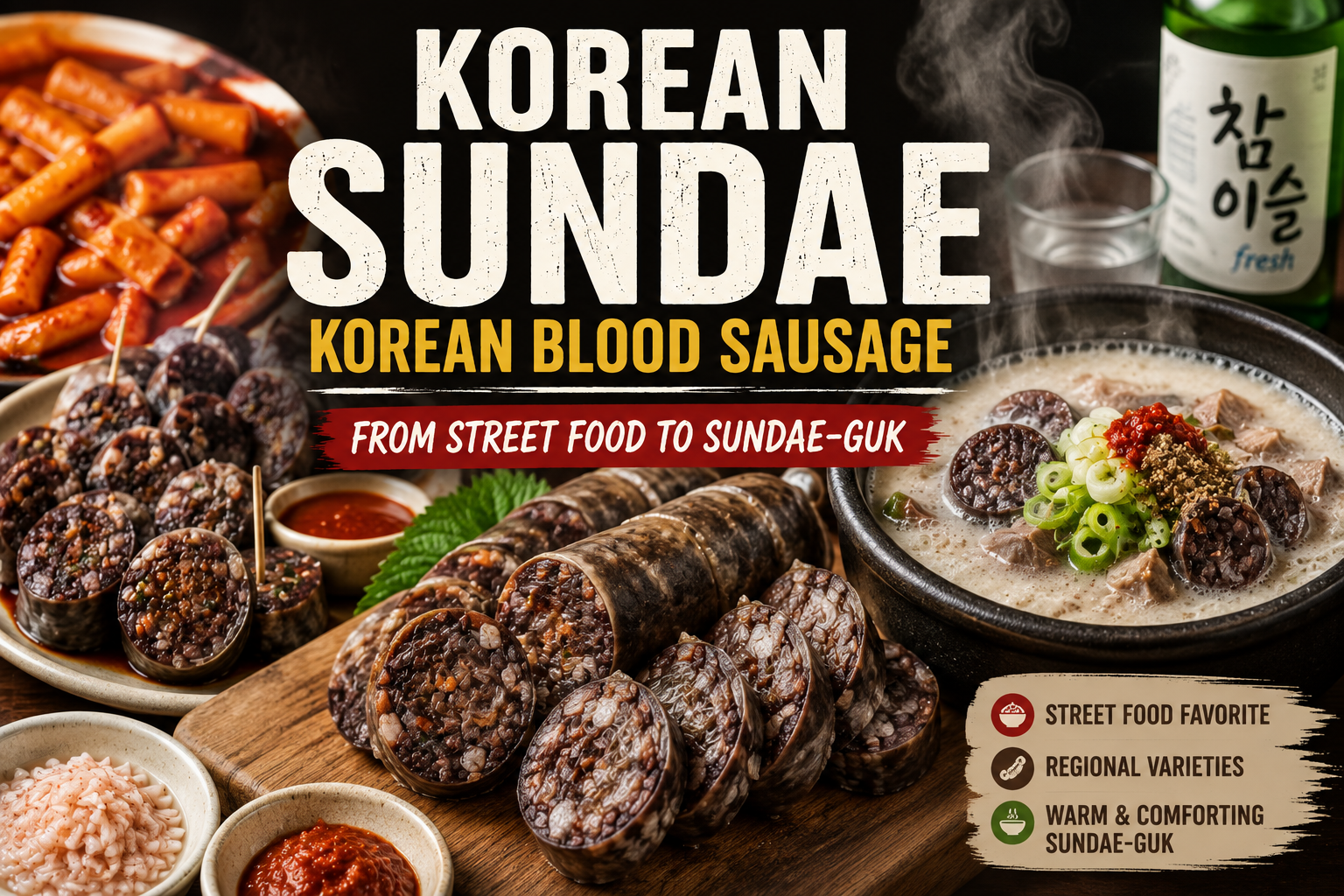
  • Sundae: Korean Blood Sausage, Street Food & the Soul of Sundae-guk

    Sundae: Korean Blood Sausage, Street Food & the Soul of Sundae-guk

    For many Koreans, Sundae grows up with them.

    As a student, you might stop at a small bunsik shop after school with friends.

    Someone orders tteokbokki.

    Someone else orders Sundae.

    A plate of warm Korean blood sausage arrives, and before long, pieces of Sundae are being dipped into the spicy red tteokbokki sauce.

    Years later, the scene changes.

    It’s a freezing winter evening.

    You’ve finished a long day at work.

    Instead of an after-school snack, there’s now a steaming stone bowl of Sundae-guk in front of you.

    Add some green onions.

    A little saeujeot.

    Maybe perilla seed powder and spicy seasoning.

    Put some rice into the soup.

    And perhaps pour yourself a glass of soju.

    The food didn’t really change.

    The person eating it did.

    That’s one reason Sundae is much more than Korea’s version of blood sausage.

    It’s a food that follows Koreans through different stages of life.

    What Is Korean Sundae?

    First, let’s clear up one potentially confusing name.

    Search for “sundae” in English and you’ll probably find ice cream.

    That’s not what we’re talking about.

    Sundae (순대) — also sometimes romanized as soondae — is a traditional Korean sausage.

    A common modern version uses pork intestine as a casing filled with ingredients such as glass noodles, vegetables and pork blood.

    But Sundae isn’t one single recipe.

    Traditional and regional versions can contain rice, glutinous rice, barley, vegetables, meat and other ingredients.

    The dish has changed considerably over time.

    Korea.net notes that blood sausage recipes appear in historical Korean cookbooks including the 1809 Gyuhap Chongseo, while modern versions commonly use pork intestine and starch noodles.

    What Does Sundae Taste Like?

    If you’ve never eaten blood sausage, the name may sound intimidating.

    But common Korean street-food Sundae can actually have a relatively mild flavor.

    The glass noodles create a soft, slightly springy texture.

    The casing adds chewiness.

    Depending on the type, you may taste pork, vegetables, sesame oil and the earthy richness associated with blood sausage.

    For many first-time visitors, the texture is more surprising than the flavor.

    And Koreans rarely eat Sundae completely alone.

    What you dip it into — or what you eat beside it — is part of the experience.

    Sundae Is One of Korea’s Classic Bunsik Foods

    To understand everyday Sundae, you need to understand bunsik (분식).

    Bunsik refers today to affordable, casual Korean foods commonly sold at small snack shops and street-food stalls.

    Korea.net identifies tteokbokki, gimbap and Sundae among its representative dishes and explains how modern bunsik culture expanded significantly during the 1960s and 1970s.

    That’s why Sundae carries a different feeling from an expensive restaurant meal.

    For generations of Koreans, it’s accessible food.

    Food you can share.

    Food you can eat standing near a market.

    And especially:

    food students can buy with friends after school.

    The Classic Combination: Sundae and Tteokbokki

    Walk into a Korean bunsik shop and Sundae rarely lives in isolation.

    Nearby you’ll probably find:

    Tteokbokki.

    Eomuk.

    Twigim.

    Gimbap.

    And ramyeon.

    But Sundae and tteokbokki have a particularly satisfying relationship.

    Take a piece of relatively mild Sundae.

    Dip it into the thick, spicy-sweet red sauce left on the tteokbokki plate.

    Suddenly the flavor changes completely.

    The soft, savory sausage absorbs the spicy sauce.

    For many Koreans, this is one of the simplest pleasures of eating at a bunsik shop.

    If you’re trying Korean Sundae for the first time, Sundae + Tteokbokki is an excellent place to start.

    What Do Koreans Dip Sundae In?

    Here’s where Sundae gets even more interesting.

    There isn’t one universal answer.

    Depending on region, restaurant and personal preference, Sundae may be served with different condiments.

    Salt is common in Seoul and many central areas.

    Elsewhere you may encounter ssamjang or other seasoned sauces.

    And at a bunsik shop?

    Sometimes the best “sauce” is simply the tteokbokki sauce already sitting on the table.

    This regional variation is part of the fun.

    Ask Koreans what Sundae should be dipped into and you may get surprisingly strong opinions.

    Don’t Forget the Liver and Offal

    Order Sundae at a traditional market or old-fashioned bunsik shop and you may receive more than sliced sausage.

    Pieces of steamed pork liver and other offal may be served alongside it.

    For someone unfamiliar with Korean food, that can be a surprise.

    You don’t have to eat everything.

    But if you’re adventurous, try them.

    The liver is dense and crumbly compared with the soft, chewy Sundae, creating another texture contrast on the same plate.

    Sundae Bokkeum: When Sundae Gets Spicy

    Now take Sundae away from the simple steamer and put it onto a hot griddle.

    You get another Korean favorite:

    Sundae Bokkeum (순대볶음).

    Sundae is stir-fried with vegetables such as cabbage, onions and green onions.

    Perilla leaves add their distinctive herbal aroma.

    Then comes a spicy seasoning.

    The result combines several textures and flavors at once:

    Chewy Sundae.

    Crunchy vegetables.

    Fragrant perilla leaves.

    Spicy sauce.

    Nutty sesame or perilla seed powder.

    And because everything is cooked together on a hot griddle, the aroma is part of the experience.

    Sillim-dong Sundae Town

    If you’re serious about Sundae Bokkeum, there’s a place in Seoul worth knowing:

    Sillim-dong Sundae Town (신림동 순대타운).

    Seoul’s official tourism guide identifies the area as one of the city’s destinations for Sundae. The area’s Sundae restaurants trace their roots to market restaurants and street vendors, with businesses gathering into the dedicated Sundae Town building in 1992.

    And Sillim has its own famous style.

    What Is Baek Sundae?

    You might expect stir-fried Sundae to be covered in red spicy sauce.

    Not always.

    Sillim-dong is famous for Baek Sundae Bokkeum (백순대볶음).

    Baek means white.

    Instead of coating everything in a red gochujang-based seasoning, Sundae, pork intestines and vegetables are stir-fried with ingredients such as sesame oil and perilla seed powder.

    Then you can dip each bite into sauce.

    Seoul’s official tourism guide specifically identifies Baek Sundae as Sillim-dong’s signature style.

    So if you visit Sillim with friends, there’s an obvious experiment:

    Spicy Sundae Bokkeum vs. Baek Sundae.

    Try both.

    Then choose your side.

    Korea Doesn’t Have Just One Sundae

    Just as Korea has regional kimchi and noodle traditions, Sundae changes from place to place.

    Ingredients, casing, texture and preparation can differ dramatically.

    That means eating Sundae while traveling around Korea can become its own food journey.

    Byeongcheon Sundae

    One of the best-known regional varieties comes from Byeongcheon in Cheonan, Chungcheongnam-do.

    Byeongcheon Sundae uses pork small intestine and a filling that can include vegetables, sticky rice and glass noodles.

    VISITKOREA describes it as having plenty of vegetables and a relatively clean, light flavor.

    Byeongcheon is also famous for its Sundae restaurants and Sundae-gukbap.

    The area’s relationship with markets is important too: Korean tourism material describes Sundae-gukbap as an inexpensive, filling meal long associated with market-goers.

    Abai Sundae

    Travel to Sokcho and you’ll encounter another famous name:

    Abai Sundae (아바이순대).

    This style is associated with Korea’s northern food traditions and the culture carried south by people displaced during the Korean War.

    Compared with the inexpensive glass-noodle Sundae many people encounter at bunsik shops, regional northern-style Sundae can feel much more substantial.

    Sokcho’s Abai Village became particularly associated with food traditions brought by refugees from Hamgyeong Province.

    It’s another reminder that Korean food history is often inseparable from Korean modern history.

    Ojingeo Sundae

    And then there’s a version that doesn’t look like ordinary Sundae at all.

    Ojingeo Sundae (오징어순대).

    Ojingeo means squid.

    Instead of pig intestine, a squid body is stuffed with a seasoned filling, steamed and sliced into rounds.

    This specialty is strongly associated with Gangwon-do and particularly Sokcho.

    So even the word “Sundae” doesn’t always mean pork intestine.

    The underlying idea of a stuffed casing can take very different forms.

    Then There Is Sundae-guk

    Street-food Sundae is only half the story.

    Put Sundae into a steaming pork-based soup and you enter another part of Korean food culture:

    Sundae-guk (순댓국).

    The bowl may contain sliced Sundae together with pork meat and offal in a rich broth.

    Rice is often eaten alongside it or mixed directly into the soup.

    VISITKOREA describes Sundae-guk as a traditional Korean soup built around Sundae, and restaurants specializing in it can be found throughout Korea.

    It’s inexpensive.

    It’s filling.

    It’s hot.

    And on a freezing Korean winter evening, that’s exactly the point.

    A Winter Bowl After a Long Day

    Imagine walking into a small neighborhood Sundae-guk restaurant after work.

    Outside, it’s bitterly cold.

    Inside, steam rises from stone bowls.

    Your soup arrives bubbling.

    You taste the broth first.

    Then add whatever you like:

    Green onion.

    Garlic chives.

    Perilla seed powder.

    Saeujeot.

    Black pepper.

    Maybe some spicy dadaegi.

    There’s rice beside the bowl and kimchi on the table.

    For many people, this is simply dinner.

    But add a bottle of soju and the same bowl becomes anju — food eaten with alcohol.

    A warm bowl of Sundae-guk and a glass of soju after a difficult day represents a very different side of Korean food culture from trendy cafés and luxury Korean barbecue.

    It’s ordinary.

    Affordable.

    Comforting.

    And deeply familiar.

    How Koreans Customize Sundae-guk

    There’s something important to know before eating Sundae-guk.

    Don’t immediately throw every condiment into the bowl.

    Taste the broth first.

    Then customize it.

    Add saeujeot if you need more saltiness and fermented depth.

    Add perilla seed powder for a nuttier character.

    Add chopped chili for heat.

    Add dadaegi if you want the broth spicy.

    Some restaurants provide garlic chives or green onions.

    Everyone’s bowl can end up tasting slightly different.

    That’s part of the experience.

    Is Sundae-guk Always Spicy?

    No.

    This surprises some visitors.

    The broth itself may arrive relatively mild and pale.

    The red color often comes from dadaegi, a spicy seasoning that the diner adds.

    So if you don’t enjoy spicy food, don’t automatically avoid Sundae-guk.

    Taste it first.

    You control much of what happens next.

    Easy Sundae-guk Recipe at Home

    Traditional restaurant Sundae-guk can involve long-cooked pork broth and several cuts of meat and offal.

    But there’s a much easier way to experience the basic idea at home.

    Use packaged Korean sagol-gomtang or a good bone broth.

    Ingredients — 2 Servings

    • 300 g Korean Sundae
    • 150 g thinly sliced pork shoulder
    • 500 ml packaged sagol-gomtang
    • About 200 ml water
    • 1/2 green onion
    • A handful of garlic chives
    • 1 tbsp minced garlic
    • 1–2 tbsp perilla seed powder
    • Saeujeot, to taste
    • Black pepper
    • Green chili, optional

    If you can find cooked pork head meat or Korean-style pork offal, add some.

    But don’t worry if you can’t.

    This is an easy home version, not an attempt to reproduce a specialist Sundae-guk restaurant.

    Easy Dadaegi

    Mix:

    • 1 tbsp gochugaru
    • 1/2 tbsp minced garlic
    • 1/2 tbsp saeujeot
    • 2 tbsp hot broth

    Adjust according to your preferred level of heat and saltiness.

    Step 1: Make the Broth

    Pour the packaged sagol-gomtang and water into a pot.

    Bring it to a simmer.

    Add the thinly sliced pork and cook it completely.

    Add the minced garlic.

    Step 2: Add the Sundae Last

    This is important.

    Most packaged Sundae is already cooked.

    If you boil sliced Sundae aggressively for too long, the casing may split and the filling can fall apart.

    So add the Sundae near the end.

    You’re essentially heating it through in the soup.

    Step 3: Finish the Soup

    Add green onions and garlic chives.

    Transfer everything to bowls.

    Then let each person add:

    Perilla seed powder.

    Saeujeot.

    Black pepper.

    Chili.

    And dadaegi.

    Don’t over-season the whole pot.

    Part of the Sundae-guk experience is adjusting the bowl yourself.

    Step 4: Add Rice

    Now eat the soup with steamed rice.

    Or do what many Koreans do:

    Put some rice directly into the hot broth.

    At this point, your soup becomes an incredibly satisfying one-bowl meal.

    What Should a First-Time Visitor Order?

    If you’re visiting Korea and have never tried Sundae, I wouldn’t necessarily begin with the most intense traditional version.

    Start simple.

    Order a plate of regular Sundae at a bunsik shop.

    Eat one piece with salt.

    Then dip another into tteokbokki sauce.

    If you like it, move to:

    Sundae Bokkeum.

    Then:

    Sundae-guk.

    And finally explore regional varieties such as Byeongcheon Sundae or Abai Sundae.

    Think of it as a Sundae progression.

    Don’t Let the Words “Blood Sausage” Scare You

    There’s no reason to pretend Sundae isn’t blood sausage.

    Traditionally, blood is an important ingredient.

    But translating it only as “blood sausage” can make the dish sound more extreme than the actual eating experience.

    For many Koreans, there’s nothing exotic about it.

    It’s the plate they shared with friends after school.

    It’s something their parents bought at the market.

    It’s what they dip into tteokbokki sauce.

    It’s what sizzles on a griddle in Sillim-dong.

    And it’s what sits inside a steaming bowl of soup on a cold night.

    That’s the difference between knowing what Sundae contains and understanding what Sundae means.

    From After-School Snack to Late-Night Soju

    Maybe that’s the best way to understand Korean Sundae.

    When you’re young, it might cost only enough to share with friends after school.

    You stand around a small bunsik shop eating Sundae and tteokbokki.

    Years pass.

    Now you’re sitting in a neighborhood restaurant after work.

    There’s a hot bowl of Sundae-guk in front of you.

    Maybe there’s a glass of soju beside it.

    Different place.

    Different age.

    Different reason for eating.

    But somehow, Sundae is still there.

    For many Koreans, Sundae grows up with them.


    FAQ

    What is Korean Sundae?

    Korean Sundae (순대) is a traditional sausage commonly made using pork intestine filled with ingredients such as glass noodles, vegetables and pork blood. Recipes and regional varieties differ considerably. Historical Korean cookbooks also contain older forms of blood sausage.

    Is Korean Sundae the same as an ice cream sundae?

    No. They simply share the same English spelling. Korean Sundae is pronounced roughly soon-deh and refers to Korean sausage.

    Is Sundae always made with blood?

    Blood is characteristic of many traditional and common Sundae recipes, but Sundae has numerous regional forms and ingredient combinations. Ojingeo Sundae, for example, uses squid as its casing and represents a substantially different style.

    Is Korean Sundae spicy?

    Regular steamed Sundae isn’t usually spicy. Sundae Bokkeum can be spicy, while Sillim-dong’s Baek Sundae is known for being stir-fried without the typical red chili-paste seasoning.

    What is Sundae-guk?

    Sundae-guk is a hot Korean soup containing Sundae and often pork meat or offal. It is commonly eaten with rice and seasonings such as saeujeot, perilla seed powder and spicy dadaegi.

    Where can I try Sundae in Seoul?

    One famous destination is Sillim-dong Sundae Town, near Sillim Station in Seoul. The area is particularly known for stir-fried Sundae and Baek Sundae.

    What is the best way to try Sundae for the first time?

    Try ordinary Sundae at a Korean bunsik shop alongside tteokbokki. Taste it plain or with salt first, then dip a piece into tteokbokki sauce.


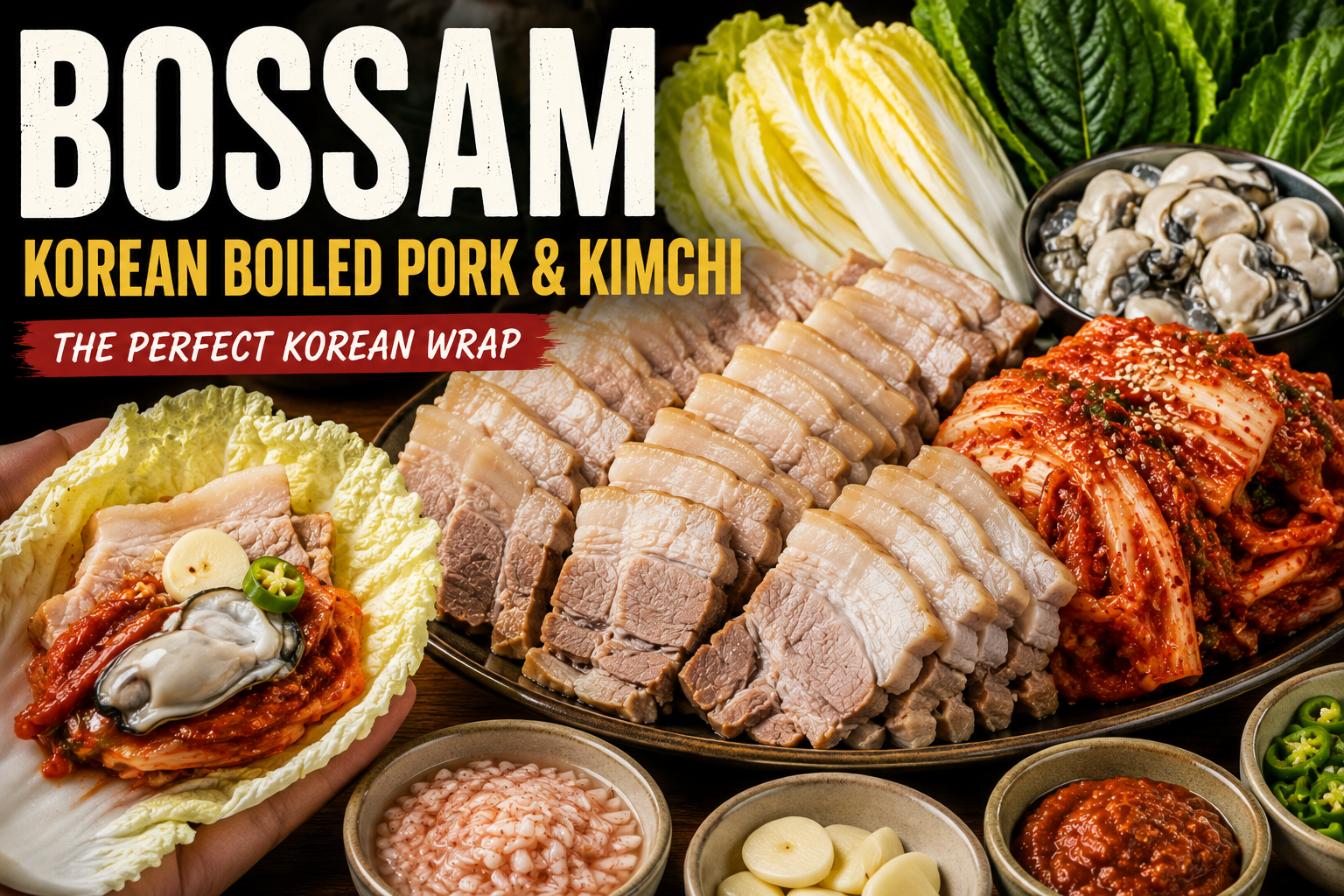
  • Bossam: Korean Boiled Pork, Kimchi & the Art of the Perfect Wrap

    Bossam: Korean Boiled Pork, Kimchi & the Art of the Perfect Wrap

    Imagine spending an entire cold autumn day making a huge amount of kimchi.

    Cabbages are everywhere.

    Red seasoning covers the table.

    Family members are working together, seasoning and packing cabbage that will be eaten throughout the winter.

    And somewhere nearby, pork is slowly cooking.

    When the work is finally done, someone slices the warm pork.

    You pick up a piece of freshly seasoned kimchi — not fermented for weeks, but made just moments ago — place a warm slice of pork inside and wrap them together.

    Sometimes you add a fresh oyster.

    Then you eat everything in one bite.

    For many Koreans, this is one of the great rewards of Kimjang Day.

    And it also helps explain one of Korea’s most satisfying pork dishes:

    Bossam (보쌈).

    What Is Bossam?

    Bossam is a Korean dish of tender boiled pork served with kimchi, vegetables and various condiments.

    Pork belly and pork shoulder are commonly used.

    The meat is gently cooked, sliced and placed on a large platter.

    But Bossam isn’t really complete when you eat the pork by itself.

    The fun begins when you wrap it.

    Take a cabbage leaf, lettuce or another leafy vegetable.

    Add pork.

    Add kimchi.

    Maybe some garlic.

    A little saeujeot.

    Perhaps ssamjang.

    Wrap everything together.

    And eat it in one bite.

    That’s the Bossam experience.

    VISITKOREA describes Bossam as simmered, thinly sliced pork eaten with kimchi seasoning or spicy radish salad, noting that pork belly and shoulder are commonly used.

    Bossam Isn’t Just Boiled Pork

    If you search for Bossam in English, you’ll often see:

    “Korean boiled pork.”

    That’s useful.

    But it doesn’t tell the whole story.

    Boiled pork is only the center of the meal.

    What makes Bossam special is the combination:

    tender pork + fresh vegetables + kimchi + fermented condiments + garlic

    Each component tastes completely different.

    But when you wrap them together, they become one bite.

    That’s why understanding Korean ssam (쌈) culture is essential to understanding Bossam.

    Suyuk vs. Bossam: What’s the Difference?

    These two Korean words are often confused.

    Suyuk (수육) generally refers to boiled meat itself.

    Slice the cooked pork and place it on a plate, and you’re essentially looking at suyuk.

    Bossam, in common modern usage, refers to the broader dish and eating experience in which sliced pork is eaten with kimchi, vegetables and condiments, often wrapped together.

    An easy way to remember it is:

    Suyuk is the pork.

    Bossam is the complete wrap experience.

    The distinction isn’t always rigid in everyday restaurant language, but it’s useful if you’re trying to understand a Korean menu.

    The Best Time to Understand Bossam? Kimjang Day

    To understand why pork and fresh kimchi work so beautifully together, you need to know about Kimjang (김장).

    Kimjang is Korea’s traditional practice of making and sharing large quantities of kimchi in preparation for winter.

    Traditionally, families and communities worked together during late autumn to make enough kimchi to last through the cold months.

    In 2013, Kimjang, making and sharing kimchi in the Republic of Korea, was inscribed on UNESCO’s Representative List of the Intangible Cultural Heritage of Humanity. UNESCO emphasizes not only the food itself but also family cooperation, sharing and the transmission of knowledge between generations.

    And after all that work?

    It’s time to eat.

    Fresh Kimchi and Warm Pork: The Reward of Kimjang

    One of the pleasures associated with Kimjang is eating the newly made kimchi with freshly cooked pork.

    This isn’t something invented for tourists.

    Korea.net, the official website of the Republic of Korea, describes families preparing boiled or steamed pork during Kimjang and eating it with the newly made kimchi.

    And this combination makes perfect sense.

    Freshly seasoned Kimjang kimchi is crisp, spicy and vibrant.

    The pork is warm, soft and rich.

    The kimchi cuts through the richness of the meat.

    The pork softens the intensity of the fresh seasoning.

    One balances the other.

    For many Koreans, that first bite of warm pork with freshly made kimchi is part of what makes Kimjang Day memorable.

    Fresh Kimchi Tastes Different

    There’s another detail foreigners may find interesting.

    The kimchi eaten on Kimjang Day hasn’t necessarily had time to ferment.

    It has just been made.

    That means the cabbage can still be particularly crisp and fresh, while the seasoning tastes bright and intense.

    Place a warm slice of pork against that cold, freshly seasoned cabbage and you get one of the best contrasts in Korean food.

    Hot and cold.

    Rich and fresh.

    Soft and crunchy.

    That’s Bossam at its best.

    And Then Koreans Add Oysters

    If pork and fresh kimchi weren’t enough, there’s another ingredient closely associated with this season:

    oysters.

    Late autumn and winter are traditionally an important season for enjoying oysters in Korea, and some families add raw oysters to their Kimjang kimchi.

    Korea.net specifically describes the combination of boiled pork, kimchi and fresh oysters as a seasonal winter delicacy.

    So try this:

    Fresh cabbage.

    Warm pork.

    Freshly seasoned kimchi.

    An oyster.

    Wrap everything together.

    One bite.

    Now you’re getting into serious Korean winter food territory.

    What Is Gul Bossam?

    This leads to another Korean favorite:

    Gul Bossam (굴보쌈).

    Gul means oyster in Korean.

    Gul Bossam combines Bossam pork with oysters and the usual vegetables and kimchi.

    It is particularly associated with the colder season.

    VISITKOREA also lists oyster Bossam as a recognized variation of Bossam and notes that Bossam restaurants may offer oyster versions during winter.

    For seafood lovers, it can be one of the most interesting versions of Bossam to try.

    How to Eat Bossam Like a Korean

    Your Bossam platter arrives.

    What now?

    Start with a cabbage or lettuce leaf.

    Place one slice of pork on it.

    Then add a little:

    • Bossam kimchi or seasoned radish
    • Saeujeot
    • Garlic
    • Ssamjang
    • Chili pepper, if you like

    If oysters are being served, add one.

    Now fold the leaf around everything.

    And eat the entire wrap together.

    The idea isn’t to taste every ingredient separately.

    The wrap is the dish.

    Why Is Saeujeot Served With Pork?

    You’ll often see a tiny dish of pinkish salted shrimp beside Korean boiled pork.

    That’s:

    Saeujeot (새우젓).

    It’s a fermented salted shrimp condiment.

    Because the flavor is strong and salty, you don’t need much.

    Lightly dip a piece of pork into it or add a small amount to your wrap.

    The salty fermented flavor works especially well against relatively mild boiled pork.

    It’s also one of the classic accompaniments shared by both Bossam and Jokbal.

    What Is Bossam Kimchi?

    Here’s where things become a little more complicated.

    The term Bossam Kimchi (보쌈김치) can refer to a distinctive Korean kimchi tradition in which ingredients are wrapped inside cabbage leaves, creating something resembling a small bundle.

    But the kimchi served with restaurant Bossam today isn’t necessarily that historical wrapped form.

    Korea.net specifically cautions that the kimchi commonly served with boiled pork — often sweeter and rich in radish — is different from the separate traditional dish known as Gaeseong Bossam Kimchi.

    That’s an important distinction.

    So when you order Bossam in Korea, don’t assume every plate will include a perfectly wrapped bundle of traditional Bossam Kimchi.

    Restaurant styles vary considerably.

    Why Is It Called Bossam?

    The word ssam (쌈) means wrapping food in a leaf.

    And that’s exactly what happens at the table.

    The deeper history of the name “Bossam,” however, is more complicated than simply translating it as “wrapped pork.”

    Traditional wrapped kimchi dishes also used the Bossam name, and over time the word became strongly associated with the modern pork-and-kimchi dish Koreans know today.

    Rather than reducing Bossam to a literal translation, the easiest way to understand the name is to experience the food itself:

    You build a bundle and eat everything together.

    Easy Bossam Recipe at Home

    Bossam looks impressive on the table, but the basic pork is surprisingly approachable.

    Ingredients

    For about 3–4 servings:

    • 700–800 g pork belly or pork shoulder
    • 1 onion
    • 1 green onion
    • 6–8 garlic cloves
    • A few slices of ginger
    • 1–2 tbsp doenjang (Korean fermented soybean paste)
    • Black pepper
    • Water

    For serving:

    • Kimchi
    • Seasoned radish
    • Napa cabbage or lettuce
    • Saeujeot
    • Ssamjang
    • Garlic
    • Chili peppers

    Optional:

    • Fresh oysters

    Step 1: Prepare the Pork

    Use a thick piece of pork belly or pork shoulder.

    Pork belly will give you a richer result with visible layers of fat and meat.

    Shoulder is generally leaner and meatier.

    Step 2: Build the Cooking Liquid

    Place the pork in a pot with onion, green onion, garlic, ginger and black pepper.

    Add enough water to cover or mostly cover the pork.

    Mix in a little doenjang.

    Korean households and restaurants use many different aromatic combinations, so there isn’t one universal Bossam boiling liquid. Korea.net likewise notes that family and restaurant recipes vary widely.

    Step 3: Cook Until Tender

    Bring the liquid to a boil and then reduce to a steady simmer.

    Cook until the pork is completely cooked through and tender.

    For a piece around this size, roughly 45–60 minutes is a reasonable starting range, but thickness matters.

    Use doneness and tenderness rather than the clock alone.

    Step 4: Rest Before Slicing

    Remove the pork and let it rest briefly.

    Then slice it into pieces thick enough to remain juicy but thin enough to fit comfortably inside a wrap.

    Step 5: Build the Bossam Table

    Don’t serve only the pork.

    Put everything on the table:

    Pork + kimchi + cabbage + saeujeot + ssamjang + garlic + chili peppers

    That’s what transforms boiled pork into a Bossam meal.

    Bossam vs. Jokbal: What’s the Difference?

    If you’ve visited a Korean Bossam restaurant, you may have noticed something interesting.

    Jokbal is often on the same menu.

    VISITKOREA listings for Bossam restaurants regularly show Jokbal alongside Bossam, reflecting how naturally the two dishes are paired in Korean dining.

    Both are pork dishes.

    Both are served sliced.

    Both work well as large sharing platters.

    Both are popular with drinks.

    But their textures are completely different.

    Bossam: soft, tender and meaty.

    Jokbal: rich, springy and gelatinous, with its characteristic chewy skin.

    This is why restaurants often sell a combination platter.

    You don’t feel like you’re eating the same pork twice.

    Bossam and Jokbal: The Perfect Korean Pork Combination

    The accompaniments change the experience too.

    Bossam shines with flavorful kimchi and seasoned radish.

    Jokbal is excellent with saeujeot, garlic, ssamjang and spicy noodles.

    Order both for a group and everyone can build different combinations.

    One person reaches for Bossam.

    Another prefers Jokbal.

    Then someone makes a wrap with everything.

    That’s very Korean.

    Is Bossam Spicy?

    The pork itself isn’t spicy.

    The heat usually comes from kimchi, seasoned radish, ssamjang or chili peppers.

    So Bossam can actually be an excellent Korean dish for someone who doesn’t enjoy very spicy food.

    Simply adjust what goes inside your wrap.

    Is Bossam the Same as Samgyeopsal?

    No.

    Both may use pork belly, but the cooking and eating experience are very different.

    Samgyeopsal is grilled at the table, giving the pork browned edges and a grilled flavor.

    Bossam is gently boiled or simmered, producing softer, moist slices of pork.

    Both can be eaten as ssam.

    But one celebrates grilling.

    The other celebrates tenderness.

    When Is the Best Time to Eat Bossam?

    Bossam is eaten throughout the year in Korea.

    You can order it from restaurants, have it delivered or eat it as anju with drinks.

    But culturally, late autumn and winter tell the most interesting Bossam story.

    That’s Kimjang season.

    That’s when newly made kimchi appears.

    That’s when oysters become part of the experience.

    And that’s when the relationship between pork and kimchi makes the most sense.

    Bossam Is More Than Korean Boiled Pork

    Calling Bossam “Korean boiled pork” isn’t wrong.

    It’s just incomplete.

    Bossam is the warm slice of pork.

    It’s the crisp cabbage leaf.

    It’s freshly made kimchi.

    It’s a tiny dab of salted shrimp.

    It’s garlic and ssamjang.

    Sometimes it’s a fresh winter oyster.

    And behind that one bite is the much larger Korean tradition of Kimjang — families and communities preparing food together for winter.

    So when you try Bossam, don’t eat the pork alone.

    Build the wrap.

    Add the kimchi.

    Try the saeujeot.

    And eat everything together.

    Because with Bossam, the perfect bite isn’t one ingredient.

    It’s everything inside the wrap.


    FAQ

    What is Bossam?

    Bossam (보쌈) is a Korean dish consisting of tender boiled pork, usually pork belly or shoulder, served with kimchi, leafy vegetables and condiments such as saeujeot and ssamjang.

    What is the difference between Bossam and Suyuk?

    Suyuk generally refers to the cooked, sliced meat itself. Bossam refers more broadly to the dish in which the pork is eaten with kimchi, vegetables and condiments, often as a wrap.

    How do you eat Bossam?

    Place a slice of pork on cabbage, lettuce or another leafy vegetable, add kimchi or seasoned radish and a little saeujeot or ssamjang, then wrap it and eat the ingredients together.

    Why do Koreans eat Bossam during Kimjang?

    Eating freshly cooked pork with newly made kimchi has long been associated with Kimjang. Korea’s official government site describes families preparing pork during Kimjang and eating it with fresh kimchi.

    What is Gul Bossam?

    Gul Bossam is Bossam served with oysters. Oyster Bossam is particularly associated with winter, when oysters pair naturally with pork and seasonal kimchi.

    What’s the difference between Bossam and Jokbal?

    Bossam usually uses pork belly or shoulder and has a soft, meaty texture. Jokbal uses pig’s trotters and is known for its richer, springier, gelatin-rich skin.

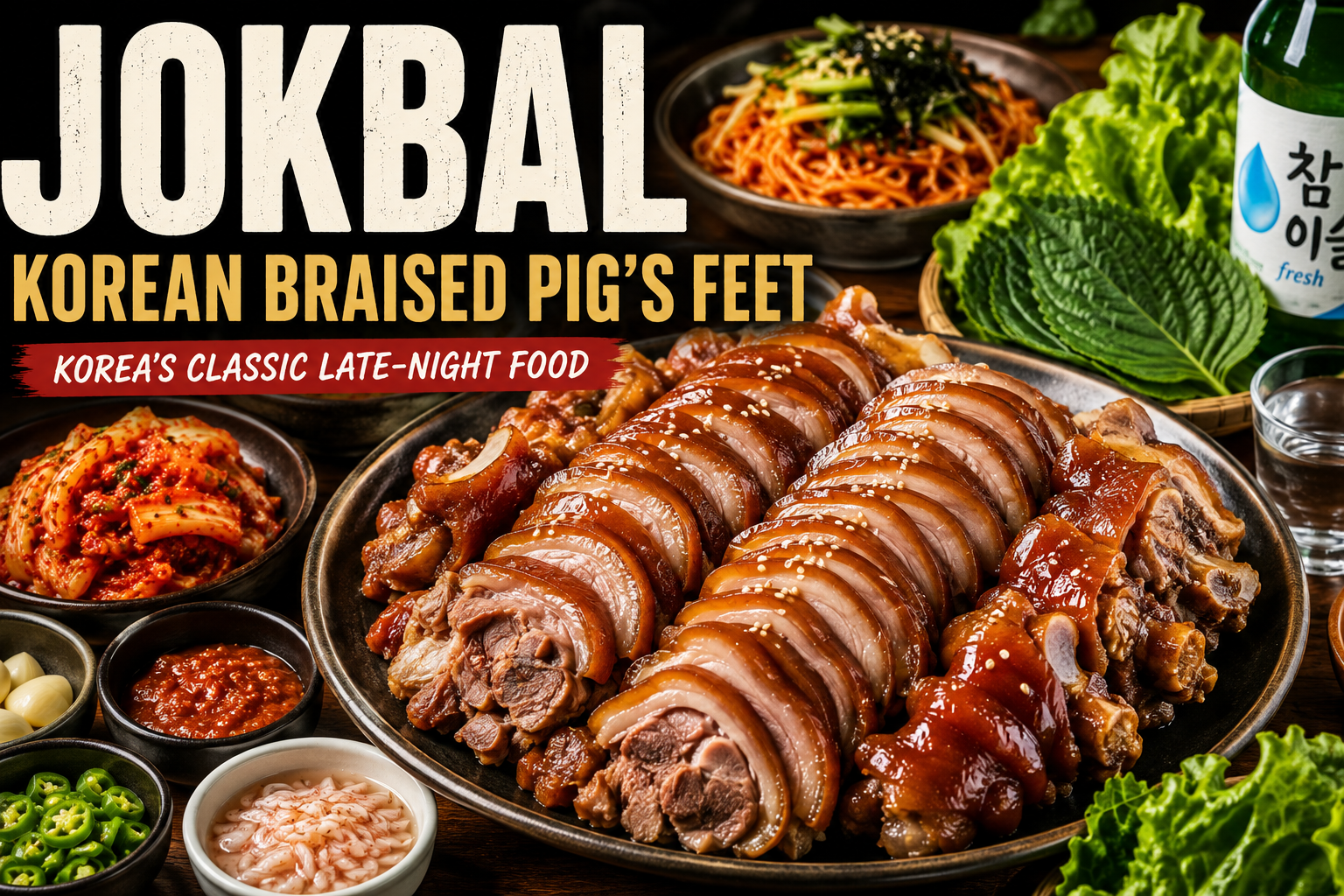
  • Jokbal: Why Koreans Love Braised Pig’s Feet as a Late-Night Meal

    Jokbal: Why Koreans Love Braised Pig’s Feet as a Late-Night Meal

    When Koreans get hungry late at night, fried chicken isn’t the only answer.

    For many people, another classic choice is:

    Jokbal (족발).

    A large plate arrives piled high with glossy slices of pork, surrounded by lettuce, garlic, chili peppers, ssamjang, salted shrimp and often a plate of spicy noodles.

    It’s rich.

    It’s savory.

    It’s tender.

    But what makes Jokbal truly different from ordinary pork is something you notice with the very first bite.

    The texture.

    What Is Jokbal?

    Jokbal is a Korean dish made by cooking pig’s trotters for an extended period until the meat becomes tender and flavorful.

    The cooked meat is removed from the bone, sliced and usually served on a large platter for sharing.

    But don’t imagine an ordinary plate of sliced pork.

    Jokbal has its own distinctive texture.

    The meat is tender, while the skin and connective tissue provide the pleasantly springy, chewy and gelatin-rich bite that Jokbal lovers look for.

    That contrast between tender pork and chewy skin is one of the biggest reasons Jokbal is so different from pork belly, pork shoulder or other familiar cuts.

    Korea’s official tourism site also describes Jokbal as soft yet chewy and notes that differences in cooking ingredients and preparation can give each restaurant its own flavor.

    Why Is Jokbal So Chewy?

    If you’ve never eaten Jokbal before, the texture may be the biggest surprise.

    Pig’s trotters contain plenty of skin, connective tissue and cartilage.

    Long cooking transforms those tissues and gives Jokbal its characteristic gelatinous, pleasantly chewy texture.

    That’s why Koreans often describe good Jokbal as:

    쫄깃쫄깃 — jjolgit-jjolgit.

    There isn’t a perfect one-word English translation.

    “Chewy” gets close, but good Jokbal shouldn’t simply feel tough.

    Think:

    tender meat + soft, springy skin + a rich, gelatinous bite.

    That’s the attraction.

    Jokbal Is One of Korea’s Classic Late-Night Foods

    To understand Jokbal, you also have to understand Korean yasik (야식) culture.

    Yasik simply means late-night food.

    After dinner, people may still get hungry while watching TV, drinking with friends, working late or simply relaxing at home.

    That’s when foods such as fried chicken and Jokbal become especially tempting.

    Jokbal works particularly well as a shared meal.

    Instead of everyone ordering an individual dish, a large platter is placed in the middle of the table.

    People make lettuce wraps, eat spicy noodles between bites and share drinks.

    It’s not just something to eat.

    Jokbal is a social late-night meal.

    Jokbal and Soju: A Classic Korean Combination

    Jokbal is also popular as anju (안주) — food eaten while drinking alcohol.

    Take a slice of Jokbal.

    Dip it lightly in saeujeot (새우젓), Korean salted shrimp.

    Place it on a lettuce or perilla leaf.

    Add garlic.

    Maybe a slice of chili pepper.

    Add a little ssamjang.

    Wrap everything together.

    Then take a sip of soju.

    That’s a very Korean Jokbal experience.

    Korea’s official tourism material specifically identifies salted shrimp as a classic accompaniment to Jokbal.

    How to Eat Jokbal Like a Korean

    There’s no single mandatory way to eat Jokbal, but if it’s your first time, try building a Korean-style ssam (쌈).

    Start with:

    1. Lettuce or perilla leaf

    Add:

    2. One slice of Jokbal

    Then:

    3. Garlic

    4. Chili pepper, if you like

    5. Ssamjang or saeujeot

    Fold the leaf around everything.

    And — this part matters —

    eat the whole wrap in one bite if you can.

    The fresh vegetables, salty sauce, garlic and rich pork all meet at once.

    That’s why simply eating Jokbal with a fork doesn’t quite give you the full experience.

    Don’t Forget the Saeujeot

    One of the smallest dishes on the Jokbal table can make a surprisingly big difference.

    Saeujeot (새우젓) is fermented salted shrimp.

    Rather than covering the meat in a heavy sauce, Koreans often lightly dip Jokbal into saeujeot before eating it.

    Its intense salty, fermented flavor contrasts with the richness of the pork.

    If you’re trying Jokbal for the first time, don’t ignore that tiny dish sitting beside the meat.

    It is there for a reason.

    And Then Comes the Spicy Noodles

    After several rich pieces of Jokbal, you may want something sharper and more refreshing.

    Enter:

    Makguksu (막국수) or jaengban-guksu (쟁반국수).

    Depending on the restaurant, a large plate of spicy, sweet-and-sour noodles may arrive alongside the pork.

    Take a bite of chewy Jokbal.

    Then eat some cold, spicy noodles.

    Then return to the pork.

    The contrast keeps the meal interesting.

    VISITKOREA specifically recommends spicy buckwheat noodles as a companion to Jokbal, and Korean Jokbal restaurants commonly list makguksu alongside the pork.

    Why Is Jangchung-dong Famous for Jokbal?

    If you ask Koreans to name a place famous for Jokbal, one name will come up quickly:

    Jangchung-dong (장충동), Seoul.

    Today, Jangchung-dong Jokbal Street is one of Seoul’s best-known food alleys.

    According to VISITKOREA, the street’s Jokbal tradition began about 50 years ago with two restaurants, followed by more Jokbal restaurants opening during the late 1970s and early 1980s.

    There is also a deeper story behind it.

    Official Korean tourism material traces the modern Jangchung-dong Jokbal tradition to people who came south from what is now North Korea during the Korean War.

    One early restaurant owner from North Pyeongan Province reportedly drew on memories of the pork dishes she had eaten back home when she began serving Jokbal as an affordable, substantial drinking food in Seoul.

    How Jangchung Arena Helped Create a Jokbal District

    Location mattered too.

    Nearby Jangchung Arena hosted sporting events, concerts and other major gatherings.

    After events ended, large numbers of visitors needed somewhere to eat.

    And Jokbal restaurants were waiting.

    Seoul’s official tourism guide credits the crowds from Jangchung Arena with helping Jokbal restaurants in the neighborhood become famous and eventually creating today’s Jokbal Alley.

    So Jangchung-dong Jokbal isn’t simply a famous restaurant district.

    Its story connects:

    migration + Seoul history + sports and entertainment + drinking culture + food.

    That’s what makes Korean food history interesting.

    Jokbal Isn’t Always the Same

    Traditional sliced Jokbal remains the standard, but modern Korean restaurants have developed many variations.

    You may encounter:

    Spicy Jokbal (매운족발)
    Jokbal coated or served with a fiery spicy sauce.

    Buljokbal (불족발)
    A particularly spicy style often associated with a smoky or fire-grilled character.

    Naengchae Jokbal (냉채족발)
    Chilled Jokbal served with vegetables and a sharp mustard-based sauce.

    Naengchae Jokbal is particularly associated with Busan’s Jokbal Alley near Gukje Market; VISITKOREA describes it as chilled Jokbal combined with cucumber, jellyfish and mustard sauce.

    So even within one dish, the experience can change dramatically.

    Is Jokbal Spicy?

    Traditional Jokbal itself is usually not spicy.

    The flavor comes primarily from the pork and the seasoned cooking liquid.

    Spiciness generally comes from the accompaniments or from specific variations such as spicy Jokbal or buljokbal.

    That makes regular Jokbal a good Korean dish for people who want to explore Korean food but don’t tolerate much chili heat.

    Jokbal vs. Korean Fried Chicken

    Both are classic foods for sharing.

    Both work well with drinks.

    And both have become deeply connected with Korean evening and delivery culture.

    But they’re completely different experiences.

    Korean Fried Chicken is crispy, crunchy and often paired with cold beer.

    Jokbal is tender, chewy and rich, often wrapped in vegetables and enjoyed with salted shrimp, spicy noodles and drinks such as soju.

    If Korean Fried Chicken represents the crispy side of Korea’s late-night culture, Jokbal represents its rich, chewy and communal side.

    Why Do Jokbal Restaurants Also Sell Bossam?

    Look at the menu of a Korean Jokbal restaurant and you’ll often find another famous pork dish:

    Bossam (보쌈).

    That’s not a coincidence.

    Both dishes are based on cooked pork and work extremely well as large sharing platters, but their textures are very different.

    Jokbal offers its signature chewy skin and rich flavor.

    Bossam, commonly made from pork belly or shoulder, is generally softer, meatier and milder.

    Even official Korean tourism restaurant listings frequently show Jokbal and Bossam together on the same menu.

    Jokbal and Bossam: Two Different Pork Experiences

    The side dishes also help separate the experiences.

    With Bossam, the star accompaniment is often flavorful Bossam kimchi or seasoned radish.

    With Jokbal, salted shrimp, garlic, ssamjang, vegetables, pickles and spicy noodles create different combinations.

    That’s why groups often order both.

    One person may prefer tender Bossam.

    Another wants chewy Jokbal.

    And everyone can share.

    It’s especially well suited to a night of drinking, a group dinner or a late-night gathering.

    What Should You Order for Your First Jokbal?

    If you’re visiting Korea and trying Jokbal for the first time, don’t overcomplicate it.

    Order the original Jokbal first.

    Add spicy noodles if available.

    Try one slice by itself.

    Then try another dipped lightly in saeujeot.

    Finally, build a full ssam with lettuce, Jokbal, garlic and ssamjang.

    You’ll immediately understand how much the accompaniments change the same piece of pork.

    If you’re eating with several people, a Jokbal and Bossam combination platter is an even better introduction to Korean boiled pork dishes.

    Is Jokbal Similar to Other Pig’s Feet Dishes?

    Pig’s feet aren’t unique to Korea.

    Many cultures have developed their own ways of cooking this inexpensive but flavorful part of the animal.

    Germany has dishes such as Eisbein, while several Chinese cuisines have their own braised pig’s trotter traditions.

    What makes Korean Jokbal distinctive isn’t simply the use of pig’s feet.

    It’s the complete eating experience:

    sliced Jokbal + saeujeot + ssam + garlic + ssamjang + spicy noodles + shared platter + drinks.

    The culture around the plate is just as important as the pork itself.

    Jokbal Is More Than Braised Pig’s Feet

    “Braised pig’s feet” tells you what Jokbal is made from.

    But it doesn’t really explain why Koreans love it.

    Jokbal is the contrast between tender meat and chewy skin.

    It’s the tiny dish of salted shrimp beside the plate.

    It’s wrapping pork, garlic and sauce inside a fresh leaf.

    It’s eating spicy noodles when the pork starts to feel rich.

    It’s sharing one enormous platter with friends late at night.

    And it’s the history of places like Jangchung-dong, where Jokbal restaurants have been serving generations of customers for decades.

    So if you’re exploring Korean food beyond barbecue, kimchi and fried chicken, don’t let the words “pig’s feet” scare you away.

    Take one glossy slice.

    Dip it in saeujeot.

    Wrap it in lettuce.

    And you may understand why Jokbal became one of Korea’s classic late-night foods.


    FAQ

    What is Jokbal?

    Jokbal (족발) is a Korean dish made by cooking pig’s trotters until tender, then slicing the meat and serving it as a shared platter with vegetables, sauces and side dishes.

    What does Jokbal taste like?

    Jokbal is savory and rich, with tender meat and soft, pleasantly chewy skin. The exact flavor varies depending on the restaurant’s cooking liquid and seasonings.

    Why is Jokbal chewy?

    Pig’s trotters contain skin, connective tissue and cartilage. Long cooking gives Jokbal its distinctive soft, springy and gelatin-rich texture.

    How do Koreans eat Jokbal?

    Koreans commonly eat Jokbal by itself, dip it in saeujeot, or wrap it in lettuce or perilla leaves with garlic, chili pepper and ssamjang. Spicy noodles are also a popular accompaniment.

    Is Jokbal spicy?

    Traditional Jokbal is generally not spicy. However, spicy variations such as maeun jokbal and buljokbal are also popular.

    What is the difference between Jokbal and Bossam?

    Jokbal is made from pig’s trotters and is known for its chewy, gelatin-rich skin. Bossam is generally made from pork belly or shoulder and has a softer, meatier texture. Both are commonly served as sharing dishes.

    Where is Jokbal famous in Seoul?

    Jangchung-dong is Seoul’s best-known Jokbal district. Its Jokbal alley developed around restaurants that became popular from the 1970s onward, helped by crowds visiting nearby Jangchung Arena.

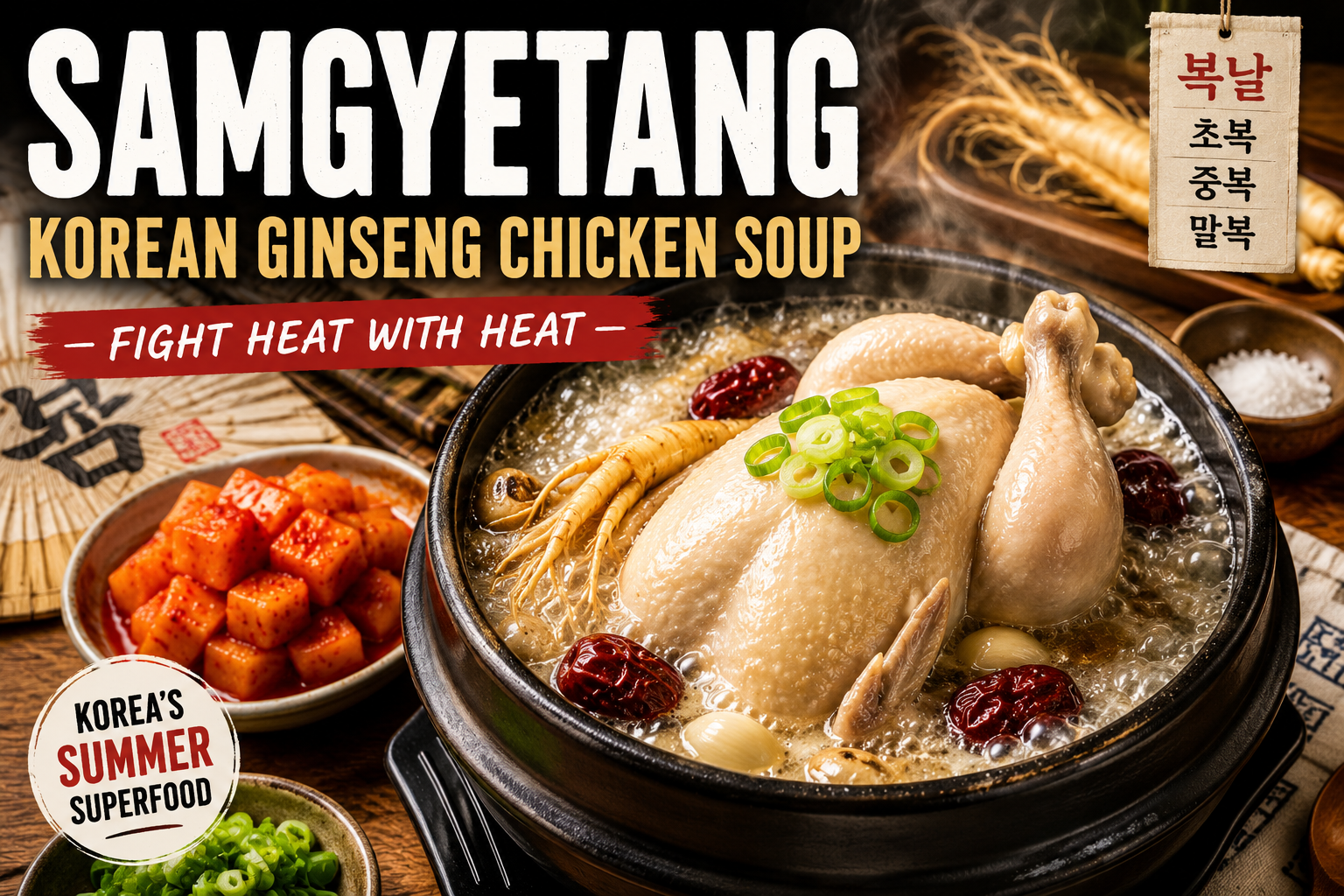
  • Samgyetang: Why Koreans Eat Hot Chicken Soup on the Hottest Days

    Samgyetang: Why Koreans Eat Hot Chicken Soup on the Hottest Days

    Imagine the hottest day of summer in Korea.

    The temperature is soaring. The humidity is exhausting.

    What would you want for lunch?

    Ice cream?

    Cold noodles?

    An iced drink?

    Many Koreans choose something completely different:

    a bubbling-hot pot containing an entire chicken.

    This is Samgyetang (삼계탕), Korea’s famous ginseng chicken soup.

    And eating it on the hottest days of summer is not a mistake.

    It’s a Korean tradition.

    What Is Samgyetang?

    Samgyetang is a traditional Korean chicken soup made by simmering a whole young chicken with ingredients such as ginseng, glutinous rice, garlic and jujubes.

    But there’s an interesting detail.

    The rice and other ingredients aren’t simply placed beside the chicken.

    They are stuffed inside it.

    Cut open the tender chicken and you may find soft glutinous rice infused with chicken broth and the aroma of ginseng and garlic.

    The Korea Tourism Organization describes samgyetang as a young chicken stuffed with sweet rice, garlic, jujube and ginseng and simmered until tender. It is particularly associated with summer as a nourishing food.

    But that leads to an obvious question.

    Why would Koreans eat something this hot during summer?

    Fight Heat With Heat: Iyeolchiyeol

    There is a traditional Korean expression:

    Iyeolchiyeol (이열치열, 以熱治熱).

    It can be understood as:

    “Fight heat with heat.”

    Instead of always trying to escape hot weather with cold food, Korean tradition also embraced the idea of eating a steaming, nourishing meal during exhausting summer weather.

    You eat hot chicken.

    You drink hot broth.

    You sweat.

    And traditionally, the meal has been regarded as a way to replenish energy during the hottest period of the year.

    This cultural idea is one of the reasons Samgyetang became so closely connected with Korean summer.

    Official Korean tourism material describes the sight perfectly: during Boknal, people can line up outside Samgyetang restaurants and then sit inside sweating over bubbling-hot chicken soup.

    For a foreign visitor seeing it for the first time, it can look completely backwards.

    For Koreans, it’s summer.

    What Is Boknal?

    Samgyetang is especially associated with Boknal (복날).

    Traditionally, the hottest period of the Korean summer is divided into three Bok days:

    Chobok (초복) — the first Bok day

    Jungbok (중복) — the middle Bok day

    Malbok (말복) — the final Bok day

    Together, they are called Sambok (삼복).

    These days are traditionally regarded as the hottest part of summer, and Samgyetang has become one of the foods most strongly associated with them.

    On Boknal, famous Samgyetang restaurants can become extremely busy.

    That’s one of the clearest signs that this isn’t simply chicken soup.

    It’s part of Korea’s seasonal food culture.

    Korea Has Two Opposite Ways to Survive Summer

    Here’s where Korean summer food becomes particularly interesting.

    Koreans have another famous summer dish:

    Naengmyeon — ice-cold Korean noodles.

    So Korea effectively has two completely opposite culinary answers to the summer heat.

    Naengmyeon: Fight heat with cold.

    Samgyetang: Fight heat with heat.

    One bowl can arrive with icy broth.

    The other can arrive still bubbling.

    Yet both are iconic Korean summer foods.

    That’s one of the fascinating contradictions of Korean food culture.

    What’s Inside Samgyetang?

    A traditional Samgyetang usually begins with a small whole young chicken.

    Inside you’ll commonly find:

    • Glutinous rice
    • Fresh ginseng
    • Garlic
    • Jujube

    Depending on the recipe or restaurant, other ingredients may also be used.

    Traditional or herbal versions can include ingredients such as hwanggi (황기, astragalus root) to add another layer to the broth.

    The chicken is simmered until tender, while the rice inside absorbs the chicken broth.

    The result isn’t supposed to taste like an aggressively seasoned spicy Korean dish.

    Samgyetang is generally much gentler.

    The chicken, broth, garlic and aromatic ingredients are the focus.

    Samgyetang Is a Korean Boyangsik

    To understand the dish culturally, another Korean word is useful:

    Boyangsik (보양식).

    It refers broadly to foods traditionally eaten for nourishment or to replenish energy.

    Samgyetang is one of Korea’s representative examples.

    That’s why Koreans don’t necessarily eat it only because they’re hungry for chicken.

    People may seek out Samgyetang when they feel exhausted or want a substantial meal traditionally associated with restoring energy.

    VISITKOREA describes ginseng chicken soup as one of Korea’s representative nourishing dishes and specifically connects it with Boknal and iyeolchiyeol.

    This is best understood as Korean food tradition and culture, rather than a medical treatment.

    Korean Fried Chicken vs. Samgyetang

    Koreans love chicken in completely different forms.

    At one end you have:

    Korean Fried Chicken

    Crispy.

    Seasoned.

    Perfect with an ice-cold beer.

    Connected with chimaek, delivery, sports and nights out with friends.

    At the other end:

    Samgyetang

    A whole chicken slowly cooked in broth with rice, garlic, ginseng and jujube.

    Hot, comforting and deeply connected with Korea’s traditional summer food culture.

    Same main ingredient.

    Completely different experience.

    This diversity is part of what makes Korean chicken culture so interesting.

    How Do Koreans Actually Eat Samgyetang?

    If a whole chicken arrives bubbling in front of you, don’t worry.

    It’s easier than it looks.

    First, taste the broth.

    Samgyetang may initially seem lightly seasoned compared with many other Korean foods.

    That’s normal.

    Salt and pepper may be provided so you can adjust the seasoning yourself.

    The Korea Tourism Organization specifically recommends adding salt to the soup according to taste and enjoying pieces of chicken with a little salt.

    Next, pull the tender chicken apart.

    You can dip pieces of chicken into salt or eat them with the broth.

    Then open the chicken.

    Inside you’ll find the soft glutinous rice and other ingredients that have been cooking in the broth.

    Eat the rice together with the soup.

    By the end, the dish almost becomes a chicken-and-rice porridge.

    Don’t Ignore the Kimchi

    Like many Korean soups, Samgyetang becomes even better when paired with kimchi.

    Kkakdugi (깍두기) — cubed radish kimchi — is an especially satisfying partner.

    The soup is mild and comforting.

    The kimchi is fermented, crunchy and flavorful.

    Alternating between hot chicken broth and crisp kimchi gives the meal balance.

    Some Samgyetang restaurants are remembered almost as much for their kimchi as for the chicken.

    Traditional Samgyetang Recipe

    If you want to experience a more traditional version at home, here’s the basic idea.

    Ingredients

    For approximately 2 servings:

    • 2 small young chickens
    • 1/2 cup glutinous rice
    • 2 small fresh ginseng roots
    • 6–8 garlic cloves
    • 2–4 dried jujubes
    • Green onion
    • Salt
    • Black pepper

    Optional for a more traditional herbal broth:

    • Astragalus root (hwanggi)

    Step 1: Soak the Rice

    Wash the glutinous rice and soak it in water for about 1–2 hours.

    Drain well.

    Step 2: Prepare the Chicken

    Remove excess fat and any remaining internal parts from the cavity.

    Wash and prepare the chicken carefully.

    Step 3: Stuff the Chicken

    Place some soaked glutinous rice inside each chicken along with:

    • Ginseng
    • Garlic
    • Jujube

    Don’t pack the rice too tightly because it will expand during cooking.

    Step 4: Close the Chicken

    Traditionally, the legs can be crossed or secured to help keep the filling inside while the chicken cooks.

    Step 5: Prepare the Broth

    For an herbal version, simmer hwanggi in water first to create a light herbal broth.

    Remove the root before serving.

    Step 6: Cook the Chicken

    Place the stuffed chickens in the pot and cover them generously with water or the prepared herbal broth.

    Bring to a boil.

    Then reduce the heat and simmer until the chicken is completely cooked and tender.

    Depending on the size of the bird, expect roughly 50–70 minutes, but always judge doneness by the chicken itself rather than time alone.

    For food safety, poultry should reach a safe internal temperature throughout.

    Step 7: Season at the Table

    Add chopped green onion.

    Instead of making the entire pot strongly salty, serve salt and pepper separately.

    Each person can season the broth and chicken according to taste.

    That’s very much part of the Samgyetang experience.

    Easy Samgyetang for Beginners

    If you’re outside Korea, finding fresh ginseng and several traditional herbs may be difficult.

    There’s an easier solution.

    Many Korean supermarkets sell Samgyetang or Baeksuk herbal packets.

    These may contain a combination of dried ingredients intended for Korean chicken soup.

    For an easy version, prepare:

    • 1 small whole chicken
    • 1 Samgyetang/Baeksuk herbal packet
    • 6–8 garlic cloves
    • Glutinous rice or cooked rice
    • Green onion
    • Salt and pepper

    Cook the chicken with the herbal packet and garlic until completely tender and safely cooked through.

    If stuffing raw glutinous rice into the chicken feels difficult, you can simplify the process by serving cooked rice with the broth instead.

    It won’t reproduce every detail of the traditional version.

    But it makes Korean-style nourishing chicken soup much more accessible for a first attempt.

    What Is Ogolgye Samgyetang?

    You may occasionally see another version called Ogolgye Samgyetang (오골계 삼계탕).

    Ogolgye refers to a distinctive black-boned or silkie-type chicken.

    Some Korean restaurants offer it as an alternative or premium variation.

    VISITKOREA lists ogolgye soup alongside traditional Samgyetang and abalone Samgyetang at specialized restaurants, showing how the basic dish has developed into multiple variations.

    Want an Even More Luxurious Version? Meet Haesintang

    And then Korea takes nourishing chicken soup another step further.

    Meet:

    Haesintang (해신탕).

    Versions of this luxurious soup combine chicken with premium seafood such as abalone and octopus, along with ingredients associated with Korean nourishing soups.

    Imagine opening one pot and finding:

    whole chicken + abalone + octopus + garlic + jujube + rich broth.

    It’s essentially the meeting of the land and the sea in one substantial meal.

    Restaurants also commonly offer variations such as abalone Samgyetang and medicinal-herb Samgyetang.

    For someone exploring the Korean idea of boyangsik, these upgraded chicken soups are worth discovering after traditional Samgyetang.

    Is Samgyetang Spicy?

    Usually, no.

    This surprises some people who associate Korean food with red chili peppers.

    Traditional Samgyetang is generally mild.

    Its character comes from chicken broth, garlic, ginseng and other aromatic ingredients rather than gochujang or large amounts of chili.

    So if you want to introduce someone to Korean food who doesn’t enjoy spicy dishes, Samgyetang can be a very approachable choice.

    When Should You Eat Samgyetang?

    You can eat Samgyetang year-round.

    But for the most culturally interesting experience, try it during Korean summer — especially around Boknal.

    That’s when you can understand the contradiction firsthand.

    The weather outside is scorching.

    The soup in front of you is bubbling.

    Everyone around you is eating the same thing.

    And suddenly the Korean expression iyeolchiyeol makes much more sense.

    Samgyetang Is More Than Ginseng Chicken Soup

    “Ginseng chicken soup” is a useful English translation.

    But it doesn’t tell the whole story.

    Samgyetang represents something larger:

    Korea’s seasonal food traditions.

    The three Boknal periods of summer.

    The idea of iyeolchiyeol.

    The tradition of boyangsik.

    A whole chicken filled with rice, ginseng, garlic and jujube.

    And generations of Koreans sitting down to a steaming meal when the weather outside is already unbearably hot.

    Perhaps that’s the best way to understand Korean summer food.

    Sometimes Koreans fight heat with ice-cold Naengmyeon.

    Sometimes they fight heat with steaming-hot Samgyetang.

    One country. Two completely opposite bowls. Two Korean ways to survive summer.

    FAQ

    What does Samgyetang mean?

    Samgyetang (삼계탕) refers to Korean ginseng chicken soup. The dish typically combines a whole young chicken with ginseng, glutinous rice, garlic and jujube.

    Why do Koreans eat Samgyetang in summer?

    Samgyetang is traditionally associated with Boknal, the hottest period of the Korean summer. It reflects the cultural idea of iyeolchiyeol, or “fighting heat with heat.”

    What is inside a Samgyetang chicken?

    The chicken is commonly stuffed with glutinous rice, ginseng, garlic and jujube. Ingredients vary depending on the restaurant and recipe.

    Is Samgyetang spicy?

    Traditional Samgyetang is generally mild rather than spicy. Diners often add salt and pepper according to their own taste.

    What is the difference between Samgyetang and Korean fried chicken?

    Both use chicken, but the cooking style and culture are very different. Korean fried chicken is crispy and closely associated with chimaek and casual social occasions, while Samgyetang is a simmered whole-chicken soup associated with traditional nourishing food and summer Boknal culture.

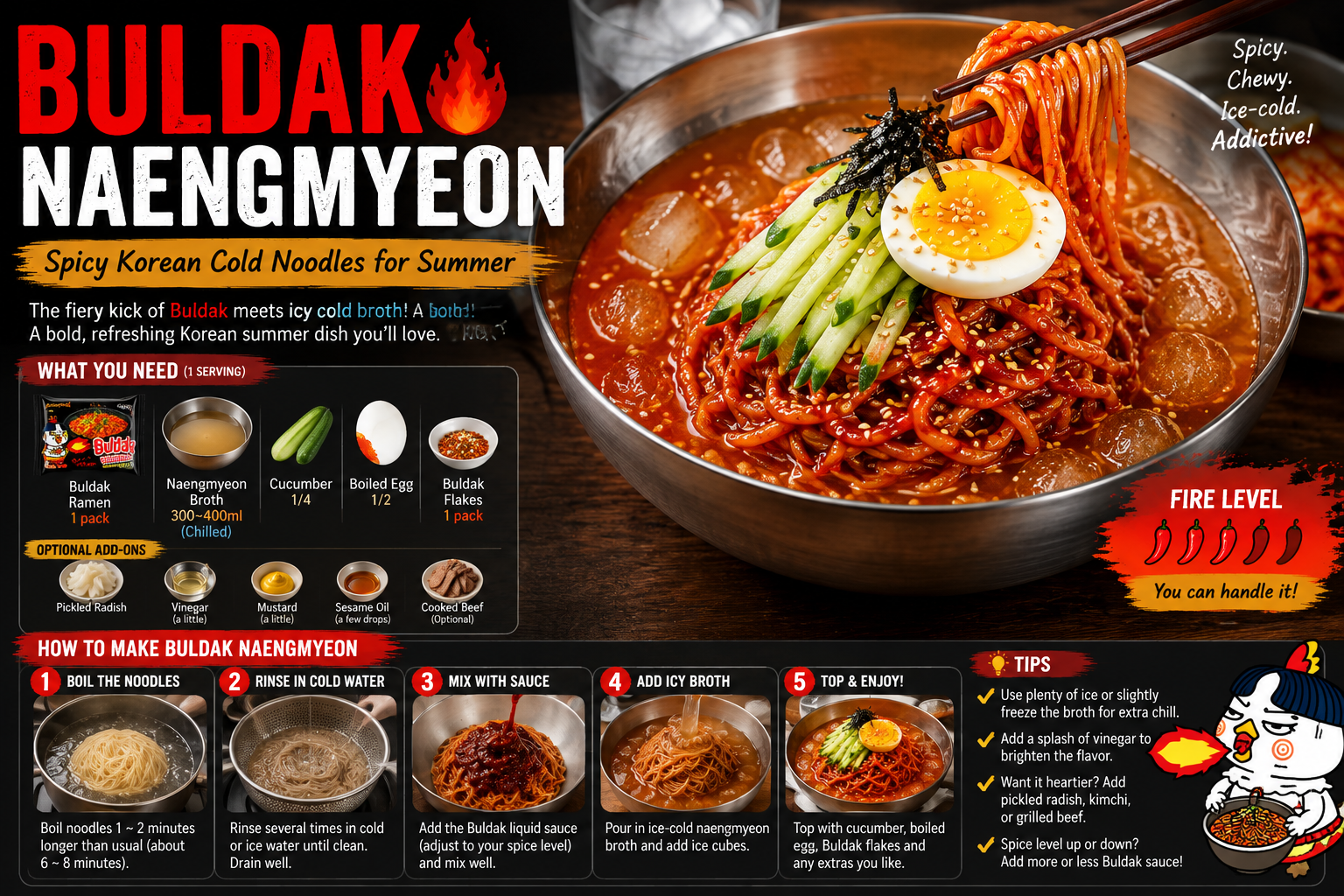
  • Buldak Naengmyeon Recipe: Spicy Korean Cold Noodles for Summer

    Buldak Naengmyeon Recipe: Spicy Korean Cold Noodles for Summer

    Imagine taking one of Korea’s hottest noodle flavors and dropping it into an ice-cold bowl.

    That’s Buldak Naengmyeon.

    It combines the fiery, addictive flavor associated with Buldak noodles with one of Korea’s most refreshing summer foods: naengmyeon, or Korean cold noodles.

    The result sounds contradictory.

    It’s hot.

    It’s cold.

    It’s spicy.

    It’s refreshing.

    And somehow, it works.

    If you already love Buldak but want something different for summer, this may be one of the easiest Korean fusion noodle recipes to try at home.

    What Is Buldak Naengmyeon?

    Buldak Naengmyeon (불닭냉면) is a modern spicy variation of Korean cold noodles.

    Traditional naengmyeon has a much longer history and includes famous styles such as Pyongyang and Hamhung naengmyeon.

    Buldak Naengmyeon is different.

    Instead of trying to recreate a traditional dish, we’re combining the intense spicy flavor of Buldak with chilled naengmyeon broth.

    If you’re new to Korean cold noodles, read our complete Naengmyeon: Korean Cold Noodles Explained guide first.

    Then come back when you’re ready to turn up the heat.

    Why Buldak and Cold Broth Work Together

    At first, spicy sauce and icy broth might sound like an odd combination.

    But Korean food often plays with contrasts.

    Hot grilled meat is eaten with cold noodles.

    Spicy bibim naengmyeon can be served as a refreshing summer meal.

    And intensely spicy dishes are frequently balanced with cool or mild accompaniments.

    Buldak Naengmyeon takes that contrast further.

    The Buldak sauce gives you an immediate spicy kick, while the chilled broth and cucumber provide a cooling sensation.

    Then another spicy bite arrives.

    That’s what makes the dish fun.

    Buldak Naengmyeon Ingredients

    For 1 Serving

    • 1 pack Buldak ramen
    • 300–400 ml chilled naengmyeon broth
    • Buldak liquid sauce, to taste
    • 1/4 cucumber, thinly sliced
    • 1/2 boiled egg
    • Buldak flakes from the package
    • Ice cubes, optional

    Optional Toppings

    • Pickled Korean radish
    • A little vinegar
    • Korean mustard
    • Kimchi or yeolmu kimchi
    • Sesame seeds
    • Sliced grilled beef or pork

    You don’t need every topping.

    Buldak noodles + cold broth + cucumber + egg are enough to make a simple version.

    How to Make Buldak Naengmyeon

    Step 1: Chill the Broth

    Put your naengmyeon broth in the refrigerator until very cold.

    For an even more refreshing version, place it in the freezer long enough for it to become slightly slushy rather than completely frozen.

    This makes a big difference on a hot summer day.

    Step 2: Cook the Buldak Noodles

    Boil the noodles according to the package directions.

    Because the noodles will be rinsed in cold water afterward, avoid leaving them overly firm.

    You want them cooked through while still retaining their chewiness.

    Step 3: Rinse in Very Cold Water

    Drain the noodles immediately.

    Rinse them several times under cold running water or in ice water.

    Gently rub and separate the noodles while rinsing.

    This removes surface starch, stops the cooking process and gives the noodles a cleaner texture.

    Drain thoroughly.

    This step is important.

    Warm noodles will quickly ruin the refreshing character of the dish.

    Step 4: Add the Buldak Sauce

    Place the cold, drained noodles in your serving bowl.

    Add some of the Buldak liquid sauce first rather than automatically using the entire packet.

    Mix thoroughly.

    Taste before adding more.

    Remember that you’re going to add broth, so the flavor will become somewhat diluted.

    You can always add more sauce.

    You can’t take it back out.

    Step 5: Add the Ice-Cold Broth

    Pour approximately 300–400 ml of chilled naengmyeon broth around the noodles.

    Start closer to 300 ml if you want a stronger Buldak flavor.

    Add more if you prefer something lighter and more refreshing.

    A few ice cubes can make the bowl even colder.

    Step 6: Add the Toppings

    Finish with:

    • Cucumber
    • Half a boiled egg
    • Buldak flakes
    • Pickled radish, if available
    • Sesame seeds

    And that’s it.

    Your Buldak Naengmyeon is ready.

    The Most Important Tip: Don’t Add All the Sauce Immediately

    Buldak sauce can be extremely spicy, especially for people who aren’t accustomed to Korean spicy food.

    The safest method is simple:

    Start with less. Taste. Then add more.

    The chilled broth changes the overall intensity, but don’t assume cold automatically makes Buldak mild.

    If you’re making this for friends, letting everyone adjust their own spice level is even better.

    Want More Sourness?

    Naengmyeon and acidity work very well together.

    Try adding a small splash of vinegar.

    Don’t pour in too much at once.

    A little acidity can brighten the spicy sauce and make the cold broth taste cleaner.

    Traditional Korean mustard can also be added if you want an additional sharp kick.

    Again, taste first.

    Make It Even Better With Korean BBQ

    Here’s the version I’d recommend if you’re really hungry.

    Grill some thinly sliced beef, pork belly or another favorite cut of meat.

    Then take:

    one piece of hot grilled meat + a small bundle of ice-cold Buldak noodles.

    Eat them together.

    The contrast is excellent.

    The fatty, savory meat softens the sharp spicy-sour flavor while the cold noodles refresh your mouth between bites.

    This idea also comes from the way Koreans commonly enjoy bibim naengmyeon with grilled meat.

    Buldak Naengmyeon With Yeolmu Kimchi

    Another good addition is yeolmu kimchi (열무김치), young radish kimchi.

    Its crisp texture and refreshing sourness work particularly well with cold noodles.

    Add a small amount on top rather than mixing in too much from the beginning.

    You want the Buldak flavor to remain the star.

    How Spicy Is Buldak Naengmyeon?

    That depends almost entirely on how much Buldak sauce you use.

    Mild(er)

    Use about one-third of the sauce packet and more broth.

    Medium

    Start around half the packet and adjust after tasting.

    Very Spicy

    Use most or all of the packet.

    But if this is your first experience with Buldak, there is no prize for suffering.

    Start low.

    Can I Make It Without Buldak Ramen?

    Yes.

    If Buldak sauce is available separately where you live, you can use actual naengmyeon noodles instead.

    This creates a texture closer to Korean cold noodles while retaining the Buldak flavor.

    You can also experiment with buckwheat noodles, although the result will have a different character.

    Think of Buldak Naengmyeon as a flexible modern Korean fusion dish rather than a recipe with centuries-old rules.

    Buldak Naengmyeon vs. Bibim Naengmyeon

    They may look similar, but they aren’t the same dish.

    Traditional bibim naengmyeon uses a Korean spicy-sweet-tangy seasoning developed specifically for cold noodles.

    Buldak Naengmyeon gets its defining heat and flavor from Buldak-style sauce.

    Bibim naengmyeon belongs to Korea’s established naengmyeon tradition.

    Buldak Naengmyeon is a modern twist inspired by contemporary Korean spicy-noodle culture.

    Both can be delicious.

    Just don’t confuse the two.

    Why This Is Such a Korean Combination

    Buldak Naengmyeon brings together two very different sides of Korean food culture.

    Naengmyeon represents tradition.

    Its history stretches back centuries, with famous regional traditions connected to Pyongyang and Hamhung.

    Buldak represents modern global K-food culture.

    Put them together and you get something that would have sounded strange generations ago but feels perfectly at home in today’s experimental Korean food scene.

    Buldak Naengmyeon Recipe at a Glance

    Prep time: About 5 minutes
    Cooking time: About 5 minutes
    Servings: 1

    Difficulty: Easy
    Spice level: Adjustable

    The basic formula is:

    Cook → Chill → Mix → Add icy broth → Top → Eat.

    The most important points are to rinse the noodles thoroughly, keep the broth extremely cold and add the Buldak sauce gradually.

    Final Tip

    Don’t think of this recipe as simply cold Buldak ramen.

    The goal is contrast.

    You want the noodles spicy, the broth ice-cold, the cucumber crisp and the toppings fresh.

    On a hot day, that combination creates a completely different Buldak experience.

    And if Buldak Naengmyeon is your first introduction to Korean cold noodles, don’t stop here.

    Try traditional mul naengmyeon, bibim naengmyeon, Pyongyang naengmyeon and Hamhung naengmyeon too.

    Buldak may bring the fire.

    But the much older story of Korean cold noodles is even more interesting.

  • Naengmyeon: Korean Cold Noodles Explained — History, Types & How to Eat It

    Naengmyeon: Korean Cold Noodles Explained — History, Types & How to Eat It

    Walk through Korea on a hot and humid summer day and you may see people lining up for something unusual: a bowl of noodles served in an ice-cold broth.

    This is naengmyeon (냉면), one of Korea’s most distinctive noodle dishes.

    For someone trying Korean food for the first time, the idea can be surprising. The broth may arrive extremely cold, sometimes with visible ice or slush floating around the noodles.

    But there is much more to naengmyeon than simply “cold noodles.”

    There are mild and spicy versions, soft buckwheat noodles and extremely chewy starch noodles, and even versions topped with seasoned raw fish.

    And behind that bowl is a fascinating story involving Korea’s seasons, regional food traditions, war, migration and even K-pop.

    Here is what you should know before eating naengmyeon in Korea.

    What Is Naengmyeon?

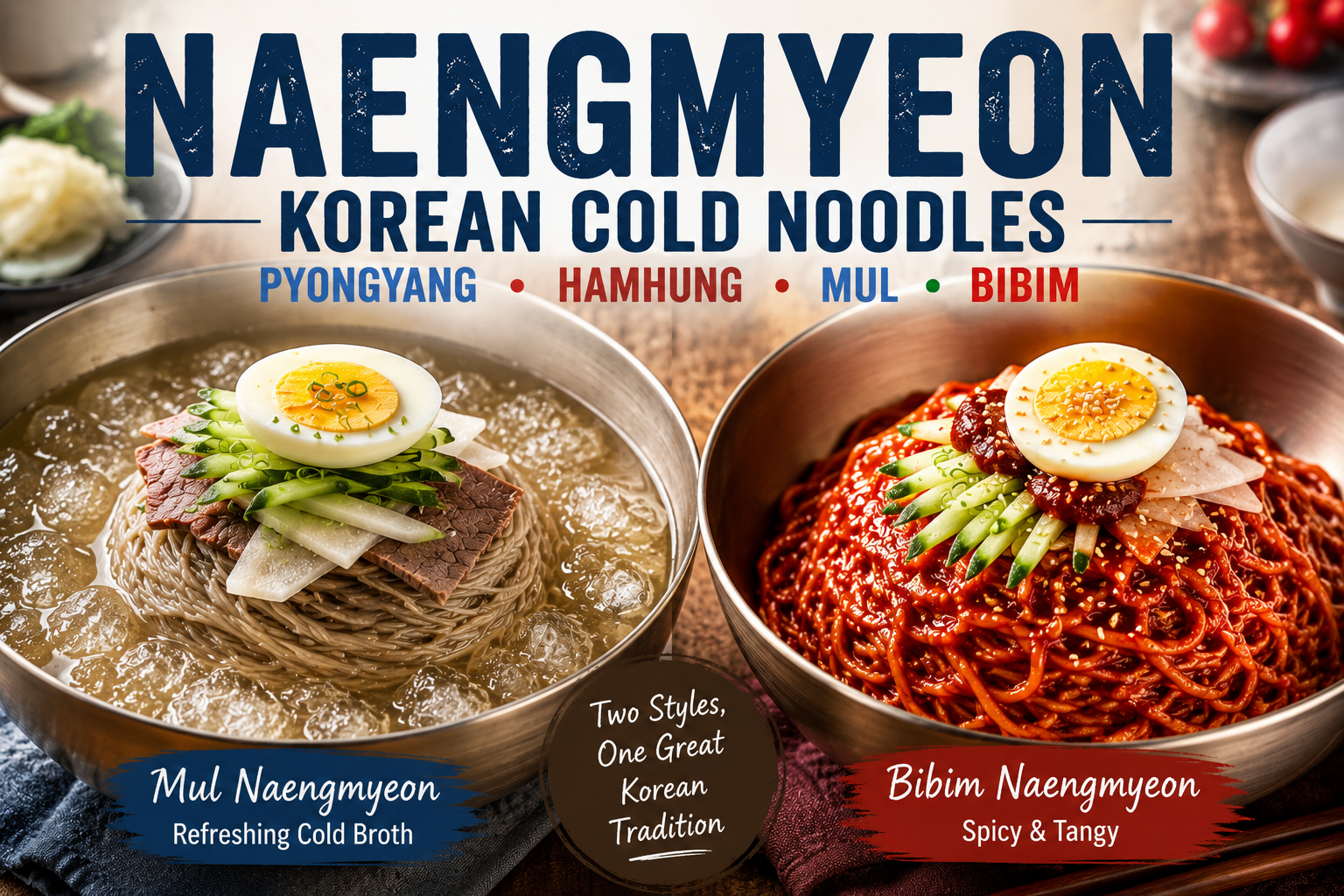
    The Korean word naengmyeon (냉면) literally means “cold noodles.”

    Today, the two varieties most visitors encounter are:

    Mul naengmyeon (물냉면) — noodles served in chilled broth.

    Bibim naengmyeon (비빔냉면) — noodles mixed with a spicy, sweet and tangy red sauce.

    But those two names only tell part of the story.

    To really understand naengmyeon, you need to know about two famous regional traditions: Pyongyang naengmyeon and Hamhung naengmyeon.

    And surprisingly, the story begins not with Korea’s hot summers — but with its freezing winters.

    Naengmyeon Was Originally a Winter Food

    Today, Koreans strongly associate naengmyeon with summer.

    When the temperature climbs, an icy bowl of mul naengmyeon can feel almost like air conditioning you can eat.

    Historically, however, naengmyeon was closely associated with winter in the northern Korean Peninsula.

    Before modern refrigeration, winter naturally provided the cold environment needed for chilled broth. Dongchimi — a refreshing radish water kimchi traditionally prepared for winter — could provide the cold liquid used with noodles.

    Korea Tourism Organization also notes this unusual history: naengmyeon was once enjoyed during freezing winters, even while people sat on warm ondol, Korea’s traditional heated floors.

    That creates one of the great ironies of Korean food:

    One of Korea’s most famous summer foods began as a winter dish.

    Koreans Were Eating Naengmyeon Centuries Ago

    Naengmyeon is not a recent invention.

    One important historical reference appears in Gyegokjip (계곡집), a collection associated with Joseon scholar Jang Yu (1587–1638) and published in 1643.

    His writing contains an early known reference to naengmyeon, describing cold noodles with a purple-colored broth associated with omija.

    Historical sources from later periods provide additional evidence of cold noodles being eaten in northern Korea.

    So when you sit down for a bowl today, you are eating a dish with roots stretching back centuries.

    Pyongyang Naengmyeon: Subtle, Buckwheat and Brothy

    Pyongyang naengmyeon (평양냉면) is perhaps the most famous traditional style.

    The noodles traditionally contain a significant amount of buckwheat.

    That matters because buckwheat behaves very differently from starch.

    Rather than being extremely elastic and chewy, traditional Pyongyang-style noodles tend to be softer and easier to bite through.

    The other defining element is the broth.

    Pyongyang naengmyeon is known for a clean, restrained broth traditionally associated with dongchimi and/or meat stock.

    For foreigners accustomed to strongly seasoned Korean foods such as bulgogi, kimchi or tteokbokki, the first spoonful can therefore be surprising.

    Some first-time diners may even wonder:

    “Is this supposed to taste this mild?”

    Yes.

    That subtlety is part of its appeal.

    Instead of overwhelming the noodles with seasoning, good Pyongyang naengmyeon lets you notice the buckwheat aroma and delicate broth.

    It is a food that many people appreciate more deeply after eating it several times.

    Hamhung Naengmyeon: Chewy, Spicy and Intense

    Now move from Pyongyang to the Hamhung tradition and the experience changes dramatically.

    Hamhung naengmyeon (함흥냉면) is famous for thin, remarkably chewy starch-based noodles.

    Instead of emphasizing a mild broth, Hamhung-style noodles are strongly associated with spicy seasoning.

    One particularly famous variation is:

    Hoe naengmyeon (회냉면).

    This combines chewy noodles with spicy seasoned raw or cured fish.

    The coastal environment around Hamhung influenced this style, and versions of the dish later evolved as people from the North settled in South Korea.

    Today, the contrast is easy to remember:

    Pyongyang → buckwheat + delicate broth

    Hamhung → starch noodles + chewy texture + spicy seasoning

    How Hamhung Naengmyeon Came to Seoul

    Naengmyeon also carries the story of modern Korean history.

    After the Korean War, many people who had lived in northern Korea settled in the South.

    They brought their food traditions with them.

    Recipes inevitably changed as cooks adapted to ingredients available in their new homes.

    One place where this history remains visible is Ojang-dong in Seoul, which became particularly associated with Hamhung-style naengmyeon.

    The Korea Tourism Organization describes one famous Ojang-dong restaurant as originating with a woman who migrated from Hamgyongnam-do to Seoul during the Korean War and began selling Hamhung-style starch noodles.

    So for some older Koreans and displaced families, naengmyeon represents more than food.

    A bowl of noodles could also carry the memory of a hometown they could no longer return to.

    That is why understanding naengmyeon also means understanding a small piece of modern Korean history.

    Mul Naengmyeon vs. Bibim Naengmyeon

    For most visitors to Korea, however, the immediate decision at a restaurant is much simpler:

    Mul or bibim?

    Mul Naengmyeon

    Choose mul naengmyeon when you want something genuinely refreshing.

    The noodles arrive submerged in cold broth, and modern versions are sometimes served with partially frozen broth or crushed ice.

    Typical toppings may include cucumber, pickled radish, sliced meat and half a boiled egg.

    On a hot Korean summer day, drinking the cold broth is part of the experience.

    Don’t think of the broth as something that simply accompanies the noodles.

    The broth is one of the main reasons people order mul naengmyeon.

    Bibim Naengmyeon

    Choose bibim naengmyeon when you want something much more intense.

    There is little or no broth.

    Instead, the noodles are mixed with a red sauce that can combine spicy, sweet, savory and sour flavors.

    The result is bold and refreshing in a completely different way.

    And there is one Korean way of eating it that visitors should definitely try.

    Try Bibim Naengmyeon Wrapped in Korean BBQ

    If you order bibim naengmyeon at a Korean barbecue restaurant, don’t necessarily wait until all the meat is gone.

    Take a piece of grilled meat.

    Pick up a small bundle of spicy noodles.

    Eat them together in one bite.

    The rich, savory meat balances the spicy and tangy noodles, while the cold noodles cut through the fattiness of the meat.

    This is why naengmyeon and Korean BBQ make such a natural combination.

    Many Koreans also order naengmyeon toward the end of a meal after eating galbi or other grilled meats.

    So if you see naengmyeon on a Korean barbecue menu, it isn’t there by accident.

    How Koreans Season Naengmyeon

    You will often find vinegar and mustard on the table at a naengmyeon restaurant.

    But don’t immediately pour large amounts into your bowl.

    Try the broth or noodles first.

    Then add a small amount according to your taste.

    Vinegar adds acidity and freshness, while mustard provides a sharp kick.

    With spicy Hamhung-style noodles, these condiments can make the flavor even more intense.

    Why Are You Served Something Hot With Cold Noodles?

    Here is another interesting contradiction.

    Some traditional naengmyeon restaurants give you something hot to drink before or alongside your freezing-cold noodles.

    At some Pyongyang-style restaurants, you may encounter myeonsu (면수) — warm water from cooking the noodles, carrying some of the aroma of buckwheat.

    Hamhung-style restaurants may instead serve a cup of warm savory broth.

    So the experience can involve:

    warm broth → freezing cold noodles → warm broth again.

    It may sound unusual, but it is part of the pleasure of eating naengmyeon.

    Korea’s Summer Paradox: Naengmyeon vs. Samgyetang

    Korean summer food culture contains an even bigger contradiction.

    On one scorching summer day, Koreans may eat ice-cold naengmyeon to cool themselves down.

    On another, they may sit in front of a bubbling-hot bowl of samgyetang, a chicken soup traditionally prepared with ingredients such as ginseng, garlic and glutinous rice.

    Why eat extremely hot soup when the weather is already hot?

    Korea has an expression:

    Iyeol chiyeol (이열치열) — roughly, “fight heat with heat.”

    The idea is that nourishing hot food can help restore energy during exhausting summer weather.

    So two seemingly opposite dishes became Korean summer classics:

    Naengmyeon cools you down.

    Samgyetang heats you up.

    Yet Koreans enjoy both as ways of getting through the hottest part of the year.

    Naengmyeon Is Also Part of Korean Pop Culture

    Naengmyeon even made its way into Korean pop culture.

    In 2009, Girls’ Generation member Jessica teamed up with entertainer Park Myung-soo as the project duo MyungCa Drive (명카드라이브).

    Their summer song was appropriately called:

    “Naengmyeon (냉면).”

    The catchy song became associated with summer in Korea — another example of how an everyday Korean food can become part of popular culture.

    For K-pop fans visiting Korea, listening to Naengmyeon while actually eating naengmyeon on a hot summer day might be one of the more unusual Korean food experiences.

    Can You Make Naengmyeon at Home?

    Yes.

    Traditional restaurant-style naengmyeon can require considerable work, especially when making broth from scratch.

    But modern Korean supermarkets sell packaged naengmyeon noodles and chilled broth, making an easy home version possible.

    A simple bowl can be made with:

    • Naengmyeon noodles
    • Chilled naengmyeon or dongchimi broth
    • Cucumber
    • Pickled radish
    • Boiled egg
    • Vinegar and Korean mustard

    Cook the noodles according to the package directions, then rinse them thoroughly under very cold water.

    This step matters.

    Removing excess starch while rapidly cooling the noodles helps create the clean, springy texture associated with naengmyeon.

    Pour over very cold broth — slightly slushy broth is particularly refreshing — and add your toppings.

    For bibim naengmyeon, replace most or all of the broth with spicy bibim sauce.

    Which Naengmyeon Should You Try First?

    If this is your first experience, choose according to what you normally enjoy.

    Want something cold and refreshing?
    Start with mul naengmyeon.

    Love spicy Korean food?
    Try bibim naengmyeon.

    Interested in subtle traditional flavors?
    Look for Pyongyang naengmyeon.

    Love chewy noodles and strong flavors?
    Try Hamhung-style bibim or hoe naengmyeon.

    Eating Korean BBQ?
    Order bibim naengmyeon and try a bite wrapped with grilled meat.

    And if two people are eating together, there is an even easier solution:

    Order one mul and one bibim and share.

    Naengmyeon Is More Than Korean Cold Noodles

    Calling naengmyeon simply “Korean cold noodles” is accurate.

    But it doesn’t tell the whole story.

    Inside one bowl you can find the cold winters of northern Korea, buckwheat and dongchimi, regional differences between Pyongyang and Hamhung, the memories of people displaced by war, Korea’s modern summer culture and even a little K-pop.

    Today, eating a freezing-cold bowl of naengmyeon during a hot Korean summer feels completely natural.

    Yet centuries of history lie behind that simple experience.

    So when you visit Korea and someone asks:

    “Mul naengmyeon or bibim naengmyeon?”

    you’ll know there’s much more behind the question than choosing between broth and spicy sauce.

    And if ordinary naengmyeon isn’t spicy enough for you, there is a modern Korean twist waiting next:

    Buldak Naengmyeon — ice-cold noodles with the fiery flavor of Buldak.

    That’s our next recipe.

  • Manager Kim K-Drama Guide: So Ji-sub, Cast, Episodes, Story & Where to Watch

    Manager Kim K-Drama Guide: So Ji-sub, Cast, Episodes, Story & Where to Watch

    Manager Kim K-drama is attracting attention with So Ji-sub at the center of a story about work, family and the uncertain future facing a middle-aged Korean office worker.

    Instead of a billionaire, genius or superhero, the drama focuses on an ordinary salaryman who has spent much of his adult life trying to succeed at work and provide for his family.

    That simple premise makes the series particularly interesting—not only for Korean viewers who recognize the pressures of corporate life, but also for international K-drama fans curious about Korean workplace culture.

    Here is a complete guide to Manager Kim, including So Ji-sub’s character, cast, story, episodes, original source and the Korean cultural background that makes the drama easier to understand.

    What Is the Manager Kim K-Drama About?

    Manager Kim follows a veteran corporate employee who has spent decades building his career.

    For years, he believed that working hard, staying loyal to his company and becoming a manager would eventually provide security for himself and his family.

    But middle age brings a different reality.

    Younger employees are moving up.

    Corporate expectations keep changing.

    Job security becomes less certain.

    And outside the office, family responsibilities continue to grow.

    The result is a drama about a man beginning to ask a difficult question:

    If my job title disappears, who am I?

    That question gives Manager Kim a deeper emotional dimension than a typical workplace drama.

    So Ji-sub Stars as Kim Nak-su

    So Ji-sub plays Kim Nak-su, a veteran sales manager who has devoted much of his adult life to his company.

    On paper, he appears successful.

    He has survived corporate competition long enough to become a manager, supports his family and has built the kind of stable life many younger employees hope to achieve.

    But stability turns out to be fragile.

    As changes inside the company threaten his position, Kim Nak-su begins confronting fears that many middle-aged workers understand: career stagnation, replacement by younger employees and uncertainty about life after corporate employment.

    So Ji-sub’s performance is therefore one of the biggest reasons to watch the series.

    Rather than portraying an extraordinary hero, he plays an ordinary man trying desperately to protect the life he spent decades building.

    Manager Kim Cast and Characters

    So Ji-sub — Kim Nak-su

    Kim Nak-su is a veteran sales manager and the central character.

    After spending around 25 years in corporate life, he reaches a point where professional success no longer guarantees security.

    His struggle between protecting his position and discovering what he actually wants from life drives the story.

    Choi Dae-hoon — Seong Han-su

    Seong Han-su is one of the important people surrounding Kim Nak-su.

    Through their relationship, the drama explores another side of survival inside a competitive organization.

    Yoon Kyung-ho — Park Jin-cheol

    Park Jin-cheol adds another perspective on workplace relationships and the compromises people make during long careers.

    Yoon Kyung-ho’s grounded acting style fits particularly well with the drama’s realistic office environment.

    Joo Sang-wook — Joo Kang-chan

    Joo Kang-chan becomes another significant figure in Kim Nak-su’s professional and personal world.

    His presence adds further tension to the workplace relationships surrounding the main character.

    Son Na-eun — Jung Sang-a

    Jung Sang-a represents part of the younger generation surrounding Kim Nak-su.

    Her character helps highlight differences between generations in how they think about work, success and life.

    Kim Sung-kyu — Park Kang-seong

    Park Kang-seong is another character connected to the changing relationships around Kim Nak-su.

    As the workplace conflict develops, his role contributes to the pressure facing the protagonist.

    Manager Kim Story Explained

    Kim Nak-su has spent decades believing in a familiar formula:

    Work hard → get promoted → support your family → build a secure future.

    For a long time, that formula seems to work.

    But the corporate world changes faster than he expected.

    Suddenly, experience can feel less valuable.

    Younger employees have different skills and different attitudes toward work.

    The company that once represented security begins to feel like the source of his greatest anxiety.

    At home, things are not necessarily easier.

    Kim Nak-su isn’t only a manager.

    He is also a husband and father.

    Housing costs, children’s education, retirement and family expectations do not disappear simply because his career is becoming unstable.

    That conflict between employee, husband, father and individual forms the emotional heart of the drama.

    Why Korean Viewers Relate to Manager Kim

    The word “bujang” (부장) is important for understanding the drama.

    It is usually translated into English as department manager, general manager or simply manager depending on the company.

    But the title carries cultural meaning in Korea.

    Reaching the position often requires many years inside a corporate hierarchy.

    A bujang is senior to many employees but is not necessarily an executive.

    That creates an uncomfortable position.

    You have finally reached a relatively senior level—but you may also be approaching the stage when promotion opportunities become limited and retirement begins to feel much closer.

    Manager Kim builds much of its story around that contradiction.

    Korean Corporate Hierarchy Explained

    International viewers may notice Korean workplace titles being used constantly.

    Traditional Korean companies often have hierarchical titles such as:

    Sawon (사원) — entry-level employee

    Daeri (대리) — assistant manager

    Gwajang (과장) — manager

    Chajang (차장) — deputy/general manager level

    Bujang (부장) — department manager

    Titles and structures differ between companies, and many Korean corporations have been simplifying their hierarchy.

    Still, these titles remain culturally familiar.

    Knowing this helps international viewers understand why becoming—or remaining—a bujang can carry so much emotional weight.

    Why Manager Kim Is More Than an Office Drama

    The office is only one part of the story.

    The drama is also about family.

    For Kim Nak-su, providing for his family has been one of the main reasons he endured corporate pressure for so many years.

    But that responsibility can also become a burden.

    Mortgage or housing expenses, children’s education costs and retirement planning are major concerns for many middle-aged Korean households.

    That means losing a corporate position isn’t simply an employment problem.

    It can threaten the financial structure of an entire family.

    The Generational Conflict

    Another interesting theme is the difference between older and younger Korean workers.

    For many people in Kim Nak-su’s generation, loyalty to the company was closely connected with professional success.

    You worked long hours.

    You endured difficult bosses.

    You waited for promotion.

    And ideally, the company rewarded that loyalty with career stability.

    Younger workers may see things differently.

    Work-life balance, changing jobs and prioritizing personal happiness have become much more accepted.

    Manager Kim places those different attitudes inside the same workplace.

    That makes the drama useful for international viewers interested in how Korean working culture is changing.

    How Many Episodes Is Manager Kim?

    Check the broadcaster’s latest official schedule for the confirmed episode count and final broadcast date.

    Broadcast schedules can occasionally change, so official programming information should be treated as the most reliable source.

    As the series progresses, this section should also be updated with the latest episode and finale information.

    Where Can You Watch Manager Kim?

    Streaming availability can vary by country.

    International viewers should check the official broadcaster and streaming platforms available in their region for the latest information.

    This is particularly important for K-dramas because a series may be available through one service in Korea and a different platform internationally.

    Manager Kim’s Original Story

    The drama is based on a story about the realities faced by an ordinary Korean corporate manager.

    One reason the source material attracted attention is its focus on recognizable problems rather than an extraordinary fantasy world.

    Workplace competition, family responsibilities, career uncertainty and the fear of starting over are issues many readers can understand immediately.

    The television adaptation adds another dimension by bringing those everyday situations to life through its cast and office setting.

    Why International Viewers Are Responding to Manager Kim

    At first glance, Manager Kim may seem extremely Korean.

    Its corporate hierarchy, job titles, housing pressures and education expenses are deeply connected with modern Korean society.

    But its central fear is universal.

    What happens when the career you’ve spent decades building no longer feels secure?

    What happens when your professional identity disappears?

    And how do you begin again in middle age?

    Those questions can resonate with viewers almost anywhere.

    That combination of specifically Korean details and universal human anxiety is one reason the drama has potential with international audiences.

    What to Watch for in Manager Kim

    So Ji-sub’s transformation into an ordinary middle-aged employee is an obvious attraction.

    But pay attention to the smaller cultural details as well.

    How younger employees speak to senior workers.

    How job titles are used instead of first names.

    How promotion affects status.

    How family finances influence career decisions.

    And how differently generations define a “successful life.”

    Those details can make Manager Kim particularly interesting to viewers discovering Korean workplace culture through K-dramas.

    Manager Kim Ending

    This guide will not reveal major ending spoilers.

    More important than simply asking whether Kim Nak-su keeps his job is understanding what he eventually decides his life is worth outside his corporate title.

    For decades, his company and position helped define who he was.

    The larger question is whether he can build an identity that doesn’t depend entirely on being Manager Kim.

    After the series concludes, the ending deserves a separate spoiler article because searches such as “Manager Kim ending explained” can become valuable international search terms.

    Manager Kim Quick Guide

    Title: Manager Kim
    Korean title: 김부장
    Country: South Korea
    Genre: Workplace, Family, Human Drama
    Lead actor: So Ji-sub
    Main cast: So Ji-sub, Choi Dae-hoon, Yoon Kyung-ho, Joo Sang-wook, Son Na-eun, Kim Sung-kyu
    Main character: Kim Nak-su
    Themes: Corporate life, family, middle age, career insecurity and generational conflict

    Is Manager Kim Worth Watching?

    Manager Kim stands out because its hero isn’t trying to save the world.

    He’s trying to save the ordinary life he spent decades building.

    That may sound less dramatic than supernatural powers, serial killers or billionaire romances.

    But for many viewers, it can feel much more real.

    The fear of losing a career, the responsibility of supporting a family and the realization that professional success cannot last forever are experiences that cross national boundaries.

    For international viewers, the series offers something else as well: a window into Korean corporate culture and the life of Korea’s middle-aged salaryman generation.

    And beneath all of those cultural details is a very simple question:

    Who are you when your job no longer defines you?

    That may ultimately be the most interesting reason to watch Manager Kim.

  • 김부장 드라마 총정리|소지섭 출연진·몇부작·시청률·줄거리·원작

    김부장 드라마 총정리|소지섭 출연진·몇부작·시청률·줄거리·원작

    본문

    김부장 드라마가 소지섭 주연으로 국내뿐 아니라 해외 K-Drama 팬들에게도 관심을 받고 있습니다.

    화려한 재벌이나 천재 주인공이 아니라 회사와 가족 사이에서 하루하루를 버티는 평범한 중년 직장인을 중심에 세웠다는 점이 이 작품의 가장 큰 특징입니다.

    특히 소지섭을 중심으로 최대훈, 윤경호, 주상욱, 손나은, 김성규 등 개성 강한 배우들이 등장하면서 직장과 가족, 인간관계에서 벌어지는 현실적인 이야기를 보여줍니다.

    이번 글에서는 김부장 출연진, 등장인물, 몇부작, 시청률, 줄거리, 원작과 OTT 정보까지 시청 전에 궁금한 내용을 정리해보겠습니다.

    김부장 드라마는 어떤 작품일까?

    김부장은 오랫동안 회사에서 살아남기 위해 달려온 한 중년 직장인의 이야기를 중심으로 전개됩니다.

    주인공 김낙수는 회사에서 자신의 자리를 지키고 가족을 책임지기 위해 묵묵히 살아온 인물입니다.

    겉으로 보면 안정적인 직장과 가정을 가진 평범한 가장처럼 보이지만 회사에서는 실적과 승진 경쟁, 후배들의 추격을 견뎌야 합니다.

    집으로 돌아오면 가족과 자녀 문제라는 또 다른 현실이 기다리고 있습니다.

    결국 김부장은 단순한 회사 이야기가 아니라 한국의 평범한 중년 가장이 직장과 가족 사이에서 자신의 인생을 다시 돌아보는 이야기라고 볼 수 있습니다.

    김부장 주연은 소지섭

    이번 작품에서 가장 먼저 눈에 들어오는 배우는 소지섭입니다.

    소지섭은 김낙수 역을 맡아 오랫동안 회사생활을 해온 영업팀 부장의 현실을 보여줍니다.

    젊은 시절에는 열심히 일하면 회사에서 인정받고 더 나은 미래가 기다릴 것이라고 생각했지만 시간이 흐르면서 상황은 달라집니다.

    후배들은 빠르게 치고 올라오고 회사는 더 이상 자신의 미래를 보장해주지 않습니다.

    그렇다고 가족을 책임져야 하는 가장이 쉽게 회사를 그만둘 수도 없습니다.

    이러한 김낙수의 상황은 실제 한국의 40~50대 직장인들이 공감하기 쉬운 부분입니다.

    김부장 등장인물·출연진

    소지섭 — 김낙수

    25년 차 영업팀 부장.

    오랜 시간 회사에 충성하며 가족을 위해 살아왔지만 어느 순간 회사와 자신의 인생 모두에서 위기를 맞습니다.

    이번 작품의 핵심은 김낙수가 그 위기를 어떻게 받아들이고 자신의 새로운 삶을 찾아가는가에 있습니다.

    최대훈 — 성한수

    김낙수 주변에서 회사생활의 또 다른 모습을 보여주는 주요 인물입니다.

    조직 안에서 살아남기 위한 현실적인 판단과 인간적인 관계가 맞물리면서 김낙수와 여러 상황에서 부딪히게 됩니다.

    윤경호 — 박진철

    직장생활과 인간관계를 통해 김낙수의 현실을 더욱 입체적으로 보여주는 인물입니다.

    윤경호 특유의 현실적인 연기가 직장인들의 공감을 끌어낼 수 있는 캐릭터입니다.

    주상욱 — 주강찬

    김낙수의 직장과 인생에 영향을 주는 주요 인물 중 하나입니다.

    회사 내 경쟁과 인간관계가 본격적으로 전개될수록 중요한 역할을 하게 됩니다.

    손나은 — 정상아

    김낙수 주변의 젊은 세대를 보여주는 주요 인물입니다.

    기성세대인 김낙수와 다른 가치관과 삶의 방식을 보여주면서 세대 차이라는 또 하나의 주제를 만들어냅니다.

    김성규 — 박강성

    이야기의 긴장감을 높이는 주요 등장인물입니다.

    김낙수를 둘러싼 직장과 인간관계가 변화하면서 작품의 전개에 영향을 주게 됩니다.

    김부장 줄거리

    김낙수는 오랫동안 회사에서 성실하게 살아온 직장인입니다.

    그에게 회사는 단순히 돈을 버는 곳이 아닙니다.

    자신의 젊음을 바쳤고 가족의 생계를 책임졌으며 사회에서 자신의 위치를 증명해주는 공간이기도 합니다.

    하지만 어느 순간 회사에서 자신의 위치가 흔들리기 시작합니다.

    실적 압박과 조직 변화, 후배들의 성장 속에서 김낙수는 자신이 언제까지 지금의 자리를 지킬 수 있을지 고민하게 됩니다.

    여기에 가족 문제까지 겹칩니다.

    회사에서는 부장이지만 집에서는 남편이고 아버지입니다.

    회사와 가족 모두를 지키려고 노력하지만 어느 쪽도 마음대로 되지 않습니다.

    결국 김낙수는 중요한 질문과 마주하게 됩니다.

    “회사를 빼고 나면 나는 누구인가?”

    이 질문이 김부장이라는 작품을 단순한 직장 드라마 이상으로 만드는 핵심입니다.

    왜 직장인들이 김부장에 공감할까?

    한국에서 ‘부장’이라는 직급은 특별한 의미를 가지고 있습니다.

    신입사원부터 시작해 오랜 시간 조직에서 살아남아야 도달할 수 있는 자리지만 동시에 임원 승진과 퇴직이라는 갈림길에 가까워지는 시기이기도 합니다.

    젊은 직원에게는 높은 직급이지만 회사 전체에서 보면 언제든 새로운 세대로 교체될 수 있습니다.

    그래서 김낙수가 느끼는 불안은 특정 개인만의 이야기가 아닙니다.

    승진, 구조조정, 퇴직, 자녀 교육비, 주거비, 노후 준비.

    이런 문제들이 한꺼번에 몰려오는 한국 중년 직장인의 현실을 드라마 속에 녹여냈다는 것이 중요한 관전 포인트입니다.

    김부장 몇부작?

    김부장의 전체 회차를 확인할 때는 방송사의 최신 편성정보를 기준으로 보는 것이 가장 정확합니다.

    방송 일정은 특별편성이나 방송사 사정으로 변경될 수 있기 때문입니다.

    특히 검색 유입을 노린다면 이 부분은 방송이 진행될 때마다 최신 회차와 최종회 날짜를 업데이트하는 것이 좋습니다.

    김부장 시청률이 중요한 이유

    김부장은 단순히 젊은 시청자만을 겨냥한 작품이 아닙니다.

    직장생활을 경험한 30~50대 시청자들이 쉽게 공감할 수 있는 소재를 가지고 있기 때문에 온라인 화제성과 TV 시청률을 함께 볼 필요가 있습니다.

    특히 김낙수에게 큰 변화가 생기는 회차나 직장 내 갈등이 본격화되는 시점에는 검색량도 함께 증가할 가능성이 있습니다.

    따라서 이 글도 방송이 진행되는 동안 최고 시청률과 최신 시청률을 계속 업데이트하는 것이 검색 순위 유지에 유리합니다.

    김부장 원작은?

    김부장은 직장인의 현실을 다룬 원작 이야기를 기반으로 드라마화된 작품입니다.

    원작에서 독자들이 공감했던 가장 큰 이유 역시 특별한 영웅이 아니라 우리 주변에서 쉽게 볼 수 있는 평범한 직장인의 현실을 다뤘기 때문입니다.

    드라마에서는 배우들의 연기와 회사 공간, 가족생활이 영상으로 표현되면서 원작과는 또 다른 현실감을 느낄 수 있습니다.

    원작을 이미 읽었다면 드라마에서 인물과 사건이 어떻게 재구성됐는지 비교해보는 것도 재미있는 관전 방법입니다.

    김부장 OTT 어디서 볼 수 있을까?

    김부장을 다시 보려는 시청자는 방송사와 공식 OTT의 최신 제공 정보를 확인하는 것이 가장 정확합니다.

    특히 해외 시청자는 국가에 따라 제공되는 스트리밍 서비스와 공개 시점이 달라질 수 있습니다.

    해외에서 작품이 화제가 될수록 Where to watch Manager Kim? 같은 검색도 증가할 수 있기 때문에 영어판에서는 OTT 정보를 별도로 강조하는 것이 좋습니다.

    김부장의 진짜 관전 포인트

    첫 번째는 소지섭의 중년 직장인 연기입니다.

    강한 액션이나 완벽한 남성 캐릭터가 아니라 회사에서 자신의 자리를 걱정하고 가족 앞에서는 가장의 책임을 느끼는 현실적인 모습을 어떻게 보여주는지가 중요합니다.

    두 번째는 직장 내 세대갈등입니다.

    오랫동안 조직생활을 해온 김낙수와 젊은 세대는 회사와 성공을 바라보는 기준 자체가 다를 수 있습니다.

    세 번째는 가족입니다.

    김낙수에게 회사에서 버티는 가장 큰 이유 중 하나가 가족이지만 동시에 가족 역시 그가 해결해야 하는 현실적인 문제를 안겨줍니다.

    해외 시청자가 김부장을 흥미롭게 보는 이유

    해외 시청자에게 김부장은 한국의 직장문화를 들여다볼 수 있는 작품이기도 합니다.

    한국 드라마에서 자주 등장하는 부장, 과장, 대리 같은 직급문화와 선후배 관계, 회식, 승진 경쟁 등은 해외 시청자에게는 낯설면서도 흥미로운 한국문화가 될 수 있습니다.

    특히 한국의 빠른 경제성장 과정에서 회사에 자신의 삶을 바친 부모 세대와 개인의 삶을 더 중요하게 생각하는 젊은 세대 사이의 차이는 작품을 이해하는 중요한 배경입니다.

    이 부분은 나중에 영어판에서 별도의 Korean Office Culture Explained 콘텐츠로 확장할 수 있습니다.

    김부장 결말은?

    아직 작품을 보지 않은 사람을 위해 이 글에서는 중요한 결말을 직접 공개하지 않습니다.

    김부장에서 중요한 것은 단순히 김낙수가 회사에 남느냐 떠나느냐만이 아닙니다.

    그동안 자신의 직급과 회사가 곧 자신의 가치라고 생각했던 사람이 회사 밖에서도 자신의 인생을 찾을 수 있는가가 더 중요한 질문입니다.

    작품을 모두 본 이후에는 김부장 결말 해석을 별도의 글로 분리하는 것이 좋습니다.

    결말 검색은 작품 종영 직전과 종영 직후 검색량이 크게 올라가는 대표적인 드라마 키워드이기 때문입니다.

    김부장 드라마 핵심 정리

    제목: 김부장
    장르: 직장·가족·휴먼 드라마
    주연: 소지섭
    주요 출연진: 최대훈, 윤경호, 주상욱, 손나은, 김성규
    핵심 인물: 김낙수
    주요 소재: 직장생활, 가족, 승진, 세대갈등, 중년의 위기
    관전 포인트: 소지섭의 연기, 현실적인 직장생활, 가족 이야기, 중년의 성장

    김부장, 왜 볼 만할까?

    김부장의 가장 큰 매력은 특별한 사람이 아니라 평범하게 살아온 사람을 주인공으로 만든다는 것입니다.

    열심히 회사에 다니고 가족을 책임지면 안정적인 미래가 기다릴 것이라고 믿었던 사람이 어느 날 자신의 자리가 영원하지 않다는 사실을 깨닫습니다.

    한국에서 직장생활을 해본 사람이라면 김낙수의 고민 중 적어도 하나에는 공감할 가능성이 높습니다.

    그리고 해외 시청자에게는 한국 중년 직장인의 삶과 가족문화, 회사문화를 들여다볼 수 있다는 또 다른 재미가 있습니다.

    그래서 김부장은 단순한 직장 드라마를 넘어 “일이 사라진 뒤에도 나는 누구인가?”라는 질문을 던지는 작품으로 볼 수 있습니다.

    새로운 한국 드라마를 찾고 있다면 송강 주연 포핸즈 드라마 총정리도 함께 확인해보세요.