Spoiler Warning: This article discusses major events and the ending of Attack on Titan.
1. Eren Wanted Freedom More Than Anything
At the beginning of Attack on Titan, Eren Yeager seems to have one simple goal: destroy the Titans and escape the walls that imprison humanity.
To him, the walls represent more than physical barriers. They represent a world in which other people decide how far he can go, what he can see, and how he is allowed to live.
Eren’s anger is understandable. He grows up believing that the world has taken away humanity’s freedom.
But as the story expands, something becomes increasingly uncomfortable.
What happens when someone who wants freedom refuses to accept that other people also have the right to live freely?
2. The Ocean Was Supposed to Be the Beginning
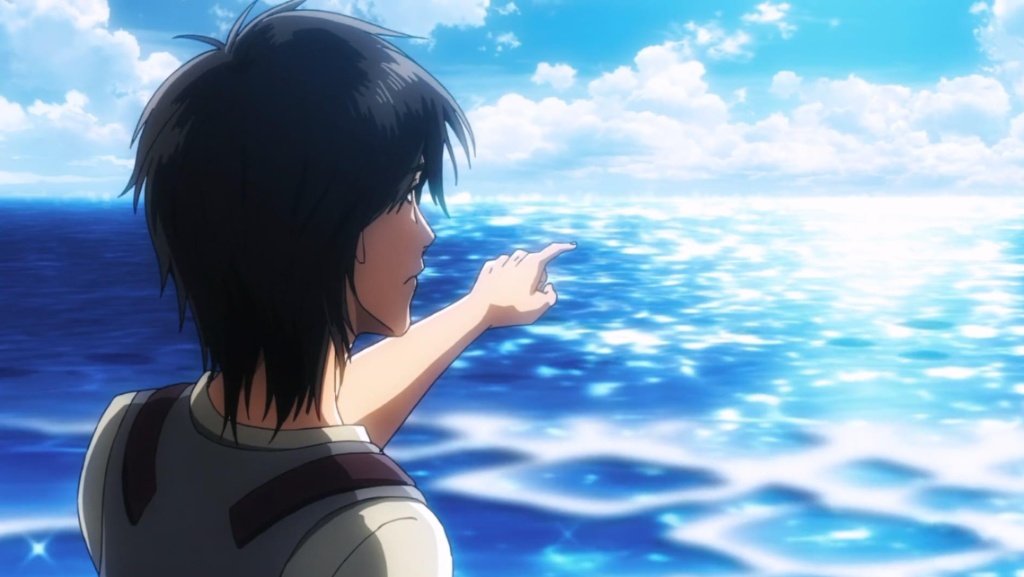
Reaching the ocean should have been the greatest moment of Eren’s childhood dream.
For years, he had imagined the world beyond the walls as an unexplored place full of possibilities.
Yet when he finally stands at the shoreline, he does not celebrate.
Instead, he points toward the distant enemy territory and asks whether killing everyone over there would finally make them free.
The ocean changes the meaning of his journey.
At first, freedom meant discovering the world. Now, it seems to mean removing anyone who might threaten him.
The destination has been reached, but the dream has become something darker.
3. The Outside World Destroys His Simplest Belief
Eren once believed that humanity was trapped because Titans existed outside the walls.
But the truth is far more complicated.
The Titans are not simply mindless monsters. Beyond the sea, there are nations, governments, armies, and people who have their own histories and fears.
The people outside the walls are not all responsible for the suffering of Paradis.
This discovery creates a problem Eren cannot easily solve.
His enemies are no longer a clearly defined group of monsters. They are human beings.
And if he wants to protect his people, he must confront a terrible question: how much violence can he justify in the name of survival?
4. Freedom Becomes an Obsession
Eren’s idea of freedom is unusual.
Armin dreams of experiencing the world. He wants to see the ocean, deserts, mountains, and places that exist beyond the walls.
Eren’s desire is different.
He does not simply want to experience the world. He wants to remove every obstacle that prevents him from reaching the world he imagined.
This distinction matters.
Armin’s dream is about discovery. Eren’s dream increasingly becomes about control.
The more he pursues absolute freedom, the less room he leaves for the freedom of others.
5. The Future Memory Changes Everything
The Attack Titan’s ability to receive memories from future inheritors introduces one of the story’s most disturbing ideas.
Eren does not merely fear what might happen. He receives glimpses of events that have not yet occurred.
These memories influence his decisions and eventually lead him toward a future he already knows.
But does seeing the future mean he has no choice?
The story deliberately makes this difficult to answer.
Eren experiences the future as something unavoidable, yet his own actions are part of the chain of events that produces it.
He is not simply watching destiny happen to him.
He is also helping create it.
6. Did Eren Choose the Rumbling?
The Rumbling is often discussed as an act of national survival.
Eren wants to protect Paradis from the outside world’s hostility. He also wants his friends to have a chance to live long lives.
Those motives are real parts of his character.
However, his conversation with Armin reveals something more disturbing.
Eren admits that his reasons were not limited to protecting his friends or his homeland. He also wanted to achieve a deeply personal vision of freedom.
He wanted to see the world emptied of the obstacles that stood between him and that vision.
This confession makes the Rumbling harder to explain away as a purely defensive action.
Eren was protecting people, but he was also pursuing his own desire at an unimaginable cost.
7. The Boy Who Hated Oppression Becomes an Oppressor
One of the greatest contradictions in Eren’s character is that he becomes what he once hated.
As a child, he could not accept that anyone should be imprisoned simply because someone stronger had decided it.
Yet during the Rumbling, he takes away the lives and futures of countless people who have no personal connection to his suffering.
His original belief was that freedom should not be taken away.
His final actions demonstrate how easily that belief can become distorted when someone considers their own freedom more important than everyone else’s.
Eren does not stop believing in freedom.
He simply narrows the definition until other people’s lives no longer matter.
8. Was Eren a Slave to Fate or to Himself?
This is perhaps the most important question in the entire ending.
There are two major ways to interpret Eren.
The first is that he became a prisoner of fate. His memories of the future showed him events that he could not change, and he eventually walked toward the outcome he had already seen.
The second interpretation is that Eren was a prisoner of his own nature. He wanted a particular kind of freedom so desperately that he continued making choices that led to destruction.
These interpretations are not necessarily mutually exclusive.
The future memories may have restricted his understanding of what was possible. But the desires that shaped his decisions belonged to him.
The tragedy is that Eren may have been both trapped by the future and responsible for moving toward it.
9. Mikasa Understands Something Eren Cannot
Mikasa’s final decision is not simply about defeating Eren.
She loves him, but she also recognizes that love cannot justify everything he has done.
Her choice is painful precisely because her feelings do not disappear.
She does not need to stop loving Eren in order to stop him.
This creates an important contrast between the two characters.
Eren cannot release his attachment to his personal vision of freedom. Mikasa, despite her attachment to Eren, finds the strength to make a different choice.
Her decision becomes part of the answer to Ymir’s long-standing emotional imprisonment.
Love does not always mean holding on.
Sometimes it means letting go, even when doing so is unbearable.
10. Ymir’s Freedom Is Connected to Mikasa’s Choice
Ymir Fritz has spent centuries bound to King Fritz and the power of the Titans.
Her relationship with him is deeply disturbing because it combines affection, obedience, suffering, and an inability to escape.
Mikasa’s decision gives Ymir a different example of love.
Mikasa loves Eren, but she does not allow that love to prevent her from acting.
This does not mean that Mikasa and Ymir have identical experiences.
Rather, Mikasa demonstrates that love and obedience are not the same thing.
The end of the Titan power is therefore not only a military victory. It is also tied to the emotional decision that Ymir could not make for herself.
11. Armin Is the Character Who Challenges Eren’s Definition of Freedom
Armin and Eren begin their journey with a shared dream of seeing the world beyond the walls.
But their understanding of that dream gradually separates.
Armin wants to experience what the world contains, even when it is complicated, frightening, or different from what he imagined.
Eren wants a world without the barriers that prevent him from experiencing his ideal vision.
Their final conversation exposes this difference.
Armin does not simply accept Eren’s explanation. He challenges him, questions his choices, and refuses to treat the Rumbling as something that can be excused by destiny.
In that sense, Armin represents an alternative to Eren’s worldview: the possibility of pursuing freedom without denying the humanity of others.
12. Why Reddit Still Debates Eren’s Freedom
Discussions among Attack on Titan fans frequently return to one central question: was Eren genuinely free to choose?
One interpretation emphasizes that Eren’s desire was always part of his personality. He saw the future, but he still wanted the outcome that his actions produced.
Another interpretation focuses on the Attack Titan’s memories and the strange relationship between past, present, and future. From this perspective, Eren’s choices were trapped inside a causal structure that he could not escape.
Some viewers also question whether the ending explains his motivations clearly enough.
The debate is not simply about whether Eren was right or wrong. It is about whether responsibility can exist when a person believes the future is already determined.
That unresolved tension is one reason the ending continues to invite discussion.
13. Did Eren Actually Achieve Freedom?
If freedom means removing every external obstacle, Eren comes frighteningly close to achieving his goal.
But if freedom means having the ability to choose a life beyond one’s own obsession, his story ends in failure.
He cannot escape his desire. He cannot imagine a future that does not revolve around the vision he has pursued. Even after discovering what his actions will cause, he continues toward them.
This is the irony at the center of his character.
Eren spends his life fighting against chains, only to become bound by the strongest chain of all: his own idea of freedom.
The person who wanted to be free from everything becomes unable to free himself.
14. Attack on Titan’s Most Disturbing Question
Attack on Titan does not offer a simple answer to the meaning of freedom.
It shows how a legitimate desire for survival can become an excuse for cruelty. It shows how fear can turn into hatred, and how a person can become a threat while believing that they are protecting something precious.
Eren is not merely a victim of fate, nor is he simply a villain who never cared about anyone.
He is a character whose love, fear, anger, ambition, and obsession become inseparable.
Perhaps the most disturbing lesson of his story is this:
A person can spend an entire lifetime fighting for freedom and still become a prisoner of the thing they desire most.
Eren wanted a world without walls.
But in the end, the most powerful wall was inside himself.