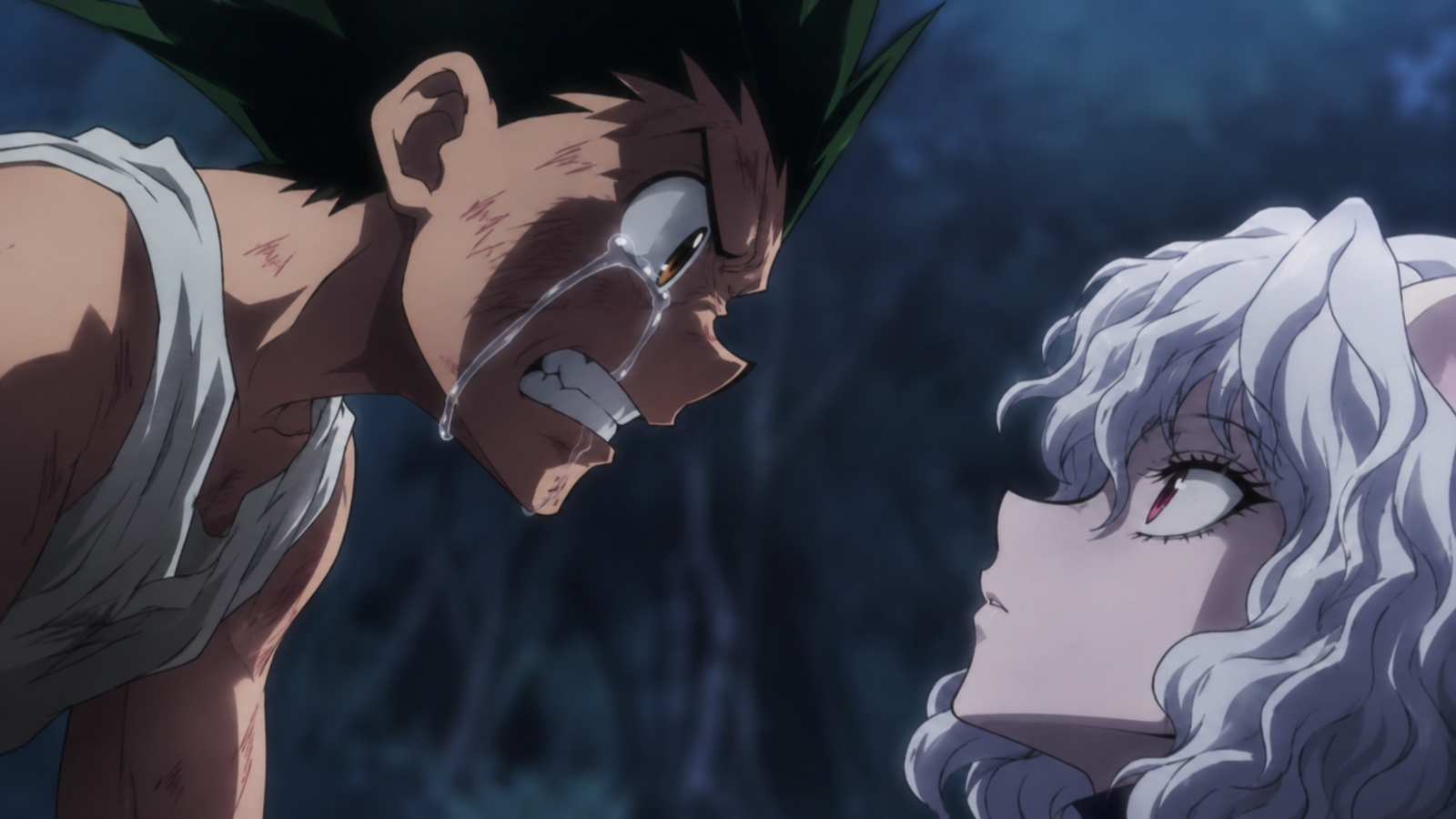
One of the most common interpretations of Hunter x Hunter is that Gon lost his humanity while Meruem gained his.
At first, the comparison seems obvious.
Gon, the cheerful boy who begins his journey with a bright smile, eventually becomes consumed by rage and revenge. Meruem, the ruthless Chimera Ant King who initially treats human beings as disposable creatures, gradually develops affection for a powerless human girl named Komugi.
One character appears to move toward darkness.
The other appears to move toward compassion.
But is that really what Yoshihiro Togashi is trying to tell us?
Perhaps Gon did not lose his humanity.
Perhaps he revealed a part of it that we never wanted to see.
And perhaps Meruem did not simply become human because he learned to love someone.
The Chimera Ant arc becomes much more disturbing when we stop treating humanity as a synonym for kindness.
1. Gon Was Never as Simple as He Appeared
When Gon first appears, he seems like a straightforward adventure protagonist.
He is energetic, curious, honest, and unusually optimistic. He makes friends easily and approaches difficult situations with an almost fearless attitude.
His kindness is one of the reasons audiences become attached to him.
But there is another characteristic that deserves attention.
Gon is incredibly determined when he wants something.
He rarely approaches his desires with hesitation. Once he decides what matters to him, he moves toward it with extraordinary intensity.
This quality makes him brave and admirable.
It also makes him dangerous.
The same determination that allows Gon to overcome impossible obstacles can become destructive when his desire is no longer balanced by patience, empathy, or self-control.
His personality does not suddenly change during the Chimera Ant arc.
Instead, the story gradually reveals what happens when one of his strongest characteristics is pushed beyond its limits.
2. Meruem Was Born with Power but Without Understanding
Meruem enters the world as the King of the Chimera Ants.
His physical abilities are extraordinary, and his position within the ant hierarchy is unquestioned.
He does not need to earn authority through years of struggle.
He is born with the expectation that everything exists beneath him.
Human beings are initially little more than resources to be consumed or controlled.
From Meruem’s perspective, this is not necessarily cruelty in the ordinary human sense.
It is the natural order of the world as he understands it.
The strongest should rule.
The weaker should serve.
His worldview is built around power, hierarchy, and survival.
But the story begins to challenge that worldview when Meruem encounters someone who cannot defeat him physically, yet possesses something he cannot easily understand.
That person is Komugi.
3. Komugi Changes the Meaning of Strength
Komugi is physically fragile and appears completely insignificant beside the King.
She cannot defeat Meruem in combat.
She cannot command an army or challenge his authority.
Yet she repeatedly defeats him in Gungi, the strategic board game in which she is extraordinarily talented.
This is important because Meruem initially assumes that superiority in one area should naturally translate into superiority everywhere.
Komugi challenges that assumption.
She possesses a form of excellence that Meruem cannot obtain simply through physical strength or royal authority.
For the first time, he encounters someone who has something he does not.
His curiosity gradually becomes respect.
That respect develops into a relationship that changes the way he understands the world.
Komugi does not defeat the King with physical power.
She makes him question what power actually means.
4. Gon and Meruem Move in Opposite Directions
The parallel between Gon and Meruem is one of the most fascinating elements of the Chimera Ant arc.
While Meruem gradually becomes more interested in an individual human being, Gon becomes increasingly consumed by the desire to avenge Kite.
Meruem begins to recognize value beyond strength.
Gon becomes increasingly unable to see anything beyond his own loss.
Their emotional directions appear to reverse.
The boy who once represented innocence becomes frightening.
The creature who once represented humanity’s greatest threat begins to display tenderness.
This contrast is powerful because it challenges the audience’s assumptions.
We naturally expect the human protagonist to represent goodness and the nonhuman antagonist to represent evil.
Togashi refuses to maintain that comfortable division.
Instead, he asks whether the capacity for cruelty and the capacity for love can exist within the same individual.
The answer is uncomfortable.
They can.
5. Did Gon Become a Monster After Kite’s Death?
Kite’s death changes Gon profoundly.
Kite is not simply another hunter who happens to be killed by an enemy.
He is someone connected to Gon’s father, Ging. He also becomes an important figure in Gon’s journey and a person Gon deeply respects.
When Gon discovers what happened to Kite, he struggles to accept the reality of the situation.
His anger becomes increasingly focused on Neferpitou.
At first, Gon still believes that Kite might be saved.
But as the truth becomes unavoidable, his hope turns into rage.
His emotional state becomes dangerous because he cannot separate his desire for revenge from his sense of justice.
He wants Pitou to pay.
He wants Kite’s death to mean something.
And he is increasingly willing to sacrifice anything to achieve that outcome.
This is not simply a transformation from good to evil.
It is the destructive side of grief, attachment, and desire becoming impossible to control.
6. Gon’s Transformation Was Not Just About Physical Power
Gon’s transformation into an adult form is one of the most shocking moments in the series.
It is often remembered as a spectacular power-up.
But its emotional meaning is much darker.
Gon makes a terrible sacrifice to obtain the power necessary to defeat Pitou.
He gives up his future for strength in the present.
The transformation is not a reward for hard work.
It is the physical expression of a decision made under extreme emotional pressure.
Gon is no longer thinking about what his life could become.
He is focused entirely on what he wants to do now.
That is what makes the transformation so disturbing.
The audience sees a character who once represented the excitement of possibility deliberately destroying his own possibilities.
His strength becomes a symbol of self-destruction.
7. The Most Uncomfortable Part of Gon’s Revenge
Gon’s actions toward Pitou are understandable on an emotional level.
Pitou killed Kite.
Gon loved and respected Kite.
His anger therefore has a clear origin.
But the situation becomes more complicated when Komugi enters the picture.
Pitou is trying to heal Komugi, and Gon is forced to confront the possibility that his revenge may endanger someone who has done nothing to him.
At this moment, his priorities become frighteningly narrow.
He is willing to use Komugi as leverage because his desire to punish Pitou has become more important than the life of another person.
This is one of the clearest moments in which the story exposes the darker side of Gon’s character.
It does not mean that everything he has done before was false.
It means that genuine kindness does not make someone incapable of selfishness or cruelty.
Gon can care deeply about others.
He can also become dangerously indifferent to them when his own desire takes control.
8. Did Meruem Really Become Human?
Meruem’s transformation is often described as the moment when a monster discovers humanity.
There is truth in that interpretation.
At the beginning, he treats other living beings according to their usefulness and position within his hierarchy.
His relationship with Komugi changes this.
He begins to value someone without needing to dominate or consume her.
He discovers that another person’s existence can matter independently of power.
But there is an important distinction.
Meruem does not become worthy of compassion simply because he develops feelings for Komugi.
His earlier actions still matter.
His victims do not disappear because he experiences emotional growth.
The story does not erase the violence that came before.
Instead, it presents a character who develops the capacity to understand something he previously ignored.
His transformation is meaningful precisely because it does not make his past irrelevant.
9. Humanity Is Not the Same as Kindness
This is where the popular interpretation of the arc becomes more complicated.
Many viewers describe Gon as losing his humanity and Meruem as gaining it.
But humanity has a broader meaning than kindness, mercy, or empathy.
Human beings are capable of extraordinary love.
They are also capable of jealousy, revenge, selfishness, violence, and destruction.
The Chimera Ant arc repeatedly explores this contradiction.
Gon demonstrates the destructive potential of personal desire.
Meruem gradually discovers the value of an individual life.
Meanwhile, the humans fighting against the ants are willing to use methods that are themselves deeply destructive.
The distinction between human and monster becomes increasingly unstable.
Perhaps the story is not asking which character is more human.
Perhaps it is asking what humanity actually contains.
10. Netero Shows the Darkest Side of Human Civilization
Meruem’s confrontation with Isaac Netero brings this theme into even sharper focus.
Netero is not simply a powerful martial artist protecting humanity.
He represents a civilization that has developed extraordinary knowledge, technology, and destructive capacity.
His battle against Meruem ultimately leads to the use of the Poor Man’s Rose.
The weapon is not a beautiful technique or a noble display of individual strength.
It is a weapon of mass destruction.
Even after Meruem demonstrates a growing ability to understand another person’s value, humanity has a means of defeating him through overwhelming technological violence.
The Rose is especially significant because it exposes something uncomfortable.
Humans are not necessarily more moral than the creatures they fight.
They are capable of creating destruction on a scale that individual monsters cannot easily match.
The threat of humanity is not only physical strength.
It is the ability to organize cruelty, develop destructive tools, and justify their use.
11. Gon and Meruem Are Not Simple Opposites
It is tempting to describe the two characters as complete opposites.
Gon loses his humanity.
Meruem gains his humanity.
But this interpretation risks making both characters less interesting.
Gon does not become a completely different person. His revenge grows from an attachment that was genuine.
Meruem does not become a completely innocent person. His affection develops after a history of violence and domination.
Both characters reveal different aspects of desire.
Gon wants to punish the person responsible for Kite’s death.
Meruem initially wants to rule the world because he believes that is what he was born to do.
Both begin with desires that place their own priorities above the lives of others.
Their journeys differ because their relationships with those desires change in different ways.
Meruem learns to value something beyond domination.
Gon becomes trapped inside the desire for revenge.
The contrast is not between a good person and a bad person.
It is between different ways human-like desire can develop.
12. Killua Understands the Cost of Gon’s Darkness
Killua’s role makes Gon’s transformation even more painful.
Unlike many other characters, Killua understands how deeply Gon matters to him.
He has built much of his emotional world around their friendship.
But his relationship with Gon is not simply a story of loyalty.
Killua gradually learns that caring about someone does not mean that person will always recognize the cost of being loved.
During the Chimera Ant crisis, Killua witnesses Gon’s emotional collapse.
He tries to support him, but he cannot control the decisions Gon makes.
This creates a painful imbalance.
Killua is deeply concerned about Gon’s survival and emotional state.
Gon becomes so focused on his own pain that he struggles to recognize Killua’s feelings.
The tragedy is not that Killua stops caring.
It is that caring alone cannot prevent someone else from destroying themselves.
His experience also forces him to recognize that his own worth cannot depend entirely on being useful to Gon.
13. Why Reddit Fans Still Debate the Meaning of Humanity
Reddit discussions show that the interpretation of Gon and Meruem remains controversial.
One popular interpretation argues that Gon did not lose his humanity at all.
Instead, he revealed the selfish and destructive side of human desire.
A highly discussed Reddit post in July 2026 challenged the idea that Gon became inhuman simply because he pursued revenge. Its argument was that desire itself is a fundamental part of humanity, even when that desire becomes morally destructive.
Other viewers defend the more familiar interpretation.
They point to Meruem’s growing affection for Komugi and Gon’s willingness to threaten Komugi as evidence that the two characters move in opposite moral directions.
There are also discussions about how grief affects Gon’s behavior and whether his worst actions should define his entire personality.
These disagreements are important because they show why the arc remains interesting.
The story does not provide an easy definition of humanity.
It gives the audience characters whose actions force us to question our own assumptions.
14. The Chimera Ant Arc’s Most Disturbing Question
The Chimera Ant arc is often remembered for its battles, transformations, and emotional ending.
But its greatest achievement may be the way it destroys the comfortable boundary between humans and monsters.
Meruem begins as a creature who believes that strength gives him the right to rule.
Through Komugi, he discovers a relationship that cannot be explained through power.
Gon begins as a boy whose kindness and determination make him easy to admire.
Through grief and revenge, he reveals how destructive those same human qualities can become.
Neither character offers a simple lesson about good and evil.
Meruem’s affection does not erase his violence.
Gon’s revenge does not erase his kindness.
And humanity itself is not a guarantee of moral goodness.
Perhaps that is why the arc’s central question remains so powerful.
Did Gon lose his humanity while Meruem gained his?
Maybe the more unsettling answer is that both characters revealed what humanity can become.
One discovered the value of another person’s existence.
The other showed how easily love and grief can turn into an obsession that destroys everything around it.
The Chimera Ant arc does not ask us to choose which character is the real monster.
It asks us to recognize that the capacity to become one has never belonged exclusively to monsters.