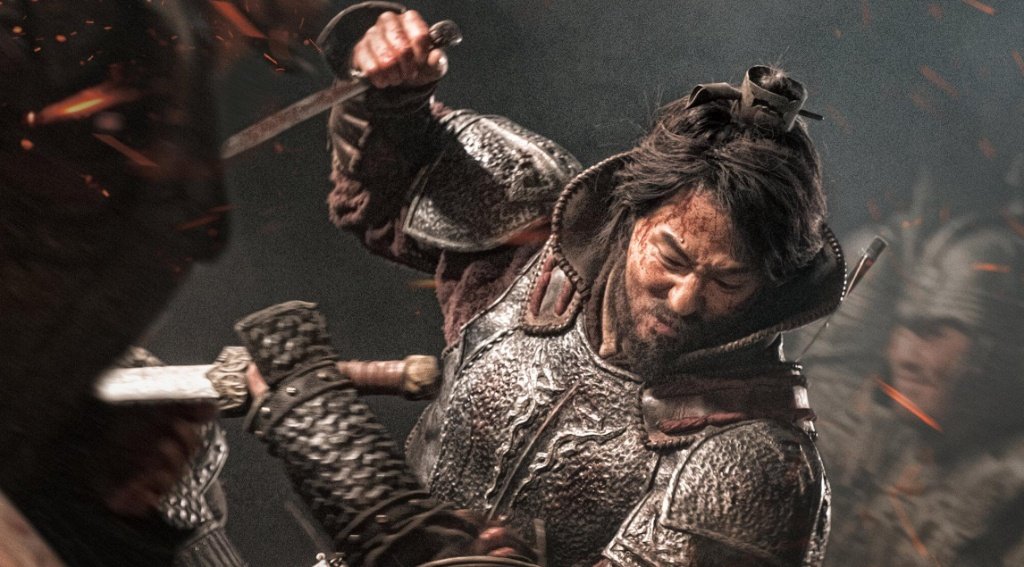
The Great Battle (2018), directed by Kim Kwang-sik, tells the story of the legendary defense of Ansi Fortress during the Goguryeo–Tang War of 645.
At first, it appears to be a straightforward war movie about a small fortress resisting an enormous invading army. But beneath the siege engines, battlefield tactics, and spectacular combat lies a more interesting conflict.
Yang Man-chun is not simply fighting the Tang army. He is also a commander whose relationship with Goguryeo’s central leadership is deeply troubled.
His situation raises a difficult question: when the orders of a ruler conflict with the responsibility to protect ordinary people, whom should a commander obey?
The film may be remembered for its battles, but its most compelling idea is the difference between serving a government and protecting the people who live under it.
1. A Fortress Standing Against an Empire
The historical background of The Great Battle is the Tang invasion of Goguryeo in 645.
The Tang dynasty, under Emperor Taizong, launched a major military campaign against Goguryeo. Its forces captured important fortifications, but the resistance at Ansi Fortress became one of the most famous episodes of the campaign.
The film transforms this historical confrontation into a dramatic struggle between an enormous imperial army and a relatively small defending force.
The imbalance is obvious.
The Tang army possesses superior numbers and considerable military resources. The defenders have a fortress, their knowledge of the terrain, and the determination to survive.
This is what makes the central conflict so compelling.
The defenders cannot simply overpower their enemy. They must understand the enemy’s strengths, exploit weaknesses, and make every defensive decision count.
But the film’s deeper tension comes from the fact that the defenders are not only fighting an external enemy. They are also caught in a political conflict within their own country.
2. Yang Man-chun: A Commander Who Refuses to Abandon His People
Jo In-sung plays Yang Man-chun, the commander of Ansi Fortress.
He is portrayed as a leader who understands that a fortress is not merely a military position. It is a place where ordinary people live.
His responsibility therefore extends beyond military victory.
He must consider the soldiers who defend the walls, the families who remain inside, and the civilians whose survival depends on his decisions.
This makes his leadership different from the distant calculations of central political power.
A ruler may think in terms of territories, armies, and national strategy. A commander responsible for a besieged city must also think about the people who will suffer if that strategy fails.
Yang Man-chun’s greatest strength in the film is not simply his ability to fight.
It is his refusal to treat the people under his protection as expendable numbers.
3. Yeon Gaesomun: The Burden of Central Power
Yeon Gaesomun is presented as a powerful political and military figure who has taken control of Goguryeo’s government.
His relationship with Yang Man-chun is tense.
The film portrays Yang as someone whose military decisions have made the central leadership suspicious of him. He is not fully trusted by the political authorities, even as the Tang invasion approaches.
From Yeon Gaesomun’s perspective, this distrust may appear to be a matter of national security.
A commander who does not follow central orders can become a serious threat during wartime. A divided military structure may weaken the entire kingdom.
But the film also invites viewers to question the cost of this centralized authority.
If a ruler demands obedience without understanding the circumstances faced by the people on the battlefield, can that obedience still be considered responsible leadership?
Yeon Gaesomun represents the difficult reality of governing a country during an existential crisis.
His position is not necessarily without logic, but the film contrasts his political calculations with Yang Man-chun’s immediate responsibility for human lives.
4. Is Disobeying an Order the Same as Betraying a Country?
One of the film’s most interesting questions concerns the relationship between obedience and loyalty.
Yang Man-chun is treated with suspicion because he does not fit comfortably into the central leadership’s expectations.
But does refusing to follow a particular order automatically make someone disloyal?
Military organizations depend on command structures. Without coordination, armies can collapse into confusion.
At the same time, commanders must make decisions based on conditions that distant authorities may not fully understand.
A battlefield is not an abstract political map.
The people responsible for defending it must respond to immediate dangers, changing circumstances, and the lives directly affected by their choices.
The film suggests that loyalty cannot be measured only by obedience.
Sometimes a commander may believe that protecting the people requires resisting the decisions of those who claim to represent the nation.
That does not mean every act of disobedience is justified.
It means that obedience and responsibility are not always the same thing.
5. The Battle Against Tang: Strength Is Not the Same as Victory
The Tang army represents overwhelming military power.
Its resources and numbers give it an enormous advantage over the defenders of Ansi Fortress.
But the film repeatedly demonstrates that military strength does not guarantee victory.
The defenders use the fortress itself as part of their strategy. Walls, terrain, defensive structures, and carefully timed responses become essential tools.
Their goal is not to defeat the Tang army in a conventional open battle.
It is to prevent the enemy from achieving its objective.
This distinction is important.
A weaker force does not always need to destroy a stronger opponent. Sometimes it only needs to make the cost of victory too high.
The defense of Ansi becomes a story about turning limitations into advantages.
The film’s action sequences are built around this idea, showing how tactical decisions can challenge an apparently unbeatable military force.
6. The Fortress Is More Than a Military Structure
Ansi Fortress functions as the film’s central symbol.
From a military perspective, it is a defensive position that must be held against invasion.
From the perspective of the people living inside it, however, it is home.
This difference changes the meaning of the battle.
If the fortress falls, the consequences are not limited to the loss of a strategic location. The people inside may lose their homes, families, and lives.
For Yang Man-chun, defending the fortress therefore means defending a community.
This is why his decisions carry a different emotional weight from those of a commander whose primary concern is territorial expansion or political reputation.
The fortress represents something that cannot be measured simply by its strategic value.
It represents the lives that depend on it.
7. Sa-mul: The Man Sent to Judge Yang Man-chun
Nam Joo-hyuk plays Sa-mul, a young warrior who arrives at Ansi with a mission connected to the central leadership.
He is initially positioned as someone who must evaluate Yang Man-chun and carry out the political instructions he has received.
But what he encounters challenges his assumptions.
Instead of discovering a selfish commander who has abandoned his country, he sees a leader whose relationship with the people is very different from what he expected.
Sa-mul’s perspective is important because he allows the audience to reconsider Yang Man-chun.
At first, he represents the judgment of central authority. As the story progresses, he begins to understand the difference between political suspicion and the reality of leadership.
His experience suggests that loyalty cannot always be understood from a distance.
Sometimes people must witness the consequences of a decision before they can judge whether it was right.
8. The Women of Ansi: War Is Not Only a Story About Generals
The film also gives attention to the people who contribute to the defense beyond the traditional image of male warriors.
Seol-hyun plays Baek-ha, whose character participates in the struggle surrounding Ansi Fortress.
Her presence helps broaden the film’s picture of wartime responsibility.
A city under siege does not survive through its commander alone. Its survival depends on the participation of people with different abilities and different roles.
This is an important idea, even if the film does not develop every supporting character as deeply as it could.
War movies often place the general at the center of history. But the survival of a community depends on many people whose names may never appear in official records.
The defense of Ansi is presented as a collective effort, not merely the personal achievement of one heroic commander.
9. The Siege: How Can a Smaller Force Survive?
One of the strongest elements of The Great Battle is its attention to siege warfare.
The Tang army cannot simply walk through the fortress walls. It must find ways to weaken the defenses, overcome obstacles, and create an opportunity to enter the city.
The defenders must anticipate these attempts and respond with limited resources.
This creates a cycle of attack and counterattack.
The film uses these sequences to demonstrate the importance of preparation and adaptability.
A fortress is only as strong as the decisions made by the people defending it.
Walls can be damaged. Supplies can run out. Soldiers can become exhausted.
No defensive structure is invulnerable.
The defenders’ greatest advantage is their ability to use their knowledge of the environment and respond creatively to the enemy’s methods.
The battle becomes a contest between overwhelming resources and intelligent resistance.
10. How Historically Accurate Is The Great Battle?
This is where viewers should separate historical events from cinematic storytelling.
The defense of Ansi Fortress during the Tang invasion of 645 is a real historical event.
However, the surviving historical records do not provide a complete account of every character, conversation, and battlefield maneuver depicted in the film.
The film takes creative liberties to turn the historical confrontation into a dramatic narrative.
Even Yang Man-chun’s historical identity requires caution. His name is widely associated with the commander of Ansi Fortress, but the surviving records do not establish it with the same certainty that the film’s confident portrayal might suggest.
The famous story that Emperor Taizong was struck in the eye by an arrow fired by Yang Man-chun is also not established as a reliable historical fact.
Similarly, certain tactical elements shown in the movie, including the dramatic underground strategy, should be understood as cinematic inventions rather than confirmed historical events.
The distinction matters.
A historical film can use real events to explore ideas about leadership, courage, and sacrifice. But viewers should not assume that every memorable scene represents documented history.
The film’s emotional interpretation may be powerful even when its specific details are fictionalized. <Cite refs={[“turn377978search1″,”turn377978search0″,”turn377978search5”]}/>
11. Why the Film’s Action Is More Convincing Than Its Character Development
One of the film’s most recognizable strengths is its large-scale battle choreography.
The siege sequences create a strong sense of physical danger, and the fortress becomes a visually compelling environment for the conflict.
However, the film’s character development is less consistent.
There are many soldiers, commanders, and supporting characters, but not all of them receive enough time to develop fully.
This creates a contrast between the scale of the battle and the depth of some individual stories.
Viewers who primarily want a spectacular war movie may find this less important.
Those who expect a more detailed political drama may feel that the film leaves several promising conflicts unexplored.
The relationship between Yang Man-chun and Yeon Gaesomun, for example, could have supported a much deeper examination of political authority and military independence.
The film introduces that conflict but often returns to the immediate demands of the siege.
Its greatest missed opportunity may be that it raises a fascinating political question without exploring every consequence of it.
12. Why Yang Man-chun’s Leadership Still Matters
Yang Man-chun’s leadership can be examined through a distinction between authority and responsibility.
Authority gives a person the power to issue orders.
Responsibility requires that person to consider the consequences of those orders.
A leader who possesses authority but ignores the people affected by decisions may preserve control while losing legitimacy.
Yang Man-chun’s leadership is compelling because the film portrays him as someone who understands that his position exists for the sake of the people he protects.
This does not make him a flawless leader.
His decisions are still shaped by limited information, military pressure, and the possibility of failure.
But his legitimacy comes from the relationship he maintains with the people of Ansi.
They are not simply instruments of his military strategy.
They are the reason the fortress must be defended.
That is the difference between commanding a territory and taking responsibility for a community.
13. What Makes The Great Battle Worth Discussing?
The film’s appeal comes from several different sources.
Its battle scenes offer the scale expected from a historical war epic. Its central character provides a recognizable image of courage and leadership. Its historical background gives the conflict a sense of national significance.
But the most valuable discussion comes from the tension between the film’s two ideas of loyalty.
One is loyalty to the political leadership of a country.
The other is loyalty to the people whose lives depend on the decisions of that leadership.
The film does not need to prove that one form of loyalty is always correct.
Its strength lies in showing why the two can come into conflict.
Discussions of the film’s historical accuracy also create an opportunity to distinguish the real siege from the dramatic choices made by the filmmakers.
This makes The Great Battle more than a story about a heroic last stand.
It becomes a useful starting point for discussing how history is transformed into national memory and cinematic mythology.
14. Was Yang Man-chun Defending a Fortress, or Defying His Own King?
At the end of The Great Battle, the defense of Ansi Fortress represents more than a military victory.
It represents the determination of a community to survive despite overwhelming pressure.
Yang Man-chun is celebrated because he refuses to surrender, but his character raises a question that goes beyond the battlefield.
What makes a leader loyal to a country?
Is it obedience to the ruler who commands the army?
Is it the willingness to sacrifice everything for national strategy?
Or is it the responsibility to protect the people who have entrusted their lives to that leader?
Yeon Gaesomun represents the burden of protecting an entire kingdom through centralized power. Yang Man-chun represents the responsibility of protecting the people directly under his command.
Both positions emerge from the pressures of war, but they produce different ideas about what loyalty means.
Perhaps the film’s most interesting message is that a country is not simply its ruler, its army, or its territory.
It is also the people who live within its borders.
A fortress can be rebuilt. A political leader can be replaced. But the lives lost because of a decision cannot be restored.
If obeying the central government meant abandoning the people under your protection, would refusing that order make you a traitor—or the only leader still fulfilling the meaning of loyalty?