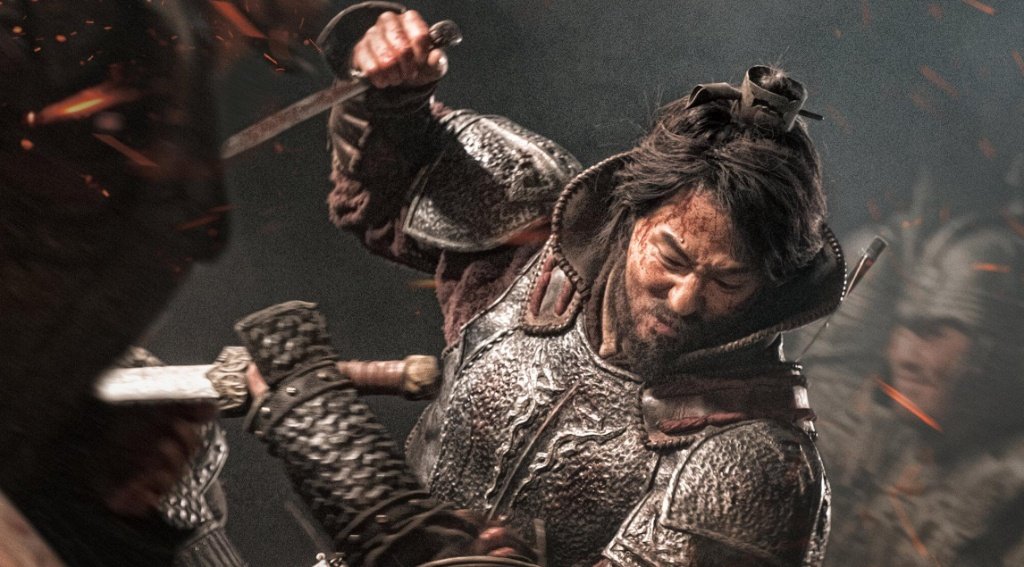
• The Great Battle: Was Yang Man-chun Defending a Fortress, or Defying His Own King?

    The Great Battle: Was Yang Man-chun Defending a Fortress, or Defying His Own King?

    The Great Battle (2018), directed by Kim Kwang-sik, tells the story of the legendary defense of Ansi Fortress during the Goguryeo–Tang War of 645.

    At first, it appears to be a straightforward war movie about a small fortress resisting an enormous invading army. But beneath the siege engines, battlefield tactics, and spectacular combat lies a more interesting conflict.

    Yang Man-chun is not simply fighting the Tang army. He is also a commander whose relationship with Goguryeo’s central leadership is deeply troubled.

    His situation raises a difficult question: when the orders of a ruler conflict with the responsibility to protect ordinary people, whom should a commander obey?

    The film may be remembered for its battles, but its most compelling idea is the difference between serving a government and protecting the people who live under it.

    1. A Fortress Standing Against an Empire

    The historical background of The Great Battle is the Tang invasion of Goguryeo in 645.

    The Tang dynasty, under Emperor Taizong, launched a major military campaign against Goguryeo. Its forces captured important fortifications, but the resistance at Ansi Fortress became one of the most famous episodes of the campaign.

    The film transforms this historical confrontation into a dramatic struggle between an enormous imperial army and a relatively small defending force.

    The imbalance is obvious.

    The Tang army possesses superior numbers and considerable military resources. The defenders have a fortress, their knowledge of the terrain, and the determination to survive.

    This is what makes the central conflict so compelling.

    The defenders cannot simply overpower their enemy. They must understand the enemy’s strengths, exploit weaknesses, and make every defensive decision count.

    But the film’s deeper tension comes from the fact that the defenders are not only fighting an external enemy. They are also caught in a political conflict within their own country.

    2. Yang Man-chun: A Commander Who Refuses to Abandon His People

    Jo In-sung plays Yang Man-chun, the commander of Ansi Fortress.

    He is portrayed as a leader who understands that a fortress is not merely a military position. It is a place where ordinary people live.

    His responsibility therefore extends beyond military victory.

    He must consider the soldiers who defend the walls, the families who remain inside, and the civilians whose survival depends on his decisions.

    This makes his leadership different from the distant calculations of central political power.

    A ruler may think in terms of territories, armies, and national strategy. A commander responsible for a besieged city must also think about the people who will suffer if that strategy fails.

    Yang Man-chun’s greatest strength in the film is not simply his ability to fight.

    It is his refusal to treat the people under his protection as expendable numbers.

    3. Yeon Gaesomun: The Burden of Central Power

    Yeon Gaesomun is presented as a powerful political and military figure who has taken control of Goguryeo’s government.

    His relationship with Yang Man-chun is tense.

    The film portrays Yang as someone whose military decisions have made the central leadership suspicious of him. He is not fully trusted by the political authorities, even as the Tang invasion approaches.

    From Yeon Gaesomun’s perspective, this distrust may appear to be a matter of national security.

    A commander who does not follow central orders can become a serious threat during wartime. A divided military structure may weaken the entire kingdom.

    But the film also invites viewers to question the cost of this centralized authority.

    If a ruler demands obedience without understanding the circumstances faced by the people on the battlefield, can that obedience still be considered responsible leadership?

    Yeon Gaesomun represents the difficult reality of governing a country during an existential crisis.

    His position is not necessarily without logic, but the film contrasts his political calculations with Yang Man-chun’s immediate responsibility for human lives.

    4. Is Disobeying an Order the Same as Betraying a Country?

    One of the film’s most interesting questions concerns the relationship between obedience and loyalty.

    Yang Man-chun is treated with suspicion because he does not fit comfortably into the central leadership’s expectations.

    But does refusing to follow a particular order automatically make someone disloyal?

    Military organizations depend on command structures. Without coordination, armies can collapse into confusion.

    At the same time, commanders must make decisions based on conditions that distant authorities may not fully understand.

    A battlefield is not an abstract political map.

    The people responsible for defending it must respond to immediate dangers, changing circumstances, and the lives directly affected by their choices.

    The film suggests that loyalty cannot be measured only by obedience.

    Sometimes a commander may believe that protecting the people requires resisting the decisions of those who claim to represent the nation.

    That does not mean every act of disobedience is justified.

    It means that obedience and responsibility are not always the same thing.

    5. The Battle Against Tang: Strength Is Not the Same as Victory

    The Tang army represents overwhelming military power.

    Its resources and numbers give it an enormous advantage over the defenders of Ansi Fortress.

    But the film repeatedly demonstrates that military strength does not guarantee victory.

    The defenders use the fortress itself as part of their strategy. Walls, terrain, defensive structures, and carefully timed responses become essential tools.

    Their goal is not to defeat the Tang army in a conventional open battle.

    It is to prevent the enemy from achieving its objective.

    This distinction is important.

    A weaker force does not always need to destroy a stronger opponent. Sometimes it only needs to make the cost of victory too high.

    The defense of Ansi becomes a story about turning limitations into advantages.

    The film’s action sequences are built around this idea, showing how tactical decisions can challenge an apparently unbeatable military force.

    6. The Fortress Is More Than a Military Structure

    Ansi Fortress functions as the film’s central symbol.

    From a military perspective, it is a defensive position that must be held against invasion.

    From the perspective of the people living inside it, however, it is home.

    This difference changes the meaning of the battle.

    If the fortress falls, the consequences are not limited to the loss of a strategic location. The people inside may lose their homes, families, and lives.

    For Yang Man-chun, defending the fortress therefore means defending a community.

    This is why his decisions carry a different emotional weight from those of a commander whose primary concern is territorial expansion or political reputation.

    The fortress represents something that cannot be measured simply by its strategic value.

    It represents the lives that depend on it.

    7. Sa-mul: The Man Sent to Judge Yang Man-chun

    Nam Joo-hyuk plays Sa-mul, a young warrior who arrives at Ansi with a mission connected to the central leadership.

    He is initially positioned as someone who must evaluate Yang Man-chun and carry out the political instructions he has received.

    But what he encounters challenges his assumptions.

    Instead of discovering a selfish commander who has abandoned his country, he sees a leader whose relationship with the people is very different from what he expected.

    Sa-mul’s perspective is important because he allows the audience to reconsider Yang Man-chun.

    At first, he represents the judgment of central authority. As the story progresses, he begins to understand the difference between political suspicion and the reality of leadership.

    His experience suggests that loyalty cannot always be understood from a distance.

    Sometimes people must witness the consequences of a decision before they can judge whether it was right.

    8. The Women of Ansi: War Is Not Only a Story About Generals

    The film also gives attention to the people who contribute to the defense beyond the traditional image of male warriors.

    Seol-hyun plays Baek-ha, whose character participates in the struggle surrounding Ansi Fortress.

    Her presence helps broaden the film’s picture of wartime responsibility.

    A city under siege does not survive through its commander alone. Its survival depends on the participation of people with different abilities and different roles.

    This is an important idea, even if the film does not develop every supporting character as deeply as it could.

    War movies often place the general at the center of history. But the survival of a community depends on many people whose names may never appear in official records.

    The defense of Ansi is presented as a collective effort, not merely the personal achievement of one heroic commander.

    9. The Siege: How Can a Smaller Force Survive?

    One of the strongest elements of The Great Battle is its attention to siege warfare.

    The Tang army cannot simply walk through the fortress walls. It must find ways to weaken the defenses, overcome obstacles, and create an opportunity to enter the city.

    The defenders must anticipate these attempts and respond with limited resources.

    This creates a cycle of attack and counterattack.

    The film uses these sequences to demonstrate the importance of preparation and adaptability.

    A fortress is only as strong as the decisions made by the people defending it.

    Walls can be damaged. Supplies can run out. Soldiers can become exhausted.

    No defensive structure is invulnerable.

    The defenders’ greatest advantage is their ability to use their knowledge of the environment and respond creatively to the enemy’s methods.

    The battle becomes a contest between overwhelming resources and intelligent resistance.

    10. How Historically Accurate Is The Great Battle?

    This is where viewers should separate historical events from cinematic storytelling.

    The defense of Ansi Fortress during the Tang invasion of 645 is a real historical event.

    However, the surviving historical records do not provide a complete account of every character, conversation, and battlefield maneuver depicted in the film.

    The film takes creative liberties to turn the historical confrontation into a dramatic narrative.

    Even Yang Man-chun’s historical identity requires caution. His name is widely associated with the commander of Ansi Fortress, but the surviving records do not establish it with the same certainty that the film’s confident portrayal might suggest.

    The famous story that Emperor Taizong was struck in the eye by an arrow fired by Yang Man-chun is also not established as a reliable historical fact.

    Similarly, certain tactical elements shown in the movie, including the dramatic underground strategy, should be understood as cinematic inventions rather than confirmed historical events.

    The distinction matters.

    A historical film can use real events to explore ideas about leadership, courage, and sacrifice. But viewers should not assume that every memorable scene represents documented history.

    The film’s emotional interpretation may be powerful even when its specific details are fictionalized. <Cite refs={[“turn377978search1″,”turn377978search0″,”turn377978search5”]}/>

    11. Why the Film’s Action Is More Convincing Than Its Character Development

    One of the film’s most recognizable strengths is its large-scale battle choreography.

    The siege sequences create a strong sense of physical danger, and the fortress becomes a visually compelling environment for the conflict.

    However, the film’s character development is less consistent.

    There are many soldiers, commanders, and supporting characters, but not all of them receive enough time to develop fully.

    This creates a contrast between the scale of the battle and the depth of some individual stories.

    Viewers who primarily want a spectacular war movie may find this less important.

    Those who expect a more detailed political drama may feel that the film leaves several promising conflicts unexplored.

    The relationship between Yang Man-chun and Yeon Gaesomun, for example, could have supported a much deeper examination of political authority and military independence.

    The film introduces that conflict but often returns to the immediate demands of the siege.

    Its greatest missed opportunity may be that it raises a fascinating political question without exploring every consequence of it.

    12. Why Yang Man-chun’s Leadership Still Matters

    Yang Man-chun’s leadership can be examined through a distinction between authority and responsibility.

    Authority gives a person the power to issue orders.

    Responsibility requires that person to consider the consequences of those orders.

    A leader who possesses authority but ignores the people affected by decisions may preserve control while losing legitimacy.

    Yang Man-chun’s leadership is compelling because the film portrays him as someone who understands that his position exists for the sake of the people he protects.

    This does not make him a flawless leader.

    His decisions are still shaped by limited information, military pressure, and the possibility of failure.

    But his legitimacy comes from the relationship he maintains with the people of Ansi.

    They are not simply instruments of his military strategy.

    They are the reason the fortress must be defended.

    That is the difference between commanding a territory and taking responsibility for a community.

    13. What Makes The Great Battle Worth Discussing?

    The film’s appeal comes from several different sources.

    Its battle scenes offer the scale expected from a historical war epic. Its central character provides a recognizable image of courage and leadership. Its historical background gives the conflict a sense of national significance.

    But the most valuable discussion comes from the tension between the film’s two ideas of loyalty.

    One is loyalty to the political leadership of a country.

    The other is loyalty to the people whose lives depend on the decisions of that leadership.

    The film does not need to prove that one form of loyalty is always correct.

    Its strength lies in showing why the two can come into conflict.

    Discussions of the film’s historical accuracy also create an opportunity to distinguish the real siege from the dramatic choices made by the filmmakers.

    This makes The Great Battle more than a story about a heroic last stand.

    It becomes a useful starting point for discussing how history is transformed into national memory and cinematic mythology.

    14. Was Yang Man-chun Defending a Fortress, or Defying His Own King?

    At the end of The Great Battle, the defense of Ansi Fortress represents more than a military victory.

    It represents the determination of a community to survive despite overwhelming pressure.

    Yang Man-chun is celebrated because he refuses to surrender, but his character raises a question that goes beyond the battlefield.

    What makes a leader loyal to a country?

    Is it obedience to the ruler who commands the army?

    Is it the willingness to sacrifice everything for national strategy?

    Or is it the responsibility to protect the people who have entrusted their lives to that leader?

    Yeon Gaesomun represents the burden of protecting an entire kingdom through centralized power. Yang Man-chun represents the responsibility of protecting the people directly under his command.

    Both positions emerge from the pressures of war, but they produce different ideas about what loyalty means.

    Perhaps the film’s most interesting message is that a country is not simply its ruler, its army, or its territory.

    It is also the people who live within its borders.

    A fortress can be rebuilt. A political leader can be replaced. But the lives lost because of a decision cannot be restored.

    If obeying the central government meant abandoning the people under your protection, would refusing that order make you a traitor—or the only leader still fulfilling the meaning of loyalty?

  • Yeon Gaesomun: Hero or Dictator? The Man Who Changed Goguryeo’s Destiny

    Yeon Gaesomun: Hero or Dictator? The Man Who Changed Goguryeo’s Destiny

    Historical note: This article discusses the 2006 Korean historical drama Yeon Gaesomun alongside the historical figure on whom it is based. Some dramatic events and character relationships are fictionalized or interpreted differently from historical scholarship.

    Few historical figures create such a complicated impression as Yeon Gaesomun, the powerful military leader of Goguryeo.

    To some, he was the man who refused to surrender to the expanding Tang Dynasty and defended his kingdom against one of the strongest empires in East Asia. To others, he was a ruthless political figure who overthrew a king, concentrated power in his own hands, and left behind a leadership structure that struggled to survive after his death.

    The 2006 Korean historical drama Yeon Gaesomun brings these contradictions to the screen through political rivalries, military campaigns, personal ambition, and the struggle to preserve a kingdom under enormous pressure.

    What makes his story so compelling is that neither interpretation completely explains him.

    A leader can defend his country against foreign aggression while undermining its internal political order. A military victory can demonstrate extraordinary leadership without guaranteeing the long-term survival of a state.

    The most important question is therefore not simply whether Yeon Gaesomun was a hero or a dictator.

    It is whether the kind of power he created was capable of protecting Goguryeo beyond his own lifetime.

    1. Yeon Gaesomun Was a Man Born Into a Kingdom Under Pressure

    To understand Yeon Gaesomun, we must first understand the world in which he lived.

    Goguryeo was one of the major kingdoms of ancient Northeast Asia. Its territory covered important areas of the Korean Peninsula and parts of Manchuria, placing it in a strategically significant position between neighboring powers.

    By the seventh century, the political environment had become increasingly dangerous.

    The Sui Dynasty had previously attempted major invasions of Goguryeo and suffered devastating setbacks. The Tang Dynasty, which replaced the Sui, eventually emerged as another powerful imperial force.

    Goguryeo therefore faced a difficult strategic problem.

    It had to defend its territory while managing relationships with neighboring states and maintaining political stability at home.

    Yeon Gaesomun emerged within this environment of military pressure and internal competition.

    His rise was not simply the result of personal ambition. It occurred at a time when decisions about foreign policy, military preparedness, and royal authority could determine the survival of the kingdom.

    This context is essential.

    A leader who rises during a national emergency often gains legitimacy through the promise of security. But the same emergency can also become a justification for concentrating extraordinary power.

    2. The Coup of 642 Changed the Political Structure of Goguryeo

    One of the defining events associated with Yeon Gaesomun was the political upheaval of 642.

    Historical records describe how Yeon overthrew King Yeongnyu and killed members of the existing political leadership. He subsequently installed King Bojang on the throne.

    This was not an ordinary change of government.

    The king remained formally important, but effective political and military authority became concentrated in Yeon Gaesomun’s hands.

    The event created the central contradiction of his legacy.

    He became the dominant leader at a moment when Goguryeo needed strong coordination against external threats. Yet the way he obtained power raised serious questions about the legitimacy of his rule.

    Was the existing royal government incapable of defending the country?

    Did Yeon believe that eliminating political opposition was necessary for national survival?

    Or did he use the international crisis as an opportunity to establish personal dominance?

    The historical evidence does not allow us to treat every motive attributed to him as certain.

    What is clear is that the coup fundamentally changed the relationship between the monarchy and the military leadership.

    The drama uses this political transformation to create one of its most important conflicts: the tension between the authority of the throne and the authority of the man who actually controls the state.

    3. The Hero and the Dictator Can Exist in the Same Person

    It is tempting to classify historical leaders according to their most famous achievements.

    A general who defeats an invasion becomes a national hero. A politician who removes a king becomes a traitor or dictator.

    But history rarely fits into such simple categories.

    Yeon Gaesomun’s military resistance against Tang China is an important part of his historical reputation. His seizure of political power is another.

    Both belong to the same biography.

    This is what makes his legacy difficult.

    If we evaluate him only through his resistance to Tang, we risk ignoring the political violence that accompanied his rise.

    If we evaluate him only through the coup, we risk overlooking the military and strategic challenges that Goguryeo faced.

    A more serious historical judgment must consider both.

    The question is not whether his achievements erase his abuses of power, or whether his abuses erase his achievements.

    It is how those decisions interacted.

    Yeon could be an effective military leader while creating political weaknesses. He could defend the independence of Goguryeo while damaging the institutions that were supposed to preserve that independence.

    This contradiction is far more interesting than a simple debate over whether he was good or evil.

    4. His Conflict With Tang China Was About More Than Military Pride

    The Tang Dynasty was not simply another neighboring kingdom.

    Under Emperor Taizong, it possessed considerable military resources, administrative organization, and imperial ambition.

    For Tang, Goguryeo represented a major strategic obstacle in Northeast Asia.

    For Goguryeo, accepting Tang dominance would threaten its political independence.

    The conflict was therefore about more than prestige.

    It involved territorial security, regional influence, diplomatic status, and the balance of power between two states.

    Yeon Gaesomun adopted a strongly resistant position.

    His leadership became associated with the refusal to submit to Tang pressure.

    This policy could be interpreted as an expression of national determination. However, it also carried considerable risks.

    A powerful empire could return with additional troops and resources. Military resistance required economic support, political coordination, and the ability to sustain long campaigns.

    The drama emphasizes the courage and determination of the Goguryeo leadership.

    But the historical question is broader: how can a smaller state preserve independence when facing a much larger empire?

    The answer involves not only military bravery but also diplomacy, logistics, alliances, and political stability.

    5. The Ansi Fortress Battle Reveals the Limits of Imperial Power

    <image-placeholder>An image of the Siege of Ansi Fortress during the Tang invasion</image-placeholder>

    The Tang campaign against Goguryeo in 645 is one of the most famous episodes associated with the kingdom’s resistance.

    Emperor Taizong personally participated in the campaign, demonstrating the importance he attached to defeating Goguryeo.

    Tang forces achieved several military successes, but their advance was ultimately checked by the prolonged resistance around Ansi Fortress.

    The siege became a defining symbol of Goguryeo’s defensive strength.

    The story of Ansi is particularly interesting because it demonstrates that military superiority does not guarantee victory.

    A larger army may possess more resources, but it still faces geographical limitations, supply problems, defensive fortifications, weather, and the determination of the defenders.

    The traditional Korean account associates the defense of Ansi with a commander known as Yang Manchun. However, the surviving historical records do not provide a secure identification of the commander by that name, so the familiar story should be treated with historical caution.

    It is also important not to confuse the defense of Ansi with direct command by Yeon Gaesomun. The evidence does not establish that he personally directed the fortress defense.

    The drama can connect these events through its storytelling, but historical analysis must distinguish what is documented from what is dramatically reconstructed.

    6. Yeon Gaesomun’s Greatest Strength Was His Ability to Concentrate Power

    In a military emergency, divided authority can become dangerous.

    Different political factions may disagree about strategy. Commanders may compete for influence. Government decisions can become slow when the kingdom needs a coordinated response.

    Yeon Gaesomun’s political position allowed him to concentrate decision-making authority.

    This could produce clear advantages.

    He could maintain a consistent military policy, exercise influence over important officials, and prevent rival groups from easily changing the direction of the state.

    However, concentrated power also creates a serious institutional problem.

    When a kingdom depends heavily on one person’s judgment, the quality of government becomes closely connected to that individual’s ability.

    The system may appear strong while its central leader is alive.

    But what happens when that leader dies?

    If authority has not been transferred through stable institutions, the state can face uncertainty precisely when continuity is most necessary.

    This is one of the most important questions raised by Yeon’s political career.

    His strength as an individual leader may have become a weakness for the political system that depended on him.

    7. King Bojang’s Position Reveals the Difference Between a Throne and Real Power

    After the coup, King Bojang became the ruler of Goguryeo.

    Yet the political reality was complicated.

    Yeon Gaesomun held the dominant position in government and military affairs. The existence of a king did not necessarily mean that the king exercised independent control over the state.

    This distinction between formal authority and actual power is common in political history.

    A ruler may possess the title, ceremonial status, and symbolic legitimacy of a monarch while another individual controls the institutions that make decisions.

    The arrangement can function as long as the dominant figure maintains political support.

    But it creates a question of succession.

    If the powerful minister dies, who has the authority to restore balance between the monarchy and the political elite?

    Can the king recover independent authority?

    Will another powerful family or military leader take control?

    The drama uses the relationship between Yeon and the royal court to create tension around this problem.

    It is not merely a personal disagreement.

    It is a struggle over the fundamental structure of government.

    8. Military Success Does Not Automatically Create a Stable Nation

    One of the most dangerous assumptions in political leadership is that defeating an external enemy proves that a government is functioning successfully.

    Military victories are important, especially when national independence is at stake.

    But a state also needs institutions capable of managing taxation, administration, succession, diplomacy, and internal disputes.

    A kingdom can win battles while accumulating political weaknesses.

    It can defend its borders while failing to create a stable arrangement for the transfer of authority.

    Yeon Gaesomun’s career raises precisely this issue.

    His personal dominance helped define Goguryeo’s resistance during a critical period. Yet the political structure surrounding him remained vulnerable to the problem of succession.

    This does not mean that a different political arrangement would certainly have saved Goguryeo.

    It means that military resistance and institutional stability must be evaluated separately.

    A leader may be capable of defending a country during his lifetime without building a system capable of defending it after his death.

    That distinction is central to understanding the eventual collapse of Goguryeo.

    9. The Drama’s Most Important Theme Is the Price of Political Ambition

    The 2006 drama does not portray its historical world as a peaceful society disrupted by a single conflict.

    Its characters operate in an environment where ambition, family loyalty, military responsibility, and political survival constantly collide.

    This is one reason historical dramas can be so engaging.

    The characters rarely face choices with completely clean outcomes.

    A political figure may believe that removing a rival is necessary to prevent national instability. A military leader may believe that refusing compromise is the only way to preserve independence.

    Yet every decision creates consequences for other people.

    The pursuit of power can begin with a claim of public responsibility and gradually become inseparable from personal survival.

    This is particularly relevant to Yeon Gaesomun.

    His political authority was closely connected to the security of Goguryeo. But the concentration of authority also made his personal position essential to the continuation of the political order.

    The more power he accumulated, the more difficult it became to separate the fate of the kingdom from the fate of one individual.

    That is a dangerous situation for any state.

    10. The Death of Yeon Gaesomun Exposed the Weakness of Personal Rule

    Yeon Gaesomun died in 666.

    His death did not immediately destroy Goguryeo, but it created a major political problem.

    His sons became involved in a struggle over succession and political authority.

    The conflict among Yeon Namsaeng, Yeon Namgeon, and Yeon Namsan had consequences that went far beyond a family disagreement.

    Namsaeng eventually defected to Tang, bringing knowledge and political support that could be useful to Goguryeo’s enemies.

    The internal conflict weakened the kingdom at a critical moment.

    This episode reveals the vulnerability of a political system built around personal dominance.

    A strong leader may be able to keep rival factions under control during his lifetime. But unless there is an accepted process for transferring power, the same factions may compete violently once the leader disappears.

    The problem is not simply that Yeon had sons who disagreed.

    It is that the state did not possess a sufficiently stable mechanism to manage the transition.

    The succession struggle became a major factor in Goguryeo’s final crisis.

    11. Goguryeo’s Fall Cannot Be Explained by One Man’s Failure

    Goguryeo fell in 668 through the combined military pressure of Tang and Silla.

    It is tempting to connect this outcome directly to Yeon Gaesomun’s political decisions.

    His coup, concentration of power, and the succession conflict after his death are important parts of the explanation.

    But they are not the entire explanation.

    Goguryeo had faced repeated wars and enormous military pressure. The Tang-Silla alliance created a formidable strategic challenge. Internal divisions, diplomatic circumstances, economic resources, and the kingdom’s ability to sustain prolonged warfare all mattered.

    A historical state rarely collapses because of one decision made by one individual.

    The collapse of Goguryeo should therefore be understood as the result of several interacting pressures.

    This does not absolve Yeon Gaesomun of responsibility for the political system he helped create.

    It simply prevents an overly simplistic conclusion.

    A leader can contribute to a state’s vulnerability without being the sole cause of its destruction.

    That distinction makes the history more accurate and the analysis more meaningful.

    12. The Historical Record Itself Shapes Yeon Gaesomun’s Reputation

    There is another important difficulty in evaluating Yeon Gaesomun: the historical record.

    Much of the surviving written information about Goguryeo’s final period comes through records produced by neighboring states, especially Chinese historical traditions.

    These records are valuable, but they were not written from a politically neutral position.

    The relationship between Goguryeo and Tang was shaped by war, diplomacy, and competing claims to regional authority.

    As a result, descriptions of Goguryeo’s leaders may reflect the political perspective of the writers who recorded them.

    This does not mean that every negative account is false.

    It means that historians must consider who produced a record, when it was written, what sources were available, and what political assumptions influenced its language.

    The distinction is important because later generations often inherit historical judgments without examining how those judgments were formed.

    Yeon Gaesomun’s image as either a national hero or a dangerous usurper cannot be understood without examining the traditions through which his story has survived.

    13. Why the Hero-or-Traitor Debate Still Matters

    The debate surrounding Yeon Gaesomun is not only about ancient Korean history.

    It reflects a much broader question about political leadership.

    Can a leader violate established political rules in the name of national survival?

    If the country survives a military crisis, does that justify the concentration of power?

    If the leader later fails to create a stable succession, should his earlier achievements be judged differently?

    These questions remain relevant because political communities often face the temptation to exchange institutional limits for immediate security.

    During emergencies, people may support leaders who promise decisive action.

    They may accept extraordinary authority because they believe normal political procedures are too slow or ineffective.

    But emergency power creates its own long-term risks.

    A country needs strong leadership, but it also needs institutions that can function when a powerful leader is no longer present.

    Yeon Gaesomun’s story is a historical example of the tension between these two requirements.

    His military determination deserves serious examination. So does the political system that remained after him.

    14. What the 2006 Drama Gets Right as a Historical Story

    The greatest value of Yeon Gaesomun is not that every dramatic scene should be treated as a precise historical record.

    Historical dramas necessarily compress time, construct dialogue, and create personal relationships to make distant events understandable.

    The important question is whether the drama encourages viewers to think about the historical forces behind those events.

    In this respect, the story of Yeon Gaesomun offers particularly rich material.

    It connects personal ambition with national survival. It shows how royal authority, military power, and family politics can become intertwined. It also illustrates the difference between winning a battle and preserving a political system.

    The drama’s scale and focus on political confrontation make it memorable.

    But its historical value becomes greater when viewers move beyond the question of which character was right.

    Instead, they can ask why the political system produced such intense conflicts and what those conflicts meant for Goguryeo’s future.

    That is where historical fiction becomes a starting point for serious historical curiosity.

    The drama does not need to provide the final answer.

    It can provide the questions that encourage viewers to look deeper.

    15. Yeon Gaesomun’s Greatest Victory May Also Have Been His Greatest Political Failure

    Yeon Gaesomun remains a fascinating figure because his achievements and failures cannot easily be separated.

    He rose during a dangerous period, challenged royal authority, and became the dominant political and military figure in Goguryeo.

    His leadership was associated with determined resistance against Tang China, and the kingdom survived his lifetime despite repeated military pressure.

    Yet the political order he dominated proved vulnerable after his death.

    The struggle among his sons weakened Goguryeo at a time when the Tang-Silla alliance was increasing pressure on the kingdom.

    It would be unfair to say that Yeon alone caused Goguryeo’s fall. It would be equally simplistic to ignore the consequences of the political structure that developed under his authority.

    Perhaps the most revealing question is not whether Yeon Gaesomun was a hero or a dictator.

    It is whether he succeeded in protecting Goguryeo only while he personally held power, or whether he created a political system capable of protecting the kingdom without him.

    His story reminds us that defending a nation and building a durable state are two different responsibilities.

    A great commander may save a kingdom from an enemy army.

    A great statesman must also ensure that the kingdom can survive the day after his own death.

    Yeon Gaesomun may have helped Goguryeo resist the greatest empire of his age. But the ultimate test of his leadership was not only whether he could defeat Tang China. It was whether the political order he left behind could endure without him.