1. A Film About Kindness That Raises an Uncomfortable Question
At first glance, Radio (2003) seems like a straightforward inspirational drama.
A high school football coach notices a vulnerable young man being bullied by his players. Instead of ignoring the situation, the coach reaches out to him. Over time, the young man becomes part of the football team and eventually the wider school community.
It is a story about friendship, compassion, and changing attitudes.
But there is a more uncomfortable question beneath the film’s warmth.
When a community welcomes someone who has been excluded, does it truly learn to see that person as an equal? Or does it simply enjoy the feeling of being kind?
The distinction is important.
A person should not have to become a symbol of goodness for other people before being treated with dignity.
That is the question that makes Radio worth examining beyond its inspirational message.
2. The Real Story Behind Radio
The film is inspired by the life of James Robert Kennedy, known as Radio, a real man from Anderson, South Carolina.
He became closely associated with T. L. Hanna High School and its football community. His love of radios gave him the nickname by which many people came to know him.
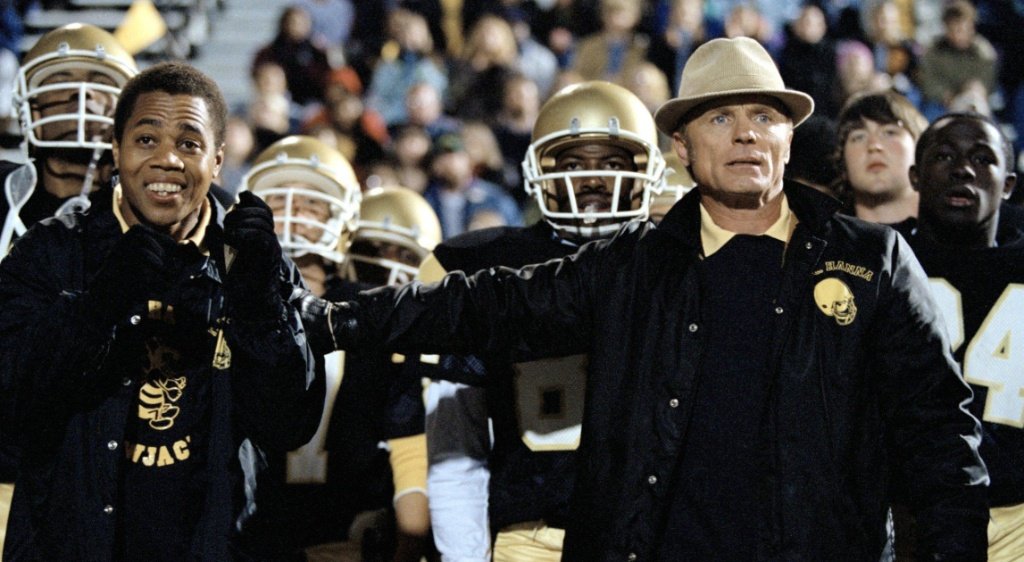
The film focuses on his relationship with football coach Harold Jones, played by Ed Harris.
Cuba Gooding Jr. portrays Radio, while the story follows how the coach’s decision to protect and include him gradually changes the atmosphere around the school.
However, Radio is not a documentary.
It was inspired by Gary Smith’s 1996 Sports Illustrated article, “Someone to Lean On,” and dramatizes events for the screen.
That distinction matters because the film’s emotional structure is not necessarily a complete account of the real people involved.
3. Coach Jones: A Good Man or a Man Who Needs to Be Needed?
Harold Jones initially becomes involved because he sees Radio being mistreated by members of his football team.
His decision to intervene is understandable. He has a responsibility to stop bullying, and he recognizes that ignoring the situation would be wrong.
But his relationship with Radio gradually becomes more complicated.
Jones does not simply stop the bullying. He brings Radio into the team’s activities, takes an interest in his life, and becomes increasingly protective of him.
The film presents this relationship as a positive example of leadership.
Yet there is another interpretation worth considering.
Does Jones help Radio because he recognizes his independence and potential? Or does he gradually build an identity for himself around being the person who protects Radio?
These motivations do not have to be mutually exclusive.
A person can genuinely care about someone while also finding personal meaning in being needed.
The important question is whether that relationship leaves room for the person receiving help to become more independent.
4. When Kindness Becomes a Public Performance
One of the most interesting aspects of Radio is how the community reacts to the coach’s decision.
At first, Radio is treated as an outsider. Some students and adults do not understand him, while others openly mistreat him.
As the story progresses, more people begin to accept him.
The change is encouraging.
However, the film also raises a question about the relationship between kindness and public approval.
When a community celebrates its own generosity, the person receiving that generosity can become part of the community’s self-image.
Radio is no longer simply a person who attends the school and enjoys being around the football team. He becomes a visible example of how compassionate the town can be.
That may be positive, but it can also be limiting.
True inclusion should not depend on how much inspiration someone provides to everyone else.
5. Is Radio Allowed to Be More Than Innocent?
The film repeatedly presents Radio as gentle, trusting, and emotionally expressive.
These qualities make him appealing to the audience.
But there is a problem with building an entire character around innocence.
People with intellectual disabilities are not simply symbols of kindness. They have individual preferences, frustrations, habits, ambitions, and complicated emotions.
They can make mistakes. They can disagree with others. They can have difficult personalities.
Most importantly, they do not need to be exceptionally innocent to deserve respect.
This is where Radio becomes open to criticism.
The character is frequently positioned as someone whose goodness teaches other people how to behave. That approach is emotionally effective, but it risks reducing a person to the moral lesson he provides.
A more complete portrayal would allow Radio to exist beyond the role of the inspirational outsider.
6. The Problem with Turning a Person into a Symbol
The film’s title itself places Radio at the center of the story.
Yet the narrative often develops through the reactions of other people.
Coach Jones learns patience. The football players learn respect. The school becomes more accepting. The town begins to change.
Radio is the catalyst for these developments.
This structure creates an important storytelling problem.
If the central character mainly exists to transform everyone around him, does the audience ever get to understand him as an individual?
The distinction between representation and symbolism matters.
Representation asks us to understand a person.
Symbolism can turn that person into an idea.
Radio deserves to be more than a symbol of kindness, just as any other person deserves to be understood beyond the effect they have on others.
7. The Football Team: Inclusion or a Place to Belong?
Football provides the film with its central social environment.
Radio begins as an outsider who spends time near the school and its football activities. Eventually, he becomes involved with the team.
This development is meaningful because belonging is not created only through formal declarations.
It often develops through ordinary experiences: being present, sharing routines, recognizing familiar faces, and having a place where people expect to see you.
For Radio, the football community becomes an important part of his daily life.
But there is a difference between being included as a mascot and being included as an equal participant.
A community may welcome someone while still defining that person’s role for them.
The film does not fully resolve this tension, but it gives viewers a reason to ask what genuine inclusion should look like.
8. The School’s Responsibility: Protecting One Person Without Forgetting Everyone Else
The principal, played by Alfre Woodard, represents another perspective on the situation.
Her responsibility extends beyond Radio.
She must consider the needs of the entire school, including its students, teachers, and staff.
This creates a useful conflict.
Coach Jones becomes deeply involved in Radio’s life, but the school must also consider boundaries, supervision, safety, and the educational environment.
It would be too easy to interpret every concern as prejudice.
Inclusion does not mean that practical questions disappear. A school still has responsibilities to everyone in its care.
The more difficult task is finding a way to protect a vulnerable student without excluding him simply because his needs are different.
This is one of the film’s more realistic conflicts.
9. The Family Behind Radio
Radio’s mother, Maggie Kennedy, provides another important perspective.
She knows her son in a way that the football team and the wider community cannot.
For the town, Radio is becoming a familiar and beloved figure. For his mother, he is her son, with a life that exists beyond the football field.
That difference is significant.
A community may celebrate a person during public events, but family members understand the ordinary responsibilities and difficulties that continue after everyone else goes home.
The film gives Maggie an important emotional role, although it could have explored her perspective more deeply.
A story about inclusion becomes more complete when it considers not only the people who discover someone, but also the people who have been caring for that person all along.
10. Cuba Gooding Jr.’s Performance: Emotional Commitment or Caricature?
Cuba Gooding Jr. takes on a difficult role.
He must portray a real person whose mannerisms and communication style are familiar to people who knew him.
Some viewers have praised the performance for its emotional commitment. Others have criticized it for relying too heavily on exaggerated expressions and physical gestures.
The criticism is not simply about whether the acting is convincing.
It concerns how disabled characters are represented in mainstream cinema.
When a performance exaggerates certain traits to make a character immediately recognizable, it can unintentionally turn an individual into a collection of recognizable behaviors.
That creates a difficult balance for an actor.
The intention may be to communicate affection and authenticity. The result may nevertheless feel theatrical or reductive to some viewers.
A respectful portrayal needs more than imitation. It needs to preserve the character’s individuality and dignity.
11. Why Critics and Audiences Responded Differently
The reception of Radio was divided.
Rotten Tomatoes recorded a much more favorable audience response than its critics’ response. Its critical consensus specifically questioned the film’s sentimental treatment of Radio, suggesting that the character was presented more as an innocent symbol than as a fully developed person.
Roger Ebert, however, appreciated the film’s sincerity and its uncomplicated warmth.
Other critics were much harsher, arguing that the movie used disability to generate pity and emotional reactions.
These different responses reveal a larger disagreement about what an inspirational film should accomplish.
Some viewers value emotional sincerity and a story that encourages people to treat one another better.
Others expect a more complicated representation, especially when a film is based on a real person.
Both reactions deserve consideration.
A film can have a positive intention and still deserve criticism for the way it represents the person at its center.
12. What Reddit Viewers Reveal About the Film
Reddit discussions about Radio are relatively limited, so they should not be treated as a representative survey of the audience.
Nevertheless, the available conversations reveal a range of reactions.
Some users remember the film fondly and describe it as an emotional movie they enjoyed growing up.
Others approach it through the lens of its portrayal of disability, criticizing the exaggerated performance and the way the film constructs its emotional appeal.
There are also viewers who defend the film’s intentions, arguing that it was an honest attempt to tell a story about a real person who had a positive influence on his community.
This disagreement is more interesting than a simple positive or negative verdict.
The film’s supporters often focus on its message of compassion. Its critics focus on whether the person receiving that compassion is represented with sufficient complexity.
The two sides are not necessarily arguing about whether kindness matters.
They are arguing about what genuine respect should look like.
13. The Difference Between Helping Someone and Respecting Them
This is where the film’s central question becomes most important.
Helping someone can be an act of kindness.
But respect requires something more.
It requires recognizing that the other person has a life, preferences, and a perspective that do not exist merely to satisfy the helper’s expectations.
A person can be generous and still make decisions on someone else’s behalf without listening.
A community can celebrate inclusion while continuing to treat the included person as an exception.
And a film can promote compassion while unintentionally presenting its central character as a lesson for everyone else.
None of these problems means that helping people is wrong.
They mean that good intentions should not be the end of the conversation.
The real test of inclusion is whether someone is allowed to belong without having to perform a role that makes everyone else comfortable.
14. Radio: Was He Truly Accepted, or Did the Town Need Him?
Radio wants its audience to believe that one person’s presence can change an entire community.
There is something meaningful in that message.
A coach chooses not to ignore bullying. A football team learns to treat an outsider differently. A school begins to recognize someone who had previously been overlooked.
These are worthwhile changes.
But the film also leaves us with a more difficult question.
Was Radio truly accepted as an individual, with his own needs and identity? Or did the town become attached to the version of Radio that made its own people feel compassionate?
The answer does not have to be entirely one or the other.
The people around Radio may have genuinely cared for him. Their kindness may have made his life richer. At the same time, the film’s sentimental storytelling may have simplified the person at its center.
Perhaps the greatest measure of inclusion is not how warmly a community celebrates someone.
It is whether that person can be treated with dignity even when he is not inspiring anyone, entertaining anyone, or making anyone feel like a better human being.
Was Radio truly accepted by his community, or did the town need him to feel good about itself?