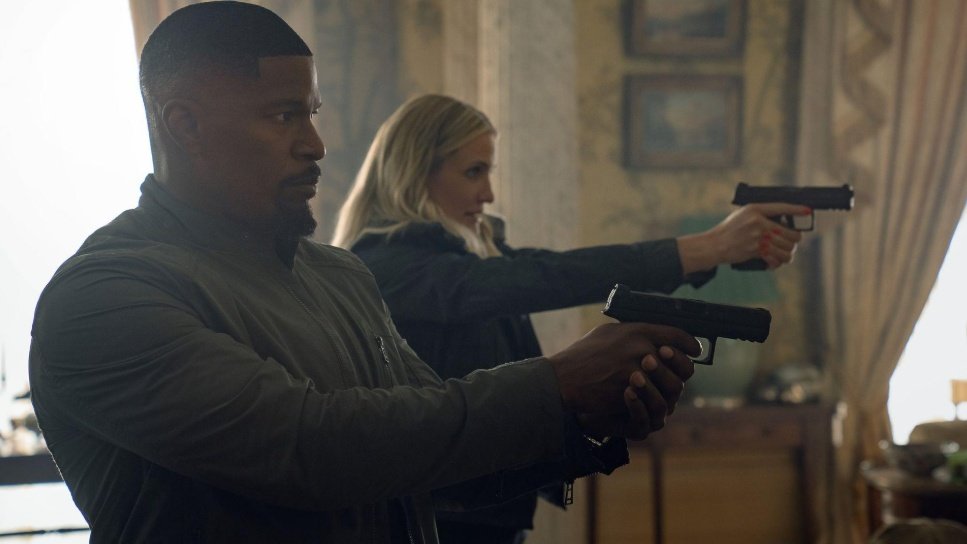
When Cameron Diaz returned to the screen in Back in Action (2025), the film arrived with an obvious advantage: audiences were curious to see her working alongside Jamie Foxx again.
The premise also seemed promising.
Two former CIA agents have left their dangerous careers behind to raise a family. Years later, their secret identities are exposed, forcing them back into the world of espionage. Their children must suddenly confront the fact that their ordinary parents have extraordinary pasts.
It is a setup that offers plenty of possibilities for action, comedy, family conflict, and character development.
Yet one reaction appeared repeatedly in online discussions after the film’s release:
Why does this feel like something we have already watched?
Some Reddit viewers specifically compared Back in Action to Mark Wahlberg’s The Family Plan (2023), pointing to similarities in the family-spy premise and certain comedic situations.
That comparison does not prove copying. But it reveals a genuine problem with the film’s identity.
Back in Action has recognizable stars, an accessible premise, and enough action to keep the story moving. What it struggles to provide is a distinctive reason to remember it.
The problem is not simply that the film uses familiar ideas. Almost every genre film does that.
The problem is that it rarely transforms those familiar ideas into something that feels uniquely its own.
1. Cameron Diaz’s Return Created Expectations the Story Had to Meet
The most important event surrounding Back in Action was not an explosion, a chase, or a secret intelligence operation.
It was Cameron Diaz’s return to feature films after roughly a decade away.
Her absence created a natural sense of anticipation. Audiences remembered her from films such as Charlie’s Angels, The Mask, and There’s Something About Mary. She had built a screen identity around physical comedy, expressive reactions, and a distinctive combination of confidence and playfulness.
That history gave the film an opportunity.
It could have used Emily’s return to action as a reflection of Diaz’s own return to acting. A character who has spent years away from a dangerous profession could have rediscovered not only her abilities, but also the parts of herself she had left behind.
Instead, the film mostly uses the comeback as an attraction.
Diaz is back, and the audience gets to watch her fight, run, joke, and perform action sequences again.
That is enjoyable in itself, but it is not the same as giving her a character whose journey makes the comeback meaningful.
The difference between seeing a familiar star again and seeing that star in a genuinely new role is where the film misses an opportunity.
2. The Former Spy Who Becomes a Parent Is Already a Familiar Formula
The basic premise of Back in Action belongs to a well-established action-comedy tradition.
A highly trained operative leaves a dangerous career, builds an ordinary family life, and tries to keep the past hidden. Eventually, an old enemy or a new threat exposes the secret.
The family then discovers that the person they thought they knew has an entirely different identity.
This structure works because it creates an immediate contrast.
The same person who struggles with everyday parenting can suddenly handle weapons, evade surveillance, and defeat professional attackers.
The contrast naturally produces comedy.
It also creates emotional possibilities. A parent who has hidden an entire part of their life must explain why the secret existed and whether the family can still trust them.
The problem is that Back in Action does not significantly reinvent this structure.
The film moves through recognizable stages: the secret is exposed, danger returns, the family becomes involved, and the parents must use their old skills again.
Familiarity is not automatically a weakness.
But when the audience can predict not only the broad direction of the story but also the emotional beats along the way, the film needs unusually strong characters or inventive action to compensate.
Here, neither element consistently provides that surprise.
3. Why Did Reddit Viewers Compare It to The Family Plan?
One of the most interesting audience discussions came from viewers who compared Back in Action with The Family Plan, the 2023 action comedy starring Mark Wahlberg.
In a Reddit thread on r/netflix, a viewer argued that the two films shared a very similar basic premise and pointed to particular situations, including a club sequence and characters singing familiar songs in their cars.
Other commenters agreed that the resemblance made Back in Action feel predictable.
This is worth examining carefully.
Both films use the idea of a family discovering that an apparently ordinary parent has a dangerous professional past. Both combine domestic comedy with action and international danger.
That shared structure can create an immediate sense of déjà vu.
However, similar premises do not establish that one film copied the other. The retired-operative-with-a-family concept has existed in action cinema for years.
The more useful question is why the comparison became so easy for viewers to make.
A new film needs to establish its own identity through character relationships, tone, visual style, and memorable situations.
When audiences can describe a new film primarily by naming an earlier one, its individual identity has not become strong enough.
Source: Reddit — Back In Action copied almost everything from The Family Plan.
4. The Problem Is Not Similarity—It Is the Lack of a Distinctive Identity
There is nothing wrong with borrowing a familiar genre structure.
True Lies, Mr. & Mrs. Smith, and numerous other films have explored the tension between romantic or family relationships and secret professional lives.
The important question is what each film does differently.
A successful genre film can take an old premise and give it a new emotional center.
For example, the conflict might focus on a marriage built on deception, a child discovering that a parent has been lying, or two former partners who no longer agree about the meaning of their work.
Each possibility could create a different film.
Back in Action has the ingredients for several of these directions.
Emily and Matt have a shared history, a family, and professional abilities that have been hidden from their children. Their return to espionage could force them to reconsider what they sacrificed when they left their old lives.
But the film tends to prioritize movement over deeper exploration.
The characters keep moving from one dangerous situation to another, while the underlying questions receive less attention than the premise deserves.
That is why the film can feel familiar even when its individual scenes are not identical to those in another movie.
5. Emily and Matt Have Star Power, but Their Relationship Needs More Depth
Cameron Diaz and Jamie Foxx are individually charismatic performers.
Diaz brings energy and expressive physical comedy. Foxx has a relaxed screen presence and a talent for delivering humor without appearing to work too hard for it.
Together, they should have been an ideal combination for an action comedy.
The difficulty is that chemistry between actors cannot automatically compensate for a relationship that has not been developed convincingly on the page.
Emily and Matt are introduced as former CIA operatives who have built a family together. Their shared past should give their relationship a particular texture.
They know each other’s strengths and weaknesses. They have experienced danger together. They also have reasons for wanting to leave that life behind.
This creates the possibility of a relationship in which affection, frustration, trust, and professional rivalry coexist.
But the film often relies on familiar husband-and-wife banter.
The characters argue, react to danger, and exchange jokes, but the emotional history behind their relationship does not always receive enough attention.
Some critics made a similar observation. RogerEbert.com, for example, praised the individual appeal of the performers while criticizing the script and the limited chemistry between them.
The missed opportunity is significant.
A film about two people returning to a shared past should make us feel why that past still matters to their relationship.
6. The Children Should Have Been the Emotional Center of the Story
The family element is more than a convenient source of comedy.
The children have grown up believing that their parents live ordinary lives. Discovering that their mother and father were elite intelligence operatives should change how they understand their family.
It should raise questions about trust.
Why were the parents hiding their past? What else have they concealed? Were the decisions they made for the family really based on protecting the children, or were they also protecting themselves?
These questions could have given the film an emotional foundation that distinguishes it from a conventional spy adventure.
Instead, the children sometimes function more as participants in the action than as characters whose changing understanding of their parents drives the story.
That does not mean the family comedy is entirely unsuccessful.
The premise naturally creates entertaining situations, especially when the children discover that their parents possess abilities they never imagined.
But the emotional consequences of that discovery could have been explored much further.
If the family is the reason Emily and Matt abandoned their former lives, then the family’s reaction to their return should be one of the most important parts of the story.
7. Glenn Close Shows How a Supporting Character Can Change the Film’s Energy
Glenn Close plays Ginny, Emily’s estranged mother and another formidable figure with a history in espionage.
Her presence adds a different dimension to the family dynamic.
Emily is not simply a former operative trying to protect her children. She is also a daughter whose relationship with her own mother remains complicated.
That creates an interesting generational contrast.
Emily has built a family while trying to keep her former life behind her. Ginny represents an older generation that has never entirely separated personal relationships from the world of intelligence and danger.
The tension between them could have become a major emotional thread.
Close brings authority and personality to the role, and several audience reactions singled out her performance as a highlight.
This response is revealing.
When a supporting character attracts attention in a film built around two major stars, it suggests that the supporting character may be providing a freshness that the central story lacks.
Ginny is not enough to solve the film’s structural problems, but she demonstrates how much more interesting the family relationships could have been.
8. Andrew Scott Is an Example of Casting Potential That the Script Does Not Fully Use
Andrew Scott is another performer whose presence creates expectations.
He plays Baron, an MI6 agent connected to Emily’s past and the pursuit of the key at the center of the story.
Scott has demonstrated considerable range in other projects, including Fleabag and All of Us Strangers.
His casting suggests that Baron could be a memorable figure.
But a recognizable and talented actor still needs a character with meaningful dramatic material.
If a character mainly exists to explain information, pursue the protagonists, or move the plot toward its next action sequence, the performance has limited room to develop.
RogerEbert.com’s review specifically criticized the way Scott’s role was underused.
This points to a broader issue in Back in Action.
The film has assembled a cast with enough talent to create several compelling relationships. Yet many of those possibilities remain secondary to the mechanics of the spy plot.
A strong cast can attract viewers.
A strong script gives them a reason to care about what those actors are doing.
9. The Action Sequences Are Large, but Scale Is Not the Same as Excitement
The film contains car chases, fights, shootouts, and large-scale set pieces.
There is no shortage of movement.
But action becomes memorable through more than the amount of destruction on screen.
A great action sequence has a clear dramatic purpose. It reveals a character’s abilities, forces a difficult decision, changes the relationship between two people, or creates a visual idea that the audience has not seen before.
In Back in Action, the action often serves as the next required stage of the adventure.
The characters escape one danger and enter another.
This keeps the plot moving, but it does not always give individual sequences a distinct identity.
The audience can recognize that the action is expensive and technically elaborate without feeling that it is especially inventive.
That distinction helps explain why some critics described the film as watchable but forgettable.
The issue is not necessarily a lack of effort in the stunt work.
It is the limited connection between the action and the characters’ emotional development.
10. Why Do the Music Choices Feel So Familiar Too?
One of the film’s stylistic choices is the use of well-known songs during violent or chaotic action scenes.
The contrast is intended to create comedy.
A familiar, upbeat song plays while characters fight, chase, or attack one another. The mismatch between the music and the violence is supposed to make the scene amusing.
This technique can work extremely well.
But it depends on timing, surprise, and the personality of the scene.
When the audience has already seen similar musical contrasts in numerous action comedies, the technique can begin to feel automatic.
RogerEbert.com’s review specifically criticized the film’s use of ironic song choices, including songs by Etta James, James Brown, and Dean Martin.
The deeper issue is that music can become a substitute for comic invention.
Instead of creating a genuinely surprising situation, a film can ask the audience to laugh because a familiar song is playing over an unexpected image.
That may produce a quick reaction.
It does not necessarily create a memorable scene.
11. The Film’s Tone Never Fully Decides What It Wants to Be
Back in Action moves between family comedy, spy thriller, action spectacle, and emotional drama.
There is nothing inherently wrong with mixing these genres.
Some of the most successful action comedies work precisely because they can move between genuine danger and absurd humor.
But a film needs a clear sense of balance.
If the family conflict is too exaggerated, it becomes difficult to take the emotional stakes seriously. If the action is too detached from the characters, it becomes spectacle without much dramatic weight.
The same problem affects the comedy.
The film frequently uses arguments, misunderstandings, and exaggerated reactions to create humor. Yet those moments do not always grow naturally from the characters’ personalities.
The result is a movie that is easy to follow but not always emotionally consistent.
This is one reason the performances can seem stronger than the material around them.
The actors bring their own energy to the scenes, but the script does not always give that energy a clear direction.
12. Is This the Netflix Formula: Familiar Stories, Recognizable Stars, and Easy Viewing?
It would be unfair to claim that every Netflix action film follows the same formula.
Streaming platforms release films across many genres and with very different creative ambitions.
But Back in Action illustrates a recognizable commercial strategy.
Start with a premise audiences can understand immediately. Add familiar stars. Build the story around international locations, action sequences, family conflict, and comedy. Make the film accessible to viewers who may not want a complicated story.
There are clear advantages to this approach.
The audience does not need extensive background knowledge. The premise is easy to communicate. The cast provides immediate recognition, and the action makes the film suitable for casual viewing.
The weakness appears when accessibility becomes predictability.
A film can be easy to watch without being distinctive.
The challenge for a streaming action comedy is not simply to deliver a familiar experience. It is to give viewers a reason to choose this particular film over the many others competing for their attention.
Back in Action demonstrates how difficult that can be when the story relies heavily on established genre conventions.
13. Cameron Diaz’s Comeback Deserved a More Original Character
The most disappointing aspect of Back in Action may be what it represents for Cameron Diaz.
Her return was an opportunity to show how an established star could re-enter the industry with a role that reflected both her past screen identity and her current stage of life.
Emily could have been a particularly interesting character.
She is an experienced operative, a mother, a partner, and a person who has spent years trying to live outside the world that once defined her.
That is a rich combination.
The film could have explored how someone changes after leaving a dangerous profession. It could have examined whether a person can truly abandon the identity they built over years of training and experience.
It could also have used the relationship between Emily and her children to explore the difference between protecting a family and being honest with it.
Instead, the character is often placed inside a conventional action-comedy framework.
Diaz remains an appealing screen presence, but the film does not give her a sufficiently original character journey.
The comeback works as an event.
It is less successful as a creative reinvention.
14. Back in Action Brings Its Stars Back, but Does It Bring Anything New?
The title Back in Action works on two levels.
It describes Emily and Matt returning to espionage. It also reflects Cameron Diaz and Jamie Foxx returning to this kind of action-comedy entertainment.
But the title creates an unintended question.
What exactly has come back?
The stars have returned. The familiar spy-comedy structure has returned. The action sequences, family arguments, international locations, and musical contrasts have returned.
What is less visible is a new idea strong enough to make the film stand apart.
The Reddit comparison with The Family Plan is useful because it captures the audience’s experience of déjà vu. It is not proof that the films are the same, nor does it establish that one copied the other.
It shows that Back in Action struggled to establish a sufficiently distinctive identity in a crowded genre.
The film is not without entertainment value. Diaz and Foxx bring recognizable appeal, Glenn Close adds personality, and the premise remains accessible.
But the cast deserved a story that challenged them more.
Cameron Diaz came back to action. The real disappointment is that the movie brought back so many familiar ideas instead of giving her a genuinely new one.