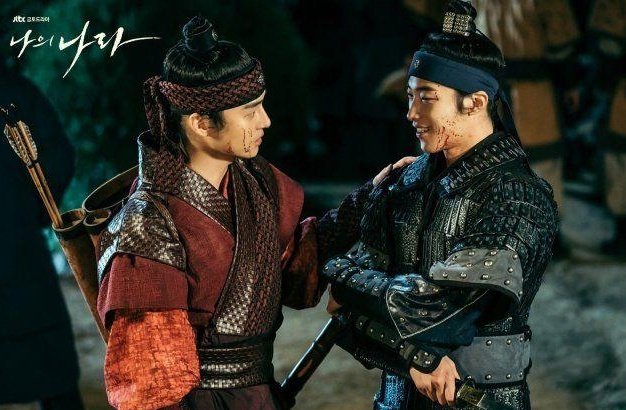
Why Did Two Friends Who Dreamed of a Better World Become Enemies in the Struggle for Power?
Historical dramas often portray the founding of a nation as a heroic achievement. Kings establish new political systems, generals win decisive battles, and ambitious leaders reshape the destiny of an entire population.
But behind these grand historical events are people whose lives are destroyed by the decisions of those who seek power.
JTBC’s My Country: The New Age (2019), starring Yang Se-jong as Seo Hwi, Woo Do-hwan as Nam Seon-ho, and Jang Hyuk as Yi Bang-won, explores this uncomfortable side of political transformation.
Set during the turbulent transition from Goryeo to Joseon, the drama follows two friends who initially share a vision of a better world but gradually become trapped on opposite sides of a violent struggle for power.
Seo Hwi dreams of protecting the people he loves. Nam Seon-ho wants to escape the social limitations imposed by his birth. Yi Bang-won seeks to establish a political order strong enough to survive the instability surrounding the foundation of a new dynasty.
Their ambitions are understandable, but they are not compatible.
This is the central tragedy of the series: three men speak about the future of their country, yet each understands the meaning of that country differently.
Reddit discussions frequently highlight the emotional intensity of Seo Hwi and Nam Seon-ho’s relationship, the performances of the leading actors, and the dramatic presence of Yi Bang-won. Other viewers have criticized the treatment of female characters, historical liberties, and certain aspects of the later narrative.
These divided reactions reveal an opportunity for a deeper interpretation.
My Country: The New Age is not simply a story about who deserves to rule. It is about what happens when personal dignity, friendship, and political ambition collide during the creation of a new state.
1. Three Men, Three Different Countries
The title My Country appears straightforward, but the drama gives it a much more complicated meaning.
For Seo Hwi, a country should be a place where ordinary people can live without constantly suffering under the decisions of powerful men.
For Nam Seon-ho, a country represents the possibility of escaping a social identity that has already determined his position in life.
For Yi Bang-won, a country must be a political structure capable of concentrating authority and preventing competing powers from destroying the new order.
All three men want something that could be described as a better future.
But their definitions of a better future are fundamentally different.
Seo Hwi prioritizes the people closest to him. Seon-ho wants recognition and freedom from the limitations of his birth. Yi Bang-won believes that political stability requires decisive authority.
The conflict is not simply between good and evil.
It is between competing ideas about what a nation should protect.
This distinction gives the drama its strongest philosophical foundation. The title does not refer to one shared national vision. It refers to the personal expectations that different people attach to the idea of a country.
2. Seo Hwi: A Man Who Wants to Protect People Rather Than Rule Them
Seo Hwi is not driven by the desire to become a powerful political leader.
His motivations are much more personal.
He wants to protect his family, maintain his dignity, and prevent the people he cares about from becoming victims of a violent political environment.
This makes him different from the ambitious figures surrounding him.
He does not initially imagine that building a new country requires controlling the state. His understanding of a better world begins with the lives of ordinary people.
However, this apparently simple desire becomes increasingly difficult to maintain.
Every political conflict creates another situation in which Hwi must choose between his personal values and the demands of survival.
His loyalty becomes both his greatest strength and his greatest vulnerability.
People who care deeply about others can be manipulated through that attachment. If someone threatens the people they love, they may accept decisions they would otherwise reject.
Hwi’s tragedy is that his desire to protect others repeatedly pulls him deeper into the very violence he wants to escape.
He does not seek power for its own sake, but he cannot remain outside the struggle for power.
3. Nam Seon-ho: The Man Who Wants to Escape His Birth
Nam Seon-ho’s story is arguably the most psychologically complicated in the drama.
His social position determines how other people see him before he has the opportunity to define himself.
He possesses talent, intelligence, and ambition, but his birth places limits on the recognition he can receive.
This creates a particularly destructive psychological conflict.
Seon-ho does not simply want wealth or political influence. He wants proof that his identity does not have to be determined by the circumstances of his birth.
For someone in his position, power can become more than a practical instrument.
It can become a form of revenge against a society that has repeatedly reminded him that he is inferior.
But this desire contains a dangerous contradiction.
If a person seeks recognition from the same system that has humiliated them, they may gradually begin accepting the system’s values.
Seon-ho wants to overcome the hierarchy, yet his ambition increasingly draws him toward the political structures that preserve it.
He does not necessarily reject the system itself. At times, he appears to want a position within that system powerful enough to make its previous judgments irrelevant.
That is what makes him tragic.
His desire for dignity is understandable, but the methods through which he pursues it threaten to destroy the relationships that once gave his life meaning.
4. The Friendship Between Hwi and Seon-ho: Why Their Relationship Matters More Than Their Rivalry
The emotional center of My Country is the relationship between Seo Hwi and Nam Seon-ho.
Their friendship is important because it begins before their political identities become fully defined.
They are not initially enemies representing opposing ideological camps. They are two young men who share experiences, hopes, and an understanding of each other’s personal struggles.
This shared history creates an emotional bond that survives even when their circumstances become increasingly hostile.
The audience knows something that the characters cannot easily escape: they once trusted each other.
That knowledge changes the meaning of every confrontation.
When two strangers fight, the conflict can be understood through their opposing interests.
When former friends fight, every act of violence also becomes a reminder of what has been lost.
This explains why many viewers found their relationship more compelling than the conventional romantic elements of the series.
Their connection contains affection, resentment, betrayal, guilt, and the possibility of reconciliation.
The strongest emotional scenes do not simply ask whether they will become friends again.
They ask whether people can recover a relationship after making choices that fundamentally change how they see each other.
5. Betrayal Is Sometimes the Result of Different Definitions of Survival
It is easy to describe Seon-ho as a betrayer.
From Hwi’s perspective, Seon-ho’s political choices repeatedly threaten their friendship and shared ideals.
But understanding the character requires examining the conditions under which he makes those decisions.
For Hwi, survival is closely connected to protecting people.
For Seon-ho, survival also means escaping a social identity that has made him feel powerless.
This difference is crucial.
Two people can face the same political crisis and reach completely different conclusions because they are protecting different things.
Hwi may regard loyalty as a moral obligation. Seon-ho may see loyalty as a luxury that someone in his position cannot afford.
Neither perspective completely explains every action, but the conflict reveals how unequal social conditions can reshape personal morality.
This does not mean Seon-ho should be excused for everything he does.
Understanding why someone betrays another person is not the same as declaring that betrayal acceptable.
The drama becomes more powerful when viewers can recognize both the emotional reasons behind Seon-ho’s choices and the damage those choices cause.
6. Yi Bang-won: The Man Who Understands That Power Cannot Remain Divided
Yi Bang-won occupies a different position from Hwi and Seon-ho.
He is not simply another ambitious individual trying to improve his circumstances.
He understands that political authority is unstable when several powerful figures claim competing rights to determine the future.
His approach to power is shaped by the belief that a new dynasty cannot survive indefinitely through unclear authority.
From this perspective, decisive action becomes a political necessity.
But the same logic creates the danger that makes him such a compelling character.
If stability requires the elimination of competing centers of power, how many people must be sacrificed before the state becomes secure?
Yi Bang-won understands political competition as a struggle that cannot always be resolved through compromise.
He sees hesitation as a potential weakness.
This gives him a strategic advantage, but it also makes him dangerous to anyone whose personal values conflict with his political objectives.
Jang Hyuk’s performance emphasizes this combination of intelligence, intensity, and unpredictability.
The character is frightening not simply because he possesses power, but because he appears to understand how much human suffering he is willing to accept in order to obtain it.
7. The Difference Between Building a Country and Building a Throne
One of the most important questions raised by the drama concerns the relationship between political institutions and personal ambition.
A new dynasty may be presented as a national achievement, but the process of creating it can also become a struggle among individuals who want to control the state.
These are not necessarily identical goals.
Building a country should involve creating institutions that allow people to live under predictable rules.
Building a throne involves securing the authority of a particular ruler.
Sometimes these objectives overlap. A powerful ruler may be able to establish order during a period of instability.
But they can also conflict.
When the survival of a political leader becomes more important than the principles the new state is supposed to represent, the nation risks becoming an extension of personal ambition.
This is one of the central tensions surrounding Yi Bang-won.
He understands that a new political order requires strength. Yet the methods used to secure that strength raise questions about the human cost of state formation.
The drama does not offer a simple answer because political stability and individual freedom do not always move in the same direction.
8. The Father and Son Conflict: Nam Jeon and the Inheritance of Power
Seon-ho’s relationship with his father, Nam Jeon, adds another dimension to the story.
His personal ambitions cannot be separated from the influence of the man whose position and authority shape his circumstances.
The father-son relationship becomes a struggle over recognition, control, and the possibility of escaping an inherited identity.
This is more than a conventional family conflict.
Nam Jeon represents a political world in which social hierarchy and personal power determine whose ambitions are considered legitimate.
Seon-ho wants to become more than the identity assigned to him, but he remains deeply affected by the expectations and judgments of his father.
This creates a psychological trap.
He wants to prove that he is independent, yet the desire for recognition can keep him emotionally tied to the very person whose judgment he resents.
The struggle becomes especially painful when personal dignity is pursued through the same political values that created the original humiliation.
The drama suggests that escaping an oppressive hierarchy is not always as simple as defeating the person who controls it.
Sometimes the more difficult task is refusing to reproduce the hierarchy after gaining power.
9. Social Status: Why Talent Alone Cannot Overcome an Unequal System
Seon-ho’s position reveals one of the drama’s most important social criticisms.
A society may claim to reward ability, but its institutions can still determine whose abilities are recognized.
Talent does not operate independently of social circumstances.
A person with powerful family connections may receive opportunities that remain unavailable to someone with equal or greater ability.
This is why Seon-ho’s ambition has emotional force.
He does not merely want to become successful. He wants to challenge the assumption that his birth has already determined what he can become.
However, the drama also presents a difficult question.
If the goal is to escape an unfair system, is gaining a powerful position within that system enough?
Seon-ho’s journey suggests that recognition and liberation are not necessarily the same thing.
A person may overcome personal exclusion while leaving the underlying structure untouched.
They may even become part of the system that excludes others.
This is a broader political lesson that extends beyond the historical setting of the series.
The person who once suffered under an unfair hierarchy does not automatically become committed to dismantling it after gaining influence.
Sometimes the desire to occupy the top position becomes stronger than the desire to change the structure itself.
10. Han Hee-jae: The Female Character Who Deserved More Narrative Space
Han Hee-jae provides another perspective on the struggle for a new country.
She is introduced as an intelligent and independent woman whose political awareness and personal convictions give her a role beyond conventional romantic support.
Her character suggests that women can also participate in the political and social transformation surrounding the foundation of a new dynasty.
However, some viewers criticized the way her role developed later in the series.
The concern was that a character introduced with considerable potential did not always receive enough narrative attention to sustain that initial promise.
This criticism matters because the drama’s political world is overwhelmingly shaped by men.
If Hee-jae’s role becomes increasingly secondary, the story loses an opportunity to explore how women experience political instability and social transformation.
The question is not whether she should have become as powerful as the male political figures.
It is whether the series could have developed her independent perspective more fully.
A drama about the creation of a country becomes richer when it asks how different groups experience the new order, rather than treating the political decisions of powerful men as the only events worth exploring.
Hee-jae represents an important opportunity that the narrative could have used more effectively.
11. Romance Versus Friendship: Why the Emotional Hierarchy Feels Different
Many historical dramas use romance as the primary emotional engine.
Characters fall in love, face separation, overcome obstacles, and eventually discover whether their feelings can survive political conflict.
My Country uses romance, but its strongest emotional relationship is arguably the friendship between Hwi and Seon-ho.
This creates an unusual emotional hierarchy.
The audience is not simply waiting to discover which romantic partner will remain with the protagonist.
Instead, viewers are watching whether two people who once understood each other can survive the consequences of their political choices.
Their relationship has a different kind of emotional weight.
Romantic separation can be painful because two people lose the possibility of a shared future.
The destruction of a deep friendship can be equally painful because it also destroys the memory of a shared past.
For Hwi and Seon-ho, the past cannot simply be erased.
Even when they oppose each other, they remain connected through the knowledge of who they once were.
This is one reason the drama’s friendship storyline became such a prominent subject in audience discussions.
It gives the political conflict a deeply personal cost.
12. Historical Fiction and the Difference Between Accuracy and Emotional Truth
My Country: The New Age uses the transition from Goryeo to Joseon as the background for a fictionalized story.
Its characters and relationships should therefore be understood through two different standards.
Historical accuracy concerns whether events, institutions, chronology, and political figures correspond to the historical record.
Emotional truth concerns whether the characters’ motivations and conflicts feel psychologically convincing.
A historical drama can take creative liberties and still communicate meaningful ideas about power, ambition, and social inequality.
But creative freedom does not remove the need for internal consistency.
When a series changes historical circumstances to create a dramatic confrontation, the audience still expects those changes to serve a coherent narrative.
The presence of Yi Bang-won makes this particularly important.
He was a real historical figure whose political actions were central to the establishment of Joseon and the later consolidation of royal authority.
The drama uses his historical identity to create a character who represents the difficult relationship between state formation and personal ambition.
Viewers should distinguish between the historical Yi Bang-won and the dramatic interpretation presented by the series.
The latter is not a documentary account. It is a fictional narrative using historical events to explore political and emotional questions.
13. The Violence of State Formation: Who Pays for a New Political Order?
The founding of a new dynasty is often remembered through the achievements of rulers and military leaders.
But political transformation rarely occurs without people paying a price.
Soldiers die, families lose their livelihoods, communities become divided, and individuals are forced to choose sides in conflicts they did not create.
The drama repeatedly returns to this human cost.
Hwi and Seon-ho are not simply fighting over personal disagreements. Their lives become entangled in a historical transformation that is larger than either of them.
This creates an important moral distinction.
A political leader may describe violence as necessary for the establishment of order.
But the people who experience that violence do not necessarily benefit from the resulting political stability.
The question is therefore not only whether a new state succeeds.
It is who has the power to define success and whose suffering becomes an acceptable cost.
This is one of the strongest political questions in My Country.
The creation of a nation may be celebrated by later generations, but the people who lived through its violent beginnings may remember it very differently.
14. Why the Later Episodes Divided Viewers
Reddit discussions reveal that viewers responded differently to the drama’s later development.
Some remained strongly invested in the relationship between Hwi and Seon-ho and found the emotional conclusion meaningful.
Others expressed reservations about the pacing, historical liberties, character development, and the treatment of certain supporting roles.
The criticisms of Hee-jae’s reduced narrative importance are particularly relevant because they point toward a wider structural problem.
The series establishes several promising conflicts: social hierarchy, political ambition, friendship, family control, romance, and the founding of a new dynasty.
But a drama must allocate time carefully among these elements.
When one storyline becomes dominant, other promising conflicts can lose their development.
The same applies to action sequences and dramatic confrontations.
Spectacle can increase excitement, but it cannot replace the emotional consequences of the decisions that lead to those confrontations.
The series is most effective when political events change the relationships between characters.
It is less effective when the scale of the historical conflict becomes more important than the development of the people experiencing it.
15. The Ending: Can Friendship Survive the Country They Tried to Build?
The emotional meaning of the ending cannot be separated from the relationship established at the beginning.
Hwi and Seon-ho begin as friends who share a vision of a different future.
Their paths diverge because their circumstances, ambitions, and understandings of survival become increasingly incompatible.
By the time their story reaches its conclusion, the question is no longer whether they can return to the innocent friendship of their youth.
That possibility has already been changed by everything they have experienced.
The ending carries the weight of a relationship that has been damaged by political choices but never entirely erased from memory.
For some viewers, this makes the conclusion tragic but emotionally appropriate.
For others, the journey may feel unnecessarily painful or dependent on dramatic escalation.
Both reactions are understandable.
The central relationship is powerful precisely because the characters cannot simply forget their shared past.
But emotional connection does not guarantee reconciliation.
Sometimes the people who understand each other most deeply are also the people who have become capable of hurting each other most profoundly.
That is the tragedy at the heart of Hwi and Seon-ho’s story.
16. The Real Meaning of My Country: Who Owns the Future?
The most important question raised by My Country: The New Age is not which character has the strongest political argument.
It is who has the right to decide what a country should become.
Seo Hwi wants a world in which ordinary people can protect the lives they value.
Nam Seon-ho wants to escape a social order that has defined his worth through his birth.
Yi Bang-won wants a political structure strong enough to survive the instability of a new dynasty.
Each man understands a different part of the problem.
A country needs stability. It also needs fairness. And its people need more than the opportunity to survive under the authority of someone powerful.
The tragedy is that the struggle to create a better country can reproduce the very inequalities and violence that its founders claim to oppose.
Seon-ho’s ambition shows how the desire to escape an unfair hierarchy can become a desire to occupy its highest position.
Yi Bang-won’s political strategy shows how the pursuit of stability can justify increasingly severe forms of control.
Hwi’s loyalty shows how personal values can become vulnerable when political forces turn relationships into instruments of survival.
The title My Country therefore becomes a question rather than a declaration.
Whose country is it?
The ruler’s? The ambitious person’s? The people who fought for it? Or the ordinary people who must live with the consequences of its creation?
The drama never offers an entirely comfortable answer.
That uncertainty is what makes its political and emotional conflicts worth revisiting.
Final Verdict: A Political Drama About the Cost of Betraying the People Closest to You
My Country: The New Age stands out because it connects the founding of a dynasty with the destruction of a personal relationship.
Its strongest achievement is the emotional conflict between Seo Hwi and Nam Seon-ho. Their friendship gives the political story a human center that is more powerful than a conventional struggle for the throne.
Jang Hyuk’s portrayal of Yi Bang-won adds another dimension, presenting power as something that can create order while demanding an enormous human price.
The drama is not without weaknesses. Some supporting characters, particularly Han Hee-jae, could have received more sustained development. Certain narrative choices and historical liberties may also frustrate viewers who expect a more balanced treatment of the political and personal storylines.
Nevertheless, its central question remains compelling.
A country may be founded through political victories, but its moral value cannot be measured only by the strength of its ruler.
It must also be measured by the lives of the people who were sacrificed along the way.
Hwi and Seon-ho began by dreaming of a better country. Their tragedy was discovering that the struggle to create it could destroy the very friendship that once gave that dream meaning.