Korean glass skin

  • Does Korean Skincare Work for Indian Skin? What K-Beauty Brands Don’t Always Explain

    TTK Original — Beyond the Headlines
    K-Beauty Deep Dive | Episode 02

    A young woman in Mumbai watches a Korean beauty influencer apply a lightweight serum.

    The result looks incredible.

    Her skin appears smooth, hydrated, and luminous. The product promises the kind of glow that has made Korean skincare famous around the world.

    So the viewer orders the same serum.

    But after two weeks, her face looks oilier, her skin feels irritated, and the dark spots she hoped to improve are still there.

    What went wrong?

    Was the product designed only for Korean skin?

    Or was the problem something completely different?

    Does Korean skincare actually work for Indian skin?

    The short answer is yes. Korean skincare products can work well for Indian consumers.

    But the longer answer challenges one of the beauty industry’s most persistent assumptions.

    Your skin does not choose products according to your nationality. It responds to ingredients, formulation, environment, and individual biology.

    Understanding that difference is the key to using K-beauty effectively.

    1. Is Indian Skin Different From Korean Skin?

    There is no single type of Indian skin, just as there is no single type of Korean skin.

    India includes people with a wide range of natural skin tones, genetic backgrounds, and skin characteristics.

    Korea also has substantial variation among individuals.

    Some people have oily skin.

    Others experience dryness, sensitivity, acne, eczema, or pigmentation concerns.

    Melanin, the pigment responsible for much of the skin’s natural color, plays an important role in how skin responds to sunlight and inflammation.

    But skin color alone cannot tell you whether a moisturizer, cleanser, or serum will be suitable.

    A person with darker skin may have very dry skin.

    A person with lighter skin may experience persistent acne.

    Two people with similar skin tones may react differently to the same cosmetic product.

    This is why the phrase “skincare for Indian skin” should be approached carefully.

    It can be useful when discussing common consumer concerns or local environmental conditions.

    But it should never imply that more than a billion people share one biological skin type.

    2. Why Is Korean Skincare Becoming Popular in India?

    Korean beauty products have benefited from the wider popularity of Korean entertainment.

    K-dramas, K-pop, social media, and beauty influencers have introduced Indian audiences to Korean cosmetics and skincare routines.

    But entertainment alone does not explain why people purchase the products.

    Consumers may also be attracted to lightweight textures, hydrating formulas, distinctive packaging, and products featuring ingredients such as centella asiatica, ceramides, and hyaluronic acid.

    Indian retailers have expanded their K-beauty offerings as consumer interest has grown.

    A 2025 India Today report quoted an Innisfree India executive who said the number of Korean skincare brands in the Indian market had grown from just a few to more than 60.

    That figure was an industry representative’s estimate, not an independently verified count of every Korean brand sold in India.

    Still, it illustrates how much the market has changed.

    K-beauty is no longer something Indian consumers encounter only through overseas websites.

    It has become part of the country’s broader skincare conversation.

    But popularity does not prove that every product is effective.

    The next question is whether a formula addresses the buyer’s actual needs.

    3. Can Korean Moisturizers Work in India’s Hot and Humid Weather?

    Yes, but texture matters.

    Imagine using a thick cream during a humid summer afternoon in Chennai or Mumbai.

    Even if the cream contains useful moisturizing ingredients, it may feel heavy or uncomfortable.

    A lightweight gel or lotion may be more pleasant for someone whose skin becomes oily in warm weather.

    Now imagine the same person visiting a colder, drier region or spending long hours in an air-conditioned environment.

    Their skin may feel tighter and need more substantial moisturizing support.

    India has many different climates.

    Delhi’s seasonal conditions differ from those of coastal Kerala.

    Bengaluru, Kolkata, Jaipur, and the Himalayan regions also present different environmental experiences.

    A single skincare routine cannot account for all of them.

    Korean products are available in different textures, from watery lotions to rich barrier creams.

    The right choice depends on skin type, comfort, and environmental conditions.

    A product does not fail because it is Korean. It may simply be the wrong formula for the situation.

    4. What About Indian Skin That Is Prone to Dark Spots?

    Hyperpigmentation is an important skincare concern for many people, including those with medium to deep skin tones.

    Dark marks can develop after acne, inflammation, or skin injury.

    This is known as post-inflammatory hyperpigmentation.

    Some people also experience melasma, a pigmentation condition that can be influenced by sunlight, hormones, and other factors.

    Korean skincare brands frequently market products containing ingredients such as niacinamide, vitamin C derivatives, and other compounds associated with improving uneven skin tone.

    Some of these ingredients have evidence supporting particular skincare benefits.

    However, the effectiveness of a product depends on its formulation, concentration, stability, and how consistently it is used.

    The word “brightening” on a package is not proof that the product will treat melasma or remove stubborn dark spots.

    And aggressive skincare can make the problem worse.

    Irritation itself can contribute to pigmentation changes.

    That is why gentle skincare and appropriate sun protection are often more important than purchasing multiple brightening serums.

    Persistent or worsening pigmentation may require evaluation by a dermatologist.

    5. Why Might Sunscreen Matter More Than an Expensive Serum?

    This is one of the most important questions in the entire K-beauty conversation.

    Imagine spending money on several serums designed to improve dark spots while neglecting daily sun protection.

    The skincare routine may be working against itself.

    Ultraviolet radiation contributes to skin damage and can worsen pigmentation concerns.

    Visible light from the sun can also aggravate certain pigmentation problems, particularly in people with darker skin tones.

    The American Academy of Dermatology recommends broad-spectrum sunscreen with SPF 30 or higher.

    For people concerned about melasma or dark spots, tinted sunscreen containing iron oxides can provide additional protection against visible light.

    Water resistance is particularly useful when sweating or spending time outdoors.

    And sunscreen should be reapplied according to the product’s directions, generally about every two hours during outdoor exposure and after swimming or heavy sweating.

    A sunscreen that feels comfortable and blends with the user’s natural skin tone may be easier to use consistently.

    That practical detail can matter more than whether the product is Korean, Indian, Japanese, or European.

    6. Why Do Some Korean Sunscreens Leave a White Cast?

    A white cast is the pale residue that certain sunscreens leave on the skin.

    It can be particularly noticeable on medium and deeper skin tones.

    The effect depends on the product’s ingredients and formulation.

    Some mineral sunscreen formulations containing zinc oxide or titanium dioxide can create a visible residue.

    However, modern formulations vary considerably, and not all mineral sunscreens produce the same result.

    Some tinted products are designed to blend more naturally with different skin tones.

    The important point is that a sunscreen can provide effective UV protection while still being cosmetically unpleasant for a particular user.

    And if someone dislikes the appearance enough to avoid wearing it, that becomes a practical problem.

    Indian consumers should therefore evaluate sunscreen on more than the SPF number alone.

    Consider its texture, white cast, skin tolerance, water resistance, and suitability for the intended conditions.

    A pleasant-looking finish is not proof of adequate protection.

    But comfortable wear can encourage consistent use.

    7. Is Korean Glass Skin Possible on Brown Skin?

    Absolutely.

    The glass skin aesthetic refers to a smooth-looking, hydrated, luminous complexion.

    It does not require a particular natural skin color.

    Brown skin can look radiant.

    Deep skin tones can look radiant.

    A healthy glow does not belong exclusively to lighter complexions.

    Unfortunately, beauty marketing sometimes confuses brightness with fairness.

    These are not the same thing.

    A product that helps reduce uneven pigmentation does not need to change a person’s natural skin tone.

    And the goal of treating acne marks or melasma should not be confused with trying to become a different color.

    For Indian consumers, this distinction is especially important because beauty advertising has historically included harmful messages about skin fairness.

    K-beauty should not become another way to reinforce those expectations.

    Healthy skin is not lighter skin. It is skin that is cared for according to its needs.

    8. Are Popular K-Beauty Ingredients Suitable for Indian Consumers?

    Several ingredients commonly found in Korean skincare can be useful across different skin tones.

    But each deserves a realistic explanation.

    Hyaluronic acid is used in hydrating formulas because it helps attract and retain moisture.

    Glycerin is another widely used humectant that supports hydration.

    Ceramides are lipids that help support the skin’s protective barrier.

    Niacinamide is included in products targeting several concerns, including skin barrier support and uneven appearance.

    Centella asiatica is frequently marketed in soothing skincare products, although the quality of evidence depends on the particular extract, formulation, and claimed effect.

    Snail secretion filtrate is used in some moisturizing products, but it is not an essential ingredient for healthy skin, and dramatic marketing claims should be treated cautiously.

    None of these ingredients works exclusively on Korean skin.

    But no ingredient is universally suitable either.

    Fragrance, preservatives, botanical extracts, and active ingredients can cause irritation or allergy in some individuals.

    A product should be judged by its complete formulation, not simply by the most fashionable ingredient printed on the front.

    9. Can Korean Skincare Make Acne Worse?

    Yes, some products can aggravate acne in susceptible users.

    A rich moisturizer may feel excellent on dry skin but be unsuitable for someone who develops breakouts with heavier formulations.

    Layering several products can also make it harder to identify which one is causing a reaction.

    The American Academy of Dermatology recommends that acne-prone consumers consider products labeled oil-free or non-comedogenic.

    But those labels are useful selection clues, not absolute guarantees.

    A product marketed as gentle may still irritate someone.

    And acne is a medical condition that sometimes requires specific treatment.

    Hydrating toner and soothing serum cannot replace appropriate acne medication when treatment is needed.

    For consumers with acne-prone skin, a simpler routine may be easier to manage.

    Introduce one new product at a time.

    Observe how the skin responds.

    And avoid assuming that more products automatically mean better results.

    10. Why Might a Korean 10-Step Routine Be Wrong for Some Indian Consumers?

    The famous Korean 10-step skincare routine has helped shape the international image of K-beauty.

    But it is not a medical requirement.

    Consider someone living in a hot climate who already has oily, acne-prone skin.

    Using multiple layers of toner, essence, serum, cream, and sleeping mask may feel uncomfortable.

    Some combinations could also increase irritation.

    For another person with dry skin, layering a hydrating serum and moisturizer may be helpful.

    The number of steps is not the deciding factor.

    The real questions are simpler.

    What problem are you trying to address?

    Which ingredients have a reasonable chance of helping?

    Does your skin tolerate the formula?

    And can you maintain the routine consistently?

    A carefully selected three-step routine may be more useful than an expensive ten-step routine copied from a social media video.

    K-beauty is best understood as a source of skincare options, not a compulsory sequence of products.

    11. Should Indian Consumers Use Korean or Indian Skincare Brands?

    The answer depends on the product, not the flag on the packaging.

    Indian brands may offer products developed with local consumer preferences, climate conditions, and price expectations in mind.

    Korean brands may offer formulations or textures that some consumers particularly enjoy.

    Both markets include excellent products and disappointing ones.

    Both also use marketing claims that deserve scrutiny.

    A Korean product is not automatically more advanced because it was developed in Seoul.

    An Indian product is not automatically better because it was developed for the domestic market.

    Consumers should compare ingredients, product suitability, manufacturer information, authenticity, price, and credible evidence for specific claims.

    The best skincare product is not necessarily the most fashionable international import.

    It is the one that meets the user’s needs safely and consistently.

    12. How Can Indian Buyers Avoid K-Beauty Shopping Mistakes?

    The biggest mistake is buying a complete routine before understanding what the skin needs.

    A consumer sees a viral video and purchases a cleanser, toner, essence, serum, moisturizer, and sleeping mask at once.

    Then irritation develops.

    Which product caused it?

    The answer becomes difficult to identify.

    A better approach is to start with the basics.

    Choose a gentle cleanser if cleansing is needed.

    Select a moisturizer appropriate for the skin type.

    Use suitable sunscreen.

    Then consider one targeted product for a clearly defined concern.

    Buy from reputable retailers and check packaging, expiration information, and the manufacturer’s instructions.

    New products can be tested on a small area before wider use, although this cannot prevent every reaction.

    People with known allergies, eczema, or other skin conditions may need additional caution.

    If a product causes persistent burning, swelling, or a rash, stop using it and seek appropriate medical advice.

    A skincare routine should make life easier, not become a constant experiment in irritation.

    13. What Is a Practical Korean-Inspired Routine for Indian Skin?

    Rather than copying a celebrity routine, consider a flexible starting point.

    Morning

    Use a gentle cleanser if needed.

    Apply a lightweight moisturizer or a richer one, depending on your skin’s needs.

    Finish with broad-spectrum SPF 30 or higher sunscreen.

    If pigmentation is a major concern, a suitable tinted sunscreen with iron oxides may be particularly useful.

    Evening

    Remove makeup and sunscreen gently.

    Cleanse without aggressive scrubbing.

    Apply a moisturizer suited to your skin type.

    If you have a specific concern, such as acne or uneven pigmentation, consider an appropriate targeted treatment rather than adding several products without a clear purpose.

    People with sensitive skin may benefit from fragrance-free formulas.

    People with persistent acne, melasma, eczema, or unexplained irritation should consider professional advice.

    This is a Korean-inspired approach in its emphasis on consistent care and barrier support.

    But it is not a uniquely Korean medical formula.

    It is simply a practical skincare foundation that can be adapted to individual needs.

    14. Why Does K-Beauty Need to Adapt to India?

    India is not a smaller version of the Korean beauty market.

    Its consumers live in different climates, have diverse skin tones, and bring their own cultural expectations to skincare.

    A product popular in Seoul may need a different texture, shade range, or marketing message to succeed in Mumbai or Chennai.

    For example, tinted sunscreens need shades that work with a broad range of complexions.

    Heavy creams may not appeal to everyone living in humid conditions.

    Products advertised as whitening may also raise concerns when the marketing reinforces unhealthy color-based beauty standards.

    The opportunity for K-beauty brands is not simply to export the Korean ideal of glass skin.

    It is to offer useful skincare products while respecting Indian consumers’ actual needs.

    That requires listening to the market rather than assuming every customer wants to look like a Korean celebrity.

    15. What Can Korea Learn From Indian Beauty Consumers?

    The cultural exchange does not have to move in one direction.

    India has longstanding beauty and personal-care traditions, a sophisticated cosmetics market, and consumers with diverse preferences.

    Indian buyers may prioritize different product textures, sunscreen finishes, pigmentation concerns, ingredient preferences, and price points.

    These preferences can challenge Korean brands to create more inclusive products.

    A wider range of shades can improve the usefulness of tinted sunscreens.

    More options for humid climates can make products comfortable for additional customers.

    Clearer ingredient labeling can help consumers make informed choices.

    And more responsible messaging can move the beauty conversation away from fairness and toward skin health.

    That would benefit consumers far beyond India.

    The best result of international beauty exchange is not one country copying another.

    It is both markets becoming more responsive to the people they serve.

    The Real Truth: Does Korean Skincare Work for Indian Skin?

    Yes, Korean skincare can work for Indian skin.

    But not because Korean products possess a special ability to transform people from another country.

    They work when the ingredients, formulation, and routine suit the individual.

    A hydrating serum may benefit dry skin regardless of nationality.

    A lightweight moisturizer may feel more comfortable in humid weather.

    A suitable sunscreen may help protect against sun-related damage and worsening pigmentation.

    And a poorly chosen product may irritate the skin regardless of how popular it is.

    The lesson is simple.

    Korean skincare does not need to turn Indian skin into Korean skin. It needs to help Indian consumers care for the skin they already have.

    That is a more realistic, more inclusive, and ultimately more useful understanding of K-beauty.

    Because the future of Korean skincare in India should not be about changing the color of someone’s skin.

    It should be about expanding the choices available to care for it.


    TTK Original — Beyond the Headlines
    K-Beauty Deep Dive | Episode 02

    Editorial note: This article provides general skincare information and is not a substitute for individualized medical advice.
  • Why Does Korean Skin Look So Good? The Truth Behind Glass Skin

    TTK Original — Beyond the Headlines
    K-Beauty Deep Dive | Episode 01

    A Korean actress appears on screen.

    Her skin looks smooth, luminous, and almost impossibly clear. There are no obvious pores, barely any visible blemishes, and a soft glow that seems to come from beneath the surface.

    Then you look in the mirror.

    Your skin has texture. You can see pores. Perhaps there are a few dark spots, fine lines, or signs of fatigue.

    And suddenly, a familiar question appears.

    Why does Korean skin look so good?

    Is it genetics? A secret skincare routine? Expensive cosmetics? Or something that beauty advertisements rarely explain?

    The answer is more interesting than any single miracle product.

    Korea’s famous glass skin look is created through a combination of skincare, cosmetic techniques, individual skin characteristics, and sometimes professional treatments.

    But there is another factor that deserves much more attention.

    What looks like perfect skin on a screen is not necessarily what healthy skin looks like in real life.

    1. What Is Korean Glass Skin?

    Glass skin is a K-beauty term describing skin that appears exceptionally smooth, clear, hydrated, and luminous.

    The name comes from the impression that light reflects evenly across the face, creating a polished, almost transparent appearance.

    It does not literally mean that skin becomes transparent.

    Nor does it mean that pores disappear.

    Human skin naturally contains pores, fine lines, follicles, and variations in texture. These features remain present even when the skin is healthy.

    The glass skin aesthetic emphasizes a particular visual effect: a complexion that looks hydrated and reflects light smoothly.

    That distinction matters because achieving a dewy appearance and achieving healthy skin are related goals, but they are not identical.

    A moisturizer can temporarily make skin appear smoother.

    Makeup can create a luminous finish.

    Lighting can soften shadows and reduce the visibility of texture.

    None of these effects necessarily means that the underlying skin has fundamentally changed.

    2. Is Korean Skin Naturally Better Because of Genetics?

    Genetics influence many aspects of skin.

    They can affect pigmentation, oil production, sensitivity, and certain characteristics of skin aging.

    But there is no scientific basis for claiming that every Korean person is born with flawless skin.

    Korean people experience acne, eczema, pigmentation concerns, dryness, and other skin conditions just as people elsewhere do.

    There is also considerable variation among individuals.

    Age, hormones, environment, medical conditions, and daily habits all influence the appearance of skin.

    What international audiences often see, however, is a highly selective image of Korea.

    Actors, idols, influencers, and beauty models are not representative samples of the country’s population.

    Their appearances may reflect professional makeup, carefully controlled lighting, skincare, styling, and digital editing.

    Some may also use professional dermatological treatments.

    So when someone compares their everyday reflection with a Korean celebrity’s promotional photograph, they are not making a fair comparison.

    They are comparing ordinary skin with an image created for public presentation.

    3. Why Is Hydration So Important to the Glass Skin Look?

    One of the most important elements of glass skin is hydration.

    When the outer layer of the skin is adequately hydrated, it can appear smoother and more supple.

    Dryness may make fine lines and rough patches more noticeable.

    Moisturizing products help by attracting water, supporting the skin’s protective surface, or reducing moisture loss.

    Common ingredients include glycerin, hyaluronic acid, and ceramides.

    They work in different ways.

    Glycerin and hyaluronic acid help attract and retain moisture.

    Ceramides are lipids that support the skin barrier.

    But applying multiple hydrating products does not guarantee better results.

    The skin can only benefit from products it tolerates.

    For some people, a gentle moisturizer is enough.

    Others may prefer a hydrating serum followed by a cream.

    The goal is not to make the face permanently wet or shiny.

    It is to maintain comfortable, adequately moisturized skin.

    4. The Skin Barrier: The Part Beauty Advertisements Often Overlook

    The skin barrier is the outer protective system that helps limit water loss and defend against environmental irritants.

    When it is functioning well, skin is generally better able to retain moisture.

    When it is irritated or disrupted, symptoms can include dryness, stinging, flaking, and sensitivity.

    This is why a skincare routine that constantly exfoliates, scrubs, or introduces strong active ingredients can backfire.

    Someone may be trying to make their skin smoother while actually increasing irritation.

    That irritation can make the skin look worse.

    For people prone to post-inflammatory hyperpigmentation, irritation may also contribute to dark marks.

    A gentler routine can therefore be more useful than an aggressive attempt to eliminate every visible imperfection.

    The real secret is not necessarily adding another serum.

    Sometimes it is knowing when to stop.

    5. Why Is Sunscreen So Important in Korean Skincare?

    One of the most practical habits associated with maintaining healthy-looking skin is sun protection.

    Ultraviolet radiation contributes to premature skin aging and increases skin cancer risk.

    It can also worsen some pigmentation concerns.

    The American Academy of Dermatology recommends broad-spectrum sunscreen with SPF 30 or higher, along with protective clothing and shade.

    Sunscreen does not create instant glass skin.

    Its value is primarily preventive.

    It helps reduce damage that can accumulate over time.

    And sun protection matters for every skin tone.

    Darker skin contains more melanin, but that does not make it immune to sun damage.

    For people concerned about dark spots or melasma, tinted sunscreens containing iron oxides may provide additional protection against visible light that contributes to pigmentation.

    This is especially relevant to readers in India and other regions with strong sunlight.

    The goal should be protecting the skin, not making it lighter.

    Healthy skin is possible in every natural skin tone.

    6. Does the Korean 10-Step Skincare Routine Actually Work?

    K-beauty became internationally associated with elaborate routines involving cleansers, toners, essences, serums, masks, moisturizers, and sunscreen.

    But the idea that everyone needs ten steps is misleading.

    A skincare routine is not more effective simply because it contains more products.

    Each additional product introduces another possibility of irritation, incompatibility, or unnecessary expense.

    Dermatologists often recommend beginning with a much simpler foundation.

    A gentle cleanser.

    A moisturizer suited to the skin type.

    And appropriate sun protection during the day.

    Additional treatments can be introduced for specific concerns, such as acne or pigmentation.

    For example, someone with persistent acne may benefit from evidence-based acne treatments rather than another hydrating essence.

    Someone with dry, sensitive skin may need a richer moisturizer rather than frequent exfoliation.

    The best routine is not the one with the most steps.

    It is the one that addresses the person’s actual skin needs without creating new problems.

    7. Why Does Korean Makeup Make Skin Look So Smooth?

    Skincare is only part of the visual story.

    Korean beauty trends have also influenced the way makeup is applied.

    Cushion foundations, lightweight complexion products, and luminous finishes can create the impression of hydrated, even-looking skin.

    Makeup artists may use thin layers to avoid emphasizing texture.

    A carefully selected base product can help even out visible color differences.

    Highlighters and other reflective products can create additional shine in particular areas.

    Then lighting changes everything.

    Soft, frontal lighting reduces the shadows that make pores and fine lines more visible.

    Camera angles, image processing, and retouching can further alter the result.

    This does not mean every Korean beauty image is fake.

    It means that the final appearance is often a combination of real skin and visual presentation.

    Understanding that difference can help consumers set more realistic expectations.

    8. Can Skincare Really Make Pores Disappear?

    No skincare product can permanently erase normal pores.

    Pores are part of the skin’s anatomy.

    Their visibility varies according to genetics, oil production, age, and other factors.

    Some treatments and skincare ingredients may reduce the appearance of enlarged or congested pores.

    For example, products that address excess oil or clogged pores may improve the look of certain areas.

    But the idea of completely poreless skin is not a realistic biological goal.

    Even people with beautiful, healthy skin have visible texture when examined closely.

    A photograph that shows absolutely no pores may reflect distance, lighting, makeup, or digital smoothing.

    Consumers should be cautious of products promising permanently invisible pores.

    A better goal is comfortable skin with concerns managed appropriately.

    9. Why Do Korean Celebrities Look Different From Ordinary People?

    Professional appearance is part of a celebrity’s job.

    Actors and idols may have access to experienced makeup artists, stylists, skincare professionals, and dermatologists.

    They may receive treatments that ordinary consumers do not use regularly.

    They are also filmed and photographed under controlled conditions.

    Their public images are selected from many possible photographs and camera angles.

    That creates a distorted comparison.

    An ordinary person sees their own face in bathroom lighting, often from just a few inches away.

    They see a celebrity through a carefully produced image.

    The difference may say as much about image production as it does about skin quality.

    And it is worth remembering that celebrities can experience skin problems too.

    Perfect-looking photographs do not reveal someone’s complete dermatological history.

    10. Does Diet Explain the Korean Glass Skin Look?

    Korean food is sometimes presented as a secret explanation for beautiful skin.

    Kimchi, seaweed, vegetables, and other familiar Korean ingredients are often mentioned in beauty discussions.

    A balanced diet can support overall health, including skin health.

    But there is no convincing evidence that eating kimchi or following a Korean diet automatically produces glass skin.

    Dietary patterns vary widely among Koreans.

    Skin conditions are influenced by multiple factors.

    And no single food can replace appropriate skincare or medical treatment.

    The relationship between diet and skin can be important in certain situations, including some cases of acne.

    But broad claims about one national cuisine creating flawless skin are oversimplified.

    Korean food deserves appreciation for its culinary and cultural value without being turned into a miracle beauty treatment.

    11. Can Indian Skin Achieve the Glass Skin Look?

    Yes, people with many different natural skin tones can achieve a hydrated, luminous appearance.

    Glass skin is an aesthetic description, not a particular skin color.

    It should never be confused with becoming fairer.

    For Indian consumers, the more useful considerations are individual skin type, climate, product tolerance, and specific concerns.

    Someone living in a hot, humid environment may prefer lightweight moisturizers.

    Someone with dry skin may need a richer cream.

    People prone to acne or post-inflammatory hyperpigmentation may need products selected with those concerns in mind.

    The American Academy of Dermatology emphasizes that irritation can worsen dark spots in some skin tones.

    That makes gentle skincare and appropriate sun protection especially important.

    There is no reason to imitate another person’s exact routine simply because they are Korean.

    The objective should be to improve the condition and comfort of your own skin.

    Not to change your natural identity.

    12. What Is the Simplest Routine for Healthy, Glowing Skin?

    For many people, a straightforward routine is a sensible starting point.

    Morning

    Cleanse gently if needed.

    Apply a suitable moisturizer.

    Use broad-spectrum SPF 30 or higher sunscreen before outdoor exposure, and reapply as directed.

    Evening

    Remove makeup and sunscreen thoroughly without harsh scrubbing.

    Cleanse gently.

    Apply moisturizer.

    That basic routine can be adjusted according to skin type and medical needs.

    Targeted ingredients may help with acne, uneven pigmentation, or signs of aging, but they should be introduced thoughtfully.

    Persistent acne, eczema, melasma, or significant irritation may require professional evaluation.

    And if a product causes burning, swelling, or a persistent rash, continuing to use it in pursuit of a beauty trend is not a good strategy.

    Healthy skin should not require enduring ongoing discomfort.

    13. Is Glass Skin an Unrealistic Beauty Standard?

    It can become one.

    The original appeal of glass skin is understandable.

    People like the appearance of smooth, hydrated, luminous skin.

    But social media can turn an aesthetic preference into an impossible expectation.

    When every visible pore is treated as a flaw, ordinary skin begins to look abnormal.

    When every photograph is edited, viewers may forget what natural texture looks like.

    The result can be a cycle of unnecessary purchases and disappointment.

    Someone buys a product expecting a celebrity’s complexion.

    Their skin becomes more hydrated, but their pores remain visible.

    They assume the product failed.

    Then they buy another.

    The problem may not be the skincare routine.

    It may be the expectation created by the image.

    This is why responsible K-beauty coverage should distinguish between skin health and beauty marketing.

    14. So Why Does Korean Skin Look So Good?

    The answer is not one secret.

    Some Korean people have naturally smooth-looking skin.

    Some maintain consistent skincare habits.

    Some use products that improve hydration and comfort.

    Some receive professional treatments.

    And many of the images that shape global perceptions of Korean beauty are influenced by makeup, lighting, and digital presentation.

    All these factors can contribute to the glass skin image.

    But they should not be confused with a universal biological characteristic of Korean people.

    Nor should they convince anyone that healthy skin must look completely poreless.

    The most valuable lesson from K-beauty may be simpler than its most elaborate routines suggest.

    Care for your skin consistently.

    Protect it from unnecessary sun exposure.

    Support its moisture barrier.

    Choose products according to your needs rather than trends.

    And remember that visible texture is normal.

    The Real Truth Behind Korean Glass Skin

    The global fascination with Korean glass skin reveals something bigger than a beauty trend.

    It shows how a carefully presented image can become an international ideal.

    But the image and the underlying reality are not always the same.

    Healthy skin can have pores.

    It can have texture.

    It can have freckles, pigmentation, and occasional blemishes.

    And it can exist in every natural skin tone.

    The real secret behind beautiful-looking skin is not making your face look like glass. It is learning the difference between caring for your skin and chasing an image of perfection.

    That may be the most useful K-beauty lesson of all.


    TTK Original — Beyond the Headlines
    K-Beauty Deep Dive | Episode 01

    Editorial note: This article provides general skincare information, not individualized medical advice.

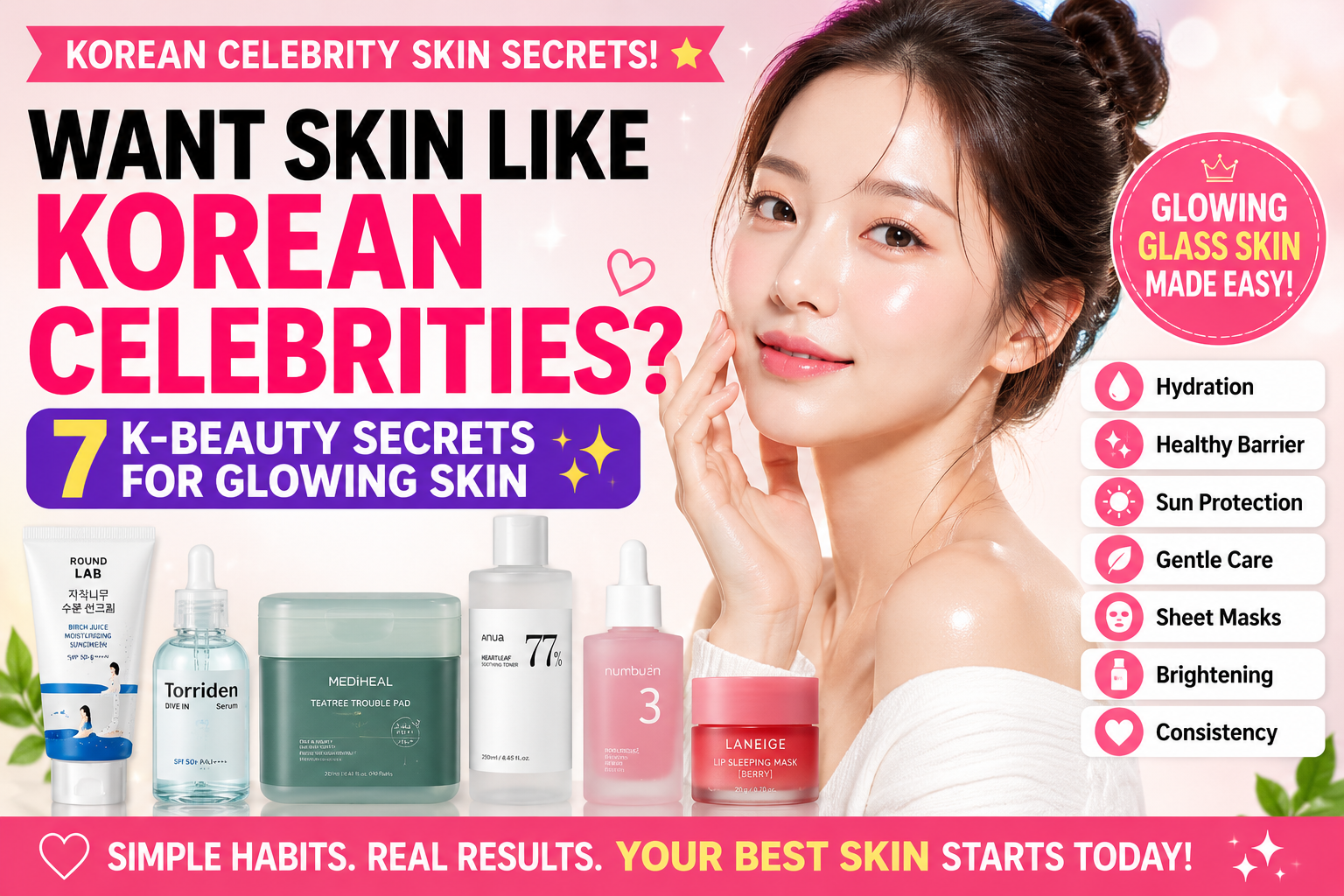
  • Want Skin Like Korean Celebrities? Discover the Secrets Behind Korean Glowing Skin

    Want Skin Like Korean Celebrities? Discover the Secrets Behind Korean Glowing Skin

    Have you ever watched a K-drama or K-pop performance and wondered:

    “How does their skin look so clear, smooth and glowing?”

    Korean celebrities often appear on camera with luminous, hydrated-looking skin — the kind of complexion that helped make terms such as “glass skin” famous around the world.

    But there isn’t one magical Korean cream that creates perfect skin overnight.

    The more interesting story behind Korean skincare is a culture of consistent care, hydration, gentle cleansing, sun protection and choosing products according to your skin’s needs.

    And you don’t have to live in Seoul — or be a K-pop star — to learn from those habits.

    Here are seven K-beauty principles worth knowing.


    1. Korean Skincare Is About Consistency, Not Magic

    One misconception about K-beauty is that everyone in Korea follows an elaborate 10-step routine every morning and night.

    That isn’t necessarily true.

    K-beauty experts interviewed by Vogue in 2026 explained that Korean skincare is highly personalized. Depending on the condition of your skin, a routine might contain only a few products or considerably more.

    The important idea is consistency.

    Jessica Jung, for example, previously told Vogue that her Korean skincare approach centered on following her daily and nightly routine consistently.

    Instead of constantly searching for a miracle product, think about what your skin actually needs and build a routine you can maintain.


    2. Clean Skin Comes First

    At the end of the day, your face may contain sunscreen, makeup, sebum, sweat and environmental residue.

    That’s why cleansing has become such an important part of K-beauty.

    One method commonly associated with Korean skincare is double cleansing.

    The basic idea is simple:

    First cleanse: remove oil-based residue such as makeup and sunscreen.

    Second cleanse: use a water-based cleanser to remove remaining sweat and impurities.

    Beauty and skincare experts describe evening double cleansing as a foundation of many Korean-style routines, particularly for people wearing makeup or sunscreen.

    But more cleansing isn’t automatically better.

    If your skin becomes dry, tight or irritated, a gentler routine may be more appropriate.


    3. Hydration Is One of the Foundations of the “Glass Skin” Look

    What makes “glass skin” look different from simply shiny skin?

    Hydration.

    The goal is usually described as skin that appears smooth, plump, even and naturally luminous.

    K-beauty experts emphasize maintaining hydration and supporting the skin barrier rather than simply covering the face with heavy makeup.

    This explains the popularity of Korean products such as:

    toners → essences → serums → moisturizers → masks

    The idea isn’t necessarily to use every product.

    Instead, lightweight hydration can be layered according to what your skin needs.


    4. Don’t Forget Sunscreen

    If there is one habit worth remembering from Korean skincare culture, it is sun protection.

    UV exposure contributes to pigmentation and visible signs of skin aging, which is why sunscreen is repeatedly emphasized by skincare professionals.

    Korean sunscreens have also become internationally popular partly because many modern formulas aim for comfortable textures suitable for everyday use.

    The lesson is simple:

    Expensive skincare means much less if you ignore daily sun protection.

    And sunscreen isn’t just something to use at the beach.

    For many people, it is an everyday skincare step.


    5. Sheet Masks and Toner Pads Are Helpers — Not Magic

    Walk into an Olive Young store in Korea and you’ll quickly notice sheet masks and toner pads.

    They are everywhere.

    Toner pads can serve different purposes depending on their formulation, including hydration, soothing, brightening or exfoliation. Dermatologist Y. Claire Chang explained to Vogue that their function can go well beyond simply being “toner on a pad.”

    Sheet masks are also commonly used as an additional hydration or soothing step.

    But remember:

    A mask cannot compensate for poor everyday skincare habits.

    Think of masks and toner pads as supporting players rather than the entire routine.


    6. Korean Stars Don’t Necessarily Use 20 Products Every Day

    This may surprise you.

    Some Korean celebrities have demonstrated elaborate beauty routines, while others keep things remarkably simple.

    For example, LE SSERAFIM’s Kazuha showed Vogue a relatively streamlined 2026 morning routine beginning with cleansing and toner pads, and said she generally keeps her skincare simple.

    That tells us something useful.

    The secret isn’t:

    “Use as many Korean products as possible.”

    It’s:

    “Find products and habits that work for your skin and use them consistently.”

    More products can also mean more opportunities for irritation, particularly when multiple strong active ingredients are combined.


    7. Skincare and Dermatology Are Not the Same Thing

    This distinction is especially important.

    Korean cosmetics can help support everyday skincare, hydration and appearance.

    But cosmetics are not substitutes for medical diagnosis or treatment.

    Persistent acne, severe irritation, unusual pigmentation, scars or other skin conditions may require evaluation by a qualified medical professional.

    This is also one reason Korea’s dermatology sector attracts so many international visitors.

    If you’re considering professional treatment rather than everyday skincare, read our Dermatology in Korea for Foreigners 2026: Treatments, Costs & How to Book guide.


    A Simple Korean-Inspired Skincare Routine for Beginners

    You don’t need 10 steps to begin.

    A simple routine might look like this:

    Morning

    Gentle cleanse
    → Hydrating serum or toner if needed
    → Moisturizer
    → Sunscreen

    Evening

    Remove sunscreen and makeup
    → Gentle cleanser
    → Hydrating or targeted skincare
    → Moisturizer

    Then adjust according to your skin type and concerns.

    That’s much more realistic than buying ten unfamiliar products at once.


    So, What’s the Real Korean Skin Secret?

    There probably isn’t one.

    It’s the combination of:

    Gentle cleansing + hydration + sun protection + appropriate products + consistency

    that matters more than any single trendy product.

    And perhaps that’s the most useful lesson behind K-beauty.

    Instead of asking:

    “What miracle product gives Korean celebrities perfect skin?”

    try asking:

    “What small skincare habits can I consistently follow every day?”

    Beautiful-looking skin is usually built over time.

    Not overnight.

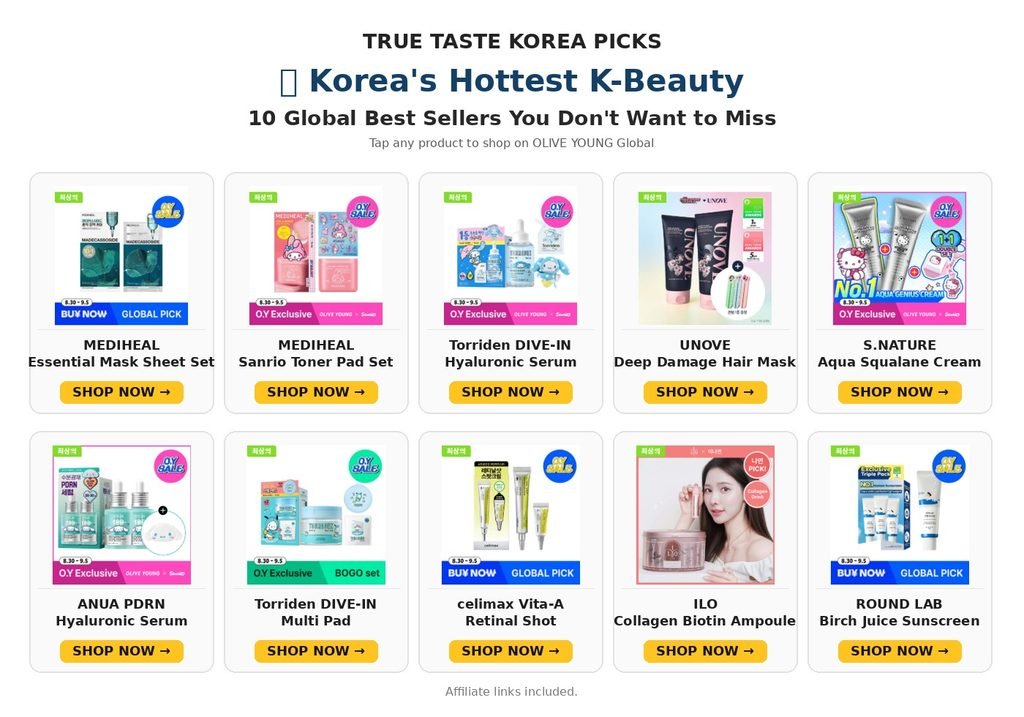
    Korea's hottest K-Beauty 10 global best sellers selected by True Taste Korea