Discover Korean culture through authentic food, K-beauty, travel, traditions, and everyday life. Explore the stories behind Korean dishes, skincare trends, cultural experiences, and must-visit destinations. Go beyond the trends to understand what makes Korean culture unique and why it fascinates people around the world.
One answer has appeared more than once over the years:
Samgyeopsal (삼겹살), Korean grilled pork belly.
In an earlier interview, Jimin listed samgyeopsal among his favorite Korean dishes and explained that he loves meat in general. Years later, when asked about foods he enjoys with soju, he again mentioned samgyeopsal.
So what exactly is samgyeopsal—and why is it one of Korea’s most popular meals?
What Is Samgyeopsal?
Samgyeopsal literally refers to pork belly, usually cut into thick slices and grilled at the table.
Unlike heavily marinated Korean barbecue dishes, samgyeopsal is often cooked without a complicated marinade.
That sounds simple.
But the fun begins after it hits the grill.
The pork becomes crispy and browned on the outside while staying juicy inside.
Then you build your own perfect bite.
How Do Koreans Eat Samgyeopsal?
A typical bite might include grilled pork belly, lettuce, garlic, ssamjang and perhaps kimchi.
Wrap everything together and eat it in one bite.
That combination is called a ssam (쌈).
But there isn’t just one correct way to eat samgyeopsal.
Some people dip the meat in sesame oil and salt. Others prefer ssamjang. Some grill kimchi alongside the pork so it absorbs a little of the rendered pork fat.
And, of course, many adults pair it with soju.
Jimin himself mentioned samgyeopsal when discussing foods he enjoys as anju—food eaten while drinking alcohol.
Jimin Has Loved Meat for Years
This isn’t based on a single recent comment.
In a 2014 interview, Jimin was asked about his favorite Korean dishes.
His list included samgyeopsal, pork-and-rice soup, fried rice, kimchi stew, jokbal and sundae.
He explained that he simply really likes meat and enjoys many foods containing it.
Another Japanese magazine interview from the following period listed pork belly, kimchi fried rice and gimbap among his favorite foods.
That makes samgyeopsal a particularly good dish to associate with Jimin: it keeps appearing in his food preferences across different interviews.
Why Should First-Time Visitors Try It?
Samgyeopsal isn’t only about the pork.
It’s about the experience.
The grill sits in the middle of the table. Everyone cooks together, shares side dishes and makes their own wraps.
That makes Korean barbecue very different from simply ordering a cooked steak and waiting for it to arrive.
And you don’t need to be a K-pop fan to understand why Jimin likes it.
Once that first piece of pork belly comes sizzling off the grill, the appeal is pretty easy to understand.
If you’re visiting Korea and want to try one of the foods BTS Jimin has repeatedly mentioned over the years, samgyeopsal is an easy place to start.
But one of his favorite foods is surprisingly simple: ramyeon.
In a BTS interview, when the members were asked about their favorite foods, Jungkook’s answer was simply “ramen.”
And over the years, his love of Korean instant noodles has become even more interesting.
Jungkook doesn’t just eat ramyeon.
He experiments with it.
What Is Korean Ramyeon?
Korean ramyeon (라면) is the Korean version of instant noodles.
Unlike many mild instant noodle varieties, Korean ramyeon is often known for a stronger broth, bold seasoning and plenty of spice.
It’s cheap, fast and found almost everywhere in Korea—from convenience stores to Korean homes.
But Jungkook has taken this everyday food and created his own combinations.
Jungkook Even Created His Own Ramyeon Recipe
One of his best-known creations is Bulguri (불그리).
Jungkook shared the recipe with fans on Weverse in 2023. It combines two famous Korean instant noodles: Buldak Hot Chicken Flavor Ramen and Neoguri.
The result combines Buldak’s intense heat with Neoguri’s seafood-flavored seasoning.
The Korea Tourism Organization later featured Jungkook’s Bulguri in its guide to special ramyeon recipes from Korean celebrities.
He even gave specific cooking instructions rather than simply throwing the two noodle packets together.
This is apparently serious business.
There’s More Than Bulguri
Jungkook’s noodle experiments didn’t end there.
He also developed a spicy version of perilla-oil makguksu, a Korean buckwheat noodle dish.
In a Weverse Magazine interview, Jungkook explained how he repeatedly experimented with the sauce, adding spicy Buldak sauce and eventually ingredients such as mayonnaise and egg yolk until he reached the flavor and texture he wanted.
That tells us something interesting about Jungkook and food.
He doesn’t necessarily want complicated food.
He wants food to taste exactly the way he likes it.
Want to Eat Like Jungkook?
You don’t need an expensive Korean restaurant.
Start with Korean ramyeon.
And if ordinary instant noodles seem too easy, try Bulguri—Jungkook’s combination of Buldak and Neoguri.
Sometimes the Korean food loved by one of the world’s biggest K-pop stars comes in a packet that takes only a few minutes to cook.
If you had to guess BLACKPINK Lisa’s favorite Korean food, what would you choose?
Korean barbecue? Tteokbokki? Fried chicken?
The answer is gamjatang (감자탕) — a hearty, spicy Korean pork-bone stew.
In a YG interview, Lisa was asked which Korean food she liked the most. Her answer was simple: gamjatang. She explained that she had never tried it in Thailand and first discovered it after coming to Korea. It turned out to be exactly her kind of food.
What Is Gamjatang?
Gamjatang is made by simmering pork backbone in a rich, spicy broth.
A typical pot includes potatoes, vegetables or kimchi cabbage, and perilla powder. The pork becomes tender after cooking, while the perilla gives the broth its distinctive nutty, savory flavor.
Despite the word gamja meaning “potato” in modern Korean, this isn’t simply a potato soup. The star of the dish is the pork bone and its deeply flavored broth.
What Does Gamjatang Taste Like?
Think of it as something between a spicy stew and a slow-cooked pork soup.
The broth is rich and savory, with noticeable spice, while the meat around the bones becomes soft and tender. Korea Tourism Organization also notes that gamjatang is popular as a hangover dish because of its hearty, spicy broth.
And there’s something very Korean about eating it.
You pick the tender meat from the bones, eat it with rice, and keep returning to the bubbling broth.
It isn’t particularly glamorous.
But it is serious comfort food.
Lisa Discovered It in Korea
That may be the most interesting part of Lisa’s answer.
Lisa grew up in Thailand, but said she hadn’t encountered gamjatang there. She tried it only after arriving in Korea and found that it perfectly suited her taste.
So if you’re exploring Korean food because of K-pop, don’t stop at barbecue and tteokbokki.
Try a bubbling pot of gamjatang.
You might discover the same Korean comfort food that won over Lisa.
If the isolated village in Na Hong-jin’s HOPE looked unusually real, there is a good reason.
Much of it was real.
The fictional “Hope Harbor” was created largely in Namchang-ri, Bukpyeong-myeon, Haenam, a small community at the southern end of South Korea.
Rather than constructing an entirely artificial village set, the production transformed real streets, houses, shops and other buildings into the eerie community seen in the movie.
But Haenam is much more than a filming location.
For Koreans, the name is also associated with cabbage for kimchi, an extraordinary Buddhist temple, and one of the country’s most symbolic destinations — Ttangkkeut, or “Land’s End.”
For international viewers who discovered Haenam through HOPE, the real place may be almost as interesting as the fictional one.
Is Hope Harbor a Real Place?
Not exactly.
The movie’s Hope Harbor is fictional.
But its physical appearance came largely from the real village of Namchang-ri in Haenam County, South Jeolla Province.
The production didn’t simply build a Hollywood-style town and tear it down afterward.
Existing shops, homes, narrow streets and the local terminal area were transformed for filming.
That is one reason Hope Harbor feels lived-in.
It wasn’t designed from nothing.
People actually live there.
Some traces of the production have remained after filming, and the success of HOPE has already begun bringing movie fans to the village.
Why Did HOPE Choose Haenam?
The contrast is fascinating.
In HOPE, the village becomes a place of fear, isolation and survival.
Real Haenam feels very different.
It is a largely rural coastal county surrounded by farmland, mountains and sea.
Director Na Hong-jin has explained that the fictional village needed to feel completely isolated. He wanted something enormous to begin in an almost insignificant place — a tiny point on the map that could eventually expand into a story on a cosmic scale.
Haenam’s old village streets and coastal landscape helped create that feeling.
The production team also found something increasingly difficult to manufacture:
a Korean rural village that actually looks like a Korean rural village.
Haenam Is Also Famous for the Cabbage Behind Kimchi
There is another side of Haenam that international moviegoers would never guess from HOPE.
It is famous for baechu — napa cabbage used to make kimchi.
If you have eaten traditional Korean baechu kimchi, you already know the vegetable.
Cabbage is salted and combined with ingredients such as red pepper powder, garlic, ginger and fermented seafood to make the red kimchi found on Korean dining tables.
And Haenam has long been closely associated with cabbage grown for Korea’s kimjang season.
Its southern climate allows cabbage to grow into the colder months, making the region particularly well known for winter cabbage.
So there is an amusing contrast for HOPE viewers.
The terrifying village where humans encounter mysterious extraterrestrial beings was filmed in a region Koreans also associate with something extremely ordinary:
the cabbage on their dinner table.
Daeheungsa: A UNESCO Buddhist Temple in Haenam
Drive away from Hope Harbor’s filming location and Haenam reveals another completely different landscape.
At the foot of Duryunsan Mountain stands Daeheungsa Temple.
Daeheungsa is one of seven Korean Buddhist mountain monasteries included in UNESCO’s World Heritage site “Sansa, Buddhist Mountain Monasteries in Korea.”
These temples represent centuries of Korean Buddhist religious practice, architecture and monastic life.
Daeheungsa is surrounded by forest and mountain scenery, giving visitors a very different image of Korea from Seoul’s skyscrapers and crowded shopping districts.
For someone visiting Haenam because of HOPE, it is one of the places that makes extending the trip worthwhile.
And Then There Is Korea’s “Land’s End”
Haenam is probably best known domestically for one place:
Ttangkkeut Village.
The Korean word ttangkkeut (땅끝) literally means “the end of the land.”
Located at the southern tip of the Korean mainland, the area became symbolic as the place where the Korean Peninsula’s land seems to end and the sea begins.
Visitors can climb toward the Ttangkkeut Observatory and look across the islands scattered through the southern sea.
For Koreans, it has long been a symbolic travel destination.
You go to the end of the land —
and then begin again.
That makes it strangely appropriate that one of Korea’s most ambitious science-fiction stories was filmed nearby.
HOPE Could Turn Haenam Into a New K-Movie Destination
Something interesting is already happening.
Tourism programs are beginning to connect the HOPE filming locations with other Haenam attractions, including Ttangkkeut Village and local food.
That creates a very different type of K-content tourism.
International visitors already travel to Seoul locations from famous K-dramas.
But HOPE could send viewers much farther south — into a part of Korea many foreign tourists have never considered visiting.
There they can walk through the real streets that became Hope Harbor.
Then leave the alien nightmare behind.
Eat food made with ingredients grown in Haenam.
Walk through a centuries-old Buddhist temple.
And finally stand at Korea’s Land’s End looking out over the sea.
The fictional Hope Harbor doesn’t exist.
But the place underneath it does.
And in some ways, the real Haenam may be the more interesting discovery.
If you are planning a trip to South Korea in late September 2026, you may have suddenly discovered something that was not in your original itinerary:
Chuseok.
Then comes the panic.
Will everything be closed?
Will I be able to get a KTX ticket?
Should I cancel my trip to Busan?
Will Seoul be empty?
Can I still find restaurants?
These questions are appearing repeatedly among travelers planning Korea trips around Chuseok.
The good news is simple:
You do not need to cancel your trip to Korea because of Chuseok.
But you should change the way you travel.
The biggest mistake is not visiting Korea during Chuseok.
The biggest mistake is trying to travel around Korea as if Chuseok were an ordinary weekend.
When Is Chuseok in 2026?
In 2026, the main Chuseok holiday falls around:
September 24–26, 2026
with Chuseok Day on Friday, September 25.
For tourists, however, it is better to think of the holiday as a wider travel period rather than just one day.
Millions of Koreans traditionally travel to their hometowns or visit family during Chuseok.
That creates one enormous problem for visitors:
intercity transportation.
The Biggest Problem Is Not Seoul — It Is Moving Between Cities
This is the most important advice I can give foreign travelers.
If possible, avoid major intercity travel during the peak Chuseok period.
A normal Seoul-to-Busan trip is easy.
During Chuseok, it can become one of the most difficult transportation reservations of your entire Korea trip.
KTX and other long-distance trains are heavily used by Koreans traveling home for the holiday.
For 2026, KORAIL introduced a separate Chuseok reservation process for trains operating during the holiday period rather than simply selling them through the normal booking window.
That is why some travelers checking the KORAIL calendar became confused when trains suddenly appeared unavailable.
The trains had not disappeared.
They were being sold through the special holiday reservation system.
If You Already Have a KTX Ticket
Great.
Keep it.
If You Do Not Have One
Do not build an important itinerary around the assumption that you will simply arrive at Seoul Station and buy a seat.
Especially for popular routes such as:
Seoul–Busan
Seoul–Daegu
Seoul–Gyeongju
Seoul–Daejeon
Seoul–Gwangju
Seoul–Jeonju
availability can become extremely limited.
If your international flight depends on getting back to Seoul, leave yourself a safety margin.
Missing one tourist attraction is disappointing.
Missing your flight home because you could not get transportation back to Seoul is a much bigger problem.
Should I Stay in Seoul During Chuseok?
For many first-time international visitors, my answer is:
Yes.
If your itinerary allows it, Seoul is one of the easiest places to spend the core Chuseok holiday.
This may sound strange because many Koreans leave Seoul to visit their hometowns.
But that can actually work in a tourist’s favor.
The city does not shut down.
Major tourist districts remain alive, public transportation continues operating, and cultural events are often organized specifically for the holiday.
Instead of trying to fight millions of Koreans for long-distance transportation, you can slow down and experience Seoul differently.
Is Everything Closed During Chuseok?
No.
This is probably the biggest misunderstanding among first-time visitors.
Korea does not completely shut down for three days.
But neither should you assume that everything operates normally.
The businesses most likely to close are smaller independent businesses where the owner and family want to spend Chuseok together.
That can include:
small local restaurants
traditional markets or individual stalls
independent cafés
family-run stores
neighborhood businesses
This is especially important on Chuseok Day itself, September 25.
If there is one restaurant you absolutely want to visit, check its opening hours shortly before going.
Do not assume Google Maps or an old blog post is correct for a national holiday.
What About Convenience Stores, Shopping and Tourist Areas?
In major Seoul tourist districts, you are unlikely to find a completely deserted city.
Convenience stores are among the easiest places to find open, and many large commercial businesses operate during at least part of the holiday.
Areas such as:
Myeongdong, Hongdae, Gangnam, Itaewon and major shopping districts
are very different from a small neighborhood where many family-run businesses may close.
Still, individual stores can set their own holiday schedules.
So think of Chuseok this way:
The city is open. Every individual business is not guaranteed to be open.
That distinction will save you a lot of frustration.
Chuseok Can Actually Be a Great Time to Experience Korean Culture
There is another side to the holiday that travelers sometimes overlook.
Chuseok is not merely an inconvenience.
It is one of Korea’s most important traditional holidays.
Seoul organizes cultural events around the holiday, including traditional performances, games and hands-on cultural programs.
For example, Seoul’s official September 2026 cultural calendar includes Chuseok programs at locations such as the Seoul Baekje Museum and Seoul Urban Life Museum, with performances, traditional games and family activities.
For a foreign visitor, this can be an opportunity rather than a problem.
Instead of treating Chuseok as a day when your normal itinerary has been ruined, consider making Chuseok itself part of your itinerary.
Be Careful With Museums and Attractions
Here is where planning becomes important.
Do not assume that every museum follows the same holiday schedule.
Some cultural attractions remain open or organize special programs, while others may close on Chuseok Day.
That means you should check the official website of each major attraction shortly before visiting.
This is especially important for museums.
A traveler can easily make the mistake of thinking:
“It’s a national holiday, so tourist attractions must be open.”
Or the opposite:
“It’s a national holiday, so everything must be closed.”
Neither assumption is reliable.
Check individually.
What About Restaurants?
You will find food.
You are not going to starve in Seoul during Chuseok.
But your carefully planned list of five famous restaurants may not work exactly as planned.
Small family-run restaurants are the biggest uncertainty.
This is one reason I recommend having several backup restaurants in the same neighborhood.
If Restaurant A is closed, do not spend an hour crossing Seoul to reach Restaurant B.
Open Naver Map or KakaoMap and look nearby.
Major tourist districts usually provide plenty of alternatives.
And if everything goes wrong?
There is one institution that has rescued countless hungry travelers and Koreans alike:
the Korean convenience store.
A convenience-store meal may not have been part of your dream Korea vacation, but Korean convenience stores are an experience of their own.
Should You Visit Busan or Gyeongju During Chuseok?
You can.
But I would separate two questions.
Is Busan worth visiting?
Absolutely.
Should you casually travel from Seoul to Busan during peak Chuseok without confirmed transportation?
No.
The same principle applies to Gyeongju, Jeonju and other popular destinations.
If your transportation and accommodation are already confirmed, enjoy your trip.
If they are not, I would rather reorganize the itinerary than spend an important vacation day fighting for transportation.
For first-time visitors, there is more than enough to do in Seoul for several days.
A Simple Chuseok Strategy for Foreign Tourists
If I were helping a friend from overseas plan a Korea trip during Chuseok 2026, I would keep it simple.
Before the holiday: Do your long-distance travel.
Visit Busan, Gyeongju, Jeonju or other cities before the peak movement begins if your schedule allows.
September 24–26: Stay primarily in one city.
For many first-time visitors, Seoul is the easiest choice.
Explore palaces, parks, neighborhoods and confirmed-open cultural attractions. Look for Chuseok events.
September 25 — Chuseok Day: Make this your most flexible day.
Do not create an itinerary that depends on six specific restaurants and stores being open.
Enjoy the city, experience a cultural event, walk along the Han River or explore an area where you have several alternatives.
After the holiday: Resume your normal itinerary, but remember that return traffic can remain heavy around the end of the holiday period.
What Travelers on Reddit Are Worried About
Looking at recent Korea travel discussions, the same concerns appear again and again.
Foreign travelers are asking whether they can get from Busan or Andong back to Seoul during Chuseok, whether KTX reservations will be available to foreigners, whether restaurants will close, and even whether they should change their entire Korea trip.
Those concerns are understandable.
But travelers who have previously spent Chuseok in Seoul also describe another experience: a quieter city, cultural events and plenty of things still available to do.
Both experiences can be true.
The difference is usually planning.
Someone trying to cross the country without a train reservation may remember Chuseok as a transportation nightmare.
Someone already staying in Seoul may remember it as one of the most interesting days of the trip.
A Korean’s Advice: Don’t Fight Chuseok
This is the most important point.
When Koreans know Chuseok is approaching, we change our plans.
We think about traffic.
We think about train tickets.
We check whether businesses will be open.
We avoid unnecessary long-distance movement.
Foreign visitors should do the same.
Do not try to force your normal itinerary through one of the biggest travel periods of the Korean year.
Travel with the holiday instead of against it.
Stay in one place.
Slow down.
Check opening hours.
Experience some traditional Korean culture.
And if you can avoid competing with millions of Koreans for a KTX seat during the busiest period of the year, do it.
Final Answer: Should You Travel to Korea During Chuseok 2026?
Yes.
I would not cancel a Korea vacation simply because it overlaps with Chuseok.
But I would change the itinerary.
The safest approach for most foreign tourists is:
Avoid unnecessary intercity travel during the peak holiday, secure transportation early, stay flexible on Chuseok Day, and check individual businesses before visiting.
If you do that, Chuseok does not have to ruin your Korea trip.
It may actually give you something most tourists never experience:
Korea during one of the most important holidays of the year.
After a long day, sometimes you don’t want another burger.
You don’t want fried chicken.
You don’t want pizza covered in cheese.
You don’t even want something exciting.
You just want something warm.
That may help explain why some Americans are discovering one of Korea’s least flashy but most comforting foods:
Seolleongtang (설렁탕).
In places like Los Angeles, people can drive across town to Koreatown for a steaming bowl of Korean beef soup.
Some restaurants specializing in Korean soups have traditionally served late-night diners, and seolleongtang has long been associated with breakfast, hangovers, cold weather and those days when your body simply doesn’t feel right.
Eater Los Angeles, for example, recommends seolleongtang as a Korean breakfast and describes it as especially restorative for people recovering from a hangover or nursing a cold.
But to understand why this simple-looking soup can inspire such loyalty, you have to understand what seolleongtang means in Korea.
Because for many Koreans, it isn’t merely soup.
It is the kind of food you eat when your body needs a little help getting through the day.
What Is Korean Seolleongtang?
Seolleongtang is a traditional Korean soup made by slowly simmering beef bones and meat.
The long cooking process extracts flavor and richness from the bones and beef, often creating the pale, cloudy broth many people associate with the dish.
But not every seolleongtang looks exactly the same.
Some restaurants prefer a milky-white broth with a stronger bone flavor.
Others produce a clearer broth with more emphasis on the clean flavor of beef.
MICHELIN describes seolleongtang as one of Korea’s quintessential soul foods and notes that preparation varies considerably from restaurant to restaurant.
The bowl itself can look surprisingly plain.
Beef.
Broth.
Rice.
Sometimes thin noodles.
Green onions.
Salt and pepper.
That’s about it.
And that’s exactly why making truly great seolleongtang is harder than it looks.
In Korea, Seolleongtang Feels Like an Early Morning
Ask a Korean what image comes to mind when thinking about seolleongtang, and many answers will have less to do with fine dining than with everyday life.
For me, one of the strongest images is early morning.
It is still cold outside.
The city hasn’t completely woken up.
Someone who has to start work early pushes open the door of a small restaurant.
He is hungry.
A long day is waiting for him.
Then a black earthenware bowl arrives at the table.
The broth is still bubbling.
Steam rises toward his face.
He adds some chopped green onions, a little salt and perhaps some black pepper.
Then he puts rice into the soup.
One spoonful.
Then another.
Gradually, the cold disappears.
The stomach becomes full.
And somehow the day feels a little more manageable.
That is the emotional image of seolleongtang that is difficult to explain with the English words “beef bone soup.”
Technically, that description may be useful.
Emotionally, it doesn’t come close.
A Food Koreans Turn to When They Don’t Feel Well
Seolleongtang also has a strong reputation in Korea as nourishing food.
When someone feels weak, catches a cold or simply feels exhausted, a hot bowl of soup is often appealing.
That doesn’t mean seolleongtang should be considered medicine.
It isn’t.
But culturally, it occupies a similar emotional space to chicken soup in parts of the United States.
Warm. Familiar. Gentle. Restorative.
And something interesting is happening in America.
People are beginning to experience it in much the same way.
Eater Los Angeles recently featured a bowl of seolleongtang eaten just before the writer came down with a summer cold, describing the soup’s warmth and rich texture as deeply soothing.
That’s fascinating to me.
The person eating the soup may have changed.
The country has changed.
But the emotional purpose of the food remains remarkably similar.
The Secret Partner Isn’t Another Meat Dish
If you order seolleongtang for the first time, there is one thing you shouldn’t ignore.
Kkakdugi (깍두기).
Kkakdugi is Korean radish kimchi, usually cut into cubes and fermented with chili pepper, garlic and other seasonings.
A spoonful of rich, mild broth followed by a crunchy, slightly sour and spicy piece of kkakdugi creates one of those combinations that makes much more sense after you taste it.
The broth calms the kimchi.
The kimchi wakes up the broth.
This isn’t a side dish placed on the table merely because Korean restaurants serve lots of side dishes.
Kkakdugi is part of the seolleongtang experience.
MICHELIN’s discussion of the dish makes the same point: kimchi, especially kkakdugi, cuts through the richness of the beef broth, and famous seolleongtang restaurants often take their kimchi extremely seriously.
Some Koreans even add a little kkakdugi juice to their soup.
For someone tasting seolleongtang for the first time, that may sound strange.
Try the original broth first.
Then try it with kkakdugi.
You’ll understand.
The Best Way to Eat Seolleongtang
There isn’t one mandatory method.
But this is how I would introduce it to someone eating Korean seolleongtang for the first time.
First, taste the broth before seasoning it.
Good seolleongtang is often intentionally served lightly seasoned so each diner can adjust it.
Then add a little salt.
Add black pepper if you like it.
Add plenty of chopped green onions.
Taste again.
Now take a bite of beef.
Then kkakdugi.
Once you’ve tasted the broth on its own, add some rice.
Don’t necessarily throw everything in immediately.
Add a little rice at a time and see how the texture changes.
Soon you are no longer eating soup and rice separately.
You are eating gukbap (국밥) — one of the most comforting forms of Korean everyday food.
And Then Comes Dolsotbap
There is an even better combination found at some Korean restaurants:
Seolleongtang with dolsotbap (돌솥밥).
Dolsotbap means rice cooked and served in a hot stone pot.
When the lid is opened, steam rises from freshly cooked rice.
The rice is hot, glossy and fragrant.
You scoop it out.
Then put some into your seolleongtang.
Hot rice.
Hot beef broth.
Tender beef.
And one crunchy piece of kkakdugi.
But here is the part many first-time visitors don’t expect.
Don’t take away the empty stone pot.
The meal isn’t finished.
Wait — Why Are Koreans Pouring Hot Water Into the Rice Pot?
After the rice is removed, a thin layer remains stuck to the scorching-hot bottom of the stone pot.
This is nurungji (누룽지) — toasted, scorched rice.
Pour hot water into the pot.
Put the lid back on.
Then continue eating your seolleongtang.
By the time you finish the soup, return to the stone pot.
The toasted rice has softened and infused the water with a subtle roasted-rice flavor.
Depending on how it is prepared and described, this final rice-water experience is closely associated with sungnyung (숭늉).
Now you have one last warm, clean-tasting finish to the meal.
So a meal that initially looked like nothing more than beef soup has become:
That’s one reason Korean food can be difficult to understand from a menu photograph.
Sometimes the experience isn’t one dish.
It’s the sequence in which you eat it.
Seolleongtang Looks Easy. It Isn’t.
This may be the most important thing to understand about seolleongtang.
It looks simple.
And simple food can be incredibly difficult to make well.
A spicy sauce can sometimes hide imperfections.
Strong seasoning can dominate other flavors.
Seolleongtang has nowhere to hide.
The quality of the bones and meat matters.
How the broth is simmered matters.
How fat is managed matters.
How the meat is cooked matters.
And above all:
time matters.
One of Seoul’s oldest famous seolleongtang restaurants, Imun Seolnongtang, has historically simmered its broth for more than 17 hours, according to MICHELIN’s feature on the dish.
Mapo Ok, another long-running Seoul specialist, is described by MICHELIN as slowly boiling beef and ox bones to produce its signature broth. The restaurant dates to 1949.
There is no dramatic moment when the dish suddenly becomes great.
It happens slowly.
Hour after hour.
Perhaps that’s part of its character.
Why Seolleongtang Works So Well in America
American food culture isn’t lacking in soup.
Chicken noodle soup already plays an important comfort-food role.
There are regional stews, chowders and countless immigrant soup traditions.
So why might seolleongtang connect with American diners?
I think the answer is surprisingly simple.
You don’t need to understand Korean culture to understand being tired.
You don’t need to speak Korean to know what it feels like to come home after a terrible day.
You don’t need to know the history of gukbap to appreciate holding a spoon over a steaming bowl on a cold morning.
And you don’t need to grow up eating kkakdugi to discover that its sharp fermented flavor is wonderful with a mild beef broth.
That universality may be one of seolleongtang’s greatest strengths.
It doesn’t demand attention.
It doesn’t explode with spice.
It doesn’t need melted cheese, an enormous portion or a dramatic tableside presentation to impress you.
It simply makes you feel better.
From Seoul Before Sunrise to Los Angeles After Midnight
There is something beautiful about how food travels.
In Seoul, I think of a worker eating seolleongtang early in the morning before starting a long day.
In Los Angeles, someone may seek out the same soup after a long day, during a cold, or when they simply want something warm and familiar.
Koreatown’s long-running Han Bat has become particularly associated with seolleongtang, with Eater describing generations of the same family slowly simmering ox bones for the restaurant’s broth.
Different city.
Different customers.
Different lives.
But perhaps the reason they lift that first spoonful isn’t so different.
The Korean Comfort Food That Doesn’t Need to Shout
Korean food has become famous around the world for powerful flavors.
Korean fried chicken.
Tteokbokki.
Buldak.
Korean barbecue.
They are exciting, colorful and easy to show in a short video.
Seolleongtang is almost the opposite.
White broth.
White rice.
A few pieces of beef.
Green onions.
Kkakdugi on the side.
It isn’t particularly Instagrammable.
But perhaps that is exactly the point.
Seolleongtang isn’t food that asks you to look at it.
It’s food that asks you to sit down.
To warm your hands.
To add some rice.
To eat a piece of kkakdugi.
And to forget, for twenty minutes, how tiring the day has been.
Sometimes We Don’t Need Exciting Food
Seolleongtang looks simple.
But simple Korean food is often the hardest to make.
There is nowhere for bad ingredients to hide.
No powerful sauce needs to cover the broth.
What creates its depth isn’t a secret seasoning.
It is time.
Maybe that’s also why a bowl of seolleongtang can feel so comforting after a long day.
The person eating it might be in Seoul before sunrise.
Or driving across Los Angeles looking for Korean soup late at night.
The place has changed.
The language has changed.
But the reason for eating it may not have changed very much.
Sometimes, after a difficult day, what we want most isn’t exciting food.
We just want something warm.
And sometimes, that’s enough.
What About You?
Have you ever tried seolleongtang?
Would you choose a mild Korean beef soup over spicy Korean food after a long, exhausting day?
Maybe BLACKPINK, Stray Kids, SEVENTEEN, aespa, IVE or another artist you’ve followed from thousands of miles away.
The concert may last only a few hours.
But if you are flying all the way to South Korea, don’t make the concert your entire trip.
Make it the beginning.
K-pop fans are increasingly traveling to Korea not only to see their favorite artists, but to experience the country behind the music.
And for a first visit, there is one itinerary I recommend more than almost any other:
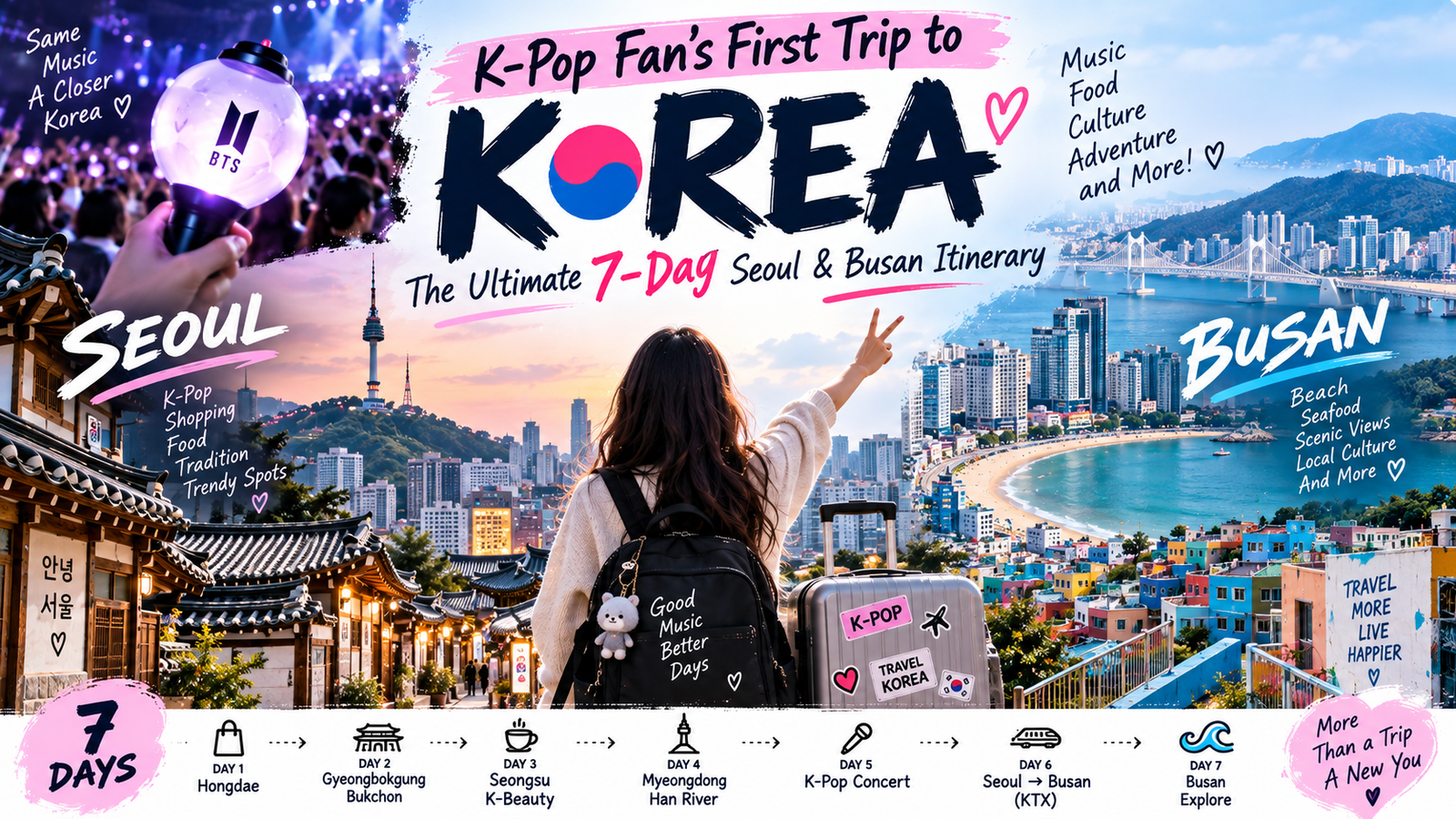
5 Days in Seoul + 2 Days in Busan
Seven days is long enough to experience modern Seoul, traditional Korea, K-pop culture, Korean food, K-beauty and the country’s most famous coastal city — without turning your vacation into an exhausting race between tourist attractions.
This itinerary is designed especially for a first-time international visitor to South Korea who loves K-pop.
You don’t need to spend seven days visiting idol-related locations.
Instead, we’ll use K-pop as the doorway and experience the Korea that exists beyond the concert.
Why 7 Days Is a Great First Korea Trip
You can technically visit Seoul in three or four days.
But if you are flying from North America, Europe or another long-distance destination, that can feel painfully short.
Seven days gives you time for:
K-pop
Korean food
K-beauty
traditional Korea
modern Seoul
shopping
the Han River
and
Busan
without changing hotels every night.
There is another advantage.
If your main reason for visiting Korea is a concert, arriving several days early gives you protection against flight delays.
Never schedule an international arrival only hours before a concert you spent months trying to attend.
For this itinerary, I would ideally place the concert around Day 4 or Day 5.
Before You Arrive: The Three Things You Need
Before discussing the itinerary, prepare three things.
1. A Transportation Card
Seoul’s subway and bus network makes traveling around the city relatively easy.
A rechargeable transportation card can be used across much of Korea’s public transit system.
You’ll use public transportation constantly, so this should be one of the first things you organize after arriving.
2. Korean Map Apps
One surprise for many international travelers is that Google Maps is not always the best navigation option in South Korea.
Install at least one Korean navigation app before your trip.
Naver Map and KakaoMap are widely used for navigating Korean cities.
Save your hotel and important destinations in advance.
This will make your first day considerably easier.
3. Comfortable Shoes
This sounds trivial.
It isn’t.
You are going to walk.
A lot.
Subway stations can be large, neighborhoods are best explored on foot, and several attractions involve hills or long walking routes.
Your fashionable concert shoes and your sightseeing shoes do not necessarily need to be the same pair.
Your feet will thank you by Day 5.
DAY 1 — Arrive in Seoul, Hongdae and Your First Korean Night
Don’t plan too much for your first day.
After immigration, baggage collection and transportation from the airport, you may already be tired.
Check into your hotel, take a short break and begin with one of Seoul’s easiest neighborhoods for younger international visitors.
Hongdae
Hongdae is an excellent introduction to modern Seoul.
The neighborhood is filled with:
cafés,
restaurants,
fashion shops,
street performers,
music,
beauty stores
and nightlife.
If K-pop was your introduction to Korea, Hongdae will probably feel surprisingly familiar and completely new at the same time.
Don’t spend your first evening checking boxes on a sightseeing list.
Walk.
Explore.
Eat.
Watch the city.
What Should You Eat on Your First Night?
For your first Korean meal, keep it fun.
Try:
samgyeopsal — Korean grilled pork belly
or
Korean fried chicken
If you are traveling with friends, Korean barbecue is particularly good because eating together around the grill is part of the experience.
And if you still have energy afterward?
Find a Korean convenience store.
Buy a drink and some snacks.
Congratulations.
Your Korea trip has officially started.
DAY 2 — Traditional Korea: Gyeongbokgung, Bukchon and Insadong
Yesterday was modern Korea.
Today, go backwards in time.
Start at:
Gyeongbokgung Palace
Built during the Joseon Dynasty, Gyeongbokgung is one of Seoul’s most important historical landmarks.
If this is your first visit to Korea, don’t skip it simply because it appears on every tourist itinerary.
There is a reason it does.
The contrast between the palace architecture and modern Seoul surrounding it is one of the city’s defining experiences.
Many visitors also rent hanbok, traditional Korean clothing, near the palace.
If that interests you, allow extra time.
Walk Toward Bukchon
After the palace, explore the traditional streets around Bukchon Hanok Village.
But remember something important:
Bukchon is not a theme park.
People actually live there.
Keep your voice down, respect restricted areas and avoid blocking residential entrances while taking photographs.
That small amount of consideration makes tourism better for everyone.
Lunch: Try a Traditional Korean Meal
This is a good day to move beyond the most internationally famous Korean foods.
Consider:
bibimbap
bulgogi
mandu
samgyetang
or a Korean set meal with multiple side dishes.
One of the best parts of traveling in Korea is discovering that Korean food is much larger than barbecue and kimchi.
Finish the Day in Insadong
Insadong is an easy continuation from the palace area.
You’ll find:
traditional crafts,
tea houses,
souvenirs,
galleries
and smaller streets worth exploring.
If Day 1 showed you the Korea of K-pop, Day 2 shows you part of the cultural foundation underneath modern Korea.
DAY 3 — Seongsu, K-Beauty and Contemporary Seoul
Today is about the Korea that is changing right now.
Head to:
Seongsu
Seongsu has become one of Seoul’s most interesting neighborhoods for fashion, beauty, cafés and pop-up culture.
This is particularly relevant for K-pop fans.
K-pop does not exist separately from Korean:
fashion,
beauty,
design,
brands
and youth culture.
They constantly influence one another.
And Seongsu is one of the easiest places to see those worlds overlap.
Don’t Overplan Seongsu
This is important because pop-ups change constantly.
A store that everyone was posting about three months ago may already be gone.
Instead of building your entire itinerary around one old viral TikTok, check what events and pop-ups are operating shortly before your trip.
Then spend time simply exploring the neighborhood.
Sometimes the most interesting place will be something that did not exist when you booked your flight.
K-Beauty Shopping
If you’ve wanted to try Korean skincare or makeup, today is a good day.
But don’t feel that you need to buy everything immediately.
Korean beauty stores are everywhere in Seoul.
Compare products.
Check what actually suits your skin.
And remember that a giant shopping bag becomes much less exciting after carrying it around for six hours.
DAY 4 — Myeongdong, Namsan and the Han River
Start with one of Korea’s most famous shopping districts.
Myeongdong
Myeongdong is touristy.
And that’s perfectly fine.
For a first-time visitor, it is convenient.
You can find:
K-beauty,
fashion,
restaurants,
cafés,
street food,
currency exchange
and easy transportation.
It is also a good place to buy gifts for people back home.
Try Korean Street Food
Depending on what is available, look for foods such as:
tteokbokki
hotteok
eomuk
dakgangjeong
and various grilled snacks.
Don’t worry about eating every famous Korean dish in one afternoon.
You have seven days.
N Seoul Tower and Namsan
From Myeongdong, you can continue toward Namsan.
Whether you actually go to the top of N Seoul Tower is up to you.
The more important experience is seeing Seoul from above and understanding just how enormous the city really is.
Evening: Do Something Very Korean — Nothing
After several busy days, slow down.
Go to the:
Han River
Buy food.
Get a drink.
Sit.
Talk.
Watch bicycles pass.
Look at Seoul’s skyline.
If you’ve watched Korean dramas, variety shows or idol content, you’ve probably seen people spending time beside the Han River.
It may not sound as exciting as a palace or concert.
But ordinary experiences are often what travelers remember most.
DAY 5 — K-Pop Day and Concert Night
This is the day you came for.
But don’t ruin it by exhausting yourself beforehand.
Keep the daytime schedule light.
Sleep a little longer.
Eat properly.
Charge your phone.
Check your ticket.
Check the venue’s official rules.
Check transportation.
Check prohibited items.
And most importantly:
Follow the organizer’s official instructions rather than random social-media posts.
Concert procedures can change.
What to Do Before a K-Pop Concert
If official merchandise is being sold, queues can be long.
There may also be:
fan events,
pop-up stores,
photo zones,
special cafés,
album events
or citywide promotions.
Plan those around your concert rather than trying to squeeze them into the final hour.
If the venue is outside central Seoul — for example, Goyang or Incheon — allow significantly more transportation time than the map initially seems to suggest.
Thousands of other people may be traveling to the same place.
The Most Important Concert Tip: Plan the Trip Home
Everyone plans how to reach the concert.
Fewer people think carefully about what happens when tens of thousands of fans leave simultaneously.
Before entering the venue, know:
your subway route,
the last train time,
alternative routes,
taxi possibilities,
and where you will meet friends if your phones stop working.
Your concert ends when you are safely back at your hotel.
Not when the encore ends.
DAY 6 — Take the KTX to Busan
Now we change cities.
And this is where your first Korea trip becomes much more interesting.
Take the KTX high-speed train from Seoul to Busan.
The journey is roughly 2.5 to 3 hours depending on the service.
For many international visitors, the train ride itself becomes part of the experience.
You leave the enormous capital behind and begin seeing a different side of Korea.
First Stop in Busan: The Sea
Seoul is one of the world’s great metropolitan cities.
Busan feels different almost immediately.
It is Korea’s largest port city, surrounded by mountains and the sea.
For a short first visit, I would focus on a few major areas rather than trying to see everything.
Haeundae Beach
Haeundae is one of Korea’s most famous beaches.
Walk along the coast, explore nearby restaurants and enjoy the slower atmosphere.
If your Seoul days have been packed with subway transfers and shopping streets, the contrast feels wonderful.
Gwangalli at Night
If you can choose only one Busan night view, Gwangalli is hard to beat.
The illuminated Gwangan Bridge stretches across the water in front of you.
Find somewhere to eat nearby or simply walk along the beach.
This is one of those moments when you’ll realize:
Korea is much more than Seoul.
What to Eat in Busan
Busan has its own strong food identity.
Depending on your preferences, consider trying:
dwaeji gukbap — pork soup with rice
milmyeon — wheat noodles
eomuk — Busan-style fish cake
and, if you enjoy seafood, visit one of the city’s seafood districts.
This is exactly why adding Busan to a K-pop trip is worthwhile.
The music may be the same.
But the Korea around you has changed.
DAY 7 — Gamcheon, Jagalchi and Goodbye to Korea
Your final day should combine one more memorable neighborhood with food and a little shopping.
Start with:
Gamcheon Culture Village
Gamcheon is famous for its colorful hillside houses and narrow streets.
It has become one of Busan’s most recognizable destinations.
Take your time.
The neighborhood is hilly.
Again: comfortable shoes.
Jagalchi Market
Then experience another side of Busan at Jagalchi Market, one of Korea’s best-known seafood markets.
Even if you don’t eat seafood, the area around the market offers an interesting look at Busan’s identity as a port city.
Nearby streets are also good for exploring traditional markets and local food.
One Last Korean Meal
Your final meal does not need to be expensive.
In fact, one of the joys of Korea is that memorable meals can come from very ordinary places.
A small gukbap restaurant.
A noodle shop.
A gimbap restaurant.
A market stall.
A neighborhood barbecue restaurant.
By Day 7, you’ll probably already have your own opinion about which Korean food deserves one final meal.
That’s when you know you’ve actually traveled.
The Complete 7-Day Korea Itinerary
Here is the entire route in one place:
Day
Destination
Main Experience
Day 1
Hongdae
Arrival, modern Seoul, Korean food
Day 2
Gyeongbokgung–Bukchon–Insadong
Traditional Korean culture
Day 3
Seongsu
K-pop culture, cafés, K-beauty, pop-ups
Day 4
Myeongdong–Namsan–Han River
Shopping, street food, Seoul lifestyle
Day 5
Concert Day
K-pop concert and fan experiences
Day 6
Seoul → Busan
KTX, Haeundae, Gwangalli
Day 7
Busan
Gamcheon, Jagalchi, local food
Where Should a First-Time Visitor Stay in Seoul?
For this particular itinerary, three areas stand out.
Hongdae
Best if you want:
youthful atmosphere,
nightlife,
cafés,
easy airport access
and lots of restaurants.
Excellent for younger travelers and K-pop fans.
Myeongdong
Best if you want:
central location,
shopping,
K-beauty,
tourist convenience
and relatively easy access to major attractions.
For a first visit to Korea, Myeongdong is difficult to beat for convenience.
Seoul Station Area
Best if you plan to take the KTX to Busan and value transportation convenience.
It is not necessarily the neighborhood I would choose purely for atmosphere, but it makes moving around Korea easier.
How Much Money Should You Budget?
There is no single answer because Korea can accommodate very different travel styles.
Your biggest expenses are likely to be:
international airfare,
hotel,
concert ticket,
and shopping.
Public transportation and everyday Korean food can be relatively affordable compared with many major global cities.
A budget traveler can use:
guesthouses,
subways,
local restaurants
and convenience stores.
A higher-budget traveler can easily spend much more on:
hotels,
fine dining,
beauty treatments,
taxis,
shopping
and premium concert experiences.
The important thing is to separate your concert budget from your daily travel budget.
K-pop merchandise has a mysterious ability to make carefully planned budgets disappear.
Should You Visit Only K-Pop Locations?
I wouldn’t.
And I’m saying that in a guide specifically written for K-pop fans.
If BTS, BLACKPINK, Stray Kids or another artist made you curious about Korea, that’s wonderful.
Visit the places connected to them.
Go to the concert.
Buy the album.
Take the photos.
But don’t leave Korea having experienced only your fandom.
Spend one day learning about Korean history.
Eat food you’ve never seen your favorite idol eat.
Visit a neighborhood you discovered by accident.
Talk to people.
Take the train to another city.
Sit beside the Han River without doing anything.
Let K-pop bring you to Korea.
Then let Korea surprise you.
Why This Trip Is Bigger Than K-Pop
Recent tourism data shows that K-pop concerts can have a remarkable effect on international travel to Korea.
Foreign accommodation bookings during selected major K-pop concert weeks rose dramatically compared with non-concert periods, while government research around BTS performances found international concertgoers staying longer and spending more than the average foreign visitor.
That’s the phenomenon I explored in our previous article:
The BTS Effect: Why K-Pop Concerts Are Transforming Tourism in South Korea
But statistics only tell half the story.
The other half begins when the fan walks out of the stadium.
What happens next?
They eat tteokbokki.
They discover Seongsu.
They walk beside the Han River.
They shop in Myeongdong.
They ride the KTX.
They see Busan.
And suddenly the concert they flew across the world to attend becomes only one chapter of a much bigger memory.
A Few Mistakes First-Time Korea Travelers Should Avoid
Don’t schedule your flight too close to the concert.
Don’t rely entirely on one navigation app without preparing alternatives.
Don’t carry your passport, wallet and every valuable item carelessly in one place.
Don’t try to visit ten Seoul neighborhoods in one day.
Don’t assume every viral restaurant is worth waiting two hours for.
Don’t forget that residential areas such as parts of Bukchon require respectful behavior.
And don’t spend your entire vacation looking through your phone camera.
You traveled a long way.
Look at Korea with your own eyes too.
What If You Have More Than 7 Days?
Excellent.
Then I would not add more Seoul.
I would add more Korea.
With 9–10 days, consider:
Seoul → Gyeongju → Busan
Gyeongju offers a completely different experience from both Seoul and Busan.
It was the capital of the ancient Silla kingdom and is filled with archaeological and historical sites.
With 10–12 days, you could consider adding Jeju Island.
That gives you four dramatically different versions of Korea:
Seoul — modern metropolis
Gyeongju — history
Busan — coastal city
Jeju — nature
That’s a far richer introduction to Korea than spending the entire trip in one city.
Final Thoughts: Come for the Concert, Stay for Korea
Maybe your journey starts with a notification.
“World Tour Announced.”
Then comes the ticket battle.
The flight search.
The hotel reservation.
The countdown.
Finally, you arrive in Korea.
And for one night, thousands of people inside a stadium sing the same songs together.
That may be the reason you came.
But years later, you might remember something else just as clearly.
The smell of Korean barbecue on your first night.
The rooflines of Gyeongbokgung.
A random café in Seongsu.
Convenience-store ramyeon beside the Han River.
The KTX pulling out of Seoul Station.
The lights of Gwangan Bridge reflecting on the sea.
That is the wonderful thing about traveling because of music.
K-pop may give you the ticket to Korea.
But Korea gives you the journey.
So if you’re traveling thousands of miles for a concert, don’t simply attend the show and fly home.
For rail schedules and KTX reservations, use KORAIL. Because schedules, fares, concert rules, pop-ups and opening hours can change, verify these details shortly before traveling.
K-Beauty Shopping
If you want to explore Korean skincare, cosmetics and beauty products before or after your trip, you can browse OLIVE YOUNG Global.
For millions of international travelers, a trip to South Korea once began with a familiar checklist:
Seoul.
Gyeongbokgung Palace.
Myeongdong.
Korean barbecue.
Maybe Jeju Island or Busan.
But a new kind of traveler is changing Korean tourism.
Their trip may begin with something completely different:
A concert ticket.
A BTS performance. A BLACKPINK concert. A Stray Kids show.
Fans fly thousands of miles to Korea for a few hours of music — but they rarely leave after the concert.
They stay in hotels.
They eat Korean food.
They shop.
They visit neighborhoods connected to their favorite artists.
They travel to other cities.
And increasingly, K-pop is becoming not simply something tourists enjoy while visiting Korea.
K-pop is becoming the reason they visit Korea in the first place.
New tourism data shows just how powerful this phenomenon has become.
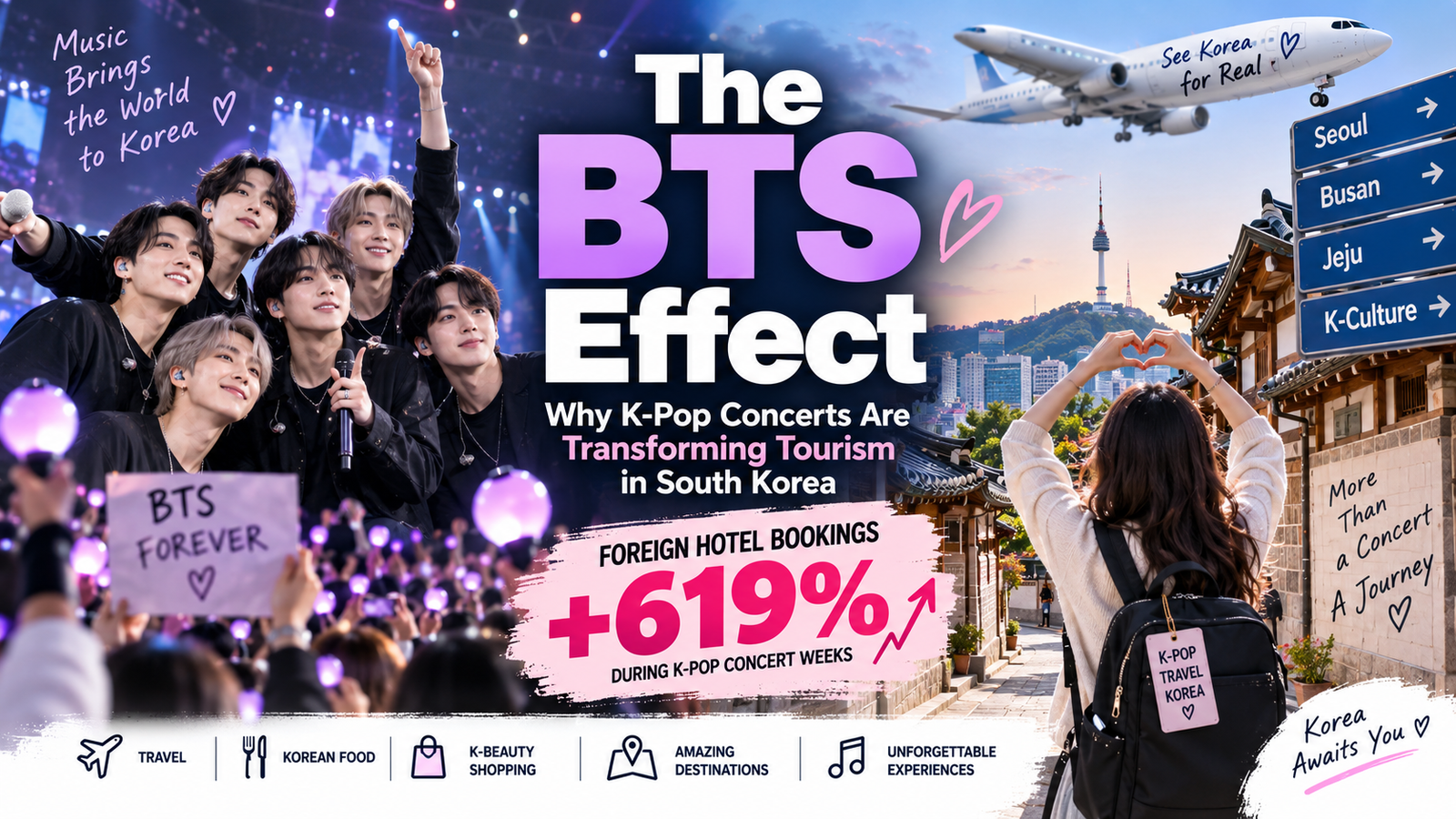
According to an analysis by the Korea Tourism Organization, accommodation bookings by foreign visitors surged 619.2% during weeks featuring concerts by three major K-pop acts compared with non-concert weeks in the dataset.
And BTS provides perhaps the clearest example yet of what happens when global fandom turns into actual travel.
Welcome to the new era of K-pop tourism in South Korea.
The BTS Effect Is Bigger Than a Concert
When BTS returned to the stage in South Korea in 2026, thousands of international ARMYs traveled to the country.
But Korea’s Ministry of Culture, Sports and Tourism wanted to know something beyond concert attendance:
What did those fans do after they arrived?
Together with the Korea Culture & Tourism Institute and Korea Tourism Organization, the ministry surveyed concertgoers and analyzed mobile-network and credit-card data surrounding BTS performances in Seoul and Goyang.
The results were remarkable.
Foreign visitors who attended BTS’s March 21 Gwanghwamun performance stayed in South Korea for an average of:
8.7 days
and spent approximately:
KRW 3.53 million per person.
By comparison, the average international visitor during the first quarter of 2026 stayed 6.1 days and spent approximately KRW 2.45 million.
In other words, BTS concert visitors stayed about 2.6 days longer and spent roughly KRW 1.08 million more per person than the average international tourist.
That changes the way we should think about a K-pop concert.
It is not simply a three-hour entertainment event.
For international fans, it can become the anchor around which an entire Korean vacation is built.
73.6% Came to Korea Primarily Because of BTS
There is an even more important number.
Among foreign visitors surveyed around BTS’s Gwanghwamun performance:
73.6% said the BTS event was their primary reason for visiting South Korea.
Another 17.4% were already visiting Korea for another purpose and added the event to their trip.
Think about what that means.
Without the concert, many of those international visitors might not have booked:
a flight to Korea,
a hotel room,
airport transportation,
restaurant meals,
shopping trips,
or visits to Korean attractions.
The concert created the trip.
This is why the phrase “BTS Effect” is more than fan language.
It increasingly describes a measurable tourism phenomenon.
BTS Fans Didn’t Just Attend the Concert and Go Home
The Goyang concerts provide an even clearer picture.
International fans attending BTS’s Goyang shows stayed in Korea for an average of 7.4 days and spent approximately KRW 2.91 million per person.
And they traveled well beyond the stadium.
Visitors connected their concert trips with places such as:
Yongsan
Myeongdong
Dongdaemun Design Plaza (DDP)
and the National Museum of Modern and Contemporary Art.
These destinations were linked to the broader “BTS THE CITY Seoul” experience surrounding the performances.
This is exactly why K-pop matters so much to tourism.
A concert may last several hours.
But the trip surrounding it can last more than a week.
One BTS Concert Area Saw Foreign Spending Jump 38-Fold
Perhaps the most dramatic evidence comes from the neighborhood surrounding the Goyang concert venue.
The Korea Tourism Organization compared mobile and card data around Daehwa-dong, where the concerts took place, with the same period a year earlier.
During the three BTS concert days, foreign visitors increased from 1,397 to 48,581.
That’s approximately:
35 times more foreign visitors.
Foreign card spending in the area increased from approximately KRW 8.9 million to KRW 337.8 million.
That’s roughly:
38 times more spending.
These numbers show why cities around the world compete aggressively to host major concerts.
The economic impact does not stop at the ticket booth.
It reaches:
hotels,
restaurants,
cafés,
convenience stores,
taxis,
subways,
shopping centers,
tourist attractions
and local businesses.
Then Came an Even Bigger Number: 619%
BTS is not an isolated case.
A newer Korea Tourism Organization analysis examined accommodation behavior surrounding major events.
The results suggest that the concert-tourism effect extends across K-pop.
During weeks featuring concerts by BTS, BLACKPINK and Stray Kids in the analyzed data, accommodation bookings increased dramatically.
Domestic bookings rose around 99.4%.
But bookings by foreign visitors increased by approximately:
619%
compared with non-concert periods in the analysis.
That number deserves attention.
Fans are not merely streaming Korean music from Los Angeles, Tokyo, Paris, Bangkok or London.
Increasingly, they are getting on airplanes.
K-Pop Has Changed the Meaning of a “Tourist Attraction”
Traditionally, tourism promotion centered around physical landmarks.
For Korea, that meant places such as:
Gyeongbokgung Palace,
Bukchon Hanok Village,
N Seoul Tower,
Jeju Island,
or Haeundae Beach.
Those places remain important.
But younger international travelers increasingly build trips around something less traditional.
They want to visit places connected to Korean culture they already love.
A café visited by an idol.
A music-video filming location.
A neighborhood featured in Korean entertainment.
A pop-up store.
A concert venue.
A K-pop agency district.
A restaurant associated with an artist.
A beauty store selling products used by Korean celebrities.
The tourist attraction is no longer always a monument.
Sometimes the attraction is a connection to a story, artist or fandom.
Why K-Pop Fans Often Stay Longer
Traditional sightseeing trips can be surprisingly short.
A visitor might spend three or four days checking off famous attractions and then leave.
Fandom tourism works differently.
Imagine flying to Seoul for a Saturday concert.
You may arrive several days early because international travel is expensive and you don’t want to risk missing the event.
Then you discover that your favorite group has:
a pop-up event,
a merchandise store,
a themed café,
a photo exhibition,
or related attractions elsewhere in the city.
After the concert, you might add another few days for Korean food, shopping and sightseeing.
Suddenly, a concert weekend becomes:
a seven- or eight-day Korea vacation.
The BTS data shows exactly this pattern.
Where Do K-Pop Fans Go in Korea Beyond the Concert?
This is where K-pop tourism becomes particularly interesting for first-time visitors.
You don’t have to spend your entire vacation searching for idol-related locations.
The best K-pop trip combines fandom with Korea itself.
Here are several places that fit naturally into that itinerary.
1. Hongdae
Hongdae is one of Seoul’s most energetic neighborhoods.
Street performances, cafés, fashion, nightlife and music culture make it especially popular with younger travelers.
For a K-pop fan visiting Korea for the first time, Hongdae is one of the easiest places to experience contemporary Seoul.
2. Myeongdong
Myeongdong remains one of the most convenient areas for international visitors.
You can combine:
K-beauty shopping,
Korean street food,
restaurants,
fashion
and easy transportation.
BTS concert visitors were also observed traveling to Myeongdong during their wider Korea itinerary.
3. Yongsan
Yongsan has become increasingly relevant to K-pop travelers.
The area combines major transportation connections, shopping and proximity to entertainment-related destinations.
It also appeared among locations visited by international BTS concertgoers.
4. Dongdaemun Design Plaza
DDP is one of Seoul’s most recognizable modern landmarks.
It frequently hosts exhibitions, pop-ups, fashion events and cultural programs.
Its late-night surroundings also make it easy to combine sightseeing with shopping and food.
5. Seongsu
If you want to understand modern Korean pop culture beyond music, visit Seongsu.
The neighborhood has become known for:
brand pop-ups,
fashion,
cafés,
beauty launches
and collaborations involving celebrities and entertainment brands.
It represents another important part of contemporary Korean youth culture.
6. The Han River
Not everything needs to be a paid attraction.
One of the simplest Seoul experiences is spending an evening along the Han River.
Buy convenience-store food, order Korean fried chicken, sit by the river and watch Seoul slow down after sunset.
For international visitors who first discovered Korea through highly produced music videos and dramas, ordinary experiences like this often become some of the most memorable moments of the trip.
And K-Pop Tourism Is Moving Beyond Seoul
This may ultimately be the most important change.
Historically, international tourism to Korea has been heavily concentrated in Seoul.
But recent tourism data shows foreign travelers are increasingly exploring other regions.
The share of international visitors staying outside the greater Seoul region rose from 39.5% to 43%, according to the recent tourism analysis.
Growth was particularly notable in destinations including:
Busan
Jeju
Andong
and Gyeongju.
K-pop can accelerate that trend.
If a major concert takes place outside central Seoul, thousands of international fans suddenly need:
accommodation,
transportation,
food,
shopping
and things to do nearby.
A concert can therefore become a gateway to regional Korea.
Busan May Be the Perfect Example
For many international visitors, Busan is already Korea’s obvious second destination after Seoul.
It offers something completely different:
beaches,
seafood,
traditional markets,
mountains,
coastal temples,
night views
and a more relaxed atmosphere.
K-pop events can give travelers the initial reason to visit.
But once they arrive, places such as:
Haeundae,
Gwangalli,
Jagalchi Market,
Gamcheon Culture Village
and Haedong Yonggungsa Temple
turn a concert trip into a broader Korean travel experience.
This is the real tourism value of K-pop.
Music gets people onto the plane.
Korea gives them reasons to stay.
K-Pop Is Also Selling Korean Food
There is another powerful effect that tourism statistics alone don’t fully capture.
Fans often arrive in Korea already familiar with Korean food.
They have seen idols eating:
tteokbokki,
ramyeon,
samgyeopsal,
fried chicken,
gimbap,
kimchi jjigae
and Korean convenience-store food.
So when they finally visit Korea, eating those foods can feel like participating in the culture they have followed from abroad.
This is one reason K-pop tourism connects naturally with food tourism.
A fan who travels to Korea for BTS may return home remembering the concert.
But they may also remember:
their first Korean barbecue dinner,
late-night fried chicken,
tteokbokki from a street stall,
or convenience-store ramyeon eaten beside the Han River.
That emotional connection is extremely powerful.
K-Pop Also Leads Travelers Into K-Beauty
The same phenomenon occurs with Korean beauty.
K-pop fans are constantly exposed to:
Korean skincare,
makeup,
fashion,
hairstyles
and beauty trends.
Once they arrive in Korea, stores in Myeongdong, Hongdae, Gangnam and Seongsu become part of the tourism experience.
This is why the economic value of Korean popular culture extends far beyond music sales.
One song can eventually influence spending on:
travel,
hotels,
restaurants,
beauty,
fashion,
transportation
and entertainment.
That is the larger K-Culture economy.
K-Pop Tourism Is Different From Ordinary Celebrity Tourism
Celebrity tourism is not new.
People have always traveled to see musicians.
But K-pop has several characteristics that make the effect unusually powerful.
First, K-pop fandoms are highly organized internationally.
Fans communicate through social media and online communities across national borders.
When a concert is announced, information about:
tickets,
flights,
hotels,
transportation,
restaurants
and fan events
can spread globally within hours.
Second, K-pop provides a constant stream of content between concerts.
Music videos, livestreams, variety shows, social media, documentaries and fan platforms create continuous engagement.
For many international fans, Korea does not feel like a completely unfamiliar country by the time they arrive.
They have already been experiencing parts of Korean culture digitally for years.
The physical trip becomes the final step of a relationship that began online.
From “Korean Wave” to “Travel to Korea”
For years, people talked about the Korean Wave — Hallyu — primarily in terms of exports.
Korean music was exported.
Korean dramas were exported.
Korean movies were exported.
Korean beauty products were exported.
But something more interesting is now happening.
Instead of Korean culture only traveling overseas, overseas consumers are traveling to Korea.
That represents a major change.
A Spotify stream generates one type of economic value.
A tourist who flies to Korea and stays for eight days generates something completely different.
They may buy:
airfare,
accommodation,
concert tickets,
food,
transportation,
cosmetics,
fashion,
souvenirs
and additional travel experiences.
The BTS tourism data makes this difference visible.
What This Means for Someone Planning a Korea Trip
If you are considering traveling to Korea for a K-pop concert, there is one piece of advice worth remembering:
Don’t make the concert your entire trip.
Make it the beginning.
If your concert is in Seoul or Goyang, consider spending several days exploring Seoul before or after the event.
Then add another destination.
For example:
Days 1–4: Seoul Day 5: K-pop concert Days 6–7: Seoul neighborhoods and shopping Days 8–9: Busan or Gyeongju
Even a shorter trip can combine K-pop with Korean food, history and everyday culture.
And that is often where the best memories happen.
The BTS Effect May Be Showing Us the Future of Korean Tourism
The most interesting thing about the BTS tourism data isn’t simply that BTS is popular.
We already knew that.
What matters is what fans do because of that popularity.
They cross borders.
They stay longer.
They spend more.
They explore neighborhoods.
They eat Korean food.
They shop for Korean products.
And increasingly, they travel beyond Seoul.
Government data showed foreign visitors around BTS’s Goyang concert increased about 35-fold, while their card spending increased about 38-fold compared with the same period a year earlier.
More recent tourism data found foreign accommodation bookings surging roughly 619% during selected major K-pop concert weeks.
Those aren’t streaming numbers.
They represent people physically moving around Korea.
Final Thoughts: They Come for BTS — But They Discover Korea
Perhaps the simplest way to understand K-pop tourism is this:
Fans may buy the plane ticket because of BTS.
But BTS isn’t necessarily what they remember most about every day of the trip.
They may remember eating grilled pork with friends in Seoul.
Getting lost on the subway.
Walking along the Han River at night.
Buying skincare in Myeongdong.
Discovering a tiny restaurant they had never seen on TikTok.
Taking the KTX to Busan.
Seeing the Korean coastline for the first time.
That is where K-pop’s tourism power becomes much larger than music.
K-pop gives millions of people a reason to become curious about Korea.
And once they arrive, Korea itself becomes the experience.
That may be the real BTS Effect — not simply selling more concert tickets, but turning global music fans into travelers who want to experience the country behind the music.
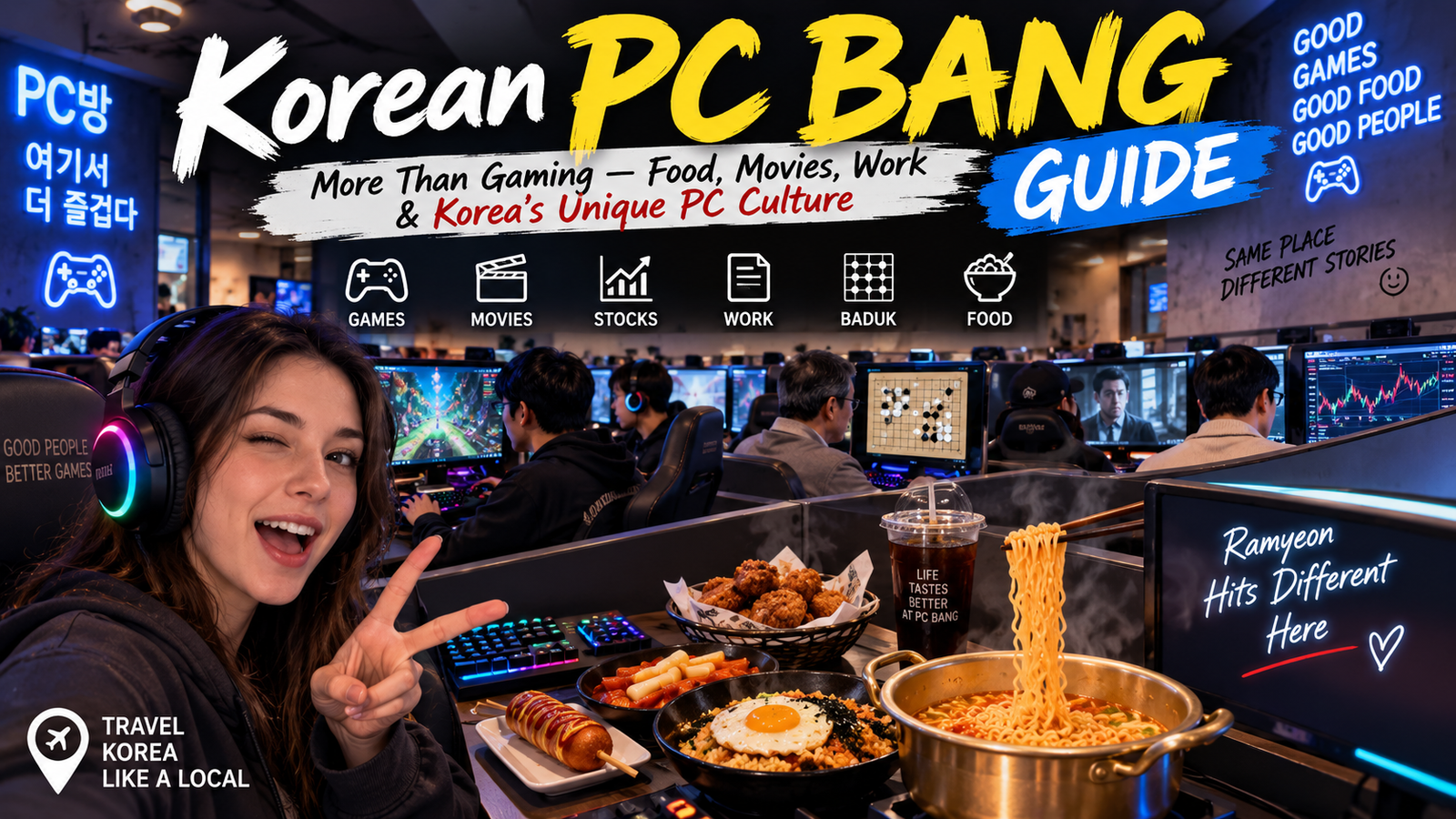
When most foreigners hear the words “Korean PC Bang,” they imagine one thing:
Gamers.
Rows of young people playing League of Legends, Valorant, PUBG or other online games on powerful computers.
That image isn’t wrong.
But it is incomplete.
Walk into a PC bang in Korea and you may find someone playing an intense online game at one desk.
At another, an older customer may be playing online baduk, the Korean game of Go.
Someone else may be watching a movie.
Another person may be checking stock prices.
Someone may be working on a document.
And somewhere nearby, someone who barely cares about games may be eating a bowl of ramyeon or kimchi fried rice.
That is what makes the Korean PC bang interesting.
You don’t have to be a gamer to experience one.
For travelers who want to see how Koreans actually spend their everyday lives—not just visit palaces and famous tourist attractions—a PC bang can be one of the most surprisingly authentic experiences in Korea.
What Is a Korean PC Bang?
The word “bang” (방) means “room” in Korean.
So PC bang literally means:
“PC room.”
But translating it as an “internet café” doesn’t really capture what it is.
In many countries, an internet café is simply a place where you pay to use a basic computer and internet connection.
A modern Korean PC bang can be very different.
You may find:
powerful gaming PCs,
high-refresh-rate monitors,
gaming keyboards and mice,
large monitors,
comfortable chairs,
fast internet,
hundreds of installed games,
food and drinks,
and ordering systems built directly into the computer.
Some premium locations even offer private or group rooms.
Korea Tourism Organization describes PC bangs as affordable spaces with high-quality equipment, comfortable seating and food, and notes that they provide travelers with a glimpse into everyday Korean gaming culture.
But gaming is only the beginning.
PC Bangs Are Part of Everyday Korean Life
Korea’s PC bang culture developed alongside the country’s rapid broadband expansion and the rise of competitive online gaming.
Games such as StarCraft helped turn PC bangs into social spaces where people could meet friends and compete together.
Eventually they became closely connected with Korea’s enormous esports culture.
Today, however, the PC bang has evolved into something broader.
Think of it as a place where you rent:
a powerful computer + a comfortable chair + fast internet + your own digital space
for a certain amount of time.
That makes it useful for many different people.
Who Actually Uses Korean PC Bangs?
1. Gamers
Obviously, gamers remain the biggest group.
League of Legends is particularly visible, but depending on the location you may see people playing everything from FPS games and MMORPGs to strategy and casual games.
Playing at a PC bang also has a social element.
Friends may sit beside each other and play as a team instead of playing alone at home.
That is part of why PC bangs remain relevant even though almost everyone in Korea has internet access.
2. People Playing Baduk and Board Games Online
Not every person staring seriously at a monitor is playing an action game.
You may find older customers playing baduk (바둑), known internationally as Go, or other online board and card games.
This is an interesting side of PC bang culture that foreign travelers may not expect.
The customers aren’t necessarily all teenagers or esports fans.
Different generations can use the same space in very different ways.
3. People Watching Movies, YouTube or Sports
A large monitor, headphones, fast internet and a comfortable chair also make a PC bang a convenient place to watch videos.
Some people use them to watch:
movies,
YouTube,
streaming content,
sports,
or esports broadcasts.
If you have time to kill before a train or appointment, renting a computer for an hour can be surprisingly convenient.
4. People Checking Stocks and Crypto
You may also occasionally see people staring at charts instead of games.
Korea has an enormous community of individual investors.
So PC bangs can also be used for checking stock markets, financial news or cryptocurrency prices when someone needs access to a computer away from home.
Of course, travelers should be careful when logging into sensitive financial accounts on any shared computer.
5. People Working
Need to edit a document?
Download a file?
Send an email?
Search for information?
Deal with something that is annoying to do on a phone?
A PC bang can solve the problem.
Seoul’s official tourism guide has long noted that PC bangs can also be used for email and other practical computer tasks.
For a traveler whose laptop is back at the hotel—or who didn’t bring one at all—that can be useful.
6. People Who Come for the Food
And then there is perhaps the most surprising customer.
The person who comes partly because they want to eat.
Yes.
PC bang food has become a culture of its own.
And this deserves an entire section.
PC Bang Food: The Surprise Most Foreigners Don’t Expect
Imagine walking into an internet café and seeing a menu containing:
ramyeon,
tteokbokki,
kimchi fried rice,
rice bowls,
fried chicken,
dumplings,
hot dogs,
French fries,
coffee,
smoothies,
and desserts.
That is possible in Korea.
Some PC bangs have evolved so far beyond packaged snacks that their food menu looks like a small casual restaurant.
Korea Tourism Organization even highlights PC bang food as part of the experience; examples at gaming venues include ramyeon and kimchi fried rice, while other PC cafés offer items such as tteokbokki, fried chicken-and-mayo rice and hot dogs.
Menus vary enormously by location, so don’t expect every PC bang to sell everything listed below.
But these are some foods worth looking for.
10 PC Bang Foods You Should Try in Korea
1. Ramyeon — 라면
If you try only one PC bang food, make it ramyeon.
Few things feel more Korean-PC-bang than playing a game while eating steaming Korean instant noodles.
Depending on the location, you may be able to add:
egg
cheese
tteok (rice cakes)
or other toppings.
And unlike simply buying a cup of noodles from a convenience store, many PC bangs prepare the noodles for you.
2. Kimchi Fried Rice — 김치볶음밥
This is one of the safest choices for someone who wants an actual meal.
Warm rice stir-fried with kimchi is filling, inexpensive and easy to eat at the computer.
Some places add an egg or other toppings.
Korea Tourism Organization specifically features kimchi fried rice among foods available at gaming venues.
3. Tteokbokki — 떡볶이
Spicy rice cakes are another classic Korean comfort food.
If you’ve already tried street-market tteokbokki, ordering it inside a PC bang gives you a completely different setting for the same iconic food.
And if you’ve read our Korean food guides, this is another chance to see how deeply tteokbokki is woven into everyday Korean life.
4. Jjapagetti / Jjajang-style Noodles
Black-bean-flavored instant noodles are perfect computer food.
They’re savory, filling and easy to eat while watching something or playing a game.
Some places add egg, cheese or meat.
5. Rice Bowls — 덮밥
PC bangs with larger kitchens may offer surprisingly substantial rice dishes.
Popular variations can include things like:
chicken mayo,
spicy pork,
bulgogi-style meat,
or other toppings over rice.
At T1 Base Camp, for example, Korea Tourism Organization has highlighted a chicken-and-mayonnaise rice dish among the player-inspired menu choices.
6. Dumplings — 만두
Fried or steamed dumplings are ideal if you want a snack rather than a full meal.
They’re also easy to share if you’re visiting with a friend.
7. Sotteok-Sotteok — 소떡소떡
This is a fun one for first-time visitors.
Sausage + rice cake + sausage + rice cake on a skewer, usually finished with sauce.
It’s strongly associated with Korean snack culture and is also found on some PC bang menus.
8. Hot Dogs & Fried Snacks
Depending on the PC bang, you may see:
hot dogs,
French fries,
fried chicken,
chicken skewers,
fried dumplings,
and other quick snacks.
This is where the distinction between “internet café” and “mini restaurant with computers” starts getting blurry.
9. Toast & Simple Snacks
If you’re not very hungry, look for toast, packaged snacks or simple baked items.
They’re easy to eat without interrupting whatever you’re doing.
10. Iced Americano — 아이스 아메리카노
And finally:
coffee.
In Korea, the iced Americano is practically an everyday companion.
PC bangs are no exception.
If you see Koreans gaming late at night with a giant plastic cup beside the keyboard, there’s a good chance coffee is involved.
The Best Part: Order Food Without Leaving Your Computer
This is the part foreign visitors should experience at least once.
You don’t necessarily walk up to a counter to order your food.
At many PC bangs, there is a food-ordering menu directly on the computer.
You click the food icon.
Browse the menu.
Choose your ramyeon or fried rice.
Place the order.
Then continue using the computer.
A little later:
your food arrives at your desk.
A recent guide for foreign residents describes exactly this process: customers can open the food-order menu from the PC, choose dishes such as ramyeon, sotteok-sotteok or kimchi fried rice, and staff deliver the order directly to the seat. Payment method varies by location.
For Koreans, this feels normal.
For many first-time foreign visitors, it can be one of the most memorable parts of the experience.
How to Use a Korean PC Bang: Step by Step
If you’ve never visited one, don’t worry.
It is usually easier than it looks.
Step 1 — Find a PC Bang
Search Korean map services for:
PC방
You’ll find them almost everywhere in major cities.
In Seoul, areas around universities, nightlife districts and busy subway stations tend to have plenty.
Step 2 — Enter and Look for the Kiosk
Many modern PC bangs use self-service kiosks.
You’ll usually see options for members and non-members.
If you’re visiting Korea temporarily, look for something similar to:
Non-member / Guest / 비회원
A recent 2026 foreigner guide notes that many kiosks allow non-members to purchase time using cash or card and receive temporary login information.
The exact system differs by business.
Step 3 — Buy Some Time
PC bangs normally charge according to time.
Prices vary by location, equipment and whether you’re a member.
For reference, Korea Tourism Organization currently lists T1 Base Camp in Seoul at ₩2,000 per hour for members and ₩3,000 for non-members, although this is a premium branded location and should not be treated as a nationwide standard.
For a tourist, buying just an hour or two is enough to experience the culture.
Always check the current price at the specific location.
Step 4 — Choose a Seat
Depending on the system, you may select a seat at the kiosk or take an available seat and log in.
Some premium locations have different sections.
You may see:
regular seats,
premium seats,
FPS gaming seats,
dual-monitor seats,
or private/group rooms.
For example, the Gen.G GGX gaming complex in Dongdaemun includes dedicated FPS seating, dual-monitor areas, premium rooms and team rooms.
Can Foreigners Use Korean PC Bangs?
Generally, yes.
Korea Tourism Organization notes that many internet cafés are foreigner-friendly and that English-language guidance may be available.
However, there is an important difference between:
using the PC
and
accessing every Korean online game.
Some Korean games or Korean servers may require a Korean game account or identity verification.
So don’t assume that every locally installed game can automatically be played by a tourist.
If you already use Steam or another international gaming service, bringing your own account may make things easier.
And remember:
Always log out before you leave.
This applies especially to:
email,
social media,
cloud storage,
Steam,
financial services,
and any other personal account.
Do not save passwords on a public computer.
What If You Don’t Play Games?
This is actually one of my favorite reasons to recommend a PC bang to travelers.
Don’t play games?
That’s fine.
Try this instead.
Buy one hour.
Sit down.
Order a bowl of ramyeon and an iced Americano.
Watch YouTube.
Look up tomorrow’s travel route.
Write your travel journal.
Check your photos.
Watch an esports match.
Or simply observe what the people around you are doing.
You are still experiencing Korean PC bang culture.
That’s because the PC bang isn’t interesting only because of the computer.
It’s interesting because of how Koreans use the space.
A Great Place When Korea’s Weather Turns Bad
There’s another practical reason tourists should remember PC bangs.
Imagine you’re in Seoul and suddenly:
it starts pouring,
it’s freezing outside,
the summer heat becomes unbearable,
or you have two hours before meeting someone.
Instead of sitting in another café, try a PC bang.
You get a chair, computer, internet, entertainment and food under one roof.
Some locations operate 24 hours, although hours vary and travelers should always check the individual business before visiting. Major gaming venues such as T1 Base Camp and Gen.G GGX are currently listed by Korea Tourism Organization as operating 24 hours.
Want a Premium PC Bang Experience? Try an Esports-Themed Venue
If you’re a serious esports fan, Seoul has some particularly interesting options.
T1 Base Camp
Fans of League of Legends will immediately recognize the name T1 and its legendary player Faker.
T1 Base Camp in Hongdae combines a PC bang with premium gaming rooms, merchandise and esports culture.
Korea Tourism Organization currently lists it as open 24 hours and highlights menu items inspired by T1 players, including T1 Ramyeon and chicken-mayo rice.
This is less like randomly entering a neighborhood PC bang and more like visiting an esports attraction.
Gen.G GGX
Another interesting option is Gen.G GGX, near Dongdaemun Design Plaza.
The complex combines high-end gaming equipment, esports merchandise and Korean food.
There are FPS seats, dual-monitor setups, premium rooms and team rooms.
Its food space even includes Korean dishes such as bibim ramyeon and kimchi fried rice.
For an international esports fan, this could easily become part of a Seoul itinerary.
PC Bang Etiquette for Foreign Visitors
You don’t need to know complicated rules.
But a few things help.
Keep your voice reasonable. Excited gamers can certainly be noisy, but that doesn’t mean you need to shout across the room.
Don’t touch someone else’s equipment.
Keep food around your own desk area.
Use headphones.
Check whether your seat type costs extra.
Don’t leave your personal accounts logged in.
And if you’re unsure about something, asking the staff politely is perfectly fine.
Useful Korean Words at a PC Bang
Korean
Meaning
PC방
PC bang
비회원
Non-member
회원
Member
자리
Seat
시간
Time
먹거리
Food/snacks
주문
Order
라면
Ramyeon
김치볶음밥
Kimchi fried rice
떡볶이
Tteokbokki
만두
Dumplings
아이스 아메리카노
Iced Americano
Even knowing 비회원 (non-member) can make your first visit easier.
The Perfect 1-Hour PC Bang Experience for a Tourist
If you’re visiting Korea and don’t know what to do, try this simple challenge.
Minute 0–10
Find a good-looking PC bang and purchase one hour as a non-member.
Minute 10–15
Choose your seat and explore the computer.
Minute 15
Open the food menu.
Order:
Ramyeon + Iced Americano
or
Kimchi Fried Rice + a drink.
Minute 20–50
Play a game, watch something, check your travel plans or simply browse the internet.
Eat your food at the computer like a local.
Minute 50–60
Take a final look around.
You’ll probably notice that the people surrounding you aren’t all doing the same thing.
And that’s the point.
PC Bang vs. Regular Café: What’s the Difference?
Korean PC Bang
Regular Café
High-performance PC
Usually no PC
Pay mainly for computer time
Buy drinks/food
Gaming
Usually not
Movies/videos
Possible on PC
Work
Possible
Food delivered to your seat
Counter/table service
Ramyeon & fried rice
Café-style menu
Gaming peripherals
No
Late-night options common
Depends on café
Esports culture
No
A café is still better if you want sunlight, conversation and coffee.
But if you need a computer—or simply want to experience a very Korean digital environment—the PC bang wins.
PC Bang, Jjimjilbang, Noraebang: Understanding Korea’s “Bang Culture”
There’s also a larger cultural idea here.
Korea has many spaces whose names end in bang (방):
PC bang — computer room
noraebang — singing room
jjimjilbang — Korean sauna/bathhouse complex
The experiences are completely different, but together they reveal something interesting about modern Korean leisure culture.
Instead of always meeting in large public spaces, Koreans have developed many specialized spaces where people can spend time around a particular activity.
For travelers, experiencing these spaces can sometimes teach you more about everyday Korea than checking another famous landmark off a list.
Why a PC Bang Belongs on Your Korea Itinerary
You can see beautiful palaces in Korea.
You can visit Buddhist temples.
You can walk along the Han River.
You can watch a KBO baseball game.
All of those are worthwhile.
But if you want to understand modern Korea, spend an hour in a PC bang too.
Because modern Korea isn’t only ancient palaces, K-pop and Korean barbecue.
It is also:
ultra-fast internet,
online games,
esports,
late-night digital culture,
individual investors watching charts,
people working at computers,
friends playing together,
and someone eating spicy ramyeon while staring intensely at a glowing monitor.
That is Korea too.
Final Thoughts: You Don’t Have to Be a Gamer
This is the most important thing to remember.
You don’t have to love games to enjoy a Korean PC bang.
Go because you’re curious.
Go because it’s raining.
Go because you need a computer.
Go because you want to see where Korea’s gaming culture lives.
Or go simply because you want to order ramyeon from a computer and have someone bring it to your desk.
For many tourists, the most memorable moments in Korea aren’t necessarily the famous attractions.
Sometimes they are the ordinary things Koreans barely think about anymore.
A neighborhood market.
Ramyeon beside the Han River.
A late-night convenience store.
A baseball crowd singing together.
Or a glowing PC bang at midnight.
If your goal is to experience Korea like a Korean rather than only see Korea like a tourist, a PC bang deserves at least one hour of your trip.