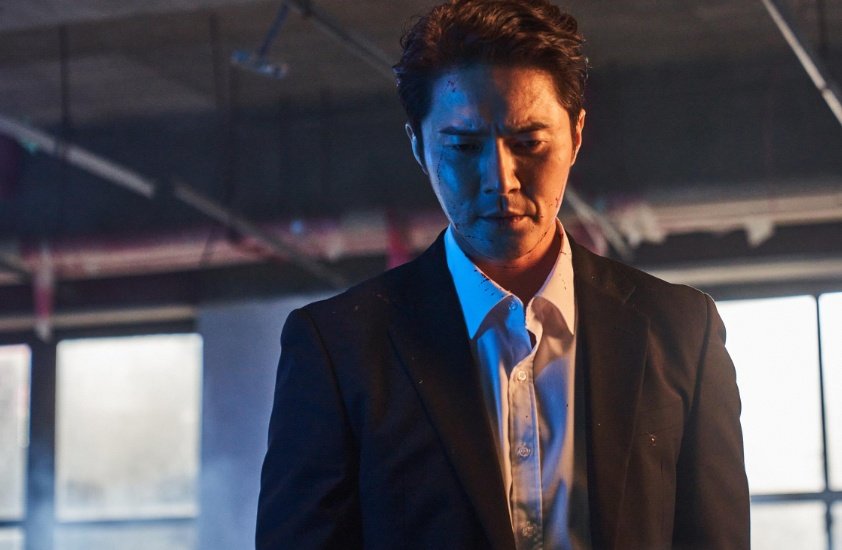
The Goblin (2022) is a South Korean action noir about two men whose relationship is destroyed by ambition, betrayal, and the legacy of violence. One man was the original Goblin, a feared fixer who sacrificed ten years of his life for someone he considered a brother. The other took his place—and became terrified when the real Goblin returned.
But the film’s central conflict is not simply about which gangster is stronger. It is about what happens when a man who once lived through violence tries to build a peaceful life, only to discover that his old identity still has power over everyone around him.
Here is the story, the characters, and the ending of The Goblin explained.
1. What Is The Goblin (2022) About?
Directed by Kim Hee-sung, The Goblin is a 2022 South Korean action film starring Jo Dong-hyeok, Lee Wan, and Im Jung-eun.
The story follows Doo-hyun, a legendary criminal fixer known as the Goblin. After taking the blame for a crime committed by Young-min, a man he once trusted like a brother, Doo-hyun spends ten years in prison.
During his absence, Young-min takes over the organization and begins using the Goblin’s name.
When Doo-hyun is released, Young-min realizes that the man whose identity he stole may still be more dangerous than he is.
2. Who Is the Real Goblin?
Doo-hyun is the original Goblin, a feared enforcer associated with the Baekjeong criminal organization.
His reputation was built on violence and the ability to handle situations that other gang members could not. He was not simply another gangster. He was the person whose name alone could create fear.
That reputation becomes important after his imprisonment.
Even when Doo-hyun is no longer physically present, the name Goblin continues to influence the organization. Young-min can occupy his position, but he cannot automatically inherit the fear and authority that Doo-hyun created.
3. Why Did Doo-hyun Go to Prison for Young-min?
The relationship between Doo-hyun and Young-min is the foundation of the entire story.
They were close enough that Doo-hyun was willing to accept responsibility for Young-min’s crime. The official synopsis describes Young-min as someone who was like a brother to him.
Doo-hyun’s decision costs him ten years of freedom.
The sacrifice creates an enormous imbalance between the two men. Doo-hyun loses a decade of his life, while Young-min gets the opportunity to move upward in the criminal organization.
The tragedy is not merely that one man betrays another. It is that the person who receives the sacrifice eventually uses it as an opportunity to take the other man’s identity.
4. How Did Young-min Become the New Goblin?
With Doo-hyun out of the picture, Young-min takes control of the organization and begins acting as the Goblin.
But there is an important difference between possessing a title and deserving it.
Young-min can occupy Doo-hyun’s position, command other gang members, and benefit from the reputation attached to the name. However, the original Goblin remains a threat as long as he is alive.
Young-min’s power therefore depends on Doo-hyun staying away.
His position is built on the absence of the man who made the name valuable in the first place.
5. Why Is Young-min Afraid of Doo-hyun’s Release?
Young-min’s anxiety reveals the weakness beneath his authority.
If he truly believed he had become the new Goblin, Doo-hyun’s release should not have frightened him so much.
But Young-min knows that his position is connected to a past betrayal. He also knows that Doo-hyun has a legitimate claim to the identity and reputation he has taken.
The return of the original Goblin threatens more than Young-min’s position. It threatens the story he has built about himself.
That is why Young-min decides to strike first.
6. Why Did Doo-hyun Want a Normal Life?
After ten years in prison, Doo-hyun is no longer interested in returning to his former position.
He wants to live quietly with his daughter, Yena, and his wife, Ji-young.
This change is central to understanding his character.
The old Doo-hyun was feared because he was willing to use violence. The new Doo-hyun wants to protect his family without returning to that world.
However, leaving a criminal organization does not mean that the organization has forgotten him.
His past continues to follow him, even when he tries to live like an ordinary father.
7. Who Are Yena and Eun-ju?
Yena is Doo-hyun’s daughter. Eun-ju is Young-min’s daughter.
The two girls attend the same school, creating an unexpected connection between the families.
Their relationship becomes the bridge between the old conflict involving the fathers and the new conflict involving their children.
The adults’ history of betrayal and violence begins affecting the next generation.
This is where the film shifts from a conventional gangster rivalry into a story about two fathers whose actions threaten the safety of their own children.
8. What Happens Between Yena and Eun-ju at School?
A serious incident occurs between the two girls.
Eun-ju pushes Yena, and Yena suffers a serious head injury. The incident creates a crisis for both families.
Instead of allowing the situation to be handled calmly, Young-min becomes increasingly suspicious of Doo-hyun.
Doo-hyun’s attempt to understand what happened to his daughter is interpreted as a possible threat.
The misunderstanding turns a school incident into a dangerous confrontation between two men who already have a history of distrust.
9. Why Does Young-min Target Doo-hyun’s Family?
Young-min believes that Doo-hyun’s return could threaten everything he has gained.
Rather than confronting the past honestly, he treats Doo-hyun as an enemy who must be eliminated.
The situation becomes even more dangerous when the daughters are drawn into the conflict.
Young-min’s decision to use family members as leverage shows how far he has moved away from the brother-like relationship the two men once shared.
He is no longer simply trying to protect his position. He is willing to endanger innocent people to keep it.
10. Why Does Doo-hyun Become the Goblin Again?
Doo-hyun’s return to violence is not motivated by a desire to reclaim his old status.
His daughter is in danger, and the peaceful life he tried to build has been destroyed by the very world he wanted to leave.
This distinction matters.
Doo-hyun does not return because he misses being feared. He returns because the people threatening his family understand only the language of violence.
The Goblin is therefore not just a nickname. It is the identity Doo-hyun must revive when ordinary life is no longer enough to protect the people he loves.
11. What Does the Title The Goblin Mean?
The English title The Goblin refers to the feared identity associated with Doo-hyun.
The Korean title, Pineun Mulboda Jinhada (피는 물보다 진하다), literally means “Blood Is Thicker Than Water.”
The two titles emphasize different parts of the story.
The Goblin focuses on the legendary criminal identity that Young-min wants to possess and Doo-hyun once embodied.
Blood Is Thicker Than Water points toward the family relationships that eventually become more important than the rivalry between the two men.
The contrast is revealing: the men spend much of the film fighting over a criminal name, while their daughters become the reason they must reconsider what truly matters.
12. Why Does the Final Confrontation Take Place at the Furniture Factory?
The conflict eventually leads to a final confrontation at a furniture factory, where Yena is being held.
Doo-hyun fights his way through Young-min’s men to reach his daughter.
The factory becomes the setting for the final test of the Goblin’s reputation. Young-min has spent years acting as the man who replaced Doo-hyun, but now he must face the original directly.
The confrontation is not simply about organizational power anymore.
For Doo-hyun, the immediate goal is to rescue Yena. For Young-min, the encounter is the collapse of the identity he has tried to build.
13. Who Wins the Fight Between Doo-hyun and Young-min?
Doo-hyun proves to be the stronger fighter.
After defeating the men sent against him, he finally confronts Young-min directly. Young-min cannot match the original Goblin and eventually ends up kneeling before him.
The physical result reinforces the central idea of the film: Young-min could imitate the Goblin’s position, but he could not truly replace the man behind the name.
However, the victory is not presented as a simple celebration.
Doo-hyun has been pulled back into a violent world, and the consequences of that return cannot be erased just because he wins the fight.
14. What Happens to the Daughters at the End?
The daughters are ultimately rescued from the conflict.
The ending shifts attention away from the men’s struggle for dominance and toward the children who have been caught in it.
Doo-hyun and Young-min have spent years defining themselves through the criminal world. Their daughters, however, have no responsibility for the choices their fathers made.
The rescue of the girls gives the story a different emotional destination from a conventional gangster revenge film.
The most important victory is not simply defeating an enemy. It is preventing the next generation from being permanently trapped in the same conflict.
15. The Goblin Ending Explained: Why Do the Two Fathers Walk Together?
The final image of the two fathers walking together can seem surprising after so much violence.
It should not necessarily be read as proof that the betrayal has been forgiven or that the men have returned to their former friendship.
A more useful interpretation is that the film shifts the focus from their old criminal identities to their shared responsibility as fathers.
Both men have daughters. Both have seen how their choices can endanger their children. And both have been forced to confront the consequences of allowing their past to control the present.
Their final movement together suggests a temporary recognition of that shared responsibility.
The title’s meaning becomes clearer here: blood relationships and family responsibilities matter more than the criminal name that once defined them.
16. Is There a Post-Credits Scene in The Goblin (2022)?
There is no reliably documented post-credits scene in the sources available for this article.
If you watched the film for a sequel clue, there is no confirmed additional scene that establishes a continuation of Doo-hyun and Young-min’s story.
The ending works primarily as a conclusion to the conflict between the two men and their families.
Final Verdict: Is The Goblin Worth Watching?
The Goblin is a compact Korean action noir built around a familiar but accessible premise: a legendary gangster tries to leave violence behind, only to be dragged back by the man who stole his identity.
Its strongest hook is the contrast between the real Goblin and the man who wants to become him.
The film’s story also introduces a family dimension through the two daughters, giving the conflict a reason to move beyond a simple fight for criminal authority.
Viewers looking for an elaborate crime saga may find the plot familiar. But those interested in Korean action films about betrayal, fatherhood, and the return of a feared figure may find the central conflict worth exploring.
The real question is not whether Young-min can become the Goblin. It is whether Doo-hyun can stop being one before the violence destroys the family he wants to protect.