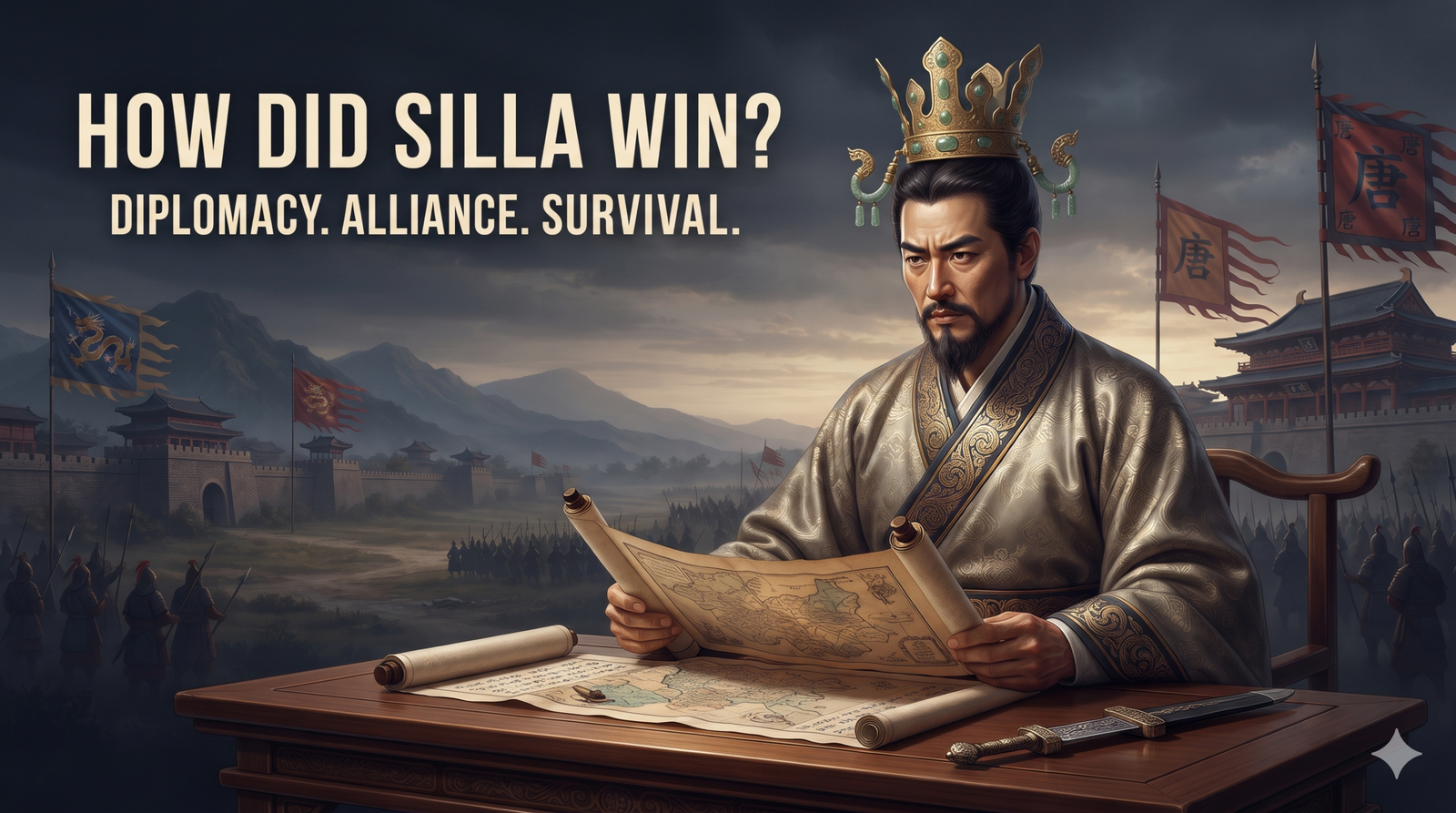
How Kim Chun-chu Turned Diplomacy into a Survival Strategy, Why Tang China Joined the War, and How an Alliance Became a New Enemy
What does a relatively small kingdom do when it is surrounded by stronger enemies?
It can attempt to defeat them through military strength. It can seek protection from a more powerful neighbor. Or it can recognize something that its enemies may not fully understand: the balance of power between great kingdoms can sometimes create opportunities for a smaller state to survive.
This is the strategic problem at the heart of the seventh-century Korean Peninsula.
The Netflix historical drama Sword & Silence (Munmu) begins against a background of prolonged warfare among Silla, Baekje, and Goguryeo. Its story introduces a period when Silla faced serious military pressure, Goguryeo experienced an internal political upheaval, and Tang China was seeking to expand its influence across East Asia.
At the center of this situation stands Kim Chun-chu, the Silla leader who pursued an alliance with Tang.
But the familiar explanation—that Silla joined forces with Tang and eventually unified the Three Kingdoms—does not tell the whole story.
The more interesting question is why Silla made that decision, what Tang expected in return, and how Silla responded when its powerful ally began to threaten its own independence.
The history of Silla’s unification is not simply a story of military victory.
It is a story about strategic dependence, diplomatic calculation, political timing, and the difficult art of surviving beside a powerful ally.
1. The Small Kingdom That Could Not Afford to Fight Everyone
To understand Silla’s strategy, we first need to understand its position.
During the seventh century, the Korean Peninsula was divided among three major kingdoms.
Goguryeo occupied extensive territories in the north, including important areas of Manchuria. Baekje controlled the southwestern part of the peninsula and maintained important maritime and diplomatic connections. Silla was based in the southeast.
These kingdoms were not equal in territory, military resources, or strategic position.
Silla faced pressure from both Baekje and Goguryeo. Its geographical position also created serious difficulties when it attempted to communicate or coordinate with distant allies.
The problem was not simply that Silla had fewer soldiers.
It was that fighting one enemy could expose it to another.
A kingdom surrounded by potential adversaries cannot make military decisions independently of geography. Every campaign carries the possibility of opening another front.
This is the first important point behind Silla’s eventual strategy.
Silla needed more than a battlefield victory. It needed to change the political environment in which it was forced to fight.
Its survival depended on preventing its enemies from combining their advantages against it.
2. The Fall of Daeya Fortress Changed Silla’s Political Calculations
One of the most important events preceding the Silla-Tang alliance occurred in 642.
Baekje captured Daeya Fortress, an important Silla stronghold.
The defeat was not merely a loss of territory. It created a serious political and psychological crisis within Silla.
Kim Chun-chu also suffered a deeply personal loss connected with the fall of Daeya. His daughter and son-in-law were among those killed.
But the significance of the event extended beyond personal tragedy.
Silla’s existing security arrangements were no longer sufficient to protect its important territories. The kingdom needed to reconsider how it would deal with the surrounding powers.
Kim Chun-chu subsequently pursued diplomatic efforts, including an attempt to obtain assistance from Goguryeo.
That approach did not produce the support Silla needed.
The failure helped push Silla toward a different diplomatic direction.
This is an important distinction: the alliance with Tang was not simply the result of a leader who suddenly decided to cooperate with a powerful empire.
It emerged from a deteriorating security situation in which other options had become increasingly difficult.
A serious defeat can force a state to reconsider its entire foreign policy.
For Silla, Daeya was one of those turning points.
3. Kim Chun-chu Understood That Silla Needed to Change the Structure of the Conflict
A weaker country often faces a dangerous temptation.
When it loses a battle, it may respond by concentrating even more resources on military expansion. But if its opponents possess greater manpower and resources, simply increasing military expenditure may not solve the underlying problem.
Kim Chun-chu’s diplomatic strategy offered another possibility.
Instead of confronting every threat directly, Silla could connect its security interests with those of a powerful external state.
This would not eliminate the military imbalance. It would change the conditions under which the imbalance mattered.
Tang China had its own conflict with Goguryeo. Silla could therefore present its struggle against neighboring kingdoms as part of a larger strategic problem facing Tang.
The interests were not identical, but they overlapped.
That overlap created an opportunity for cooperation.
The deeper lesson is that diplomacy is not always about persuading another country to share your values.
Sometimes it is about demonstrating that helping you serves its own interests.
Kim Chun-chu’s diplomatic achievement was to make Silla’s survival relevant to Tang’s wider strategic calculations.
4. Why Tang China Was Interested in Silla
It would be a mistake to imagine that Tang joined Silla simply because it wanted to rescue a smaller kingdom.
Tang was an expanding empire with its own ambitions.
Its relationship with Goguryeo had already become increasingly hostile. Tang Taizong launched a major campaign against Goguryeo in 645, but the campaign failed to achieve its ultimate objective.
Goguryeo’s defensive strength made direct conquest difficult.
In this context, Silla possessed considerable strategic value.
It occupied territory south of Goguryeo and could potentially provide military pressure from another direction.
Silla was therefore more than a kingdom requesting assistance.
It was a possible strategic partner positioned near one of Tang’s principal military objectives.
This distinction helps explain why the alliance became attractive to both sides.
Silla wanted protection and territorial security.
Tang wanted a more favorable strategic position against Goguryeo and greater influence over the Korean Peninsula.
They could cooperate because their interests temporarily overlapped.
But overlapping interests are not the same as permanent trust.
That difference would eventually become the central problem of the alliance.
5. The Alliance Was Not a Gift. It Was a Negotiation Between Unequal Partners
Kim Chun-chu’s diplomatic mission to Tang in 648 was a decisive stage in the relationship.
His objective was to secure military support and establish a more dependable relationship with the Tang court.
The negotiations involved more than a general promise of friendship.
They concerned military cooperation, the sequence of campaigns, and the arrangement of territories after victory.
Research published in the Korean Journal of Classics Studies examines the formation of the Silla-Tang alliance and emphasizes the importance of these negotiations.
It also discusses the diplomatic arrangements involving Kim Chun-chu and Tang Taizong.
There is an important historical nuance here: scholarship differs over the precise dating and stages of the alliance’s formal establishment. The diplomatic mission and negotiations are associated with 648, while one study identifies 649 as the point at which the alliance was formally established.
For a deeper understanding, the important issue is not simply the date.
It is that Silla was negotiating the terms of cooperation rather than merely accepting an unconditional promise of protection.
Kim Chun-chu had to secure an agreement that could turn Tang’s military ambitions into an opportunity for Silla.
The alliance was therefore a political bargain between unequal states.
And unequal bargains always contain a question:
What happens when the stronger partner decides that the agreement no longer serves its interests?
6. Silla Accepted a Degree of Dependence Because Independence Was Already Under Threat
One of the most revealing aspects of the alliance was the extent to which Silla adjusted its relationship with Tang.
Kim Chun-chu accepted elements of Tang’s political and diplomatic system.
He requested Tang-style official clothing, and his son Kim In-mun remained at the Tang court as a member of the imperial guard.
Silla also adopted Tang’s era-name system.
These decisions were not merely ceremonial details.
They signaled a political relationship in which Silla was willing to demonstrate loyalty and accommodate the expectations of a powerful empire.
From one perspective, these concessions could be interpreted as a loss of independence.
From another, they were the price of securing a strategic partnership that Silla urgently needed.
This is where the story becomes more complicated than a simple celebration of national pride.
A state under pressure may have to accept limitations in one area to preserve its survival in another.
The question is whether those limitations remain manageable.
Silla was accepting a degree of dependence because it believed the alternative was more dangerous.
But the arrangement contained a long-term risk: Tang might eventually interpret cooperation as an opportunity to exercise greater control.
7. The Most Important Strategic Decision Was to Make Baekje the First Target
The Silla-Tang relationship did not immediately produce a campaign against Goguryeo.
The coalition first concentrated on Baekje.
This decision made strategic sense.
Baekje had been a major source of military pressure against Silla. Removing that threat would improve Silla’s security and create a more favorable position for the next stage of the conflict.
For Tang, the destruction of Baekje also provided a useful strategic base for further operations on the peninsula.
The campaign was therefore beneficial to both partners, although their longer-term objectives were not identical.
In 660, Silla and Tang launched their joint attack on Baekje.
The political situation inside Baekje was also important.
By the later years of King Uija’s reign, internal divisions among the nobility had weakened the kingdom’s ability to respond effectively.
The Silla-Tang offensive exploited this unfavorable situation.
Baekje fell, but its destruction did not end resistance.
Restoration movements continued, demonstrating that conquering a capital and establishing stable control over a territory are two very different achievements.
This distinction is essential to understanding what happened next.
Silla had helped destroy a powerful rival.
But it had not yet secured the political future it wanted.
8. The Fall of Baekje Created a New Problem for Silla
The destruction of Baekje should have been an enormous strategic success for Silla.
One of its principal enemies had been removed.
Yet the disappearance of Baekje also changed the balance of power between Silla and Tang.
During the campaign, the two kingdoms had shared a common enemy.
After victory, they had to decide what would happen to the conquered territory.
And their expectations were not the same.
Silla wanted to secure the former Baekje territories as part of its own political and territorial expansion.
Tang, however, established its own administrative presence in the conquered region and sought to maintain direct influence.
The disagreement was not a minor diplomatic misunderstanding.
It exposed the fundamental weakness of the alliance.
Silla had entered the partnership to improve its security and expand its strategic position.
Tang had entered it to advance its own imperial objectives.
As long as their interests overlapped, cooperation was possible.
Once the question of territorial control became unavoidable, the differences became much harder to ignore.
The alliance had succeeded militarily but had not resolved the question of who would control the victory.
9. Tang Was Not Simply Helping Silla Unify the Peninsula
This is one of the most important points that overseas audiences should understand.
The traditional simplified narrative can make it appear that Tang entered the conflict primarily to assist Silla in unifying the Three Kingdoms.
But Tang had its own imperial vision.
It wanted to weaken Goguryeo, establish influence over the former Baekje territory, and strengthen its position in the eastern part of its international order.
Research examining the unification process from Tang’s perspective shows that Tang’s objectives involved territorial claims and an expanding imperial conception of political authority.
This matters because it changes how we interpret the alliance.
Tang was not necessarily a loyal partner whose interests were identical to Silla’s.
It was an empire using a regional conflict to advance its own strategic position.
Silla, meanwhile, was trying to use Tang’s military strength without allowing the empire to determine the future of the peninsula.
Both sides were attempting to benefit from the same partnership.
But only one of them possessed the resources of a continental empire.
That imbalance made Silla’s diplomatic position extremely difficult.
10. Why Did Silla Continue Cooperating With Tang After Baekje Fell?
If Tang was already asserting control over the former Baekje territories, why did Silla not immediately abandon the alliance?
The answer lies in the remaining threat.
Goguryeo was still standing.
It remained a formidable military power, and Tang’s campaign against it had not yet succeeded.
Silla could not easily fight Tang and Goguryeo simultaneously.
Even if the relationship with Tang had become uncomfortable, the alliance still offered military advantages against a dangerous neighboring kingdom.
This illustrates an important principle of strategic decision-making.
A country cannot always choose between an ideal partner and an ideal opponent.
Sometimes it must work with a difficult partner because the immediate alternative is worse.
Silla’s continued cooperation with Tang was therefore not necessarily evidence that it had abandoned its own interests.
It reflected the reality that the strategic situation had not yet changed enough to make a direct confrontation possible.
The disappearance of one common enemy did not automatically eliminate the need to confront the other.
Silla had to manage the timing of its next move.
11. Goguryeo’s Internal Crisis Changed the Balance of Power
Goguryeo had repeatedly resisted major military campaigns from Sui and Tang China.
Its defensive capabilities were formidable, and the failure of Tang Taizong’s 645 campaign demonstrated the difficulty of conquering the kingdom.
But military strength does not guarantee permanent political stability.
In 666, Yeon Gaesomun died.
His death was followed by a struggle among his sons.
The conflict weakened the political cohesion of Goguryeo at a moment when Tang was preparing another major offensive.
Yeon Namsaeng, the eldest son, was driven out and eventually surrendered to Tang.
Other nobles and local forces also became dissatisfied with the existing political order.
Tang exploited these internal divisions.
The fall of Goguryeo in 668 was therefore not simply the result of Tang possessing a larger army.
It was also connected to the breakdown of Goguryeo’s internal political structure.
This is a crucial distinction.
A state may survive repeated external attacks as long as its internal political system remains sufficiently coordinated.
But when succession struggles and elite divisions weaken that structure, even a powerful military can become vulnerable.
Goguryeo’s final crisis illustrates how external pressure and internal fragmentation can reinforce each other.
12. The Fall of Goguryeo Did Not Complete Silla’s Victory
By 668, both Baekje and Goguryeo had fallen to the Silla-Tang coalition.
At first glance, this appears to be the successful conclusion of the alliance.
But the disappearance of the two kingdoms removed the common enemy that had held Silla and Tang together.
Their disagreement over territory now became an open strategic conflict.
Tang sought to maintain control over former Baekje and Goguryeo territories.
Silla wanted to secure the peninsula’s southern and central regions under its own authority.
The question was no longer how to defeat the same enemy.
It was who would inherit the political space left behind.
This is the moment when the original purpose of the alliance became fundamentally different for each partner.
Silla had wanted to use Tang’s military power to overcome its regional disadvantages.
Tang had wanted to use Silla’s cooperation to strengthen imperial control.
Their victory created the conditions for confrontation.
In other words, the alliance’s greatest success also produced its greatest crisis.
13. Silla Had to Fight the Power It Had Previously Invited
Around 670, the Silla-Tang conflict developed into open warfare.
The fighting was not simply a sudden betrayal by one side.
It was the result of competing territorial objectives that had been present throughout the alliance.
Tang sought to maintain control over conquered regions, while Silla resisted the expansion of Tang authority on the peninsula.
Silla now faced an extraordinarily difficult situation.
It had cooperated with Tang to defeat Baekje and Goguryeo.
But it could not accept a settlement in which Tang became the dominant power over the territories Silla hoped to incorporate.
The military conflict that followed required Silla to change its strategic approach.
It was no longer enough to cooperate with a stronger empire.
Silla had to demonstrate that it could resist that empire when its own political survival was at stake.
This is the most important transformation in the story.
The country that had once sought external assistance was now fighting to prevent its former ally from becoming its new ruler.
14. Silla’s Strategy Was Not to Defeat Tang Everywhere
It is easy to interpret the Silla-Tang War as a simple confrontation between a small kingdom and a giant empire.
But this misses the strategic conditions that shaped the outcome.
Tang possessed enormous resources, but it also faced challenges beyond the Korean Peninsula.
Its western frontier became increasingly unstable, particularly as conflict with the Tibetan Empire intensified.
This placed additional demands on Tang’s military resources.
Silla did not need to destroy the Tang Empire.
It needed to make the cost of maintaining control over the peninsula sufficiently high, while exploiting opportunities created by Tang’s wider strategic commitments.
This is an important difference between defeating an enemy and changing an enemy’s calculation.
A smaller state may not possess the capacity to win a total war against a great power.
But it may possess enough military strength, geographic advantage, and political determination to prevent the great power from achieving its objectives.
Silla’s resistance was therefore not just a test of military courage.
It was also a struggle over the costs and limits of imperial expansion.
15. The Final Victory Was a Combination of Military Resistance and International Circumstances
The fighting continued through the 670s.
Silla achieved important victories against Tang forces in 675 and 676.
Tang eventually withdrew its forces from the peninsula, and Silla secured control over the region south of Pyongyang.
This outcome is sometimes described simply as the unification of the Three Kingdoms.
But a more precise historical explanation is necessary.
Silla did not absorb every former Goguryeo territory.
The northern regions remained outside its control, and the later emergence of Balhae in 698 further demonstrates that the political history of the former Goguryeo world did not end in 668.
Silla’s achievement was substantial, but it was not the complete unification of every territory once associated with the Three Kingdoms.
It established a new political order over a large part of the peninsula.
Its success was made possible by military resistance, diplomatic calculation, Tang’s strategic difficulties elsewhere, and the ability to adapt when the original alliance became dangerous.
No single explanation is sufficient.
16. Was Kim Chun-chu’s Alliance a Masterstroke or a Dangerous Gamble?
It is tempting to describe Kim Chun-chu as a brilliant strategist who foresaw the entire sequence of events.
But history rarely offers such simple certainty.
He could not have known every consequence of the alliance.
He could not guarantee that Tang would honor every expectation.
Nor could he fully control the political changes that would follow the deaths of major rulers and generals.
What he could do was recognize that Silla’s existing position was dangerous and that diplomatic cooperation offered an opportunity to change it.
His strategy involved accepting risks that could not be completely eliminated.
This is what makes his decision historically significant.
A diplomatic alliance is not successful merely because it produces an immediate military victory.
Its real value must be judged by whether the country can protect its interests when the partner’s objectives begin to diverge.
Kim Chun-chu helped create the conditions for Silla’s rise.
But the later struggle against Tang demonstrates that the alliance required a second stage of strategy—one that depended on resistance rather than cooperation.
The achievement was not simply making an alliance.
It was the ability of Silla’s political leadership to recognize when that alliance had become a threat.
17. The Difference Between Winning a War and Building a State
The fall of Baekje and Goguryeo did not automatically create a stable unified political system.
Silla had to govern territories with different political traditions, elites, populations, and military experiences.
It also needed to incorporate people who had previously fought against it.
This required more than battlefield success.
Silla gradually reorganized its administrative structure and incorporated members of the former Baekje and Goguryeo ruling classes into its political system, although not on equal terms with the established Silla aristocracy.
It also organized military and administrative structures that included people from the newly incorporated territories.
This is an important part of the unification process that is often overlooked in stories focused on kings and generals.
A military campaign can destroy a rival state.
But only political institutions can turn conquered territories into a functioning state.
The real test of victory begins after the battlefield becomes quiet.
Silla’s postwar policies demonstrate that the process of unification involved governing, integrating, and managing the consequences of conquest.
18. Was Silla’s Victory Really a Victory of Diplomacy?
The answer is yes, but only partly.
Diplomacy allowed Silla to bring Tang into the conflict and alter the balance of power.
Without that partnership, the military situation would have been significantly more difficult.
However, diplomacy alone could not secure the final outcome.
Silla also needed military capacity, internal political coordination, and the ability to resist Tang after the alliance broke down.
The final result came from the interaction of several factors:
- Diplomatic cooperation with Tang.
- The strategic weakening of Baekje and Goguryeo.
- Internal political divisions within rival kingdoms.
- Silla’s military resistance against Tang.
- Tang’s competing strategic commitments elsewhere.
- Silla’s ability to establish political control over newly acquired territories.
This is why the phrase “diplomatic victory” should not be treated as a complete explanation.
Diplomacy opened the opportunity.
Military action changed the balance.
Political organization made the victory sustainable.
Silla needed all three.
19. The Hidden Cost of Silla’s Strategy
There is another side to this story.
The destruction of Baekje and Goguryeo involved enormous human suffering.
Cities were destroyed, political communities collapsed, and people who had once belonged to independent kingdoms were forced to adapt to a new order.
The language of unification can make these events appear inevitable or universally beneficial.
But historical unification is rarely experienced in the same way by everyone involved.
For Silla’s ruling class, the outcome represented a major expansion of power.
For the people of the conquered kingdoms, it could mean the loss of political independence and the restructuring of their social world.
This does not erase the strategic achievement of Silla.
It reminds us that the success of a state and the experience of its population are not always identical.
A serious analysis of Sword & Silence should therefore avoid treating unification as a simple story in which one kingdom was destined to win.
The outcome was shaped by decisions, conflicts, and sacrifices.
And those decisions had consequences far beyond the royal court.
20. The Most Important Lesson: A Powerful Ally Can Become the Greatest Threat
The story of Silla offers a strategic lesson that extends beyond the seventh century.
A smaller state may need a powerful ally to survive.
But the stronger partner will always have its own objectives.
The alliance may be mutually beneficial at one moment and deeply unequal at another.
The challenge is not simply to secure assistance.
It is to preserve enough independent capacity to act when the partner’s interests change.
Silla’s relationship with Tang demonstrates this difficult balance.
At first, Tang’s military power helped Silla overcome its immediate security crisis.
Later, the same power threatened Silla’s territorial ambitions and political independence.
The alliance did not fail because cooperation had been meaningless.
It became dangerous because the conditions that made cooperation possible had changed.
This is perhaps the most revealing strategic theme behind Sword & Silence.
The central question is not whether Silla was strong enough to defeat all its enemies.
It is whether Silla’s leaders understood that survival required different strategies at different moments.
First, they needed diplomacy.
Then, they needed military cooperation.
Finally, they needed the courage and capacity to resist the empire they had once invited.
That sequence is what makes the history of Silla’s rise so compelling.
Final Thought: Silla Did Not Win by Remaining the Same
The rise of Silla is often remembered through the achievements of great leaders, decisive battles, and the eventual establishment of Unified Silla.
But the deeper story is about strategic adaptation.
Silla recognized that it could not solve every problem through military strength alone. It used diplomacy to change the balance of power, accepted an unequal alliance when necessary, and later resisted the same partner when cooperation threatened its future.
This was not a perfect strategy, and its consequences were not universally positive.
But it reveals an important distinction between a state that merely survives and one that learns how to change its position.
The most important question raised by Sword & Silence is therefore not simply how Silla defeated its rivals.
It is this:
How did a kingdom that needed a powerful empire to survive eventually find the strength to prevent that empire from controlling its future?
The answer lies in the difficult relationship between diplomacy, military power, and political independence.
And that is the real strategy behind Silla’s rise.