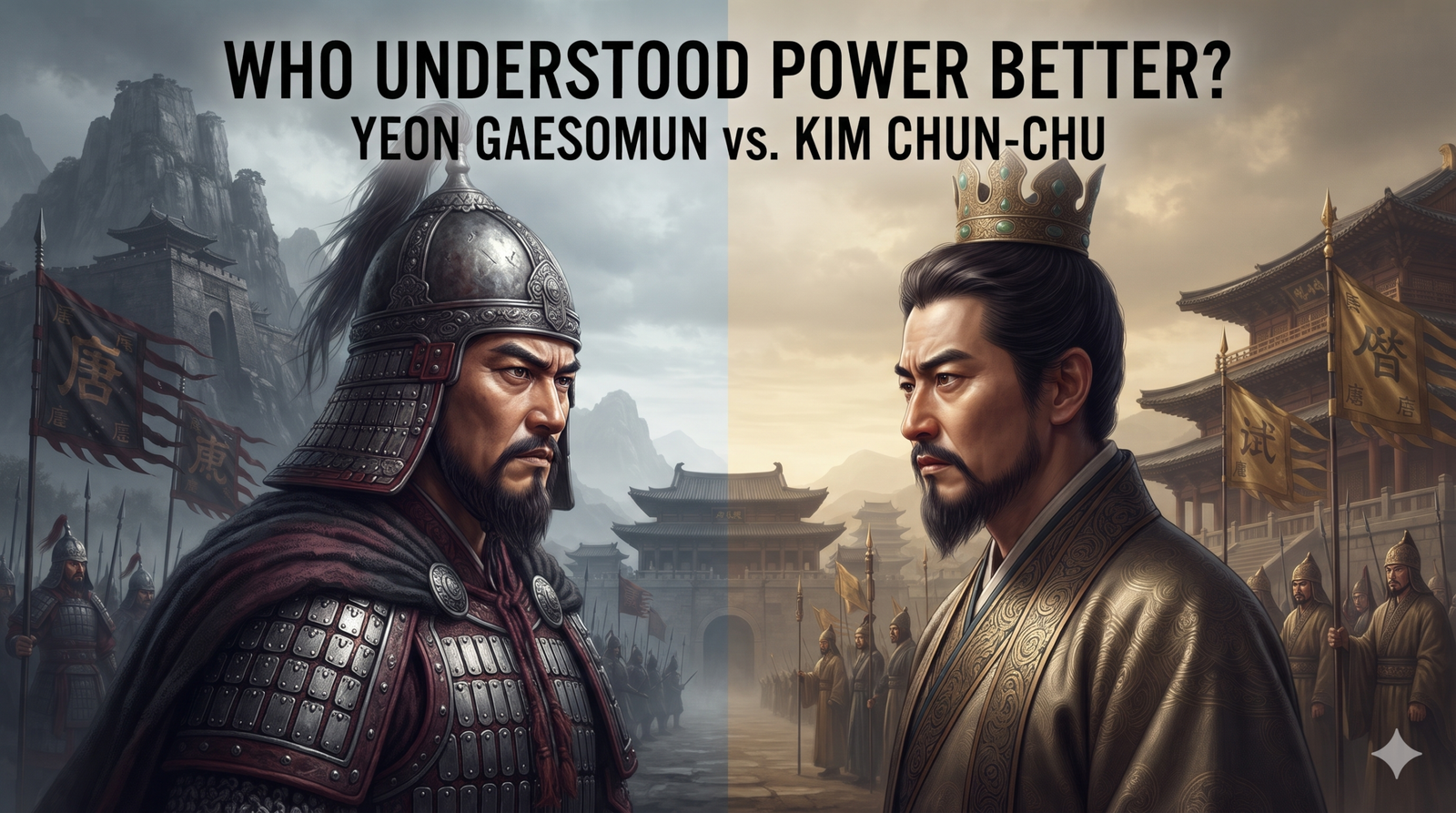
• Yeon Gaesomun vs. Kim Chun-chu: Who Understood Power Better?

    Yeon Gaesomun vs. Kim Chun-chu: Who Understood Power Better?

    One seized control through political force. The other expanded his kingdom’s options through diplomacy, royal authority, and institutional change. Their different approaches reveal why controlling a state and strengthening a state are not necessarily the same achievement.

    1. Two Leaders, Two Different Ideas of Power

    In the final decades of the Three Kingdoms period, two powerful figures helped shape the political future of the Korean Peninsula: Yeon Gaesomun of Goguryeo and Kim Chun-chu of Silla.

    They are often compared as opposing leaders. Yeon is remembered as the powerful military and political figure who dominated Goguryeo, while Kim is associated with the diplomatic strategy that eventually helped Silla defeat Baekje and Goguryeo.

    But this comparison becomes more interesting when we move beyond military victories and defeats.

    The deeper question is not simply which man possessed greater ambition or courage. It is how each understood the relationship between personal authority, political institutions, military power, and national survival.

    Yeon believed that strong leadership required the ability to control the political center and confront external threats. Kim increasingly pursued a different approach: building alliances, strengthening royal authority, and changing the structures through which Silla governed itself.

    Their careers reveal two different ways of responding to a dangerous international environment.

    2. Yeon Gaesomun: A Political Rise Built on Conflict

    Yeon Gaesomun emerged from one of the most powerful aristocratic families in late Goguryeo.

    His rise took place during a period of political tension between King Yeongnyu, influential aristocratic groups, and political forces associated with Yeon.

    In 642, Yeon launched a coup that resulted in the deaths of King Yeongnyu and numerous political opponents. He subsequently became the dominant figure in Goguryeo’s government.

    Traditional accounts often present this event as a straightforward struggle between a strong military commander and a weak king. However, the actual political background was more complicated.

    Modern historical research has questioned several details concerning Yeon’s early career, political position, and the precise circumstances that led to the coup.

    A 2025 study by historian Choi Hee-soo specifically revisits Yeon’s family background and early official positions, emphasizing that surviving historical records contain conflicting information.

    This matters because Yeon’s rise should not be reduced to a simple story of an ambitious general taking power.

    It was also a turning point in the relationship between Goguryeo’s monarchy and its aristocratic political structure.

    3. What Did Yeon Actually Gain by Taking Power?

    A successful coup can remove political opponents, but it also creates a new problem.

    The person who takes power must establish why others should continue to obey him.

    Yeon achieved extraordinary political influence. He could direct major military and political decisions without relying on the authority of the king in the traditional sense.

    Yet the structure of his power remained fundamentally different from an established hereditary monarchy.

    He was not simply replacing one king with another. He was creating a political arrangement in which his own authority became central to the operation of the state.

    This brought immediate advantages.

    • Political decisions could be concentrated around a powerful leader.
    • Military resistance could be organized under a dominant command structure.
    • Opponents within the ruling elite could be controlled or marginalized.
    • The government could pursue a more unified policy toward external threats.

    However, centralizing authority also created a long-term question:

    Could the political system remain stable when the person holding the greatest power was no longer alive?

    Yeon’s leadership demonstrated the advantages of personal control. It did not automatically solve the problem of transferring that control to the next generation.

    4. A Strong Leader Is Not Automatically a Strong Institution

    This distinction is essential to understanding Goguryeo’s final decades.

    A leader may be capable of making rapid decisions, controlling military commanders, and suppressing internal opposition.

    But institutions perform a different function.

    They allow a state to continue operating even when its most influential individual disappears.

    A political system becomes vulnerable when too many responsibilities depend on one person’s relationships, authority, and ability to manage competing groups.

    This does not mean that Goguryeo had no functioning institutions or that Yeon’s government was entirely dependent on him.

    It means that the concentration of political authority around the Yeon family made the question of succession particularly important.

    The strength of a political leader must therefore be evaluated through two separate questions:

    1. How effectively could he control the state during his lifetime?
    2. How successfully could the political structure survive after his death?

    These questions would become increasingly important in the final years of Goguryeo.

    5. Kim Chun-chu: Power Through Political Relationships

    Kim Chun-chu followed a very different path.

    He was a member of Silla’s royal family and possessed the political background necessary to participate in the kingdom’s highest levels of government.

    But his rise was not simply the result of royal birth.

    He developed relationships with influential political figures, participated in diplomatic missions, and gradually became central to Silla’s response to the growing military pressure from Baekje and Goguryeo.

    The fall of Daeya Fortress in 642 was particularly important.

    The defeat exposed Silla’s strategic vulnerability and increased the urgency of securing external support.

    Kim’s diplomatic activities became an important part of Silla’s survival strategy.

    Unlike Yeon, who consolidated his position through a dramatic internal seizure of power, Kim expanded his political influence through a combination of aristocratic relationships, royal service, diplomacy, and institutional development.

    His approach did not eliminate political competition.

    Instead, it gradually changed the balance of power within Silla.

    6. Kim’s Diplomacy Was Also a Strategy for Domestic Political Change

    It is easy to interpret Kim Chun-chu’s relationship with Tang China as a purely military decision.

    Silla needed assistance against its enemies, and Tang possessed the military resources that could help change the balance of power.

    But there was another dimension.

    Kim’s diplomatic relationship with Tang also provided opportunities to strengthen Silla’s political institutions and royal authority.

    A study published in the Historical Vistas journal in 2025 examines Kim Chun-chu’s leadership in social integration and diplomatic strategy. It highlights the relationship between his political activities, marriage alliances, and the broader challenge of integrating Silla’s society.

    This suggests that his political strategy should not be understood only through the battlefield.

    He was also working within a kingdom where aristocratic influence and royal authority had to be carefully balanced.

    The external alliance and the internal political structure were connected.

    Kim’s diplomacy helped Silla obtain military opportunities, but it also formed part of a wider effort to reorganize the state.

    7. The Difference Between Controlling People and Building Cooperation

    Yeon and Kim approached political relationships differently.

    Yeon’s authority became concentrated around his personal leadership and the military-political structure he controlled.

    Kim’s strategy depended more heavily on managing relationships among different political forces.

    This distinction should not be exaggerated into a simple contrast between dictatorship and democracy.

    Neither man operated within a modern democratic political system.

    Both were leaders in an aristocratic society where military power, family background, political alliances, and royal legitimacy shaped the distribution of authority.

    Nevertheless, their methods were different.

    Yeon’s political position was strengthened by his ability to dominate the existing power structure.

    Kim’s position grew through his ability to work within Silla’s political environment while gradually reshaping it.

    One approach emphasized direct control.

    The other emphasized the management of relationships and institutions.

    Neither method was free from risk.

    8. The Most Important Difference: Their Relationship With the Monarchy

    Yeon’s rise fundamentally altered the relationship between Goguryeo’s king and the actual holder of political power.

    After the 642 coup, King Bojang occupied the throne, but Yeon became the dominant political figure.

    This arrangement allowed Goguryeo to retain its monarchy while concentrating much of the practical authority in the hands of another individual.

    Kim Chun-chu, by contrast, eventually became king himself.

    He ascended the throne in 654 as King Muyeol.

    His political influence therefore developed toward the strengthening of royal authority rather than the establishment of a separate power center above the king.

    This difference was more than a matter of personal ambition.

    It reflected the different political structures within which the two men operated.

    For Yeon, power was built through control over the political center without replacing the monarchy.

    For Kim, political power increasingly became associated with the king himself and the institutions supporting royal government.

    That distinction would have consequences beyond their individual careers.

    9. Why Kim Chun-chu Needed More Than Military Victories

    Kim’s political challenge was not simply to defeat Baekje.

    Silla had to become capable of mobilizing resources, coordinating military operations, managing aristocratic interests, and maintaining political unity.

    Military victories could create new territory, but territory alone did not guarantee a stronger state.

    The government also needed administrative systems capable of managing that territory.

    Kim’s earlier diplomatic contact with Tang exposed him to a different political and administrative environment.

    The development of Silla’s government during the reigns of Queen Seondeok, Queen Jindeok, and King Muyeol involved changes in official structures and political organization.

    The establishment of the National Confucian Academy, Gukhak, in 682 occurred after Kim’s death under King Sinmun, so it should not be presented as an institution he personally established.

    However, earlier administrative developments and the influence of Tang institutions were part of the broader political transformation associated with Kim’s diplomatic activities.

    His strategy was therefore not limited to obtaining foreign troops.

    It was connected to the question of how Silla could become a more capable governing state.

    10. Yeon’s Military Leadership: A Different Kind of Strength

    Yeon Gaesomun’s reputation was closely connected to Goguryeo’s military resistance against Tang.

    Tang China under Emperor Taizong was one of the most powerful states in East Asia.

    Its military campaigns against Goguryeo represented an enormous threat.

    Goguryeo’s ability to resist Tang’s attacks demonstrated that the kingdom possessed significant defensive capabilities, military organization, and strategic resources.

    Yeon’s leadership became associated with that resistance.

    But we should be careful about assigning every military achievement exclusively to one individual.

    Goguryeo’s defensive strength had developed over generations. Its fortresses, terrain, military traditions, and experienced commanders all contributed to its ability to withstand external attacks.

    Yeon’s contribution must be understood within this larger system.

    A leader can direct a military response, but he does not personally create every resource that makes resistance possible.

    This is an important distinction when comparing historical leaders.

    The achievements of a state should not be confused with the achievements of one man.

    11. Was Yeon’s Political Control a Source of Strength or a Hidden Weakness?

    The answer may be both.

    A concentrated leadership structure can be extremely effective during a crisis.

    It can reduce political disagreement, accelerate decisions, and create a clear center of command.

    For a kingdom facing a powerful external enemy, these advantages can be significant.

    But the same arrangement can become dangerous when political competition is not resolved through stable institutions.

    If powerful figures cannot agree on how authority should be transferred, the death of the central leader may expose tensions that were previously contained.

    This is precisely why Yeon’s succession became so important.

    The issue was not simply whether his sons were capable individuals.

    It was whether the political structure could manage their competing claims without undermining the state.

    Goguryeo’s later history suggests that the answer was no.

    12. The Succession Crisis After Yeon’s Death

    Yeon Gaesomun died around 665.

    The precise details of his death and the development of the succession arrangement have been subjects of historical research.

    His sons Yeon Namsaeng, Yeon Namgeon, and Yeon Namsan became central figures in the political struggles that followed.

    Yeon Namsaeng initially occupied an important position, but conflict with his brothers eventually destroyed the family’s political unity.

    In 666, the internal struggle intensified.

    Yeon Namsaeng eventually defected to Tang, while Yeon Namgeon and Yeon Namsan continued the resistance within Goguryeo.

    A 2016 study by Kim Jin-han of the Academy of Korean Studies examines the political conflict among Yeon’s sons between 665 and 668.

    The research highlights how the internal division accelerated Goguryeo’s collapse.

    This is one of the most revealing parts of the comparison between Yeon and Kim.

    Yeon had succeeded in establishing a powerful political position during his lifetime.

    But the authority he accumulated did not produce a stable succession.

    The state faced a crisis at the very moment when it needed political unity most.

    13. Kim Chun-chu’s Political Legacy Was Also About Succession

    Kim Chun-chu died in 661, after becoming King Muyeol and leading Silla through a critical phase of its military and diplomatic strategy.

    His son Kim Beopmin succeeded him as King Munmu.

    The transition did not mean that Silla suddenly became free of political conflict.

    Nor does it prove that Kim had created a perfect political system.

    However, Silla maintained its central political leadership through the succession from Muyeol to Munmu.

    This continuity was important because the kingdom was still engaged in an enormous struggle.

    Baekje had fallen in 660, but Goguryeo remained powerful, and Tang’s ambitions in the region would soon create another major conflict.

    King Munmu therefore inherited not only a throne but also a diplomatic and military situation that required further strategic decisions.

    The contrast with Goguryeo is striking.

    Silla’s leadership transition allowed the state to continue its campaign.

    Goguryeo’s internal succession struggle weakened its ability to respond to the final Tang offensive.

    This was not simply a difference in the personalities of two generations.

    It was also a difference in the political consequences of succession.

    14. Did Kim Chun-chu Understand the Importance of Institutions Better?

    Kim’s political legacy suggests that he recognized the importance of combining royal authority with administrative organization and external relationships.

    He did not rely on one military victory or one diplomatic agreement to secure Silla’s future.

    His strategy involved several connected elements:

    • Strengthening Silla’s diplomatic position.
    • Expanding the kingdom’s military options.
    • Consolidating political influence around the monarchy.
    • Developing administrative structures.
    • Managing relationships among aristocratic groups.

    These policies were not all completed during his lifetime.

    Some of their consequences emerged under later rulers.

    Nevertheless, Kim’s political career shows an understanding that national strength requires more than the personal authority of a single leader.

    A kingdom must be able to coordinate its resources and maintain political direction across generations.

    That is a different kind of power from simply commanding obedience.

    15. But Kim’s Strategy Was Not Without Serious Risks

    It would be misleading to present Kim Chun-chu as a leader who always made the correct decision.

    His reliance on Tang created an enormous strategic dependency.

    The alliance helped Silla defeat Baekje in 660 and contributed to the eventual destruction of Goguryeo in 668.

    However, Tang also pursued its own imperial interests.

    After the destruction of Baekje and Goguryeo, the relationship between Silla and Tang deteriorated.

    Silla eventually had to fight against the very power that had helped it achieve its earlier military objectives.

    This reveals an important limitation of Kim’s strategy.

    Diplomacy can expand a state’s choices, but it cannot guarantee that an ally will continue to share the same interests.

    Kim’s political approach was more flexible than a strategy based entirely on direct military confrontation.

    Yet it also exposed Silla to the danger of becoming dependent on a stronger external power.

    The alliance was an instrument of survival, not a permanent guarantee of security.

    For a deeper examination of this process, see the first article in this series:

    Why Did Silla Win Against Stronger Kingdoms? The Hidden Strategy Behind Sword & Silence

    That analysis explores how Silla used its alliance with Tang, why the partnership eventually broke down, and how the kingdom fought to preserve its independence.

    16. The Real Difference Was Not Courage but Political Design

    It is tempting to describe Yeon as a military leader and Kim as a diplomat.

    That distinction is useful, but incomplete.

    Yeon was not merely a soldier. He was a political figure who understood the importance of controlling the ruling structure.

    Kim was not merely a diplomat. He was a political strategist who understood that foreign relationships could be used to change the internal balance of power.

    Both understood that national survival depended on political authority.

    Their difference was in how they designed that authority.

    Yeon’s power was concentrated around his own leadership and the political structure he dominated.

    Kim’s influence developed through the monarchy, diplomacy, administrative change, and the management of competing political interests.

    The results were also shaped by circumstances beyond their control.

    Goguryeo faced a powerful Tang military threat, while Silla was able to exploit the changing international balance through its alliance.

    Neither man’s achievements can be separated from geography, military resources, political traditions, and the decisions of other rulers.

    History becomes less useful when it turns complex political outcomes into simple personality contests.

    17. What Their Stories Reveal About Leadership

    The comparison offers a broader lesson about political leadership.

    A leader who can dominate a government may create immediate stability.

    But immediate stability is not necessarily long-term institutional strength.

    Likewise, a leader who builds alliances and reforms institutions may expand a state’s options.

    But those choices can create new dependencies and risks.

    The most important test of leadership is therefore not only what happens while the leader is in power.

    It is what happens after the leader is gone.

    Can the government continue to make decisions?

    Can political rivals coexist within an accepted structure?

    Can the state respond to an external crisis without being paralyzed by internal competition?

    These questions are more revealing than asking whether a historical figure was simply strong or weak.

    18. The Historical Question Behind Sword & Silence

    The story of Yeon Gaesomun and Kim Chun-chu is especially relevant to a historical drama about the final struggle among the Three Kingdoms.

    Their political choices represent two different responses to the same fundamental problem: how can a kingdom survive when stronger forces threaten its existence?

    Yeon sought to secure Goguryeo through concentrated political authority and military resistance.

    Kim worked to expand Silla’s options through diplomacy, royal leadership, and political organization.

    Neither approach was perfect.

    Yeon’s political dominance did not prevent a devastating succession conflict.

    Kim’s diplomatic success did not prevent Tang from becoming a new threat.

    But the different consequences of their political systems are impossible to ignore.

    One kingdom became increasingly vulnerable to internal division after its dominant leader died.

    The other maintained political continuity through a critical transition and eventually survived a confrontation with its former ally.

    This is the deeper historical tension behind their comparison.

    19. So, Who Understood Power Better?

    There is no meaningful way to answer this question by simply declaring one man superior.

    Yeon Gaesomun demonstrated how concentrated authority could mobilize a kingdom against a powerful external enemy.

    Kim Chun-chu demonstrated how diplomacy, political relationships, and institutional development could expand a kingdom’s strategic possibilities.

    Their achievements also had different limitations.

    Yeon’s political system struggled with succession.

    Kim’s alliance strategy created a dangerous dependence on Tang.

    If we evaluate leadership only by immediate control, Yeon’s political dominance deserves attention.

    If we examine the ability of a state to maintain direction through political transition and changing international circumstances, Kim’s approach offers a different kind of historical significance.

    The comparison is not a contest between a brave warrior and a clever diplomat.

    It is a study of two different answers to the question of how power should be organized.

    20. The Most Dangerous Political Weakness May Appear After a Leader’s Success

    The fall of Goguryeo should not be explained solely by the death of Yeon Gaesomun or the conflict among his sons.

    Tang’s military strength, Goguryeo’s strategic difficulties, the changing regional situation, and the internal division all contributed to the final outcome.

    Likewise, Silla’s eventual success should not be attributed exclusively to Kim Chun-chu.

    King Munmu and the people, commanders, and political forces who continued the struggle also played essential roles.

    But the contrast remains meaningful.

    A leader’s greatest achievement may be the power he accumulates.

    A state’s greatest achievement may be its ability to function when that leader is no longer there.

    That is why the history of Yeon Gaesomun and Kim Chun-chu matters beyond the drama itself.

    It reminds us that controlling power and building a political system capable of surviving power are two very different challenges.

    And sometimes, the most important test of a leader begins only after his own era has ended.


    About This Historical Series

    This article is Part 2 of Sword & Silence: The Historical Strategy Series.

    This article distinguishes documented historical events from broader political interpretation. The drama’s fictionalized scenes and character portrayals should not be treated as independent historical evidence.
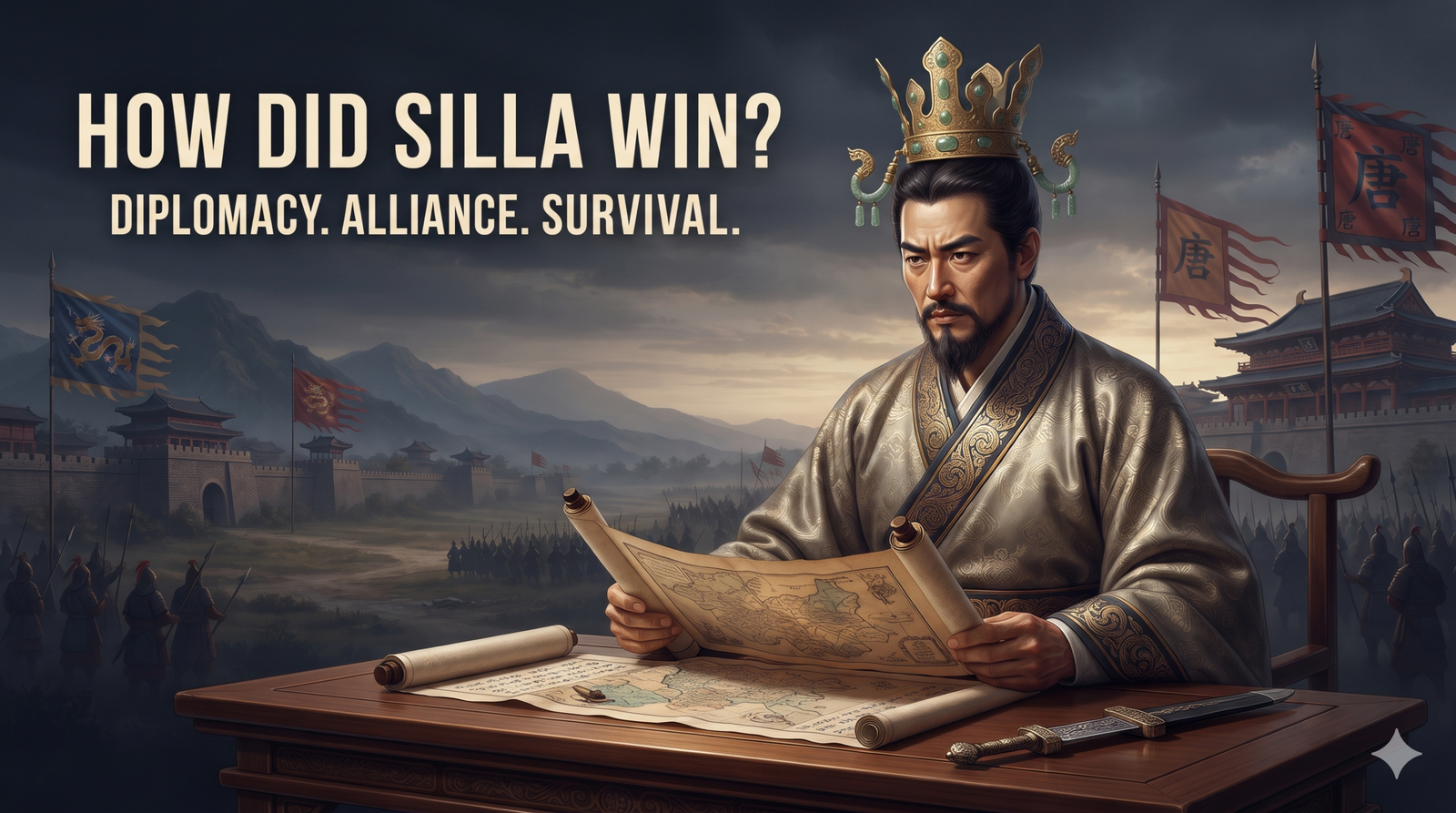
  • Why Did Silla Win Against Stronger Kingdoms? The Hidden Strategy Behind Sword & Silence

    Why Did Silla Win Against Stronger Kingdoms? The Hidden Strategy Behind Sword & Silence

    How Kim Chun-chu Turned Diplomacy into a Survival Strategy, Why Tang China Joined the War, and How an Alliance Became a New Enemy

    What does a relatively small kingdom do when it is surrounded by stronger enemies?

    It can attempt to defeat them through military strength. It can seek protection from a more powerful neighbor. Or it can recognize something that its enemies may not fully understand: the balance of power between great kingdoms can sometimes create opportunities for a smaller state to survive.

    This is the strategic problem at the heart of the seventh-century Korean Peninsula.

    The Netflix historical drama Sword & Silence (Munmu) begins against a background of prolonged warfare among Silla, Baekje, and Goguryeo. Its story introduces a period when Silla faced serious military pressure, Goguryeo experienced an internal political upheaval, and Tang China was seeking to expand its influence across East Asia.

    At the center of this situation stands Kim Chun-chu, the Silla leader who pursued an alliance with Tang.

    But the familiar explanationโ€”that Silla joined forces with Tang and eventually unified the Three Kingdomsโ€”does not tell the whole story.

    The more interesting question is why Silla made that decision, what Tang expected in return, and how Silla responded when its powerful ally began to threaten its own independence.

    The history of Silla’s unification is not simply a story of military victory.

    It is a story about strategic dependence, diplomatic calculation, political timing, and the difficult art of surviving beside a powerful ally.

    1. The Small Kingdom That Could Not Afford to Fight Everyone

    To understand Silla’s strategy, we first need to understand its position.

    During the seventh century, the Korean Peninsula was divided among three major kingdoms.

    Goguryeo occupied extensive territories in the north, including important areas of Manchuria. Baekje controlled the southwestern part of the peninsula and maintained important maritime and diplomatic connections. Silla was based in the southeast.

    These kingdoms were not equal in territory, military resources, or strategic position.

    Silla faced pressure from both Baekje and Goguryeo. Its geographical position also created serious difficulties when it attempted to communicate or coordinate with distant allies.

    The problem was not simply that Silla had fewer soldiers.

    It was that fighting one enemy could expose it to another.

    A kingdom surrounded by potential adversaries cannot make military decisions independently of geography. Every campaign carries the possibility of opening another front.

    This is the first important point behind Silla’s eventual strategy.

    Silla needed more than a battlefield victory. It needed to change the political environment in which it was forced to fight.

    Its survival depended on preventing its enemies from combining their advantages against it.

    2. The Fall of Daeya Fortress Changed Silla’s Political Calculations

    One of the most important events preceding the Silla-Tang alliance occurred in 642.

    Baekje captured Daeya Fortress, an important Silla stronghold.

    The defeat was not merely a loss of territory. It created a serious political and psychological crisis within Silla.

    Kim Chun-chu also suffered a deeply personal loss connected with the fall of Daeya. His daughter and son-in-law were among those killed.

    But the significance of the event extended beyond personal tragedy.

    Silla’s existing security arrangements were no longer sufficient to protect its important territories. The kingdom needed to reconsider how it would deal with the surrounding powers.

    Kim Chun-chu subsequently pursued diplomatic efforts, including an attempt to obtain assistance from Goguryeo.

    That approach did not produce the support Silla needed.

    The failure helped push Silla toward a different diplomatic direction.

    This is an important distinction: the alliance with Tang was not simply the result of a leader who suddenly decided to cooperate with a powerful empire.

    It emerged from a deteriorating security situation in which other options had become increasingly difficult.

    A serious defeat can force a state to reconsider its entire foreign policy.

    For Silla, Daeya was one of those turning points.

    3. Kim Chun-chu Understood That Silla Needed to Change the Structure of the Conflict

    A weaker country often faces a dangerous temptation.

    When it loses a battle, it may respond by concentrating even more resources on military expansion. But if its opponents possess greater manpower and resources, simply increasing military expenditure may not solve the underlying problem.

    Kim Chun-chu’s diplomatic strategy offered another possibility.

    Instead of confronting every threat directly, Silla could connect its security interests with those of a powerful external state.

    This would not eliminate the military imbalance. It would change the conditions under which the imbalance mattered.

    Tang China had its own conflict with Goguryeo. Silla could therefore present its struggle against neighboring kingdoms as part of a larger strategic problem facing Tang.

    The interests were not identical, but they overlapped.

    That overlap created an opportunity for cooperation.

    The deeper lesson is that diplomacy is not always about persuading another country to share your values.

    Sometimes it is about demonstrating that helping you serves its own interests.

    Kim Chun-chu’s diplomatic achievement was to make Silla’s survival relevant to Tang’s wider strategic calculations.

    4. Why Tang China Was Interested in Silla

    It would be a mistake to imagine that Tang joined Silla simply because it wanted to rescue a smaller kingdom.

    Tang was an expanding empire with its own ambitions.

    Its relationship with Goguryeo had already become increasingly hostile. Tang Taizong launched a major campaign against Goguryeo in 645, but the campaign failed to achieve its ultimate objective.

    Goguryeo’s defensive strength made direct conquest difficult.

    In this context, Silla possessed considerable strategic value.

    It occupied territory south of Goguryeo and could potentially provide military pressure from another direction.

    Silla was therefore more than a kingdom requesting assistance.

    It was a possible strategic partner positioned near one of Tang’s principal military objectives.

    This distinction helps explain why the alliance became attractive to both sides.

    Silla wanted protection and territorial security.

    Tang wanted a more favorable strategic position against Goguryeo and greater influence over the Korean Peninsula.

    They could cooperate because their interests temporarily overlapped.

    But overlapping interests are not the same as permanent trust.

    That difference would eventually become the central problem of the alliance.

    5. The Alliance Was Not a Gift. It Was a Negotiation Between Unequal Partners

    Kim Chun-chu’s diplomatic mission to Tang in 648 was a decisive stage in the relationship.

    His objective was to secure military support and establish a more dependable relationship with the Tang court.

    The negotiations involved more than a general promise of friendship.

    They concerned military cooperation, the sequence of campaigns, and the arrangement of territories after victory.

    Research published in the Korean Journal of Classics Studies examines the formation of the Silla-Tang alliance and emphasizes the importance of these negotiations.

    It also discusses the diplomatic arrangements involving Kim Chun-chu and Tang Taizong.

    There is an important historical nuance here: scholarship differs over the precise dating and stages of the alliance’s formal establishment. The diplomatic mission and negotiations are associated with 648, while one study identifies 649 as the point at which the alliance was formally established.

    For a deeper understanding, the important issue is not simply the date.

    It is that Silla was negotiating the terms of cooperation rather than merely accepting an unconditional promise of protection.

    Kim Chun-chu had to secure an agreement that could turn Tang’s military ambitions into an opportunity for Silla.

    The alliance was therefore a political bargain between unequal states.

    And unequal bargains always contain a question:

    What happens when the stronger partner decides that the agreement no longer serves its interests?

    6. Silla Accepted a Degree of Dependence Because Independence Was Already Under Threat

    One of the most revealing aspects of the alliance was the extent to which Silla adjusted its relationship with Tang.

    Kim Chun-chu accepted elements of Tang’s political and diplomatic system.

    He requested Tang-style official clothing, and his son Kim In-mun remained at the Tang court as a member of the imperial guard.

    Silla also adopted Tang’s era-name system.

    These decisions were not merely ceremonial details.

    They signaled a political relationship in which Silla was willing to demonstrate loyalty and accommodate the expectations of a powerful empire.

    From one perspective, these concessions could be interpreted as a loss of independence.

    From another, they were the price of securing a strategic partnership that Silla urgently needed.

    This is where the story becomes more complicated than a simple celebration of national pride.

    A state under pressure may have to accept limitations in one area to preserve its survival in another.

    The question is whether those limitations remain manageable.

    Silla was accepting a degree of dependence because it believed the alternative was more dangerous.

    But the arrangement contained a long-term risk: Tang might eventually interpret cooperation as an opportunity to exercise greater control.

    7. The Most Important Strategic Decision Was to Make Baekje the First Target

    The Silla-Tang relationship did not immediately produce a campaign against Goguryeo.

    The coalition first concentrated on Baekje.

    This decision made strategic sense.

    Baekje had been a major source of military pressure against Silla. Removing that threat would improve Silla’s security and create a more favorable position for the next stage of the conflict.

    For Tang, the destruction of Baekje also provided a useful strategic base for further operations on the peninsula.

    The campaign was therefore beneficial to both partners, although their longer-term objectives were not identical.

    In 660, Silla and Tang launched their joint attack on Baekje.

    The political situation inside Baekje was also important.

    By the later years of King Uija’s reign, internal divisions among the nobility had weakened the kingdom’s ability to respond effectively.

    The Silla-Tang offensive exploited this unfavorable situation.

    Baekje fell, but its destruction did not end resistance.

    Restoration movements continued, demonstrating that conquering a capital and establishing stable control over a territory are two very different achievements.

    This distinction is essential to understanding what happened next.

    Silla had helped destroy a powerful rival.

    But it had not yet secured the political future it wanted.

    8. The Fall of Baekje Created a New Problem for Silla

    The destruction of Baekje should have been an enormous strategic success for Silla.

    One of its principal enemies had been removed.

    Yet the disappearance of Baekje also changed the balance of power between Silla and Tang.

    During the campaign, the two kingdoms had shared a common enemy.

    After victory, they had to decide what would happen to the conquered territory.

    And their expectations were not the same.

    Silla wanted to secure the former Baekje territories as part of its own political and territorial expansion.

    Tang, however, established its own administrative presence in the conquered region and sought to maintain direct influence.

    The disagreement was not a minor diplomatic misunderstanding.

    It exposed the fundamental weakness of the alliance.

    Silla had entered the partnership to improve its security and expand its strategic position.

    Tang had entered it to advance its own imperial objectives.

    As long as their interests overlapped, cooperation was possible.

    Once the question of territorial control became unavoidable, the differences became much harder to ignore.

    The alliance had succeeded militarily but had not resolved the question of who would control the victory.

    9. Tang Was Not Simply Helping Silla Unify the Peninsula

    This is one of the most important points that overseas audiences should understand.

    The traditional simplified narrative can make it appear that Tang entered the conflict primarily to assist Silla in unifying the Three Kingdoms.

    But Tang had its own imperial vision.

    It wanted to weaken Goguryeo, establish influence over the former Baekje territory, and strengthen its position in the eastern part of its international order.

    Research examining the unification process from Tang’s perspective shows that Tang’s objectives involved territorial claims and an expanding imperial conception of political authority.

    This matters because it changes how we interpret the alliance.

    Tang was not necessarily a loyal partner whose interests were identical to Silla’s.

    It was an empire using a regional conflict to advance its own strategic position.

    Silla, meanwhile, was trying to use Tang’s military strength without allowing the empire to determine the future of the peninsula.

    Both sides were attempting to benefit from the same partnership.

    But only one of them possessed the resources of a continental empire.

    That imbalance made Silla’s diplomatic position extremely difficult.

    10. Why Did Silla Continue Cooperating With Tang After Baekje Fell?

    If Tang was already asserting control over the former Baekje territories, why did Silla not immediately abandon the alliance?

    The answer lies in the remaining threat.

    Goguryeo was still standing.

    It remained a formidable military power, and Tang’s campaign against it had not yet succeeded.

    Silla could not easily fight Tang and Goguryeo simultaneously.

    Even if the relationship with Tang had become uncomfortable, the alliance still offered military advantages against a dangerous neighboring kingdom.

    This illustrates an important principle of strategic decision-making.

    A country cannot always choose between an ideal partner and an ideal opponent.

    Sometimes it must work with a difficult partner because the immediate alternative is worse.

    Silla’s continued cooperation with Tang was therefore not necessarily evidence that it had abandoned its own interests.

    It reflected the reality that the strategic situation had not yet changed enough to make a direct confrontation possible.

    The disappearance of one common enemy did not automatically eliminate the need to confront the other.

    Silla had to manage the timing of its next move.

    11. Goguryeo’s Internal Crisis Changed the Balance of Power

    Goguryeo had repeatedly resisted major military campaigns from Sui and Tang China.

    Its defensive capabilities were formidable, and the failure of Tang Taizong’s 645 campaign demonstrated the difficulty of conquering the kingdom.

    But military strength does not guarantee permanent political stability.

    In 666, Yeon Gaesomun died.

    His death was followed by a struggle among his sons.

    The conflict weakened the political cohesion of Goguryeo at a moment when Tang was preparing another major offensive.

    Yeon Namsaeng, the eldest son, was driven out and eventually surrendered to Tang.

    Other nobles and local forces also became dissatisfied with the existing political order.

    Tang exploited these internal divisions.

    The fall of Goguryeo in 668 was therefore not simply the result of Tang possessing a larger army.

    It was also connected to the breakdown of Goguryeo’s internal political structure.

    This is a crucial distinction.

    A state may survive repeated external attacks as long as its internal political system remains sufficiently coordinated.

    But when succession struggles and elite divisions weaken that structure, even a powerful military can become vulnerable.

    Goguryeo’s final crisis illustrates how external pressure and internal fragmentation can reinforce each other.

    12. The Fall of Goguryeo Did Not Complete Silla’s Victory

    By 668, both Baekje and Goguryeo had fallen to the Silla-Tang coalition.

    At first glance, this appears to be the successful conclusion of the alliance.

    But the disappearance of the two kingdoms removed the common enemy that had held Silla and Tang together.

    Their disagreement over territory now became an open strategic conflict.

    Tang sought to maintain control over former Baekje and Goguryeo territories.

    Silla wanted to secure the peninsula’s southern and central regions under its own authority.

    The question was no longer how to defeat the same enemy.

    It was who would inherit the political space left behind.

    This is the moment when the original purpose of the alliance became fundamentally different for each partner.

    Silla had wanted to use Tang’s military power to overcome its regional disadvantages.

    Tang had wanted to use Silla’s cooperation to strengthen imperial control.

    Their victory created the conditions for confrontation.

    In other words, the alliance’s greatest success also produced its greatest crisis.

    13. Silla Had to Fight the Power It Had Previously Invited

    Around 670, the Silla-Tang conflict developed into open warfare.

    The fighting was not simply a sudden betrayal by one side.

    It was the result of competing territorial objectives that had been present throughout the alliance.

    Tang sought to maintain control over conquered regions, while Silla resisted the expansion of Tang authority on the peninsula.

    Silla now faced an extraordinarily difficult situation.

    It had cooperated with Tang to defeat Baekje and Goguryeo.

    But it could not accept a settlement in which Tang became the dominant power over the territories Silla hoped to incorporate.

    The military conflict that followed required Silla to change its strategic approach.

    It was no longer enough to cooperate with a stronger empire.

    Silla had to demonstrate that it could resist that empire when its own political survival was at stake.

    This is the most important transformation in the story.

    The country that had once sought external assistance was now fighting to prevent its former ally from becoming its new ruler.

    14. Silla’s Strategy Was Not to Defeat Tang Everywhere

    It is easy to interpret the Silla-Tang War as a simple confrontation between a small kingdom and a giant empire.

    But this misses the strategic conditions that shaped the outcome.

    Tang possessed enormous resources, but it also faced challenges beyond the Korean Peninsula.

    Its western frontier became increasingly unstable, particularly as conflict with the Tibetan Empire intensified.

    This placed additional demands on Tang’s military resources.

    Silla did not need to destroy the Tang Empire.

    It needed to make the cost of maintaining control over the peninsula sufficiently high, while exploiting opportunities created by Tang’s wider strategic commitments.

    This is an important difference between defeating an enemy and changing an enemy’s calculation.

    A smaller state may not possess the capacity to win a total war against a great power.

    But it may possess enough military strength, geographic advantage, and political determination to prevent the great power from achieving its objectives.

    Silla’s resistance was therefore not just a test of military courage.

    It was also a struggle over the costs and limits of imperial expansion.

    15. The Final Victory Was a Combination of Military Resistance and International Circumstances

    The fighting continued through the 670s.

    Silla achieved important victories against Tang forces in 675 and 676.

    Tang eventually withdrew its forces from the peninsula, and Silla secured control over the region south of Pyongyang.

    This outcome is sometimes described simply as the unification of the Three Kingdoms.

    But a more precise historical explanation is necessary.

    Silla did not absorb every former Goguryeo territory.

    The northern regions remained outside its control, and the later emergence of Balhae in 698 further demonstrates that the political history of the former Goguryeo world did not end in 668.

    Silla’s achievement was substantial, but it was not the complete unification of every territory once associated with the Three Kingdoms.

    It established a new political order over a large part of the peninsula.

    Its success was made possible by military resistance, diplomatic calculation, Tang’s strategic difficulties elsewhere, and the ability to adapt when the original alliance became dangerous.

    No single explanation is sufficient.

    16. Was Kim Chun-chu’s Alliance a Masterstroke or a Dangerous Gamble?

    It is tempting to describe Kim Chun-chu as a brilliant strategist who foresaw the entire sequence of events.

    But history rarely offers such simple certainty.

    He could not have known every consequence of the alliance.

    He could not guarantee that Tang would honor every expectation.

    Nor could he fully control the political changes that would follow the deaths of major rulers and generals.

    What he could do was recognize that Silla’s existing position was dangerous and that diplomatic cooperation offered an opportunity to change it.

    His strategy involved accepting risks that could not be completely eliminated.

    This is what makes his decision historically significant.

    A diplomatic alliance is not successful merely because it produces an immediate military victory.

    Its real value must be judged by whether the country can protect its interests when the partner’s objectives begin to diverge.

    Kim Chun-chu helped create the conditions for Silla’s rise.

    But the later struggle against Tang demonstrates that the alliance required a second stage of strategyโ€”one that depended on resistance rather than cooperation.

    The achievement was not simply making an alliance.

    It was the ability of Silla’s political leadership to recognize when that alliance had become a threat.

    17. The Difference Between Winning a War and Building a State

    The fall of Baekje and Goguryeo did not automatically create a stable unified political system.

    Silla had to govern territories with different political traditions, elites, populations, and military experiences.

    It also needed to incorporate people who had previously fought against it.

    This required more than battlefield success.

    Silla gradually reorganized its administrative structure and incorporated members of the former Baekje and Goguryeo ruling classes into its political system, although not on equal terms with the established Silla aristocracy.

    It also organized military and administrative structures that included people from the newly incorporated territories.

    This is an important part of the unification process that is often overlooked in stories focused on kings and generals.

    A military campaign can destroy a rival state.

    But only political institutions can turn conquered territories into a functioning state.

    The real test of victory begins after the battlefield becomes quiet.

    Silla’s postwar policies demonstrate that the process of unification involved governing, integrating, and managing the consequences of conquest.

    18. Was Silla’s Victory Really a Victory of Diplomacy?

    The answer is yes, but only partly.

    Diplomacy allowed Silla to bring Tang into the conflict and alter the balance of power.

    Without that partnership, the military situation would have been significantly more difficult.

    However, diplomacy alone could not secure the final outcome.

    Silla also needed military capacity, internal political coordination, and the ability to resist Tang after the alliance broke down.

    The final result came from the interaction of several factors:

    • Diplomatic cooperation with Tang.
    • The strategic weakening of Baekje and Goguryeo.
    • Internal political divisions within rival kingdoms.
    • Silla’s military resistance against Tang.
    • Tang’s competing strategic commitments elsewhere.
    • Silla’s ability to establish political control over newly acquired territories.

    This is why the phrase “diplomatic victory” should not be treated as a complete explanation.

    Diplomacy opened the opportunity.

    Military action changed the balance.

    Political organization made the victory sustainable.

    Silla needed all three.

    19. The Hidden Cost of Silla’s Strategy

    There is another side to this story.

    The destruction of Baekje and Goguryeo involved enormous human suffering.

    Cities were destroyed, political communities collapsed, and people who had once belonged to independent kingdoms were forced to adapt to a new order.

    The language of unification can make these events appear inevitable or universally beneficial.

    But historical unification is rarely experienced in the same way by everyone involved.

    For Silla’s ruling class, the outcome represented a major expansion of power.

    For the people of the conquered kingdoms, it could mean the loss of political independence and the restructuring of their social world.

    This does not erase the strategic achievement of Silla.

    It reminds us that the success of a state and the experience of its population are not always identical.

    A serious analysis of Sword & Silence should therefore avoid treating unification as a simple story in which one kingdom was destined to win.

    The outcome was shaped by decisions, conflicts, and sacrifices.

    And those decisions had consequences far beyond the royal court.

    20. The Most Important Lesson: A Powerful Ally Can Become the Greatest Threat

    The story of Silla offers a strategic lesson that extends beyond the seventh century.

    A smaller state may need a powerful ally to survive.

    But the stronger partner will always have its own objectives.

    The alliance may be mutually beneficial at one moment and deeply unequal at another.

    The challenge is not simply to secure assistance.

    It is to preserve enough independent capacity to act when the partner’s interests change.

    Silla’s relationship with Tang demonstrates this difficult balance.

    At first, Tang’s military power helped Silla overcome its immediate security crisis.

    Later, the same power threatened Silla’s territorial ambitions and political independence.

    The alliance did not fail because cooperation had been meaningless.

    It became dangerous because the conditions that made cooperation possible had changed.

    This is perhaps the most revealing strategic theme behind Sword & Silence.

    The central question is not whether Silla was strong enough to defeat all its enemies.

    It is whether Silla’s leaders understood that survival required different strategies at different moments.

    First, they needed diplomacy.

    Then, they needed military cooperation.

    Finally, they needed the courage and capacity to resist the empire they had once invited.

    That sequence is what makes the history of Silla’s rise so compelling.


    Final Thought: Silla Did Not Win by Remaining the Same

    The rise of Silla is often remembered through the achievements of great leaders, decisive battles, and the eventual establishment of Unified Silla.

    But the deeper story is about strategic adaptation.

    Silla recognized that it could not solve every problem through military strength alone. It used diplomacy to change the balance of power, accepted an unequal alliance when necessary, and later resisted the same partner when cooperation threatened its future.

    This was not a perfect strategy, and its consequences were not universally positive.

    But it reveals an important distinction between a state that merely survives and one that learns how to change its position.

    The most important question raised by Sword & Silence is therefore not simply how Silla defeated its rivals.

    It is this:

    How did a kingdom that needed a powerful empire to survive eventually find the strength to prevent that empire from controlling its future?

    The answer lies in the difficult relationship between diplomacy, military power, and political independence.

    And that is the real strategy behind Silla’s rise.