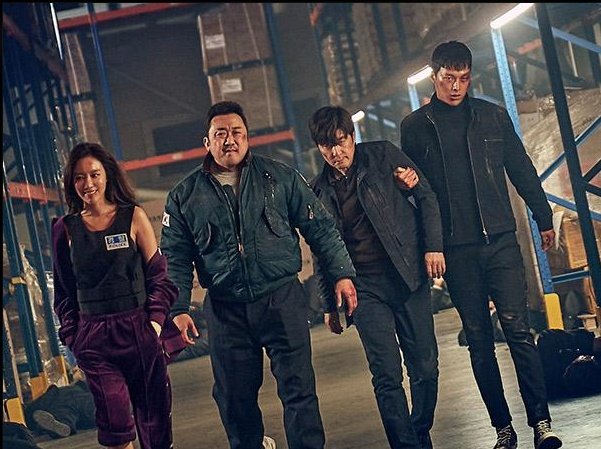
What happens when the police can no longer rely on ordinary law enforcement to catch dangerous criminals?
In The Bad Guys: Reign of Chaos (2019), the answer is both entertaining and unsettling. Instead of assembling a conventional police task force, the authorities bring together people who have already crossed the boundaries of the law.
Directed by Son Yong-ho, the film stars Ma Dong-seok as Park Woong-cheol, alongside Kim Sang-joong, Kim Ah-joong, and Jang Ki-yong. The story follows an unusual team assembled after a prison transport vehicle overturns and dangerous inmates escape.
At first glance, this looks like a straightforward action film built around powerful punches, comic exchanges, and spectacular confrontations. But its central idea is more interesting: if the system needs criminals to restore order, what does that say about the system itself?
The film is not a philosophical courtroom drama. It prefers momentum and action. Nevertheless, its unusual team provides a useful way to examine justice, institutional power, loyalty, and the complicated relationship between good and evil.
1. The Central Paradox: Why Do the Police Need Criminals?
The most interesting idea in the film is built into its premise.
The police are supposed to protect society by enforcing the law. Yet, when a dangerous group of prisoners escapes, the authorities turn to people who have criminal records of their own.
This creates an immediate contradiction.
The people recruited to restore public order are not examples of conventional law-abiding citizens. They are individuals whose abilities developed outside the boundaries of ordinary society.
The film uses this contradiction as its starting point. Rather than asking whether criminals can become heroes, it asks whether the existing system can solve every problem using only its officially approved methods.
The answer is not particularly reassuring.
The police need extraordinary results, and they are willing to use extraordinary people to obtain them. The arrangement is effective for an action story, but it also raises an uncomfortable question: does the system value justice, or does it simply value successful outcomes?
2. Park Woong-cheol: A Man Whose Violence Has a Code
Park Woong-cheol, played by Ma Dong-seok, is the team’s most immediately recognizable figure.
His physical strength is almost absurd. He can face groups of opponents without appearing particularly concerned about the numerical disadvantage.
But reducing him to a powerful fighter would miss an important part of his character.
Woong-cheol operates according to a personal code. His history, relationships, and sense of loyalty matter to him. He may have lived as a gangster, but he does not behave as though every human relationship is simply another transaction.
That distinction makes him interesting.
The film does not pretend that personal loyalty erases criminal responsibility. Instead, it presents a character whose moral instincts do not fit neatly into the categories assigned by the legal system.
Woong-cheol is dangerous, but he is not portrayed as emotionally empty.
His strength attracts attention. His loyalty gives the character a reason to remain memorable.
3. Oh Gu-tak: The Police Officer Who Understands Unconventional People
Kim Sang-joong plays Oh Gu-tak, the experienced detective responsible for assembling the new team.
Unlike the others, Gu-tak represents the official institution. Yet he understands that conventional procedures may not be enough to deal with the situation.
He knows the personalities and capabilities of the people he recruits. More importantly, he understands that managing this group requires something different from simply issuing orders.
His authority is not based only on his position as a police officer. It also comes from his ability to read people who do not easily accept authority.
This creates an unusual relationship between the detective and his team.
Gu-tak needs their abilities, but he cannot treat them like ordinary subordinates. He must negotiate with their individual motives, personal histories, and unpredictable behavior.
In that sense, he is not merely the team’s leader. He is the person trying to hold together a temporary alliance between people who would normally stand on opposite sides of the law.
4. Kwak No-soon: Intelligence Can Be More Dangerous Than Strength
Kim Ah-joong plays Kwak No-soon, a skilled con artist who brings a different kind of intelligence to the team.
Her presence is important because the film does not make physical power the only useful form of ability.
Woong-cheol can overwhelm an opponent. No-soon can understand situations, recognize opportunities, and manipulate circumstances.
These are different forms of power.
A criminal organization is not defeated simply because someone can punch harder than its members. It must also be understood. Its relationships, weaknesses, financial interests, and internal structures have to be exposed.
No-soon’s contribution highlights this difference.
She also changes the team’s dynamic. The group is no longer simply a collection of tough men confronting other tough men. It becomes a combination of physical force, deception, experience, and strategic thinking.
The film’s action works better when these abilities complement one another.
5. Ko Yoo-sung: The Complicated Position of a Former Police Officer
Jang Ki-yong plays Ko Yoo-sung, a former police officer who has ended up in prison.
His presence creates another layer of contradiction.
Unlike Woong-cheol, Yoo-sung has direct experience inside the police institution. He understands the expectations placed on officers, but he is no longer standing comfortably within that world.
He occupies an uncomfortable middle position.
He is connected to law enforcement by his past, yet his current circumstances place him among people whom the police normally regard as threats.
This makes him a useful character for examining the difference between professional identity and personal responsibility.
A person can once have represented the law and still become someone the system punishes. At the same time, a criminal record does not automatically explain everything about a person’s character.
Yoo-sung’s role helps the film move beyond a simple division between policemen and criminals.
6. The Prison Transport Escape: A Crisis That Exposes the System
The story begins when a vehicle transporting dangerous prisoners overturns and several inmates escape.
This is more than a convenient action-movie opening.
The incident creates a public security crisis that demands an immediate response. It also exposes the limits of the authorities’ existing arrangements.
The police must capture the escapees, but the situation is complicated by the people and organizations connected to them.
The authorities need a team capable of operating in a dangerous environment. That requirement leads them back to Gu-tak and his unconventional methods.
The opening therefore establishes the film’s central mechanism: a crisis makes an otherwise unacceptable solution appear necessary.
The more dangerous the situation becomes, the easier it is for the system to justify extraordinary measures.
That is where the film’s moral tension begins.
7. The Criminal Organization: The Real Enemy Is Bigger Than One Escape
The escaped prisoners are only the beginning of the investigation.
As the team follows the trail, it becomes clear that the case is connected to a much larger criminal organization.
This shift is important because it changes the scale of the conflict.
At first, the mission appears to be about finding individual fugitives. But the deeper the investigation goes, the more the team encounters a network of power that cannot be understood through isolated arrests.
The film uses this expansion to move from a simple pursuit story toward a broader confrontation.
A criminal organization is dangerous not merely because individual members are violent. Its strength comes from coordination, hierarchy, money, and the ability to influence events beyond the immediate crime scene.
This also explains why the authorities need a team with unusual capabilities.
The enemy is not simply a collection of people waiting to be punched. It is a structure that must be uncovered and dismantled.
8. Why the Team Works: Different Forms of Power
The team is entertaining because its members do not solve problems in the same way.
Woong-cheol represents physical force. No-soon represents deception and tactical intelligence. Yoo-sung brings police experience and determination. Gu-tak provides leadership and institutional knowledge.
Their abilities are not interchangeable.
If the team consisted entirely of fighters, it would have difficulty uncovering the larger organization. If it consisted only of investigators, it might struggle when the investigation turned violent.
The combination gives the story its momentum.
There is also a useful lesson in the team’s structure: people who are very different can become effective partners when their abilities serve a shared objective.
That does not mean they suddenly become friends or agree on everything.
Their cooperation is based on necessity, not perfect harmony. This makes the group more convincing as an action-movie team.
9. Justice Versus Results: Does Catching the Criminal Make Everything Acceptable?
The film’s premise creates an uncomfortable ethical question.
If the authorities use criminals to catch other criminals, what limits should govern that decision?
A successful arrest may look like a victory. But success alone cannot answer whether the method was justified.
This distinction matters because justice is not simply the achievement of a desirable outcome.
The process also matters.
A system that ignores its own rules whenever it faces a difficult problem risks weakening the very principles it claims to defend.
The film does not spend much time developing this issue into a detailed political argument. Its priority remains action and entertainment.
Still, the premise invites the audience to think about a familiar dilemma: should exceptional circumstances allow exceptional methods?
And if so, who decides when the exception ends?
10. Loyalty: The Emotional Force Behind Woong-cheol
For Woong-cheol, personal loyalty is more than a decorative character trait.
His relationships give his actions emotional meaning. His past is not simply background information; it influences the way he responds to the people around him.
This is one reason Ma Dong-seok’s character works so well in the film.
The audience does not need to agree with Woong-cheol’s history to understand his emotional motivations.
His sense of loyalty creates a contrast between the violent world he comes from and the personal values he continues to hold.
That contrast is familiar in crime cinema, but it remains effective when the character is written and performed with enough conviction.
The film’s emotional center is not the idea that violence makes someone good.
It is the idea that even a person with a violent past can have relationships and loyalties that matter deeply to him.
11. Ma Dong-seok’s Action Style: Why His Presence Changes the Film
Ma Dong-seok has a distinctive screen presence.
His physical appearance, movement, and fighting style create an immediate expectation: when Woong-cheol enters a confrontation, the balance of physical power is about to change.
The appeal is not simply that he hits hard.
His action scenes often work through contrast. Opponents move quickly, surround him, and attempt to overwhelm him. Woong-cheol responds with direct, heavy movements that make the physical impact easy to understand.
This creates a clear visual rhythm.
The audience does not need complicated choreography to understand who has the advantage.
His performance also provides comic relief. The contrast between his intimidating appearance and his reactions to certain situations helps the film avoid becoming relentlessly grim.
This combination of action and humor is an important part of the movie’s identity.
12. The Film’s Weakness: A Strong Premise Needs More Than Action
The film has an attractive central concept, but its execution is not equally strong in every area.
The ensemble is entertaining, and the action sequences provide energy. However, the larger conspiracy can feel more complicated than the emotional and investigative development needed to make it fully convincing.
Some characters receive less development than their potential deserves.
The story also relies heavily on the familiar structure of a team gathering, pursuing enemies, discovering a larger conspiracy, and confronting the main antagonists.
This is not necessarily a fatal problem for an action film. Audiences often watch this kind of movie for its characters, pacing, and confrontations.
But it does limit how deeply the film can explore its most interesting question.
The premise suggests a complicated examination of law and criminality. The final experience leans more toward energetic action entertainment.
That difference is worth recognizing rather than ignoring.
13. The Connection to the Original Bad Guys Series
The 2019 film is a cinematic spin-off of the OCN television series Bad Guys, which began in 2014.
That connection matters because the original series established the central attraction of the concept: a group of dangerous or unconventional individuals brought together to pursue criminals.
The film carries that idea into a larger cinematic setting.
For viewers familiar with the original series, the return of Park Woong-cheol and Oh Gu-tak offers a sense of continuity.
For newcomers, however, the movie can still be approached as a self-contained action story.
The important point is that the film does not invent its central idea from nothing. It expands an existing television concept by introducing a new team dynamic and a larger criminal case.
This background helps explain why the story places so much emphasis on assembling an unusual group rather than following a conventional police investigation.
14. Why the Story Still Appeals to International Audiences
The central idea is easy to understand even without detailed knowledge of Korean police dramas.
A group of criminals is recruited to catch other criminals. Their abilities are unusual, their personalities clash, and their leader must keep them working toward a common objective.
This is a recognizable action-team formula.
But the Korean film adds a particular mixture of physical comedy, crime drama, and character relationships.
Ma Dong-seok’s international recognition also gives the movie an accessible entry point for viewers who have enjoyed his other action roles.
The film may not offer a completely new interpretation of crime cinema. Its strength is the combination of a simple hook, distinctive personalities, and energetic action.
For international viewers exploring Korean action films, it provides another example of how Korean genre cinema can mix humor, violence, and questions about social order.
15. The Final Question: Who Are the Real Bad Guys?
The title The Bad Guys seems straightforward. It suggests that the audience already knows who deserves to be feared.
But the premise makes that certainty less comfortable.
The people recruited by the police are criminals. They have histories that cannot simply be erased because they are now working on the side of the authorities.
At the same time, the people who represent official power are not automatically beyond criticism.
The film’s most interesting question is therefore not whether bad people can do good things.
It is whether society can maintain a meaningful distinction between justice and power when the system itself begins using morally questionable methods.
The movie does not fully resolve that question. It is more interested in delivering an entertaining action experience than in developing a complete theory of justice.
Nevertheless, the contradiction remains at the heart of its appeal.
The Bad Guys: Reign of Chaos is not just about criminals chasing criminals. It is about a system willing to make an unusual bargain when ordinary methods are no longer enough.
And that leads to the question worth remembering after the action ends:
If the police need bad guys to catch bad guys, who is responsible for making sure the good guys remain good?