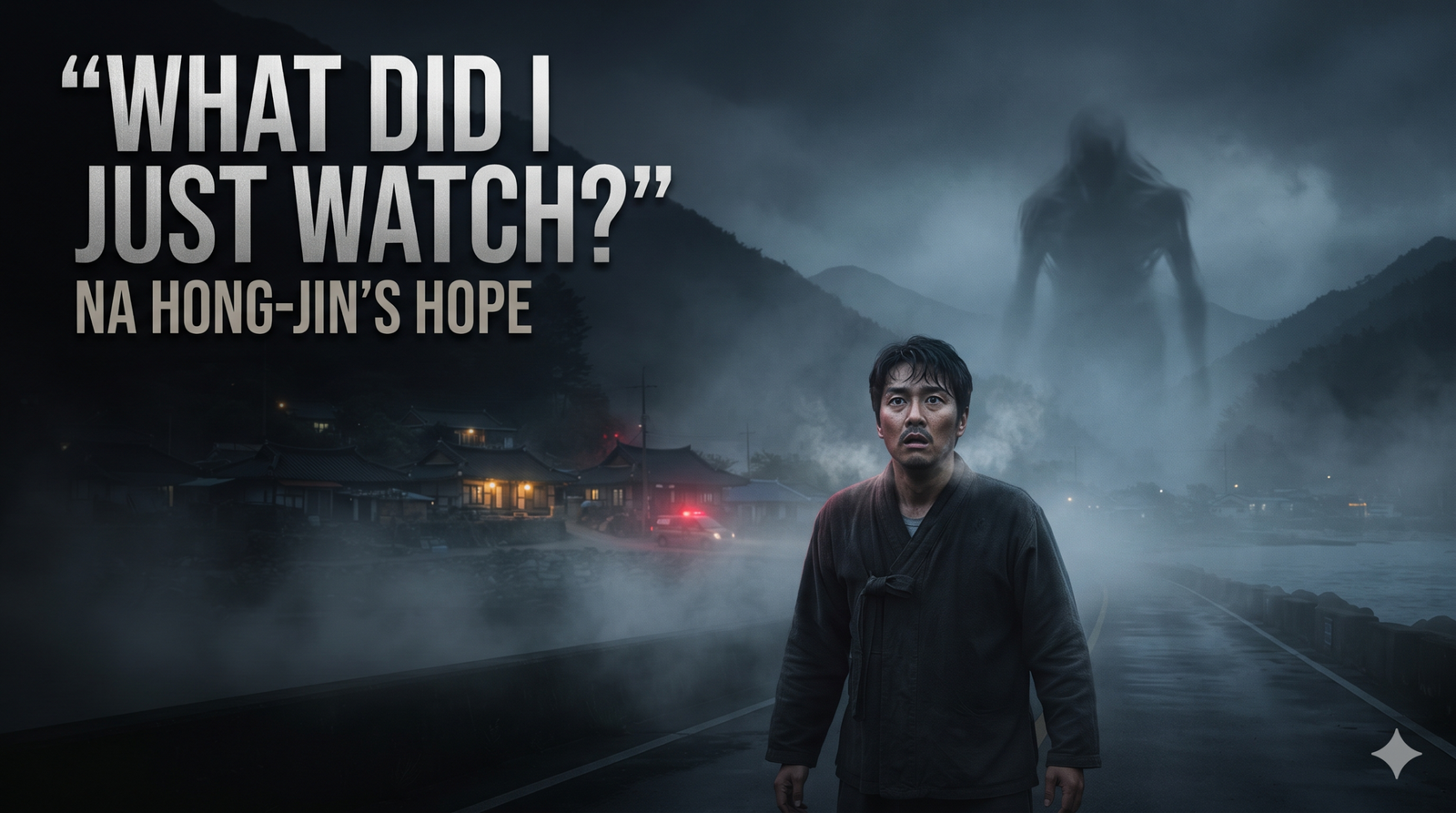
Na Hong-jin’s HOPE became one of South Korea’s most talked-about movie releases of 2026. It attracted millions of moviegoers, generated extraordinary praise for its action and cinematography, and triggered equally passionate criticism of its story, dialogue and ending. But the most interesting reaction was not simply that audiences disliked the film. It was that some viewers found it incredibly entertaining while simultaneously wondering what they had just watched.
1. A Box Office Hit That Divided Its Own Audience
When Na Hong-jin’s HOPE opened in South Korea on July 15, 2026, expectations were unusually high.
It was the director’s first feature film in a decade following The Wailing, and its combination of Korean stars, Hollywood actors, science fiction and creature-feature action made it one of the year’s most anticipated releases.
The opening numbers were impressive.
According to the Korean Film Council figures reported by Yonhap, HOPE attracted approximately 1.5 million moviegoers over its opening weekend. Its cumulative admissions passed 2.1 million by its fifth day.
But the box office success concealed an unusual problem.
Audiences were not responding to the film in a consistent way.
Some described it as an extraordinary theatrical experience. Others considered it an ambitious but deeply frustrating production.
The Korea Herald reported that Naver’s ticket-verified audience ratings were sharply divided at the time: 53 percent of ratings were 9 or 10, while 23 percent were 1 or 2.
That is not an ordinary disagreement over whether a film is slightly above average.
It suggests that HOPE delivered experiences so different that viewers could leave the same screening with almost opposite opinions.
2. “The First Half Was Incredible. What Happened After That?”
One of the most revealing complaints concerned the difference between the film’s opening and its later developments.
The early sections establish a remote village, strange reports of an animal attack and a growing sense that something dangerous is approaching.
The police and local residents try to understand what is happening.
The tension builds through uncertainty, frantic movement and the familiar atmosphere of a Na Hong-jin thriller.
For some viewers, this was the film at its strongest.
The opening creates an effective combination of mystery and physical danger. The audience knows that something is wrong, but does not yet understand the scale of the threat.
Then the film begins expanding beyond the expectations established by its opening.
The creature encounters become increasingly strange. The story moves between different tones, and the original village mystery develops into something much larger.
Aju Press reported one particularly revealing mixed reaction: a viewer praised the overwhelming first half and the cinematography but found the second half somewhat anticlimactic.
This criticism is more specific than simply saying the movie becomes boring.
It suggests that the film establishes one set of expectations and then moves into a different kind of storytelling.
For viewers who wanted the opening mystery to develop into a more conventional creature thriller, that change could feel like a loss of direction.
3. The Strange Contradiction: “I Didn’t Understand It, But I Was Entertained”
Perhaps the most interesting Korean audience reaction was the combination of admiration and frustration.
A viewer quoted by Aju Press criticized the film’s story, world-building and visual effects but still described it as one of the most entertaining Korean films they had watched recently.
That is a particularly useful reaction because it separates two things that movie reviews often combine:
The quality of the viewing experience and the quality of the storytelling.
A film can be exciting without being completely coherent.
It can have extraordinary action sequences while leaving important questions unanswered.
It can create memorable images without developing every character or idea to the audience’s satisfaction.
In HOPE, these elements frequently appear together.
The film keeps introducing new situations, visual ideas and unexpected developments. Even when the larger story becomes difficult to follow, the experience remains active.
This helps explain why some viewers could criticize the screenplay while still recommending the movie as a theatrical experience.
They were not necessarily contradicting themselves.
They were evaluating different parts of the same film.
4. Why Did the Dialogue Become Such a Big Problem?
Another recurring criticism involved the dialogue.
Some Korean viewers complained that conversations were difficult to understand during noisy action sequences. Others felt that the characters relied too heavily on profanity and shouting.
Aju Press reported complaints about dialogue delivery, including a viewer who struggled to understand what characters were saying.
The Korea Herald also identified dialogue as one of the recurring areas of audience dissatisfaction.
But the problem deserves a closer look.
In a conventional action film, dialogue often serves a practical purpose.
Characters explain the threat, exchange information, make decisions and move the story forward.
In a film as chaotic as HOPE, however, the dialogue also has to establish the personalities and emotional reactions of the villagers.
If the conversations become difficult to follow, viewers can lose more than individual lines.
They may also lose their understanding of the characters’ motivations.
This is particularly important when the story moves into unfamiliar science-fiction territory.
The more extraordinary the situation becomes, the more important it is for audiences to understand how the human characters are responding to it.
For some viewers, the film’s dialogue did not provide enough clarity to balance its increasingly unusual developments.
5. Why Did Everyone Seem to Be Shouting?
The criticism of the dialogue was closely connected to another reaction: some viewers felt that the characters displayed too narrow an emotional range.
The situation in HOPE is extraordinary.
A remote Korean community encounters a threat that challenges everything its residents understand about the world.
Fear, confusion, anger, disbelief and desperation should naturally overlap.
But some audience reviews suggested that the characters’ emotional responses became repetitive.
Instead of experiencing a wide range of personalities reacting differently to an impossible situation, viewers sometimes felt surrounded by constant shouting and aggression.
There is another way to interpret this choice.
Na Hong-jin’s previous films often place ordinary people under extreme pressure. His characters do not necessarily behave with the calmness or logic expected from conventional movie heroes.
In HOPE, that approach is pushed into a much larger and stranger setting.
The question is whether the audience experiences that behaviour as convincing chaos or simply exhausting repetition.
That difference may explain why the same performances could feel energetic to one viewer and irritating to another.
6. The Creature Effects Became Part of the Debate
The film’s visual effects were another major dividing line.
HOPE was an unusually ambitious Korean production, combining live-action performances, creature design, motion-capture work and extensive visual effects.
The mysterious beings are central to the film’s identity.
They are not simply ordinary monsters appearing in a familiar invasion story.
Their presence changes the scale and direction of the narrative.
But some viewers felt that the computer-generated imagery weakened the experience rather than strengthening it.
This criticism was not limited to Korean audiences.
At Cannes, international coverage also highlighted sharply divided reactions to the creature effects.
Some viewers were impressed by the scale and imagination of the film. Others questioned whether the visual effects consistently matched the ambition of the production.
There is an important distinction here.
A creature design can be imaginative while its digital execution remains unconvincing.
And in a film that depends so heavily on the audience believing in unfamiliar beings, visual inconsistencies can become particularly noticeable.
For viewers who were already struggling to understand the story, questionable effects could make the experience even more difficult.
7. “Was This Really a Na Hong-jin Film?”
This reaction was especially revealing because expectations surrounding the director were so high.
Na Hong-jin built his reputation through films such as The Chaser, The Yellow Sea and The Wailing.
Those works are associated with escalating tension, disturbing violence, moral uncertainty and carefully constructed suspense.
Audiences therefore entered HOPE with a particular understanding of what a Na Hong-jin film might deliver.
But HOPE is a very different kind of project.
It mixes science fiction, creature horror, action, dark comedy and elements of farce.
The film does not remain inside the familiar boundaries of a serious Korean thriller.
That change may be one of its most ambitious qualities.
It may also be one reason some viewers felt disappointed.
When audiences expect another film in the tradition of The Wailing, a strange science-fiction spectacle can feel like a completely different promise.
The problem is not necessarily that the new film is worse.
It is that the director’s established reputation creates expectations that the new work deliberately challenges.
8. The Ending: Why Did Some Viewers Feel the Movie Had Just Begun?
The ending became one of the most controversial parts of HOPE.
After approximately 156 minutes, viewers might reasonably expect the central conflict to reach a more conventional conclusion.
Instead, the film moves toward a much larger picture of the events surrounding the village and the mysterious beings.
Some viewers found this exciting.
Others felt that the story stopped just as it was becoming more interesting.
The Korea Herald reported that the lack of a satisfying resolution was among the complaints raised by Korean audiences.
The comparison to a very long trailer is therefore understandable.
The film introduces a world that appears to contain far more story than can be explored in a single movie.
However, that does not automatically mean the film is incomplete.
A story can deliberately end without explaining every element of its larger world.
The real question is whether the unresolved material feels like a meaningful artistic decision or an unsatisfying interruption.
For some viewers, the open-ended structure created anticipation.
For others, it created frustration.
That disagreement is central to the film’s reception.
9. The Most Interesting Question: Is HOPE Actually About the Creatures?
There is another possible explanation for why viewers reacted so differently.
Perhaps the film is not primarily interested in delivering a conventional alien-invasion story.
Director Na Hong-jin has discussed the importance of differences in perspective and the way misunderstanding can create conflict.
In an interview with The Washington Post, he explained that the project initially developed around ideas involving xenophobia and immigration before expanding into a much larger story.
This gives the film another possible interpretive direction.
The creatures are not necessarily just an external threat.
They also create a situation in which humans must confront something they do not understand.
The villagers interpret the unknown through their own fears, assumptions and limited information.
Their reactions are shaped by what they believe is happening, not necessarily by what is actually happening.
That creates a connection between the film’s science-fiction premise and its human conflicts.
It also offers one explanation for the deliberately unstable tone.
The audience is not always given a comfortable position from which to understand the events.
Instead, viewers experience the confusion of a community confronted with something far beyond its understanding.
This interpretation does not resolve every criticism of the film’s pacing or dialogue.
But it helps explain why the story may be more interested in perspective and misunderstanding than in providing a straightforward explanation of every mystery.
10. Why Did the Film Become Such a Big Online Argument?
The debate around HOPE became part of the film’s wider cultural life.
People were not simply comparing ratings.
They were arguing about what kind of movie it was supposed to be.
Was it a creature feature?
A science-fiction action film?
A dark comedy?
A social allegory?
An intentionally chaotic experiment in genre filmmaking?
Different viewers focused on different aspects.
Some praised the cinematography and large-scale action.
Others concentrated on the visual effects, dialogue and narrative structure.
The film’s unusual mixture of genres made it difficult to summarize in a single sentence.
That difficulty helped fuel online discussion.
In a Reddit discussion following the North American release, one viewer described the experience as feeling like too much was happening while the actual story was not progressing enough.
Another argued that the film’s opening created a level of tension that the later sections never fully recovered.
These comments are individual reactions, not a representative survey. But they illustrate that the central disagreement continued outside South Korea.
The film’s conversation became almost as unpredictable as the movie itself.
11. Did American Audiences React Differently?
The North American release provided another opportunity to test whether the Korean reaction was tied to local expectations.
NEON released HOPE in the United States on September 9, 2026, with a wide theatrical rollout.
The Korea Herald reported that the film opened in approximately 1,560 theaters across the United States and Canada, making it the widest North American release for a Korean-language film since Parasite.
The critical response was not uniformly positive or negative.
Rotten Tomatoes’ audience reviews also included viewers who praised the action and humour while criticizing the abrupt ending and the length of the film.
This is important because it challenges the idea that Korean audiences simply failed to understand a film that foreign viewers appreciated.
The same basic disagreement appeared in both markets.
Some viewers embraced the unusual experience.
Others wanted a more coherent story and a more satisfying conclusion.
Cultural background may influence how viewers interpret certain themes, but the film’s structural and stylistic divisions are not exclusive to Korea.
12. Was the Sequel the Reason the Ending Felt So Unfinished?
There is a reason viewers began discussing a possible continuation.
Na Hong-jin confirmed that he had already developed additional story material and hoped to create an opportunity to make a sequel.
Reuters reported his comments at Cannes in May 2026.
But there is an important distinction between having a story prepared and having a sequel officially moving into production.
The existence of additional material does not prove that the first film was designed only as an introduction.
Na has also discussed wanting to explore the aliens’ perspective more deeply.
That possibility is particularly interesting because the first film spends much of its time presenting events through the human community.
A continuation could expand the story beyond the limited understanding of the villagers.
For viewers who felt that HOPE ended just as the larger mystery was beginning, that possibility may be appealing.
But the first film still needs to be judged on what it actually delivers.
A possible sequel cannot automatically solve problems that some viewers experienced in the original movie.
13. What Korean Audience Reactions Really Tell Us
The reaction to HOPE reveals more than a disagreement over whether one film is good or bad.
It exposes a conflict between different expectations of what a major Korean film should deliver.
Some audiences wanted a tightly constructed thriller from the director of The Wailing.
Others were excited by the opportunity to see a Korean filmmaker attempt a large-scale science-fiction spectacle.
Some valued the film’s visual imagination more than its narrative clarity.
Others believed that the story needed stronger explanations and more consistent character development.
These are different standards of evaluation.
And HOPE gave audiences plenty of reasons to apply them.
The strongest positive reactions often focused on the theatrical experience: scale, action, cinematography, performances and the sheer unpredictability of the film.
The strongest negative reactions often focused on narrative satisfaction: dialogue, pacing, visual effects, character behaviour and the ending.
That distinction is more useful than simply dividing viewers into people who loved the film and people who hated it.
It helps explain why the same movie could be described as both an exhilarating experience and a frustrating disappointment.
Final Thoughts: The Movie Ended, but the Argument Continued
The funniest reaction to Na Hong-jin’s HOPE may also be the most revealing:
“I enjoyed watching it. I’m just not entirely sure what I watched.”
That sentence captures the contradiction at the heart of the film’s reception.
HOPE delivered large-scale action, unusual imagery and a genre mixture rarely attempted at this scale in Korean cinema.
But it also left some viewers dissatisfied with its narrative direction, dialogue and ending.
Its success at the box office and the sharply divided audience ratings show that these reactions were not mutually exclusive.
For some people, the film was exactly the kind of unpredictable cinematic experience they wanted.
For others, it was a fascinating idea that never completely came together.
Perhaps the most important question is not whether Korean audiences understood HOPE.
It is whether the film successfully communicated the experience it wanted to create.
And that remains a question viewers can debate long after the credits have finished.
So, which side are you on? Was HOPE a bold and unforgettable experiment, or did its ambition become bigger than its story?