Explore Korean dramas and movies through ending explanations, character relationships, hidden meanings, fan theories, and the questions viewers are asking after watching. Go beyond the plot to discover why the story unfolds the way it does.

  • Why Tourists Are Shopping at Korean Pharmacies Instead of Just Olive Young

    For years, one store has dominated the shopping lists of beauty-loving tourists visiting South Korea:

    Olive Young.

    Walk through Myeongdong or Hongdae and you will see international visitors filling baskets with Korean sunscreens, sheet masks, serums and cleansers.

    But in 2026, another stop is becoming part of the K-beauty shopping route:

    the Korean pharmacy.

    Foreign visitors are increasingly visiting pharmacies to look for acne treatments, scar-care products, PDRN skincare, vitamins and other health-related items. In some parts of Seoul, pharmacies are even adapting their stores specifically for international shoppers.

    This raises an interesting question:

    Why are tourists adding pharmacies to a shopping trip that once revolved mainly around Olive Young?

    The answer is not simply that pharmacies sell different products. It is that visitors are becoming interested in a different side of Korean beauty culture โ€” one that combines skincare, pharmaceutical products and access to professional advice.

    1. Korean Pharmacies Are Becoming a New K-Beauty Shopping Destination

    The growth is more than a social media impression.

    According to Korea Tourism Organization data reported by The Korea Times, foreign visitors’ spending at Korean pharmacies increased by 206.1% year-on-year in May 2026.

    More recent figures show that the trend continued.

    In September 2026, pharmacies accounted for 13.88% of foreign visitors’ medical-related spending, reaching approximately 31.8 billion won.

    The share had increased from around 8.3% in December 2025.

    These figures suggest that pharmacies are becoming a more important part of the spending patterns of international visitors.

    Myeongdong is one of the most visible examples. Pharmacies in the neighborhood increasingly display skincare products near their entrances, provide multilingual product information and attract visitors who arrive with shopping lists saved on their phones.

    For some tourists, a pharmacy is no longer just somewhere to visit when they feel unwell.

    It has become a planned shopping destination.

    2. What Are Foreign Tourists Buying at Korean Pharmacies?

    The products attracting attention generally fall into several categories.

    Acne and blemish treatments

    Some visitors specifically look for Korean pharmacy products intended for acne-related concerns.

    Scar-care products

    Scar gels and other products sold through pharmacies have become popular items on international shopping lists.

    PDRN skincare

    PDRN products have attracted attention because the ingredient is also associated with Korean aesthetic and skin-treatment discussions.

    Pigmentation and dark-spot products

    Some tourists look for products marketed for concerns such as dark spots and uneven skin tone.

    Vitamins and health products

    The shopping experience is not limited to skincare. Visitors also purchase vitamins, cold remedies, pain-relief patches and other products.

    The important distinction is that not everything sold in a Korean pharmacy is medicine.

    Some products are classified as over-the-counter drugs, while others are ordinary cosmetics sold through pharmacy channels.

    That difference matters when choosing what to buy.

    3. Olive Young and Korean Pharmacies Serve Different Purposes

    For first-time visitors, this is probably the most important thing to understand.

    Olive Young is primarily a health and beauty retailer.

    It offers a broad selection of products, including:

    • Korean skincare brands
    • Sunscreens
    • Sheet masks
    • Makeup
    • Cleansers and serums
    • Hair and body products
    • Beauty devices
    • Health and wellness products

    A Korean pharmacy has a different primary role.

    It is a healthcare business where pharmacists dispense medicines and provide professional guidance. Depending on the store, visitors may also find pharmacy-sold cosmetics, skincare products and other health-related items.

    Some products that attract international attention are available through pharmacies rather than ordinary beauty retailers.

    For example, Dong-A Pharmaceutical’s Noscana Gel and Acnon Cream are over-the-counter medicines sold through pharmacies. By contrast, pharmacy-sold PDRN skincare products are cosmetics, not medicines.

    This distinction explains why the two shopping destinations can complement each other.

    Olive Young is useful for exploring mainstream K-beauty. A pharmacy offers access to a different selection of products, including certain pharmacy-only treatments and pharmacy-sold skincare.

    It is not necessarily a competition between the two.

    For many visitors, the more interesting route is to visit both.

    4. Why Myeongdong Has Become the Center of Pharmacy Shopping

    Myeongdong already has everything needed to attract international shoppers.

    It is one of Seoul’s best-known shopping districts, with cosmetics stores, fashion retailers, restaurants, street food and easy access to major tourist routes.

    Pharmacies are now adapting to the same international customer base.

    Visitors can increasingly find:

    • English, Chinese and Japanese product information
    • Displays organized around specific skincare concerns
    • Popular products promoted near store entrances
    • Staff who help international customers
    • Shopping environments that resemble beauty retailers

    Some pharmacies have even become destinations that tourists search for before arriving in Korea.

    The expansion is visible in the number of stores as well.

    According to an October 2026 report by Aju Press, 23 new pharmacies opened in Myeongdong between January and September 2026, already exceeding the previous year’s total of 11.

    This does not mean every pharmacy is becoming a beauty store. Traditional neighborhood pharmacies continue to serve local residents.

    But in major tourist districts, the way some pharmacies present their products and serve customers is clearly changing.

    5. Why Tourists Prefer Buying Certain Products at a Pharmacy

    There are several reasons visitors may choose a pharmacy over a conventional cosmetics store.

    First, product availability.

    Some medicines and pharmacy-exclusive products cannot simply be picked up at an ordinary beauty retailer.

    Second, professional guidance.

    Visitors can explain their concerns and ask a pharmacist about a product’s intended use, precautions and instructions.

    This can be especially useful when a product is unfamiliar or when a traveler is unsure whether it is a medicine or a cosmetic.

    Third, familiarity with Korean pharmacy products.

    Social media has introduced international audiences to products that were previously less familiar outside Korea.

    Travelers sometimes arrive with product names, photographs or shopping lists already prepared.

    Finally, the in-person experience.

    Buying a product directly from a pharmacy allows visitors to check its packaging, ask questions and compare available options before purchasing.

    For travelers who want more than another ordinary skincare shopping trip, that experience can be part of the attraction.

    6. Is a Korean Pharmacy Cheaper Than Olive Young?

    Not necessarily.

    This is one of the biggest misconceptions surrounding pharmacy shopping.

    A product sold at a pharmacy is not automatically cheaper than a similar product at Olive Young.

    Prices can vary by store, product category and promotion. Some pharmacies in tourist-heavy areas may also price certain beauty products differently from neighborhood pharmacies.

    There is another important point: the products being compared may not be identical.

    A pharmacy-only acne treatment and a cosmetic serum from Olive Young may address similar concerns, but they are not necessarily interchangeable products.

    Before buying, compare the exact product name, size, ingredients, intended use and price.

    If you are purchasing several items, checking more than one store can help you avoid paying extra simply because a product has become popular online.

    The best reason to visit a pharmacy should be access to the right product and useful guidance โ€” not an assumption that every item is a bargain.

    7. The Connection Between Korean Dermatology Clinics and Pharmacy Shopping

    Another reason pharmacies are attracting international visitors is the growth of beauty and medical tourism.

    Some travelers visit Korea for dermatological treatments and then look for products to use during their recovery or everyday skincare routine.

    Aju Press reported that foreign visitors increasingly visit pharmacies after treatments at dermatology clinics, particularly in Myeongdong.

    This creates a shopping pattern that connects several parts of Korea’s beauty industry:

    1. A visitor researches Korean skincare and dermatology online.
    2. The visitor travels to Korea for shopping or a treatment.
    3. The visitor visits a pharmacy to ask about suitable products.
    4. The visitor purchases skincare or other health-related items to take home.

    This does not mean every pharmacy product is appropriate after every procedure.

    Post-treatment skincare should follow the instructions of the treating medical professional. A pharmacist can also help explain the proper use of products within their professional role.

    Still, the connection between dermatology, skincare retail and pharmacy shopping helps explain why the trend has become more visible.

    8. What Should Foreign Visitors Be Careful About?

    A Korean pharmacy can be an interesting place to explore, but visitors should not treat every popular product as an ordinary cosmetic.

    There are several things to check before purchasing.

    Know whether the product is a medicine or a cosmetic.

    The distinction affects its intended use, instructions and precautions.

    Ask the pharmacist how to use it.

    Do not rely only on a social media video or a translated shopping list.

    Mention allergies and existing medications.

    If you have sensitive skin, allergies, take other medicines or have an existing medical condition, explain this before purchasing a product.

    Check the product’s instructions and active ingredients.

    Two products marketed for similar skin concerns may contain different ingredients and have different precautions.

    Check travel and customs rules before taking medicines home.

    Import restrictions differ by destination country. A product that can be purchased in Korea is not automatically permitted for personal import everywhere.

    Most importantly, do not buy a medicine simply because it is described online as a must-buy Korean product.

    The pharmacist’s advice and the product’s actual purpose matter more than its popularity.

    9. Why This Trend Is Bigger Than Skincare

    The pharmacy trend reflects a broader change in how international visitors experience South Korea.

    In the past, many visitors organized their shopping around duty-free stores, department stores, cosmetics shops and traditional markets.

    Today, travel itineraries increasingly include everyday Korean lifestyle experiences.

    Visitors explore Korean convenience stores, supermarkets, Daiso, beauty retailers, dermatology clinics and now pharmacies.

    The appeal is not limited to buying products.

    It is also about seeing how people in Korea shop, manage everyday needs and access services.

    The growth of K-beauty has helped create international interest in Korean skincare. That interest is now extending into adjacent areas such as dermatology, functional skincare and pharmacy products.

    The pharmacy is becoming part of a much wider Korean beauty and wellness experience.

    10. Should You Visit a Korean Pharmacy During Your Trip?

    If you are visiting Korea because you love Korean skincare, a pharmacy can be worth adding to your itinerary.

    But it helps to know what you are looking for.

    Visit Olive Young if you want to explore mainstream Korean beauty brands, compare popular cosmetics and discover new skincare trends.

    Visit a Korean pharmacy if you are interested in pharmacy-sold skincare, specific over-the-counter products or professional guidance about a product’s use.

    You do not have to buy anything simply because a product is trending.

    Ask questions, compare prices and choose products that genuinely match your needs.

    And remember that Myeongdong is not the only place to find Korean pharmacies. The trend is also appearing in other shopping districts and tourist areas.

    11. The New K-Beauty Shopping Route: Olive Young Plus the Pharmacy

    The rise of Korean pharmacy shopping does not mean Olive Young is losing its importance.

    Instead, it shows that international visitors are becoming more curious about the different parts of Korea’s beauty industry.

    A shopping trip that once began and ended with cosmetics stores can now include pharmacies, dermatology clinics and other wellness-related experiences.

    That is what makes the trend interesting.

    One destination offers the scale and variety of mainstream K-beauty.

    The other offers access to a different category of products and the opportunity to ask a pharmacist for guidance.

    For tourists, the most useful approach may not be choosing one over the other.

    It may be discovering what each place does best.

    And that is how an ordinary Korean pharmacy has become one of the more unexpected stops on the country’s international beauty shopping map.
  • HOPE: 7 Things to Know Before Watching Na Hong-jinโ€™s Film โ€” A Spoiler-Free Guide for U.S. Viewers

    Na Hong-jinโ€™s HOPE brings an unusually ambitious Korean science-fiction thriller to American audiences. Directed by the filmmaker behind The Chaser and The Wailing, the film combines mysterious creatures, intense action, dark humor, and a story that gradually expands beyond the boundaries of an isolated Korean village.

    But what should American viewers know before watching?

    Is it primarily a horror movie? Do you need to watch The Wailing first? How difficult is the story to follow? And is there a reason to stay after the credits begin?

    Here are seven things worth knowing before watching HOPE, without revealing its major twists.

    1. You Do Not Need to Watch The Wailing First

    Let’s begin with the most obvious question.

    HOPE is not a sequel to The Wailing. The two films have separate characters, settings, and storylines. You can understand HOPE without knowing anything about Na Hong-jin’s earlier work.

    However, watching The Wailing may help you understand the director’s approach to suspense.

    Na Hong-jin often builds tension by withholding information. Instead of explaining every strange event immediately, he allows uncertainty to influence how viewers interpret what they see.

    In The Wailing, that uncertainty becomes part of the horror. In HOPE, the same instinct operates within a much larger science-fiction framework.

    The important distinction is that familiarity with his previous films is optional. You do not need to complete any viewing homework before entering the theater.

    Just be prepared for a story that may leave you with questions afterward.

    2. HOPE Is More Than a Conventional Horror Movie

    Describing HOPE simply as a horror film does not capture its full range.

    The story begins with a mysterious threat appearing near a remote Korean harbor village. What follows combines creature-feature suspense, survival action, science-fiction mythology, and moments of unexpectedly dark comedy.

    The genre shifts are central to the experience.

    At first, the film may feel like a local survival thriller. As the situation develops, it increasingly resembles a large-scale monster movie. Eventually, its ideas move into territory closer to cosmic science fiction.

    This changing identity helps explain why audiences may respond differently to the film.

    Someone expecting a traditional alien-invasion story may be surprised by its structure. A viewer looking for a straightforward horror experience may also find that the film expands into something considerably stranger.

    Rather than choosing one genre and expecting it to remain consistent, approach HOPE as a film that deliberately changes scale and tone.

    3. Prepare for a Runtime of Approximately 2 Hours and 40 Minutes

    HOPE is a substantial theatrical experience.

    The Cannes Film Festival lists the film at 160 minutes, while Korean film information lists its running time at approximately 156 minutes. American movie listings commonly describe it as 2 hours and 40 minutes.

    That is worth considering before buying a ticket.

    The film uses its extended runtime to follow different groups of characters and gradually expand the scale of the central crisis. It includes extended action sequences, confrontations, and stretches in which viewers must piece together what is happening.

    This is not a tightly compressed thriller that moves directly from one plot point to the next.

    The length may be demanding for viewers who prefer fast resolutions. But it also gives the film room to establish its unusual atmosphere and build toward a much larger conflict.

    If you are planning a theater visit, allow enough time to watch the film without feeling rushed.

    4. The Visual Scale Is One of the Film’s Biggest Attractions

    One of the strongest reasons to consider watching HOPE on a large screen is its visual ambition.

    The cinematography is by Hong Kyung-pyo, whose previous credits include Parasite, Burning, Snowpiercer, and The Wailing.

    The film brings together Korean locations, elaborate production design, physical action, and visual effects to create an environment that becomes increasingly unstable.

    The village is not merely a background for the monster attacks. Its roads, buildings, surrounding mountains, and forests shape how the characters move, hide, and confront danger.

    The camera frequently places viewers close to the people experiencing the chaos. Rather than making every event feel like a distant spectacle, the visual approach often emphasizes the physical confusion and vulnerability of the characters.

    This is an important part of the film’s identity.

    Its scale is impressive, but the spectacle is most effective when it remains connected to the people caught inside it.

    5. It Is Primarily Korean-Language โ€” and Rated R in the United States

    American viewers should know two practical details before watching.

    First, HOPE is primarily a Korean-language film with English subtitles. Its international cast includes Michael Fassbender and Alicia Vikander, but their presence does not make it an English-language Hollywood production.

    Second, the film received an R rating in the United States for strong violent content and language throughout.

    Expect intense confrontations, disturbing creature-related violence, and frequent strong language.

    The Korean theatrical classification is different: the film was rated suitable for viewers aged 15 and older in South Korea. American audiences should follow the U.S. rating when deciding whether the film is appropriate for their group.

    If you are comfortable watching subtitled films and enjoy intense genre cinema, the language should not be a major obstacle.

    However, this is not a gentle science-fiction adventure designed for the whole family.

    6. Do Not Expect Every Mystery to Receive a Clear Explanation

    This may be the most important thing to understand before watching HOPE.

    The film introduces unfamiliar creatures, unusual events, and a mythology that gradually grows beyond the original village setting. But it does not necessarily explain every detail in the order viewers might expect.

    Some questions receive answers. Others remain open to interpretation.

    That approach can be rewarding for viewers who enjoy connecting clues and discussing competing explanations. It can also frustrate people who expect every mystery to be resolved before the final credits.

    The distinction matters because HOPE is not structured like a conventional mystery in which every piece of information eventually leads to one neatly explained solution.

    Its unanswered questions are part of the viewing experience.

    For a deeper explanation after watching, you can explore our related articles:

    7. Stay During the Credits โ€” There Is an Additional Scene

    Here is one practical tip that is easy to miss.

    HOPE includes an additional scene during the closing credits.

    Without revealing its details, the scene features Sung-ki after the events of the main story. It appears during the early portion of the credits, rather than after the entire credit sequence has finished.

    You do not need to wait until the very last second of the film’s credits.

    But you should not leave the theater immediately when the main story ends.

    For viewers interested in the film’s final implications and the possibility of a larger story, this additional moment is worth seeing.

    One More Thing: Could HOPE Become a Larger Film Series?

    The possibility of another film is already attracting attention.

    Na Hong-jin has said that he has written a story for a potential continuation and would like to make it if the opportunity becomes available.

    That statement is significant because it suggests that the world of HOPE may extend beyond the events shown in the first film.

    However, having a story ready is not the same as having an officially approved sequel.

    There is currently no confirmed release date or finalized production schedule for HOPE 2.

    For now, it is better to approach the first film as a complete viewing experience rather than assuming that every unanswered question will definitely be resolved in another installment.

    So, Should You Watch HOPE?

    If you prefer conventional science-fiction films with clearly explained mythology and neatly resolved endings, HOPE may test your patience.

    But if you enjoy ambitious Korean genre filmmaking, large-scale action, unusual storytelling, and films that encourage debate after the screening, it is worth considering.

    Before watching, remember four things:

    • You do not need to watch The Wailing first.
    • Expect a runtime of approximately 2 hours and 40 minutes.
    • The film is primarily Korean-language, with English subtitles, and carries an R rating in the United States.
    • Stay when the credits begin because an additional scene appears during them.

    You may leave the theater impressed, confused, or somewhere between the two.

    That is part of what makes HOPE an unusual film. It does not simply ask viewers to watch a monster story. It invites them to experience a world that keeps expanding, even when the answers remain incomplete.

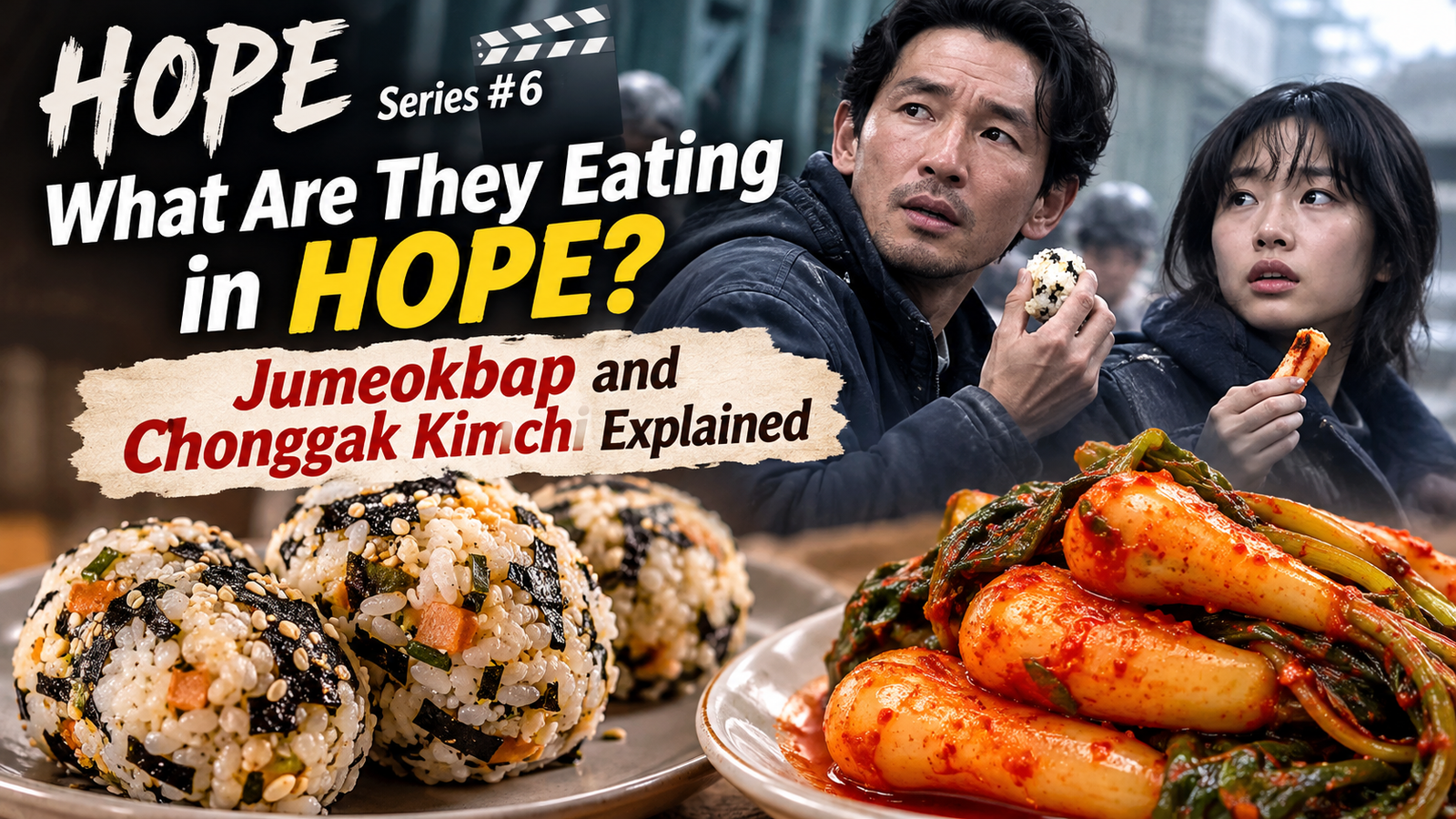
  • HOPE Series #6: What Are They Eating in HOPE? Jumeokbap and Chonggak Kimchi Explained

    HOPE Series #6: What Are They Eating in HOPE? Jumeokbap and Chonggak Kimchi Explained

    Among the monsters, explosions and extraordinary images in Na Hong-jinโ€™s HOPE, two ordinary Korean foods offer a quieter glimpse into everyday Korean culture.

    They are jumeokbap (์ฃผ๋จน๋ฐฅ) and chonggak kimchi (์ด๊ฐ๊น€์น˜).

    To Korean viewers, neither food is particularly unusual. One is a simple rice ball, and the other is a crunchy variety of radish kimchi.

    But their stories are more interesting than their appearances suggest.

    Jumeokbap reveals how a practical way of preparing rice became associated with convenience, comfort and collective memory. Chonggak kimchi offers an even more surprising story: its familiar name has a relatively recent documented history, and an old Korean film may have helped make it popular.

    Understanding these foods means looking beyond what is on the plate.

    It means understanding how ordinary Korean ingredients become part of a country’s cultural memory.

    1. What Is Jumeokbap? The Korean Food Literally Called โ€œFist Riceโ€

    The Korean word jumeokbap (์ฃผ๋จน๋ฐฅ) is made from two words:

    • Jumeok (์ฃผ๋จน): fist
    • Bap (๋ฐฅ): cooked rice or a meal

    Together, the literal meaning is โ€œfist rice.โ€

    The name describes how the food is made. Cooked rice is seasoned, sometimes mixed with other ingredients, and pressed by hand into a compact shape.

    Unlike a bowl of plain rice, jumeokbap is designed to be handled and eaten easily.

    The basic version can be made with little more than rice and salt. Other versions include sesame oil, seaweed, sesame seeds, vegetables, meat or fish.

    The shape does not have to be perfectly round. Some rice balls are small and compact, while others are larger and closer to the size of a fist.

    That flexibility is part of the appeal.

    Jumeokbap is not defined by one fixed recipe. It is defined by the simple idea of turning cooked rice into a convenient, portable meal.

    2. Jumeokbap and Korea’s Memories of Hardship

    It is easy to associate simple rice balls with poverty because they require few ingredients and can be prepared without elaborate equipment.

    But it would be inaccurate to say that jumeokbap was invented during the Korean War.

    The practice of shaping cooked rice into portable portions is not limited to one historical period, and the modern Korean dish cannot be traced to a single moment of invention.

    What is more historically meaningful is the way rice balls became connected with particular experiences of hardship and solidarity in modern Korean memory.

    One especially important example is the May 18 Gwangju Democratization Movement in 1980.

    During the uprising, citizens shared simple rice balls with people who were confronting the military crackdown. The food became associated with mutual support, courage and the determination to help one another during a dangerous period.

    In that context, jumeokbap was more than something to eat.

    It represented people sharing what they had when circumstances made ordinary life difficult.

    The rice balls remembered from Gwangju were simple, often seasoned with little more than salt. Their cultural significance came not from expensive ingredients but from the people who prepared and shared them.

    This history gives jumeokbap an emotional dimension that is not immediately visible to someone encountering it for the first time.

    3. How Jumeokbap Became a Modern Comfort Food

    Today’s restaurant versions can look very different from the simple rice balls associated with hardship.

    Modern jumeokbap is often colorful, generously seasoned and customizable.

    Common ingredients include:

    • Roasted seaweed flakes
    • Sesame oil
    • Sesame seeds
    • Chopped kimchi
    • Tuna
    • Mayonnaise
    • Minced beef
    • Vegetables
    • Fish roe
    • Cheese

    Some restaurants serve the rice and ingredients separately in a large bowl.

    Customers mix everything together and shape the rice into small balls themselves, often using disposable gloves.

    This interactive style has become part of the experience.

    It is easy to share, does not require complicated preparation and allows everyone to adjust the ingredients to their taste.

    The transformation is interesting: a food associated with simplicity and necessity has also become a playful restaurant dish.

    Its basic character has not changed, however.

    It remains a practical way to make rice portable, flavorful and easy to eat.

    4. Why Do Koreans Eat Jumeokbap With Extremely Spicy Food?

    One of the most recognizable modern combinations is dakbal (๋‹ญ๋ฐœ), or Korean spicy chicken feet, with jumeokbap.

    Dakbal is often prepared with a fiery seasoning based on gochujang, chili powder, garlic and other ingredients.

    Depending on the restaurant, it can be intensely spicy.

    Jumeokbap provides a mild and satisfying contrast.

    The rice absorbs some of the sauce, while sesame oil and seaweed add a savory flavor that balances the heat.

    This is not simply about using rice to reduce the burning sensation.

    It is also about building a satisfying rhythm between different tastes and textures.

    A bite of spicy chicken feet delivers heat and intensity. A bite of rice provides softness and a milder flavor. Then the contrast makes the next bite of spicy food enjoyable again.

    Jumeokbap is also served alongside other spicy Korean dishes, including certain kinds of stir-fried chicken, spicy seafood and heavily seasoned street food.

    For international visitors, this pairing is a useful introduction to a familiar principle in Korean meals: a mild staple food can balance a strongly flavored main dish.

    5. What Is Chonggak Kimchi?

    The second food in the discussion is chonggak kimchi (์ด๊ฐ๊น€์น˜), a type of Korean radish kimchi.

    It is traditionally made with a small, firm radish known as chonggakmu (์ด๊ฐ๋ฌด).

    The radishes are recognizable by their relatively short white roots and long green leaves.

    Unlike kkakdugi, which is usually made by cutting larger Korean radishes into cubes, chonggak kimchi often keeps the smaller radishes whole or cuts them into large pieces while retaining much of their leafy tops.

    The radishes are salted and mixed with a seasoning paste that commonly includes chili powder, garlic, ginger, green onion and fermented seafood ingredients such as salted shrimp or fish sauce.

    The result is a kimchi with a distinctive combination of flavors:

    • Spicy chili seasoning
    • Fermented sourness
    • Savory depth
    • A firm, crunchy radish texture

    For many people, that crunch is the most memorable feature.

    The radish remains substantial enough to bite into rather than simply dissolving into the softer texture of the seasoning.

    6. Why Is It Called โ€œBachelor Kimchiโ€?

    The English translation of chonggak kimchi is often โ€œbachelor kimchi.โ€

    That translation comes from the Korean word chonggak (์ด๊ฐ), which is commonly used to mean an unmarried man.

    A familiar explanation connects the name with a traditional hairstyle associated with unmarried young men.

    In older Korean society, boys and unmarried young men traditionally wore their hair differently from married men, who adopted the topknot associated with adulthood and marriage.

    The long green leaves attached to the small radishes have been compared to the shape of that traditional hairstyle.

    This is the popular explanation behind the name.

    However, there is a more interesting historical detail that is often missing from simple food explanations.

    The familiar name does not appear to have been used as far back as many people assume.

    7. The Unexpected History of the Name Chonggak Kimchi

    A 2022 study published in the Journal of the Korean Society of Food Culture examined the origin and spread of the name chonggak kimchi.

    Its findings challenge the idea that the name has been documented for centuries.

    The researchers found that the name chonggak kimchi first appeared in the November 1959 issue of the women’s magazine Yeowon.

    Earlier records used other names for similar preparations, including altarimu kimchi (์•Œํƒ€๋ฆฌ๋ฌด๊น€์น˜) and neongkul kimchi (๋„์ฟจ๊น€์น˜).

    The research also identified an unexpected influence on the name’s popularity: the 1964 Korean film Chonggak Kimchi, starring Shin Seong-il and Eom A-ran.

    According to the study, the film played a significant role in spreading the name among the public.

    This is a fascinating example of how popular culture can influence the language of food.

    A traditional preparation does not always keep one name throughout history. Names can change, spread through magazines and films, and eventually become the everyday terms people use.

    So while the hairstyle explanation is a familiar way to understand the word chonggak, the documented history of the food’s name is more recent and more complicated than a simple ancient-origin story suggests.

    8. Chonggak Kimchi vs. Kkakdugi: What Is the Difference?

    International visitors sometimes confuse chonggak kimchi with kkakdugi (๊น๋‘๊ธฐ) because both are made from Korean radish.

    But the difference becomes obvious once you see them side by side.

    Kkakdugi is generally prepared by cutting larger Korean radishes into cubes before seasoning and fermentation.

    Chonggak kimchi uses smaller radishes with their leafy stems, often keeping the roots whole or in large sections.

    That creates a different eating experience.

    Kkakdugi is usually served as bite-sized cubes. Chonggak kimchi can be eaten by holding the leafy end and biting into the firm radish.

    The difference is not just visual.

    The size, shape and preparation of the radish affect how it feels when eaten.

    Both are crunchy, spicy and fermented, but chonggak kimchi has a more distinctive combination of a compact root and attached greens.

    9. Why Fermentation Makes Chonggak Kimchi Special

    Freshly prepared chonggak kimchi and well-fermented chonggak kimchi can taste quite different.

    When it is freshly made, the radish may have a sharp, peppery flavor. The seasoning is still relatively fresh, and the fermented sourness has not fully developed.

    As fermentation progresses, lactic acid bacteria transform the kimchi’s flavor.

    The sourness becomes more noticeable, the seasoning develops greater depth, and the original sharpness of the radish becomes more balanced.

    But texture remains essential.

    A well-made batch should retain the radish’s characteristic firmness even as the flavor becomes more fermented.

    This balance is one reason chonggak kimchi is popular as a side dish.

    It can add freshness and acidity to meals containing rice, grilled meat, soups and rich stews.

    10. Why These Two Foods Work So Well Together

    Jumeokbap and chonggak kimchi are made from completely different ingredients.

    One is based on cooked rice. The other is a fermented vegetable.

    Yet they share an important characteristic: both rely on ordinary ingredients rather than expensive or elaborate components.

    Their appeal comes from preparation, seasoning and texture.

    Jumeokbap is soft, mild and comforting.

    Chonggak kimchi is crunchy, spicy, sour and savory.

    Together, they create a contrast that is central to the pleasure of many Korean meals.

    The rice provides a gentle base. The kimchi adds intensity.

    The soft texture of the rice meets the resistance of the radish. The mild flavor meets the fermented seasoning.

    This is not a complicated culinary technique, but it is an effective combination.

    And it helps explain why Korean meals often include several different textures and flavors rather than relying on one dominant dish.

    11. What These Foods Reveal About Korean Food Culture

    There is a larger cultural story behind these two foods.

    Jumeokbap shows how a simple preparation can carry different meanings across generations.

    It can represent practical everyday eating, a convenient restaurant side dish or a memory of people supporting one another during a national crisis.

    Chonggak kimchi demonstrates another aspect of food culture: even the name of a familiar dish can have a history shaped by language, publishing and popular entertainment.

    The food itself may have existed before the name became widespread.

    That distinction is important because food culture is not only about ingredients and recipes. It is also about the words people use, the memories they attach to dishes and the stories that help those dishes become recognizable.

    In that sense, both foods are more culturally interesting than their modest appearance suggests.

    12. From HOPE to the Korean Table

    Na Hong-jin’s HOPE is built around extraordinary images and an unusual science-fiction story.

    But the presence of familiar Korean food can offer a different kind of cultural detail.

    International audiences may come to the film because of its director, its cast or its ambitious visual world.

    Yet ordinary details can also help viewers understand the society in which a film is made.

    Jumeokbap connects a simple rice preparation with everyday convenience and memories of solidarity.

    Chonggak kimchi brings together Korean language, traditional food preparation, fermentation and even the influence of a 1960s movie on the popularity of a name.

    Neither dish is luxurious.

    Neither needs to be treated as an exotic mystery.

    They are everyday foods with stories that become visible when someone takes the time to look more closely.

    And that is part of what makes food such an effective window into culture.

    The Bottom Line

    Jumeokbap and chonggak kimchi may look like small details in a film as visually ambitious as HOPE, but both have interesting stories behind them.

    Jumeokbap literally means โ€œfist rice.โ€ It is a practical Korean rice dish that has also become associated with memories of hardship and solidarity, particularly through its place in the history of the May 18 Gwangju Democratization Movement.

    Chonggak kimchi is made with small Korean radishes and their leafy greens. Although its name is commonly explained through the resemblance between the radish leaves and a traditional unmarried man’s hairstyle, historical research suggests that the name itself first appeared in print in 1959 and was popularized in part by a 1964 film.

    One food tells a story about how people share what they have.

    The other shows how food names and popular culture can influence one another.

    If HOPE made you curious about the food, the two names to remember are simple:

    Jumeokbap and chonggak kimchi.

    Try the rice balls with a spicy Korean dish, add a piece of crunchy radish kimchi, and you will understand why these ordinary foods have such a lasting place on the Korean table.

  • Is Na Hong-jinโ€™s HOPE a Trilogy? Sequel Plans, Part 2 Story, and the Directorโ€™s Latest Updates

    Is Na Hong-jinโ€™s HOPE a Trilogy? Sequel Plans, Part 2 Story, and the Directorโ€™s Latest Updates

    Spoiler Warning: This article discusses major story developments and the ending of HOPE.

    Na Hong-jinโ€™s HOPE leaves viewers with an unusual kind of question. Rather than simply wondering what happened to the characters, audiences are left wondering whether they have actually seen the complete story.

    The film begins as a tense survival thriller set in a remote Korean village. Mysterious creatures appear, local residents are thrown into chaos, and the human characters struggle to understand what is happening around them. But as the story approaches its conclusion, the perspective begins to shift. The extraterrestrial characters are no longer just frightening unknowns. They become part of a much larger narrative that the film has only partially revealed.

    That shift is important because Na Hong-jin has confirmed that he developed a continuation of the story. He has also explained that the next installment would move much further into the aliensโ€™ world.

    There is another important revelation: actress Hoyeon has said that Na originally introduced the project to her as a three-film story.

    So, is HOPE officially a trilogy? Is HOPE 2 happening? And what would the next film actually explore?

    The latest interviews provide a much clearer picture, but they also reveal why the future of the series is not yet guaranteed.

    1. Is HOPE Officially a Trilogy?

    The answer requires a distinction between the directorโ€™s original vision and the production status of the films.

    In a September 2026 interview with ELLE, Hoyeon recalled that when Na Hong-jin first approached her about HOPE, he explained that the story would consist of three movies, with the first film introducing the universe he wanted to create.

    Her comments confirm that the trilogy concept was part of the project’s early creative vision. It was not simply a theory invented by viewers after seeing the ending.

    However, Hoyeon also added an important qualification.

    She said she did not believe Na had necessarily decided to make all three installments. He had a larger story in mind, but he had not clearly divided the narrative into fixed second and third films. She even suggested that the story might ultimately be told in two movies.

    This changes how the trilogy question should be understood.

    There are three separate possibilities:

    • Creative vision: Na originally imagined a story that could extend across three films.
    • Narrative structure: The continuation may require only one additional movie, depending on how the story develops.
    • Production commitment: No publicly confirmed agreement guarantees that three films will be produced.

    Therefore, the most accurate answer is that HOPE began with a three-film vision, but it is not yet a guaranteed three-film production.

    The distinction matters because a director’s ambition does not automatically become a completed film series.

    2. Has Na Hong-jin Already Written HOPE 2?

    Yes. This is one of the strongest pieces of information supporting the possibility of a sequel.

    At the 2026 Cannes Film Festival, Na revealed that a continuation already had a story and a written script. He said that he would like to make it if the opportunity arose.

    His comments were significant because they showed that the next installment was not merely an idea developed in response to audience demand.

    The director had already considered what happens beyond the first film.

    In a later interview with The Playlist published on September 11, 2026, Na described the first movie as only part of a much larger story. He explained that the narrative had been designed around a transition from daylight into darkness, with the next installment continuing through the night.

    This is more specific than a general promise to make another movie.

    It suggests that Na has already considered the relationship between the two films, including how the change in time and perspective will shape the experience.

    Nevertheless, there is an important limitation.

    A written screenplay is a creative achievement, not a production announcement. A sequel still needs financing, scheduling, production agreements, and a practical plan for bringing the project to the screen.

    The story exists. The film itself is not yet guaranteed.

    3. What Will HOPE 2 Be About? The Story Shifts to the Aliens

    The most revealing information about the possible sequel concerns its perspective.

    The first HOPE largely presents the crisis through the human characters. Viewers experience the strange events alongside the residents of Hope Harbor, who have limited information about the creatures and their intentions.

    That structure encourages the audience to identify with the humans.

    The aliens appear dangerous because their behavior is difficult to understand. Their arrival creates fear, confusion, and violence. From the villagers’ point of view, survival becomes the immediate priority.

    But the final part of the film complicates that interpretation.

    The audience learns more about the extraterrestrial characters and their relationships, particularly their connection to their offspring. The creatures are no longer simply monsters attacking a human settlement. They are beings with their own priorities and emotional stakes.

    Na has explained that the next part of the story would move toward the aliens’ perspective.

    This means the sequel may not simply repeat the first film’s structure with larger action scenes or more frightening creatures.

    Instead, it could ask viewers to understand the events from the other side.

    Why did the aliens come to Earth? What happened to their group? What are they trying to protect? And how do their actions look when the audience is no longer limited to the human point of view?

    Those questions offer a different kind of science-fiction story.

    The most interesting possibility is that the sequel could make viewers reconsider some of the assumptions they formed during the first movie.

    4. Why the Night Matters: Na Hong-jinโ€™s Most Important Sequel Clue

    One of Na’s most intriguing explanations came in his September 2026 interview with The Playlist.

    He described the story in terms of the sun rising, the events of the first film unfolding during daylight, and the sun eventually setting.

    He then explained that what audiences had seen was essentially only half of the story he had written.

    According to the director, the sequel would continue into the night and move toward the next sunrise.

    This is more than a visual detail.

    The first film deliberately places much of its creature action in daylight. That decision creates a different atmosphere from the traditional monster movie, where danger often hides in darkness.

    By contrast, the next installment could use night as a narrative and visual transition.

    The change may also reflect the shift in perspective. The first film follows human characters trying to understand an unfamiliar threat. The sequel could place the audience closer to the extraterrestrial characters, whose experiences and motivations remain largely unknown.

    The movement from day to night therefore has two possible meanings:

    1. A continuation of the timeline: The events of the second film follow the consequences of the first.
    2. A change in narrative identity: The audience moves away from the human-centered experience and enters the aliens’ world.

    Na has not revealed the full plot, so it would be premature to claim exactly what happens during that night.

    But his comments make one thing clear: the change in perspective is central to the continuation he has imagined.

    5. Why the Aliens May Be More Important Than the Humans

    The most interesting aspect of a possible HOPE 2 is not necessarily the expansion of its science-fiction universe.

    It is the possibility of changing the audience’s moral position.

    In the first film, human beings are placed in an extremely frightening situation. Their homes, families, and community are threatened. Their instinct to defend themselves is understandable.

    But the aliens also appear to be protecting something important to them.

    Na has discussed the conflict in terms of both humans and extraterrestrials trying to protect what belongs to them, particularly their offspring.

    That idea creates a difficult question.

    If both sides believe they are defending their own families, does that make the violence easier to justify?

    Or does it reveal how quickly fear and self-preservation can turn into tragedy?

    This is where the sequel could deepen the meaning of the first film.

    Rather than presenting a simple conflict between good humans and evil invaders, the story could explore how two groups can misunderstand each other even when their basic motivations are not entirely different.

    The conflict may not disappear simply because the audience learns more about the aliens.

    In fact, understanding the other side could make the tragedy more complicated.

    Na offered a particularly revealing comment when discussing the themes of the second installment. He suggested that even when understanding becomes possible, tragedy can still happen.

    That statement provides a stronger clue about the sequel’s thematic direction than any fan theory about alien technology or military strategy.

    The next film may be less interested in explaining who is right than in examining why conflict continues even when the opposing sides become more understandable.

    6. Is HOPE 2 Greenlit? The Latest Financing Update

    This is where the difference between creative preparation and actual production becomes especially important.

    In an interview with The Hollywood Reporter published on September 16, 2026, Na revealed that two parties had expressed interest in financing the sequel.

    He said that both believed the next film should be made and were willing to provide financial support.

    That is encouraging news.

    A large-scale science-fiction production requires substantial resources, particularly when its story depends on visual effects, creature performances, and an expanded fictional world.

    The interest of potential financing partners could make the project more realistic than a sequel supported only by the director’s personal enthusiasm.

    However, Na immediately added that nothing was concrete yet.

    He described the discussions as encouraging but did not announce a finalized financing agreement or an official production start.

    That distinction is essential.

    Development stageCurrent position
    Larger story conceptConfirmed
    Sequel story and scriptConfirmed by Na
    Interest from potential financiersDisclosed by Na
    Final financing agreementNot publicly confirmed
    Official production startNot confirmed
    Release dateNot announced

    The sequel has moved beyond the stage of a vague creative possibility. But it has not reached the point where audiences can treat it as an officially scheduled film.

    For now, the most responsible description is that HOPE 2 has a creative foundation and encouraging financing discussions, but no confirmed production timetable.

    7. Why Na Hong-jin May Make Another Film Before HOPE 2

    There is another factor that could delay the sequel: the director’s own creative priorities.

    In his September interview with The Playlist, Na explained that he was considering making a darker and more violent film before returning to the world of HOPE.

    He said that the project already had a substantial amount of writing behind it.

    He also suggested that working on HOPE had taken so long that he wanted to move into a different creative environment before continuing the story.

    This is understandable when considering the scale of the first movie.

    HOPE represents a major production undertaking, involving extensive visual effects, creature design, motion-capture performances, and a large international cast.

    A sequel would likely require another demanding production process.

    Taking time to develop a different film could give Na the opportunity to reset creatively rather than immediately returning to a universe that has occupied so much of his working life.

    But this also means that even if financing discussions progress, HOPE 2 may not be his immediate next project.

    The director’s schedule is therefore another reason why a release-date prediction would be premature.

    8. What Would a Third HOPE Movie Actually Do?

    If Na eventually completes the original three-film vision, the third installment would have an interesting narrative challenge.

    The first movie establishes the human side of the conflict.

    The second is expected to shift toward the extraterrestrial perspective.

    A third film could potentially bring those perspectives together and explore the consequences of what both sides have learned.

    That is a reasonable interpretation of the structure, but it is not a confirmed plot description.

    Hoyeon’s interview with ELLE is particularly useful here because she clarified that Na had not given her a fixed explanation of how the second and third films would be divided.

    She understood that the director had a larger story in mind, but he had not specified exactly which events belonged to each installment.

    This leaves room for the structure to change.

    The story could become a trilogy if the material requires three films. It could also conclude in a second movie if the director believes that is the more effective way to complete the narrative.

    The number of films should ultimately serve the story rather than become a goal in itself.

    That is why it would be misleading to describe a third movie as inevitable.

    9. Does HOPE Work as a Standalone Film?

    The debate over the ending is not simply a question of whether viewers want another installment.

    It raises a more fundamental question about what a first film should accomplish when it belongs to a larger story.

    A movie can leave mysteries unresolved and still feel complete. Not every science-fiction story needs to explain the entire history, biology, and political structure of its fictional universe.

    In HOPE, the unanswered questions are closely connected to the audience’s limited perspective.

    The human characters do not fully understand the extraterrestrial visitors. Their reactions are shaped by what they can see and what they fear.

    As the film reveals more about the aliens, the audience must reconsider its earlier assumptions.

    That structure gives the ending a purpose beyond simply advertising a sequel.

    It changes how viewers interpret the conflict they have already witnessed.

    Na has also indicated that he wanted the film to leave audiences questioning whether they remained aligned with the human perspective or had begun to sympathize with the aliens.

    This makes the open ending part of the film’s central idea.

    A sequel could expand that idea, but the first movie does not necessarily need another installment to make its thematic point.

    In other words, HOPE can be an intentionally open story without being an incomplete movie.

    Whether that approach works for individual viewers is a separate question.

    10. HOPE Sequel Status: What Is Confirmed and What Is Still Unknown?

    As of November 11, 2026, the available public statements support the following summary.

    What has been confirmed or directly stated:

    • Na Hong-jin originally developed HOPE with a much larger multi-film story in mind.
    • Hoyeon said the director initially described the project as three movies.
    • Na has confirmed that he has written story material and a script for a continuation.
    • The sequel is expected to shift toward the aliens’ perspective.
    • Na has described the next part as continuing into the night.
    • Two potential financing parties have expressed interest, according to Na’s September interview with The Hollywood Reporter.
    • Na has also considered making a different, darker film before returning to HOPE.

    What remains unconfirmed:

    • Whether the sequel has secured final financing.
    • Whether production has officially been approved.
    • Whether the project will ultimately become two films or three.
    • Whether the original cast will return in the same roles.
    • When filming will begin.
    • When a sequel could be released.

    This is the most important distinction for viewers following the project.

    The sequel is not just a fan-made possibility. The director has written a continuation and discussed its intended direction.

    But a written story and encouraging investment discussions are not the same as a finished production plan.

    Final Answer: Is Na Hong-jinโ€™s HOPE the First Part of a Trilogy?

    Creatively, yes. As a confirmed three-film production, not yet.

    Hoyeon has confirmed that Na originally presented HOPE as the first movie in a three-film story. Na himself has revealed that a continuation has already been written and that its perspective will shift toward the extraterrestrial characters.

    The most encouraging development is that potential financiers have expressed interest. However, Na has made clear that the discussions are not yet concrete, and he may make another film before returning to this universe.

    The future of HOPE therefore depends on more than the existence of a sequel script. Financing, scheduling, and the director’s creative decisions will determine whether the larger story reaches the screen.

    But the most compelling question is not simply how many movies Na Hong-jin will eventually make.

    It is whether the second film can make us reconsider everything we thought we understood about the first.

    The villagers believed they were fighting for survival. The aliens may have believed exactly the same thing.

    If both sides were trying to protect their own future, who was actually the enemy?

    That may be the question HOPE 2 is ultimately designed to explore.

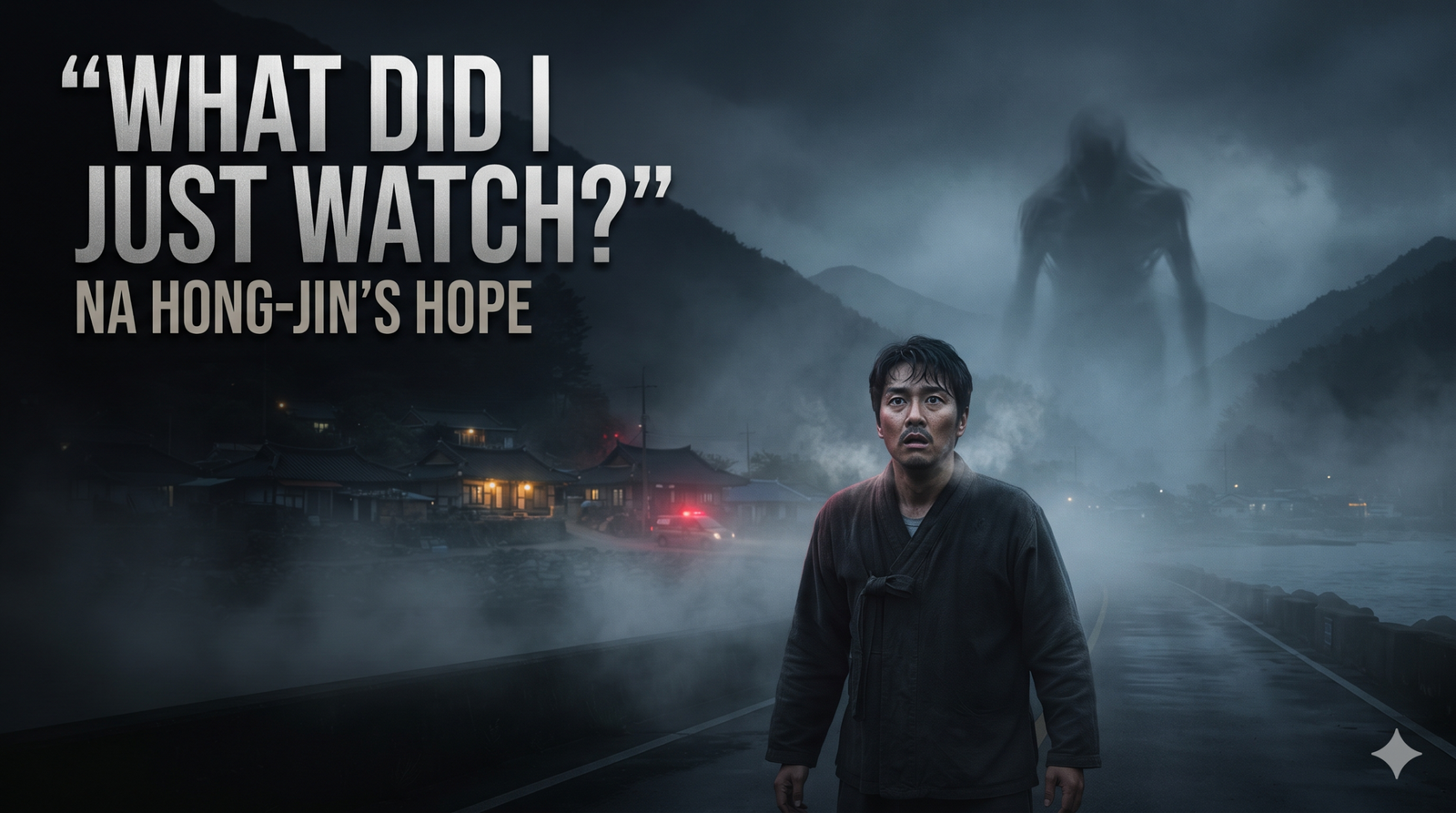
  • HOPE: โ€œWhat Did I Just Watch?โ€ Why Korean Audiences Loved and Hated Na Hong-jinโ€™s Most Divisive Film

    HOPE: โ€œWhat Did I Just Watch?โ€ Why Korean Audiences Loved and Hated Na Hong-jinโ€™s Most Divisive Film

    Na Hong-jinโ€™s HOPE became one of South Koreaโ€™s most talked-about movie releases of 2026. It attracted millions of moviegoers, generated extraordinary praise for its action and cinematography, and triggered equally passionate criticism of its story, dialogue and ending. But the most interesting reaction was not simply that audiences disliked the film. It was that some viewers found it incredibly entertaining while simultaneously wondering what they had just watched.

    1. A Box Office Hit That Divided Its Own Audience

    When Na Hong-jin’s HOPE opened in South Korea on July 15, 2026, expectations were unusually high.

    It was the director’s first feature film in a decade following The Wailing, and its combination of Korean stars, Hollywood actors, science fiction and creature-feature action made it one of the year’s most anticipated releases.

    The opening numbers were impressive.

    According to the Korean Film Council figures reported by Yonhap, HOPE attracted approximately 1.5 million moviegoers over its opening weekend. Its cumulative admissions passed 2.1 million by its fifth day.

    But the box office success concealed an unusual problem.

    Audiences were not responding to the film in a consistent way.

    Some described it as an extraordinary theatrical experience. Others considered it an ambitious but deeply frustrating production.

    The Korea Herald reported that Naver’s ticket-verified audience ratings were sharply divided at the time: 53 percent of ratings were 9 or 10, while 23 percent were 1 or 2.

    That is not an ordinary disagreement over whether a film is slightly above average.

    It suggests that HOPE delivered experiences so different that viewers could leave the same screening with almost opposite opinions.

    2. โ€œThe First Half Was Incredible. What Happened After That?โ€

    One of the most revealing complaints concerned the difference between the film’s opening and its later developments.

    The early sections establish a remote village, strange reports of an animal attack and a growing sense that something dangerous is approaching.

    The police and local residents try to understand what is happening.

    The tension builds through uncertainty, frantic movement and the familiar atmosphere of a Na Hong-jin thriller.

    For some viewers, this was the film at its strongest.

    The opening creates an effective combination of mystery and physical danger. The audience knows that something is wrong, but does not yet understand the scale of the threat.

    Then the film begins expanding beyond the expectations established by its opening.

    The creature encounters become increasingly strange. The story moves between different tones, and the original village mystery develops into something much larger.

    Aju Press reported one particularly revealing mixed reaction: a viewer praised the overwhelming first half and the cinematography but found the second half somewhat anticlimactic.

    This criticism is more specific than simply saying the movie becomes boring.

    It suggests that the film establishes one set of expectations and then moves into a different kind of storytelling.

    For viewers who wanted the opening mystery to develop into a more conventional creature thriller, that change could feel like a loss of direction.

    3. The Strange Contradiction: โ€œI Didn’t Understand It, But I Was Entertainedโ€

    Perhaps the most interesting Korean audience reaction was the combination of admiration and frustration.

    A viewer quoted by Aju Press criticized the film’s story, world-building and visual effects but still described it as one of the most entertaining Korean films they had watched recently.

    That is a particularly useful reaction because it separates two things that movie reviews often combine:

    The quality of the viewing experience and the quality of the storytelling.

    A film can be exciting without being completely coherent.

    It can have extraordinary action sequences while leaving important questions unanswered.

    It can create memorable images without developing every character or idea to the audience’s satisfaction.

    In HOPE, these elements frequently appear together.

    The film keeps introducing new situations, visual ideas and unexpected developments. Even when the larger story becomes difficult to follow, the experience remains active.

    This helps explain why some viewers could criticize the screenplay while still recommending the movie as a theatrical experience.

    They were not necessarily contradicting themselves.

    They were evaluating different parts of the same film.

    4. Why Did the Dialogue Become Such a Big Problem?

    Another recurring criticism involved the dialogue.

    Some Korean viewers complained that conversations were difficult to understand during noisy action sequences. Others felt that the characters relied too heavily on profanity and shouting.

    Aju Press reported complaints about dialogue delivery, including a viewer who struggled to understand what characters were saying.

    The Korea Herald also identified dialogue as one of the recurring areas of audience dissatisfaction.

    But the problem deserves a closer look.

    In a conventional action film, dialogue often serves a practical purpose.

    Characters explain the threat, exchange information, make decisions and move the story forward.

    In a film as chaotic as HOPE, however, the dialogue also has to establish the personalities and emotional reactions of the villagers.

    If the conversations become difficult to follow, viewers can lose more than individual lines.

    They may also lose their understanding of the characters’ motivations.

    This is particularly important when the story moves into unfamiliar science-fiction territory.

    The more extraordinary the situation becomes, the more important it is for audiences to understand how the human characters are responding to it.

    For some viewers, the film’s dialogue did not provide enough clarity to balance its increasingly unusual developments.

    5. Why Did Everyone Seem to Be Shouting?

    The criticism of the dialogue was closely connected to another reaction: some viewers felt that the characters displayed too narrow an emotional range.

    The situation in HOPE is extraordinary.

    A remote Korean community encounters a threat that challenges everything its residents understand about the world.

    Fear, confusion, anger, disbelief and desperation should naturally overlap.

    But some audience reviews suggested that the characters’ emotional responses became repetitive.

    Instead of experiencing a wide range of personalities reacting differently to an impossible situation, viewers sometimes felt surrounded by constant shouting and aggression.

    There is another way to interpret this choice.

    Na Hong-jin’s previous films often place ordinary people under extreme pressure. His characters do not necessarily behave with the calmness or logic expected from conventional movie heroes.

    In HOPE, that approach is pushed into a much larger and stranger setting.

    The question is whether the audience experiences that behaviour as convincing chaos or simply exhausting repetition.

    That difference may explain why the same performances could feel energetic to one viewer and irritating to another.

    6. The Creature Effects Became Part of the Debate

    The film’s visual effects were another major dividing line.

    HOPE was an unusually ambitious Korean production, combining live-action performances, creature design, motion-capture work and extensive visual effects.

    The mysterious beings are central to the film’s identity.

    They are not simply ordinary monsters appearing in a familiar invasion story.

    Their presence changes the scale and direction of the narrative.

    But some viewers felt that the computer-generated imagery weakened the experience rather than strengthening it.

    This criticism was not limited to Korean audiences.

    At Cannes, international coverage also highlighted sharply divided reactions to the creature effects.

    Some viewers were impressed by the scale and imagination of the film. Others questioned whether the visual effects consistently matched the ambition of the production.

    There is an important distinction here.

    A creature design can be imaginative while its digital execution remains unconvincing.

    And in a film that depends so heavily on the audience believing in unfamiliar beings, visual inconsistencies can become particularly noticeable.

    For viewers who were already struggling to understand the story, questionable effects could make the experience even more difficult.

    7. โ€œWas This Really a Na Hong-jin Film?โ€

    This reaction was especially revealing because expectations surrounding the director were so high.

    Na Hong-jin built his reputation through films such as The Chaser, The Yellow Sea and The Wailing.

    Those works are associated with escalating tension, disturbing violence, moral uncertainty and carefully constructed suspense.

    Audiences therefore entered HOPE with a particular understanding of what a Na Hong-jin film might deliver.

    But HOPE is a very different kind of project.

    It mixes science fiction, creature horror, action, dark comedy and elements of farce.

    The film does not remain inside the familiar boundaries of a serious Korean thriller.

    That change may be one of its most ambitious qualities.

    It may also be one reason some viewers felt disappointed.

    When audiences expect another film in the tradition of The Wailing, a strange science-fiction spectacle can feel like a completely different promise.

    The problem is not necessarily that the new film is worse.

    It is that the director’s established reputation creates expectations that the new work deliberately challenges.

    8. The Ending: Why Did Some Viewers Feel the Movie Had Just Begun?

    The ending became one of the most controversial parts of HOPE.

    After approximately 156 minutes, viewers might reasonably expect the central conflict to reach a more conventional conclusion.

    Instead, the film moves toward a much larger picture of the events surrounding the village and the mysterious beings.

    Some viewers found this exciting.

    Others felt that the story stopped just as it was becoming more interesting.

    The Korea Herald reported that the lack of a satisfying resolution was among the complaints raised by Korean audiences.

    The comparison to a very long trailer is therefore understandable.

    The film introduces a world that appears to contain far more story than can be explored in a single movie.

    However, that does not automatically mean the film is incomplete.

    A story can deliberately end without explaining every element of its larger world.

    The real question is whether the unresolved material feels like a meaningful artistic decision or an unsatisfying interruption.

    For some viewers, the open-ended structure created anticipation.

    For others, it created frustration.

    That disagreement is central to the film’s reception.

    9. The Most Interesting Question: Is HOPE Actually About the Creatures?

    There is another possible explanation for why viewers reacted so differently.

    Perhaps the film is not primarily interested in delivering a conventional alien-invasion story.

    Director Na Hong-jin has discussed the importance of differences in perspective and the way misunderstanding can create conflict.

    In an interview with The Washington Post, he explained that the project initially developed around ideas involving xenophobia and immigration before expanding into a much larger story.

    This gives the film another possible interpretive direction.

    The creatures are not necessarily just an external threat.

    They also create a situation in which humans must confront something they do not understand.

    The villagers interpret the unknown through their own fears, assumptions and limited information.

    Their reactions are shaped by what they believe is happening, not necessarily by what is actually happening.

    That creates a connection between the film’s science-fiction premise and its human conflicts.

    It also offers one explanation for the deliberately unstable tone.

    The audience is not always given a comfortable position from which to understand the events.

    Instead, viewers experience the confusion of a community confronted with something far beyond its understanding.

    This interpretation does not resolve every criticism of the film’s pacing or dialogue.

    But it helps explain why the story may be more interested in perspective and misunderstanding than in providing a straightforward explanation of every mystery.

    10. Why Did the Film Become Such a Big Online Argument?

    The debate around HOPE became part of the film’s wider cultural life.

    People were not simply comparing ratings.

    They were arguing about what kind of movie it was supposed to be.

    Was it a creature feature?

    A science-fiction action film?

    A dark comedy?

    A social allegory?

    An intentionally chaotic experiment in genre filmmaking?

    Different viewers focused on different aspects.

    Some praised the cinematography and large-scale action.

    Others concentrated on the visual effects, dialogue and narrative structure.

    The film’s unusual mixture of genres made it difficult to summarize in a single sentence.

    That difficulty helped fuel online discussion.

    In a Reddit discussion following the North American release, one viewer described the experience as feeling like too much was happening while the actual story was not progressing enough.

    Another argued that the film’s opening created a level of tension that the later sections never fully recovered.

    These comments are individual reactions, not a representative survey. But they illustrate that the central disagreement continued outside South Korea.

    The film’s conversation became almost as unpredictable as the movie itself.

    11. Did American Audiences React Differently?

    The North American release provided another opportunity to test whether the Korean reaction was tied to local expectations.

    NEON released HOPE in the United States on September 9, 2026, with a wide theatrical rollout.

    The Korea Herald reported that the film opened in approximately 1,560 theaters across the United States and Canada, making it the widest North American release for a Korean-language film since Parasite.

    The critical response was not uniformly positive or negative.

    Rotten Tomatoes’ audience reviews also included viewers who praised the action and humour while criticizing the abrupt ending and the length of the film.

    This is important because it challenges the idea that Korean audiences simply failed to understand a film that foreign viewers appreciated.

    The same basic disagreement appeared in both markets.

    Some viewers embraced the unusual experience.

    Others wanted a more coherent story and a more satisfying conclusion.

    Cultural background may influence how viewers interpret certain themes, but the film’s structural and stylistic divisions are not exclusive to Korea.

    12. Was the Sequel the Reason the Ending Felt So Unfinished?

    There is a reason viewers began discussing a possible continuation.

    Na Hong-jin confirmed that he had already developed additional story material and hoped to create an opportunity to make a sequel.

    Reuters reported his comments at Cannes in May 2026.

    But there is an important distinction between having a story prepared and having a sequel officially moving into production.

    The existence of additional material does not prove that the first film was designed only as an introduction.

    Na has also discussed wanting to explore the aliens’ perspective more deeply.

    That possibility is particularly interesting because the first film spends much of its time presenting events through the human community.

    A continuation could expand the story beyond the limited understanding of the villagers.

    For viewers who felt that HOPE ended just as the larger mystery was beginning, that possibility may be appealing.

    But the first film still needs to be judged on what it actually delivers.

    A possible sequel cannot automatically solve problems that some viewers experienced in the original movie.

    13. What Korean Audience Reactions Really Tell Us

    The reaction to HOPE reveals more than a disagreement over whether one film is good or bad.

    It exposes a conflict between different expectations of what a major Korean film should deliver.

    Some audiences wanted a tightly constructed thriller from the director of The Wailing.

    Others were excited by the opportunity to see a Korean filmmaker attempt a large-scale science-fiction spectacle.

    Some valued the film’s visual imagination more than its narrative clarity.

    Others believed that the story needed stronger explanations and more consistent character development.

    These are different standards of evaluation.

    And HOPE gave audiences plenty of reasons to apply them.

    The strongest positive reactions often focused on the theatrical experience: scale, action, cinematography, performances and the sheer unpredictability of the film.

    The strongest negative reactions often focused on narrative satisfaction: dialogue, pacing, visual effects, character behaviour and the ending.

    That distinction is more useful than simply dividing viewers into people who loved the film and people who hated it.

    It helps explain why the same movie could be described as both an exhilarating experience and a frustrating disappointment.

    Final Thoughts: The Movie Ended, but the Argument Continued

    The funniest reaction to Na Hong-jin’s HOPE may also be the most revealing:

    โ€œI enjoyed watching it. I’m just not entirely sure what I watched.โ€

    That sentence captures the contradiction at the heart of the film’s reception.

    HOPE delivered large-scale action, unusual imagery and a genre mixture rarely attempted at this scale in Korean cinema.

    But it also left some viewers dissatisfied with its narrative direction, dialogue and ending.

    Its success at the box office and the sharply divided audience ratings show that these reactions were not mutually exclusive.

    For some people, the film was exactly the kind of unpredictable cinematic experience they wanted.

    For others, it was a fascinating idea that never completely came together.

    Perhaps the most important question is not whether Korean audiences understood HOPE.

    It is whether the film successfully communicated the experience it wanted to create.

    And that remains a question viewers can debate long after the credits have finished.

    So, which side are you on? Was HOPE a bold and unforgettable experiment, or did its ambition become bigger than its story?

  • HOPE Series #3: Why the Cinematography and Production Design Are Winning So Much Praise

    Na Hong-jinโ€™s HOPE may be dividing audiences over its story and ending, but one aspect of the film has attracted a much more consistent response:

    Its visual craftsmanship is extraordinary.

    From a devastated Korean village to the vast forests of Romania, HOPE creates a world that feels physically enormous, unsettling, and increasingly unfamiliar. Even viewers who question the filmโ€™s narrative structure have found plenty to admire in its cinematography, production design, and large-scale action sequences.

    But what makes the film visually impressive is not simply the number of explosions, destroyed buildings, or elaborate creature effects.

    It is how carefully the filmmakers use physical environments to shape the audienceโ€™s experience.

    The village, the forest, and the open road each create a different kind of tension. Together, they make the film feel like several distinct worlds gradually colliding.

    1. The Cinematographer Behind Parasite and Burning

    HOPE was shot by acclaimed Korean cinematographer Hong Kyung-pyo, whose work has already reached international audiences through films such as Parasite, Burning, Snowpiercer, and Na Hong-jinโ€™s own The Wailing.

    For HOPE, Hong and Na chose a visual approach built around movement, scale, and uncertainty.

    During the early sequences, the camera frequently follows police chief Bum-seok as he moves through a devastated village. Rather than presenting the destruction through a series of distant, neatly composed images, the camera keeps the audience close to the characters.

    This creates an important difference.

    We do not simply observe a disaster from a safe distance. We experience it alongside people who are trying to understand what has happened.

    The camera moves through damaged spaces, follows urgent decisions, and sometimes reveals only fragments of the larger threat.

    That approach makes the cinematography part of the storytelling rather than a decorative layer placed on top of it.

    2. The Monster Is Missing, but Its Presence Is Everywhere

    One of the filmโ€™s most effective visual decisions is its handling of the creature.

    Instead of immediately showing the threat in full, HOPE allows the audience to encounter its consequences first.

    Gunshots, explosions, damaged buildings, overturned vehicles, and injured people establish the scale of the disaster before the creature becomes fully visible.

    This technique works because the audience begins constructing an image of the monster through the destruction it leaves behind.

    The question is no longer simply what the creature looks like.

    It becomes: What kind of force could have caused all this damage?

    The absence of a complete image can sometimes create more tension than an immediate reveal. The audience is forced to imagine something larger and more frightening than what it can currently see.

    The moving camera reinforces that uncertainty. As Bum-seok tries to understand the situation, viewers are also trying to catch up.

    The result is an opening that feels less like a conventional monster introduction and more like an investigation unfolding inside a disaster.

    3. The Destroyed Village Was Designed, Not Randomly Destroyed

    The production design is another major reason HOPE feels unusually physical.

    Production designer Lee Hwoo-kyung, a longtime collaborator of Na Hong-jin, helped construct the filmโ€™s environments. According to the production team’s behind-the-scenes explanations, the interior scenes were built as sets, allowing the filmmakers to control the spaces in which the characters move.

    The destroyed village is particularly interesting.

    At first glance, its damaged buildings and scattered debris appear chaotic. But the production design was developed with attention to the events that supposedly happened in each location.

    The destruction was not simply intended to make the village look expensive or spectacular.

    It needed to communicate a history.

    A collapsed structure suggests the force that struck it. A damaged road changes how characters can move. The condition of a building can hint at where the creature passed and how violently the environment was affected.

    This is where production design becomes visual storytelling.

    The audience may not consciously examine every broken wall, but the accumulated details help create the impression that the village has experienced a real event.

    The destruction feels convincing because it belongs to the geography of the story.

    4. Haenam Became a Devastated Korean Village

    The Korean village sequences were filmed in locations including Haenam County in South Jeolla Province, with other Korean locations also used during production.

    The filmmakers transformed these environments into the fictional setting of HOPE.

    The physical scale of the locations matters. Characters are not simply standing in front of isolated digital backgrounds. They move through roads, buildings, and open spaces that give the destruction a tangible presence.

    This helps explain why the village feels so different from a typical computer-generated disaster environment.

    The buildings have texture. The roads have depth. Debris occupies the same physical space as the actors.

    That does not mean visual effects are absent. Rather, the film combines physical environments with digital work to create a more convincing whole.

    The most effective production design often works this way: viewers do not need to identify which elements are real and which are enhanced. They only need to believe that the world exists.

    5. Romania Gives the Film a Completely Different Visual Identity

    The forest sequences introduce a major change in the filmโ€™s visual atmosphere.

    These scenes were filmed in Romania, where Hong Kyung-pyo and Na Hong-jin explored mountain and forest locations in search of landscapes that could give the film a distinctive atmosphere.

    The choice is important because the forest does not feel like another version of the devastated village.

    The village is crowded with evidence of human life and destruction. Its streets and buildings give viewers familiar points of reference.

    The forest removes many of those references.

    Trees, mountains, uneven terrain, and vast natural spaces make the characters appear smaller and more isolated.

    The visual effect is almost the opposite of the village sequences.

    In the village, the audience sees the consequences of an attack on a familiar human environment. In the forest, the characters enter a landscape that seems to operate according to different rules.

    This change in geography also changes the emotional experience of the film.

    The tension becomes less about investigating a visible disaster and more about confronting something that feels difficult to understand or control.

    6. Why the Forest Had to Work for Both the Camera and the Action

    The Romanian locations were not selected only for their beauty.

    The production also needed terrain capable of supporting demanding action sequences, including scenes involving horses.

    That created practical requirements.

    The filmmakers needed enough space for the horses to accelerate, move through the environment, and slow down safely. The landscape also had to accommodate camera movement and the physical demands of the scenes.

    This is an important part of large-scale filmmaking that audiences rarely notice.

    A location can look spectacular in a photograph but become difficult to use once actors, animals, cameras, lighting equipment, and stunt teams arrive.

    The best locations must serve several purposes at once.

    They must look convincing on screen, support the action, and allow the director to capture the intended visual rhythm.

    In HOPE, the Romanian forest becomes more than a beautiful background. It is an active part of the film’s physical world.

    7. A Spaceship in the Middle of a Romanian Forest

    One of the most striking production choices is the enormous spaceship environment constructed in the Romanian forest.

    The contrast is immediately memorable.

    A vast science-fiction object appears within a landscape of trees, mountains, soil, and natural light.

    Rather than separating the alien world from the natural environment, the film places them directly together.

    That contrast helps give HOPE its unusual visual identity.

    The forest feels ancient and largely untouched by modern human activity. The spaceship introduces technology and a scale that seem completely foreign to that environment.

    The two visual languages collide inside the same frame.

    This is also a useful example of why physical production design matters in a science-fiction film. A large constructed environment gives the actors and camera something tangible to interact with, while the surrounding landscape helps establish scale.

    The result is not simply an image of a spaceship.

    It is an image of something unfamiliar entering a world that was never built for it.

    8. The Road Chase Was Filmed in Hapcheon

    Another major part of the film’s production took place in Hapcheon County, South Gyeongsang Province, which was used for the climactic road chase.

    This sequence adds another visual environment to the film.

    The village is defined by damaged buildings and confined spaces. The Romanian forest creates isolation and uncertainty. The road, by contrast, offers open space, speed, and the possibility of large-scale movement.

    These environments give the action sequences different visual identities.

    That variety is important because a film can become visually repetitive when every major confrontation uses the same camera distance, landscape, and movement.

    HOPE repeatedly changes the physical relationship between its characters and their surroundings.

    The road chase therefore feels different from the village disaster or the forest sequences, even though all three belong to the same escalating story.

    9. Why HOPE Looks So Expensive

    The film’s visual scale is obvious, but its impact cannot be explained by production cost alone.

    What matters is how different filmmaking techniques are combined.

    • Physical sets provide environments for actors and cameras.
    • International locations create landscapes that are difficult to reproduce convincingly.
    • Production design gives destroyed spaces an internal logic.
    • Cinematography controls how viewers experience movement and scale.
    • Stunt work gives action sequences physical energy.
    • Visual effects extend what can be achieved through practical environments.

    The combination is more important than any single element.

    A large explosion may attract attention for a few seconds. But a convincing environment can influence every scene that takes place inside it.

    That is why HOPE often feels enormous even when the story focuses on a relatively small group of characters.

    Its world is not just a backdrop. It is constantly shaping what the audience sees and feels.

    10. Even Viewers Who Disagree About the Story Praise the Craft

    One interesting aspect of the discussion surrounding HOPE is the difference between reactions to its narrative and reactions to its filmmaking.

    The story, pacing, dialogue, creature design, and ending have generated considerable debate.

    Some viewers find the film ambitious and emotionally challenging. Others feel that its ideas are difficult to follow or that its narrative choices do not fully come together.

    But its visual craftsmanship has frequently been singled out for praise.

    Reviews have highlighted Hong Kyung-pyo’s cinematography, the scale of the environments, the production design, and the action sequences.

    That distinction is worth examining.

    A film can be visually accomplished without satisfying every viewer emotionally or narratively.

    In fact, the contrast may be part of what makes HOPE such a divisive experience. Its images can feel carefully controlled even when the story itself feels unpredictable.

    The film’s visual world is often easier to appreciate than its narrative direction.

    11. What the Visual Design Reveals About Na Hong-jin’s Approach

    The three major environments also suggest something about the director’s approach to tension.

    The village gives the audience a familiar world that has been violently disrupted.

    The forest removes familiar boundaries and makes the characters appear vulnerable within a much larger landscape.

    The road transforms the environment into a space of speed, pursuit, and physical danger.

    Each setting changes the way the audience experiences the threat.

    This is more interesting than simply making every location look impressive.

    The environments perform different narrative functions. They influence the pace of the action, the distance between characters, and the amount of information available to the audience.

    That is why the production design and cinematography should be considered together.

    One creates the physical world. The other determines how viewers encounter it.

    12. HOPE Is Also a Showcase for the People Behind the Camera

    When audiences discuss a major film, attention usually goes first to the director and actors.

    But a production on the scale of HOPE depends on the combined work of many creative and technical departments.

    Hong Kyung-pyo’s cinematography shapes how the audience experiences the destruction and the landscapes.

    Lee Hwoo-kyung’s production design gives those environments their physical character.

    Location teams find places that can become a Korean disaster zone or an unfamiliar alien landscape.

    Stunt performers, sound designers, visual-effects artists, and many other crew members help turn those environments into believable cinematic experiences.

    The film is therefore a reminder that visual spectacle is rarely the achievement of one person.

    It emerges from hundreds of decisions that must work together.

    Why Does HOPE Look So Impressive Even When Its Story Divides Audiences?

    The answer lies in the relationship between its environments and its filmmaking techniques.

    HOPE does not rely on one spectacular location or a single visual trick. It moves through several distinct physical worlds, each with its own atmosphere and dramatic purpose.

    The destroyed village makes the disaster feel immediate.

    The Romanian forest creates isolation and uncertainty.

    The spaceship introduces an extraordinary contrast between alien technology and the natural landscape.

    The road chase turns open geography into a source of action and tension.

    Together, these choices give the film a visual identity that remains memorable even for viewers who are uncertain about its story.

    You may question the pacing. You may disagree with the ending. You may even leave the theater unsure what the film ultimately wants to say.

    But the craft behind the images is difficult to overlook.

    The real achievement of HOPE is not simply that it looks spectacular. It is that its locations, camera movement, and production design make the audience feel as though they have entered a world that is physically falling apart.

  • HOPE Series #2: Why Korean Audiences Are So Divided Over Na Hong-jinโ€™s New Movie

    Na Hong-jinโ€™s HOPE is generating one of the strangest audience reactions surrounding a Korean movie in 2026.

    Some viewers are praising its breathtaking cinematography, production design, action sequences and extraordinary sense of immersion.

    Others are leaving theaters frustrated by its dialogue, storytelling and open-ended conclusion.

    But there is another reaction that may describe HOPE better than either โ€œgoodโ€ or โ€œbadโ€:

    It is incredibly entertaining โ€” and incredibly confusing.

    That contradiction helps explain why reactions to HOPE have become so polarized in Korea.

    A Movie That Is Difficult to Rate

    Most divisive movies follow a familiar pattern.

    One group loves the movie. Another group hates it.

    HOPE appears to be more complicated.

    Some viewers who criticize the ending still praise the experience of watching the movie. Others who are frustrated by the story acknowledge its remarkable visual craftsmanship.

    That creates an unusual situation where the same viewer can essentially say:

    โ€œI was completely immersed while watching it, but I didnโ€™t know what to think when it ended.โ€

    That feeling has become one of the most interesting parts of the Korean conversation surrounding HOPE.

    The Biggest Strength: Immersion

    One point repeatedly appearing in positive reactions is the filmโ€™s ability to pull viewers into its world.

    The isolated Korean village, enormous landscapes, mysterious creatures and escalating action create an atmosphere that rarely gives the audience time to relax.

    Once the central incident begins, the movie keeps expanding.

    What starts as a strange event in a remote community gradually becomes something much larger.

    For viewers who respond to this style of filmmaking, the experience can feel almost overwhelming.

    This is where Na Hong-jinโ€™s strengths are most obvious.

    Rather than constantly explaining what is happening, he often allows images, sound and action to carry the experience.

    For some viewers, that creates extraordinary immersion.

    For others, it eventually creates frustration.

    Cinematography and Production Design Are Receiving Strong Praise

    One of the least controversial aspects of HOPE appears to be its visual filmmaking.

    Even among people who have problems with the story, praise for the cinematography, sets, locations and production design has been remarkably consistent.

    The movie frequently communicates scale through its environment.

    The village does not simply function as a background. Forests, roads, destroyed buildings and open landscapes become part of the tension.

    The result is a Korean science-fiction movie that looks unusually large and physical.

    This visual confidence is one reason some viewers remain enthusiastic about HOPE even when they criticize other parts of the film.

    Then Comes the Problem: โ€œHow Is This Going to End?โ€

    The more HOPE expands, the bigger the question becomes.

    How is Na Hong-jin going to bring all of this together?

    That question seems to become particularly important during the second half of the movie.

    The mysteries grow.

    The scale grows.

    The questions grow.

    And eventually some viewers begin waiting for the moment when all of those pieces will finally connect.

    Then the movie ends.

    For viewers expecting a conventional resolution, that can be startling.

    The experience has inspired humorous comparisons among Korean moviegoers, including the feeling of watching an extremely long preview for a much bigger story that has not arrived yet.

    Others describe being completely absorbed for most of the runtime, only to feel bewildered when the credits appear.

    That contrast may be the single best explanation for HOPEโ€™s polarized reception.

    Why the Dialogue Is Being Criticized

    The visuals are not the only source of disagreement.

    Some Korean viewers and critics have also raised concerns about the dialogue.

    This is particularly noticeable because the visual storytelling is so ambitious.

    When a movie looks this impressive, awkward or repetitive dialogue can stand out even more.

    For some viewers, the dialogue and humor interrupt the tension rather than strengthening it.

    Others are more willing to accept those elements as part of Na Hong-jinโ€™s unusual mixture of horror, action and dark comedy.

    Once again, the disagreement is not simply about technical quality.

    It is also about tone.

    HOPE frequently refuses to behave like the kind of movie audiences expect it to be.

    โ€œFun, But Bafflingโ€ May Be the Best Description

    Perhaps the most interesting Korean reactions are not the traditional positive or negative reviews.

    They are the confused ones.

    People describe being entertained.

    They praise the action.

    They praise the cinematography.

    They praise the production design.

    Then they describe walking out of the theater wondering:

    What exactly did I just watch?

    That is why simply looking at a score may not tell you very much about HOPE.

    A viewer who gives the movie a low score may still admit that parts of it were spectacular.

    A viewer who loves the movie may still have difficulty explaining exactly what happened.

    In that sense, HOPE may be less interesting as a movie everyone agrees is excellent than as a movie everyone wants to argue about afterward.

    The Ending Is Where the Debate Explodes

    Without spoiling the ending, it is fair to say that HOPE does not answer every question it raises.

    That appears to be intentional.

    Na Hong-jin has already written a continuation to the story and has expressed interest in making another film.

    However, that does not automatically solve the problem for viewers watching HOPE as a standalone movie.

    Some audiences enjoy stories that leave large mysteries unresolved.

    Others expect a film lasting more than two and a half hours to provide considerably more closure.

    Both reactions are understandable.

    And that difference in expectations may explain why two people can watch exactly the same movie and leave the theater with completely opposite opinions.

    Is the Confusion Actually Helping HOPE?

    Strangely, it might be.

    A movie that explains everything can end when the credits roll.

    HOPE seems to continue in conversations afterward.

    People debate what happened.

    They discuss the creatures.

    They argue about the ending.

    They wonder whether a sequel is necessary.

    They compare interpretations.

    And Korean viewers have become remarkably creative in describing the experience.

    Some of the audience reactions are so funny that people have even joked that reading the reviews afterward can be almost as entertaining as watching the movie itself.

    That kind of conversation is difficult for a studio to manufacture.

    It happens when a movie leaves something unresolved in the audienceโ€™s mind.

    Now It Is Americaโ€™s Turn

    This makes the U.S. release particularly interesting.

    American audiences will soon encounter the same movie that has produced such dramatically different reactions in Korea.

    Will they be frustrated by the lack of answers?

    Will they respond more strongly to its science-fiction spectacle and action?

    Or will American theaters produce the same reaction reportedly experienced by some Korean moviegoers โ€” viewers leaving the screening and immediately asking each other what they just watched?

    That may ultimately become one of the most interesting stories surrounding HOPE.

    Because right now, the most accurate description of the Korean response may not be:

    โ€œPeople love it.โ€

    And it may not be:

    โ€œPeople hate it.โ€

    It may simply be:

    โ€œThey canโ€™t stop talking about it.โ€

  • HOPE (2026): Why Na Hong-jinโ€™s Korean Sci-Fi Movie Is Worth Watching

    Na Hong-jin, the filmmaker behind The Chaser, The Yellow Sea, and The Wailing, has returned with a movie that is difficult to classify.

    His 2026 science-fiction thriller HOPE brings together a remote Korean village, mysterious extraterrestrial beings, an international cast, large-scale action, and a story that deliberately refuses to explain everything immediately.

    The film opened in South Korea on July 15, 2026, before arriving in U.S. theaters through NEON on September 9. Its American digital release followed on October 13.

    By the time international audiences encountered it, however, HOPE had already become one of the year’s most divisive Korean cinematic experiences.

    Some viewers praised its ambitious visual design, relentless action, unusual humor, and immersive atmosphere. Others questioned its computer-generated effects, dialogue, narrative structure, and deliberately unresolved ending.

    That disagreement is part of what makes the film worth discussing.

    HOPE is not simply another Korean horror movie or a conventional Hollywood-style alien invasion story.

    It is an ambitious attempt to combine several genres while exploring a much more uncomfortable question:

    What happens when fear and misunderstanding turn ordinary people into participants in a catastrophe they do not fully understand?

    1. What Is HOPE About?

    HOPE takes place in Hope Harbor, a fictional fishing village in South Korea near the heavily fortified border region.

    The story begins when reports of a mysterious creature throw the community into confusion.

    Police outpost chief Bum-seok, played by Hwang Jung-min, and officer Sung-ae, played by Hoyeon, attempt to protect the village as the situation becomes increasingly dangerous.

    Meanwhile, Sung-ki, portrayed by Zo In-sung, joins a group of local hunters searching for the mysterious beast in the surrounding mountains.

    What initially appears to be a creature-hunting story gradually develops into something much larger.

    The residents are confronted with an extraordinary presence that challenges their understanding of what is happening around them.

    The official synopsis describes a chain of events in which ignorance creates the conditions for disaster, eventually escalating through human conflict into a tragedy of cosmic proportions.

    That description offers an important clue.

    The central conflict is not simply between humans and an unfamiliar creature.

    It is also about how people react when they encounter something they cannot understand.

    Rather than revealing every detail here, it is better to approach the film with limited knowledge of its later developments.

    2. Why Na Hong-jin’s Return Matters

    The director is arguably the biggest reason HOPE attracted international attention.

    Na Hong-jin built his reputation through three distinctive films:

    • The Chaser (2008)
    • The Yellow Sea (2010)
    • The Wailing (2016)

    Each film demonstrated his interest in characters trapped in increasingly dangerous situations.

    His stories often begin with recognizable human problems before expanding into something much more disturbing.

    The Chaser turns a pursuit into a desperate struggle against institutional failure and human cruelty.

    The Yellow Sea combines crime, desperation, and escalating violence.

    The Wailing begins with a seemingly local mystery before developing into a disturbing exploration of belief, suspicion, and supernatural uncertainty.

    HOPE continues his interest in uncertainty but moves into a substantially different cinematic territory.

    Instead of concentrating primarily on crime and supernatural horror, Na attempts to build a large-scale science-fiction world.

    This is his first feature film since The Wailing, making the ten-year gap particularly significant.

    The new film also demonstrates that Na is not interested in simply repeating the style that made him internationally famous.

    He wanted to make a different kind of entertainment experience.

    3. A Korean Story With an International Cast

    One of the most unusual aspects of HOPE is the combination of Korean characters and internationally recognized performers.

    The principal Korean cast includes:

    • Hwang Jung-min as Bum-seok, the police chief responsible for protecting the village
    • Zo In-sung as Sung-ki, a local hunter involved in the search for the mysterious creature
    • Hoyeon as Sung-ae, a police officer caught in the unfolding crisis

    The international cast includes:

    • Michael Fassbender
    • Alicia Vikander
    • Taylor Russell
    • Cameron Britton

    Their participation is more than an attempt to make the film commercially attractive outside Korea.

    They are connected to the science-fiction mythology that gradually emerges from the story.

    One particularly interesting production detail is that the international performers had to work with an invented alien language.

    This gives the extraterrestrial characters a different presence from the familiar Hollywood approach in which mysterious visitors simply speak English with unusual accents.

    The language itself becomes part of the film’s world-building.

    It also helps explain why some of the most important information is not communicated through conventional dialogue.

    4. The Visual Ambition Is One of the Film’s Biggest Strengths

    The cinematography is one of the most frequently discussed elements of HOPE.

    Na reunited with cinematographer Hong Kyung-pyo, whose previous work includes The Wailing and Parasite.

    The collaboration is particularly interesting because the two filmmakers are approaching a very different kind of visual challenge.

    Much of the film takes place during daylight.

    That decision matters.

    Creature horror often relies on darkness, restricted visibility, and the fear of not knowing what is hiding outside the frame.

    Na instead wanted to create disturbing images of unfamiliar beings in broad daylight.

    This creates a different visual problem.

    The audience can see the environment, the characters, and the scale of the action. The tension must come from the creatures themselves, the movement of the camera, and the increasingly dangerous situations.

    The production also used different filming locations to create the world of Hope Harbor.

    According to reporting on the production:

    • Haenam County, South Korea: The devastated village sequences
    • Romania: The forest sequences
    • Hapcheon County, South Korea: The major road-chase sequences

    These locations give the film a physical scale that is difficult to create entirely inside a studio.

    The action photography also involved specialized camera teams, including Australian company XM2, known for work involving high-speed and dynamic camera movement.

    For viewers who appreciate ambitious cinematography, these details help explain why the film attracted attention even from people who were less satisfied with its story.

    5. Why Are Korean Audiences So Divided?

    This is perhaps the most revealing part of the HOPE phenomenon.

    The film opened in South Korea on July 15, 2026, with an impressive first-day audience.

    According to Korean media reports, approximately 330,000 people watched it on opening day, making it the strongest opening-day performance among films released in Korea during 2026 at that point.

    But strong initial interest did not translate into universal approval.

    The audience reaction quickly became polarized.

    SBS described the responses as ranging from scores of 1 to 10, illustrating the distance between viewers who loved the experience and those who strongly disliked it.

    The disagreement was not simply about whether the film was entertaining.

    Different audiences were judging different aspects of the same movie.

    Supporters praised:

    • The scale of the action sequences
    • The unusual combination of science fiction and black comedy
    • The cinematography and camera movement
    • The physical performances of the actors
    • The ambition of bringing large-scale science fiction into Korean cinema

    Critics frequently focused on:

    • The visual effects
    • The amount and style of dialogue
    • The transition between genres
    • The narrative structure
    • The lack of conventional explanations near the ending

    This explains why the same film could produce such dramatically different reactions.

    Someone primarily interested in visual spectacle might find HOPE exhilarating.

    Someone expecting a tightly structured mystery with clear answers might leave frustrated.

    The disagreement is therefore partly about expectations.

    6. The CG Debate: Why Do Some Viewers Love the Action but Criticize the Effects?

    The visual-effects discussion deserves particular attention.

    A large-scale science-fiction film depends heavily on the audience believing in the world appearing on screen.

    That becomes difficult when the creatures are unfamiliar and the production must create images that have few direct real-world references.

    Some viewers praised the ambition of the creature designs and the action sequences.

    Others felt that certain computer-generated images did not match the sophistication of contemporary international blockbusters.

    SBS reported that the debate over the film’s CG became one of the central points of disagreement.

    The discussion also revealed something interesting about modern audiences.

    Viewers are now accustomed to highly polished visual effects from major international franchises, streaming productions, and computer-generated entertainment.

    As a result, expectations are extremely high.

    But there is another way to evaluate the film.

    Rather than asking only whether every visual effect looks completely realistic, viewers can also ask whether the visual design successfully communicates the director’s imagination.

    Those are not identical standards.

    A film can be technically imperfect while still containing striking visual ideas.

    Equally, ambitious intentions do not automatically excuse weak execution.

    The interesting question is whether HOPE succeeds in creating an experience that remains memorable despite the disagreements over its effects.

    7. Why Is There So Much Swearing?

    Another aspect that surprised Korean viewers was the amount of profanity.

    The characters repeatedly use strong language during dangerous and chaotic situations.

    For some viewers, this contributed to the film’s black comedy.

    For others, it became excessive.

    In an interview with The Korea Times, Na Hong-jin explained that a substantial amount of the profanity had been removed during post-production.

    He said that more than 100 instances remained, even after he had removed approximately 200.

    Na also explained that he wanted language to function as an emotional reaction in situations where ordinary expressions were no longer sufficient.

    This is an interesting creative decision.

    When characters are confronted with something completely outside their understanding, conventional dialogue can become inadequate.

    Their reactions may become exaggerated, chaotic, and emotionally uncontrolled.

    The problem is that this approach will not work for every viewer.

    Some audiences may interpret the dialogue as part of the film’s deliberately absurd tone.

    Others may find that it weakens the seriousness of the situation.

    Once again, the disagreement reflects the film’s unusual balance between horror, action, comedy, and science fiction.

    8. HOPE Is Not Simply Another Alien Invasion Movie

    It would be easy to market HOPE as a Korean alien-invasion blockbuster.

    But that description does not fully capture what Na appears to be attempting.

    During the film’s presentation at Cannes, Na discussed the connection between human violence, contemporary social problems, and the possibility of breaking repeated cycles of conflict.

    The idea is important because the film does not portray the humans and extraterrestrial beings as completely unrelated forms of life.

    Michael Fassbender also discussed a parallel between the two sides: both humans and the alien characters are concerned with protecting their young.

    That creates a more interesting possibility.

    The film may be using an extraordinary science-fiction situation to examine familiar human behavior.

    People become frightened.

    They make assumptions.

    They identify enemies.

    They react before understanding what is happening.

    And those reactions can create consequences far larger than the original misunderstanding.

    This is why the official synopsis emphasizes ignorance and human conflict rather than presenting the story as a straightforward battle between humanity and an invading force.

    The science-fiction setting provides the spectacle.

    The human behavior provides the underlying conflict.

    9. What Makes the Ending So Divisive?

    Spoiler-free discussion.

    The ending is one of the main reasons viewers have continued debating HOPE.

    Some audiences appreciate that the film does not resolve every mystery.

    Others feel that the story leaves too many questions unanswered after investing more than two and a half hours in its characters and world.

    Both reactions are understandable.

    A conventional blockbuster often establishes its central mystery, develops the threat, and then provides a satisfying explanation or resolution.

    HOPE takes a less conventional approach.

    It creates a larger world than the immediate story can fully explain.

    That decision can be effective when the audience feels that the unresolved elements have emotional or thematic meaning.

    But it can also be frustrating when viewers believe that essential information has been withheld rather than deliberately developed.

    The distinction is important.

    An open ending is not automatically profound.

    And an explained ending is not automatically better.

    The question is whether the unanswered elements create a meaningful desire to understand more.

    For some viewers, HOPE achieves that.

    For others, the ending feels like an incomplete conclusion.

    This disagreement is central to understanding the film’s reception.

    10. Is HOPE Getting a Sequel?

    This question became especially interesting after Na Hong-jin discussed the larger story behind the film.

    At the 2026 Cannes Film Festival, the director revealed that he had already written a story and script for a potential continuation.

    He explained that the world of HOPE could support another film and that he would like to make it if the opportunity arose.

    Later interviews offered more details.

    In September 2026, Na discussed the possibility of expanding the story to include military forces and events connected to North Korea.

    He also suggested that the first film represents only part of a much larger narrative.

    However, there is an important distinction between having a sequel script and having an officially approved production.

    As of November 11, 2026, the sequel had not been formally confirmed as entering production.

    Na said that potential investors had expressed interest, but he also indicated that the timing of a sequel would depend on his next creative decision.

    He has another, darker project in mind and has not committed to making HOPE 2 immediately.

    Therefore, it is reasonable to say that a sequel is being considered and that the director has substantial plans for it.

    It would be premature to describe a second or third film as officially confirmed.

    11. Why American Audiences Should Give HOPE a Chance

    The American release is important because HOPE offers something different from the Korean films that have traditionally received the most international attention.

    It is not primarily a social thriller like Parasite.

    It is not a conventional supernatural horror film like The Wailing.

    And it is not simply an attempt to reproduce the emotional structure of Train to Busan.

    Instead, Na has created a large-scale science-fiction experience built around a distinctly Korean setting and an international cast.

    Its strengths and weaknesses are closely connected.

    The ambition that makes the action sequences unusual also creates technical challenges.

    The unusual dialogue that contributes to its black comedy may frustrate viewers expecting a more restrained thriller.

    The refusal to explain everything may encourage discussion while leaving some audiences dissatisfied.

    That makes HOPE an interesting film to watch, even if it does not work equally well for everyone.

    It is a reminder that international cinema does not need to follow a familiar Hollywood formula to attract attention.

    12. Final Verdict: An Unusual Korean Sci-Fi Experiment Worth Discussing

    HOPE is not a perfectly balanced film.

    Its visual ambition, action design, performances, and unusual atmosphere are among its most distinctive qualities.

    Its effects, dialogue, narrative structure, and unresolved elements have also generated legitimate criticism.

    But the film deserves attention for attempting something that remains relatively unusual in Korean cinema: a large-scale science-fiction production that combines creature horror, action, black comedy, and questions about human behavior.

    Na Hong-jin could have made another film that closely followed the style of The Wailing.

    Instead, he chose to build a much larger and stranger world.

    That decision will not satisfy every viewer.

    But it makes HOPE difficult to dismiss as an ordinary genre release.

    The most interesting question may not be whether the film is a masterpiece or a failure.

    It may be whether its unusual combination of ideas, imagery, and unresolved mysteries will continue to influence conversations about Korean genre filmmaking.

    My conclusion is simple: watch HOPE if you are interested in ambitious science fiction, unusual Korean cinema, or films that create as much discussion as they do spectacle. Just do not expect every question to have an easy answer.


    HOPE (2026): Essential Facts

    South Korean theatrical release: July 15, 2026
    U.S. theatrical release: September 9, 2026
    U.S. digital release: October 13, 2026
    Director: Na Hong-jin
    Screenplay: Na Hong-jin
    Cinematography: Hong Kyung-pyo
    Cast: Hwang Jung-min, Zo In-sung, Hoyeon, Michael Fassbender, Alicia Vikander, Taylor Russell, Cameron Britton
    Genre: Science Fiction / Creature Thriller / Action
    Runtime: Approximately 156โ€“160 minutes
    U.S. distributor: NEON

    What Should We Explore Next?

    The most interesting follow-up is not simply a plot summary.

    It is the question of why HOPE divides viewers so dramatically.

    Some audiences see an ambitious science-fiction spectacle. Others see a film whose visual ambition is not matched by its storytelling.

    In the next article, we can examine the Korean audience reactions in greater depth, including the debate over the CG, the dialogue, the ending, and the unusual humor.

    Next: Why Is HOPE So Divisive? What Korean Audiences Are Really Saying

  • Four Hands: Is Jeong-yo Really More Talented Than Pi-o?

    There is a question that becomes harder to ignore as Four Hands, Two Sonatas develops:

    Is Choi Jeong-yo actually more talented than Kang Pi-o?

    At first, the answer seems obvious.

    Pi-o has spent years receiving elite piano training. His technique has been refined through endless practice and competitions.

    Jeong-yo comes from a completely different background.

    Yet the more Jeong-yo plays, the more people around him begin to recognize something unusual.

    Even Pi-o notices it.

    Then Pi-o’s grandfather, legendary conductor Kang Seung-woon, takes an interest in Jeong-yo and gives him an opportunity.

    That changes the question.

    Maybe this isn’t simply a story about two talented pianists.

    Maybe Four Hands is asking us what “talent” actually means.

    Pi-o Is the Pianist Who Was Built Through Years of Training

    Pi-o’s greatest advantage is obvious.

    He has been trained.

    For years.

    His musical life has been structured around lessons, practice, competitions and evaluation.

    That matters.

    Sometimes dramas romanticize natural talent so much that years of training begin to look almost meaningless.

    Real musical development doesn’t work that way.

    Technique has value.

    Control has value.

    The ability to reproduce a difficult performance consistently under pressure has value.

    Pi-o has spent years developing those abilities.

    So describing him as simply the “less talented” pianist because Jeong-yo possesses extraordinary instinct would be unfair.

    Pi-o is already an exceptional pianist.

    His tragedy is that he has difficulty believing that is enough.

    Jeong-yo’s Talent Is Different

    Jeong-yo fascinates people for almost the opposite reason.

    He has not followed Pi-o’s path.

    He does not arrive with the same polished musical background.

    Yet when he encounters music, he seems capable of understanding and absorbing it at remarkable speed.

    There is something instinctive about him.

    He does not always possess Pi-o’s refinement.

    But he can produce moments that make people listen.

    That difference is crucial.

    Pi-o often appears to understand how a piece should be played.

    Jeong-yo seems capable of discovering what the music could become.

    One is not automatically superior to the other.

    They represent two different kinds of musical intelligence.

    Technique vs Instinct Is Too Simple

    It would be easy to describe their rivalry like this:

    Pi-o = technique

    Jeong-yo = emotion

    But I think the drama is doing something more interesting.

    Pi-o obviously has emotion.

    Jeong-yo obviously needs technique.

    The difference is where each pianist begins.

    Pi-o begins with structure.

    Jeong-yo begins with instinct.

    Pi-o has spent years learning control.

    Jeong-yo is learning how to control something that seems to come naturally.

    That means their development moves in opposite directions.

    Pi-o may need to loosen himself.

    Jeong-yo may need to discipline himself.

    And somewhere between those two paths is the complete musician both are trying to become.

    The Most Important Person Who Recognizes Jeong-yo’s Talent May Be Pi-o

    This is what makes their relationship so painful.

    Pi-o does not need his grandfather to tell him that Jeong-yo is talented.

    He already knows.

    He hears it himself.

    And instead of hiding that knowledge from Jeong-yo, Pi-o actually helps him.

    He teaches him.

    He corrects him.

    He shares knowledge that took years to acquire.

    That tells us something important about Pi-o.

    Despite his jealousy and insecurity, his musical judgment remains honest.

    If Jeong-yo were mediocre, Pi-o could dismiss him.

    Instead, Pi-o recognizes exactly what makes him dangerous.

    In some ways, Pi-o may understand Jeong-yo’s potential better than almost anyone.

    And That Is Why Jeong-yo Frightens Him

    Imagine Pi-o’s position.

    You have spent most of your childhood practicing.

    You have competed repeatedly.

    You have sacrificed enormous amounts of time.

    Then someone enters your life who has not traveled the same road but possesses an ability you cannot simply reproduce through harder practice.

    That does not make Pi-o’s effort meaningless.

    But emotionally, it can feel that way.

    The frightening question is not:

    “What if Jeong-yo practices more than me?”

    It is:

    “What if Jeong-yo has something I can never learn?”

    That is a completely different kind of fear.

    Then Grandpa Chooses Jeong-yo

    Kang Seung-woon’s interest in Jeong-yo makes this private fear public.

    Pi-o has spent years wanting his grandfather’s recognition.

    But Seung-woon is notoriously uncompromising when it comes to music.

    Being family does not guarantee praise.

    So when this respected conductor recognizes Jeong-yo’s potential, Pi-o cannot dismiss it as meaningless encouragement.

    His grandfather’s judgment matters too much.

    That is why the choice hurts.

    But as I argued in my previous analysis, there is another side to this.

    If Seung-woon genuinely believed Jeong-yo deserved the opportunity, should he have chosen Pi-o simply because Pi-o was his grandson?

    That would not prove Pi-o was better.

    It would prove he was family.

    And eventually, that could create an even deeper wound.

    Does Natural Talent Make Jeong-yo the Better Pianist?

    Not necessarily.

    This is where I think viewers need to separate talent, current ability and potential.

    They are not identical.

    A musician can possess extraordinary potential without yet possessing the consistency of a more experienced performer.

    A highly trained musician can currently perform at a higher level while another musician possesses greater unexplored potential.

    Jeong-yo may have an extraordinary ceiling.

    Pi-o may currently possess abilities built through years of disciplined training that Jeong-yo cannot instantly reproduce.

    So asking simply:

    “Who is better?”

    may be the wrong question.

    Better at what?

    Under what conditions?

    Playing what kind of music?

    After how much preparation?

    That is what makes their rivalry interesting.

    Jeong-yo’s Greatest Advantage May Be His Ability to Learn

    Raw emotion alone does not create a great pianist.

    What makes Jeong-yo truly threatening is something else.

    He absorbs.

    When Pi-o teaches him something, Jeong-yo can use it.

    When he encounters a new musical idea, he changes.

    That means the gap created by Pi-o’s years of training may not remain the same forever.

    This is where natural talent becomes frightening.

    A gifted beginner is one thing.

    A gifted beginner who learns unusually quickly is another.

    And Pi-o is watching that development happen directly in front of him.

    But Pi-o Has Something Jeong-yo Needs Too

    There is a danger in becoming too fascinated by Jeong-yo’s genius.

    We can begin treating Pi-o as if he exists only to be surpassed.

    But the drama itself gives us reasons not to do that.

    Jeong-yo benefits from Pi-o.

    Pi-o possesses knowledge Jeong-yo does not.

    He understands discipline.

    He understands musical structure.

    He understands what years of serious training demand.

    And crucially, he knows how to hear Jeong-yo.

    This relationship is not simply:

    genius defeats hard worker.

    Pi-o contributes to Jeong-yo’s development.

    That means Jeong-yo’s growth itself becomes partly connected to Pi-o.

    The rival is also the teacher.

    The teacher is also the rival.

    And both are becoming different musicians because they met.

    Maybe Neither Pianist Is Complete Yet

    This is where the title Four Hands, Two Sonatas becomes especially meaningful to me.

    Four hands cannot belong to one pianist.

    The image itself suggests coexistence.

    Difference.

    Two musical identities sharing the same space.

    Pi-o possesses qualities Jeong-yo lacks.

    Jeong-yo possesses qualities Pi-o struggles to access.

    What happens if each begins learning from the other?

    Jeong-yo could gain discipline without losing instinct.

    Pi-o could rediscover emotion without losing technique.

    Then the question would no longer be:

    Who defeats whom?

    It would become:

    Who do they become because they met?

    The Real Battle May Be Inside Pi-o

    For Jeong-yo, becoming better at piano is largely a process of growth.

    For Pi-o, the challenge is more psychological.

    He may have to accept that another person’s talent does not erase his own.

    That sounds simple.

    It isn’t.

    Pi-o has spent years measuring his value through comparison.

    Rankings.

    Competitions.

    Judgment.

    Recognition.

    So Jeong-yo forces him into unfamiliar territory.

    Can Pi-o hear another pianist play beautifully without experiencing it as evidence that he himself is inadequate?

    If he can learn that, he may become a far better musician than competition alone could ever make him.

    So, Is Jeong-yo More Talented Than Pi-o?

    If by “talent” we mean raw musical instinct and extraordinary potential, the drama clearly gives us reasons to see Jeong-yo as exceptional.

    But that does not make Pi-o an inferior musician.

    Pi-o possesses years of technique, knowledge, discipline and experience that cannot simply be dismissed.

    They are gifted in different ways.

    And I suspect that distinction is intentional.

    Jeong-yo represents the frightening power of natural musical instinct.

    Pi-o represents what years of disciplined development can create โ€” and what can happen when that development becomes inseparable from pressure and recognition.

    Neither path is complete.

    My Take

    I don’t think Four Hands is ultimately trying to prove that Jeong-yo is the genius and Pi-o is the loser.

    That would be a much less interesting story.

    I think the drama is putting two incomplete musicians beside each other.

    One needs structure.

    The other needs freedom.

    One needs technique.

    The other needs to rediscover why technique exists.

    One has spent too little time inside the elite musical system.

    The other may have spent too much of his life trapped inside it.

    And perhaps that is why they need each other.

    So when viewers ask,

    “Who is more talented โ€” Pi-o or Jeong-yo?”

    my answer, at least for now, is:

    Jeong-yo may possess the more astonishing natural gift. But Pi-o possesses abilities Jeong-yo still needs.

    The real beauty of Four Hands may come when the two stop proving who is better and begin discovering what they can become together.

    Because perhaps the most important performance in this story was never meant to be played by two hands.

    It requires four.

  • Four Hands: Why Is Pi-o Falling Apart Because of Jeong-yo?

    At first glance, the relationship between Kang Pi-o and Choi Jeong-yo in Four Hands, Two Sonatas appears to follow a familiar rivalry formula.

    Two young pianists meet. One has spent years developing his technique through disciplined training, competitions, and expectations. The other possesses an instinctive musical ability that seems to emerge almost naturally.

    They become friends, but friendship gradually becomes complicated by comparison.

    Jealousy enters the picture. Competition intensifies. Their different backgrounds begin to matter.

    Yet reducing Pi-o’s emotional collapse to ordinary professional jealousy misses the most important part of their relationship.

    Pi-o is not simply afraid that Jeong-yo might become a better pianist.

    He is afraid that Jeong-yo’s talent could expose a painful possibility: perhaps the identity Pi-o has spent his entire life protecting was never as secure as he believed.

    That is what makes their relationship psychologically compelling.

    Jeong-yo is not just a rival standing in Pi-o’s way. He is someone who forces Pi-o to reconsider what music, achievement, and personal worth actually mean.

    1. Pi-o Has Confused Musical Achievement With Personal Worth

    To understand Pi-o, it is important to look beyond the moment he meets Jeong-yo.

    His competitiveness did not begin with their friendship. It was already part of the environment in which he grew up.

    Pi-o’s musical development has been shaped by expectations, evaluation, and the pressure to demonstrate exceptional ability. His mother, Ji-hye, has invested deeply in his future, while his grandfather, Kang Seung-woon, represents an especially powerful source of authority and recognition.

    For Pi-o, playing the piano has gradually become more than an artistic activity.

    It has become a way to prove that he deserves his place.

    A successful performance confirms his value. A competition result provides measurable evidence of his ability. Approval from an important teacher or family member reassures him that the sacrifices have meant something.

    This explains why his description of himself as a kind of competition machine is so revealing.

    A competition machine does not need to ask whether it enjoys playing. It needs to produce results.

    It does not necessarily ask what it wants to express through music. It asks whether the performance is good enough to win.

    The danger is that Pi-o may have learned how to become an excellent pianist without learning how to separate his musical ability from his personal identity.

    When those two things become inseparable, even a small defeat can feel like a judgment on the entire person.

    2. Jeong-yo Represents a Different Relationship With Music

    Jeong-yo enters Pi-o’s world with a very different background.

    He has not followed the same carefully structured path. His circumstances and training have been less stable, and his development does not resemble the conventional route associated with elite young musicians.

    Yet when he plays, he demonstrates something that Pi-o cannot easily ignore.

    There is instinct in his performance. There is emotional sensitivity and a natural musical intuition that cannot simply be explained by the number of hours spent practicing.

    This difference matters because Jeong-yo challenges one of the assumptions on which Pi-o’s identity rests.

    Pi-o has learned that exceptional musicianship is built through years of discipline and achievement. Jeong-yo suggests that musical ability can also emerge from a different combination of instinct, experience, and emotional understanding.

    That does not mean Jeong-yo has no need for training, or that discipline is unimportant.

    It means the two pianists are developing different strengths.

    And Pi-o is perceptive enough to recognize the difference.

    If Jeong-yo were simply an inferior competitor, Pi-o could dismiss him. But he cannot comfortably do that because his own musical judgment tells him that Jeong-yo possesses something genuinely special.

    The person threatening Pi-o’s confidence is also someone whose talent he sincerely respects.

    3. The Most Painful Contradiction: Pi-o Helps His Rival Improve

    One of the most interesting aspects of their relationship is that Pi-o does not merely watch Jeong-yo develop.

    He contributes to that development.

    He shares his knowledge, offers guidance, listens to him, and helps him understand aspects of playing that come from years of formal training.

    This creates a contradiction that makes their friendship more complicated than a conventional rivalry.

    Pi-o wants Jeong-yo to improve.

    But the better Jeong-yo becomes, the more difficult it becomes for Pi-o to ignore the possibility that his friend may eventually surpass him.

    Imagine spending most of your childhood building an identity around being exceptional. Then someone appears who seems to possess a different kind of musical ability.

    You recognize that ability.

    You respect it.

    You even help it grow.

    But every improvement also brings you closer to a comparison you do not want to face.

    This is not simply the jealousy of someone who cannot tolerate another person’s success.

    It is the emotional conflict of someone who wants a person to succeed while fearing what that success might mean for himself.

    Pi-o’s generosity and insecurity can exist at the same time. In fact, that is precisely what makes his character interesting.

    He does not have to stop caring about Jeong-yo to become jealous of him.

    4. Why His Grandfather’s Recognition Hurts So Much

    The emotional situation changes when Kang Seung-woon recognizes Jeong-yo’s potential.

    This is not just another adult praising a talented young pianist.

    Seung-woon is someone whose judgment carries exceptional importance in Pi-o’s life. His recognition is precisely the kind of approval Pi-o has spent years trying to obtain.

    That makes his attention toward Jeong-yo especially painful.

    Until this point, Pi-o could perhaps regard his doubts as private insecurity.

    He could tell himself that Jeong-yo was talented but still had a long way to go. He could believe that his own years of training and experience would eventually establish the difference between them.

    But when his grandfather sees something extraordinary in Jeong-yo, the comparison becomes much harder to avoid.

    Pi-o is no longer the only person evaluating Jeong-yo’s ability.

    The person whose recognition matters most to him is also acknowledging it.

    There is a deeper emotional wound here: Pi-o may feel that the qualities he has spent years trying to demonstrate are suddenly being discovered in someone else.

    The problem is not necessarily that his grandfather has stopped valuing him.

    It is that Pi-o may interpret recognition given to Jeong-yo as evidence that his own position is becoming less secure.

    For someone whose confidence depends heavily on external approval, that distinction can be difficult to understand.

    5. Seung-woon’s Warning Reveals the Unequal Emotional Risk

    The warning about which of the two young pianists might eventually be left in ruins is particularly significant.

    It suggests that their rivalry is not psychologically equal.

    Both young men have vulnerabilities. Jeong-yo has his own difficult circumstances, and his talent does not automatically protect him from emotional pain.

    But Pi-o carries a specific burden: he has connected his identity to being an exceptional pianist.

    That makes the same event mean different things to each of them.

    If Jeong-yo performs better, he may see it as an opportunity to grow.

    Pi-o may experience the same result as a threat to the foundation of his self-worth.

    The difference is not necessarily who is more talented.

    It is how much each person has invested in the belief that he must be the best.

    This is why the rivalry can become destructive even when neither person intends to hurt the other.

    Competition becomes dangerous when the result is no longer just a result.

    It becomes a verdict on who deserves recognition, who matters, and who has a future.

    6. Pi-o’s Mother Adds Another Layer of Pressure

    Ji-hye’s role makes Pi-o’s situation more complicated.

    Her investment in his musical future means that his achievements are not experienced as entirely personal accomplishments.

    They also carry the weight of her expectations.

    This can create a difficult emotional situation for a young person.

    What happens when the future that a parent has imagined begins to feel different from the future the child actually wants?

    Pi-o may be questioning whether he wants to continue living according to the standards that have shaped him. Yet Jeong-yo’s arrival makes that question even harder.

    If Pi-o continues competing, he must face someone whose natural ability unsettles him.

    If he steps away, he may feel that he is abandoning the identity his family has helped construct.

    He is therefore caught between two fears.

    He fears losing to Jeong-yo.

    But he may also fear discovering that he no longer knows why he wants to win.

    That second fear is much more difficult to solve through practice.

    7. The Real Conflict Is Between Two Definitions of Musical Excellence

    The contrast between Pi-o and Jeong-yo can also be understood as a conflict between two ways of approaching music.

    Pi-o represents the world of structured achievement: discipline, technique, preparation, evaluation, and measurable progress.

    Jeong-yo represents a different possibility: instinct, emotional expression, individual interpretation, and a relationship with music that does not always follow a predictable path.

    These are not mutually exclusive approaches.

    Great musicians often need both discipline and imagination. Natural ability without development can remain incomplete, while technical excellence without personal expression can become emotionally limited.

    The drama becomes interesting because the two characters expose what may be missing from each other’s musical worlds.

    Jeong-yo needs the knowledge and discipline that Pi-o has accumulated.

    Pi-o may need the freedom and emotional openness that Jeong-yo appears to possess.

    Their relationship therefore has the potential to become more than a competition between two talented pianists.

    It could become an encounter in which each discovers something essential about music through the other.

    But that development requires Pi-o to accept something difficult: Jeong-yo’s strengths do not automatically make his own strengths meaningless.

    8. Why Jeong-yo Could Be the Person Who Changes Pi-o

    There is an important distinction between destroying someone’s confidence and helping that person discover a stronger identity.

    At this stage, Jeong-yo appears to be doing the former to Pi-o, whether intentionally or not.

    His presence exposes the weaknesses in the way Pi-o understands himself.

    But that exposure could eventually become an opportunity.

    Pi-o may have to confront the possibility that he has been playing not only because he loves music, but because music has become the most reliable way to receive recognition.

    If that is true, then the collapse of his old identity may be necessary.

    He needs to discover what remains when competition results, family expectations, and his grandfather’s approval are no longer enough to tell him who he is.

    The real question is whether he can continue playing without constantly measuring himself against someone else.

    That would be a much more meaningful transformation than simply defeating Jeong-yo in a competition.

    9. Four Hands, Two Sonatas: A Different Meaning of Rivalry

    The title Four Hands, Two Sonatas offers an interesting way to think about their relationship.

    Four hands suggest two people making music together. Two sonatas suggest that they still possess separate musical identities.

    The image is important because it allows for both connection and individuality.

    They do not have to become the same musician. They do not have to eliminate each other to establish their own worth.

    Yet Pi-o may not be ready to accept that possibility.

    As long as he believes that another person’s success diminishes his own, friendship and competition will remain locked together.

    His real challenge is not simply to become better than Jeong-yo.

    It is to reach a point where Jeong-yo’s talent no longer feels like a threat to his existence.

    That is a much harder achievement than winning a piano competition.

    10. My Take: Pi-o Is Falling Apart Because He Cannot Dismiss Jeong-yo

    I do not think Pi-o’s emotional collapse can be explained by hatred or ordinary jealousy alone.

    He knows Jeong-yo is gifted.

    He respects his musical ability.

    He cares about him enough to help him improve.

    And then he watches the person whose approval he has wanted for years recognize that same talent.

    The combination is devastating because it attacks several parts of Pi-o’s identity at once: his confidence as a musician, his relationship with his grandfather, his family’s expectations, and his understanding of what makes him special.

    But there is another possibility.

    Perhaps Jeong-yo is not simply the person who will defeat Pi-o.

    Perhaps he is the person who will force Pi-o to stop living as a competition machine.

    If Pi-o eventually learns to play without needing to prove that he is better than someone else, he may become a more complete musician.

    And that would make their relationship far more meaningful than a conventional story about two rivals fighting for first place.

    Jeong-yo may be the person who breaks Pi-o’s old identity. But the person who emerges afterward may finally be able to call the music his own.