K-DRAMA & MOVIES

Explore Korean dramas and movies through ending explanations, character relationships, hidden meanings, fan theories, and the questions viewers are asking after watching. Go beyond the plot to discover why the story unfolds the way it does.

  • Is Jeong-yo His Father’s Biological Son in Four Hands, Two Sonatas? His Family Secret Explained

    Spoiler Warning: This article contains major spoilers for Four Hands, Two Sonatas Episode 4.

    Is Choi Jeong-yo really Choi Gi-taek’s biological son in Four Hands, Two Sonatas?

    Episode 4 finally gives us a clear answer:

    No. Jeong-yo is not Gi-taek’s biological son.

    But the revelation creates an even bigger mystery.

    If Gi-taek is not Jeong-yo’s biological father, who is his real father — and why has Gi-taek treated Jeong-yo so cruelly?

    Is Jeong-yo Gi-taek’s Biological Son?

    No.

    The truth is revealed after Jeong-yo once again becomes trapped in the consequences of Gi-taek’s debt.

    Loan sharks capture Gi-taek and demand 80 million won. Despite everything his father has put him through, Jeong-yo still tries to save him.

    Unable to solve the problem himself, Jeong-yo eventually asks Yun Seon-ju for help.

    She intervenes and helps resolve the immediate crisis.

    But instead of thanking the son who just saved him, Gi-taek reveals the devastating truth:

    Jeong-yo is not his biological son.

    For Jeong-yo, the revelation is heartbreaking.

    Why Does Jeong-yo Still Save His Father?

    This may be more important than the biological mystery itself.

    Jeong-yo has suffered because of Gi-taek’s debts and behavior.

    He had every reason to walk away.

    Yet when Gi-taek’s life was in danger, Jeong-yo still tried to save him.

    Why?

    Because to Jeong-yo, Gi-taek was still his father.

    Biology did not suddenly erase the years they had spent as a family.

    That is what makes the scene so painful.

    Jeong-yo essentially asks why the lack of a biological connection matters now when they once lived together as father and son.

    The tragedy is not simply that Jeong-yo discovers the truth about his birth.

    It is that he realizes the man he still considers his father may not see him the same way.

    Why Does Gi-taek Hate Jeong-yo?

    Episode 4 gives us an important clue, but not the entire answer.

    Gi-taek says that Jeong-yo is not his biological son and indicates that he had been deceived by his wife for years.

    That changes how we can interpret his resentment toward Jeong-yo.

    Until now, it was possible to see Gi-taek simply as a destructive father whose debts repeatedly ruined his son’s life.

    Now the drama suggests that his hostility may also be connected to Jeong-yo’s mother and the painful history surrounding Jeong-yo’s birth.

    However, one distinction is important:

    Jeong-yo did not cause that betrayal.

    Whatever happened between the adults, Jeong-yo was a child.

    That makes Gi-taek’s decision to direct his anger toward Jeong-yo even more tragic.

    Who Is Jeong-yo’s Real Father?

    This is now one of the biggest unanswered questions in Four Hands, Two Sonatas.

    Episode 4 confirms that Gi-taek is not Jeong-yo’s biological father.

    But it does not yet reveal the identity of Jeong-yo’s real father.

    That means viewers should be careful about theories circulating online.

    At this point, we know there is a family secret.

    We do not yet know the complete story behind it.

    And considering how closely family history, music and the relationships between the older characters are connected in this drama, Jeong-yo’s biological father could become important later.

    Jeong-yo’s Mother May Be the Key

    Jeong-yo’s mother was already central to one of his deepest emotional wounds.

    His fear of performing on stage is connected to the trauma surrounding her death.

    Now Episode 4 adds another mystery involving her past.

    If Gi-taek believed for years that Jeong-yo was his son before learning otherwise, then understanding what happened between Jeong-yo’s mother and Gi-taek may eventually explain much more about the family.

    It could also explain why Gi-taek’s relationship with Jeong-yo became so bitter.

    For now, however, the drama has revealed only part of the puzzle.

    The Cruelest Part of Jeong-yo’s Family Secret

    For me, the most painful part of this revelation is not the question of DNA.

    It is Jeong-yo’s reaction.

    This is a young man who has already been carrying burdens created by adults around him.

    Even after everything Gi-taek has done, Jeong-yo still tries to save him.

    Then he discovers that the man he has continued to call his father does not even consider him his son.

    That tells us something important about Jeong-yo.

    His instinct is not only visible in his music.

    It is also visible in the way he forms emotional bonds.

    He continues to care even when logic tells him that he should walk away.

    And that may become both one of his greatest strengths and one of his greatest vulnerabilities.

    What Happens Next?

    Episode 4 answers one question but creates several more:

    Who is Jeong-yo’s biological father?

    What really happened between his mother and Gi-taek?

    When did Gi-taek learn the truth?

    And could Jeong-yo’s real father already be connected to another character in the story?

    For now, only one thing is certain:

    Gi-taek is not Jeong-yo’s biological father.

    Until Four Hands, Two Sonatas reveals more, everything beyond that remains a theory.

    And that makes Jeong-yo’s family secret one of the biggest mysteries to watch in the episodes ahead.

    More Four Hands, Two Sonatas Explained

    If you want to understand why Jeong-yo’s natural musical talent begins to threaten Pi-o, read our analysis of why Pi-o becomes jealous of Jeong-yo and why Grandpa chooses Jeong-yo.

    You can also read our main Four Hands, Two Sonatas explained guide for a deeper look at talent, rivalry, friendship and the meaning of the piano.

  • Why Is Pi-o Jealous of Jeong-yo in Four Hands, Two Sonatas? Grandpa’s Choice Explained

    Spoiler Warning: This article contains major spoilers for Four Hands, Two Sonatas Episode 4.

    Why is Kang Pi-o suddenly so threatened by Choi Jeong-yo in Four Hands, Two Sonatas?

    The simple answer is jealousy.

    But Episode 4 suggests something much deeper.

    Pi-o is not just afraid that Jeong-yo might become a better pianist. Jeong-yo receives the one thing Pi-o has spent much of his life chasing: recognition from his grandfather, Kang Seung-woon.

    That is what makes their growing rivalry so painful.

    Jeong-yo is not a stranger Pi-o wants to defeat. He is the friend who helped Pi-o rediscover the joy of music — and at the same time, the person who exposes everything Pi-o fears he may be missing as a musician.

    Why Does Pi-o Want His Grandfather’s Approval?

    To understand Pi-o’s jealousy, we first have to understand what his grandfather means to him.

    Pi-o has grown up in a world built around elite musical training, competitions and expectations.

    He knows how to practice.

    He knows how to perform.

    And he knows how to compete.

    But beneath all of that is a much more personal desire.

    Pi-o wants Kang Seung-woon to recognize him as a musician.

    His grandfather is not simply another family member whose praise would make him happy. He represents the musical authority Pi-o desperately wants to impress.

    That helps explain why Jeong-yo’s arrival changes everything.

    Pi-o has spent years trying to earn that recognition.

    Jeong-yo seems capable of attracting it simply by playing.

    Why Does Grandpa Choose Jeong-yo?

    Episode 4 makes the contrast between the two young pianists increasingly clear.

    Pi-o has been shaped by formal training and competition.

    Jeong-yo approaches music differently.

    He improvises. He experiments with harmony. He changes what he plays according to what he feels instead of always remaining confined by the score.

    As Pi-o spends more time practicing with him, he begins noticing this difference himself.

    He discovers Jeong-yo’s composition notebook.

    He sees their teacher, Do Hyun-soo, react to Jeong-yo’s improvisation.

    Even Hong Jae-in becomes absorbed in Jeong-yo’s playing.

    Then comes the moment Pi-o fears most.

    Jeong-yo plays in front of Kang Seung-woon.

    His grandfather likes what he hears enough to consider performing with Jeong-yo.

    For Pi-o, this is not merely another musician receiving praise.

    It is Jeong-yo receiving the approval Pi-o wanted for himself.

    Pi-o vs Jeong-yo: Calculation vs Instinct

    This is where the musical conflict at the center of Four Hands, Two Sonatas becomes much more interesting than a simple question of who is the better pianist.

    Pi-o represents control.

    Jeong-yo represents instinct.

    Pi-o has learned to succeed inside the system: training, technique, competitions and disciplined preparation.

    Jeong-yo possesses a more spontaneous relationship with music.

    This does not mean Pi-o has no talent or that Jeong-yo does not work hard.

    The drama is asking a more uncomfortable question:

    What happens when someone who has spent his entire life perfecting music meets someone who seems to understand it naturally?

    For Pi-o, Jeong-yo becomes a mirror.

    And Pi-o does not necessarily like what that mirror shows him.

    Why Their Friendship Makes the Jealousy More Painful

    There is another reason Pi-o’s reaction feels so tragic.

    Jeong-yo was becoming his closest musical friend.

    When Jeong-yo struggled with stage fright, Pi-o helped him return to the piano.

    When Jeong-yo was in danger, Pi-o helped him.

    And after their conflicts, it was Pi-o who suggested that they become practice partners because he wanted to discover how to enjoy music again.

    That detail matters.

    Jeong-yo is not only Pi-o’s rival.

    He is also the person who reminded Pi-o that playing the piano could make him happy.

    That creates a cruel contradiction.

    The person who helps Pi-o rediscover his love of music is also the person who awakens his deepest insecurity.

    Why Does Pi-o Become Jealous of Jeong-yo?

    Pi-o’s jealousy builds gradually rather than appearing from nowhere.

    He sees Jeong-yo’s natural musical sense.

    He notices other musicians reacting to it.

    He hears that people in the industry may prefer Jeong-yo.

    He watches Jae-in become fascinated by Jeong-yo’s playing.

    And finally, he sees his own grandfather recognize Jeong-yo.

    Each moment reinforces the same fear:

    What if everything Pi-o worked for can be surpassed by something Jeong-yo simply possesses naturally?

    That is why calling Pi-o merely “jealous” misses the point.

    His jealousy is connected to identity.

    If being an exceptional pianist has defined Pi-o for most of his life, Jeong-yo’s talent threatens more than his position in a competition.

    It threatens Pi-o’s understanding of who he is.

    What Does Grandpa’s Warning to Pi-o Really Mean?

    After Kang Seung-woon shows interest in performing with Jeong-yo, Pi-o finally confronts his grandfather.

    He wants to know why Jeong-yo was chosen.

    The answer is devastating because it attacks the insecurity Pi-o has already begun developing.

    His grandfather essentially warns him that if this relationship continues as a competition, Pi-o may be the one who ends up emotionally destroyed.

    The warning can be interpreted in two ways.

    On the surface, Kang Seung-woon may simply believe Jeong-yo possesses greater natural musical talent.

    But there is another possibility.

    He may understand Pi-o better than Pi-o realizes.

    Jeong-yo does not appear to define himself by defeating Pi-o.

    Pi-o, however, is beginning to measure his own worth against Jeong-yo.

    That makes the rivalry far more dangerous for Pi-o.

    The greatest threat may not be losing to Jeong-yo.

    It may be becoming so obsessed with beating him that Pi-o loses the happiness he had only just rediscovered.

    Is Pi-o Really Angry at Jeong-yo?

    This may be the most important question after Episode 4.

    Pi-o appears angry at Jeong-yo.

    But much of that anger may actually be directed at himself.

    Jeong-yo did not steal his grandfather.

    He did not deliberately take Pi-o’s opportunities.

    And he did not become Pi-o’s friend in order to defeat him.

    Instead, Jeong-yo unintentionally reveals Pi-o’s deepest wound.

    Pi-o has spent years doing what everyone expected from him, yet he still cannot obtain the recognition he wants most.

    That is why his jealousy feels less like hatred and more like fear.

    Talent vs Hard Work May Not Be the Real Question

    It would be easy to interpret Four Hands, Two Sonatas as another “talent versus hard work” story.

    But the drama appears to be building toward something more complicated.

    Pi-o has what Jeong-yo lacks.

    Jeong-yo has what Pi-o lacks.

    Pi-o gives Jeong-yo structure and discipline.

    Jeong-yo shows Pi-o freedom and musical instinct.

    When they play together, those differences complement each other.

    When they begin comparing themselves, those same differences become weapons.

    That may be the real meaning of the title Four Hands, Two Sonatas.

    Two musicians do not necessarily have to become identical to create something extraordinary together.

    The tragedy begins when one decides he must become better than the other.

    What Happens Next to Pi-o and Jeong-yo?

    Episode 4 appears to mark an important turning point.

    Until now, Pi-o and Jeong-yo have repeatedly rescued each other.

    Now talent, family expectations, money and the adults surrounding them are beginning to turn friendship into competition.

    The most interesting question going forward is therefore not simply:

    Who is the better pianist?

    It is:

    Can Pi-o accept Jeong-yo’s talent without believing that it makes his own music worthless?

    If he cannot, his grandfather’s warning may become a self-fulfilling prophecy.

    And that would make Pi-o and Jeong-yo’s relationship one of the most painful parts of Four Hands, Two Sonatas.


    Related Four Hands, Two Sonatas Guide

    Want a deeper look at the drama’s central themes?

    Read our Four Hands, Two Sonatas Explained: Talent vs Hard Work, Rivalry and the Meaning of the Piano guide for more on Pi-o and Jeong-yo’s contrasting approaches to music.


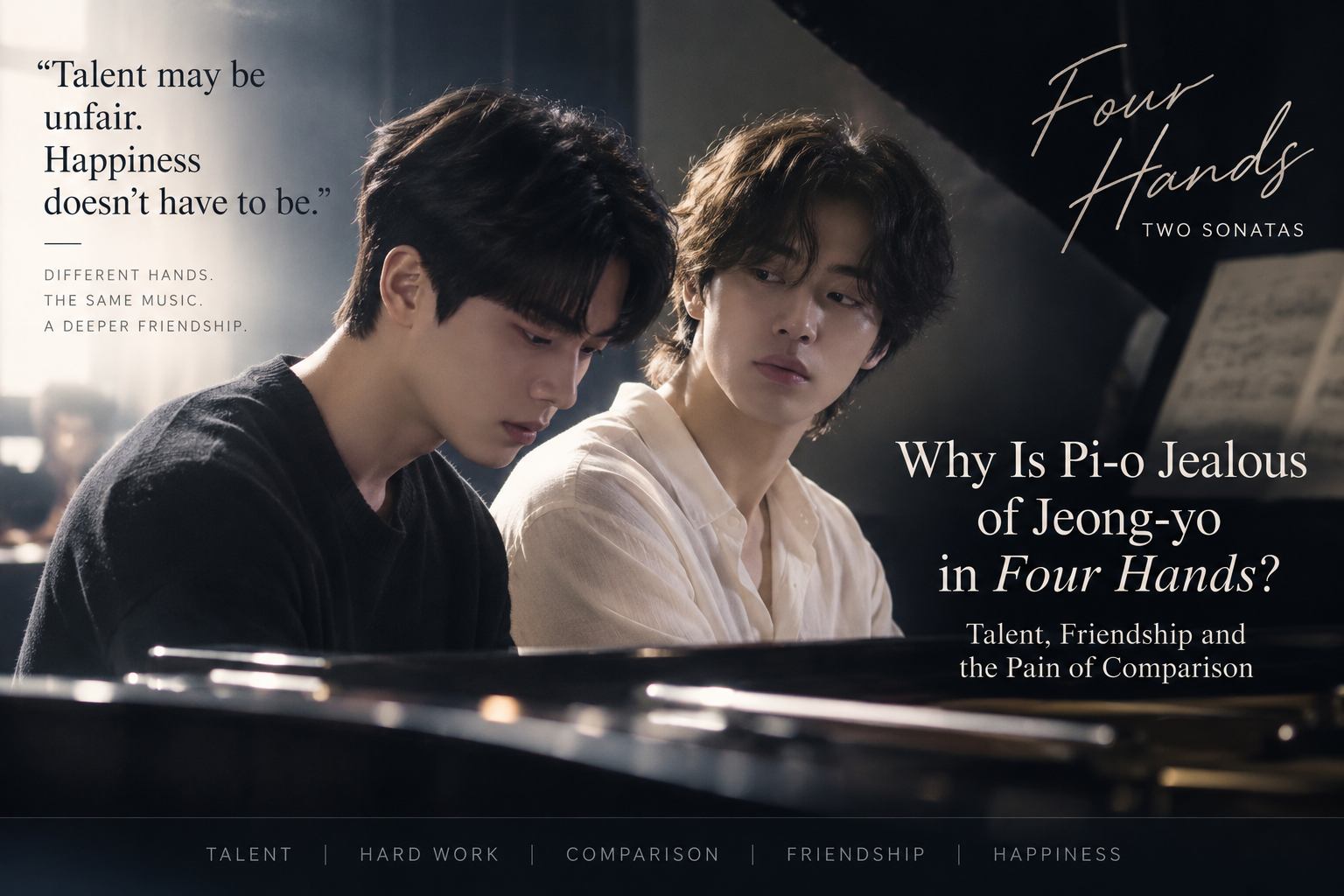
  • Why Pi-o Is Jealous of Jeong-yo in Four Hands — Talent, Friendship and the Pain of Comparison

    Why Pi-o Is Jealous of Jeong-yo in Four Hands — Talent, Friendship and the Pain of Comparison

    There is something painful about watching Pi-o and Jeong-yo in Four Hands, Two Sonatas.

    At first, it looks like a familiar story about two gifted young pianists.

    One is disciplined, polished and relentlessly trained.

    The other seems to possess something that cannot be taught.

    But the more I watched Four Hands, the less I thought this was really a story about piano.

    It is a story about something almost everyone experiences at some point in life:

    What happens when you meet someone who is simply more gifted than you?

    Someone who understands in minutes what takes you hours.

    Someone who reaches naturally for something you spent years trying to master.

    And what if that person isn’t your enemy?

    What if he becomes your friend?

    That may be the most difficult relationship at the heart of Four Hands.


    Pi-o Isn’t Ordinary — That’s What Makes It Hurt

    It would be easy to describe Kang Pi-o as the hardworking pianist and Choi Jeong-yo as the genius.

    But that description misses something important.

    Pi-o is extraordinarily talented too.

    To most people, Pi-o would already look like a prodigy.

    He has spent years training, practicing and pursuing perfection. He has developed the discipline required to turn musical ability into performance.

    Netflix describes Pi-o as an elite pianist who has relentlessly pursued perfection, while Jeong-yo is presented as a rougher, freer figure with remarkable natural musical talent.

    Without Jeong-yo beside him, Pi-o might have spent his entire life being called a genius.

    Then Jeong-yo appears.

    And suddenly Pi-o discovers that there are places he has struggled for years to reach that Jeong-yo seems to understand almost instinctively.

    That is what makes their relationship painful.

    Pi-o isn’t discovering that he is bad at piano.

    He is discovering the limits of being very, very good.


    Sometimes We Discover Our Limits Through Other People

    I think this happens far beyond music.

    Most of us don’t clearly see our own limits when we are alone.

    We work.

    We improve.

    Yesterday’s version of ourselves is our reference point.

    Then someone else appears.

    You practice something ten times.

    They understand it after two.

    You spend years learning how a business works.

    They seem to recognize the opportunity almost immediately.

    You study for hours.

    They remember something after reading it once.

    It happens in sports, art, cooking, mathematics, business, writing and almost every kind of work.

    There are people whose results seem disproportionately large compared with the effort required to produce them.

    Meeting someone like that can be uncomfortable.

    Because suddenly the comparison is no longer theoretical.

    Another person becomes a mirror that shows you your own limits.

    That, to me, is part of what Jeong-yo becomes for Pi-o.


    The Cruelest Comparison Is With Someone Close to You

    A genius who lives thousands of miles away is relatively easy to admire.

    Pi-o doesn’t have to wake up every morning consumed by jealousy because some legendary concert pianist somewhere in the world is better than him.

    That person is distant.

    Jeong-yo isn’t.

    He is right there.

    They practice together.

    They fight.

    They laugh.

    They begin to understand each other’s weaknesses.

    They become friends.

    And that makes comparison much more difficult.

    Imagine spending most of your life developing one ability.

    Then your closest friend begins receiving attention for doing something you have desperately wanted to do better than anyone else.

    As a friend, you want him to succeed.

    As a competitor, his success hurts.

    You can be happy for your friend and threatened by him at the same time.

    Those feelings are not mutually exclusive.

    That contradiction is one of the things Four Hands understands remarkably well.


    Maybe Pi-o Isn’t Really Jealous of Jeong-yo’s Success

    Jealousy is an easy word.

    But I think there is something underneath it that hurts more.

    Futility.

    The painful question may not be:

    Why is everyone paying attention to him?

    It may be:

    I spent so much of my life trying to reach this place. Why does he seem to possess naturally what I had to fight for?

    That question can destroy a person’s confidence.

    Because hard work is something we can control.

    Natural ability isn’t.

    We can practice longer.

    We can study harder.

    We can become more disciplined.

    But eventually, many of us encounter someone whose natural advantages cannot simply be erased by working another hour.

    And that is when comparison becomes dangerous.


    This Isn’t Really a Piano Story

    Piano is simply the stage on which Four Hands explores the problem.

    Replace piano with almost anything else and the story still works.

    Two students.

    Two athletes.

    Two artists.

    Two chefs.

    Two entrepreneurs.

    Two coworkers.

    Two writers.

    One person works incredibly hard and becomes exceptional.

    Then another person arrives who seems to see the same world differently.

    Most people will never experience Pi-o and Jeong-yo’s exact musical situation.

    But many people know the feeling behind it.

    “Why is this so much easier for that person than it is for me?”

    That’s why Pi-o’s struggle can feel surprisingly personal.


    Friendship Makes the Problem Harder, Not Easier

    We often assume that a deep friendship should be stronger and therefore harder to break.

    Sometimes the opposite may be true.

    The deeper the friendship, the deeper the possible wound.

    If someone I barely know succeeds, I can congratulate them and move on.

    But if the person walking beside me suddenly races ahead, I cannot avoid seeing the distance between us.

    And if we share the same dream, the problem becomes even harder.

    Pi-o and Jeong-yo are not merely friends.

    They are also rivals.

    The person who understands you best can therefore become the person most capable of hurting you.

    That’s the paradox at the center of their friendship.

    They can help each other grow precisely because they are different.

    But those same differences can tear them apart.


    Jeong-yo’s Side Isn’t Easy Either

    There is another side to this relationship.

    Jeong-yo didn’t choose his talent.

    Imagine realizing that simply doing what comes naturally to you is hurting someone you care about.

    What should you do?

    Pretend to be worse?

    Stop trying?

    Hide your ability?

    Of course not.

    Jeong-yo shouldn’t have to apologize for being gifted any more than Pi-o should feel ashamed of having worked hard.

    This is why a friendship between people with unequal abilities requires maturity from both sides.

    Pi-o needs the wisdom to accept.

    Jeong-yo needs the wisdom to understand.

    Pi-o must learn to recognize Jeong-yo’s gift without using it as evidence that his own life has less value.

    Jeong-yo must understand that something effortless to him may represent years of sacrifice to someone else.

    Neither lesson is easy.


    When I Was Younger, I Envied People Like Jeong-yo

    This is where Four Hands became more than a drama for me.

    When I was younger, people with extraordinary natural ability were easy to envy.

    If two people put in similar effort and one achieves much more, it can feel unfair.

    You begin thinking:

    “If only I had been born with that talent.”

    Then comparison begins.

    Comparison becomes envy.

    Envy can become frustration.

    Frustration can become resentment.

    And eventually some people simply give up.

    Why continue if someone else can always do it better?

    But as I’ve grown older, I’ve started to see the question differently.


    Someone Else’s Talent Does Not Take Away Your Happiness

    This took me a long time to understand.

    Someone else’s gift does not reduce the amount of happiness available to me.

    A person being a better pianist does not make my music worthless.

    Someone making more money does not automatically make my life poorer.

    Someone learning faster does not mean there is no value in what I learn slowly.

    Yet comparison makes us behave as though happiness were a fixed quantity.

    If that person has more, I must have less.

    Life doesn’t necessarily work that way.

    Talent may be distributed unequally.

    Opportunity may be distributed unequally.

    Even effort and results are often unfairly matched.

    But that does not mean happiness has already been assigned in the same proportions.

    Put simply:

    Talent may be unfair. Happiness doesn’t have to be.

    That is one of the things Pi-o’s struggle makes me think about.


    The Wisest Response to Genius Is Not Envy

    So what should we do when we meet someone far more gifted than ourselves?

    As I’ve grown older, my answer has become simpler.

    Acknowledge it.

    That person is better than me at this.

    That person learns this faster.

    That person has something I don’t.

    Saying those things does not make me smaller.

    Then comes the important part:

    Learn what you can.

    Meeting someone better than you can actually be an extraordinary advantage.

    You may learn in months what would have taken you years to discover alone.

    The tragedy begins when admiration becomes resentment.

    If you become consumed by envy, attack the other person, lose confidence and eventually abandon your own path, then their talent has defeated you.

    Not because they were better.

    Because comparison convinced you that your own journey no longer mattered.


    But Genius Doesn’t Mean Having Everything

    There is another mistake we often make.

    When we see an extraordinary person, we focus entirely on what they possess.

    We see Jeong-yo’s musical intuition and think:

    Imagine being born with that.

    But exceptional ability in one part of life does not guarantee completeness in every other part.

    Someone who understands music more naturally than everyone around them may still struggle with things that seem completely natural to other people.

    Relationships.

    Ordinary emotions.

    Belonging.

    Understanding what another person feels.

    This should not be generalized to every gifted person, of course.

    But Four Hands raises an interesting possibility:

    Sometimes the very thing that makes someone extraordinary can also make it harder for them to feel ordinary.

    And perhaps being ordinary contains gifts we rarely recognize as gifts.


    Maybe Jeong-yo Needs Pi-o Too

    This changes how I see their friendship.

    At first, it can look as though Pi-o has more to learn from Jeong-yo.

    Jeong-yo possesses a musical freedom Pi-o struggles to reach.

    But Jeong-yo is not complete either.

    He carries trauma, struggles with the stage, and needs help entering a world Pi-o already understands.

    Pi-o knows discipline.

    He knows training.

    He knows how to stand before an audience.

    He knows how to transform ability into a life as a musician.

    So perhaps their relationship is not:

    The lesser pianist learning from the greater one.

    It is two incomplete people carrying different strengths.

    Jeong-yo can teach Pi-o something about music.

    Pi-o can teach Jeong-yo something about living with music.

    And perhaps both can teach the other something about being human.


    This Is Why the Title “Four Hands” Feels So Perfect

    “Four hands” refers to two pianists playing the same piano together.

    Think about what that requires.

    Two people do not have to be equally gifted.

    But neither person can simply play however they want.

    You have to listen.

    You have to feel the other person’s timing.

    Sometimes you lead.

    Sometimes you follow.

    Sometimes you wait.

    Sometimes you make room.

    The better pianist cannot simply rush ahead and expect the music to survive.

    And the weaker pianist cannot spend the entire performance resenting the other person’s ability.

    The music only works when two different people learn to hear each other.

    Friendship may work the same way.

    Friendship, like four-hands piano, does not require two people to be equally gifted. It requires them to listen to each other’s tempo.

    That may be the real challenge facing Pi-o and Jeong-yo.


    Pi-o Must Accept. Jeong-yo Must Understand.

    If their friendship is going to survive, both of them have work to do.

    Pi-o must accept Jeong-yo’s talent without diminishing himself.

    Jeong-yo must understand Pi-o’s effort without diminishing it.

    Pi-o must learn acceptance.

    Jeong-yo must learn empathy.

    Neither needs to become the other.

    Pi-o doesn’t need Jeong-yo’s exact gift to have value.

    Jeong-yo doesn’t need to hide his talent to protect Pi-o.

    They simply have to learn that difference does not automatically create hierarchy in every part of life.

    One person can be better at piano without being better at being a person.

    That’s a much harder distinction to live than it is to write.


    The Hardest Four-Hands Performance May Not Happen at the Piano

    At this point, I’m not particularly interested in asking whether Pi-o or Jeong-yo is the better pianist.

    The drama has already made Jeong-yo’s extraordinary natural gift clear.

    The question I find much more interesting is:

    Can they remain friends?

    Can Pi-o admire someone more gifted than himself without losing his own sense of worth?

    Can Jeong-yo fully use his gift while understanding what Pi-o’s years of effort mean?

    Can two people who share the same dream survive when one person’s talent becomes a mirror reflecting the other’s limitations?

    That may be the most difficult four-hands performance in the entire drama.

    Not the piece they play together on a piano.

    But learning how to move through life together without one person’s gift becoming the other person’s wound.


    Talent May Be Unequal. Happiness Doesn’t Have to Be.

    Eventually, all of us meet someone better than ourselves.

    Someone smarter.

    Faster.

    More talented.

    More intuitive.

    Someone who reaches in two steps what takes us ten.

    We can resent them.

    We can allow their ability to become proof of our inadequacy.

    We can give up.

    Or we can acknowledge the difference, learn what we can and continue walking our own path.

    Because another person’s talent does not determine the value of our life.

    And another person’s success does not set the ceiling on our happiness.

    When I was younger, extraordinary talent seemed like one of the greatest gifts a person could receive.

    I’m less certain now.

    There are many ways to live a meaningful life, and many forms of happiness that have nothing to do with being the best.

    Perhaps talent was never distributed fairly.

    But happiness was never promised only to the talented.

    And that may be what Pi-o and Jeong-yo ultimately need to discover about each other.

    They don’t need equal gifts to remain friends.

    They need to hear each other’s tempo.

    Because sometimes the hardest part of playing four hands isn’t knowing your own part.

    It’s continuing to listen when the person beside you can play something you never could.


    FAQ: Pi-o, Jeong-yo and Talent in Four Hands

    Why is Pi-o jealous of Jeong-yo in Four Hands?

    Pi-o has spent years pursuing technical and musical perfection, while Jeong-yo possesses an unusually natural musical instinct. Their closeness makes that difference impossible for Pi-o to ignore, turning admiration, competition and friendship into complicated emotions.

    Is Jeong-yo more talented than Pi-o?

    The drama presents Jeong-yo as possessing extraordinary natural musical talent, while Pi-o represents a highly trained elite pianist shaped by discipline and relentless practice. The more interesting contrast is therefore not simply who is “better,” but what each lacks and can learn from the other.

    Are Pi-o and Jeong-yo friends or rivals?

    They are both. Their friendship and rivalry are intertwined, which is one reason their relationship becomes so emotionally complicated. Netflix itself frames Four Hands, Two Sonatas around friendship, rivalry and growth.

    What does “Four Hands” mean?

    In piano music, four-hands playing involves two pianists performing together on one piano. Within the drama, it also works as a powerful metaphor for Pi-o and Jeong-yo: two different people learning to listen, adjust and make room for each other.

    What is the main message of Pi-o and Jeong-yo’s relationship?

    One possible interpretation is that unequal talent does not make friendship impossible, but it makes friendship more demanding. Pi-o must learn to recognize Jeong-yo’s gift without losing his own self-worth, while Jeong-yo must learn to understand the effort and emotions of the person beside him.
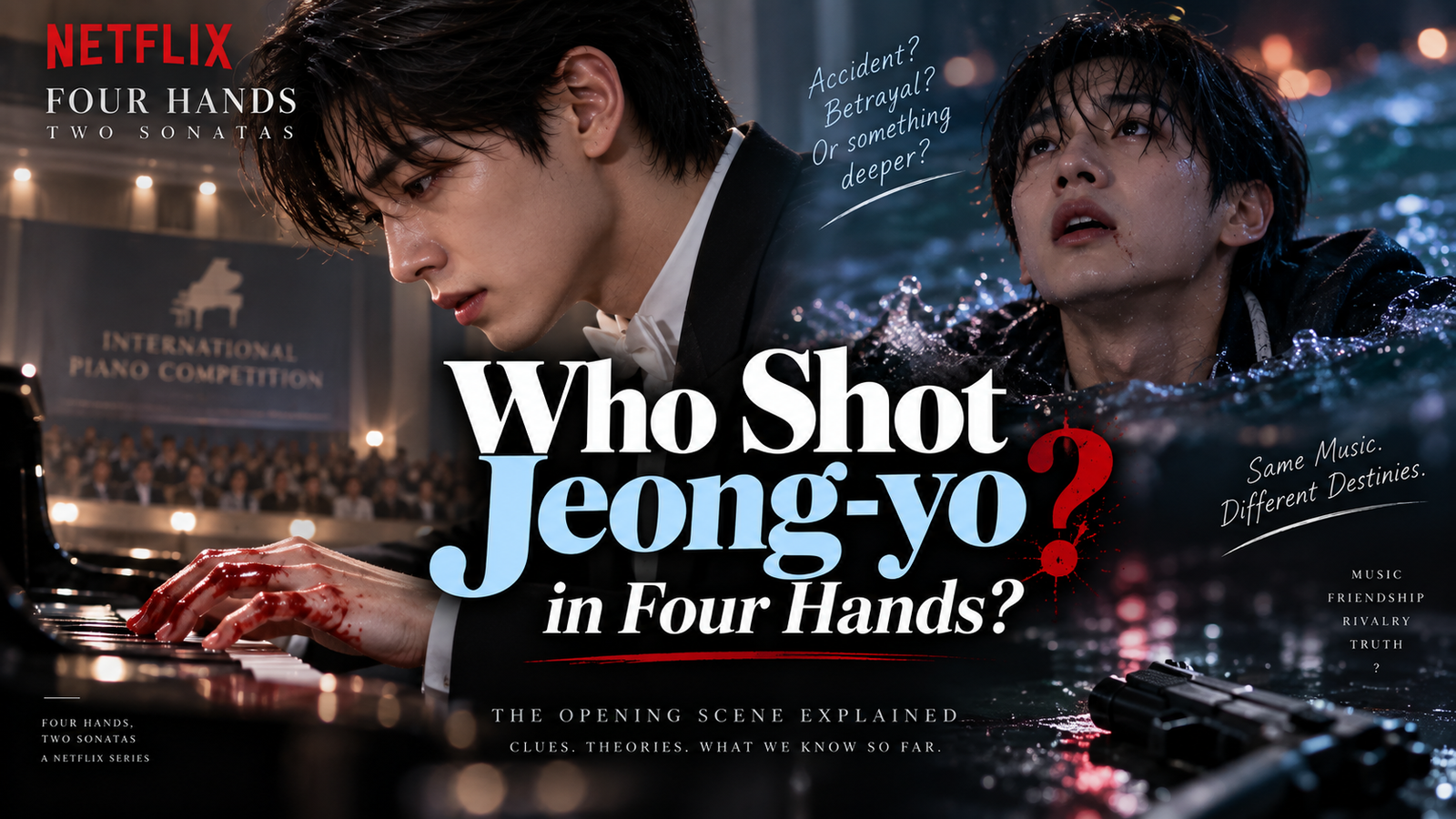
  • Who Shot Jeong-yo in Four Hands? The Opening Shooting Scene Explained

    Who Shot Jeong-yo in Four Hands? The Opening Shooting Scene Explained

    Updated through Episode 3. This article will be updated as new clues are revealed.

    Warning: Spoilers for Four Hands, Two Sonatas.

    If you started watching Four Hands, Two Sonatas expecting a beautiful coming-of-age drama about two young pianists, the opening scene probably made you wonder whether you had clicked on the wrong K-drama.

    A piano competition.

    Blood on the keys.

    Choi Jeong-yo in danger.

    A gunshot.

    And Jeong-yo falling into the water.

    Then the story takes us back to a much younger Kang Pi-o and Choi Jeong-yo, before their friendship, rivalry and musical lives have reached that terrifying moment.

    It immediately creates one of the biggest mysteries in Four Hands:

    Who shot Jeong-yo?

    The most important answer right now is:

    We don’t know yet.

    And that is exactly why the opening scene matters.

    The drama has shown us a possible future before explaining how these two young pianists could ever arrive there. Early reviews have similarly identified the violent flash-forward as one of the central mysteries hanging over the story.

    So rather than pretending we already know the shooter, let’s separate what Four Hands has actually shown us from what we can only speculate about.


    What Happens in the Four Hands Opening Scene?

    The drama begins far away from the warm school friendship that follows.

    Pi-o is playing piano at a major competition.

    But something is terribly wrong.

    His fingers are bloodied as he continues playing.

    Meanwhile, Jeong-yo is caught in a violent situation elsewhere.

    A gun goes off.

    Jeong-yo is hit and falls into the water.

    The contrast is shocking.

    One friend is playing music while the other appears to be fighting for his life.

    A review of Episodes 1 and 2 describes the opening in essentially these terms: Pi-o plays with bloodied fingers while Jeong-yo is shot and falls into water.

    But the drama doesn’t immediately tell us who shot him or how the two boys reached this point.

    Instead, it takes us backward.

    And suddenly we meet two young musicians whose relationship looks very different.


    Why Show Jeong-yo Being Shot Before We Even Know Him?

    This may be the more interesting question.

    The opening doesn’t simply create suspense.

    It changes how we watch everything that follows.

    Netflix officially describes Pi-o and Jeong-yo as two contrasting pianists whose lives become intertwined through friendship, rivalry and growth. Pi-o has followed a disciplined path toward perfection, while Jeong-yo comes from a turbulent childhood and possesses a much rawer natural talent.

    When we watch them begin to understand each other, however, we already know something they don’t.

    Something terrible is coming.

    That knowledge changes even their happiest scenes.

    When they play together, we remember the opening.

    When they become closer, we remember the opening.

    When rivalry begins to appear, we wonder whether it somehow leads to the opening.

    The drama has effectively given the audience the destination while hiding the road.


    The Biggest Question Isn’t Only “Who Shot Jeong-yo?”

    There are actually several mysteries packed into that opening.

    Who shoots Jeong-yo?

    But also:

    Why is Jeong-yo in that situation?

    Why is Pi-o somewhere else playing piano?

    Why are Pi-o’s fingers bleeding?

    Does Pi-o know Jeong-yo is in danger?

    How much time has passed since their school days?

    And perhaps most importantly:

    What happens between these two friends before we return to this moment?

    That last question may ultimately matter more than the identity of the shooter.


    Does Jeong-yo Die in Four Hands?

    This is another question viewers are likely to ask after watching the opening.

    At this stage:

    Jeong-yo’s death has not been confirmed.

    We see an extremely dangerous situation and a fall into the water.

    But showing a character apparently facing death is not the same as confirming that character’s death.

    Until the drama explicitly reveals what happens afterward, it would be misleading to say that Jeong-yo dies.

    So for now:

    Shot? Yes.

    Falls into the water? Yes.

    Confirmed dead? No.

    That distinction is important.


    Is Pi-o Connected to Jeong-yo’s Shooting?

    This is where we have to be particularly careful.

    The editing deliberately connects the two men.

    Jeong-yo is in danger while Pi-o is performing.

    Pi-o’s bloody fingers make his own scene disturbing as well.

    But parallel editing does not prove that Pi-o caused what happened to Jeong-yo.

    There is currently no reason to turn a visual connection into a factual accusation.

    What we can say is that the drama clearly wants us to ask why these two events are happening at the same time.

    And because the series is built around their friendship and rivalry, the answer will almost certainly tell us something important about how their relationship develops.


    Could Their Rivalry Become That Dark?

    At first glance, that’s an obvious theory.

    Pi-o and Jeong-yo are both extraordinary pianists.

    One has spent years being shaped toward perfection.

    The other possesses an instinctive musical gift capable of disrupting that world.

    Netflix itself describes them as characters who repeatedly clash and challenge each other, pushing one another toward new artistic heights.

    So when the opening shows blood and violence, viewers naturally wonder:

    Does their rivalry eventually destroy their friendship?

    Maybe.

    But again, the drama hasn’t established that.

    And based on the episodes we’ve seen so far, reducing their relationship to simple hatred would miss much of what makes Four Hands interesting.

    Their relationship contains competition, but it also contains admiration.

    They challenge each other precisely because each recognizes something extraordinary in the other.

    That makes the eventual journey toward the shooting scene much harder to predict.


    The Opening Makes Every Happy Scene Feel Different

    This is one of the smartest things about the storytelling so far.

    Without the flash-forward, we could simply enjoy the story of two young pianists becoming friends.

    But we can’t completely do that.

    We have already seen the blood.

    We have already heard the gunshot.

    We have already seen Jeong-yo fall.

    So when Pi-o and Jeong-yo laugh together, practice together or begin understanding each other through music, there is an uncomfortable thought sitting underneath the scene:

    How does this become that?

    One early review made the same observation: the flash-forward places tension underneath the drama because viewers know that a darker moment is waiting somewhere ahead.

    That’s an effective narrative trick.

    The drama isn’t only making us care about their friendship.

    It is making us afraid of losing it.


    Pi-o’s Bloody Fingers May Be Just as Important as the Gunshot

    It’s easy to focus entirely on Jeong-yo because a gunshot is obviously more dramatic.

    But look at Pi-o.

    Why is he playing with injured, bloody fingers?

    For a pianist, hands aren’t simply another part of the body.

    They are connected to identity, career and expression.

    And Pi-o keeps playing.

    That image raises its own questions.

    Did something happen before he went on stage?

    Is he forcing himself through an injury?

    Does his condition have any connection to what is happening to Jeong-yo?

    Or are the two scenes connected primarily symbolically rather than literally?

    We don’t know yet.

    But the drama chose to place those images beside each other.

    That makes Pi-o’s hands another clue worth watching.


    Music and Violence Are Deliberately Colliding

    This may ultimately be the most important thing about the opening.

    Everything else about Four Hands teaches us to associate these characters with music.

    Jeong-yo hears music almost everywhere. An official preview even depicts ordinary school noises transforming into music in his mind, emphasizing his instinctive relationship with sound.

    Pi-o has spent his life pursuing perfection at the piano.

    Then the opening takes the thing that defines them—

    music—

    and places it beside blood, fear and violence.

    That contrast feels deliberate.

    The piano may eventually become more than the thing that brings them together.

    It may also become connected to ambition, sacrifice and pain.


    What We Know So Far

    As of Episode 3, here’s the safest way to understand the mystery:

    Confirmed: Jeong-yo is shown being shot and falling into water in the flash-forward.

    Confirmed: Pi-o is shown performing piano with bloodied fingers.

    Confirmed: The main story then moves back to an earlier period in their lives.

    Not confirmed: Who shot Jeong-yo.

    Not confirmed: Why Jeong-yo was shot.

    Not confirmed: Whether Jeong-yo dies.

    Not confirmed: Whether Pi-o has any direct connection to the shooting.

    Not confirmed: What caused Pi-o’s injured fingers.

    That’s where the mystery stands.

    Anything beyond that is currently a theory.


    My Theory: The Shooter May Not Be the Real Mystery

    I suspect the drama wants us to focus on the obvious question:

    “Who pulled the trigger?”

    But I don’t think that will necessarily be the most important revelation.

    Four Hands is fundamentally being presented as a story about two young musicians whose lives become intertwined through friendship, rivalry and growth.

    That suggests the emotional mystery may be bigger than the crime mystery.

    The question may eventually become:

    What happened to Pi-o and Jeong-yo between the day they became friends and the day one was bleeding at a piano while the other was bleeding in the water?

    Who fired the gun will give us one answer.

    How their friendship reached that moment may give us the real story.


    Why the Opening Scene Works So Well

    We already know where the road appears to lead.

    But we don’t know how they get there.

    That means every new friendship becomes a clue.

    Every rivalry becomes a clue.

    Every family conflict becomes a clue.

    Every decision involving their careers becomes a clue.

    Even the music may become a clue.

    The opening turns what initially appears to be a youth music drama into something with an underlying mystery.

    And that’s why the scene stays in your mind even when the story returns to classrooms, competitions and piano practice.


    So Who Shot Jeong-yo?

    For now, the only accurate answer is:

    Four Hands hasn’t revealed it yet.

    And we shouldn’t invent an answer before the drama gives us one.

    What we do know is that the shooting isn’t a random scene added simply for shock.

    The drama deliberately shows us Jeong-yo’s violent future alongside Pi-o’s bloodied performance before asking us to watch their relationship develop from the beginning.

    That makes the real mystery bigger than:

    Who shot Jeong-yo?

    It becomes:

    What happened to these two boys?

    And every episode brings us a little closer to finding out.


    Four Hands Shooting Scene FAQ

    Who shot Choi Jeong-yo in Four Hands?

    As of Episode 3, the identity of the shooter has not been revealed.

    Does Jeong-yo die?

    His death has not been confirmed. The opening shows him being shot and falling into water, but viewers have not yet been shown a definitive outcome.

    Why are Pi-o’s fingers bleeding?

    That has not yet been fully explained. The drama deliberately juxtaposes Pi-o’s bloodied piano performance with Jeong-yo’s violent situation.

    Is Pi-o responsible for Jeong-yo being shot?

    There is currently no confirmed evidence that Pi-o is responsible. The editing connects their situations, but that should not be mistaken for proof.

    When will the shooting scene be explained?

    The series has 12 episodes, but there is currently no confirmed episode in which the full circumstances of the flash-forward will be revealed. The article should therefore be updated as new episodes provide clues. The 12-episode format is reflected in current series listings and discussion information.

  • Is Four Hands a BL? Or Is Their Friendship So Deep It Looks Like Love?

    Is Four Hands a BL? Or Is Their Friendship So Deep It Looks Like Love?

    Spoiler note: This article discusses the relationship between Kang Pi-o and Choi Jeong-yo through Episode 3 of Four Hands, Two Sonatas.

    If you’ve started watching Netflix’s Korean drama Four Hands, Two Sonatas, you may already have wondered:

    Is Four Hands a BL?

    It’s an understandable question.

    Song Kang’s Kang Pi-o and Lee Jun-young’s Choi Jeong-yo quickly develop an unusually intense connection. They compete, admire each other’s talent, play together, hurt each other, and seem capable of understanding parts of one another that other people cannot.

    But as of Episode 3, the answer is straightforward:

    No, Four Hands, Two Sonatas is not officially presented as a BL drama.

    Netflix describes the story around Pi-o and Jeong-yo in terms of friendship, rivalry and growth, while Korean promotional material describes their evolving relationship as friendship intertwined with musical competition.

    But after watching the first three episodes in Korea, I think there is a more interesting question than simply asking whether Four Hands is BL.

    Why can a friendship this deep sometimes look like love?

    And perhaps that confusion tells us something important about friendship itself.


    Is Four Hands, Two Sonatas Actually a BL?

    First, let’s separate official information from viewer interpretation.

    Four Hands, Two Sonatas has not been officially introduced as a Boys’ Love series.

    Netflix’s own description centers on two young pianists whose lives become intertwined through their passion for music as they navigate friendship, rivalry and personal growth.

    Korean promotional coverage similarly describes the drama as following the friendship, love, rivalry and growth of young people who meet at an arts high school and eventually become professional pianists.

    Most importantly, the relationship between Pi-o and Jeong-yo is repeatedly described as a friendship.

    So if you’re asking:

    “Are Kang Pi-o and Choi Jeong-yo officially a romantic couple?”

    At this point in the story, the answer is no.

    But that doesn’t make the question foolish.

    In fact, I think the reason viewers ask it is one of the most interesting things about the drama.


    Why Does Four Hands Sometimes Feel Like a BL?

    Pi-o and Jeong-yo aren’t ordinary classmates.

    Music immediately gives them a connection that other people struggle to enter.

    They are competitors.

    They are partners.

    They admire each other.

    They threaten each other.

    And increasingly, they become emotionally important to each other.

    The official teasers themselves emphasized how the two move from perfectly matched piano partners toward fierce rivals, with constant comparison beginning to damage their friendship.

    That produces emotional scenes we often associate with romance.

    There is admiration.

    There is jealousy.

    There is disappointment.

    There is dependence.

    There is the fear of losing someone.

    And there is pain when the other person begins to pull away.

    Put those emotions between two attractive young male leads with strong screen chemistry, and it’s not surprising that some viewers interpret the relationship through a romantic lens.

    But there is another possible interpretation.

    Maybe friendship can simply be that intense.


    Perhaps True Friendship and Love Have More in Common Than We Admit

    Watching Episode 3 made me think about this.

    We tend to describe friendship as though it should be easy.

    You meet someone.

    You like each other.

    You spend time together.

    You become friends.

    But truly deep friendship isn’t necessarily simple at all.

    It requires trust.

    Understanding.

    Compromise.

    Forgiveness.

    Sometimes sacrifice.

    And sometimes jealousy.

    You can be hurt because someone you care about doesn’t understand you.

    You can fear losing a friend.

    You can resent their success while simultaneously wanting them to succeed.

    You can desperately want their recognition.

    None of those emotions belongs exclusively to romantic love.

    Friendship can hurt precisely because friendship can matter so much.

    That’s why I think Pi-o and Jeong-yo’s relationship is more interesting if we don’t immediately force it into a romantic category.


    Pi-o and Jeong-yo Need Something From Each Other

    The two young pianists are fundamentally different.

    Pi-o has been shaped by discipline, relentless practice and enormous expectations.

    Jeong-yo arrives from a completely different life and approaches music with a raw, instinctive quality.

    Official character material deliberately emphasizes this contrast: Pi-o’s playing is described as precise and delicate, while Jeong-yo commands attention with explosive energy.

    That means their attraction to each other isn’t necessarily romantic.

    It can also be artistic.

    Each sees something in the other that he himself lacks.

    Pi-o encounters a pianist who challenges his understanding of talent.

    Jeong-yo encounters someone whose world and musical discipline are completely different from his own.

    They don’t simply want to defeat each other.

    They change each other.

    And that’s much more dangerous emotionally than ordinary competition.


    The Piano Makes Their Friendship Even More Intimate

    Even the title of the drama helps explain their relationship.

    Four hands is a piano term referring to two people playing one piano together.

    Think about what that requires.

    Two people sit beside each other.

    They play the same instrument.

    They must listen to one another.

    They must control timing together.

    One cannot simply ignore the other and perform independently.

    The drama even depicts the two naturally dividing responsibilities while performing together—one dealing with the pedals and the other with the sheet music—as their coordination develops.

    That makes four-hands piano an almost perfect metaphor for their relationship.

    Two individuals.

    One piano.

    Neither disappears into the other.

    Yet neither can create the performance alone.

    That’s friendship.

    And it’s also exactly why their relationship can feel unusually intimate on screen.


    Friendship Becomes Harder When Your Best Friend Is Also Your Rival

    Then Four Hands adds another complication.

    Imagine that the person who understands you best is also the person capable of taking away the thing you value most.

    That’s Pi-o and Jeong-yo.

    They share music.

    But music is also where they compete.

    The closer they become, the more dangerous comparison becomes.

    The drama’s promotional material explicitly foreshadowed this: outside comparisons begin putting pressure on their relationship until their previously warm friendship starts to fracture.

    That creates a painful contradiction.

    You want your friend to succeed.

    But what if his success makes you feel like a failure?

    You admire his talent.

    But what if everyone begins comparing his talent with yours?

    You want to remain beside him.

    But what if being beside him constantly reminds you of your own insecurity?

    Those aren’t specifically BL emotions.

    They’re painfully human emotions.


    Episode 3 Makes the Friendship Even More Complicated

    By Episode 3, the drama begins pushing that tension into the open.

    The relationship between Pi-o and Jeong-yo is no longer simply the warm story of two gifted students discovering that they enjoy playing together.

    Their competition and emotional frustrations begin colliding.

    Official previews for Episode 3 even showed their conflict escalating into a physical fight, with the surrounding students having to separate them.

    But what interests me isn’t simply that they fight.

    It’s why fighting with this particular person matters so much.

    Indifference doesn’t normally produce this kind of pain.

    We are most easily hurt by people whose opinions matter to us.

    And that may be one reason the relationship feels so emotionally charged.


    Is It Bromance, Then?

    “Bromance” is probably closer to the way many international viewers will describe Pi-o and Jeong-yo’s relationship at this stage.

    But even that word can sometimes make deep male friendship sound like a joke.

    Four Hands seems more serious about it.

    These aren’t simply two guys exchanging funny jokes and becoming buddies.

    Their friendship becomes tied to:

    identity, talent, ambition, insecurity and self-worth.

    The other person becomes a mirror.

    Pi-o sees himself differently because Jeong-yo exists.

    Jeong-yo’s understanding of himself also changes because Pi-o exists.

    That is a powerful relationship regardless of whether romance is involved.


    Why Are Viewers Asking “Is Four Hands a BL?”

    There is another important reason this question matters.

    People are actually searching for it.

    English-language sites have already begun publishing articles specifically answering “Is Four Hands, Two Sonatas a BL?”, which suggests that the ambiguity viewers perceive isn’t limited to one audience.

    And I can understand why.

    If viewers see two male characters:

    • intensely focused on one another,
    • emotionally affected by one another,
    • jealous or hurt because of one another,
    • sharing an intimate artistic connection,
    • and becoming central to each other’s lives,

    modern audiences may naturally ask whether romance is coming.

    But perhaps Four Hands offers another possibility.


    Maybe We Underestimate Friendship

    This is what I find most interesting about the BL question.

    Perhaps the confusion isn’t only about Four Hands.

    Maybe it also says something about how we think about friendship.

    Why do we sometimes find it difficult to believe that two people can love each other deeply without that love being romantic?

    Friendship is also a form of love.

    A different form, certainly.

    But genuine friendship can demand enormous emotional investment.

    A real friend can change the direction of your life.

    A friend can recognize something inside you before you recognize it yourself.

    A friend’s success can inspire you.

    It can also make you jealous.

    A friend’s rejection can hurt.

    And losing a friendship can sometimes hurt as much as losing a romantic relationship.

    Perhaps true friendship is sometimes confused with romance because we underestimate how powerful friendship can actually be.


    Two Pianists, One Piano — And a Difficult Friendship

    That’s why the title Four Hands, Two Sonatas increasingly feels meaningful to me beyond its musical definition.

    Pi-o and Jeong-yo are different people.

    Different personalities.

    Different backgrounds.

    Different pianists.

    They cannot become one person.

    Nor should they.

    But for four-hands piano to work, they must somehow learn to occupy the same musical space.

    Maybe friendship works the same way.

    You don’t become identical.

    You don’t surrender your own identity.

    You learn when to lead.

    When to listen.

    When to give space.

    When to follow.

    And sometimes you get the timing wrong.


    So, Is Four Hands a BL?

    Based on the series’ official presentation and the story through Episode 3: no, Four Hands, Two Sonatas is not officially a BL drama.

    Netflix presents Pi-o and Jeong-yo’s central relationship through friendship, rivalry and growth rather than a confirmed romance.

    But simply answering “no” misses what makes the question interesting.

    Because Four Hands is showing us a relationship powerful enough that some viewers may mistake its emotional intensity for romantic love.

    And perhaps that is part of what makes the story moving.

    True friendship can be difficult.

    It can involve jealousy.

    It can involve sacrifice.

    It can hurt.

    And it can transform your life.

    So maybe the most interesting question Four Hands asks isn’t:

    Are Pi-o and Jeong-yo in love?

    Maybe it’s:

    Why do we sometimes struggle to believe that friendship alone can be this intense?

    And as the drama continues, that may become one of the most interesting relationships to watch.


    FAQ

    Is Four Hands, Two Sonatas a BL drama?

    No. As of Episode 3, the series is not officially presented as a Boys’ Love drama. Netflix describes the central story around friendship, rivalry and growth.

    Are Kang Pi-o and Choi Jeong-yo a couple?

    As of Episode 3, they have not been established as a romantic couple. Their relationship is presented as an intense friendship and musical rivalry.

    Why do people think Four Hands is BL?

    The two male leads share an unusually intense emotional and musical bond. Their admiration, rivalry, jealousy, dependence and strong chemistry can make some viewers interpret their relationship romantically.

    What does “Four Hands” mean?

    In piano music, four hands refers to two pianists playing the same piano together.

    Is Four Hands about romance or friendship?

    The broader drama includes friendship, love, rivalry and growth, but the central Pi-o/Jeong-yo relationship is currently officially framed around friendship and rivalry.

  • Four Hands Taught Me Why Great Pianists Never Sound the Same

    Four Hands Taught Me Why Great Pianists Never Sound the Same

    Before watching Four Hands, Two Sonatas, I had a very simple idea of what a great pianist was.

    I thought pianists were, in a sense, highly sophisticated machines.

    The composer writes the music. The notes are printed on the score. The pianist reads those notes and plays them as accurately as possible.

    So I assumed that if two world-class pianists played the same piece correctly, their performances should sound more or less the same.

    Four Hands made me realize how wrong that idea was.

    And I suspect I am not the only non-musician who thought this way.

    The drama taught me something surprisingly profound about classical music:

    A musical score is not the music itself. It is more like a map.

    The map may be the same.

    But every great pianist takes a different journey through it.


    I Thought Playing Piano Was About Following the Score

    For someone without professional musical training, the logic seems obvious.

    A score tells the pianist which notes to play.

    It contains rhythm, tempo markings, dynamics and instructions from the composer.

    So what is left for the pianist to decide?

    A great deal, as it turns out.

    That realization is one of the most fascinating ideas presented in Four Hands.

    The drama repeatedly shows that musical ability cannot be measured simply by asking:

    “Did he play the correct notes?”

    A pianist can play every note correctly and still produce a performance that feels completely different from another pianist playing exactly the same score.

    That was something I had never really understood before watching the drama.


    The Score Is a Map, Not a Set of GPS Instructions

    The best way I can describe what Four Hands taught me is this:

    Imagine giving two travelers the same map.

    The starting point is identical.

    The destination is identical.

    The roads printed on the map are identical.

    But that does not mean their journeys will be identical.

    One person may move quickly through one section and slow down somewhere else.

    Another may stop and notice something the first traveler barely saw.

    One may see several landmarks as part of a single landscape.

    Another may focus on each landmark individually.

    The map hasn’t changed.

    Their interpretation of the journey has.

    A musical score can work in a similar way.

    And this is where Four Hands begins to explain why a truly exceptional pianist is not simply someone capable of following instructions.


    The Same Notes Can Become Different Music

    One of the ideas that fascinated me most in the drama was how differently notes can be grouped and expressed.

    A pianist doesn’t necessarily experience music as:

    note → note → note → note.

    Several notes can be understood and expressed as one musical phrase — one larger emotional unit.

    Another pianist may take a similar passage and give individual notes greater separation.

    Neither necessarily needs to change the written notes.

    What changes is how those notes are understood and communicated.

    This was a revelation to me.

    It means that the pianist isn’t merely asking:

    “Which note comes next?”

    The pianist is also asking:

    “What does this entire passage mean?”

    That is a completely different way of understanding performance.


    Tempo Is Not Just About Playing Fast or Slow

    Four Hands also made me notice something else I had previously overlooked.

    Speed itself can be expressive.

    To an ordinary listener, tempo might seem like another instruction:

    Play this piece at this speed.

    But a performance breathes.

    A pianist may push forward through one phrase, create tension, then allow another passage more space.

    Even subtle differences in timing can change how the listener experiences the music.

    A phrase can feel impatient.

    Another can feel hesitant.

    Another can sound confident.

    Another can sound almost as though it is asking a question.

    The notes themselves haven’t necessarily changed.

    The interpretation has.


    Why Choi Jeong-yo’s Talent Matters So Much

    This is also why I think the drama’s portrayal of Choi Jeong-yo, played by Lee Jun-young, is particularly interesting.

    It would have been easy for the writers simply to tell us:

    “Jeong-yo is a genius.”

    Many dramas do exactly that.

    They introduce a gifted character, have everyone around him repeatedly call him a genius, and expect the audience to accept it.

    Four Hands attempts something more interesting.

    It gradually gives the viewer a language for understanding why his musical ability is special.

    His talent isn’t meaningful simply because he can press difficult keys quickly or reproduce complicated music without making mistakes.

    What matters is how he understands the music.

    And as other characters begin to recognize something unusual in his interpretation, the audience begins learning how to recognize it too.

    That distinction is important.


    The Audience Learns Along With the Characters

    This may be one of the smartest aspects of Four Hands.

    At the beginning, many viewers probably listen to piano much like I did.

    We hear a difficult performance and think:

    “Wow. He can play really fast.”

    Or:

    “He didn’t make any mistakes. He must be brilliant.”

    But the drama gradually gives us other things to listen for.

    Why did he slow down there?

    Why did those notes feel like one large phrase?

    Why did the other pianist separate them?

    Why did one interpretation feel restrained while another felt emotional?

    Why can two performances of the same composition leave completely different impressions?

    Suddenly, the viewer isn’t merely watching characters talk about classical music.

    The viewer is learning how to listen.

    That is what surprised me most.


    Pi-o and Jeong-yo Don’t Just Compete — They Hear Music Differently

    This also changes how I see the relationship between Kang Pi-o and Choi Jeong-yo.

    On the surface, Four Hands can look like the familiar story of two geniuses competing to determine who is better.

    But if music can have countless interpretations, the question “Who is better?” becomes much more complicated.

    Pi-o and Jeong-yo don’t simply have different levels of skill.

    They have different experiences.

    Different personalities.

    Different emotions.

    Different lives.

    And all of those things can influence how a musician understands what is written on the page.

    That makes their rivalry much more interesting.

    They aren’t simply racing along the same road to see who reaches the finish line first.

    They may be reading the same map and seeing completely different landscapes.


    Why Can Great Pianists Sound Different Playing the Same Piece?

    This is the question Four Hands ultimately made me ask.

    If the score is identical, where does the difference come from?

    There are many elements of musical interpretation, including:

    Tempo — how quickly the music moves and how that pace changes.

    Phrasing — how individual notes are shaped into larger musical ideas.

    Dynamics — how softly or powerfully different passages are expressed.

    Articulation — whether notes feel connected, separated, sharp, delicate or flowing.

    Pedaling — how sounds are sustained and blended.

    Timing — tiny variations in when notes and phrases arrive.

    And beyond all of these technical concepts is something much harder to measure:

    the musician’s interpretation.

    Two pianists can look at the same score and understand its emotional meaning differently.

    That is why great performers can make familiar compositions feel new.


    The Composer Writes the Music — But the Pianist Gives It a Voice

    This changed another assumption I had.

    I used to think almost all of the creativity belonged to the composer.

    The composer creates.

    The pianist reproduces.

    Now I understand that relationship differently.

    The composer certainly creates the work.

    But a written score cannot physically make sound.

    Someone must transform those symbols into an experience that another human being can hear.

    That requires choices.

    And those choices are part of interpretation.

    A great pianist therefore occupies a fascinating position.

    The pianist must respect what the composer wrote without becoming merely a machine reproducing instructions.

    Too little interpretation, and the music can feel lifeless.

    Too much disregard for the score, and the performer may lose what the composer intended.

    The art exists somewhere between those two extremes.


    Now I Understand Why People Compare Different Recordings

    Before Four Hands, I never completely understood why classical music lovers might own or listen to several recordings of the same composition.

    If it is the same Beethoven sonata, why listen to five pianists play it?

    Shouldn’t one excellent recording be enough?

    Now the answer seems obvious.

    Because they aren’t really the same performance.

    The notes may come from the same score, but the experience can be completely different.

    One pianist may make a passage sound intimate.

    Another may make it monumental.

    One interpretation might emphasize tension.

    Another might reveal sadness.

    Another might find beauty somewhere I never noticed before.

    That means listening to different pianists isn’t simply hearing the same music repeatedly.

    It can be like hearing different interpretations of the same story.


    Four Hands Made Classical Music Easier to Understand

    I think this may be one reason Four Hands has connected so strongly with viewers in Korea.

    You don’t need to be a pianist to understand competition.

    You don’t need to study classical music to understand insecurity, friendship, pride, jealousy or the desire to be recognized.

    The drama uses those emotions to bring the viewer inside a world that might otherwise feel intimidating.

    And somewhere along the way, viewers like me begin learning about music almost without realizing it.

    I started watching a drama about talented young pianists.

    I ended up changing the way I think about piano performance itself.


    A Score Is Only a Map

    If I had to reduce what Four Hands taught me to one idea, it would be this:

    A score is a map.

    The composer draws the map.

    The notes establish the landscape.

    But the performer still has to travel through it.

    One pianist may rush toward something another approaches carefully.

    One may connect several notes into a single thought.

    Another may reveal the individual pieces hidden inside that thought.

    One may find sorrow where another finds hope.

    The map remains the same.

    The journey does not.

    And perhaps that is why we still need great performers even when the music they play was written hundreds of years ago.

    They aren’t simply repeating old notes.

    They are showing us another way to travel through them.


    Four Hands and Piano Interpretation FAQ

    Why do pianists sound different when playing the same piece?

    Because a musical score leaves room for interpretation. Pianists can differ in phrasing, timing, dynamics, articulation, pedaling and their overall understanding of the composition.

    Do classical pianists have to follow the score exactly?

    The written score provides the essential musical structure and the composer’s instructions, but interpretation remains a fundamental part of performance. The goal isn’t simply to reproduce notes mechanically.

    What does phrasing mean in piano playing?

    Phrasing is one way musicians organize individual notes into larger musical ideas. Rather than hearing every note as an isolated event, a pianist can shape groups of notes into something resembling a musical sentence.

    Why is Choi Jeong-yo considered talented in Four Hands?

    The drama portrays Jeong-yo’s ability as going beyond technical accuracy. An important part of his musical identity is the way he understands and interprets what he plays.

    What does the title Four Hands mean?

    In piano music, four hands generally refers to two pianists playing together on one piano. In the drama, the idea also works beautifully as a metaphor for two very different musicians learning to share the same musical world.

  • Mousetrap Ending Explained: Who Is the Rat and What Does the Final Scene Mean?

    Mousetrap Ending Explained: Who Is the Rat and What Does the Final Scene Mean?

    Warning: Major spoilers for all 10 episodes of Netflix’s Mousetrap (들쥐).

    Netflix’s Korean thriller Mousetrap begins with a seemingly simple mystery: someone has stolen novelist Je Moon-jae’s identity.

    But the final episode completely changes the question.

    The finale reveals not only who the Rat is, but also that Moon-jae’s story about himself cannot be trusted. The man presented as the victim has his own history of stealing another person’s work, future and identity.

    So, what really happened in the Mousetrap ending?

    Here is the ending explained.


    Who Is the Rat in Mousetrap?

    The immediate answer is Seo Yu-min.

    Yu-min is the man who takes over Moon-jae’s identity in the present-day story. He changes his appearance to resemble Moon-jae and systematically takes control of his life.

    But that is only half of the twist.

    The finale reveals that Moon-jae had wronged Yu-min years earlier.

    Moon-jae stole Yu-min’s writing and used it to build his own career as a successful novelist. The story therefore reverses the roles we have been watching throughout the series.

    Yu-min may be the literal “Rat” who steals Moon-jae’s identity in the present.

    But thematically, Moon-jae was a Rat first.


    Why Did Yu-min Steal Moon-jae’s Identity?

    Yu-min’s actions are revenge.

    Years earlier, Moon-jae, Yu-min and So Min-yeong were connected through a literary circle.

    Yu-min was the talented writer. Moon-jae became jealous of him and ultimately appropriated Yu-min’s writing, using it to establish himself as an author.

    The conflict also involved Min-yeong, whom Yu-min loved.

    The events surrounding her and Moon-jae’s actions devastated Yu-min’s life. Yu-min eventually decides to make Moon-jae experience exactly what he believes Moon-jae did to him:

    take away his identity, his achievements and his life.

    That is why the revenge is so elaborate.

    Yu-min does not simply want Moon-jae dead.

    He wants to become Moon-jae.


    Why Does the Korean Folktale Matter?

    This is where the title Mousetrap — and the Korean title 들쥐 — becomes much more meaningful.

    The series was inspired by the Korean folktale commonly known as the story of the rat that ate fingernails.

    In the folktale, a rat eats a person’s discarded fingernails and can take on that person’s appearance.

    Netflix explicitly describes the series as being inspired by this traditional story.

    Mousetrap modernizes the idea.

    Instead of a magical rat simply copying someone’s body, the drama asks:

    If someone has your face, name, money, records and social identity, how do you prove that you are really you?

    But the finale takes the metaphor one step further.

    The story isn’t only about someone stealing Moon-jae’s identity.

    It’s about people constructing their identities by taking things from others.


    What Happens on the Ship?

    The central confrontation occurs when Moon-jae finally reaches Yu-min aboard the ship.

    There, Yu-min reveals the past from his perspective.

    Much of what Moon-jae believed — or wanted to believe — about his own history is dismantled.

    Moon-jae learns the full extent of what he did to Yu-min and Min-yeong.

    The confrontation becomes violent.

    Moon-jae eventually stabs Yu-min and sends him through a broken window into the sea.

    Yu-min disappears into the water.

    But importantly, the series does not provide the audience with the comfortable certainty that everything is finished.


    Is Yu-min Dead?

    This is deliberately ambiguous.

    Yu-min falls into the sea after his confrontation with Moon-jae.

    Later, however, Moon-jae sees Yu-min again.

    The drama does not clearly establish whether this means Yu-min somehow survived or whether Moon-jae is seeing a manifestation of his guilt and deteriorating mental state.

    That ambiguity is important.

    Even if Yu-min physically died, Moon-jae cannot simply kill the truth about his past.

    Yu-min has already succeeded in forcing him to confront it.


    Why Can’t Moon-jae Write at the End?

    This is one of the most important details in the finale.

    Editor Han Ji-hye gives Moon-jae the unfinished second volume of The Rat, which Yu-min left behind.

    The manuscript contains the story of what has happened.

    Moon-jae realizes that if it is completed, the truth about him could be exposed.

    So he tries to write his own version.

    And he cannot.

    He sits before the blank page without being able to produce anything.

    That moment delivers perhaps the harshest punishment in the entire series.

    Moon-jae built his identity around being a writer.

    But the finale forces him to confront the possibility that the foundation of that identity was never truly his.

    His name may have survived.

    His career may have survived.

    But his belief in himself has not.


    So Who Is the “Real” Rat?

    This is the cleverest part of the ending.

    There are essentially two answers.

    The literal Rat: Seo Yu-min

    Yu-min is the person who steals Moon-jae’s identity and becomes his double.

    The symbolic Rat: Moon-jae

    Moon-jae stole Yu-min’s writing and benefited from another person’s talent and suffering.

    That means the drama ultimately turns its original question upside down.

    For most of the series we ask:

    “Who stole Moon-jae’s life?”

    By the finale, the more important question becomes:

    “Whose life did Moon-jae steal first?”


    What Does the Final Scene Mean?

    Moon-jae’s problems are far from over.

    He is haunted by images of field mice and by Yu-min’s presence.

    Then comes the final interruption.

    Someone arrives at Moon-jae’s door.

    It is Seung-gyu, whose own unfinished business with Moon-jae remains unresolved.

    The ending deliberately denies Moon-jae a clean escape.

    He may have defeated Yu-min physically.

    He may have regained control of his identity.

    But he hasn’t escaped the consequences of everything that came before.

    That’s the point.

    Getting your name back does not erase what you did while wearing it.


    Does Mousetrap Have a Happy Ending?

    Not really.

    Moon-jae survives, but survival is not presented as victory.

    He ends the series isolated and psychologically destabilized, unable to simply return to the successful novelist he once believed himself to be.

    Yu-min’s ultimate fate remains ambiguous.

    And Seung-gyu’s arrival makes it clear that Moon-jae’s past is still pursuing him.

    The physical identity theft may be over.

    The identity crisis isn’t.


    Why Is the Ending Called a Twist?

    Because Mousetrap spends much of its story encouraging viewers to sympathize with Moon-jae.

    Someone has his face.

    Someone has his money.

    Someone has his identity.

    Naturally, we see him as the victim.

    The finale deliberately destroys that simple interpretation.

    Yu-min did steal Moon-jae’s life.

    But Moon-jae had already taken something enormously valuable from Yu-min.

    That doesn’t make Yu-min’s crimes justified.

    Instead, it makes the distinction between victim and perpetrator deliberately uncomfortable.

    And that’s what makes the ending work.


    Mousetrap Ending FAQ

    Who is the Rat in Mousetrap?

    Seo Yu-min is the person who takes Moon-jae’s identity in the present-day story. However, the ending also presents Moon-jae himself as the symbolic “Rat” because of what he took from Yu-min in the past.

    Does Yu-min die?

    Moon-jae sends Yu-min into the sea during their final confrontation, but his later appearance is deliberately ambiguous. It may suggest survival or simply represent Moon-jae’s guilt.

    What happens to Moon-jae?

    Moon-jae survives and regains control of his life, but he ends psychologically trapped by the truth about his past and unable to simply resume his old identity as if nothing happened.

    How many episodes does Mousetrap have?

    Mousetrap has 10 episodes. Netflix lists it as a limited series.

    Is Mousetrap based on a true story?

    No. It is a fictional thriller inspired in part by the Korean “rat that ate fingernails” folktale and based on the webtoon Field Mouse. Netflix officially identifies the traditional folktale as a key inspiration.


    Understanding who the Rat is only solves part of Mousetrap’s ending mystery. The drama’s title offers another way to interpret the final scene, especially the question of who has truly escaped and who remains trapped. Explore the hidden meaning of Mousetrap’s title and the identity of the mouse for a deeper look at the story’s final reversal.

  • Why Did China Boycott South Korea’s Gwangju Biennale Over the “Taiwan Pavilion”?

    Why Did China Boycott South Korea’s Gwangju Biennale Over the “Taiwan Pavilion”?

    An international art exhibition in South Korea has suddenly become the center of a geopolitical dispute involving China, Taiwan and South Korea.

    The controversy began with just two words:

    “Taiwan Pavilion.”

    Chinese artists and curators withdrew from the 2026 Gwangju Biennale after organizers allowed Taiwanese participants to present their exhibition under that name.

    China strongly objected, arguing that the designation violated its “One China” principle.

    The dispute became serious enough for the Chinese Embassy in South Korea to intervene — turning what began as an art exhibition naming controversy into a diplomatic issue.

    So why does the name “Taiwan Pavilion” matter so much?

    And why did a disagreement at an art festival in the South Korean city of Gwangju become an international political story?


    What Happened at the Gwangju Biennale?

    The Gwangju Biennale is one of Asia’s best-known contemporary art events.

    Its 16th edition opened in September 2026 with a main exhibition and a separate Pavilion Project featuring national and institutional participants.

    Among the participants was Taiwan’s National Taiwan Museum of Fine Arts, or NTMoFA.

    The Taiwanese participants initially planned to use the name:

    Taiwan Pavilion

    But the Gwangju Biennale Foundation later changed the designation to:

    NTMoFA Pavilion

    That removed the word “Taiwan.”

    Taiwanese artists and curators protested, arguing that removing “Taiwan” from the exhibition materials amounted to political censorship.

    The organizers eventually reversed their decision.

    On August 25, the name “Taiwan Pavilion” was restored.

    And that triggered the opposite reaction.

    China protested.


    Why Did China Object to the Name “Taiwan Pavilion”?

    Beijing considers Taiwan part of China and opposes actions it believes imply that Taiwan is an independent sovereign state.

    China’s embassy argued that allowing the exhibition to use the name “Taiwan Pavilion” was inconsistent with the One China principle.

    The Chinese Embassy and Chinese Consulate General in Gwangju raised objections with South Korean officials and the Gwangju Biennale Foundation.

    Chinese participants then stopped preparing their own exhibition.

    On September 3, the Chinese curatorial team formally announced that it was withdrawing from the biennale in protest.

    The China Pavilion had been scheduled to feature 18 artists in an exhibition titled “Iron Silk Road.”

    Instead, the artists pulled out just before the festival opened.


    Why Is the Word “Taiwan” So Politically Sensitive?

    This is the key to understanding the entire controversy.

    Taiwan has its own democratically elected government, military, currency and political system.

    But Beijing claims Taiwan as part of Chinese territory.

    Most countries, including South Korea and the United States, maintain formal diplomatic relations with Beijing rather than Taipei.

    That creates an unusual situation.

    Taiwan participates extensively in global trade, technology, culture and international events, but the terminology used to describe it can become politically sensitive.

    Even seemingly simple labels such as:

    Taiwan

    Taiwan Pavilion

    or

    Republic of China

    can trigger diplomatic disputes depending on the context.

    For Beijing, the concern is that treating a Taiwanese exhibition in the same way as a national pavilion could imply recognition of Taiwan as a separate sovereign country.

    That is why this art exhibition became much more than an art exhibition.


    Did South Korea Recognize Taiwan as a Country?

    No.

    This is one of the most important points in the story.

    The use of the name “Taiwan Pavilion” at the Gwangju Biennale does not mean the South Korean government has recognized Taiwan as an independent country.

    South Korea established diplomatic relations with the People’s Republic of China in 1992.

    Seoul’s official policy regarding Taiwan has not changed.

    South Korea’s Foreign Ministry specifically emphasized during the controversy that the government’s basic position on Taiwan remained unchanged.

    The Gwangju Biennale is also operated by a foundation rather than being a foreign-policy body of the South Korean government.

    Local authorities and the foundation said the name was an expression allowed to participating artists in the artistic sphere and did not mean that South Korea or the local government recognized Taiwan as a state.

    That distinction is crucial.


    So Why Didn’t the Organizers Simply Change the Name?

    Because that created another controversy.

    When the organizers removed “Taiwan” and replaced it with “NTMoFA,” Taiwanese artists and curators accused the biennale of political censorship.

    They said the name had originally been agreed upon and that “Taiwan” was later removed from promotional material without their consent.

    The organizers therefore faced pressure from opposite directions.

    If they removed “Taiwan,” they faced accusations of censoring Taiwanese artists to satisfy political pressure.

    If they restored “Taiwan Pavilion,” they risked angering China.

    They ultimately restored the original name.

    China then withdrew.

    It was essentially a diplomatic trap with no easy solution.


    What Did the Gwangju Biennale Say?

    The foundation apologized for the confusion surrounding the pavilion project.

    Gwangju Biennale chief executive Youn Bum-mo said he regretted that the Chinese participants ultimately withdrew.

    He also explained that the Taiwanese presentation was technically an institutional pavilion, because the participating organization was the National Taiwan Museum of Fine Arts rather than the Taiwanese government itself.

    The controversy exposed a broader problem with the event’s pavilion structure.

    The biennale currently includes both national and institutional pavilions.

    That can make labels politically complicated.

    Youn said the foundation would examine reforms to the pavilion system to prevent similar controversies in the future.


    Did China Pressure South Korea?

    China did more than simply criticize the exhibition publicly.

    Chinese Ambassador to South Korea Dai Bing conveyed China’s concerns to South Korean and local officials.

    The Chinese Embassy and consulate also repeatedly raised the issue with the local government and the Gwangju Biennale Foundation.

    There was another development.

    A delegation from the Guangzhou Municipal People’s Congress canceled a planned visit to the Gwangju region after the dispute escalated.

    The cancellation was widely interpreted as another sign of Beijing’s displeasure.

    That demonstrates how quickly a cultural controversy can spill into broader relations between China and South Korea.


    Why This Story Is Bigger Than an Art Festival

    At first glance, the controversy might look almost absurd.

    Two words on an exhibition poster caused artists to withdraw from one of Asia’s major art festivals.

    But those two words represent a much larger question:

    Who gets to decide how Taiwan is described internationally?

    This issue appears repeatedly in:

    • international sporting events,
    • airlines,
    • multinational companies,
    • maps,
    • museums,
    • universities,
    • entertainment,
    • international organizations,
    • and cultural festivals.

    China frequently objects when terminology appears to present Taiwan as an independent country.

    Taiwan, meanwhile, objects when its name is removed or replaced in ways it believes diminish its identity.

    The Gwangju Biennale found itself directly between those two positions.


    The Timing Is Especially Interesting for South Korea

    There is another reason this controversy deserves attention.

    South Korea is currently dealing with its own sensitive dispute with China over terminology involving the Korean Peninsula.

    Questions have recently emerged over China’s language describing relations between North and South Korea and whether such terminology could appear to normalize North Korea’s evolving two-state approach.

    The situations involving Taiwan and Korea are legally and historically very different.

    They should not be treated as equivalent.

    But there is an interesting common thread.

    Countries care enormously about the language other countries use to describe sovereignty.

    China is extremely sensitive to terminology that could imply Taiwan is a separate country.

    South Korea, meanwhile, is sensitive to language that could affect the special political status historically assigned to relations between North and South Korea.

    Sometimes international politics really can turn on a few words.


    Why Taiwan’s Name Keeps Causing International Disputes

    For international readers, the Gwangju controversy illustrates something important about Taiwan.

    Taiwan’s diplomatic status is not merely an abstract debate among governments.

    It affects everyday decisions about names.

    Should an exhibition say “Taiwan”?

    Should a sports team compete under “Chinese Taipei”?

    Should a company list Taiwan separately from China?

    Should a museum call an exhibition a “Taiwan Pavilion”?

    Each decision can carry political meaning.

    And because China is one of the world’s largest economies, organizations frequently face substantial pressure when making those choices.

    The Gwangju Biennale is now another example.


    Could This Damage China–South Korea Relations?

    It is too early to say that the dispute will cause lasting damage.

    South Korea has emphasized that its official position regarding Taiwan has not changed.

    The biennale organizers have also tried to separate the artistic decision from government foreign policy.

    But the Chinese Embassy’s direct involvement and the withdrawal of Chinese participants show that Beijing considers the issue significant.

    Much will depend on whether the controversy remains limited to the biennale or begins affecting other cultural, economic or diplomatic exchanges.

    For now, it is better described as a diplomatic irritant than a major rupture in China–South Korea relations.


    What Happens to the Taiwan Pavilion?

    Despite the controversy, the Taiwanese exhibition remains part of the Gwangju Biennale.

    The broader biennale is continuing as scheduled.

    Chinese participants, however, have withdrawn their pavilion presentation.

    That creates an ironic result.

    A dispute intended to challenge the name “Taiwan Pavilion” has generated significant international media attention around that exact name.

    And a contemporary art exhibition in Gwangju has unexpectedly become part of one of Asia’s most sensitive geopolitical debates.


    Final Thoughts

    Why did China boycott an art festival in South Korea over the words “Taiwan Pavilion”?

    Because to Beijing, the issue is not simply the name of an exhibition.

    It touches China’s claim that Taiwan is part of its territory and its effort to prevent international language that could imply Taiwanese sovereignty.

    For Taiwanese participants, however, removing the word “Taiwan” raised a different concern:

    Who has the right to decide what Taiwanese artists are allowed to call themselves?

    And South Korea’s Gwangju Biennale became caught directly between those positions.

    That is what makes this story interesting beyond China, Taiwan or South Korea.

    It shows how a seemingly small decision — just two words on an art exhibition — can reveal some of the biggest unresolved political questions in East Asia.

    This article is intended to explain the controversy and does not advocate a political position.

  • Why Did South Korea Protest China’s “Two States” Language About the Korean Peninsula?

    Why Did South Korea Protest China’s “Two States” Language About the Korean Peninsula?

    A seemingly simple phrase from China has triggered an unusually sensitive diplomatic dispute with South Korea.

    The controversy centers on the relationship between South Korea and North Korea — and whether they should be viewed as two ordinary, separate states.

    During recent diplomatic exchanges, Chinese officials used language emphasizing the “peaceful coexistence” of South and North Korea.

    To many outside Korea, that may sound harmless.

    But in Seoul, the wording immediately touched one of the most complicated political and constitutional questions on the Korean Peninsula:

    Are North and South Korea two separate countries — or two sides of a still-divided Korea?

    South Korea has now raised concerns with Beijing over language it believes could be interpreted as supporting North Korea’s increasingly explicit “two-state” approach toward the South.

    To understand why a few words caused such controversy, we need to go back much further.


    What Did China Actually Say?

    Chinese Foreign Minister Wang Yi visited Seoul in August and held talks with South Korean Foreign Minister Cho Hyun.

    During those discussions, Wang said China hoped that South and North Korea would move toward peaceful coexistence.

    China also emphasized its intention to continue playing a constructive role in maintaining peace and stability on the Korean Peninsula.

    On the surface, there is nothing particularly confrontational about calling for peaceful coexistence.

    The problem is the political meaning behind the wording.

    South Korean officials became concerned that language treating Seoul and Pyongyang as two entities that should simply coexist could resemble North Korea’s own changing position toward inter-Korean relations.

    And that position has changed dramatically.


    North Korea Has Abandoned Its Old Unification Language

    For decades, both North and South Korea officially claimed that eventual Korean unification remained a national objective.

    They disagreed profoundly about what that unification should look like, but the basic idea of Korea as a divided nation remained.

    North Korean leader Kim Jong Un has increasingly moved away from that framework.

    Pyongyang now describes relations with South Korea through its “two hostile states” policy and has rejected many of its previous assumptions about eventual reconciliation and unification.

    Recent changes to North Korea’s ruling Workers’ Party rules have reinforced that hardened position toward South Korea.

    This is why China’s wording matters.

    If Beijing begins speaking about the two Koreas primarily as separate states that should peacefully coexist, Seoul worries that this could normalize Pyongyang’s new political framework.


    But Aren’t North and South Korea Already Two Countries?

    This is where the story becomes especially confusing for international readers.

    In practical international relations, the answer appears straightforward.

    South Korea and North Korea:

    • have separate governments,
    • have separate militaries,
    • issue separate passports,
    • maintain separate diplomatic relationships,
    • and have both been members of the United Nations since 1991.

    From the outside, they clearly function as separate states.

    But inter-Korean relations have historically been treated differently.

    The 1991 Inter-Korean Basic Agreement described the relationship between the two sides as not simply an ordinary relationship between states, but a special interim relationship arising from the process toward unification.

    That distinction remains politically important in South Korea.

    So when China appears to move toward ordinary “state-to-state” terminology, it touches a much deeper question than simple diplomatic vocabulary.


    Why Is South Korea So Sensitive About the “Two-State” Idea?

    Because accepting the two-state framework could have enormous long-term consequences.

    It could affect:

    the constitutional concept of Korean territory,

    future reunification policy,

    inter-Korean agreements,

    North Korea policy,

    and potentially even the diplomatic framework surrounding the Korean Peninsula.

    South Korea’s constitution continues to define the territory of the Republic of Korea as the Korean Peninsula and its adjacent islands.

    In practice, Seoul obviously does not govern North Korea.

    But the constitutional and historical framework is very different from simply recognizing North Korea as an unrelated foreign country.

    That is why language matters so much.


    Then Taiwan Entered the Dispute

    The controversy became even more interesting because China and South Korea exchanged objections over two different sovereignty questions.

    Beijing objected to South Korean-related language and actions concerning Taiwan and reiterated the importance of the One China principle.

    Seoul, meanwhile, raised concerns over China’s terminology regarding North and South Korea.

    This created an unusual diplomatic symmetry.

    China is extremely sensitive about any language that could imply Taiwan is an independent state.

    South Korea is sensitive about language that could appear to formalize North and South Korea as permanently separate states.

    The historical and legal situations are very different.

    But diplomatically, both demonstrate the extraordinary importance countries attach to terminology involving sovereignty and national division.


    Why Reddit Is Debating Taiwan

    The dispute immediately produced a provocative question online:

    If China treats North and South Korea as two states, why shouldn’t South Korea treat China and Taiwan as two states?

    It is an attention-grabbing argument.

    But legally and diplomatically, the comparison is much more complicated.

    South Korea established diplomatic relations with the People’s Republic of China in 1992 and recognizes Beijing under its One China policy.

    Changing that policy would represent an enormous shift in South Korean foreign relations.

    Likewise, Seoul’s objection to Chinese wording about North Korea does not mean South Korea denies the practical existence of North Korea.

    The disagreement concerns the political and legal character of inter-Korean relations.

    That distinction is important.


    Is China Actually Supporting North Korea’s “Two Hostile States” Policy?

    There is not enough evidence to make that conclusion.

    China continues publicly to emphasize peace and stability on the Korean Peninsula.

    When Wang Yi visited Seoul, he said Beijing would continue playing a constructive role and expressed support for peaceful coexistence.

    At the same time, China’s relationship with North Korea has strengthened recently.

    Chinese President Xi Jinping visited Pyongyang in June, his first visit to North Korea in nearly seven years, as Beijing sought closer ties with Kim Jong Un.

    That makes every change in China’s language toward the Korean Peninsula more closely scrutinized in Seoul.

    The question is whether China’s wording represents a genuine policy shift or simply diplomatic language intended to avoid taking sides.

    For now, the evidence does not justify saying China has formally adopted North Korea’s “two hostile states” doctrine.


    Why This Matters Beyond Korea

    The controversy may sound like an argument over words.

    It isn’t.

    The Korean War ended in 1953 with an armistice rather than a peace treaty.

    More than seven decades later, the political status of the peninsula remains unresolved.

    South Korean President Lee Jae Myung has recently called for conditions that could restart U.S.–North Korea dialogue and move the peninsula away from confrontation toward a more stable peace framework.

    Meanwhile, North Korea has moved in the opposite direction by increasingly rejecting reconciliation with Seoul.

    China sits between these competing approaches.

    As North Korea’s largest neighboring economic and diplomatic partner, Beijing’s choice of language can therefore carry considerable significance.


    What Happens Next?

    Three things are worth watching.

    First, watch China’s future terminology.

    If Beijing repeatedly describes North and South Korea in explicitly state-to-state terms, Seoul’s concerns will grow.

    Second, watch North Korea’s reaction.

    Pyongyang would likely welcome international language that appears to normalize its two-state framework.

    Third, watch the Taiwan connection.

    If disagreements over Taiwan and the Korean Peninsula continue to become linked in Seoul-Beijing diplomacy, what began as a dispute over terminology could develop into a larger political problem.


    Final Thoughts

    Why did South Korea react so strongly to a few words from China?

    Because on the Korean Peninsula, words can define political reality.

    To an outsider, South Korea and North Korea already look like two separate countries.

    But the historical, constitutional and diplomatic framework of inter-Korean relations has never been that simple.

    North Korea is now trying to redefine that relationship as one between two hostile states.

    South Korea does not want other countries to normalize that change.

    And China’s recent language has therefore touched a question that Koreans have debated for more than seven decades:

    Is Korea one divided nation — or have North and South Korea finally become two separate states?

    That question is far bigger than a diplomatic disagreement with Beijing.

    It goes to the heart of what the future of the Korean Peninsula could look like.

    This article is for informational purposes and does not advocate a political position.

  • Made in Korea Season 2: Do You Need to Watch Season 1 First?

    Made in Korea Season 2: Do You Need to Watch Season 1 First?

    Hyun Bin is back.

    And this time, Baek Ki-tae is no longer simply trying to climb to the top.

    He is already there.

    Disney+’s Korean political thriller Made in Korea returns for Season 2 on September 9, 2026, bringing back Hyun Bin and Jung Woo-sung while adding an even bigger role for Woo Do-hwan.

    But as the new season approaches, one question is especially relevant for viewers discovering the drama for the first time:

    Do you need to watch Made in Korea Season 1 before Season 2?

    The short answer is:

    Yes. You really should.

    Season 2 isn’t a completely separate story.

    It takes place nine years after the events of Season 1, and the central conflict between Baek Ki-tae and prosecutor Jang Geon-young continues directly into the new story.

    The good news?

    Season 1 is short enough to catch up quickly.

    And judging by the early discussion among K-drama fans, quite a few viewers are planning to do exactly that.


    When Does Made in Korea Season 2 Come Out?

    Made in Korea Season 2 premieres September 9, 2026.

    Disney+ currently confirms the September 9 Season 2 launch on its official Made in Korea page.

    The second season consists of six episodes and is scheduled to run through September 23.

    Made in Korea Season 2 Quick Facts

    TitleMade in Korea Season 2
    Korean Title메이드 인 코리아 시즌2
    PremiereSeptember 9, 2026
    PlatformDisney+
    Episodes6
    DirectorWoo Min-ho
    Hyun BinBaek Ki-tae
    Jung Woo-sungJang Geon-young
    Woo Do-hwanBaek Ki-hyun
    Setting1979 South Korea
    GenrePolitical / Crime / Thriller

    What Is Made in Korea About?

    Before talking about Season 2, here’s the basic setup.

    Made in Korea is set against the political and social turbulence of 1970s South Korea.

    At the center of the story is Baek Ki-tae, played by Hyun Bin.

    Ki-tae is a government intelligence operative.

    But he lives a dangerous double life.

    During the day, he works within the government system.

    Outside that world, he becomes involved in an illegal business while relentlessly pursuing wealth and power.

    Standing in his way is prosecutor Jang Geon-young, played by Jung Woo-sung.

    Geon-young becomes determined to bring Ki-tae down—even if doing so costs him almost everything.

    Disney+’s own synopsis describes the central conflict as a battle between a man obsessed with reaching the top and a prosecutor prepared to risk everything to stop him.

    That confrontation forms the foundation of Season 1.

    But Season 2 changes the balance dramatically.


    What Happens in Made in Korea Season 2?

    Season 2 jumps forward nine years.

    The story now takes place in 1979.

    And Baek Ki-tae’s situation has changed.

    He has reached the peak of power.

    The ambitious man we watched climbing upward in Season 1 now has considerably more influence.

    But reaching the top hasn’t satisfied him.

    His ambition has become even greater.

    Hyun Bin himself has said Ki-tae is bolder in Season 2, with his increased power changing everything from how he talks and walks to the way he deals with other people.

    Meanwhile, Jang Geon-young hasn’t disappeared.

    He has spent those nine years enduring his own hardships and preparing to strike back.

    And then there is a third major player.

    Baek Ki-hyun.

    Played by Woo Do-hwan, Ki-hyun is Baek Ki-tae’s younger brother.

    But he doesn’t necessarily intend to follow his brother’s path.

    He begins pursuing his own route to power.

    That turns what was already a dangerous confrontation into something more complicated.


    Do You Need to Watch Made in Korea Season 1 First?

    Yes—and there are three big reasons.

    1. Season 2 continues the same central conflict

    Baek Ki-tae and Jang Geon-young aren’t new characters being introduced again from scratch.

    Their history matters.

    Season 1 explains:

    why Geon-young is obsessed with stopping Ki-tae,

    how Ki-tae accumulated power,

    what each man sacrificed,

    and why their confrontation became personal.

    Without that context, you can probably understand the basic Season 2 plot.

    But you may miss much of the emotional weight behind it.


    2. Season 2 takes place nine years later

    A time jump works best when you know who the characters were before the jump.

    Seeing Baek Ki-tae already at the top isn’t nearly as interesting if you never watched him fight his way upward.

    The same applies to Geon-young.

    Season 2 presents a tougher, more aggressive version of the prosecutor after nine difficult years. Jung Woo-sung has described both men as people ultimately swept along by the enormous forces of their era.

    Knowing their earlier selves makes those changes more meaningful.


    3. Season 1 isn’t very long

    This may be the strongest practical reason.

    You aren’t facing a 16- or 20-episode catch-up marathon.

    The first season has six episodes.

    That makes Made in Korea relatively easy to catch up on before September 9.


    Is Made in Korea Season 1 Worth Watching?

    The numbers suggest plenty of viewers thought so.

    According to Disney+ information reported by Yonhap, Made in Korea was the most-watched Korean show on Disney+ in 2025.

    That’s important because Season 2 isn’t simply a speculative continuation of a forgotten drama.

    Disney is bringing back a Korean series that already performed strongly on its platform.

    The Reddit reaction also gives us an interesting glimpse of viewer behavior.

    In discussion surrounding Season 2, some users admitted they hadn’t watched Season 1 yet. Other viewers responded by recommending it, with one describing the first season as “amazing.”

    Another fan said they planned to watch both seasons once Season 2 arrived.

    That’s exactly why “Do I need to watch Season 1?” could become a useful search question as the premiere approaches.


    Who Is Baek Ki-tae?

    If there is one character you need to understand before Season 2, it’s Baek Ki-tae.

    Hyun Bin plays him as a man driven by extraordinary ambition.

    He isn’t satisfied with merely surviving within the political system.

    He wants money.

    Influence.

    And ultimately power.

    The first season follows his rise.

    Season 2 asks a different question:

    What happens to an ambitious man after he finally gets the power he wanted?

    Does he stop?

    Apparently not.

    The official Season 2 storyline describes Ki-tae as pursuing even greater ambitions after reaching the height of power.

    That may be the key transformation between the two seasons.


    Hyun Bin Says Baek Ki-tae Has Changed

    Hyun Bin has already teased a different version of his character.

    In recent comments about Season 2, he explained that Ki-tae has become bolder as his power has increased.

    The change isn’t only in his decisions.

    It affects the way he speaks, moves and presents himself.

    That’s an interesting detail because it suggests Season 2 isn’t simply giving Ki-tae a bigger title.

    Power has changed his personality.

    And Hyun Bin has said this is the first time he has stayed with a character for this long, making Baek Ki-tae particularly meaningful to him.


    What Happened to Jang Geon-young?

    Jung Woo-sung returns as prosecutor Jang Geon-young.

    In Season 1, Geon-young risked everything trying to stop Ki-tae.

    Season 2 finds him nine years older—and considerably harder.

    According to Jung Woo-sung, the years of hardship have made Geon-young tougher and more aggressive.

    So we’re not simply getting:

    Ki-tae vs. Geon-young, Part Two.

    We’re getting two men who have both been transformed by nine years of political struggle.

    That’s a much more interesting confrontation.


    Why Woo Do-hwan Could Be the Wild Card

    Then comes Woo Do-hwan as Baek Ki-hyun.

    Ki-hyun is Ki-tae’s younger brother.

    But Season 2 places him on a different road toward power.

    Official descriptions say Ki-hyun pursues a path distinct from his older brother’s, while the ambitions surrounding all three men begin spiraling toward an irreversible rupture.

    That gives us a new power structure:

    Baek Ki-tae

    The man who reached the top.

    Jang Geon-young

    The prosecutor returning for a counterattack.

    Baek Ki-hyun

    The younger brother building his own path to power.

    That third element could completely change the dynamics of the drama.

    And Reddit discussions already show viewers interested in seeing the two brothers collide.


    Why Is Season 2 Set in 1979?

    This detail deserves attention.

    Season 2 takes place in 1979, nine years after the first season.

    For Korean viewers, the significance of that year is immediately obvious.

    1979 was one of the most turbulent years in modern South Korean history.

    That means the drama’s political power struggle isn’t occurring in isolation.

    The characters are moving through a country undergoing enormous historical change.

    This is also why international viewers may benefit from understanding that Made in Korea isn’t simply a crime thriller.

    It’s a fictional story operating against the backdrop of real historical tensions.

    Exactly how Season 2 integrates those events into its fictional storyline will be one of the most interesting things to watch.


    Is Made in Korea Based on a True Story?

    This is another question international viewers may ask.

    Made in Korea is a fictional drama, not a straightforward true-story adaptation.

    However, it deliberately places its fictional characters and conflicts inside a recognizable period of South Korean history.

    That distinction matters.

    Viewers should not assume that Baek Ki-tae or every incident in the series represents a specific historical person or event.

    Instead, the drama uses its historical setting to explore themes such as:

    political power

    government institutions

    money

    crime

    ambition

    loyalty

    and

    survival.


    Who Is Returning for Made in Korea Season 2?

    The major cast includes:

    Hyun Bin — Baek Ki-tae

    Jung Woo-sung — Jang Geon-young

    Woo Do-hwan — Baek Ki-hyun

    Seo Eun-soo — Oh Ye-jin

    Won Ji-an — Choi Yu-ji

    Jung Sung-il — Cheon Seok-jung

    Roh Jae-won — Pyo Hak-su

    Director Woo Min-ho also returns.

    That’s important because the visual and political tone established in the first season should carry into the second.


    How Many Episodes Will Made in Korea Season 2 Have?

    Season 2 is currently listed for six episodes, airing from September 9 through September 23.

    That’s another advantage for international viewers.

    Instead of stretching the story across a traditional long K-drama season, Made in Korea operates more like a compact political thriller.

    Six episodes means the power struggle can move quickly.

    And if you haven’t watched Season 1 yet, the combined commitment is still relatively manageable.


    Where Can You Watch Made in Korea Season 2?

    The series is a Disney+ original.

    Disney+’s official listing confirms the September 9 Season 2 release.

    Availability and branding can vary by country, so viewers should check their local Disney streaming service.

    Watch Made in Korea on Disney+


    What Are K-Drama Fans Saying Before Season 2?

    This is the part we’re watching closely.

    The Reddit discussion isn’t enormous yet—but that’s actually useful.

    We’re looking for questions appearing before the search rush, rather than waiting until everyone is already writing about the same topic.

    And one recurring theme is clear:

    Some viewers haven’t watched Season 1 yet.

    One Reddit user reacting to Season 2 material said they hadn’t gotten around to Season 1.

    Responses encouraged them to watch it, emphasizing both its quality and its short six-episode length.

    Another discussion included a viewer planning to watch both seasons together once Season 2 arrives.

    That’s why this article isn’t titled simply:

    “Made in Korea Season 2 Release Date and Cast.”

    Plenty of websites can write that.

    The more useful question is:

    “Do I need to watch Season 1 first?”

    And the answer is yes.


    Can You Skip Season 1 and Still Understand Season 2?

    Probably at the basic plot level.

    You can understand:

    Baek Ki-tae is powerful.

    Jang Geon-young wants to stop him.

    Baek Ki-hyun is entering the power struggle.

    But understanding the plot isn’t the same as understanding why the confrontation matters.

    Season 1 establishes the history behind these men.

    So if you’re interested enough in Made in Korea to watch Season 2, skipping only six episodes of backstory doesn’t make much sense.

    Our recommendation:

    Watch Season 1 first.


    7 Things to Remember Before Season 2

    If you watched Season 1 months ago and don’t want to rewatch everything, remember these basic points:

    1. Baek Ki-tae is driven by wealth and power.

    2. Jang Geon-young made stopping Ki-tae his mission.

    3. Their conflict is personal as well as political.

    4. Season 2 jumps forward nine years.

    5. Ki-tae has now reached the height of power.

    6. Geon-young has spent those years becoming tougher.

    7. Baek Ki-hyun now emerges as another major contender for power.

    That should give returning viewers the basic framework needed for September 9.


    5 Questions Season 2 Needs to Answer

    1. How powerful has Baek Ki-tae become?

    Reaching the top was once his goal.

    Now we need to see what he does after getting there.

    2. What exactly has Jang Geon-young been doing for nine years?

    His counterattack could drive much of the season.

    3. Will Baek Ki-hyun challenge his own brother?

    This may become the biggest new conflict.

    4. How will the events of 1979 affect the characters?

    The historical setting could become as important as the personal rivalry.

    5. Can Baek Ki-tae’s ambition ever be satisfied?

    This may ultimately be the question at the heart of the entire series.


    Should You Watch Made in Korea Season 2?

    If you enjoy K-dramas such as political thrillers, crime stories and morally complicated power struggles, this is one of September’s releases worth watching.

    But don’t start on September 9 with Season 2.

    Start with Season 1.

    There are only six episodes, and Season 2 is specifically built around how its characters have changed nine years after the first story.

    The transformation is part of the point.


    Final Thoughts

    The most interesting thing about Made in Korea Season 2 isn’t simply that Hyun Bin is returning.

    It’s where his character is returning from.

    Season 1 showed a man climbing toward power.

    Season 2 begins with that man already standing near the top.

    Jang Geon-young has spent nine years becoming tougher.

    Baek Ki-hyun is now pursuing power on his own terms.

    And all of them are entering 1979, one of the most consequential periods in modern Korean history.

    So if you’ve seen the Season 2 trailer and are wondering:

    “Can I just start with Season 2?”

    You can.

    But you shouldn’t.

    Watch those six Season 1 episodes first.

    Season 2 premieres on Disney+ on September 9, 2026.


    K-Beauty Shopping

    Watching Korean dramas can be a gateway to Korean fashion, skincare and beauty trends too.

    Shop K-Beauty at OLIVE YOUNG Global

    If you purchase through the link above, the site operator may receive a commission at no additional cost to you.