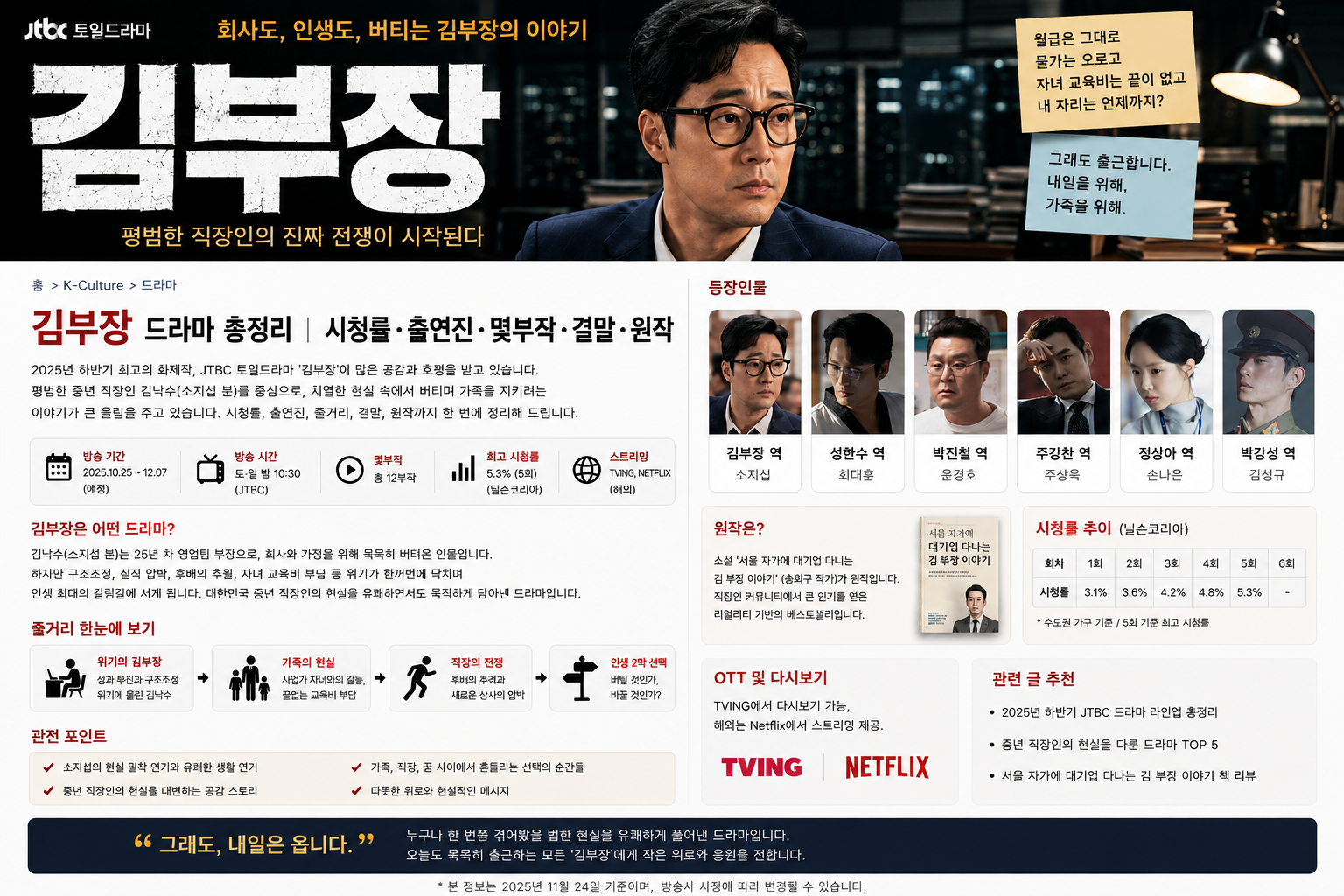
Manager Kim K-drama is attracting attention with So Ji-sub at the center of a story about work, family and the uncertain future facing a middle-aged Korean office worker.
Instead of a billionaire, genius or superhero, the drama focuses on an ordinary salaryman who has spent much of his adult life trying to succeed at work and provide for his family.
That simple premise makes the series particularly interesting—not only for Korean viewers who recognize the pressures of corporate life, but also for international K-drama fans curious about Korean workplace culture.
Here is a complete guide to Manager Kim, including So Ji-sub’s character, cast, story, episodes, original source and the Korean cultural background that makes the drama easier to understand.
What Is the Manager Kim K-Drama About?
Manager Kim follows a veteran corporate employee who has spent decades building his career.
For years, he believed that working hard, staying loyal to his company and becoming a manager would eventually provide security for himself and his family.
But middle age brings a different reality.
Younger employees are moving up.
Corporate expectations keep changing.
Job security becomes less certain.
And outside the office, family responsibilities continue to grow.
The result is a drama about a man beginning to ask a difficult question:
If my job title disappears, who am I?
That question gives Manager Kim a deeper emotional dimension than a typical workplace drama.
So Ji-sub Stars as Kim Nak-su
So Ji-sub plays Kim Nak-su, a veteran sales manager who has devoted much of his adult life to his company.
On paper, he appears successful.
He has survived corporate competition long enough to become a manager, supports his family and has built the kind of stable life many younger employees hope to achieve.
But stability turns out to be fragile.
As changes inside the company threaten his position, Kim Nak-su begins confronting fears that many middle-aged workers understand: career stagnation, replacement by younger employees and uncertainty about life after corporate employment.
So Ji-sub’s performance is therefore one of the biggest reasons to watch the series.
Rather than portraying an extraordinary hero, he plays an ordinary man trying desperately to protect the life he spent decades building.
Manager Kim Cast and Characters
So Ji-sub — Kim Nak-su
Kim Nak-su is a veteran sales manager and the central character.
After spending around 25 years in corporate life, he reaches a point where professional success no longer guarantees security.
His struggle between protecting his position and discovering what he actually wants from life drives the story.
Choi Dae-hoon — Seong Han-su
Seong Han-su is one of the important people surrounding Kim Nak-su.
Through their relationship, the drama explores another side of survival inside a competitive organization.
Yoon Kyung-ho — Park Jin-cheol
Park Jin-cheol adds another perspective on workplace relationships and the compromises people make during long careers.
Yoon Kyung-ho’s grounded acting style fits particularly well with the drama’s realistic office environment.
Joo Sang-wook — Joo Kang-chan
Joo Kang-chan becomes another significant figure in Kim Nak-su’s professional and personal world.
His presence adds further tension to the workplace relationships surrounding the main character.
Son Na-eun — Jung Sang-a
Jung Sang-a represents part of the younger generation surrounding Kim Nak-su.
Her character helps highlight differences between generations in how they think about work, success and life.
Kim Sung-kyu — Park Kang-seong
Park Kang-seong is another character connected to the changing relationships around Kim Nak-su.
As the workplace conflict develops, his role contributes to the pressure facing the protagonist.
Manager Kim Story Explained
Kim Nak-su has spent decades believing in a familiar formula:
Work hard → get promoted → support your family → build a secure future.
For a long time, that formula seems to work.
But the corporate world changes faster than he expected.
Suddenly, experience can feel less valuable.
Younger employees have different skills and different attitudes toward work.
The company that once represented security begins to feel like the source of his greatest anxiety.
At home, things are not necessarily easier.
Kim Nak-su isn’t only a manager.
He is also a husband and father.
Housing costs, children’s education, retirement and family expectations do not disappear simply because his career is becoming unstable.
That conflict between employee, husband, father and individual forms the emotional heart of the drama.
Why Korean Viewers Relate to Manager Kim
The word “bujang” (부장) is important for understanding the drama.
It is usually translated into English as department manager, general manager or simply manager depending on the company.
But the title carries cultural meaning in Korea.
Reaching the position often requires many years inside a corporate hierarchy.
A bujang is senior to many employees but is not necessarily an executive.
That creates an uncomfortable position.
You have finally reached a relatively senior level—but you may also be approaching the stage when promotion opportunities become limited and retirement begins to feel much closer.
Manager Kim builds much of its story around that contradiction.
Korean Corporate Hierarchy Explained
International viewers may notice Korean workplace titles being used constantly.
Traditional Korean companies often have hierarchical titles such as:
Sawon (사원) — entry-level employee
Daeri (대리) — assistant manager
Gwajang (과장) — manager
Chajang (차장) — deputy/general manager level
Bujang (부장) — department manager
Titles and structures differ between companies, and many Korean corporations have been simplifying their hierarchy.
Still, these titles remain culturally familiar.
Knowing this helps international viewers understand why becoming—or remaining—a bujang can carry so much emotional weight.
Why Manager Kim Is More Than an Office Drama
The office is only one part of the story.
The drama is also about family.
For Kim Nak-su, providing for his family has been one of the main reasons he endured corporate pressure for so many years.
But that responsibility can also become a burden.
Mortgage or housing expenses, children’s education costs and retirement planning are major concerns for many middle-aged Korean households.
That means losing a corporate position isn’t simply an employment problem.
It can threaten the financial structure of an entire family.
The Generational Conflict
Another interesting theme is the difference between older and younger Korean workers.
For many people in Kim Nak-su’s generation, loyalty to the company was closely connected with professional success.
You worked long hours.
You endured difficult bosses.
You waited for promotion.
And ideally, the company rewarded that loyalty with career stability.
Younger workers may see things differently.
Work-life balance, changing jobs and prioritizing personal happiness have become much more accepted.
Manager Kim places those different attitudes inside the same workplace.
That makes the drama useful for international viewers interested in how Korean working culture is changing.
How Many Episodes Is Manager Kim?
Check the broadcaster’s latest official schedule for the confirmed episode count and final broadcast date.
Broadcast schedules can occasionally change, so official programming information should be treated as the most reliable source.
As the series progresses, this section should also be updated with the latest episode and finale information.
Where Can You Watch Manager Kim?
Streaming availability can vary by country.
International viewers should check the official broadcaster and streaming platforms available in their region for the latest information.
This is particularly important for K-dramas because a series may be available through one service in Korea and a different platform internationally.
Manager Kim’s Original Story
The drama is based on a story about the realities faced by an ordinary Korean corporate manager.
One reason the source material attracted attention is its focus on recognizable problems rather than an extraordinary fantasy world.
Workplace competition, family responsibilities, career uncertainty and the fear of starting over are issues many readers can understand immediately.
The television adaptation adds another dimension by bringing those everyday situations to life through its cast and office setting.
Why International Viewers Are Responding to Manager Kim
At first glance, Manager Kim may seem extremely Korean.
Its corporate hierarchy, job titles, housing pressures and education expenses are deeply connected with modern Korean society.
But its central fear is universal.
What happens when the career you’ve spent decades building no longer feels secure?
What happens when your professional identity disappears?
And how do you begin again in middle age?
Those questions can resonate with viewers almost anywhere.
That combination of specifically Korean details and universal human anxiety is one reason the drama has potential with international audiences.
What to Watch for in Manager Kim
So Ji-sub’s transformation into an ordinary middle-aged employee is an obvious attraction.
But pay attention to the smaller cultural details as well.
How younger employees speak to senior workers.
How job titles are used instead of first names.
How promotion affects status.
How family finances influence career decisions.
And how differently generations define a “successful life.”
Those details can make Manager Kim particularly interesting to viewers discovering Korean workplace culture through K-dramas.
Manager Kim Ending
This guide will not reveal major ending spoilers.
More important than simply asking whether Kim Nak-su keeps his job is understanding what he eventually decides his life is worth outside his corporate title.
For decades, his company and position helped define who he was.
The larger question is whether he can build an identity that doesn’t depend entirely on being Manager Kim.
After the series concludes, the ending deserves a separate spoiler article because searches such as “Manager Kim ending explained” can become valuable international search terms.
Manager Kim Quick Guide
Title: Manager Kim
Korean title: 김부장
Country: South Korea
Genre: Workplace, Family, Human Drama
Lead actor: So Ji-sub
Main cast: So Ji-sub, Choi Dae-hoon, Yoon Kyung-ho, Joo Sang-wook, Son Na-eun, Kim Sung-kyu
Main character: Kim Nak-su
Themes: Corporate life, family, middle age, career insecurity and generational conflict
Is Manager Kim Worth Watching?
Manager Kim stands out because its hero isn’t trying to save the world.
He’s trying to save the ordinary life he spent decades building.
That may sound less dramatic than supernatural powers, serial killers or billionaire romances.
But for many viewers, it can feel much more real.
The fear of losing a career, the responsibility of supporting a family and the realization that professional success cannot last forever are experiences that cross national boundaries.
For international viewers, the series offers something else as well: a window into Korean corporate culture and the life of Korea’s middle-aged salaryman generation.
And beneath all of those cultural details is a very simple question:
Who are you when your job no longer defines you?
That may ultimately be the most interesting reason to watch Manager Kim.