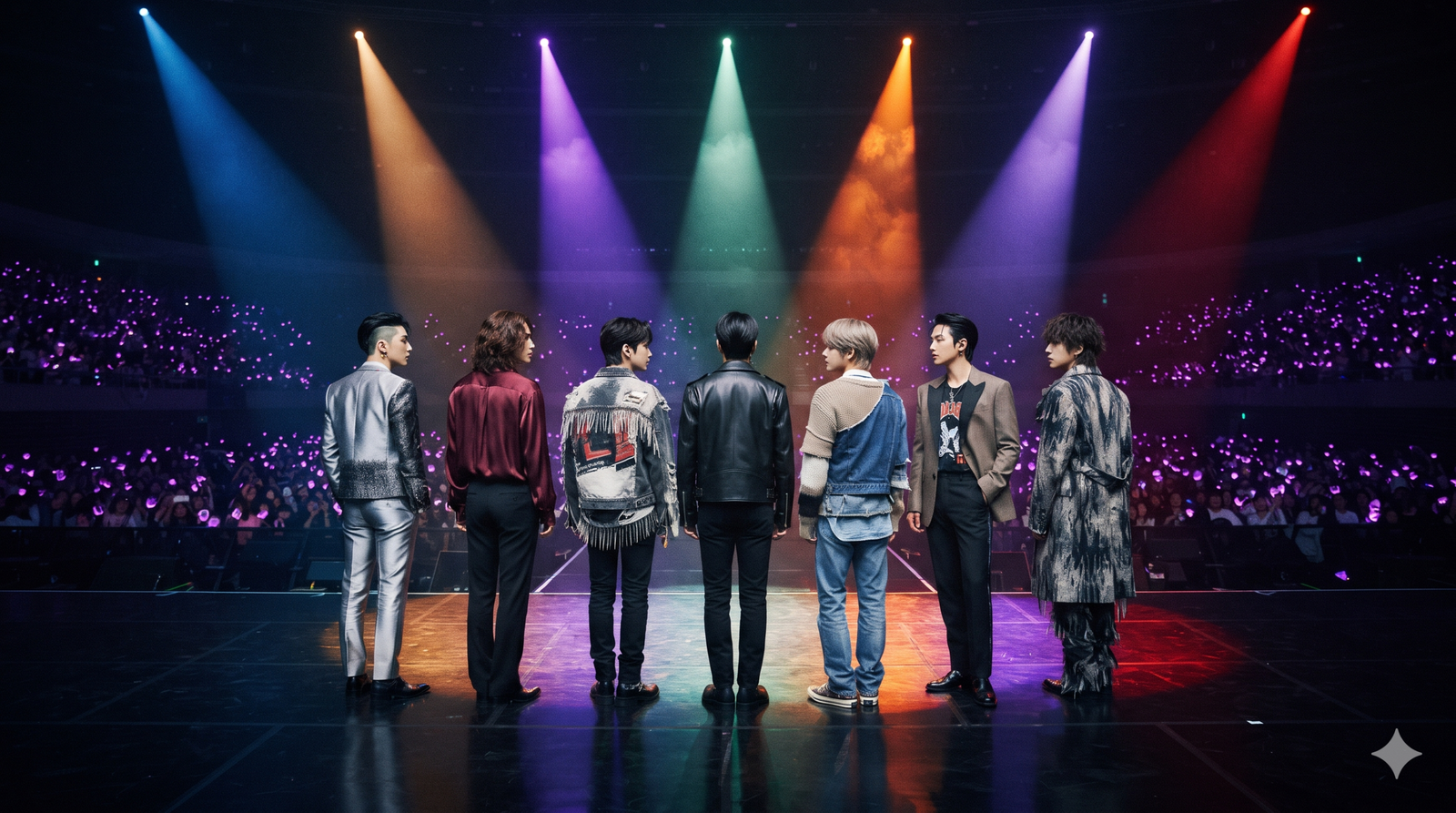
For more than a decade, BTS was recognized by one defining number: seven.
Seven members shared one name, one stage, and a musical identity that became recognizable around the world. But in 2022, the group entered a new chapter. Instead of continuing to release music exclusively as a unit, the members began exploring their individual artistic identities.
At first, this looked like a temporary change in direction. In reality, it became one of the most significant creative experiments in the group’s history.
RM released Indigo. j-hope presented a darker artistic side through Jack in the Box. SUGA completed his Agust D trilogy with D-DAY. Jimin, V, Jung Kook, and Jin each developed musical projects with their own identities.
The results raised two questions.
Did becoming individual artists make BTS stronger as a group?
And did the same process weaken the unity of ARMY?
The answer is more complicated than either a simple success story or a story of fandom division. To understand what happened, we need to look beyond album releases and streaming numbers. The real story concerns artistic identity, group economics, fan psychology, and what it means to belong to a global fandom.
1. The 2022 Decision Was About More Than Releasing Solo Albums
BTS announced a major change in June 2022 during a video marking the group’s ninth anniversary.
The members discussed the difficulty of continuing to grow artistically while maintaining the demanding expectations attached to BTS. RM spoke openly about the pressure of constantly producing music and the need for time to understand what kind of artist he wanted to become.
This was an important distinction.
The announcement was not simply that seven singers wanted individual releases. It was an acknowledgment that the group’s enormous success had created a creative environment in which personal development could become difficult.
A successful group develops its own expectations.
Fans recognize certain musical characteristics. Record labels and management teams have commercial priorities. Concert audiences expect familiar group performances. Every new release must somehow satisfy the identity that made the group successful in the first place.
For BTS, the challenge was particularly significant because its members were not interchangeable performers.
They had different musical interests, different approaches to songwriting, and different ways of expressing emotion.
The solo era created space for those differences to become complete artistic projects.
According to Yonhap News Agency’s coverage of the 2022 announcement, the members described the need to explore individual growth while continuing to see a future for BTS.
That distinction matters: a temporary pause in group activity did not necessarily mean a rejection of the group itself.
2. Seven Solo Careers Revealed Seven Different Musical Identities
One of the most interesting outcomes of the solo era was how differently the members approached their music.
Their individual releases were not simply seven versions of the same commercial formula.
RM — Indigo and Right Place, Wrong Person
RM’s solo work revealed an artist interested in reflection, identity, collaboration, and the relationship between music and personal experience.
Indigo brought together different musical voices and styles. His later album, Right Place, Wrong Person, explored a different emotional and sonic atmosphere.
His solo identity was not built around reproducing the sound of a conventional pop idol release.
j-hope — Jack in the Box and Hope on the Street Vol. 1
j-hope challenged the expectations created by his bright public image.
Jack in the Box explored darker hip-hop influences and a more confrontational artistic presentation. Hope on the Street Vol. 1 later returned to his relationship with street dance and hip-hop culture.
His work demonstrated that an energetic performer could also present a more complex and experimental musical identity.
SUGA / Agust D — D-DAY
SUGA had already established a separate identity through his Agust D projects.
D-DAY completed a trilogy that explored ambition, anger, personal history, emotional struggle, and self-understanding.
It was particularly important because it showed how a member could maintain a recognizable individual artistic world without abandoning his connection to BTS.
Jimin — FACE and MUSE
Jimin’s solo releases highlighted the relationship between his vocal character, performance style, and emotional expression.
FACE presented a personal and introspective direction, while MUSE explored a different atmosphere through themes of inspiration and affection.
His work demonstrated that the qualities audiences recognized in BTS performances could develop into a distinct solo identity.
V — Layover
V took a noticeably different route.
Layover leaned toward R&B, jazz-influenced textures, and a more relaxed musical atmosphere. It allowed his lower vocal register and understated performance style to occupy the center of the project.
Rather than competing directly with the energetic pop direction associated with some of BTS’s biggest global hits, V presented a quieter musical personality.
Jung Kook — GOLDEN
Jung Kook’s GOLDEN explored international pop on a large scale.
Its collaborations, English-language releases, and polished production positioned him within a global mainstream pop environment.
The album demonstrated how a BTS member could pursue a solo career with a commercial identity that was not limited to the group’s existing audience.
Jin — The Astronaut, Happy, and Echo
Jin’s solo releases emphasized melodic pop, emotional storytelling, and a different kind of stage presence.
His work also showed that a member did not need to follow the same artistic route as the group’s rappers or performance-focused members to establish an individual identity.
Taken together, these projects revealed something important.
BTS did not have seven members waiting to become seven identical solo stars.
It had seven artists whose differences had previously contributed to the group’s collective sound.
The solo era made those differences easier to hear.
3. The Most Important Discovery: BTS Was Never One Musical Formula
There is a common misunderstanding about successful music groups.
People often assume that a group has one fixed sound and that every member must fit inside it.
But a group’s musical identity can be the result of several different creative personalities working together.
Think of BTS as a musical system rather than a single musical style.
RM and SUGA bring different approaches to rap and songwriting. j-hope contributes a distinctive relationship with rhythm, dance, and hip-hop. The vocal members offer different tones, emotional textures, and performance instincts.
When these elements are combined, the result becomes something that none of the members would necessarily create alone.
This is why the solo projects are useful for understanding BTS.
They allow listeners to identify the individual ingredients that were previously blended into the group’s sound.
However, there is an important limit to this interpretation.
We should not assume that every musical characteristic in a solo project was hidden inside the member’s contribution to an earlier BTS song. Individual albums also reflect new collaborators, producers, experiences, and artistic decisions.
The solo era did not simply reveal a pre-existing BTS formula.
It helped the members develop new musical possibilities.
That distinction makes the group’s eventual return more interesting.
4. The Solo Era Also Changed the Business Structure of BTS
There was another side to this transformation.
A group with seven members has a powerful collective brand. But a collective brand can also limit how audiences understand its individual members.
When BTS releases an album, the public generally discusses the achievement as a BTS achievement.
When a member releases a solo album, the conversation becomes more specific.
What kind of artist is RM?
Can Jung Kook compete in the international pop market independently?
What audience responds most strongly to V’s musical style?
How does j-hope’s artistic identity differ from his public image?
These questions create seven separate points of interest.
From a business perspective, this can expand the group’s overall reach.
A listener who discovers Jung Kook through an international pop collaboration may later become interested in BTS. Someone attracted to RM’s alternative musical direction may explore the group’s earlier albums. A fan who discovers Jimin through a solo performance may eventually become curious about the other six members.
This creates a two-way relationship between the group and its individual artists.
The group introduces members to a worldwide audience.
The individual careers can then introduce the group to listeners who might not otherwise have discovered it.
The solo era therefore had the potential to expand the BTS brand rather than simply divide it.
But this advantage came with a cost.
Once the members became more visible as individual artists, comparisons between them became easier.
5. When Individual Success Becomes a Competition
This is where the relationship between BTS and ARMY became more complicated.
In a group environment, fans can celebrate a collective achievement.
A successful album, a major award, or a sold-out concert can be understood as a shared victory.
Individual releases create a different structure.
Each member has a separate album, separate promotional activities, separate chart positions, and separate commercial results.
That creates more opportunities for comparison.
Which member sold more albums?
Whose song received more streams?
Who received greater international media attention?
Whose music video attracted more views?
Which member had the strongest promotional campaign?
These questions are not automatically harmful. Comparing commercial performance is a normal part of the music industry.
The problem begins when the numbers become a way of measuring the value of the members themselves.
At that point, a fan’s support for one artist can become hostility toward another.
A member’s success is no longer celebrated on its own terms. It becomes evidence in an imaginary competition.
This is a particularly damaging change because it transforms the meaning of group membership.
Instead of seeing seven artists working within one group, some fans begin treating them as seven competing businesses.
The members did not need to create that competition for it to appear.
The structure of individual releases, online rankings, and fan-driven promotion can create it almost automatically.
6. Solo Stans and Akgaes Are Not the Same Thing
A serious discussion of ARMY should distinguish between different types of fans.
Having a favorite member is completely normal.
A listener may prefer Jung Kook’s vocal style, V’s musical atmosphere, RM’s lyrics, or Jimin’s performances. That preference does not mean the person dislikes the other members.
A solo fan may primarily follow one member’s independent career without necessarily attacking the group.
An akgae, however, is generally understood in Korean fandom culture as an individual-member supporter who actively diminishes, attacks, or undermines other members.
The distinction is important.
A person who listens mainly to one member’s music should not automatically be classified as hostile to BTS.
Likewise, someone who calls themselves an OT7 fan is not automatically free from competitive behavior.
The real issue is not whether a fan prefers one member.
It is whether that preference requires treating the other six as enemies.
This problem existed before the 2022 solo era.
In February 2021, moderators of the major r/bangtan community published an announcement addressing antagonistic solo-stan and akgae behavior. The discussion explicitly distinguished between having a favorite member and attacking other members.
That timing is significant.
The solo era did not create the entire problem. It exposed and amplified tensions that were already present.
Read the 2021 r/bangtan moderator announcement.
7. What Reddit Discussions Reveal — and What They Cannot Prove
Online discussions offer a useful window into how fans experience the solo era.
They do not, however, provide a scientific measurement of the entire ARMY population.
In an August 2025 discussion on r/btsthoughts, fans debated whether the fandom had become more divided since individual projects expanded.
Several different explanations appeared.
Some participants described more visible solo stanning, member comparisons, and tension between fan communities.
Others argued that these conflicts had existed for years but became easier to see when the members began promoting separately.
Another perspective focused on military service. With fewer regular group activities, some fans became less active in the wider fandom or concentrated on the members whose individual content interested them most.
There were also fans who described the solo era positively, explaining that they had discovered BTS through one member and later developed an interest in all seven.
This is a valuable contrast.
The same period could produce a more fragmented experience for one fan and a new route into the group for another.
A November 2025 announcement from r/bangtan moderators also addressed increased antagonistic solo-stan and anti-fan behavior as the group prepared for its next chapter.
These discussions are evidence that tensions were visible in online fan communities. They are not proof that the entire global fandom had become divided.
That qualification matters.
A highly active online argument can look much larger than it is. People who enjoy the music quietly may never participate in those debates.
Sources:
8. The Unexpected Benefit: Solo Careers Created New Doors Into BTS
There is another way to interpret the solo era.
Instead of asking whether fans moved away from BTS, we should also ask whether new listeners entered through individual members.
The traditional path into a group might look like this:
Discover BTS → become interested in the members → develop a favorite.
But the solo era made another path possible:
Discover one member → explore his individual music → become curious about BTS.
This is not a minor difference.
A listener who prefers contemporary R&B may discover V through Layover. Someone interested in international pop may encounter Jung Kook through GOLDEN. A listener drawn to introspective hip-hop may discover RM or Agust D.
Those listeners may eventually explore the group’s older music and discover a much wider artistic identity.
A March 2024 discussion on r/bangtan specifically asked how people who entered during the group’s second chapter became fans of all seven members.
The discussion reflected the possibility that individual projects could introduce new audiences to the group.
This suggests that the solo era was not simply a process of dividing one audience into seven smaller audiences.
It could also create seven entry points into a larger musical universe.
Read the r/bangtan discussion about discovering BTS through Chapter Two.
9. Military Service Changed the Meaning of the Solo Era
One important part of this story is easy to overlook.
BTS’s individual activities were not happening in an ordinary period of group promotion.
The members were also preparing for and completing South Korea’s mandatory military service.
Jin began his service in December 2022. The other members followed in stages, with the final members completing their service in June 2025.
This meant that the solo era had two overlapping purposes.
It provided opportunities for individual artistic development.
It also allowed the members to maintain their musical presence during a period when regular full-group activities were not possible.
That context changes how we should interpret the individual releases.
It would be too simplistic to say that BTS deliberately divided its members into seven competing solo brands.
The individual projects were part of a wider transition shaped by personal growth, military obligations, and the practical difficulty of maintaining a seven-member group schedule.
In other words, the solo era was not just a creative choice.
It was also a way of navigating a major life and career transition.
10. The 2026 Return Changed the Argument
The most important development came in March 2026.
After approximately three years and nine months without a new full-group album, BTS returned with its fifth studio album, ARIRANG.
The album contained 14 tracks and drew on Korean cultural identity and the emotions the members had experienced during their time apart.
Its title was especially meaningful.
Rather than presenting the reunion as a simple return to the past, BTS chose a traditional Korean folk song as a symbolic reference point for its present identity.
The choice suggested that the group was interested in reconnecting with its roots while acknowledging the changes that had taken place.
The album’s official description emphasized that it represented BTS as the seven members were in 2026, not simply the group as it existed before the hiatus.
That is a crucial difference.
The solo era had allowed the members to develop separate artistic experiences.
The reunion brought those experiences back into a shared project.
In an interview with Bloomberg published around the album’s release, members discussed the creative process and the importance of finding something that could bind the seven together again. They also made clear that individual success had not replaced their interest in working as BTS.
The group had not simply pressed a reset button.
It had returned with a different set of experiences.
Sources:
- BIGHIT MUSIC — Official ARIRANG album information
- Yonhap — BTS redefines Koreanness in ARIRANG
- Bloomberg — BTS on its return and creative process
11. Why the New BTS Cannot Simply Recreate the Old BTS
This is where the artistic question becomes more interesting than the fandom argument.
Before the solo era, BTS had already established a powerful collective identity.
But the members were younger. Their experiences were different. Their relationships with music, fame, and the world around them were still developing.
After individual releases, military service, and years of personal experiences, they returned as older artists.
It would be unrealistic to expect them to recreate the exact musical identity of 2016 or 2019.
And perhaps they should not try.
A group can become stronger by allowing its members to change.
In fact, the greatest danger for a successful group may not be individual ambition. It may be the pressure to remain permanently recognizable.
If every new BTS album had to sound like an earlier hit, the group’s artistic development could become restricted.
The solo era gave the members opportunities to experiment beyond those expectations.
The next challenge is to turn that experience into something collective.
The purpose of a reunion should not be to erase seven individual identities.
It should be to discover what those identities can create together.
12. ARMY Now Faces a Different Definition of OT7
The solo era also created a test for the fandom.
In the past, supporting all seven members could often mean supporting the same album, the same concert, and the same group activities.
Now the situation is more complicated.
One fan may prefer RM’s experimental direction. Another may follow Jung Kook’s international pop releases. Someone else may connect more strongly with Jin’s voice or Jimin’s performances.
There is no reason everyone must enjoy every individual release equally.
That expectation would be unrealistic.
A healthier understanding of OT7 might be this:
Supporting seven members does not require identical musical preferences.
It requires respecting the fact that each member has an individual artistic identity and that none of those identities needs to destroy the others.
A fan can prefer one member without attacking another.
A fan can enjoy solo albums without abandoning group music.
And a fan can remain interested in BTS even when individual projects do not appeal to them equally.
The distinction sounds simple, but it is important in a fandom where commercial performance can become a measure of personal loyalty.
13. So, Did Going Solo Make BTS Stronger or Divide ARMY?
The evidence points toward two different outcomes.
Artistically, the solo era gave the members room to explore musical directions that could not always fit within a group project.
Commercially, individual releases created additional ways for audiences to discover the members and, potentially, BTS itself.
For the fandom, however, the same process made comparisons more visible. Separate releases created separate promotional cycles, and some online communities turned those differences into competition.
But it would be inaccurate to blame every conflict on solo careers.
The tensions existed before 2022. Military service changed the rhythm of group activities. Social media rewarded confrontation and comparison. A fandom of enormous size was never going to behave as one perfectly unified community.
The solo era made these dynamics more visible.
It did not create all of them.
The 2026 return with ARIRANG provides an important new perspective. BTS has shown that individual development and collective activity do not have to be mutually exclusive.
Perhaps that is the most meaningful result of this entire period.
The seven members did not need to remain artistically identical to remain a group.
And ARMY does not need to share exactly the same preferences to remain a fandom.
The real strength of BTS may not be that seven people always sound the same. It may be that seven different artists can still create something that belongs to all of them.
The solo era tested that idea.
The reunion gave BTS an opportunity to demonstrate it.
Frequently Asked Questions
1. When did BTS begin focusing on solo activities?
BTS announced its shift toward individual projects in June 2022, during a video marking its ninth anniversary.
2. Did BTS officially disband in 2022?
No. The group shifted its focus toward individual activities and military service. It later resumed full-group activities.
3. Which BTS members released solo albums?
All seven members released individual projects. Notable releases include RM’s Indigo, j-hope’s Jack in the Box, SUGA’s D-DAY, Jimin’s FACE, V’s Layover, Jung Kook’s GOLDEN, and Jin’s Happy.
4. Did the solo era divide ARMY?
Some online fan communities reported more visible solo-stan behavior and member comparisons. However, online discussions cannot establish that the entire global fandom became divided.
5. When did BTS return as a full group?
BTS released its fifth studio album, ARIRANG, in March 2026, marking its first full-group album in approximately three years and nine months.
Sources and Further Reading
- Yonhap News — BTS’s 2022 announcement about individual activities
- BIGHIT MUSIC — BTS official discography
- BIGHIT MUSIC — ARIRANG official album information
- Yonhap News — BTS’s 2026 ARIRANG comeback
- Bloomberg — BTS’s return and creative process
- Reddit r/bangtan — Solo-stan and akgae behavior discussion, 2021
- Reddit r/btsthoughts — Fandom changes during the solo era, 2025