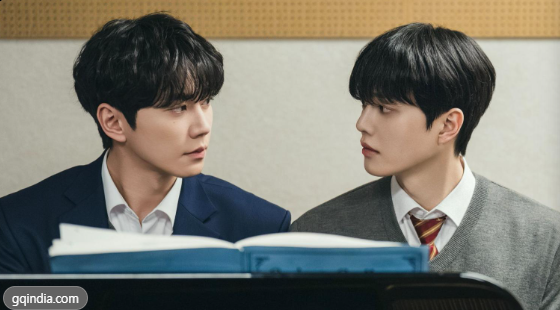
Spoiler Warning: This article contains major spoilers for all 12 episodes of Four Hands, Two Sonatas, including the finale.
Who is Choi Jeong-yo’s biological father in Four Hands, Two Sonatas?
It is one of the most intriguing questions left behind by the Korean drama. When Jeong-yo discovers that Choi Gi-taek is not his biological father, the revelation changes how viewers understand his difficult childhood and the family that raised him.
One name quickly becomes an interesting possibility: Do Hyun-soo, the accomplished pianist who recognizes Jeong-yo’s talent and becomes an important mentor to both Jeong-yo and Kang Pi-o.
Hyun-soo also has a complicated history with Kang Ji-hye, Pi-o’s mother. Their past, combined with the unresolved questions surrounding the two young pianists’ biological parents, creates an intriguing theory.
Could Hyun-soo be Jeong-yo’s real father? Could he also be Pi-o’s biological father? And if both possibilities were true, would the two pianists actually be half-brothers?
Now that all 12 episodes have aired, we can examine the theory against the complete story.
The final answer is that Do Hyun-soo is never confirmed as Jeong-yo’s biological father. The series does not identify Jeong-yo’s biological father at all.
However, the reason this theory attracted attention deserves a closer examination. The drama connects several characters through music, family history, guilt, and personal relationships, but it does not necessarily connect them through blood.
1. The Revelation That Starts the Mystery: Choi Gi-taek Is Not Jeong-yo’s Biological Father
For much of his life, Jeong-yo has treated Choi Gi-taek as his father.
Their relationship is far from healthy. Gi-taek’s drinking, financial problems, and irresponsible behavior repeatedly force Jeong-yo to take on responsibilities that should belong to an adult.
Instead of being able to concentrate on music and his own future, Jeong-yo spends much of his energy dealing with the consequences of Gi-taek’s decisions.
The revelation that Gi-taek is not his biological father therefore changes more than Jeong-yo’s understanding of his family tree.
It raises a deeper question about the life he has been living.
If Gi-taek was not his biological father, why did Jeong-yo have to carry so much of the family’s suffering? What happened between his mother and Gi-taek? And who was the man whose identity had remained outside Jeong-yo’s knowledge?
The revelation creates two separate issues that should not be confused.
First, who is Jeong-yo’s biological father?
Second, what does Gi-taek’s role as the man who raised him mean, despite the absence of a biological relationship?
The first question remains unanswered. The second becomes an important part of the emotional resolution in the finale.
For the earlier discussion of the family revelation, see our related article: Is Jeong-yo His Father’s Biological Son in Four Hands, Two Sonatas? His Family Secret Explained.
2. Why Do Hyun-soo Becomes a Suspect
Do Hyun-soo is not an ordinary supporting character.
As a respected pianist and teacher, he recognizes Jeong-yo’s unusual musical ability. He also plays an important role in bringing Jeong-yo and Pi-o together during their formative years.
His position in the story makes him an interesting figure to examine.
Hyun-soo understands both boys as musicians, but his connection to Pi-o’s family extends beyond professional mentorship.
He has a complicated past with Kang Ji-hye. That history gives viewers a reason to wonder whether his relationship with the younger generation might be more personal than the drama initially suggests.
There are three elements that make the theory attractive:
- Hyun-soo has a past relationship with Pi-o’s mother.
- He recognizes Jeong-yo’s musical ability and becomes an important influence on him.
- The series leaves Jeong-yo’s biological father unidentified even after the finale.
Together, these details create a possible story in the viewer’s imagination.
But they do not establish biological parentage.
A character can be emotionally connected to a family without being a member of that family by blood. A teacher can recognize a student’s extraordinary ability without having a biological connection to him.
To evaluate the theory fairly, we need to look at what the drama actually establishes about Hyun-soo and Ji-hye.
3. The Most Important Clue: Do Hyun-soo and Kang Ji-hye’s Past
The relationship between Hyun-soo and Ji-hye is the strongest reason viewers consider him a possible father figure in the family mystery.
Ji-hye is Pi-o’s mother, and her past with Hyun-soo gives their relationship an emotional history that extends beyond the main story involving the two pianists.
Their connection becomes particularly important in the final episode.
After Ji-hye’s imprisonment, Hyun-soo is among the people who remain connected to her. Their conversation suggests that they want to move forward together.
However, the wording of their final exchange matters.
Ji-hye tells Hyun-soo that she needs him by her side if she wants to become happy. Hyun-soo responds that they can take things slowly, like friends.
This scene gives their relationship a form of emotional resolution.
But it does not reveal when their past relationship began, establish a biological connection to either boy, or confirm that Hyun-soo is Pi-o’s father.
There is an important distinction here.
The finale confirms that Hyun-soo and Ji-hye want to remain in each other’s lives. It does not confirm that Hyun-soo fathered Pi-o or Jeong-yo.
This is especially important because viewers may be tempted to interpret the emotional reunion as the missing piece of the family mystery.
It is not.
The scene resolves something about the older characters’ relationship, but it leaves the question of biological parentage untouched.
4. Could Do Hyun-soo Be Kang Pi-o’s Biological Father?
Before asking whether Hyun-soo is Jeong-yo’s father, we should examine the possibility that he is Pi-o’s biological father.
The theory begins with his past relationship with Ji-hye.
If Hyun-soo and Ji-hye were involved before Pi-o’s birth, it is understandable that viewers might consider whether he could be Pi-o’s biological father.
But the drama does not provide the necessary confirmation.
There is no definitive statement identifying Hyun-soo as Pi-o’s biological father. Nor does the finale establish that their personal history involved a biological connection to Pi-o.
Their final conversation is about companionship and the possibility of moving forward together. It should not be treated as a substitute for a revelation about Pi-o’s birth.
This distinction matters because the Jeong-yo theory depends partly on the Pi-o theory.
If Hyun-soo were confirmed as Pi-o’s father, viewers might reasonably ask whether he could also be Jeong-yo’s father.
But the first assumption is itself unconfirmed.
A theory built on two unverified relationships cannot become a confirmed family connection simply because the characters share important scenes.
5. Could Pi-o and Jeong-yo Actually Be Half-Brothers?
This is the most dramatic possibility raised by the theory.
Imagine that Hyun-soo were the biological father of both young pianists.
Pi-o and Jeong-yo would then be half-brothers who grew up in different circumstances without knowing their shared family history.
Their rivalry would take on another meaning.
Pi-o grows up in an environment shaped by privilege, expectations, and demanding musical standards. Jeong-yo experiences a much more difficult childhood, with financial instability and family responsibilities that interfere with his musical future.
Despite their different backgrounds, the two develop an extraordinary connection through music.
They challenge one another, compete against one another, and eventually become central figures in each other’s lives.
A hidden biological relationship would add another dramatic layer to that connection.
But the theory encounters a fundamental problem.
The series never confirms that Hyun-soo is Pi-o’s biological father. It also never identifies a relationship between Hyun-soo and Jeong-yo’s biological mother that would establish him as Jeong-yo’s father.
There is no final revelation that the two young pianists share a biological parent.
Their musical similarities and emotional connection cannot serve as evidence of a shared father.
The half-brother theory is an interesting interpretation, but it remains speculation rather than a fact established by the drama.
For a broader look at the family theories, see our related article: Are Bi-o and Jeong-yo Brothers? The Hidden Family Mystery in Four Hands.
6. Does Jeong-yo’s Musical Talent Suggest That Hyun-soo Is His Father?
Another argument sometimes used to support the theory is the similarity between Jeong-yo and Hyun-soo as musicians.
Hyun-soo recognizes Jeong-yo’s unusual talent. He understands that the young pianist possesses something that cannot be explained by ordinary technical training.
Jeong-yo’s performances often emphasize instinct, emotion, and a distinctive interpretation of music.
Pi-o, by comparison, represents a more disciplined approach shaped by years of demanding training and expectations.
The contrast between the two is central to the drama’s exploration of musical talent.
It is easy to see why viewers might wonder whether Jeong-yo inherited some of his ability from Hyun-soo.
But the drama does not establish that connection.
Musical talent is not a reliable way to identify biological parentage. Two musicians can share similar instincts, sensibilities, or artistic values without being related.
There is also another explanation for Hyun-soo’s reaction to Jeong-yo.
As an experienced pianist, he may simply recognize a rare talent that other people have overlooked.
In fact, this interpretation gives his role a different kind of significance.
Hyun-soo does not need to be Jeong-yo’s father to become an important person in his musical development.
His recognition of Jeong-yo’s ability can be meaningful precisely because it comes from someone who understands the demands of professional music.
The drama allows a mentor-student relationship to carry emotional weight without requiring a hidden biological explanation.
7. What Does the Finale Actually Reveal About Jeong-yo’s Father?
The final episode gives Jeong-yo an important conversation with Gi-taek.
Through Hyun-cheol, Jeong-yo learns that Gi-taek wants to see him.
Their meeting is significant because Gi-taek finally acknowledges the harm he has caused. He tells Jeong-yo to stop spending his hard-earned money on him and to live his own life.
He also expresses guilt over the suffering involving Jeong-yo and his mother.
For Jeong-yo, this is an opportunity to reconsider a relationship that has shaped much of his childhood.
Gi-taek may not be his biological father, but he remains the person who raised him.
The finale does not erase the damage caused by Gi-taek’s behavior. Instead, it gives their relationship a quieter form of closure.
Jeong-yo has spent years carrying burdens that should never have been his responsibility.
Gi-taek’s request that he finally live for himself acknowledges that problem.
But the scene does not introduce a new biological father.
There is no DNA test, no confession identifying Hyun-soo, and no final explanation of Jeong-yo’s paternal lineage.
This is the most important factual point in the entire theory.
The finale resolves part of Jeong-yo’s emotional relationship with the man who raised him, but it does not solve the mystery of the man who fathered him.
8. The Real Mystery May Be Why the Drama Leaves the Father Unidentified
After 12 episodes, viewers might reasonably expect every major family question to receive an answer.
The series reveals the truth behind Jeong-yo’s disappearance and exposes Ji-hye’s involvement in the kidnapping. It also shows the consequences of the older generation’s decisions for both young pianists.
Yet Jeong-yo’s biological father remains unidentified.
There are two ways to understand the narrative effect of this choice.
First, the story does not make biological identity the final key to Jeong-yo’s life.
His most important struggles involve the family that raised him, the loss of his musical future, the pain caused by the kidnapping, and the complicated relationship he develops with Pi-o.
Revealing his biological father might have created another dramatic twist, but it would not automatically resolve those emotional conflicts.
Second, the series distinguishes between biological family and the people who actually shape a person’s life.
Gi-taek is not Jeong-yo’s biological father, yet his decisions have deeply influenced Jeong-yo’s childhood.
Hyun-soo is not confirmed as his father, yet he recognizes and encourages Jeong-yo’s musical talent.
Pi-o is not confirmed to be his brother, yet their relationship becomes one of the most important connections in the story.
These relationships show that family influence and emotional significance cannot always be reduced to a family tree.
It is possible to interpret the unresolved father question as part of this broader theme. However, we should be careful not to claim that the writers intentionally planned a sequel or deliberately withheld the answer for a future reveal. The completed series simply does not provide that information.
9. What the Ending Says About Hyun-soo, Ji-hye, Pi-o, and Jeong-yo
The finale is particularly revealing when viewed as a story about relationships rather than hidden parentage.
Ji-hye faces the consequences of her actions. Pi-o publicly acknowledges his own wrongdoing and decides to step away from the career that has defined him. Jeong-yo, meanwhile, tries to help Pi-o rediscover his relationship with music.
Hyun-soo remains connected to Ji-hye as she begins another stage of her life.
The final reunion between Pi-o and Jeong-yo takes place three years later in the Czech Republic.
Pi-o follows Jeong-yo’s postcard and finds him conducting a children’s choir. Their reunion is quiet, but emotionally meaningful.
The story returns to the idea that music has kept their connection alive despite years of separation, painful secrets, and personal failure.
Notice what the finale emphasizes.
It gives attention to the choices the characters make after the truth comes out. It shows how they try to rebuild their lives and reconnect with the people who matter to them.
It does not return to the question of whether Pi-o and Jeong-yo share a biological father.
That absence is significant when assessing the theory.
The family mystery remains open, but the emotional story reaches its conclusion through reconciliation, responsibility, and music.
10. Final Verdict: Is Do Hyun-soo Jeong-yo’s Biological Father?
There is no official confirmation that Do Hyun-soo is Jeong-yo’s biological father.
Even after the finale of Four Hands, Two Sonatas, the drama does not identify Jeong-yo’s biological father.
Hyun-soo is an interesting candidate because of his past with Ji-hye, his importance to Pi-o, and his role as a mentor to both young pianists.
However, none of these connections proves that he fathered Jeong-yo.
The theory that Pi-o and Jeong-yo are half-brothers also remains unconfirmed.
Here is what the completed series actually establishes:
- Confirmed: Choi Gi-taek is not Jeong-yo’s biological father.
- Confirmed: Gi-taek raised Jeong-yo and later expresses regret for the suffering he caused.
- Confirmed: Do Hyun-soo has a significant personal history with Kang Ji-hye.
- Confirmed: Hyun-soo becomes an important musical mentor to Pi-o and Jeong-yo.
- Confirmed: Hyun-soo and Ji-hye express a willingness to move forward together, like friends.
- Not confirmed: Do Hyun-soo is Jeong-yo’s biological father.
- Not confirmed: Do Hyun-soo is Pi-o’s biological father.
- Not confirmed: Pi-o and Jeong-yo are half-brothers.
The most accurate conclusion is that the drama leaves Jeong-yo’s biological father unidentified.
And this unanswered question reveals something interesting about the series.
At the beginning, Pi-o and Jeong-yo seem to belong to completely different worlds. Their family backgrounds, opportunities, and experiences are not the same.
Yet their relationship becomes more important than the circumstances that initially separated them.
They do not need to share a biological father to become central figures in each other’s lives.
Do Hyun-soo may be connected to the family mystery, but the drama never gives viewers enough evidence to call him Jeong-yo’s father. The real answer is not a hidden family revelation. It is that the series ends without identifying Jeong-yo’s biological father.
Frequently Asked Questions
Is Do Hyun-soo Jeong-yo’s real father in Four Hands, Two Sonatas?
No. The drama never confirms that Do Hyun-soo is Jeong-yo’s biological father. His connection to Ji-hye and his role as Jeong-yo’s mentor are not proof of a biological relationship.
Who is Jeong-yo’s biological father?
The series never identifies him. It confirms that Choi Gi-taek is not Jeong-yo’s biological father, but the identity of his biological father remains undisclosed.
Is Do Hyun-soo Kang Pi-o’s biological father?
This is also unconfirmed. Hyun-soo and Ji-hye have a complicated personal history, but the finale does not establish that he is Pi-o’s biological father.
Are Pi-o and Jeong-yo half-brothers?
No biological relationship between them is confirmed. The theory depends on the unproven possibility that Hyun-soo fathered both characters.
What happens between Do Hyun-soo and Kang Ji-hye in the finale?
They express a desire to remain together and move forward slowly, like friends. Their conversation provides emotional closure to their relationship, but does not reveal anything about the boys’ biological parentage.
Does the finale reveal Jeong-yo’s real father?
No. Episode 12 resolves several emotional conflicts, but Jeong-yo’s biological father remains unidentified.
Sources
- tvN Official Website – Four Hands
- The Review Geek – Four Hands, Two Sonatas Episode 12 Recap and Ending Explained
Related TTK Articles
- Is Jeong-yo His Father’s Biological Son in Four Hands, Two Sonatas? His Family Secret Explained
- Are Bi-o and Jeong-yo Brothers? The Hidden Family Mystery in Four Hands